
Pine wilt disease kills a susceptible landscape pine within a few weeks to a few months of infection, and no spray or injection saves a tree that already shows symptoms. The 9 strategies below start with the honest decision about a tree that cannot be saved, then move to the lab test, the removal, and the protection of every pine still standing near it.
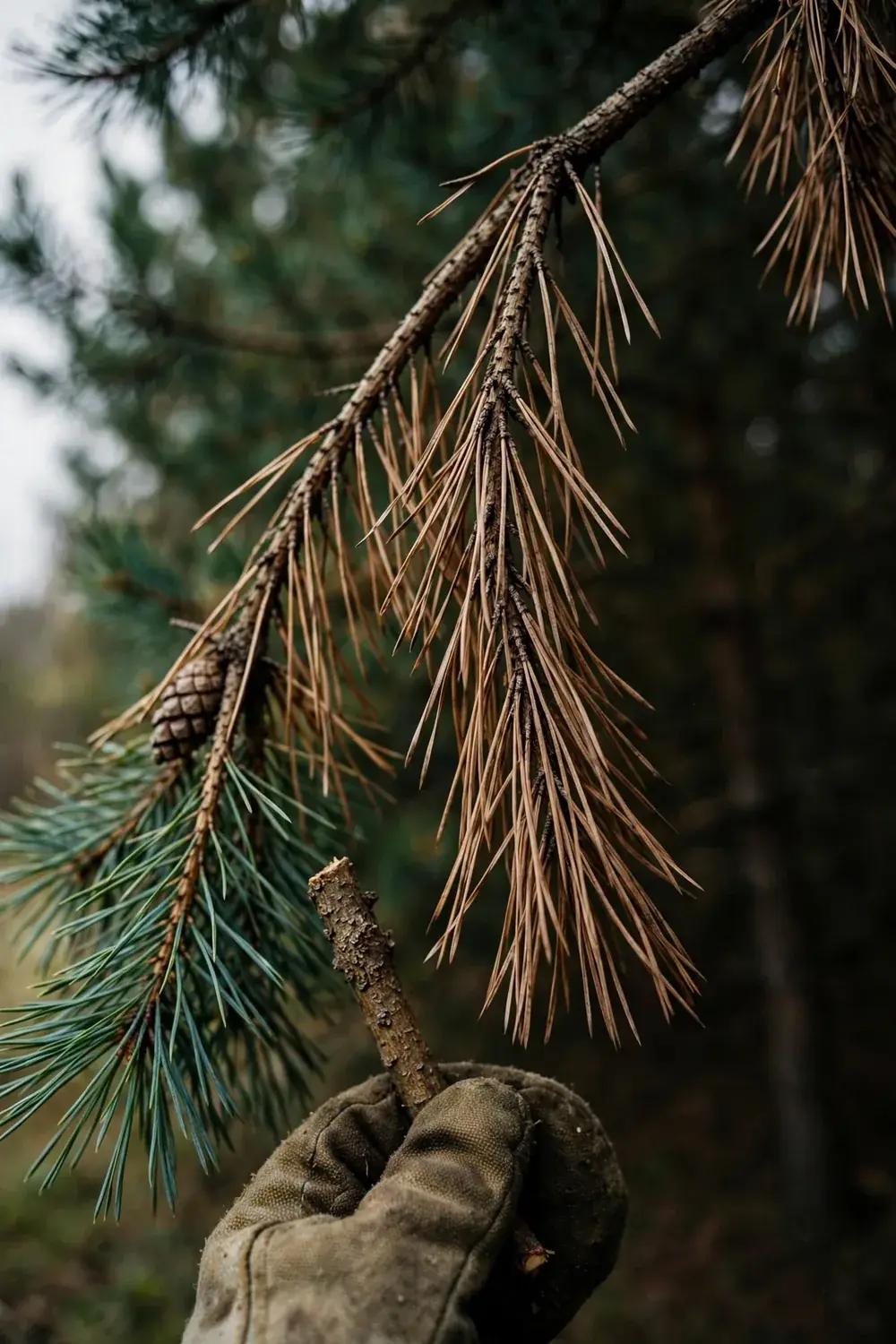
The signature is hard to miss once you know it. Wilt starts at the top of the tree and moves downward, while the dead needles turn grayish green, then tan, then brown, and stay attached for a year or more. Cut wood from an infected tree feels dry, with little to no pitch flow. A tree that matches that set is a suspect, not a confirmed case. Field signs point. The lab confirms.
The order below follows the order a gardener should work. Identify the disease first, then decide whether the tree is worth saving, then remove it fast, then protect the pines that remain. I have learned that the midsummer walk past the pines matters more than any spray bought after the needles turn. The pines at risk here are the exotic landscape species: Scots, Austrian, mugo, Japanese black, and Japanese red. Native North American pines are not susceptible to pine wilt disease.
What Pine Wilt Disease Actually Is
Pine wilt disease is a lethal wilt disease of exotic pines. The pine wood nematode, Bursaphelenchus xylophilus, causes pine wilt disease.
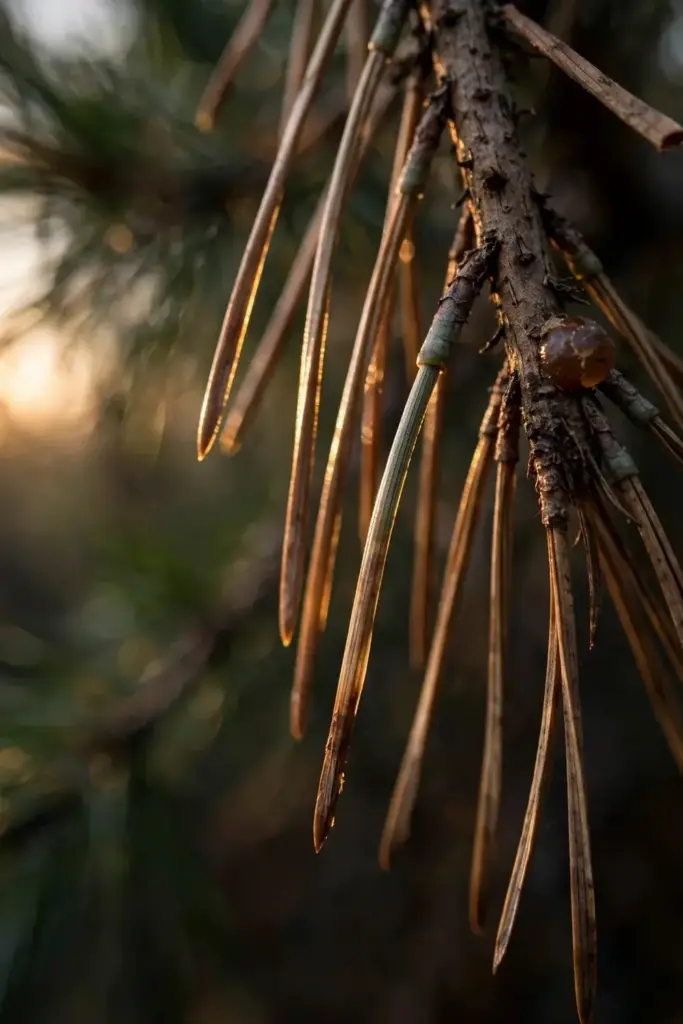
The nematode is a microscopic worm about 1 mm long, and it lives aboveground in the wood, not in the roots. The University of Nebraska-Lincoln pine wilt guide describes a worm about 1 mm long that moves from infested pines to healthy pines inside the pine sawyer beetle. That aboveground life sets this nematode apart from the soil nematodes that attack roots. Most nematodes in a garden live in the soil and feed on roots. Root-knot nematodes are one of those soil pests, and they need a completely different response. Pine wilt disease needs the tree-removal response below, not a soil treatment.
The nematode feeds on the living cells around the resin canals and the water-conducting passages of the pine. Feeding damages those cells, resin leaks into the water channels, and air pockets block the flow of water up the tree. A pine adds a new ring of wood each year, and the nematodes feed in the living sapwood of the outer rings, where water still moves. The crown wilts because water stops arriving. The tree dies because the blockage spreads through the whole crown within weeks.
The nematode cannot travel between trees on its own. It rides inside the pine sawyer beetle, a longhorned beetle with very long antennae. Adult beetles feed on young twigs of healthy pines, and the nematodes leave the beetle through those feeding wounds and enter the tree. One beetle can carry tens of thousands of nematodes, according to the Nebraska guide. A single feeding visit can seed an infection that kills a mature tree.
Pine wilt disease is native to North America. In its native range, the nematode feeds on blue-stain fungi in dying and dead pines and does not kill native hosts. The disease turns lethal when the nematode reaches exotic pines that evolved without it. Scots pine, Austrian pine, mugo pine, and the Japanese pines carry no effective defense. The same nematode that lives quietly in a dying native pine kills an exotic landscape pine outright.
How to Identify Pine Wilt Disease on Needles and Branches
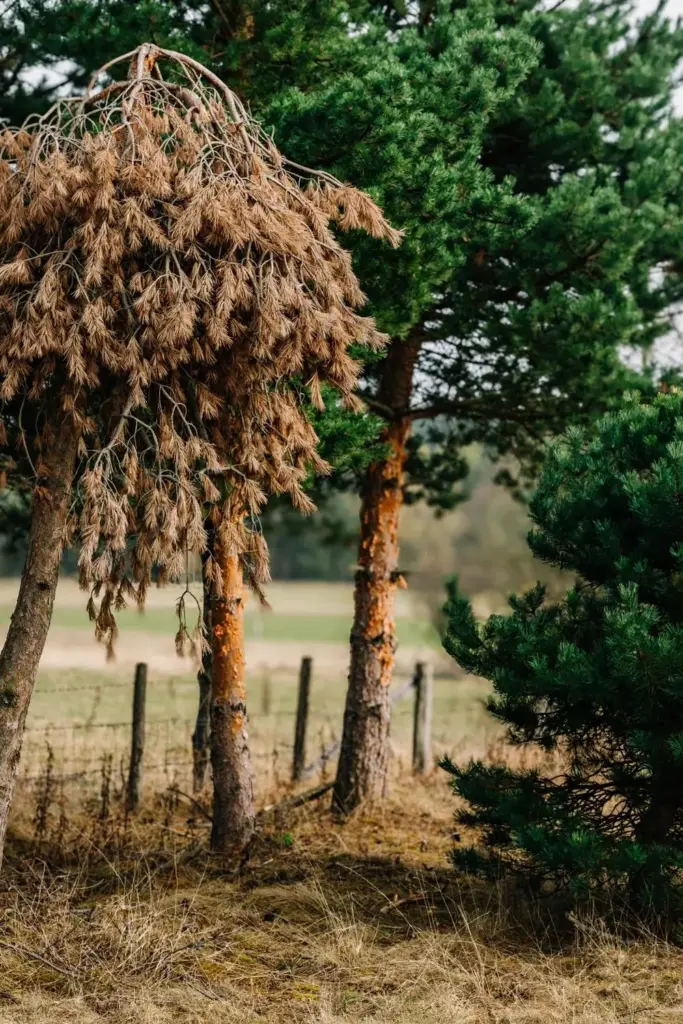
Check the top of the tree first, then the color of the needles, then whether the dead needles stay attached. Pine wilt disease starts at the top and moves down. Needle diseases start on the lower branches first, so a top-down pattern points at wilt rather than a needle blight.

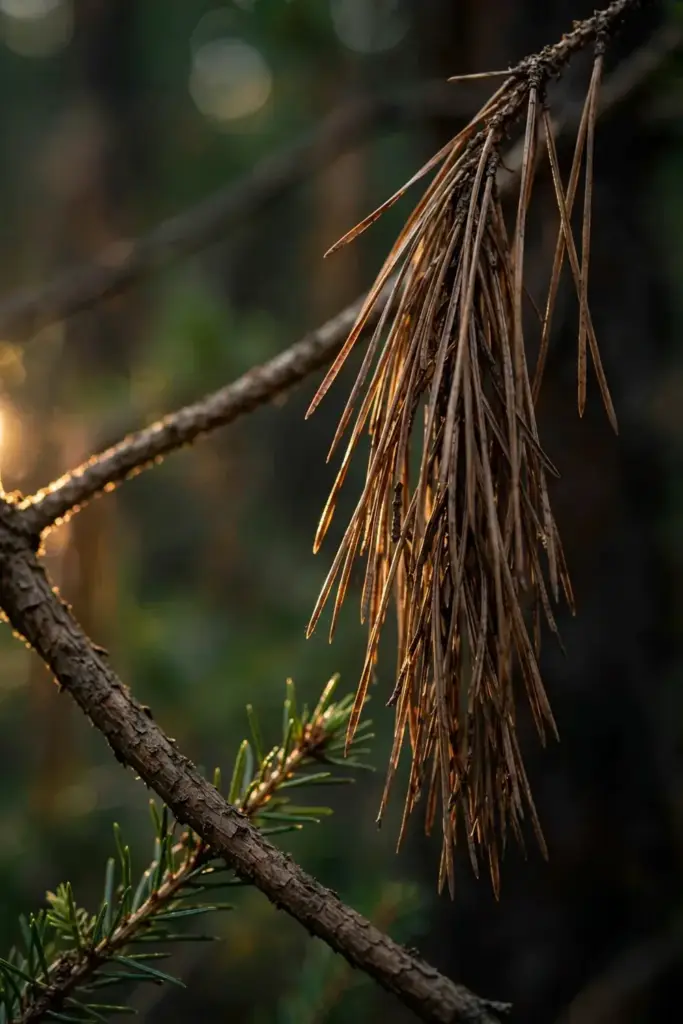
The color sequence runs grayish green, then tan, then brown. The University of Nebraska-Lincoln pine wilt guide states that needles turn grayish green first, then tan, then finally brown, and that the whole sequence can run within a few weeks to a few months. Scattered branches may brown first, and the rest of the crown follows. Some trees turn brown all at once. The speed is part of the diagnosis. A tree that goes from green to brown across the whole crown in one season is a pine wilt suspect. A tree that declines slowly over several years points elsewhere.
Dead needles stay attached to the tree for a year or more. That retention is one of the strongest field signs. The wilted foliage often hangs straight down, which gives a dead pine wilt tree a drooping look that stands out from a bark-beetle-killed tree. Needles that drop quickly after browning point at a different problem.
Check the branch pattern as well. Early wilt may strike scattered branches on one side of the crown before it spreads. A tree with one dead branch and a healthy crown is not yet a pine wilt case, and it may never become one. A tree with scattered dead branches that multiply week by week fits the pattern. Walk the tree every week through summer and watch whether the brown area grows. Growth of the brown area is the sign that separates a passing stress from a spreading infection.
How to Identify Pine Wilt Disease in the Wood
Cut a small branch and feel the wood. Pine wilt wood is dry, with little to no pitch flow. The University of Nebraska-Lincoln pine wilt guide states that resin flow in symptomatic branches ceases as the tree declines, giving the wood a dry appearance and feel, lacking the typical stickiness when cut. A healthy pine branch cut leaks sticky resin. A pine wilt branch cut stays dry. That dry cut is the single most useful field test a homeowner can run.
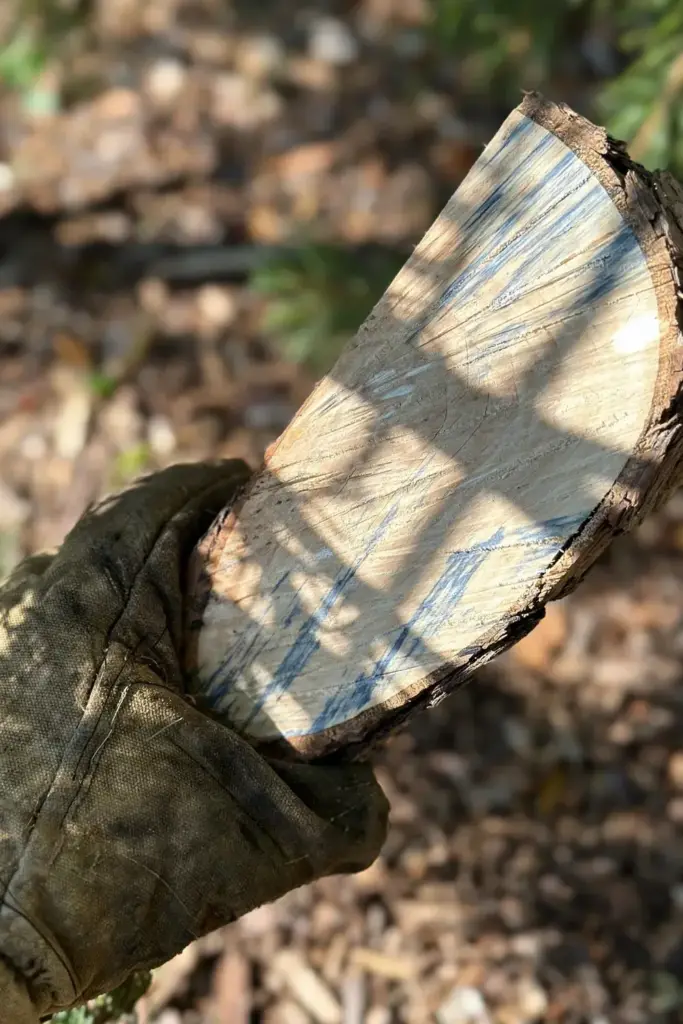
Blue stain may appear in the wood, and it proves nothing on its own. Blue-stain fungi colonize pines killed by many causes, and staining shows up in trees that died from other factors entirely. A blue-stained log is not a pine wilt diagnosis. A dry cut plus top-down wilt plus retained needles is a strong suspicion. The lab test in Step 2 turns suspicion into a decision.
Resin flow tells the same story from the other direction. A pine injured by a storm or attacked by insects floods the wound with resin. Copious resin flow means the tree still defends itself. Little or no resin flow from a wilting branch means the water system has already failed. When you cut, compare a wilting branch with a healthy branch from the same tree. The difference in stickiness is often obvious within seconds.
Do not rely on any single sign. Top-down wilt alone could be drought stress. Retained needles alone could follow a different killer, and dry wood alone could follow root damage. The three signs together, on an exotic pine, in midsummer, make a strong case. Write down the date you first saw each sign. The timeline helps the diagnostic clinic, and it helps you judge how fast the tree is going.
Which Landscape Pines Get Hit Hardest
Scots pine takes the worst of pine wilt disease in the Midwest. Austrian pine comes next, and mugo pine, Japanese black pine, and Japanese red pine all carry high susceptibility. The disease has appeared in jack pine and rarely in white pine, and in ponderosa pine the nematode has been found without killing the tree. Native North American pines are not susceptible to pine wilt disease.
| Pine | Botanical Name | Risk in Home Landscapes |
|---|---|---|
| Scots pine | Pinus sylvestris | Highest losses in the Midwest. The majority of trees killed by pine wilt have been Scots pine. |
| Austrian pine | Pinus nigra | High. Also extremely susceptible to Diplodia tip blight and Dothistroma needle blight, which stack a second threat on the same tree. |
| Mugo pine | Pinus mugo | Susceptible. Shrubby and low, so a wilted mugo is easy to miss until the whole plant browns. |
| Japanese black pine | Pinus thunbergii | Highly susceptible. A common coastal and specimen planting. |
| Japanese red pine | Pinus densiflora | Highly susceptible. Grown as an ornamental with an open, irregular crown. |
| Ponderosa pine | Pinus ponderosa | Nematode found, but not known to kill the tree. Native, and not a pine wilt casualty. |
The University of Nebraska-Lincoln pine wilt guide states that the majority of trees killed in the Midwest by pine wilt have been Scots pine, that Austrian, jack, and mugo pines show the same symptom pattern, and that native pine species generally show more resistance than species not native to North America. Age matters too. The majority of reported cases have been in trees more than 10 years old. Young plantings and Christmas tree farms lose fewer trees, because most Christmas trees are harvested before 10 years of age. The primary impact of pine wilt disease has been in landscape plantings and windbreaks, where mature exotic pines stand for decades.
If your planting holds only native pines, pine wilt disease is not the threat to plan around. If it holds a row of mature Scots pines in a windbreak, that row is the planting to watch. Scots pine windbreaks in the Midwest have carried the heaviest losses, and one infected tree in a windbreak puts the whole row at risk. The windbreak pattern is why early detection matters more than any treatment. A windbreak gives the beetles a straight line of hosts.
Pine Wilt Disease vs Bark Beetle Kill vs Diplodia Canker
Match the pattern before you cut. Pine wilt disease, bark beetle kill, and Diplodia canker all brown pine crowns, and all three can kill branches. The pattern of browning, the state of the wood, and the speed of decline separate them. Field identification stays presumptive. The lab test settles it.
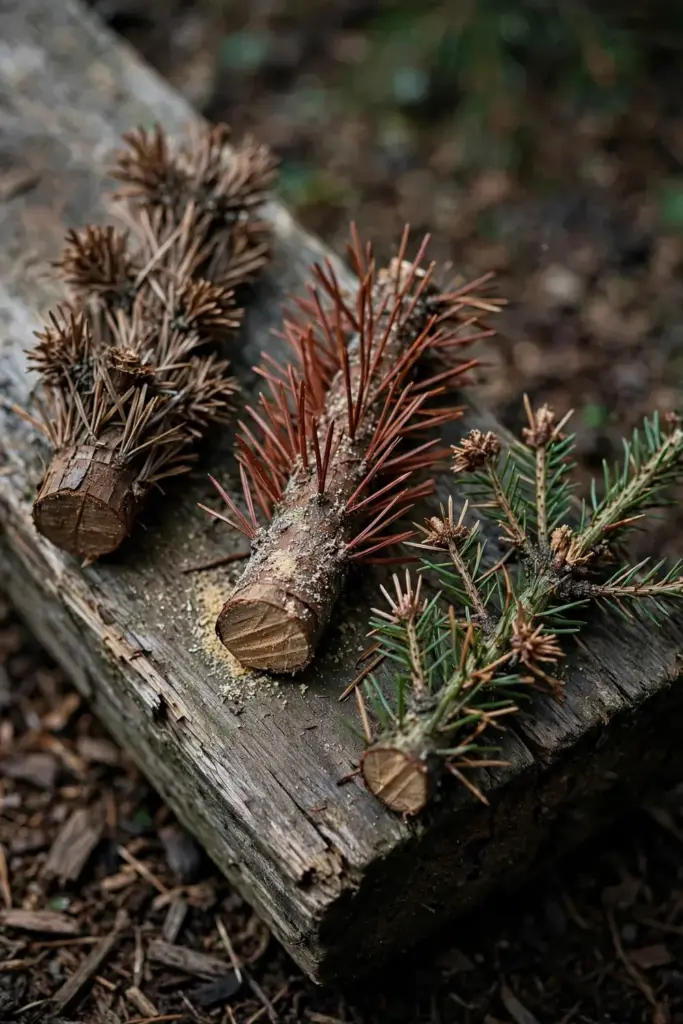
| Sign | Pine Wilt Disease | Bark Beetle Kill | Diplodia Canker |
|---|---|---|---|
| Cause | Nematode, Bursaphelenchus xylophilus, carried by pine sawyer beetles | Bark beetles boring under the bark | Diplodia fungus, canker and shoot-blight form |
| Browning pattern | Starts at the top, progresses downward, often in a spiral, then takes the whole crown | Scattered branches or whole crown, following beetle attack; needles turn red | Shoot tips and new growth die in scattered patches through the crown, not top-down |
| Dead needles | Stay attached a year or more, often hanging straight down | Drop sooner; red needles are the bark-beetle signal | Die on individual shoots; the rest of the crown stays green |
| Cut wood | Dry, little to no pitch flow | Resin flow varies; exit holes on the bark | Cankers on branches and shoots; dieback stays patchy |
| Speed | Rapid. Onset as short as 4 weeks. Death within a few weeks to a few months | Varies with beetle pressure. Can be fast in an outbreak year | Slow. Cankers expand over seasons, and the tree declines in stages |
| First move | Lab confirmation, then fast removal and destruction of the tree | Confirm beetle activity, remove infested trees, protect the rest | Prune out cankered shoots, improve vigor, watch the pattern |
The Colorado State University Extension pine wilt page states that pine wilt symptoms mainly appear at the top of the tree and progress downward, often in a spiral pattern, while Diplodia tip blight affects mostly the tips of new growth and appears randomly throughout the crown. The same page notes that ponderosa pines infected by pine wilt show browning rather than the red needles associated with bark beetles. The Plant Health Australia pine wood nematode fact sheet lists Sirex wood wasp, Diplodia canker, and five-spined bark beetle as the disorders pine wilt can be confused with, and adds that the rapid onset of symptoms, as short as 4 weeks, plus tree death, is unlike other endemic pests. That speed is the trait that tips a field call toward pine wilt.
Two cautions keep the table honest. First, beetles and wilt interact in both directions. Sawyer beetles carry the nematode to healthy trees, and beetles also breed in trees that wilt weakened. A tree can show beetle galleries and carry the nematode at the same time. The differential answers a diagnostic question, not a single-cause story. Second, visual diagnosis is error-prone. A table narrows the field. The microscope in a diagnostic clinic names the cause. Never treat a table match as a confirmed diagnosis on a tree you plan to fell.
Diplodia tip blight, the shoot-blight form of the same Diplodia fungus, is a companion disease with its own pattern, and Diplodia canker is its canker form. Neither has a live page on this site yet, so both are named here without a link. The bacterial canker guide covers canker identification and removal on fruit trees. Pine Needle Rust and Pine-Oak Gall Rust are different pine diseases with different signs, and they stay out of this table.
Why the Sawyer Beetle Partnership Spreads Pine Wilt So Fast
The nematode needs the beetle, and the beetle needs dead wood. That loop is the engine of every outbreak. Breaking the loop at any point slows the disease, and removal breaks it at the strongest point.
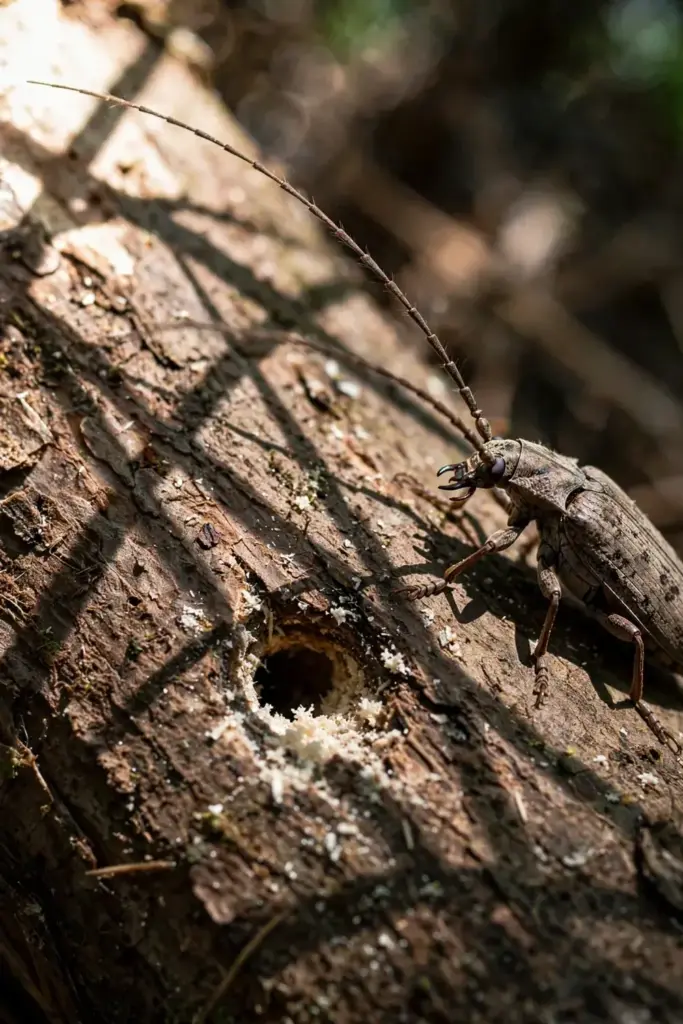
Adult pine sawyer beetles run 3/4 to 1 1/2 inches long, not counting their very long antennae. The University of Nebraska-Lincoln pine wilt guide states that adult beetles are 3/4 to 1 1/2 inches in length, not including antennae, and emerge any time from May to September. Females lay eggs under the bark of dead or dying pines during the summer. Larvae hatch, feed under the bark, tunnel deeper into the wood, and form a pupal chamber where they become adults. Nematodes gather in those chambers and move into the breathing tubes of the emerging beetles. When the beetles tunnel out and fly away, each one can carry tens of thousands of nematodes.
The flight carries the disease to the next tree. Adult beetles can fly several miles to find a stressed pine, and they feed on young twigs. The feeding itself does little damage. The feeding wounds are the entry points. Nematodes leave the beetle, migrate to the feeding sites, and enter the tree. In a resistant pine, the nematodes soon die and no disease develops. In a susceptible pine, they move to the water-conducting passages, molt into adults, and begin feeding on the living cells around the passages and resin canals. During the summer months, they move through the tree and multiply rapidly.
Heat drives the cycle. The Colorado State University Extension pine wilt page states that high average summer temperatures are required for the nematode to develop in the beetle and within infested trees. Hot summers grow more nematodes faster, and hot summers stress pines at the same time. A hot, dry summer is the season when a windbreak can lose several trees in sequence. A cool summer slows the cycle. That temperature dependence is why pine wilt disease hits hardest in the hot parts of the range and why the disease front moves with warm summers.
After the tree dies, the loop closes. Nematodes feed on blue-stain fungi in the dead wood and keep reproducing. Beetle larvae mature in the same wood. The next generation of beetles leaves the dead tree carrying the next generation of nematodes. A dead pine left standing through the summer is a nursery for both partners. Every week it stands, it feeds the next round of infections.
What Makes Pine Wilt Disease Worse in a Home Landscape
Hot, dry summers top the list. Heat speeds nematode development inside the beetle and inside the tree, and drought stress lowers the pine’s defenses at the same time. The Plant Health Australia pine wood nematode fact sheet states that the disease is exacerbated by hot, dry weather throughout summer. A pine that goes into a hot summer short of water is the tree the beetles find first.
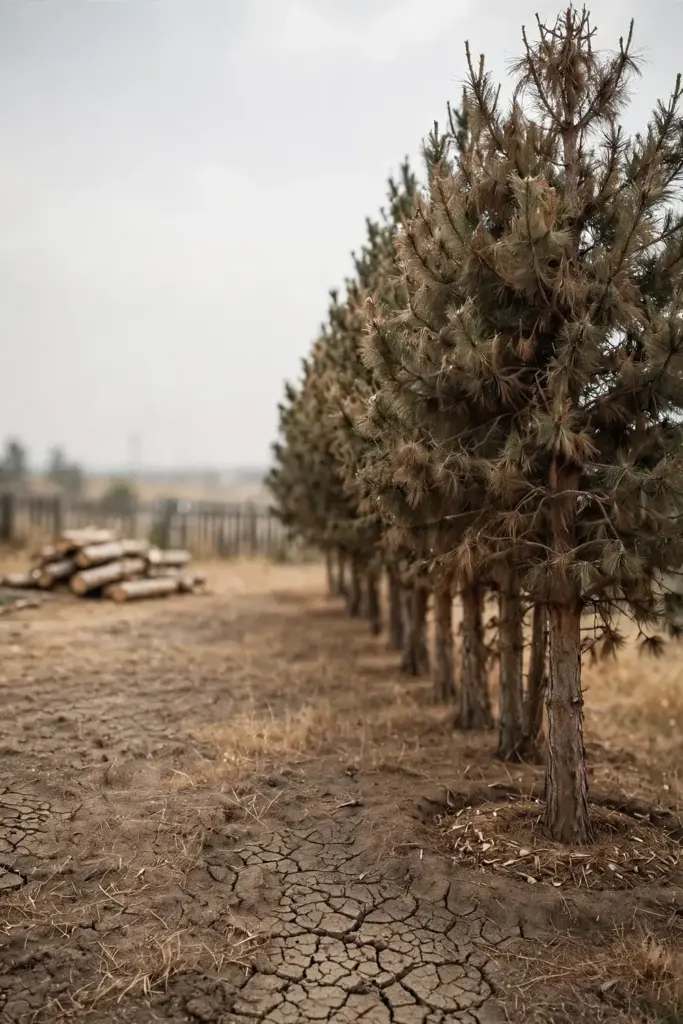
Stressed trees attract the beetles that carry the nematode. Adult sawyer beetles fly several miles to find a stressed pine to feed on. A pine stressed by drought, by construction damage to its roots, by a previous insect attack, or by crowding draws beetle attention. The beetles feed, the nematodes enter, and the infection starts. Keeping pines vigorous is not a vague goal. It is the one lever that lowers the odds of the first feeding visit.
Planting susceptible species where the disease is established stacks the risk. The Colorado State University Extension pine wilt page advises limiting future planting of the highly susceptible Austrian and Scots pines, especially where it is impractical or too expensive to protect trees with preventive injections. A new Scots pine planted into a neighborhood that already lost Scots pines to wilt starts life in the path of the disease. A deciduous tree or a resistant conifer planted in the same spot starts clean.
Fresh pine wood stored near living pines feeds the cycle. Sawyer beetles infested with the nematode may be attracted to any freshly cut pine logs, and the nematode can persist and multiply in those cut logs by feeding on blue-stain fungi. A firewood stack of fresh pine beside a row of exotic pines is a bridge between the dead wood and the living trees. Step 4 covers the wood rules in full.
Tight spacing and windbreak rows let one infected tree reach the next. The primary impact of pine wilt disease has been in landscape plantings and windbreaks, where mature exotic pines stand close together. Beetles fly from tree to tree along the row. A single infected tree in a windbreak is a threat to the whole row, not a lone casualty. Spacing new plantings wider and mixing in deciduous trees breaks the line.
Step 1: Decide Whether the Tree Is Worth Saving
Count the cost before you reach for a treatment. An infected tree cannot be saved. That sentence is the whole decision. No spray, no injection, and no fertilizer reverses pine wilt disease once symptoms show. The money question is not what saves this tree. The money question is what protects the pines still standing near it.
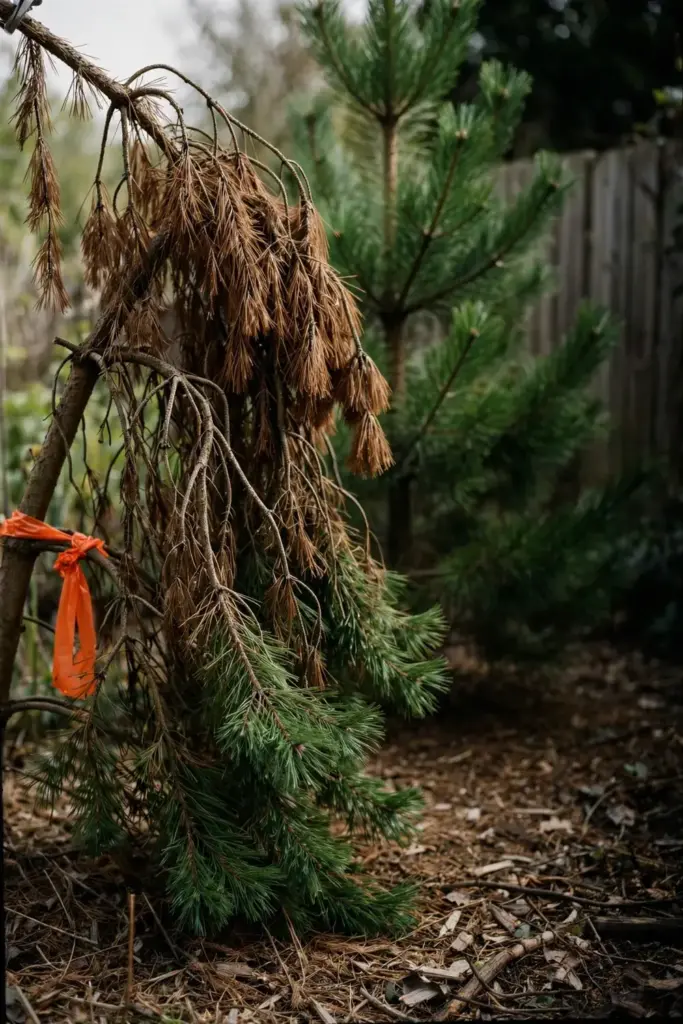
A tree with confirmed pine wilt earns removal. Removal costs money, and it costs the shade and the screen the tree gave. The alternative costs more. A dead pine left standing breeds the next generation of beetles and nematodes through the summer, and those beetles fly to the next pine. One removal now is cheaper than three removals next year. The honest cost-benefit call is removal, and the sooner it happens, the smaller the bill.
A tree with unconfirmed wilt earns a lab test first, not a chainsaw. Felling a pine on a field guess wastes a tree that might have carried a treatable problem. Step 2 covers the test. The test costs a lab fee and a few days. The removal costs far more. Test first, then cut. The one exception is a tree that is already dead and standing in an area where pine wilt is common. The University of Nebraska-Lincoln pine wilt guide states that in areas where pine wilt is already common, all Scots pines that die should be removed and disposed of quickly, because whether they died from pine wilt or not, they can serve as sources of beetles and nematodes.
A healthy pine near an infected one earns protection, not removal. Steps 5 through 7 cover that work. A high-value healthy pine earns a conversation with a professional arborist about preventive injections. Step 6 covers the injection decision, including its price and its limits. Do not let a contractor sell you an injection for a tree that already shows symptoms. Injections prevent. They do not cure.
Ask one more question before you spend anything. How many susceptible pines stand within beetle flight range of the infected tree? Beetles fly several miles, so the answer includes the neighbors’ pines and the windbreak down the road. You cannot treat trees you do not own. You can still warn the neighbors, and you can still remove your own source tree. A removed source tree helps every pine within flight range, including the ones across the fence.
Step 2: Confirm the Diagnosis With a Lab Test
Send wood to a diagnostic clinic before you fell a tree on suspicion. Visual signs point at pine wilt, and the microscope confirms it. The Colorado State University Extension pine wilt page states that confirmation with molecular testing of a wood sample is available through the CSU Plant Diagnostic Clinic. Every state runs a similar clinic through its land-grant university, and your local Extension office routes samples to it.
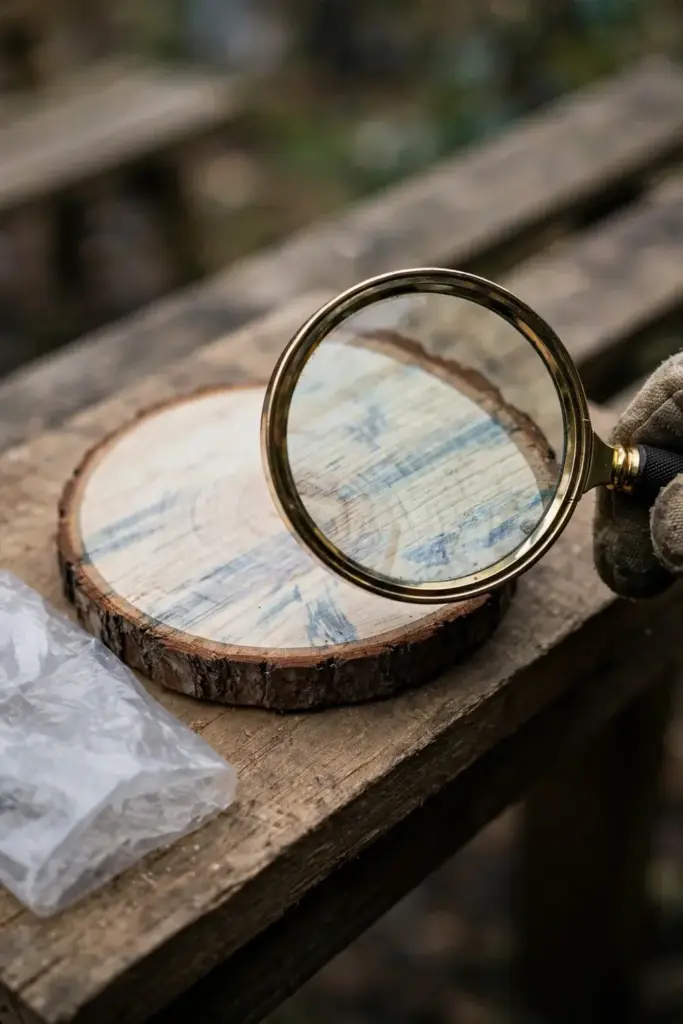
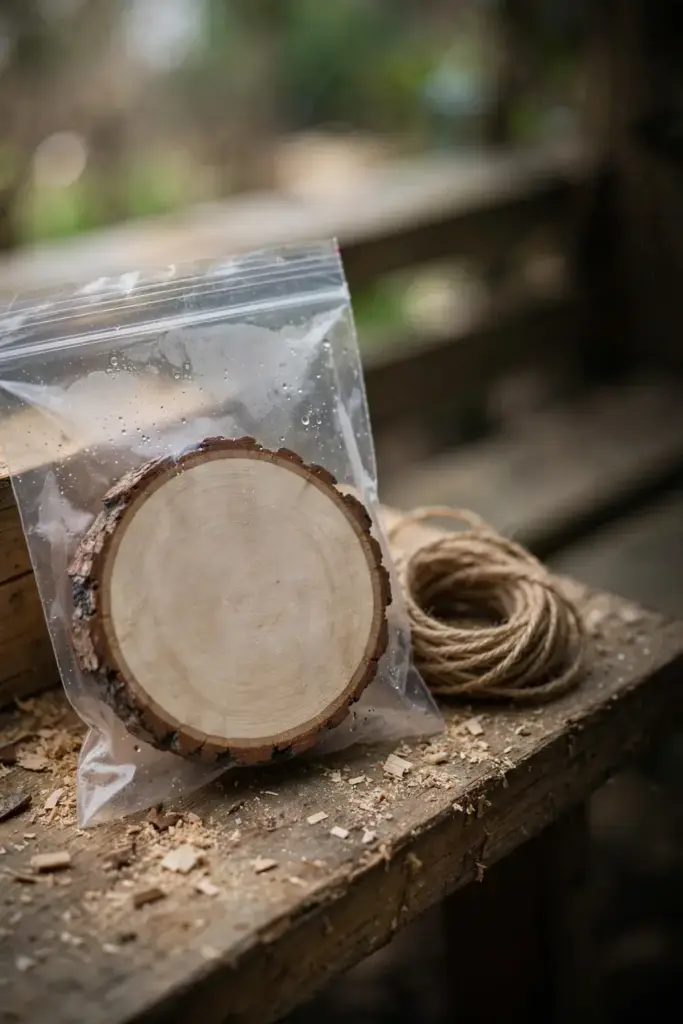
Take the sample from the right place. The University of Nebraska-Lincoln pine wilt guide states that a wood sample should come from the lower trunk or the base of large lower limbs, or as a disk of wood 3 to 4 inches in length from a branch a minimum of 3 inches in diameter near the trunk. Cut the sample from a symptomatic branch, not from dead wood at the base that may hold only fungi. Place the sample in a plastic bag and keep it cool. Ship or deliver it quickly. The clinic cuts the wood into small chips, submerges them in water, and collects the nematodes that swim out. Staff identify the pine wood nematode under a compound microscope by its distinct shapes.
Timing matters. Collect tissue as soon as possible after symptoms become apparent, when nematode numbers run high. A sample taken months after death may hold too few nematodes to find. A sample taken in midsummer from a freshly wilting branch is the best sample you can send. If the first sample comes back negative and the tree keeps declining, send a second sample from a different branch. A negative result on a poor sample is not a clean bill of health.
Do not treat a field match as a confirmed diagnosis. Several other nematode species live in trees without causing disease, and careful microscopic examination separates them from the pine wood nematode. A homeowner with a hand lens cannot make that call. The clinic can. The lab fee buys certainty, and certainty is what justifies a removal that costs far more than the test.
Step 3: Remove the Infected Tree to Ground Level and Destroy the Wood
Cut the tree down, cut the stump to ground level, and destroy the wood before the beetles emerge. Sanitation is the most important management practice against pine wilt disease. The University of Nebraska-Lincoln pine wilt guide states that sanitation is the most important management practice to prevent or slow the spread of pine wilt, and that diseased trees must be removed and destroyed before pine sawyer beetles emerge from the trees.
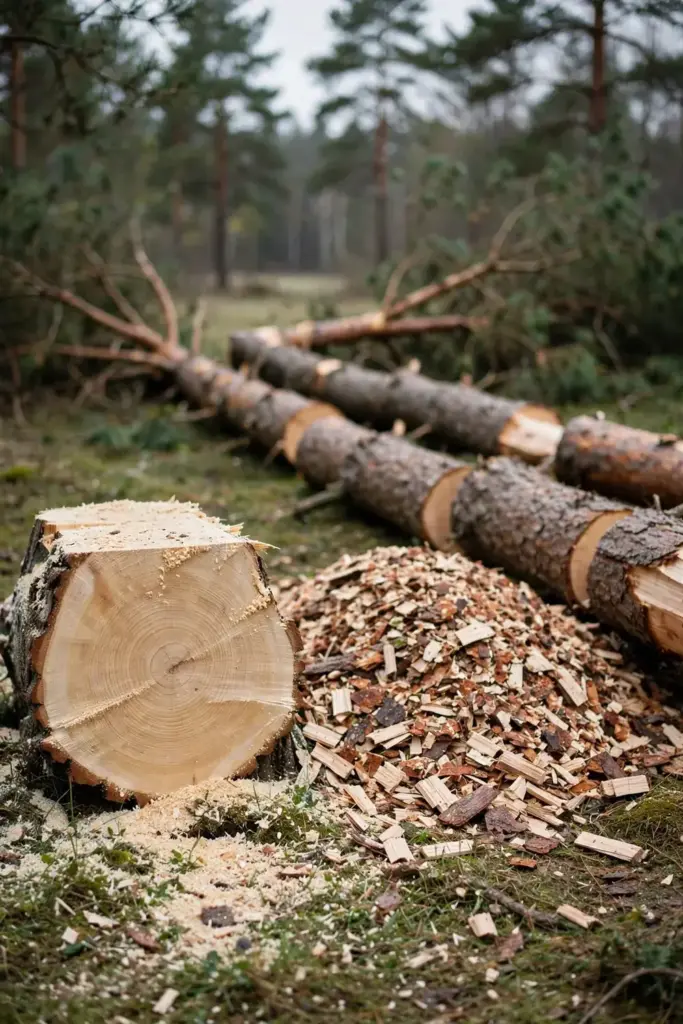
The deadline depends on when the tree died. Trees dying between May 1 and October 1 should be cut down promptly and burned, buried, or chipped. Trees identified after October 1 do not need immediate removal. Beetles stay inactive during the winter months. The trees must still be removed and destroyed by the end of April. The Colorado State University Extension pine wilt page gives the same rule for its region: trees killed in late summer or fall should be removed and destroyed before the emergence of pine sawyers in late June of the following year. Emergence timing varies by region, so check the date with your local Extension office and work to the earlier deadline when two sources disagree.
Leave no stump above ground level. Stumps hold beetle larvae and nematodes through the winter, and a stump left standing restarts the cycle in spring. Cut flush to the ground. Grind the stump if you can. A ground stump starves the next beetle generation of its nursery.
Destroy the wood by chipping, burning, or burying it. Chipping is the most useful option for a homeowner, because the chips can stay in the garden. The Colorado State University Extension pine wilt page states that there is minimal risk in moving the nematode in wood chips, so chips can be used for landscaping purposes. Burning works where local rules allow it. Burying works where it does not. The spring pruning techniques guide covers clean cut placement and tool hygiene for woody plants, and the same discipline applies to a removal: disinfect the saw between trees, and do not drag cut wood through the garden on the way out.
Hire the felling out when the tree is large, near a house, or near power lines. Pine wilt kills the whole crown, and a dead pine is brittle. A professional crew removes the tree, grinds the stump, and chips the wood in one visit. The crew’s price is the cost of doing this step right. A homeowner with a chainsaw and no rigging experience takes on a risk that no tree is worth.
Step 4: Never Save, Move, or Stack Infested Pine Wood
Do not save infested wood for firewood. Do not transport infested logs. Do not store fresh pine wood near exotic pines. The Colorado State University Extension pine wilt page states all three rules directly: do not leave stumps above ground level, do not save infested wood for firewood, do not transport logs that are potentially infested, and do not store any fresh pine wood near exotic pines.
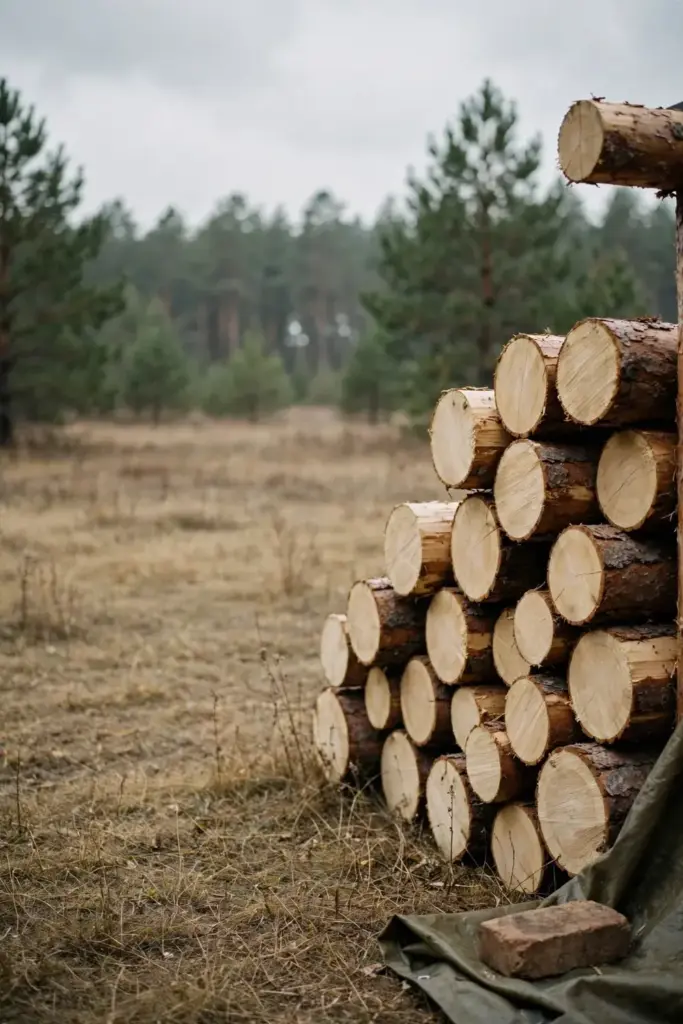
The firewood rule is the one homeowners break most often. A dead pine looks like free firewood. It is not free. Beetles can still emerge from the wood, carrying nematodes to the next pine. A stack of infested firewood beside the house is a nursery with a roof. Burn the wood where the tree stood, chip it, or bury it. Never stack it for next winter.
The transport rule reaches beyond your own garden. Pine wilt disease arrived in new regions inside infested firewood. Moving a truckload of pine logs from an infected county to a clean one moves the nematode with it. Buy firewood local, and burn it where you bought it. That rule protects every pine between your garden and the campground.
The storage rule covers fresh wood too, not only infested wood. Adult sawyer beetles infested with the nematode may be attracted to any freshly cut pine logs, even native pine logs, and the nematode can persist and multiply in those cut logs by feeding on blue-stain fungi. A fresh pine log pile beside a row of exotic pines draws beetles to the exact trees the nematode kills. Store firewood away from living pines, keep it covered, and burn the oldest wood first. A log pile far from the pines is a log pile. A log pile against the pines is a bridge.
Step 5: Keep the Pines You Still Have Vigorous
Water deeply during extended dry periods. A pine that goes into a hot summer short of water draws beetle attention and defends itself poorly once the nematodes enter. Deep watering through a drought costs a hose and an afternoon. It buys the tree the vigor that keeps beetles looking elsewhere. Mulch the root zone to hold soil moisture, and keep the mulch off the trunk.
Control the other insects and diseases that stress the tree. A pine already fighting needle blight or a bark beetle attack is a pine the sawyer beetles find first. Walk the pines monthly through the growing season and look for new stress: thinning crowns, pitch tubes, sawdust on the bark, needle spots. Treat the stress you find. A tree with one problem is a tree at risk. A tree with two problems is a tree the beetles have already marked.
Feed only where a soil test says the tree needs it. A pine fed on a schedule it does not need grows soft tissue that pests favor. A pine starved of a nutrient it lacks grows slowly and defends poorly. The soil test decides. Guessing does not.
Protect the root zone from construction damage. Trenching, grading, and soil compaction near a pine cut the roots that feed the crown. A crown with a damaged root system wilts like a crown with nematodes, and it draws beetles the same way. Fence the root zone before any digging starts near a pine you intend to keep. A root zone saved is a crown saved.
Vigor is not a cure. A vigorous pine can still catch pine wilt disease when beetles feed on it. Vigor lowers the odds. It does not remove them. Pair this step with the monitoring in Step 7 and the removal discipline in Steps 3 and 4. Vigor buys time. Removal and monitoring spend it well.
Step 6: Protect High-Value Healthy Pines With Professional Injections
Preventive trunk injections are the only chemical option with Extension backing, and they work only on healthy trees. Two avermectin compounds, abamectin and emamectin benzoate, are labeled for the prevention of pine wilt. The Colorado State University Extension pine wilt page states that these products must be injected into the pine prior to infection, and that they are not effective if the tree is symptomatic or once the nematode has colonized the tree. An injection into a wilting tree wastes the treatment and the money.
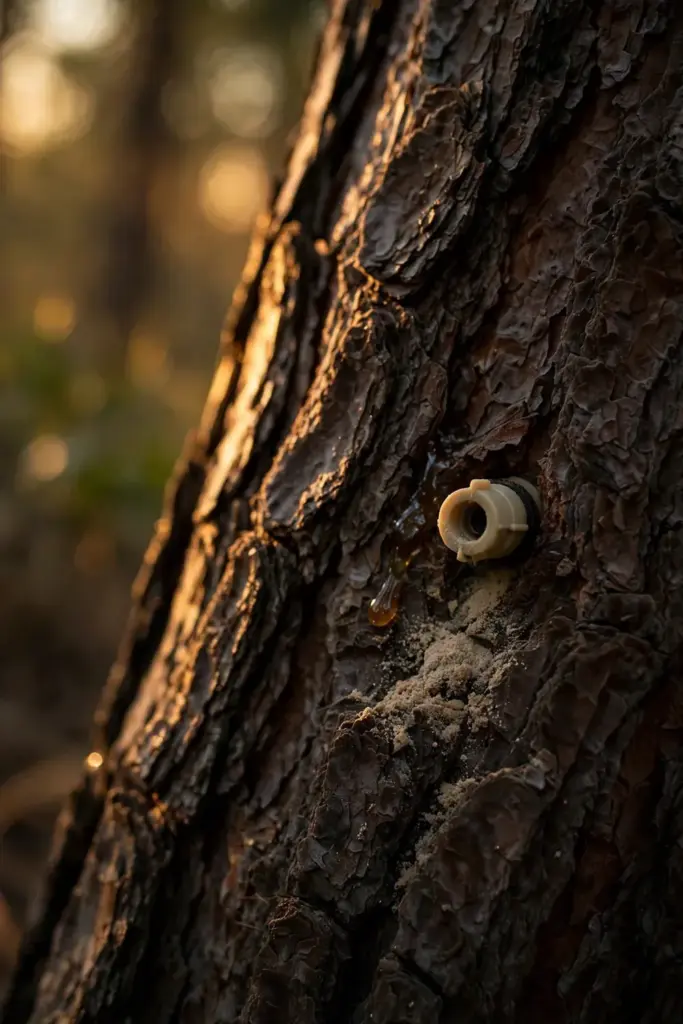
The protection is real and partial. The University of Nebraska-Lincoln pine wilt guide states that one application of abamectin provides about 70 percent protection each year for about three years. Colorado State adds that yearly injections provide the greatest protection, and that very good control has also been achieved by injecting every other year. The cost and the potential damage from the injection process are issues to weigh. A treatment that protects a specimen pine for three years earns its price on a tree that would cost thousands to remove. The same treatment on a row of windbreak pines rarely earns its price.
Injections are professional work, not homeowner work. The Colorado State University Extension pine wilt page states that pine injections are almost always done by professional arborists, injected at pressures from 30 to 50 psi, and completed by early May and before pine sawyer beetle emergence. A homeowner with a drill and a syringe cannot match that pressure, cannot place the dose, and cannot judge the uptake. Hire a licensed arborist. Ask for the product name, the label rate, and the schedule in writing before the work starts.
Foliar insecticide sprays do not prevent pine wilt disease. Colorado State states that foliar applications are not currently recommended for pine wilt control, because there is no data to support them. A spray might kill a beetle during feeding, and the nematodes could still enter the feeding wound before the beetle dies. Many foliar insecticides are not toxic to nematodes at all. Do not let a contractor sell you a spray program as pine wilt protection. The injection is the backed option. The spray is not.
Decide on injections tree by tree. A specimen Japanese black pine by the front door earns the conversation. A windbreak row of Scots pines earns removal of the infected trees and replanting with resistant species instead. The injection decision is a cost-benefit call per tree, and the arborist’s quote is the number that settles it.
Step 7: Watch Neighboring Pines for Early Top-Down Wilt
Walk every susceptible pine on the property once a week from midsummer into fall. Look at the top of each crown first. Pine wilt starts at the top, so the first sign is a grayish-green cast on the upper branches while the lower branches still look green. Catch it in that week and you gain the whole removal schedule. Miss it for a month and the tree is gone.
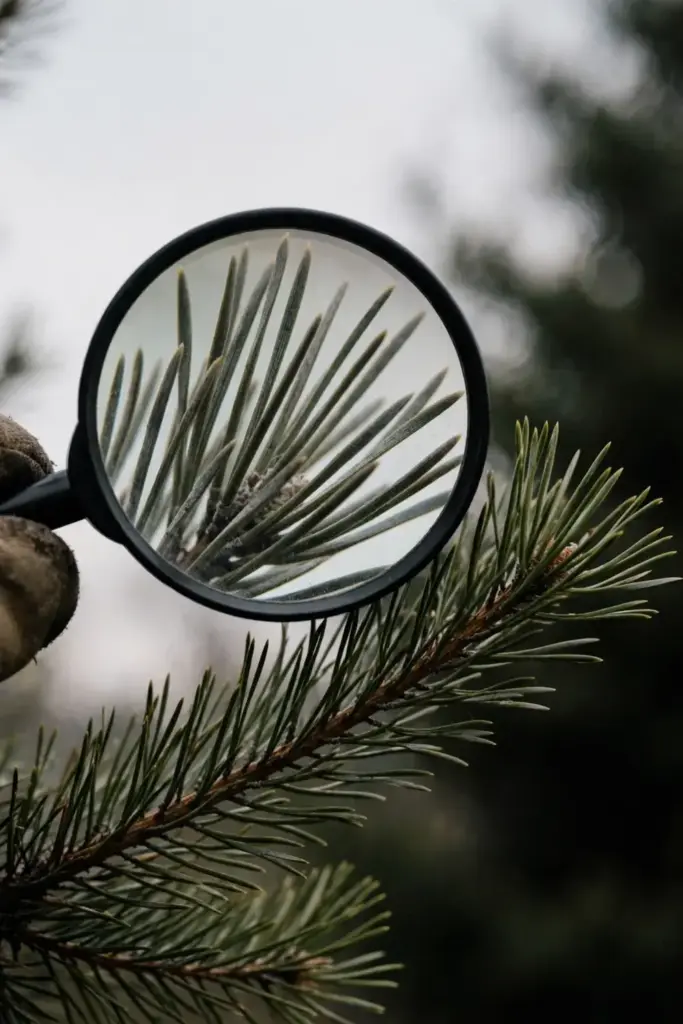
Check the neighbors’ pines too, with permission. Beetles fly several miles, so a wilt-killed pine down the street is a warning for your own trees. A neighbor who removes a dead pine promptly protects your planting, while a neighbor who leaves one standing feeds beetles to your trees. A short conversation about the removal deadline helps both gardens. Offer the name of the diagnostic clinic and the removal window. Most neighbors act once they know the tree threatens theirs.
Watch windbreak rows with extra care. The primary impact of pine wilt disease has been in landscape plantings and windbreaks, where mature exotic pines stand close together. Walk the full row, not just the trees nearest the house. Mark a suspect tree with tape and date the mark. Check the marked tree again in a week. A mark that spreads means the wilt is moving, and a mark that stays put means the tree is holding.
Keep a simple log. Date, tree, what you saw. Three lines per walk is enough. The log turns a vague feeling into a timeline, and the timeline is what the diagnostic clinic and the arborist need. A log also keeps you honest. Memory blurs a slow decline into a sudden one. The log shows the real speed.
Early detection does not save the infected tree. It saves the trees next to it, because every week gained between the first wilt and the removal is a week the beetles do not breed in that tree. The walk is the cheapest of the nine steps, and it is the step that makes every other step work.
Step 8: Replant With Pines That Resist Pine Wilt, or Go Deciduous
Do not replant a Scots pine where pine wilt killed one. The University of Nebraska-Lincoln pine wilt guide states that when replacing pines killed by pine wilt, it is recommended not to replant with a Scots pine due to their high susceptibility. A replacement Scots pine in the same soil, in the same neighborhood, faces the same beetles and the same nematodes. Planting one is a bet against the record.
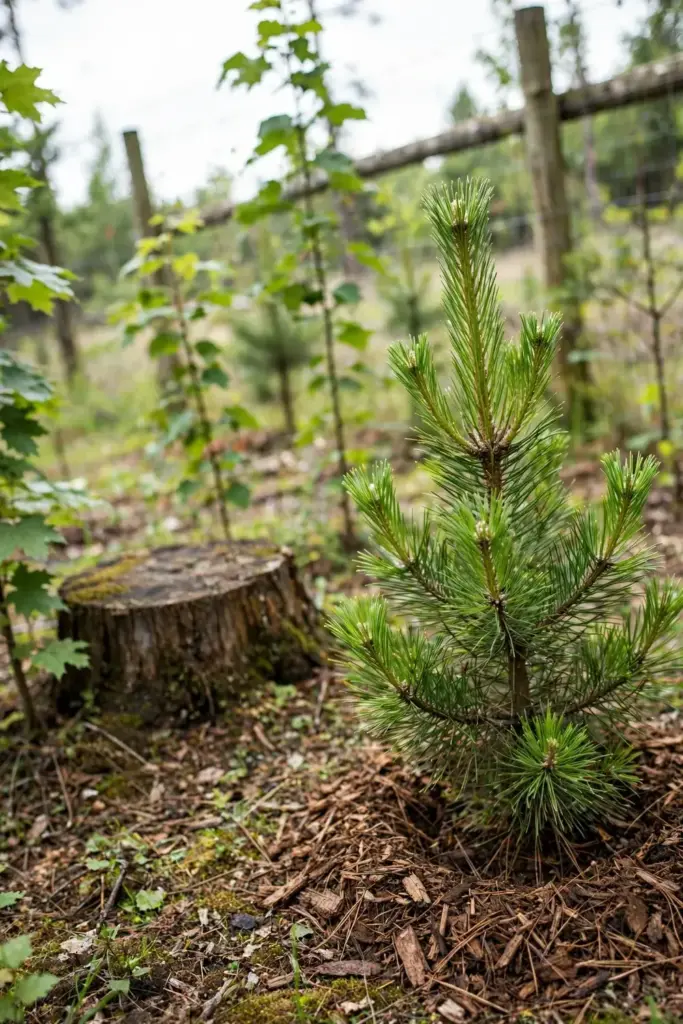
Austrian pine earns the same caution. Austrian pines can be killed by pine wilt, and they are extremely susceptible to two fungal diseases, Diplodia tip blight and Dothistroma needle blight. Replacing a wilt-killed Scots pine with an Austrian pine trades one fatal disease for three. The Nebraska guide lists spruces, firs, red cedar, junipers, and white and ponderosa pine as facing little threat from pine wilt. The Colorado State University Extension pine wilt page adds that deciduous trees and other conifers can be safely planted as replacements at sites where exotic pines have been killed from pine wilt, and that there are currently no resistant selections of Austrian or Scots pine.
Pick the replacement for the site, not for nostalgia. A windbreak gap wants a tree that grows to the same height and fills the same screen. A specimen spot wants a tree with the same presence. A hot, dry site wants a tree that tolerates heat and drought. White pine, spruce, fir, juniper, or a deciduous tree can fill each of those roles. The right replacement is the one that lives in that spot for decades, not the one that matches the tree that died there.
Wait one season before replanting into the exact spot if the stump is still decaying, and clear the old wood first. The new tree needs clean soil and full sun, not a decaying stump and a pile of old chips. A season of patience beats a replacement planted into a nursery for the next outbreak.
Step 9: Report the Outbreak and Follow Local Quarantine Rules
Tell your local Extension office when you confirm pine wilt disease. Reporting is not paperwork for its own sake. Extension tracks the disease front, warns nearby plantings, and gives you the removal deadline for your region. A confirmed case in your county changes the advice for every pine owner near you. A silent case helps no one.
In the United States, the path runs through the Extension diagnostic clinic and the state forestry agency. The clinic confirms the sample. The forestry agency tracks the outbreak and advises on firewood rules for the county. Some counties restrict pine firewood movement after confirmed cases. Ask about the rules before you move any pine wood off the property. The rules exist because firewood moved the nematode into new regions before.
European readers face a different lane. The pine wood nematode is a Priority Pest under EU legislation, established in Portugal, with recorded incursions in Spain. The Irish Department of Agriculture pest contingency plan for pine wood nematode states that the pest is categorized as a Priority Pest under EU legislation, that it has established in Portugal, and that there have been recorded incursions in Spain. A European gardener who suspects pine wilt should report the tree to the national plant protection service and follow its instructions, not treat the tree at home. Quarantine rules, not home treatment, govern the response in that lane.
Do not move pine wood across regions while you wait for instructions. The firewood rules in Step 4 apply everywhere, and they apply doubly during an outbreak. A log moved to a clean county is a new outbreak. A log burned where it fell is the end of one.
Living With Pine Wilt Damage You Cannot Undo
A pine lost to wilt leaves a gap, not a garden ruined. The work now is the gap, the stump, and the next planting. A tree that is already dead will not recover, and no feeding or watering brings it back. Accept the loss and spend the effort on the trees that remain.
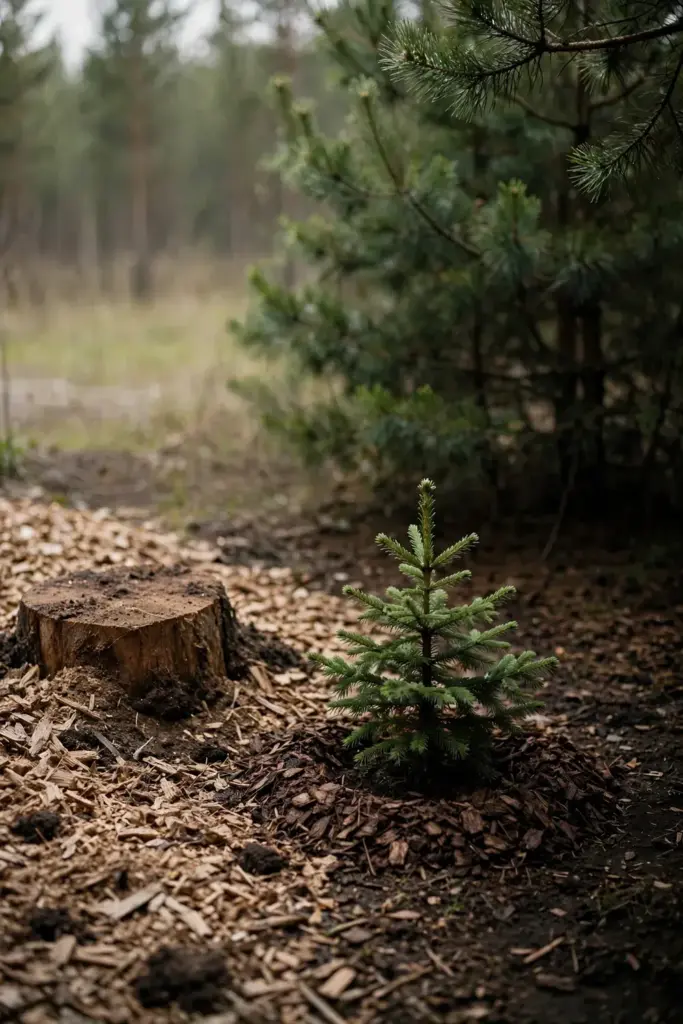
Start with the stump. Cut it flush to the ground and grind it if you can. A stump left above ground level holds beetle larvae and nematodes through the winter. A ground stump starves the next generation. Fill the hollow with soil and let the lawn or the bed close over it. The gap closes faster than most gardeners expect.
Reuse the chips. Chipped wood from a wilt-killed pine carries minimal risk of moving the nematode, and the chips can stay in the garden as mulch. Spread them on a bed away from living pines, not piled against a pine trunk. The chips return the tree to the soil without returning the disease to the pines.
Look at the gap with fresh eyes. A windbreak gap wants a fast replacement from the Step 8 list. A specimen gap wants a tree chosen for the site, not a copy of the tree that died. A gap in a mixed planting may want no replacement at all. Light reaches the bed now, and the shrubs under the old pine may grow better with the crown gone. A gap is not always a hole to fill. Sometimes it is room the garden needed.
Keep walking the remaining pines. The loss of one tree raises the stakes for the rest, and the weekly walk in Step 7 is the habit that protects them. A garden that lost a pine to wilt and then caught the next infection in its first week is a garden that loses one tree, not five. The first loss teaches the pattern. The pattern saves the rest.
Frequently Asked Questions
No. Pine wilt disease is lethal once the nematode colonizes the tree. The blockage of the water-conducting passages spreads through the crown, and the tree cannot repair it. A tree that shows top-down wilt will die within weeks to a few months. The only honest response is lab confirmation, fast removal, and protection of the pines nearby.
Death usually comes within a few weeks to a few months of infection, though Colorado State notes cases where susceptible Scots and Austrian pines died sometimes within 3 weeks. Onset of visible symptoms can run as short as 4 weeks. The speed depends on host species, tree vigor, and summer heat. Hot summers accelerate the nematodes and shorten the timeline.
No. The pine wood nematode feeds in pine wood and on fungi in dead pines. It does not infect people, pets, or other animals. The danger is to susceptible pines only. The safety rules around a wilt-killed tree concern the chainsaw, the falling crown, and the beetles in the wood, not the nematode itself.
No. Foliar insecticide sprays are not recommended for pine wilt control. Colorado State states there is no data to support foliar applications, and a sprayed beetle may still pass nematodes into a feeding wound before it dies. Many foliar insecticides are not toxic to nematodes. Spend the money on removal, monitoring, and preventive injections for healthy high-value trees.
Yes, if you pick the right species. Do not replant Scots pine where pine wilt killed one, and treat Austrian pine with the same caution. White pine, spruce, fir, juniper, red cedar, and deciduous trees face little threat from pine wilt and make safe replacements. Clear the old wood first, grind the stump, and give the new tree clean soil and full sun.
Where to Go From Here
Start with the walk. Go out this week, look at the top of every susceptible pine, and write down what you see. A ten-minute walk is the first step in all 9 strategies, and it costs nothing. If a crown looks grayish green at the top, send the sample. If the sample confirms pine wilt, remove the tree to ground level and destroy the wood before the beetles emerge. If the sample clears the tree, keep walking it weekly and keep it vigorous.
The order matters. Identify first, decide second, remove third, and protect the rest after that. A gardener who follows that order loses one tree and keeps the planting. A gardener who sprays first, waits, and then cuts loses the planting too. Pine wilt disease punishes delay and rewards speed. The speed starts with the walk.