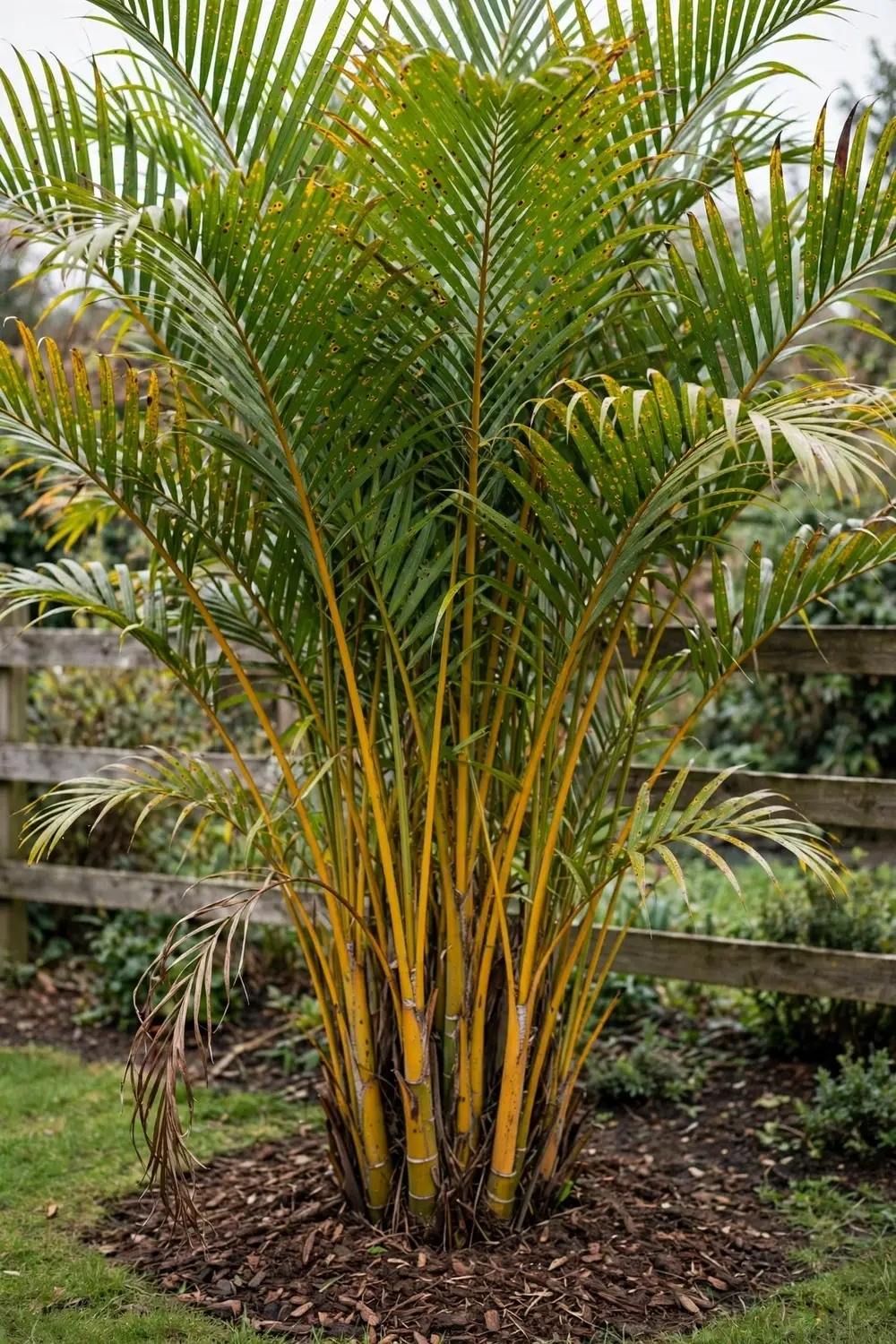

Fungal problems on palm start with 1 question: where is the symptom? The location narrows the fungus before anything else does. A spot on a leaflet points to a leaf spot fungus, while a rotting spear leaf points to bud rot and a bracket at the trunk base points to Ganoderma. This article triages palm fungal problems by location, then by treatability, so you can act on the right problem instead of spraying the wrong one.
A palm is a member of the family Arecaceae. A palm grows from a single bud at the top of the trunk. That bud is the only growing point. A palm cannot grow a replacement bud when the first one rots. This single fact sets the stakes for every fungal problem on palm. Leaf spots cost fronds. Bud rot costs the whole palm.
Two name traps sit outside this article. A sago palm is not a palm. It is a cycad, Cycas revoluta, and its problems follow cycad rules. A palm lily is not a palm either. It is a Cordyline, and its problems follow Cordyline rules. This article covers true palms only.
1. Where the Symptom Sits First: Fronds, Spear Leaf, Trunk, or Roots
The location of the first symptom names the group of fungi you are dealing with. Start every inspection at the location, not at the color. Color misleads. A yellow frond can mean a leaf spot, a nutrient shortage, a root problem, or a wilt. The address of the symptom narrows the list at once.
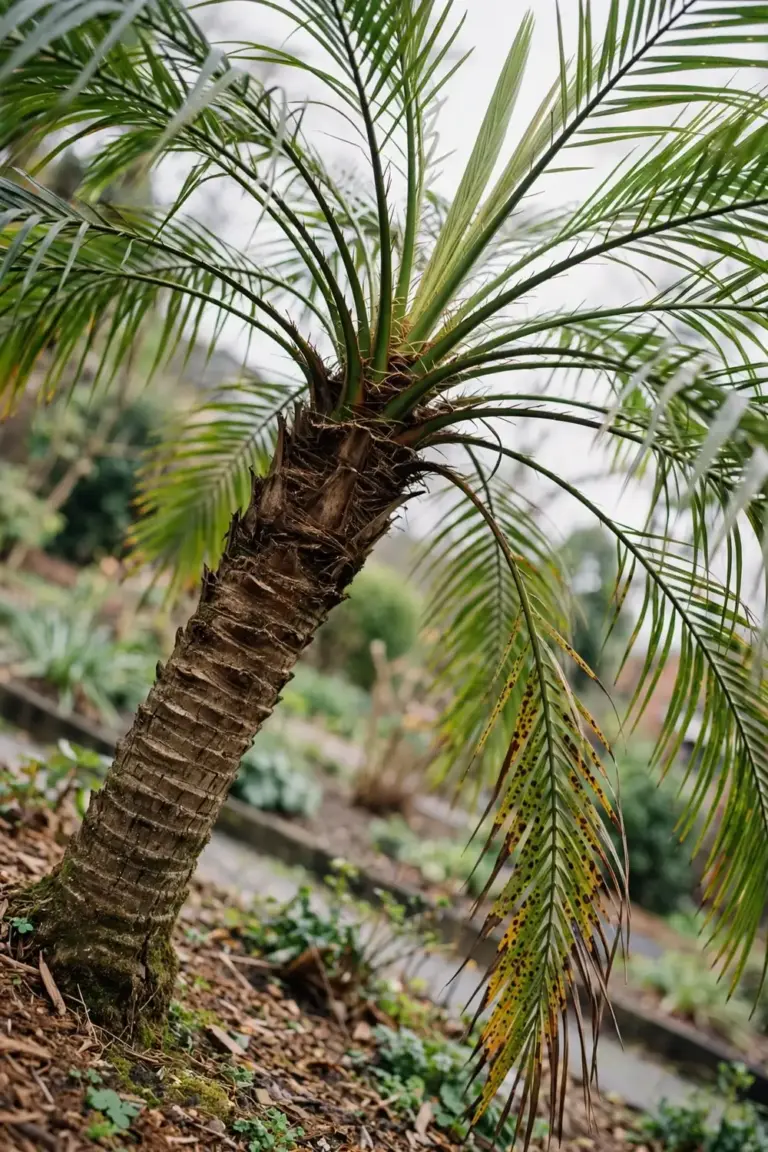
Fronds carry the treatable problems. Leaf spots, false smut, and sooty mould all show on fronds first. The spear leaf carries the emergency. Bud rot starts in the spear leaf and moves down into the bud. The trunk carries the incurable problems. Ganoderma shows at the trunk base. The roots carry the hidden problems. Root rot shows above ground as wilting that watering does not fix.
Inspect from the ground. Use binoculars for a tall crown. Photograph the symptom with a coin or a ruler beside it for scale. Never climb a palm to inspect it. A decaying trunk can fail without warning, and a falling frond can injure. Large dead fronds belong to an arborist, not to a ladder. I have learned that the frond I check from the ground with binoculars answers faster than the one I climb to reach.
Walk the palm in this order: spear leaf first, then the newest fronds, then the oldest fronds, and the trunk base last. Then check the soil. Wet soil around a wilting palm points to roots. Dry soil around a wilting palm points to water supply, not fungus. Record what you see in that order. The order keeps the diagnosis honest.
2. The Differential Table: Match the Symptom to the Fungus
The differential table is the spine of this article. Find your symptom in the first two columns. Read across for the most likely cause, whether treatment can help, and the first step. The rows run in treatability order. Treatable leaf problems come first. Incurable problems come last.
| Where | What It Looks Like | Most Likely Fungus | Treatable? | First Step |
|---|---|---|---|---|
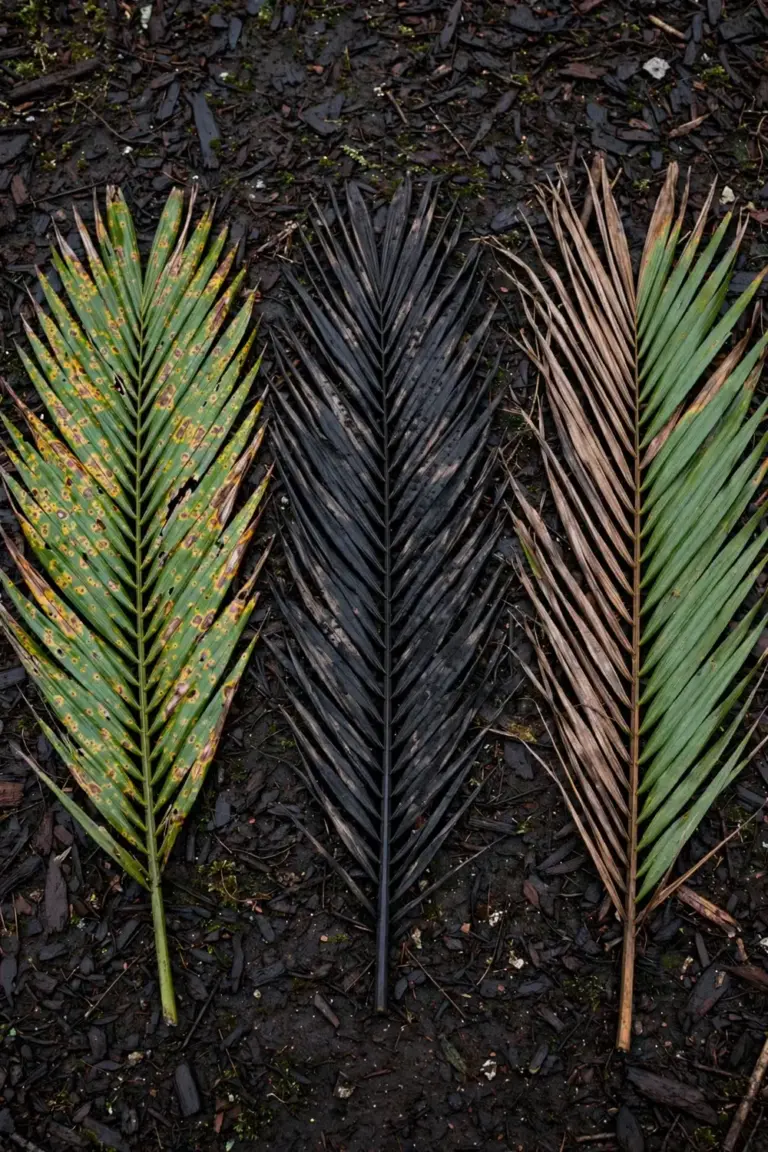
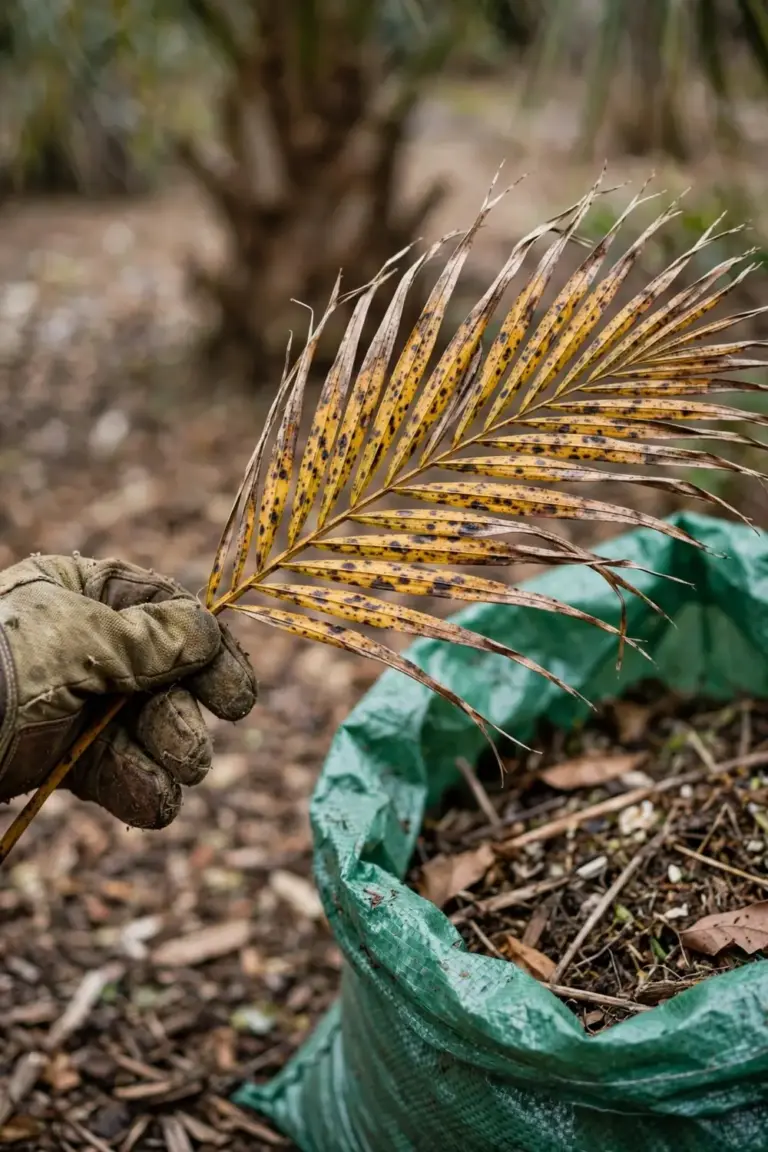
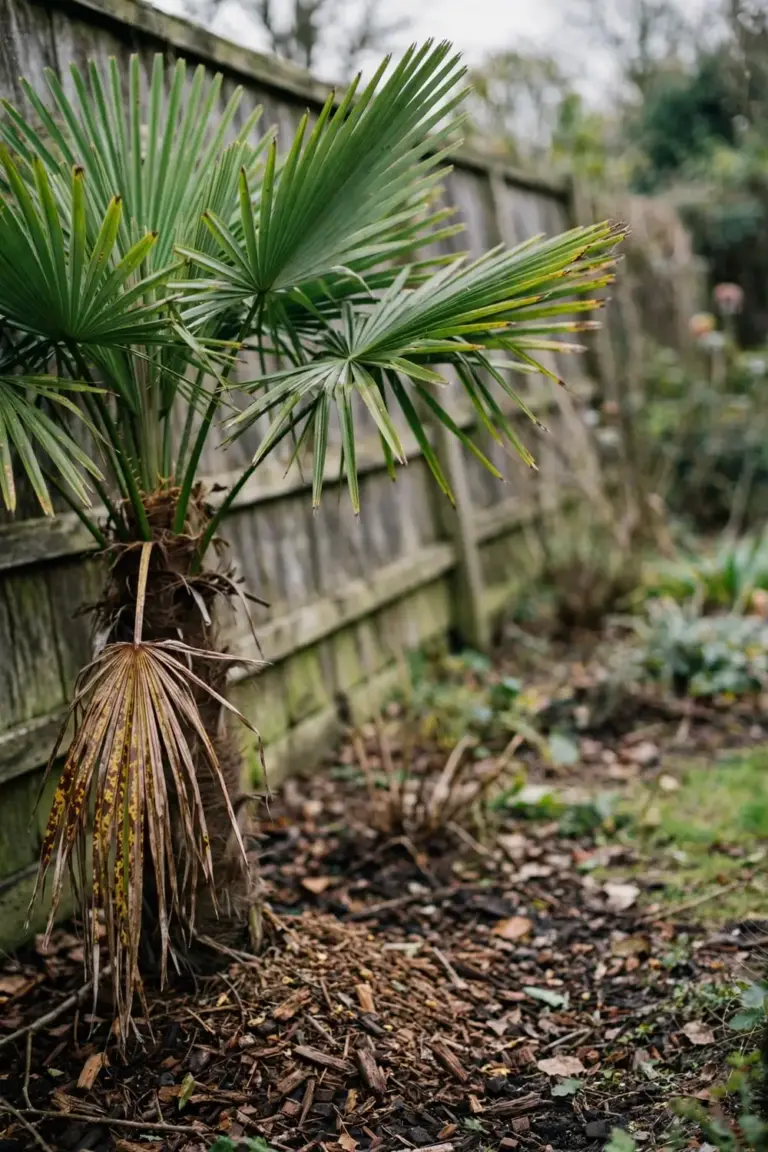
| Leaflets | Small yellow, brown, or black spots, often gray in the center with a black outline | Leaf spot complex (Pestalotiopsis, Cercospora, Bipolaris, anthracnose) | Yes, manageable | Remove the worst fronds, improve airflow, protect new growth |
| Leaflets | Tiny black cup-shaped dots that you can feel with a fingertip | False smut (Graphiola phoenicis) | Yes, cosmetic | Usually no action; check potassium before removing fronds |
| Leaflets | A black film that wipes off with a finger | Sooty mould on honeydew | Yes, through the pest | Find the sap-sucking pest and treat it |
| Spear leaf | Discoloured and wilting spear leaf that pulls out easily, sometimes with a foul smell | Bud rot (Phytophthora palmivora) | Early only | Act fast, protect the bud, call an arborist |
| Petiole bases | Pinkish spore masses on petiole bases near the crown | Pink rot (Nalanthamala vermoeseni) | Sometimes | Remove infected tissue, improve drainage, avoid wounding |
| Trunk base | A hard shelf-like bracket, called a conk, on the lower trunk | Ganoderma butt rot (Ganoderma species) | No | Remove the palm, remove conks as they form |
| Fronds | One-sided death of leaflets, then whole-frond death, with a reddish-brown streak inside the petiole | Fusarium wilt (Fusarium oxysporum forms) | No | Remove the palm, sterilise tools, do not replant a susceptible palm in the same soil |
| Roots | Wilting that watering does not fix, with dark soft roots | Root rot (Phytophthora and Pythium water moulds) | Rarely | Improve drainage, reduce water, confirm with a root check |
| Whole crown | Rapid yellowing and collapse of the whole crown, with dead fronds hanging like a skirt | Phytoplasma wilt (a bacterium, not a fungus) | No | Report the case, remove the palm, do not replant in the same spot |
Use the table as a starting point, not as a laboratory result. Several fungi produce similar spots. Species-level identification needs a laboratory. The table tells you which urgency class you face. Urgency decides the next move. A leaf spot can wait a day. A rotting spear leaf cannot.
3. Leaf Spot Complex: The Treatable Group
Leaf spot complex is the treatable group of palm fungal problems. Several fungi cause it. Pestalotiopsis, Cercospora, Bipolaris, and the anthracnose fungus Colletotrichum all produce leaf spots on palms. Field inspection separates the group from other problems. Field inspection does not separate the species inside the group. Species identification needs laboratory work. For a home gardener, the group answer is enough to act.
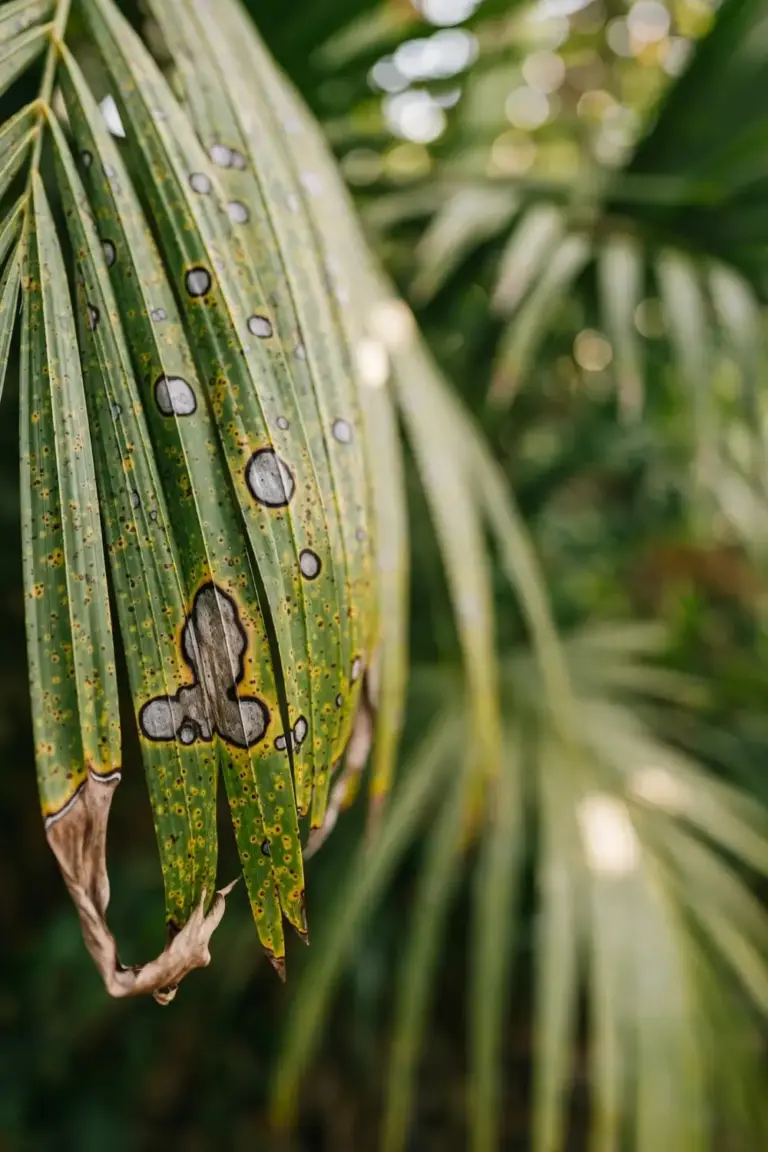
Pestalotiopsis is the best documented member of the group. Its spots begin as very small yellow, brown, or black spots. The spots may stay small. When conditions suit the fungus, the spots expand and merge into a blight. The spots often turn gray with a black outline. The same lesions can appear on the petiole or rachis. The University of Florida extension service Pestalotiopsis guide states that spots restricted to the leaf blade may never grow past 1/4 inch, which is about 6 mm, in size.
A spot on the blade alone is a minor problem on a mature palm, but a spot on the petiole or rachis is a bigger problem, because the fungus destroys tissue there, cuts the vascular tissue, and starves every leaflet beyond the damage. A rachis infection can travel down to the bud. A bud infection turns a leaf problem into a palm problem. Check every leaf spot case for rachis involvement. Look along the midrib and the petiole, not only at the leaflets.
Young palms suffer more than mature palms. A juvenile palm has no trunk and few leaves, so each spotted leaf is a large share of its canopy, and the same infection that a mature palm sheds can strip a juvenile palm bare. Protect young palms first. Keep their crowns dry. Space them for airflow. Remove badly spotted fronds before the fungus spreads.
Treatment manages leaf spot complex, although it does not cure an infected frond: a spotted frond stays spotted, while new growth stays clean once the conditions change. Remove the worst fronds and destroy them. Never compost infected fronds. Composting keeps the spores in the garden. Improve airflow by spacing plants and clearing clutter around the crown. Avoid overhead watering. Wet fronds invite infection. A copper-based protectant spray, applied exactly as its label directs, can protect new growth. A protectant coats healthy tissue. A protectant does not heal tissue that is already infected.
4. False Smut: Graphiola Leaf Spot Is Mostly Cosmetic
False smut is a fungal leaf disease that looks worse than it is. The fungus is Graphiola phoenicis. The disease is also called Graphiola leaf spot. The name false smut comes from the dark fruiting bodies. True smuts belong to a different group of fungi, so treat the name as a lookalike label rather than a family claim.
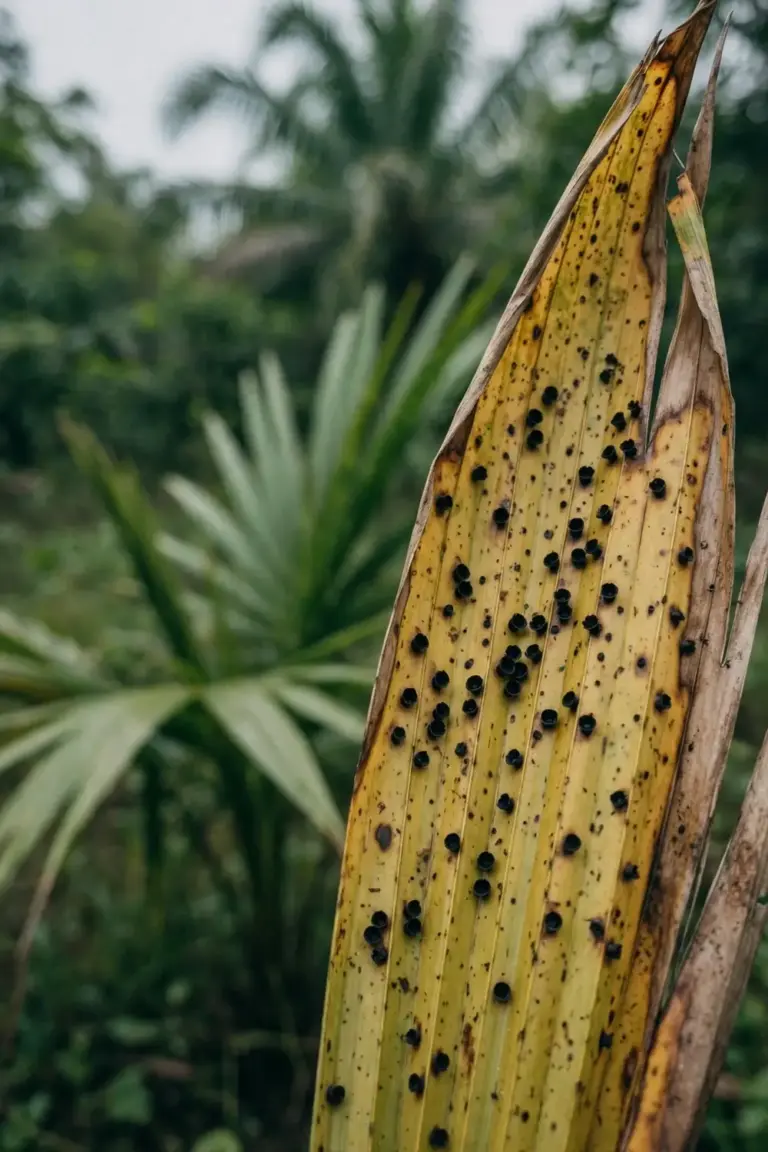
Diagnosis is direct. The fungus produces very small black cup-shaped bodies called sori on the leaf blade. The University of Florida extension service gives their size as 1/16 inch, which is about 1.5 mm. The sori sit on the oldest leaves, the lowest leaves in the canopy. You can see them without magnification, and you can also feel them, because the sori stand raised above the leaf surface. Run a fingertip lightly across the leaflet. The raised dots confirm the diagnosis.
The disease is primarily cosmetic. It does not reduce palm growth in the landscape. The confusion around false smut comes from nutrient deficiency. Most Phoenix palms in gardens show potassium deficiency. Potassium deficiency yellows and kills old leaflets, which looks like disease, yet the deficiency harms the palm far more than the fungus does. Treat the deficiency as the real problem. Treat the fungus as background noise.
Do not strip a palm of its fronds to fight false smut. Removing fronds from a potassium-deficient palm makes the deficiency worse. Fewer fronds mean less potassium reserve. The palm declines faster. Remove diseased leaves only when the palm shows no deficiency symptoms. When deficiency symptoms are present, feed the palm back to health first and leave the spotted fronds in place. A laboratory leaf test settles the question when the symptoms are unclear.
False smut favours Phoenix palms. Canary Island date palm and edible date palm are the classic hosts. The fungus also appears on golden cane, coconut, and several other palms. Humid air favours it, and overhead watering favours it, while good airflow and dry fronds slow it, so no spray program is needed for a cosmetic disease: sanitation and airflow carry the whole response.
5. Sooty Mould: Fungi on Honeydew, Not Leaf Invaders
Sooty mould is a group of fungi that grow on honeydew. Honeydew is the sugary waste that sap-sucking insects excrete. Aphids, scale insects, mealybugs, and whiteflies all produce honeydew. The fungi feed on the honeydew without invading the leaf, so sooty mould is a surface coating rather than a leaf infection.
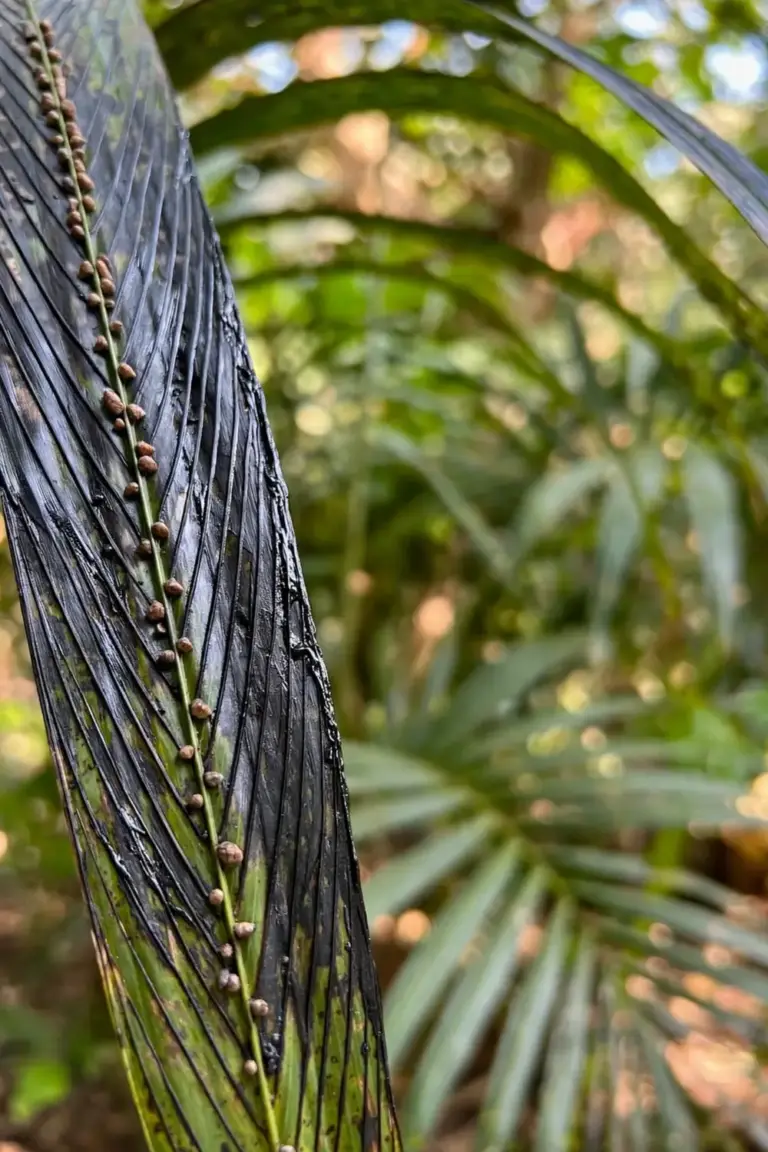
The symptom is a black film on fronds, stems, or nearby surfaces. The film wipes off with a finger. That wipe test separates sooty mould from leaf spot. Leaf spots sit inside the tissue. Sooty mould sits on top of it. The film blocks light, so a heavy coating shades the leaf, shaded leaflets photosynthesise less, and growth slows. The palm is not poisoned. The palm is shaded.
Treat the pest, not the fungus, because spraying the black film achieves nothing: the film returns while the honeydew keeps falling. Find the insects first. Check leaf undersides. Check petiole bases. Check the spear leaf sheath. Scale insects sit still and look like bumps, mealybugs hide in white waxy clusters, and aphids crowd new growth. Identify the pest before you spray anything.
Control follows the pest. Knock soft insects off with a strong jet of water. Apply horticultural oil exactly as its label directs for scale and mealybug. Encourage predators by avoiding broad-spectrum sprays. Ants farm sap-sucking insects for honeydew. Ants move aphids and protect them from predators. Control the ants when ants guard the colony. For the full organic pest ladder, the organic pest control for beginners guide covers identification and predator-friendly steps. Once the insects are gone, the sooty mould stops spreading. Rain and new growth clear the old film. Do not scrub fronds. Scrubbing wounds tissue and opens the door to real pathogens.
6. Pink Rot: The Crown-Rot Warning Sign
Pink rot is a crown-rot disease of palms. The fungus is Nalanthamala vermoeseni. Older references call it Gliocladium vermoeseni, so the name changed while the disease stayed the same. Pink rot attacks the petiole bases and the crown. It enters through wounds. It spreads in wet crowns. It can kill a palm when it reaches the bud.
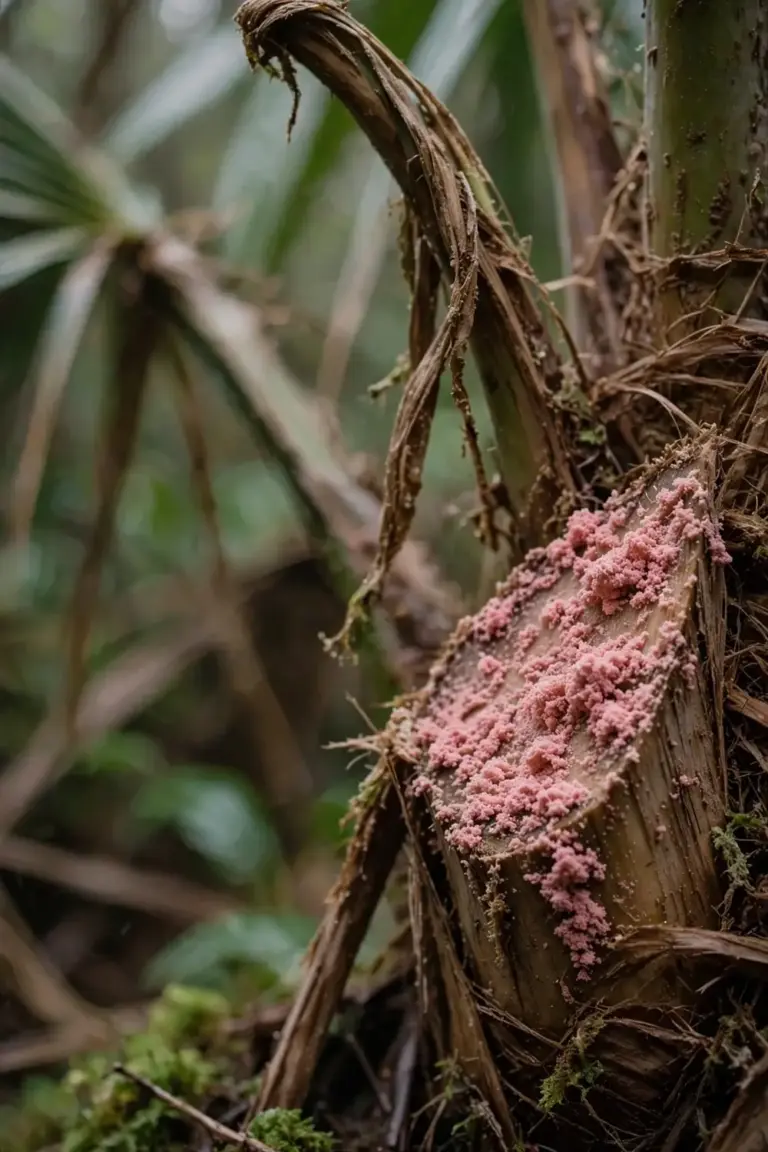
The signature sign is a pinkish spore mass on petiole bases near the crown. The color gives the disease its name. Infected petiole bases rot. Fronds wilt and collapse from the crown outward. The crown may smell stale. The spear leaf may pull out. Pink rot moves faster in palms that are already stressed. Overwatering, wounding, and poor drainage all raise the risk.
Pink rot sits between the treatable group and the incurable group. Early pink rot on outer petiole bases can be managed, but pink rot that has reached the bud cannot be managed. The dividing line is the bud. Check the bud early. If the spear leaf still stands firm and new growth continues, the palm has a chance. If the spear leaf pulls out and the bud smells rotten, the palm has passed the point of rescue.
Management starts with surgery and drainage. Remove infected petiole bases with a clean, sharp tool. Cut back to healthy tissue. Destroy the removed tissue. Never compost it. Sterilise the tool after every cut. Improve drainage around the palm, stop overhead watering, and let the crown dry between waterings. A copper-based protectant, applied exactly as its label directs, can protect fresh cuts. The spray protects wounds. The spray does not cure tissue that is already rotted. When the bud is involved, call an arborist. A palm with a rotted bud does not recover.
Wound avoidance prevents pink rot. Mower damage at the trunk base opens an entry point. Rough pruning opens entry points. Storm damage opens entry points. Keep mowers and whipper snippers away from the trunk. Prune only dead fronds. Never cut into green tissue to tidy the crown. Every unnecessary cut is an invitation.
7. Bud Rot and Spear-Leaf Rot: Act Fast
Bud rot is the emergency of palm fungal problems. The bud is the single growing point of the palm. Bud rot kills the bud. A palm with a dead bud cannot grow new fronds. Older fronds stay green for months after the bud dies. That delay misleads gardeners. A palm that looks alive above can already be dead at the top.
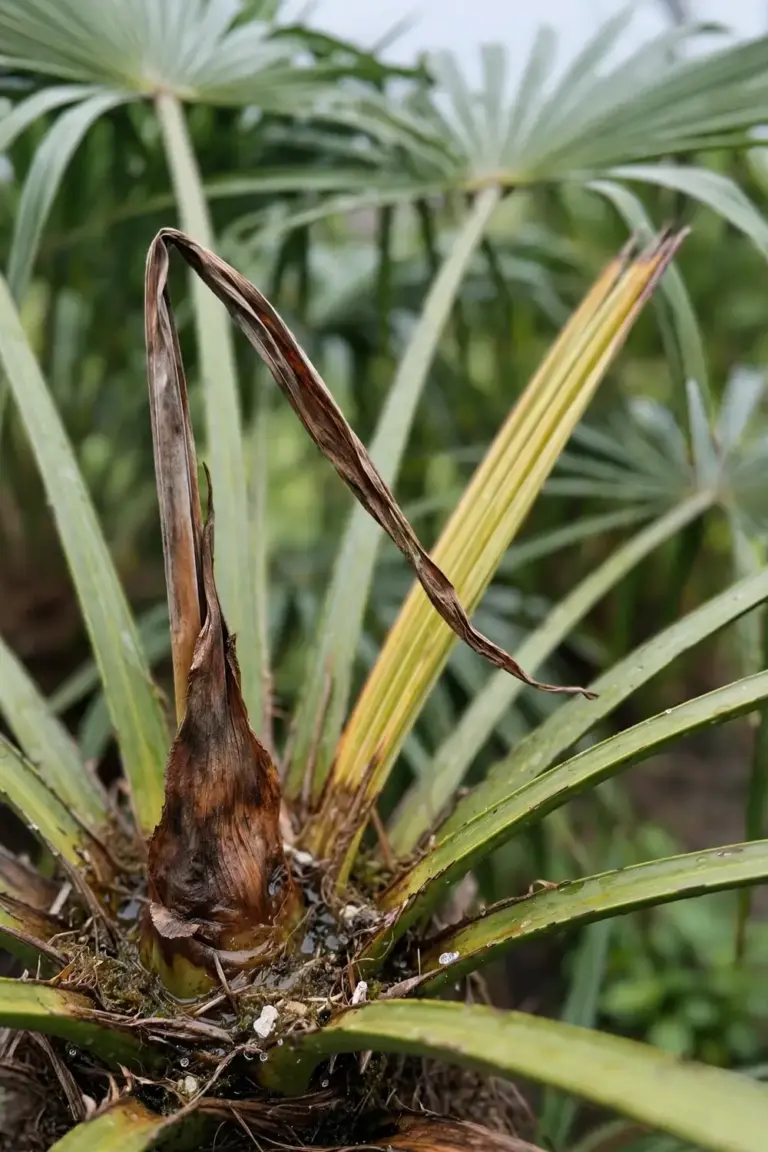
The most common bud rot pathogen is Phytophthora palmivora. Phytophthora is a water mould, not a true fungus. The distinction matters for treatment. Many fungicides target true fungi. Water moulds answer to different chemistry. The home-garden response does not depend on the distinction, since sanitation, drainage, and fast action carry the response either way. Thielaviopsis paradoxa also causes bud rot in palms. The symptoms match. The urgency matches.
The first symptom is discoloration and wilting of the spear leaf. The spear leaf is the youngest, unopened leaf at the center of the crown. The next youngest leaves may discolour and wilt too. The leaves turn a lighter green than normal, or they turn yellow. The leaves then dry, turn brown, and collapse. The University of Florida extension service bud rot guide states that a severely affected spear leaf pulls easily from the bud. A healthy spear leaf resists a gentle pull. A rotting spear leaf slides out. The base of a pulled spear leaf shows brown dead tissue and may smell foul.
Tall palms hide the first symptom. A canopy above eye level cannot be inspected from the ground, so the first visible sign becomes a lack of new leaves and an open-topped crown. The bud is already dead by that stage. Older leaves remain healthy for months after the bud dies. Check tall palms with binoculars. Look for a missing spear leaf. Look for a gap at the crown center. Look for fronds that have stopped emerging.
Bud rot spreads in free water, because the pathogen produces spores that move in wind and water, and zoospores swim in water films. Free water in the crown is the critical factor. Wet seasons and overhead watering drive outbreaks. Nurseries fight bud rot with water management and sanitation. Home gardens use the same tools. Keep the crown dry by watering at the soil rather than over the crown, and clear debris from the crown. Improve drainage so water does not sit around the trunk.
Treatment depends on timing. Early bud rot, caught while the spear leaf still stands, may respond to removing the rotted tissue and protecting the bud. Late bud rot does not respond. The University of Florida extension service notes that preventive fungicide applications help in nurseries, and help less in landscapes with mature palms. A home gardener should not pour fungicide into a rotted crown. Remove the rotted spear leaf. Protect the bud from further water. Call an arborist the same day. An arborist can judge whether the bud survives. A palm with a dead bud needs removal before it becomes a falling hazard.
8. Trunk and Stem Rot: Ganoderma Butt Rot Needs an Arborist
Ganoderma butt rot is a trunk disease with no cure. The fungus is a Ganoderma species. In Florida the palm pathogen is Ganoderma zonatum. In Australia the Northern Territory government Agnote records Ganoderma species on golden cane palms and Carpentaria palms, along with many other hosts. The species differs by region. The outcome does not. A palm with Ganoderma butt rot does not recover.
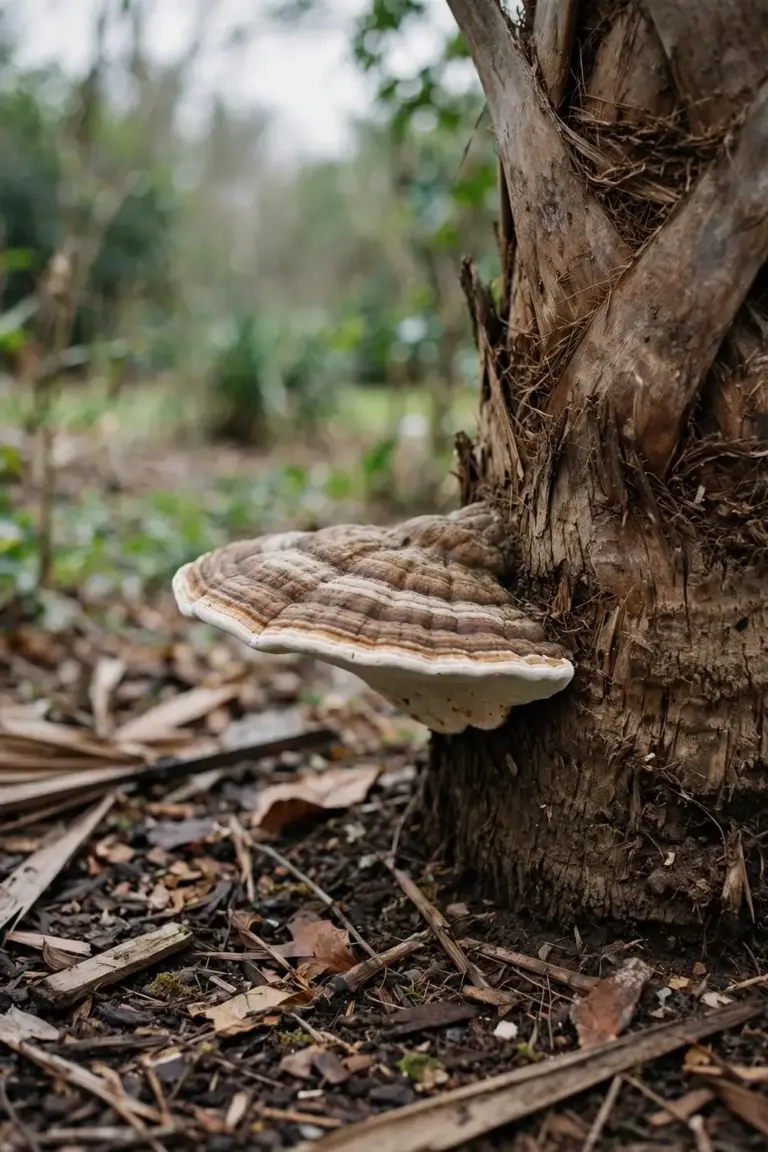
The fungus degrades lignin in the lower trunk. Lignin is the structural material of wood. The trunk loses strength from the inside, yet it still feels hard, because the rot is not soft. That hardness misleads. A palm can look solid while its base is hollowed. The University of Florida extension service states that the fungus degrades the lignin in the lower 4 to 5 feet of the trunk, which is about 1.2 to 1.5 metres. Symptoms may include wilting or a general decline. The disease is confirmed before death by the conk.
The conk is the signature sign. A conk is a hard, shelf-like fruiting body that grows on the lower trunk and releases spores. Many diseased palms never produce a conk before they die. A palm with no conk is not cleared. A palm with a conk is confirmed. The conk is the only distinguishing symptom. Internal discoloration confirms the disease after the palm is cut down.
There is no treatment. The University of Florida extension service states plainly that no cultural or chemical controls exist for preventing the disease or for curing the disease once the palm is infected. The Northern Territory government Agnote agrees. It states that no effective chemical treatment and no known cure exist for Ganoderma diseases. Any product sold as a Ganoderma cure is a false promise. Do not buy it. Do not drench the soil. Do not inject the trunk.
The response is removal and hygiene. Remove the palm as soon as possible after conks appear. Remove as much of the stump and root system as possible, or grind the stump. Monitor a remaining stump for conks. Remove conks as soon as they form, before they release spores. Bag the conks. Put them in landfill waste. Never put conks in green waste that returns to gardens as mulch. In the Top End, the Northern Territory Agnote notes that the disease tends to strike highly stressed or old plants, and that such plants should come down when they become a safety concern. A Ganoderma palm near a path, a driveway, or a play area is a falling risk. Call an arborist. Do not fell a large palm yourself.
Do not replant a palm in the same spot. The fungus persists in soil and in infected root material. A replacement palm in the same soil faces the same inoculum. Choose a different plant for the spot, or leave the spot fallow and plant elsewhere. For the full Ganoderma evidence, the UF/IFAS Ganoderma butt rot guide and the Northern Territory Government Ganoderma Agnote (PDF) both record the no-cure finding.
9. Root Rot: Pointers, Not a Full Protocol
Root rot is a group of diseases that attack palm roots. The usual culprits are Phytophthora and Pythium water moulds. Water moulds thrive in wet soil, and poor drainage, overwatering, and compacted soil all invite them, so a palm in a waterlogged hole sits in the pathogen’s ideal habitat.
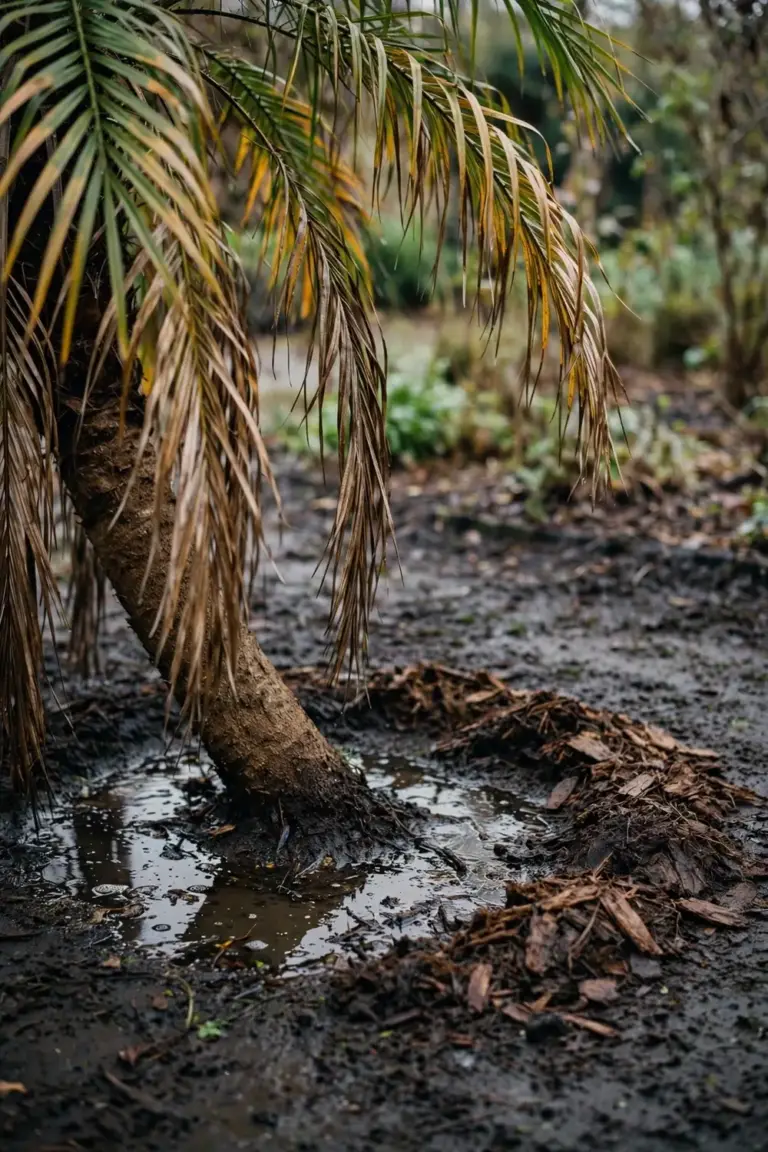
The above-ground symptom is wilting that watering does not fix. A thirsty palm lifts after watering. A root-rotted palm does not lift. Leaves yellow from the oldest fronds upward. Growth stalls. The palm may lean as anchor roots die. Confirm with a root check. Dig a small inspection hole at the drip line. Healthy palm roots are firm and pale. Rotted roots are dark, soft, and pull apart. Healthy soil smells earthy. Rotted soil may smell sour. Do not dig into the root ball of a large palm. A small inspection hole at the edge tells you enough.
This article gives pointers, not a full root-rot protocol. Root rot management depends on the drainage fix, not on a spray. Improve drainage first. Stop watering until the soil dries to a finger-depth check. Redirect downpipes and surface flow away from the palm. Lift a potted palm onto feet so the pot drains freely. Remove mulch that sits against the trunk. Mulch against the trunk holds moisture on bark. A mulch ring should sit clear of the trunk.
Do not reach for a fungicide as the first move, since a fungicide cannot drain a waterlogged hole or un-compact soil. Fix the water first. Then judge whether the palm has enough healthy roots left to recover. A palm that has lost most of its root system will not recover even in perfect drainage. A palm with a few healthy roots and a dry site may stabilise. For the soil and drainage side of the fix, the soil health guide covers structure, drainage, and organic matter. When the palm is large, when the lean is new, or when the trunk base feels soft, call an arborist. A palm with dead anchor roots can fall.
10. Fusarium Wilt: One-Sided Death With No Cure
Fusarium wilt is a vascular wilt disease of palms. The fungus is Fusarium oxysporum. Different forms attack different palms. Fusarium oxysporum f. sp. canariensis attacks Canary Island date palm. Other forms attack queen palm and Mexican fan palm. The fungus blocks the water-conducting tissue. The palm dies of thirst while its roots sit in moist soil.
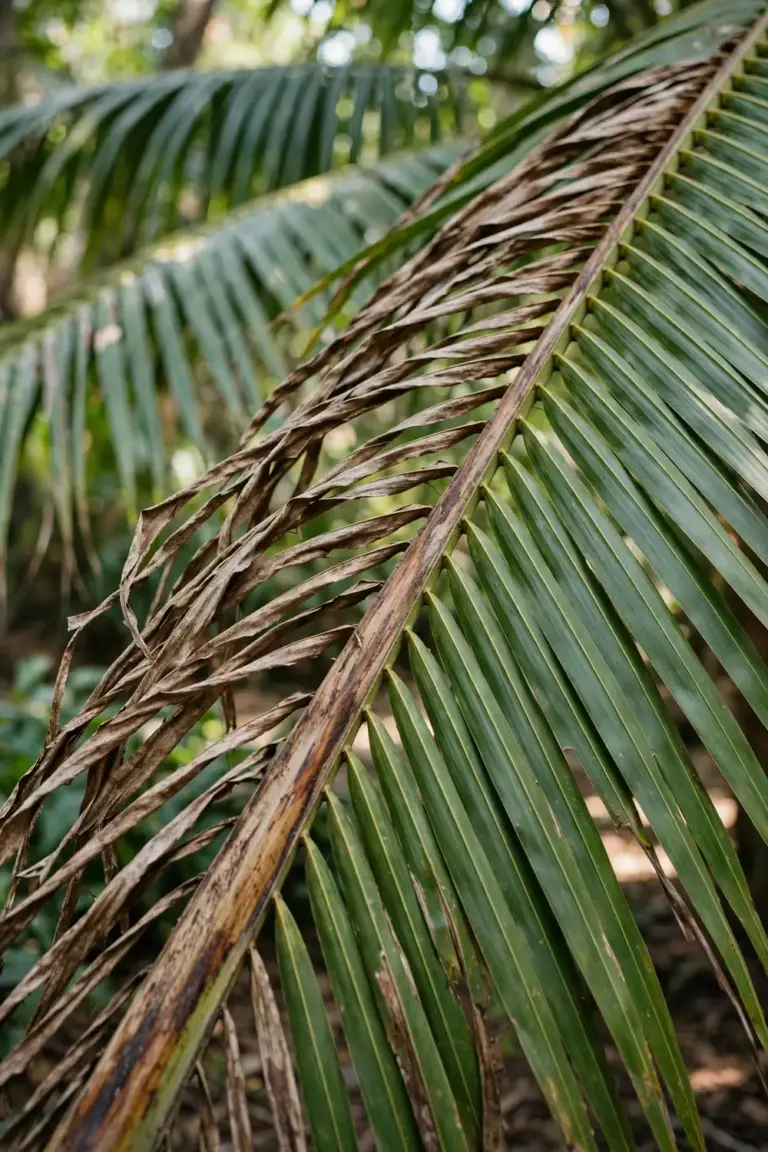
The signature symptom is one-sided death. Leaflets on one side of a frond die while leaflets on the other side stay green. The dead side turns brown and dries. The green side follows later. The whole frond dies. Death moves from older fronds upward into the crown. A cross-section of the petiole shows a reddish-brown streak on one side. The streak marks the blocked vessels. The one-sided pattern separates Fusarium wilt from general decline. General decline yellows the whole frond at once. Fusarium wilt splits the frond.
There is no cure: the University of Florida extension service states that no cures exist for this disease, and that fungicides have been evaluated without success. Management rests on prevention alone. Prevention means clean tools. The fungus travels on infested pruning tools. A saw that cut an infected palm carries the fungus to the next palm. Sterilise tools before and after every palm pruning job. Sterilise between palms, not only when the job is done. Use a fresh tool when in doubt. The rule matters most for Canary Island date palms, the classic host.
Fusarium wilt is present in Australian gardens. The City of Port Phillip in Victoria manages an outbreak on street palms. The council inspects palms annually. The council tests palms that show symptoms. The council removes any palm within one month of a positive Fusarium wilt diagnosis. The council states that removal of infected palms is currently the only effective method to control the spread of Fusarium. Home gardeners should follow the same logic at garden scale. An infected palm is a source of inoculum for every palm near it.
The response is removal, hygiene, and a replanting ban. Remove the infected palm. Destroy the material. Do not compost it. Do not chip it into mulch. Sterilise every tool that touched it, and do not replant a susceptible palm in the same soil, because the fungus persists in soil and in root fragments. Plant a non-host species in that spot, or plant the replacement palm elsewhere. Buy new palms from a reputable nursery. Inspect nursery stock for one-sided frond death before you buy. A cheap palm with a hidden wilt is the most expensive palm in the garden.
11. Lethal Yellowing-Type Decline: The Incurable Differential
Lethal yellowing-type decline looks like a fungal problem. It is not a fungal problem. The cause is a phytoplasma. A phytoplasma is a bacterium without a cell wall. Phytoplasmas live in the phloem, the sugar-conducting tissue. Insects spread them. No fungicide touches them. No spray cures them. This article includes the group only as the incurable differential. A gardener who mistakes phytoplasma wilt for a fungus wastes weeks on sprays that cannot work.
The Australian case is its own organism. Researchers named it Candidatus Phytoplasma dypsidis. The phytoplasma was first detected in 2017 in palms at the Cairns Botanic Gardens in Queensland. Further surveys found it in dying ornamental palms across the Cairns region. The disease is a fatal wilt. The research team found infection in 12 different palm species, including coconut and two native palms, Alexandra palm among them. The first thought of the investigators was a fungal disease. Laboratory screening showed a phytoplasma instead. The case shows why a sudden whole-crown collapse needs a laboratory, not a spray bottle.
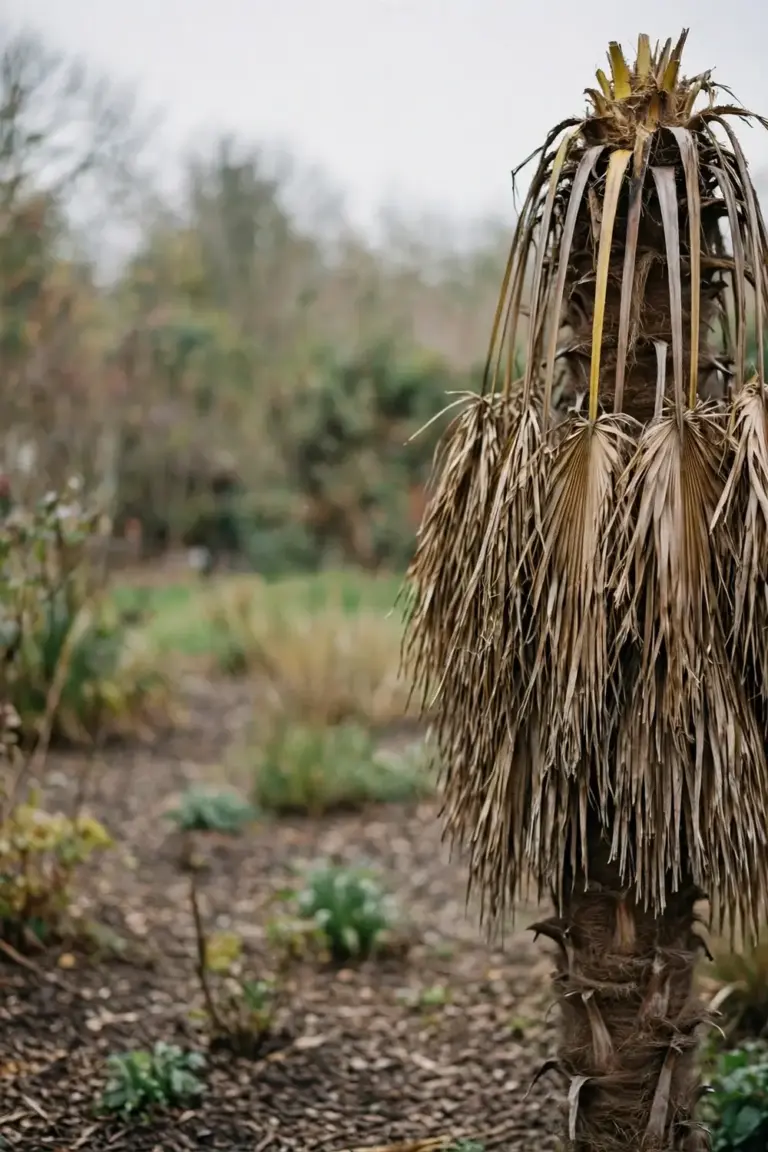
The symptom pattern is whole-crown collapse. Leaves yellow across the crown. The canopy browns. Dead fronds stay attached and hang like a skirt. Fruit drops early. The spear leaf dies. The palm dies. The speed separates phytoplasma wilt from leaf spot diseases. Leaf spots take fronds one at a time. Phytoplasma wilt takes the whole crown in one decline. The pattern resembles Fusarium wilt in speed, yet the one-sided frond death of Fusarium wilt separates the two: phytoplasma wilt yellows the whole crown, while Fusarium wilt splits single fronds.
The overseas relatives are lethal yellowing and lethal bronzing. Both are phytoplasma diseases of palms in the Americas and the Caribbean. Both kill palms. Both spread by insects. Australia does not import these diseases with garden palms. The Australian phytoplasma is a distinct organism. The management logic is the same. Report a sudden whole-crown collapse to your state plant health service. Remove the palm. Do not replant a palm in the same spot until the site has been assessed. Keep tools sterile. Do not move palm material from a suspect site to a healthy garden.
12. The Organic Treatment Ladder: Sanitation, Airflow, Spray, Arborist
The organic treatment ladder for fungal problems on palm runs in four rungs. Each rung applies to the treatable group. None of the rungs cures an established infection in a trunk, a bud, or a vascular system. The ladder manages leaf disease. The ladder prevents spread. The ladder tells you when to stop and call an arborist.
Rung one is sanitation. Remove dead and badly spotted fronds. Cut at the petiole base with a clean, sharp tool. Do not tear fronds off. Tearing wounds the trunk. Bag the removed fronds and destroy them, since infected fronds must never go into compost or into chipped mulch. Sterilise the tool after every cut on a diseased palm. Sterilise again before the next palm. Clean up fallen fronds and fruit from under the palm. Fallen material holds spores through the wet season.
Rung two is airflow and dryness. Space palms so crowns do not touch, clear clutter from around the trunk, and prune nearby shrubs that shade the crown and trap humidity. Stop overhead watering. Water at the soil. Water in the morning so any splash dries fast. For the pruning side of this rung, the spring pruning techniques guide covers clean cuts and tool care. Never pull the spear leaf. The spear leaf is the bud’s protector. A pulled spear leaf opens the bud to water and pathogens.
Rung three is organic spray. Sprays protect healthy tissue. Sprays do not heal infected tissue. Apply a copper-based protectant exactly as its label directs for leaf spot complex. Apply horticultural oil exactly as its label directs for the sap-sucking pests behind sooty mould. Apply a bicarbonate spray exactly as its label directs where a bicarbonate product is registered for the target. Read every label before you mix. Wear the protective gear the label requires. Keep pets and children off sprayed plants until the spray dries. Never spray in wind or rain. Never spray open flowers. Never mix products unless both labels allow it.
Rung four is the arborist. Call an arborist when the bud is involved, when the trunk shows a conk, when a large palm leans, or when dead fronds hang above a path. An arborist climbs with rigging and training. An arborist removes a hazardous palm without dropping it on a roof. The home gardener’s job ends at the ground. A ladder and a chainsaw are not a substitute for an arborist.
Do not push growth with fertilizer while the palm is fighting infection. A stressed palm cannot use a heavy feed. Excess nitrogen grows soft tissue that fungi colonise easily. Hold the fertilizer until the palm stabilises. Then feed only to correct a confirmed deficiency, which a leaf test confirms, since a guess does not.
13. Prevention: Drainage, Spacing, Dry Crowns, Clean Tools
Prevention beats treatment for every palm fungal problem. Most palm fungi need the same three conditions. They need wet tissue. They need still air. They need an entry wound. Remove one condition and the disease weakens, and remove two and the disease usually fails. The prevention H2 lists the five moves that remove those conditions.
Drainage comes first. Palms hate wet feet. A palm in a waterlogged hole invites root rot, bud rot, and pink rot together. Plant on a gentle mound in heavy soil. Keep the root ball above the surrounding soil level. Keep downpipes and surface flow away from the trunk. In pots, use a free-draining mix and lift the pot onto feet. Check drainage before you plant. Dig a test hole. Fill it with water. Water that still sits after an hour means the site needs a mound or a different spot.
Spacing comes second. Crowns that touch hold humidity. Humidity feeds leaf spots. Space palms so air moves between crowns. Keep shrubs clear of the trunk, and clear fallen fronds and fruit from under the palm, because fallen material holds spores. A clean floor under the palm breaks the spore cycle. Mulch helps soil moisture, and mulch must sit clear of the trunk. Mulch against the trunk holds moisture on bark and invites rot.
Dry crowns come third. Water at the soil. Never water over the crown. Morning watering dries splash fast, while evening watering leaves the crown wet all night, and night wetness is the infection window. In the wet season, skip watering entirely when rain does the job. A palm that dries between rains resists leaf spots far better than a palm that stays wet.
Clean tools come fourth. Sterilise tools before and after every palm job. Sterilise between palms. A tool that cut a Fusarium palm and then cut a healthy palm has inoculated the healthy palm. Keep a sterilising solution in the kit. Keep a second set of blades for suspect palms. The habit costs minutes. The habit saves palms.
Never wound the trunk is the fifth move. Mowers, whipper snippers, and climbing spikes all wound bark. Wounds admit Ganoderma, pink rot, and bud rot pathogens. Keep mowers away from the trunk. Keep a mulch-free clearance ring at the trunk base, prune only dead fronds, and never cut green fronds to tidy the crown. Never drive nails or screws into a palm trunk. Every wound is a door. Keep the doors shut.
Frequently Asked Questions
A palm can recover from leaf spot diseases. Leaf spots cost fronds, and new growth replaces them when the conditions change. A palm cannot recover from bud rot once the bud is dead. A palm cannot recover from Ganoderma butt rot. A palm cannot recover from Fusarium wilt. A palm cannot recover from phytoplasma wilt. The dividing line is the bud, the trunk, and the vascular system. Leaf disease is survivable. Bud, trunk, and vascular disease is not.
No spray cures an established fungal infection in a palm, although a copper-based protectant can protect healthy new growth from leaf spot fungi, and horticultural oil treats the sap-sucking pests behind sooty mould. Both products must be applied exactly as their labels direct. A protectant coats healthy tissue. A protectant does not heal tissue that is already infected. A spray that claims to cure Ganoderma, Fusarium wilt, or bud rot is a false promise. Do not buy it.
Wilting in wet soil points to roots or vessels, not to thirst. Root rot destroys roots, so the palm cannot take up water. Fusarium wilt blocks vessels, so water cannot travel up the trunk. Check the roots with a small inspection hole, and check a petiole cross-section for a one-sided reddish-brown streak. Do not add more water. Fix the drainage first, then judge whether the palm has enough healthy roots left.
Black film that wipes off is sooty mould. Sooty mould grows on honeydew from sap-sucking insects. It does not invade the leaf. It shades the leaf and slows growth. Treat the insects behind it and the mould stops spreading, while black spots that do not wipe off are leaf spot disease. Black cup-shaped dots that you can feel are false smut. The wipe test separates the three in seconds.
Call an arborist when the bud is involved, when a conk appears on the trunk, when a large palm leans, or when dead fronds hang above a path or a roof. An arborist climbs with rigging and training, removes a hazardous palm without dropping it on a building, and can judge whether a bud survives. The home gardener’s job ends at the ground. Safety comes before the palm.
Start With the Location, Then Match the Fungus
Fungal problems on palm reward one habit. Start with the location: fronds mean leaf disease, the spear leaf means emergency, the trunk base means Ganoderma, one-sided frond death means Fusarium wilt, and whole-crown collapse means phytoplasma. The location narrows the fungus before anything else does. The table above turns that location into a first step.
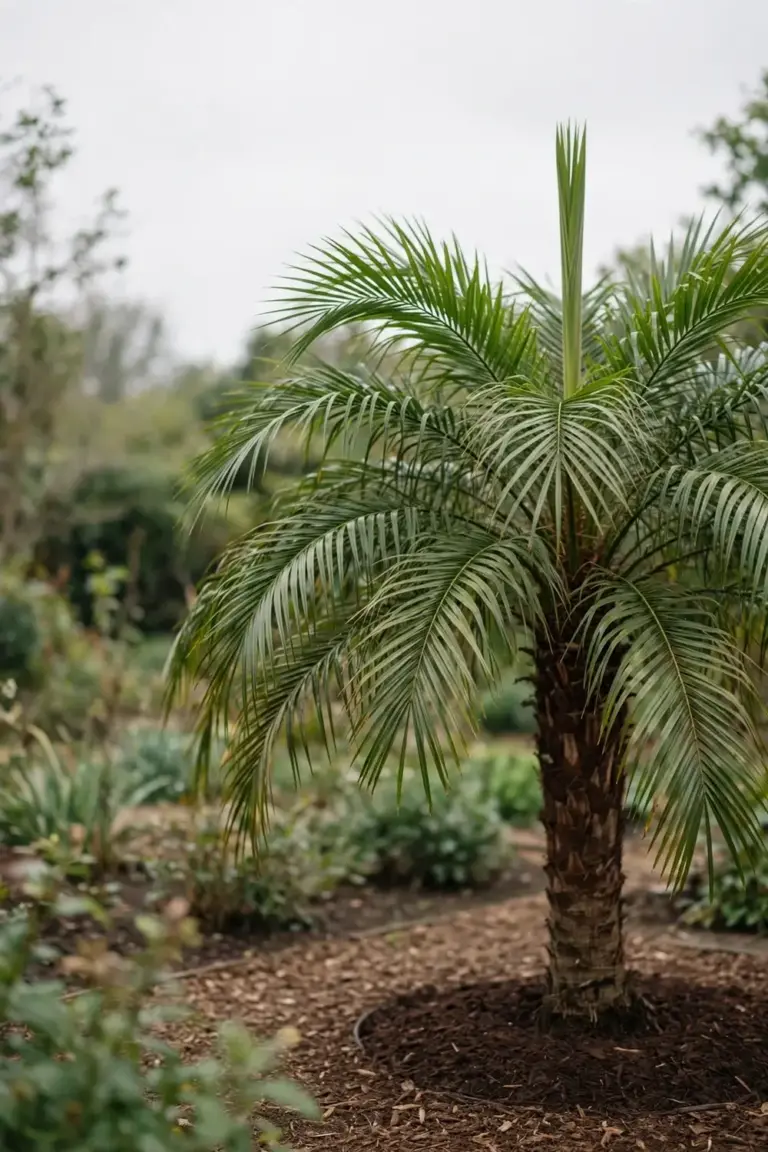
Treatable problems reward sanitation, airflow, and dry crowns. Incurable problems reward fast removal and clean tools. The hardest call is the palm that looks alive while its bud is dead. Check the spear leaf. Check it with binoculars when the crown is high. Act on what the location tells you. A palm diagnosed early keeps its fronds. A palm diagnosed late keeps only its stump.