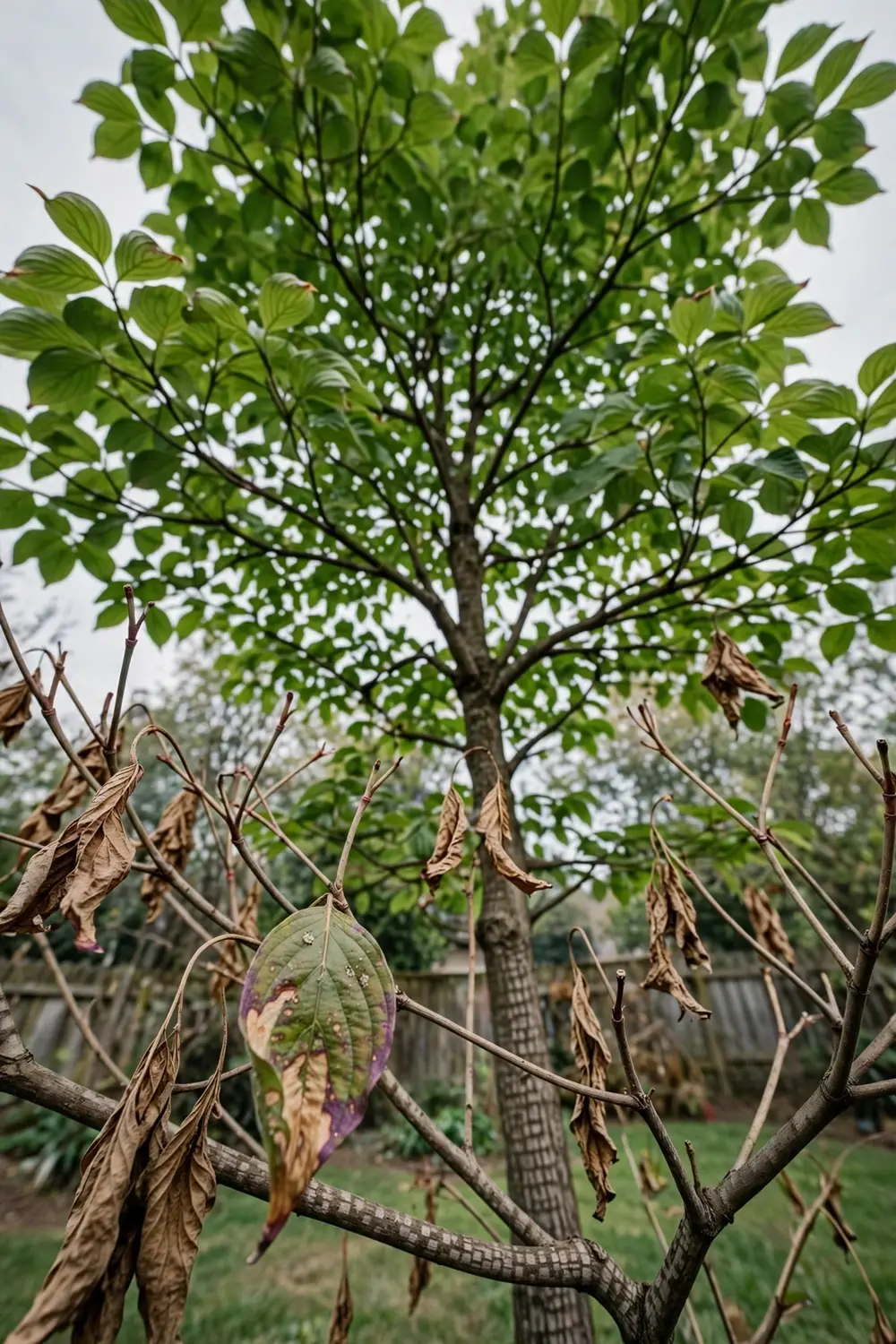

Dogwood anthracnose can kill an unchecked flowering dogwood within 2 to 3 years. The fungus Discula destructiva starts on the lowest leaves and climbs, leaf spots first, then twig cankers, then girdled branches. Catch it at the leaf-spot stage and you can still save the tree.
I have learned to check the lowest branches first, since this disease shows up there first. The lower canopy stays shaded and wet longest, and the fungus uses that damp shade to build up spores. A tree that looks fine from the driveway can already carry cankers on its lowest limbs.
The sections below walk through identification on each plant part, the dogwoods hit hardest, the lookalikes that fool gardeners, and four steps that decide whether treatment pays. The last section tells you how to live with damage that is already done.
1. What Dogwood Anthracnose Actually Is
Dogwood anthracnose is a fungal disease of dogwoods caused by Discula destructiva. The fungus invades leaves, then grows through leaf stems into twigs, where it forms cankers that cut off water and nutrients. A canker that rings a whole branch kills everything past it. Enough cankers on the trunk kill the tree.
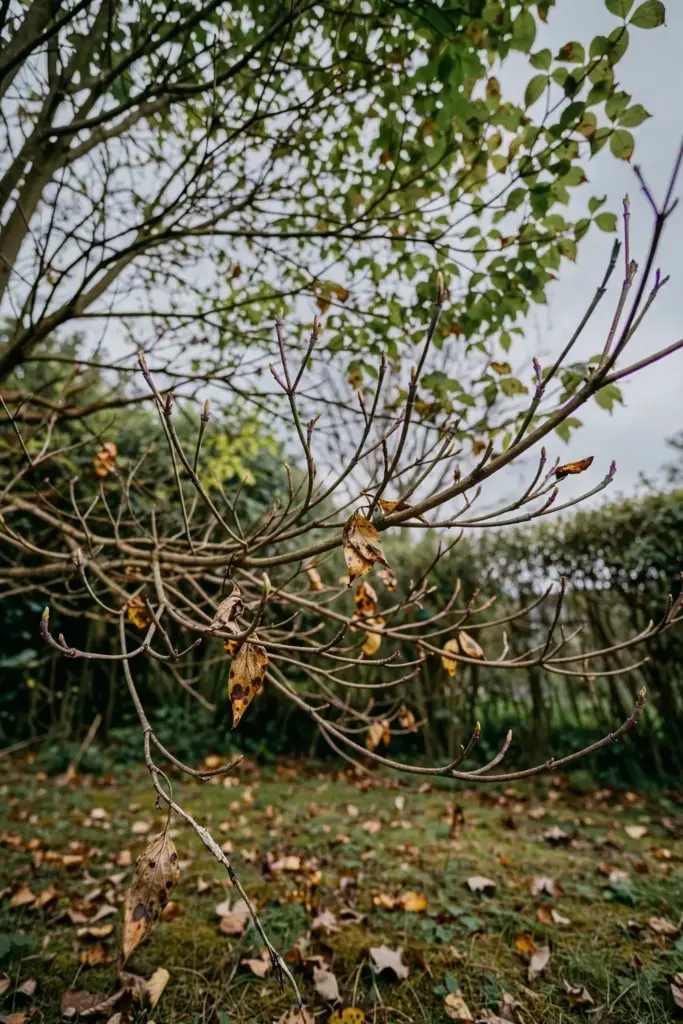
The fungus reached the United States in the 1970s, most likely from Asia, according to West Virginia Extension. It hit native flowering dogwood populations hard in forests along the East Coast before it became a landscape problem. Today it is less common than it was at its peak. Maryland Extension now ranks powdery mildew as the more serious dogwood disease, and that context matters. A dogwood with white powdery coating on its leaves probably has mildew, a different problem with a different fix.
The path into the tree runs leaf by leaf. A spore lands on a leaf and the fungus grows through the leaf tissue, then down the leaf stem into the twig. The twig canker that forms there is the real damage. Leaves regrow. Cankered wood does not heal. The rule that follows from that order: protect the leaves, and stop the fungus before it reaches the wood.
Some older garden writing calls this disease black stem disease. The name describes the dark cankers on stems. Use the botanical name Discula destructiva when you ask a nursery or extension office for help, since black stem disease is not a name they file samples under.
2. How to Identify Dogwood Anthracnose on Leaves and Bracts
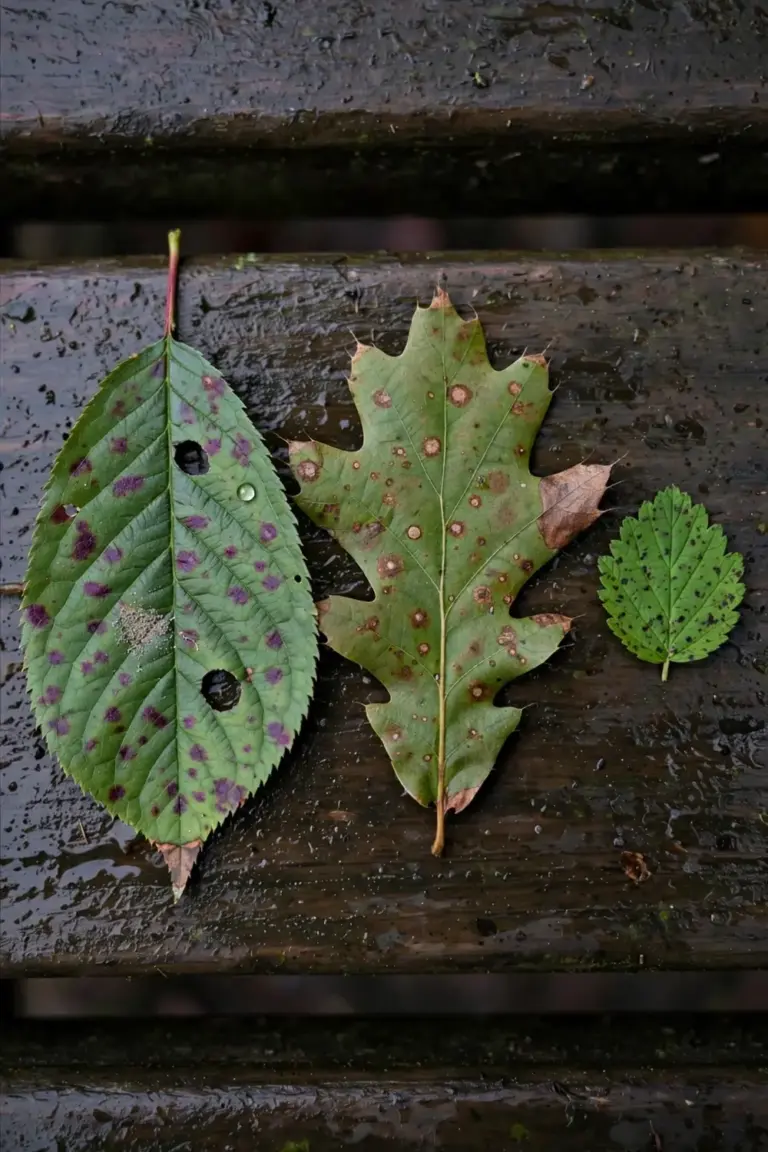
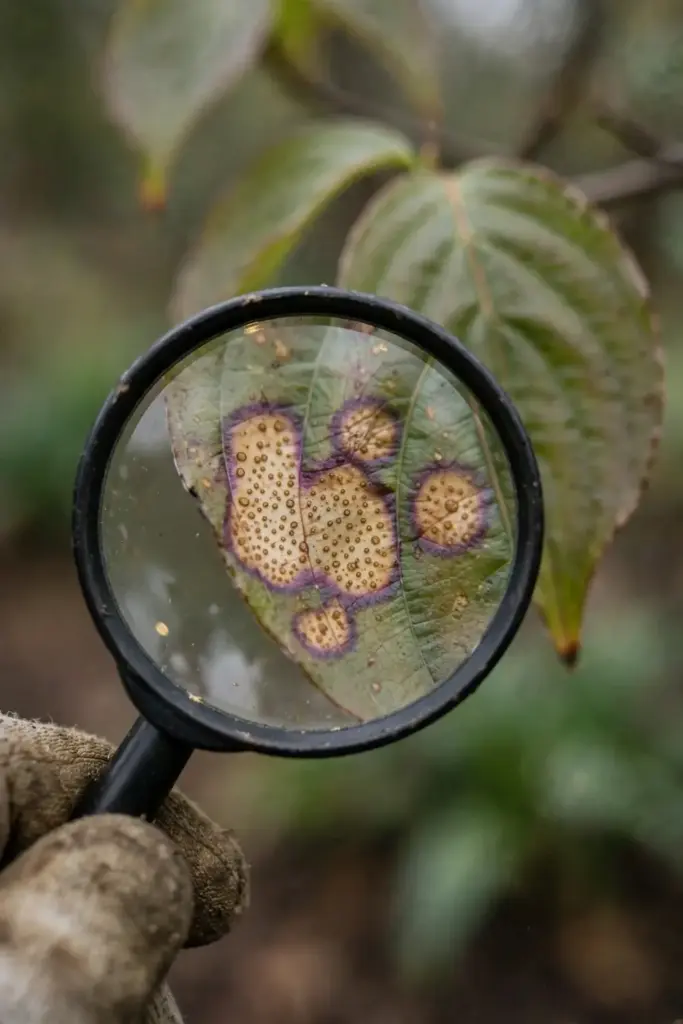
Check the lowest leaves first in mid to late May, when the first spots appear. The spots start tan with a purple or reddish border, then enlarge into scorched tan blotches that can kill the whole leaf. Blighted leaves often droop and hang on the branch in wet weather instead of dropping. The white bracts of the flowers can spot too when spring rain stays heavy.
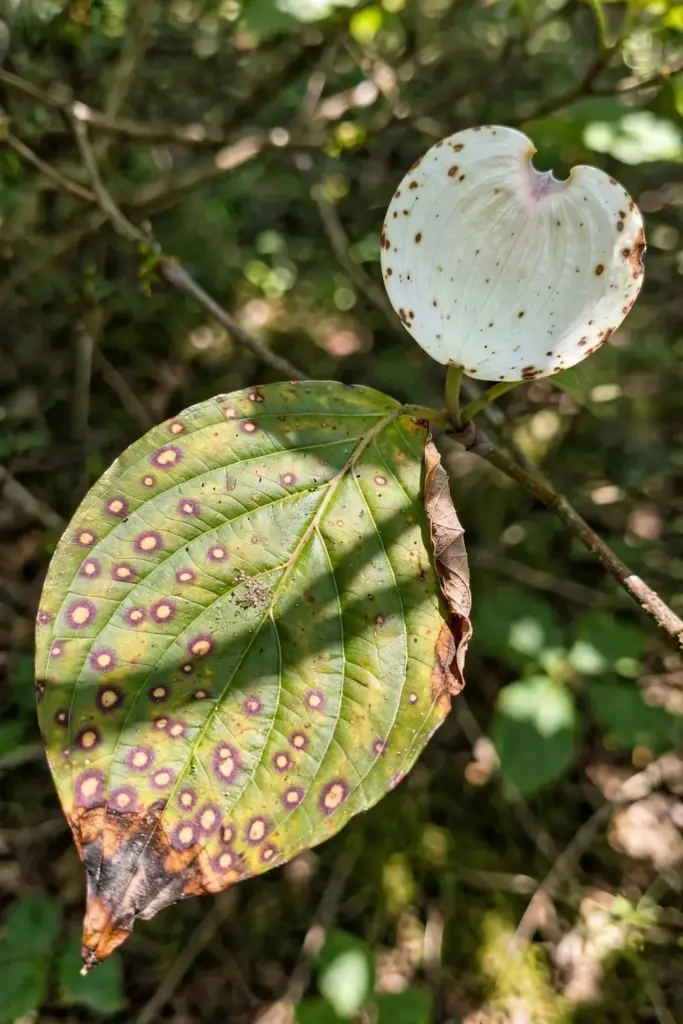
The diagnostic check sits on the underside of the leaf. Maryland Extension describes numerous small tan to brown dots, about the size of a printed period, scattered inside the blighted tissue when you look with a hand lens or magnifying glass. Those dots are the fruiting bodies that release spores. Rain, dew, and insects wash or carry those spores to healthy leaves and nearby trees.
Leaf spots alone do not condemn a tree. A dogwood can carry spotted lower leaves for a season and still recover if the infection never reaches the twigs. The leaf check tells you the fungus is present. The twig check in the next section tells you how far it has gone.
3. How to Identify Dogwood Anthracnose on Twigs, Branches, and Trunk
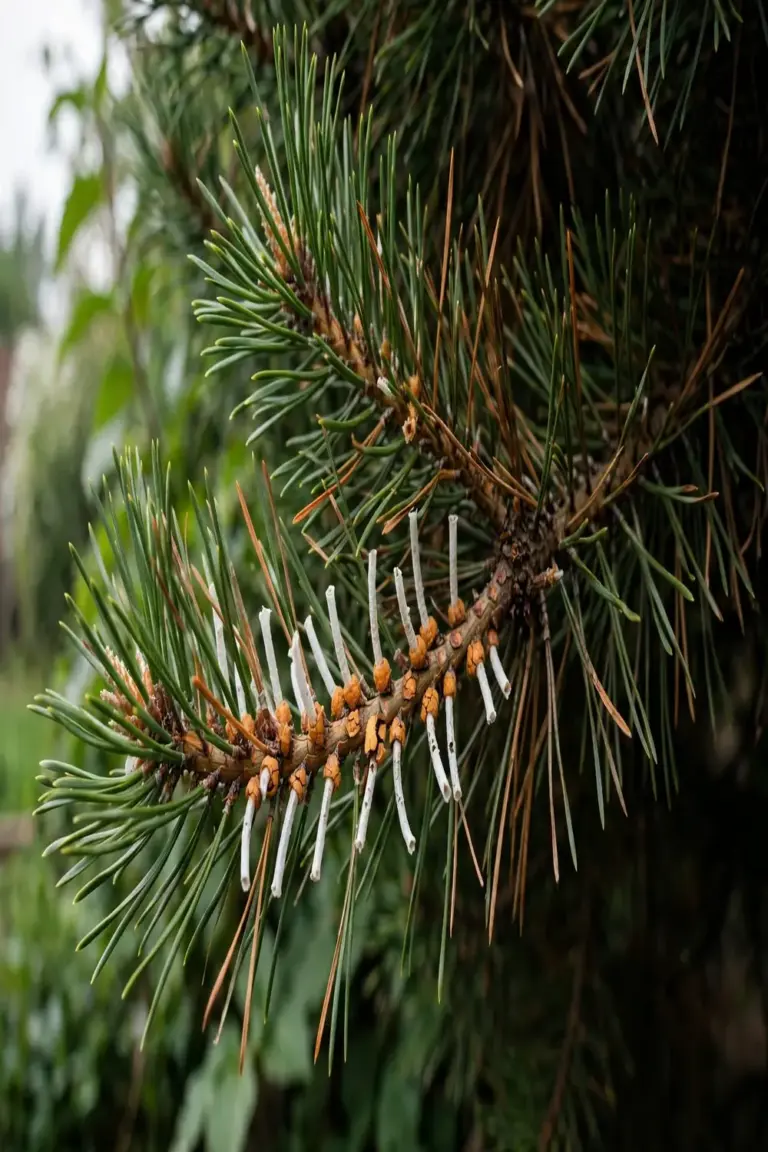
Follow the infection from a blighted leaf down its stem to the twig. The fungus travels that route and forms a canker where the leaf stem meets the twig. Dead twigs turn tan. Black pinpoint fruiting bodies dot their surface, and in wet weather those fruiting bodies release masses of orange spores that rain splashes onto fresh leaves.
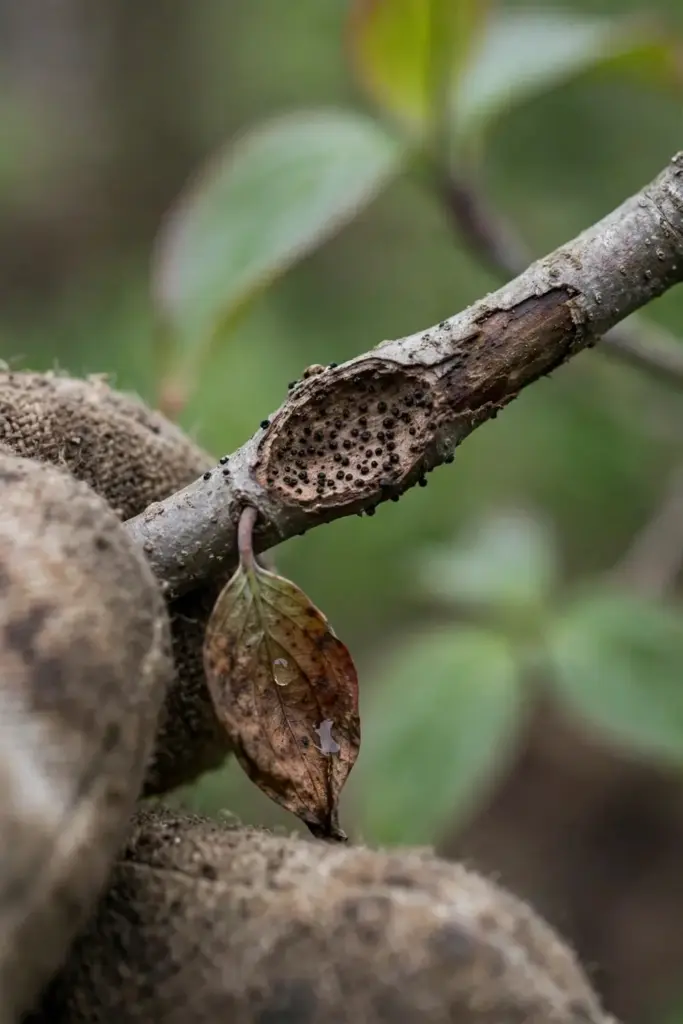
Scrape a small patch of bark over a suspect twig with a knife or fingernail. Dark brown wood under the bark points to canker. Light wood points to healthy tissue. Maryland Extension uses this color contrast as the field check that separates cankered wood from sound wood. The check takes seconds and it decides which branches you prune in Step 2.
Watch for water sprouts, the soft upright shoots that burst from the trunk after dieback. They look like recovery. They are new infection sites. The fungus invades their soft tissue fast, and each infected sprout feeds spores back into the canopy. Cut them off during the cleanup in Step 2.
A trunk with several cankers around its circumference is past the point where pruning helps. The tree cannot move water past girdled trunk wood. Step 1 covers the call on when to remove such a tree.
4. Which Dogwoods Get Hit Hardest
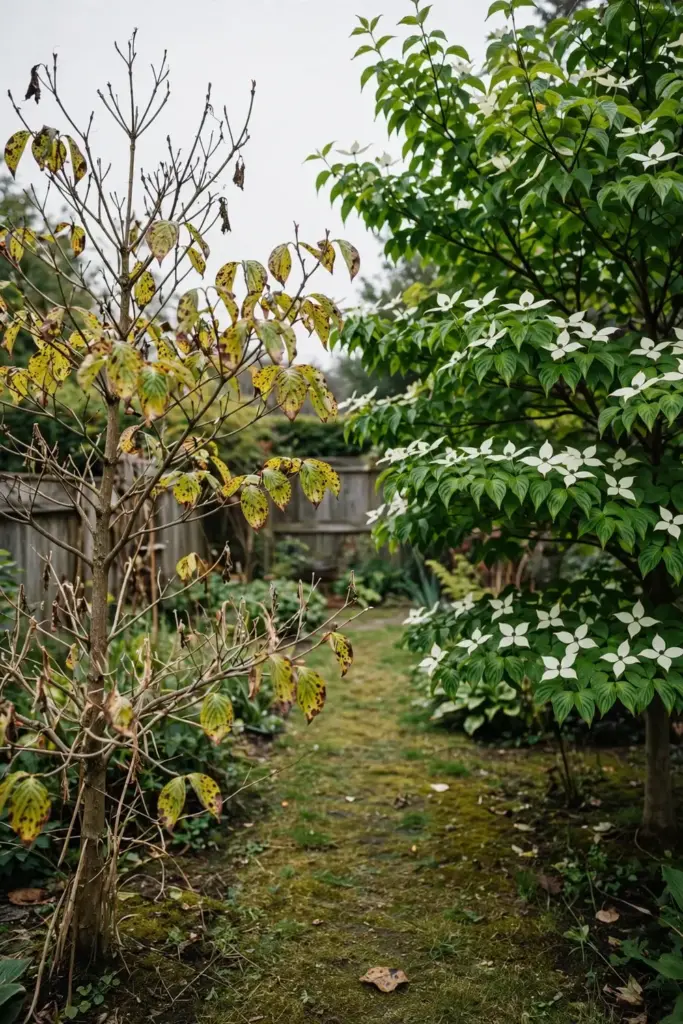
Flowering dogwood and Pacific dogwood take the worst damage. Kousa dogwood, Cornelian cherry, pagoda dogwood, and silky dogwood resist the fungus well. West Virginia Extension lists flowering dogwood and Pacific dogwood as highly susceptible, and kousa, pagoda, and silky dogwood as relatively resistant.
| Dogwood | Susceptibility | Notes |
|---|---|---|
| Flowering dogwood (Cornus florida) | High | The classic landscape victim. Native trees in forests took the first heavy losses. |
| Pacific dogwood (Cornus nuttallii) | High | Western native with the same vulnerability as flowering dogwood. |
| Kousa dogwood (Cornus kousa) | Resistant | The standard replacement for a lost flowering dogwood. Tolerates the fungus. |
| Cornelian cherry (Cornus mas) | Resistant | A different dogwood species that sidesteps the disease. Yellow early flowers. |
| Pagoda dogwood (Cornus alternifolia) | Relatively resistant | Layered branching. Holds up where flowering dogwood fails. |
| Silky dogwood (Cornus amomum) | Relatively resistant | A shrubby dogwood for wet sites. Useful where soil stays damp. |
Check the tag before you buy. Nurseries sell flowering dogwood cultivars with names that sound tough. No flowering dogwood cultivar carries full immunity. Resistance lives at the species level here, so a kousa or a Cornelian cherry is a safer buy than a flowering dogwood with a promising name.
Stellar hybrids, crosses between flowering dogwood and kousa dogwood, also resist the disease well. They keep the flowering dogwood flower shape with kousa toughness behind it. Ask for them by name if you want the classic look without the classic risk.
5. Dogwood Anthracnose Lookalikes and How to Tell Them Apart
Spot anthracnose is the closest lookalike and the easiest to confuse with this disease. Spot anthracnose is caused by Elsinoe corni. It makes small, uniform, round spots with purple borders and pale centers on leaves and bracts. It stays cosmetic. It does not cause dieback, and it does not kill branches. The companion article on spot anthracnose carries the full side-by-side comparison between the two diseases.
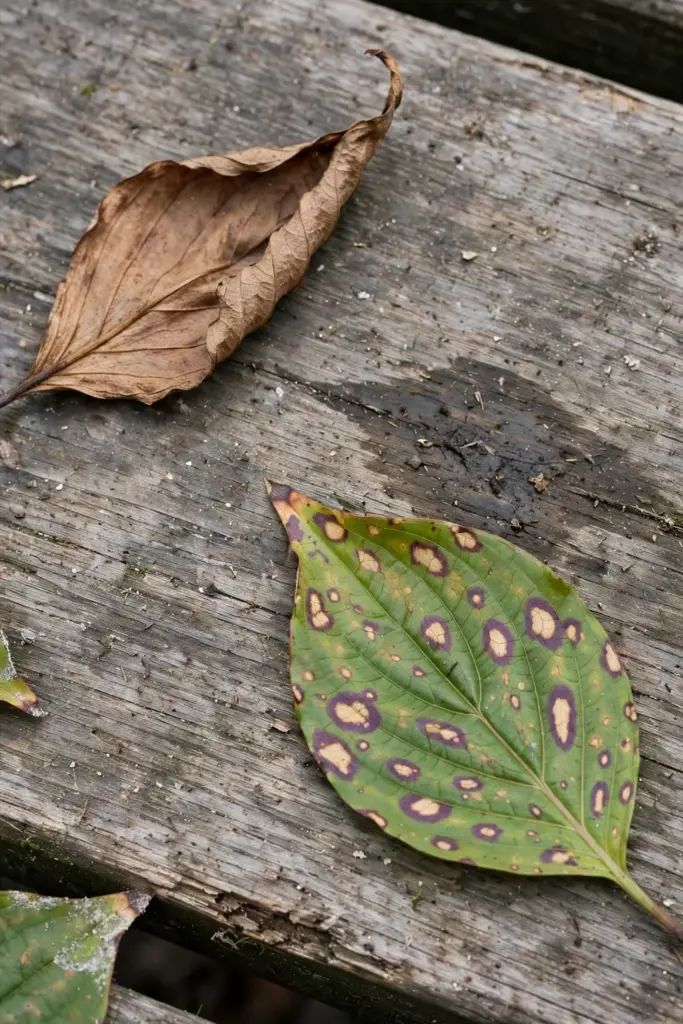
The table below sorts the other lookalikes. Run through it before you prune or spray, since each row leads to a different response.
| Lookalike | What you see | How it differs from dogwood anthracnose | What to do |
|---|---|---|---|
| Leaf scorch | Brown tips and margins, no spots with purple borders | Abiotic damage from drought, wind, or sun, not a fungus. No fruiting dots, no cankers. | Water deeply and mulch. No spray. |
| Septoria leaf spot (Septoria cornicola) | Small leaf spots that stay on the leaves | A cosmetic leaf fungus. It never forms twig cankers or girdles branches. Septoria has its own companion article. | Rake fallen leaves. No treatment needed in most years. |
| Fire blight twig blight | Shoot tips bend into a shepherd’s crook | A bacterial disease of apple, pear, and other rose-family hosts. Dogwood anthracnose bends dogwood twigs the same way, but the pathogen and the host family differ. Fire blight has its own companion article. | Confirm the host first. Never treat a dogwood with a fire blight protocol. |
| Powdery mildew on dogwood | White powdery coating on leaves | A different fungus that coats the surface instead of killing tissue. Maryland Extension now ranks it as the more serious dogwood disease. | Improve airflow and choose mildew-resistant cultivars. |
A shepherd’s crook on a dogwood twig is the one sign that sends gardeners down the wrong path. Arkansas Extension notes that infected dogwood twigs form a shepherd’s crook reminiscent of fire blight symptoms. The shape matches. The disease does not. Fire blight is bacterial and stays on rose-family hosts. Your dogwood with a hooked twig still has a fungal problem.
6. Why Shade and Wet Leaves Drive Dogwood Anthracnose
Shade is the engine of this disease. Dogwood anthracnose is worst where cool, moist, shady conditions keep leaves wet. Arkansas Extension puts the severe range at 18 to 24 degrees Celsius under wet and shady conditions. Warm dry weather slows the fungus. Cool wet weather in shade feeds it.
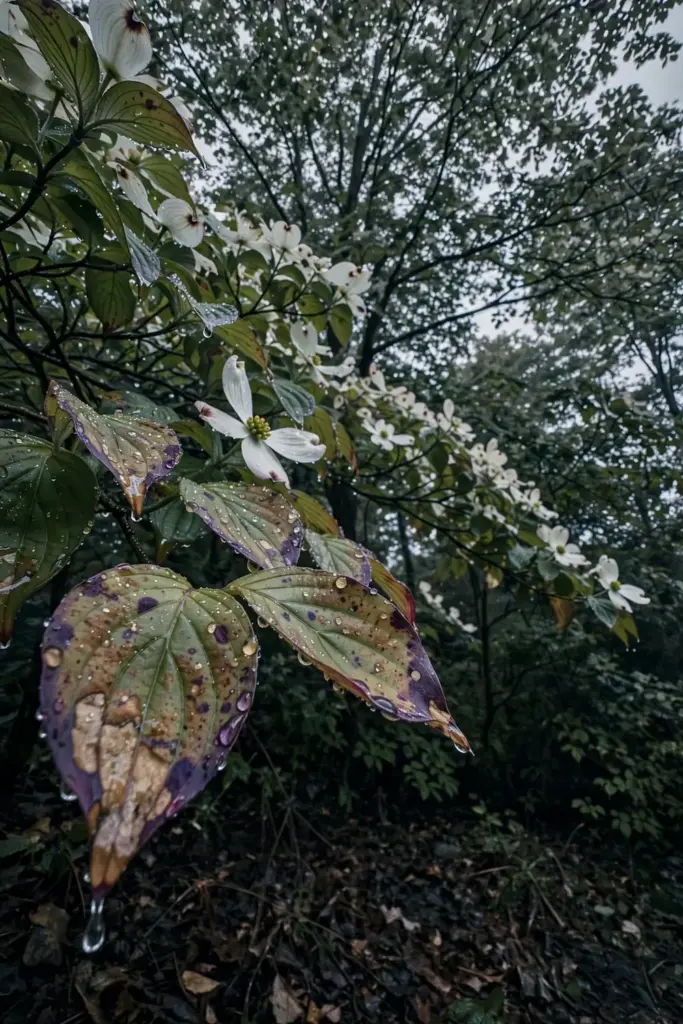
The cycle runs on rain splash. The fungus overwinters in twig cankers and fallen leaves. In spring, fruiting bodies on cankers release spores that rain splashes onto new leaves. The lowest leaves catch the first splash, since they sit closest to the ground and dry slowest. Once those leaves blight, the fungus produces fresh spores that splash upward through the canopy. Each wet week adds another round.
Shade does double damage. It keeps leaves wet longer after each rain, and it slows the drying that would otherwise strand spores on dry tissue. A dogwood planted under a dense overstory gets both penalties at once. A dogwood in morning sun dries its leaves early in the day and breaks the cycle.
This mechanism explains why the disease climbs from the bottom up. The lowest branches are the wettest, the shadiest, and the closest to the overwintering spores on the ground. Treatment that ignores shade fights the fungus with one hand tied. Open the canopy and the tree starts drying on its own schedule.
The fungus waits out winter inside cankers and fallen leaves. In spring, fruiting bodies erupt through the bark of infected twigs and on the undersides of spotted leaves that stayed attached. The first warm rain with leaf wetness starts the splash cycle. That is why the autumn cleanup in Step 2 matters as much as the spring spray in Step 3. Cleanup removes the winter shelter. Spray guards the new leaves that emerge into whatever spores remain.
7. What Makes Dogwood Anthracnose Worse in a Home Garden
Deep shade tops the list. A dogwood under a heavy overstory, against a north wall, or inside a tight planting stays wet after every rain. The fungus keeps cycling while the leaves stay damp. Thin the overstory or move the dogwood, and the disease pressure drops without a single spray.
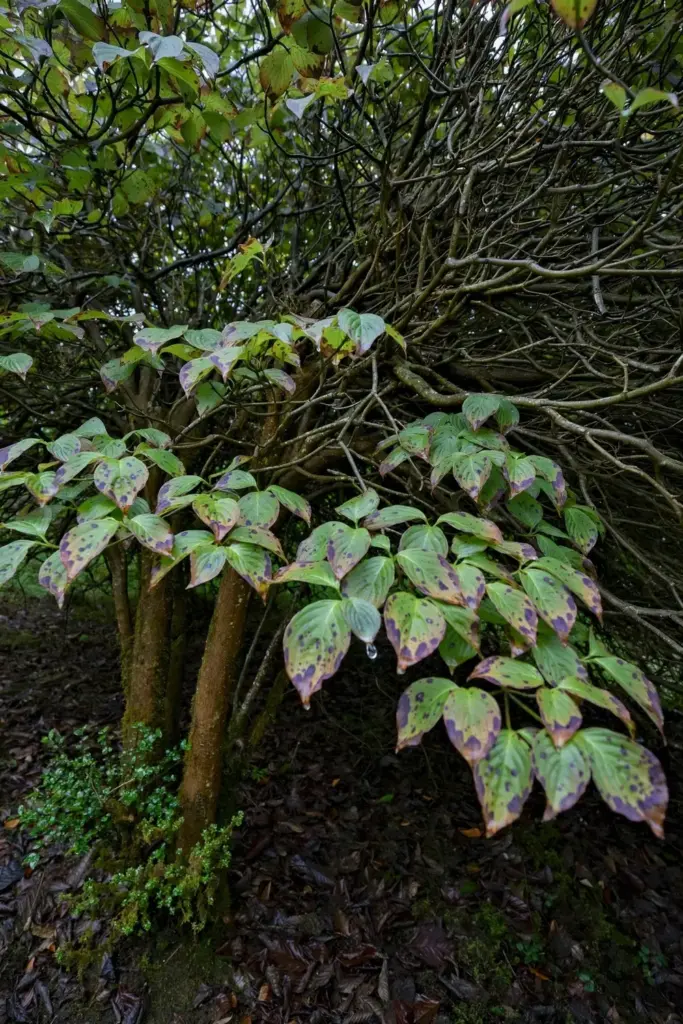
Crowded planting comes second. Branches that touch hold moisture between trees. Air cannot move through a packed bed. Prune for gaps that let wind pass, and keep neighboring shrubs off the dogwood canopy.
High-nitrogen fertilizer makes the problem worse. Fast soft growth gives the fungus tender tissue to invade. A dogwood fed heavily in spring pushes the exact shoots the fungus colonizes first. Feed lightly, and skip fertilizer on a tree that is already sick.
Drought stress weakens the tree from the other side. A dogwood short of water cannot wall off cankers as well. Water through dry spells, and keep a mulch ring around the base to hold soil moisture. The guide to building soil health covers the soil side of tree vigor, which is the long game behind every disease fight.
Injuries open doors. Mower strikes, string-trimmer nicks, and bark tears give the fungus entry points on the trunk. Keep mowers and trimmers away from the trunk, and keep the mulch ring wide enough that the mower never needs to pass close.
8. Step 1: Decide Whether Treatment Is Worth It
Count the living canopy before you spend anything. A tree with leaf spots and a few cankered twigs is treatable. A tree with extensive dieback and only a few active branches is not. New Hampshire Extension states that trees with extensive dieback and only a few active branches cannot be saved, and should be removed.
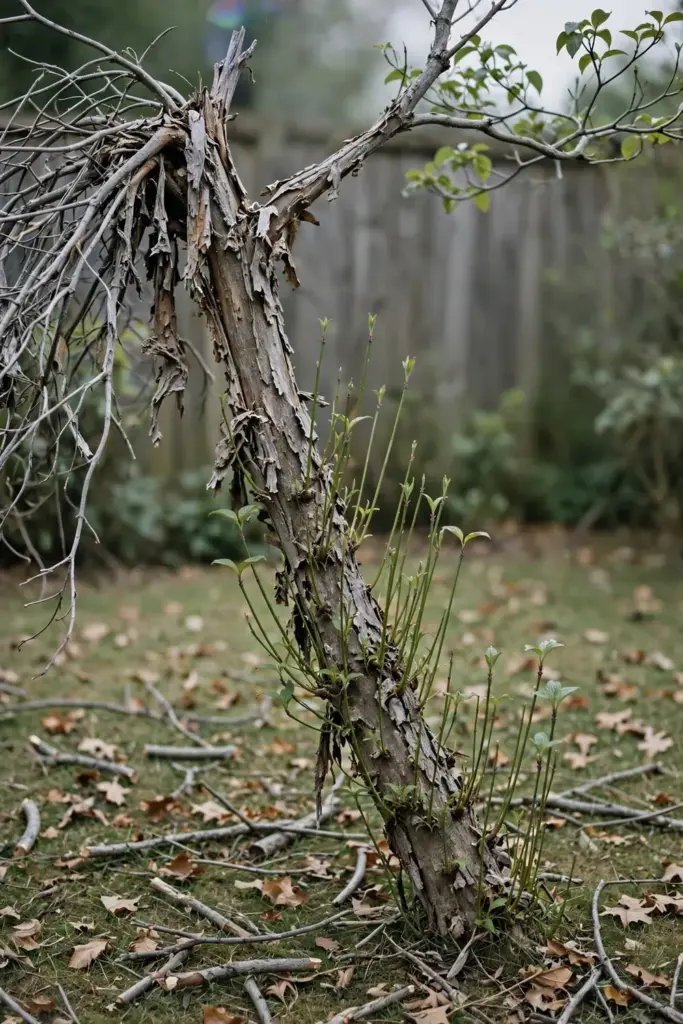
Run the bark check from Section 3 on the trunk and the main limbs. Light wood under the bark means living tissue worth protecting. Dark brown wood around the trunk means the tree is girdled at its base. A girdled trunk cannot feed the canopy no matter how much you spray.
Weigh the spray commitment honestly. Treatment means fungicide sprays across the whole wet season, plus pruning, cleanup, and watering. A young tree with most of its canopy intact earns that work, and an old tree with half its canopy gone does not. Removal costs one afternoon, while a doomed treatment program costs a season of sprays and still ends in removal.
If the tree stays, move to Step 2 while the weather is dry. If the tree goes, skip to Step 4 and plant a resistant replacement in a sunnier spot.
9. Step 2: Prune Out Cankered Wood and Clear Fallen Leaves
Prune on a dry day so fresh cuts dry fast. Cut every cankered twig back to healthy wood, well below the dark bark. Cut water sprouts off the trunk at their base. The spring pruning techniques guide covers cut placement and tool care for woody plants, which applies directly to this cleanup.
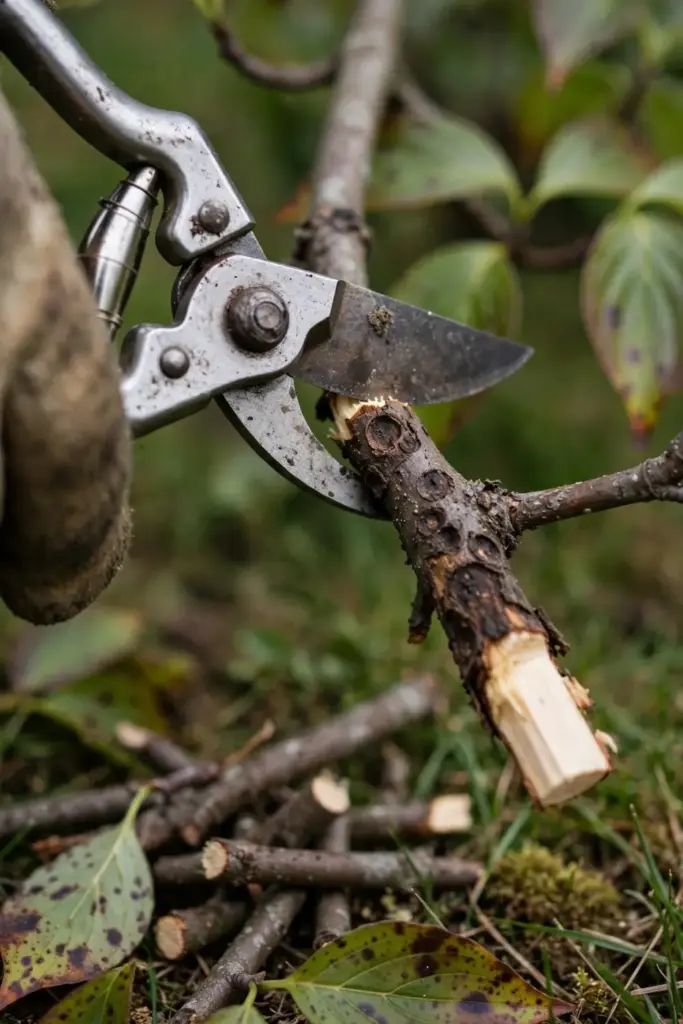
Wipe blades with rubbing alcohol between cuts. Cankered wood carries spores, and a dirty blade smears them onto the next cut. This step is slow. It is also the step that removes the spore supply for spring, so do not rush it.
Bag or burn every cutting. Never compost cankered wood. Home compost piles do not reach temperatures that kill the fungus, and the pile becomes a spore bank next to the garden.
Rake up fallen leaves in autumn and remove dead twigs and leaves still attached to the tree. The fungus overwinters in both. A clean floor under the tree removes the spring inoculum that rain splash would otherwise lift onto new leaves. Repeat the rake every autumn, not just in the year you first find the disease.
10. Step 3: Protect New Growth Through the Wet Season
Spray protects healthy new growth. It cannot heal cankered wood, and that distinction decides whether fungicide is worth buying. If Step 2 left mostly sound wood, spray earns its keep. If cankers cover the tree, spray is money on dead tissue.
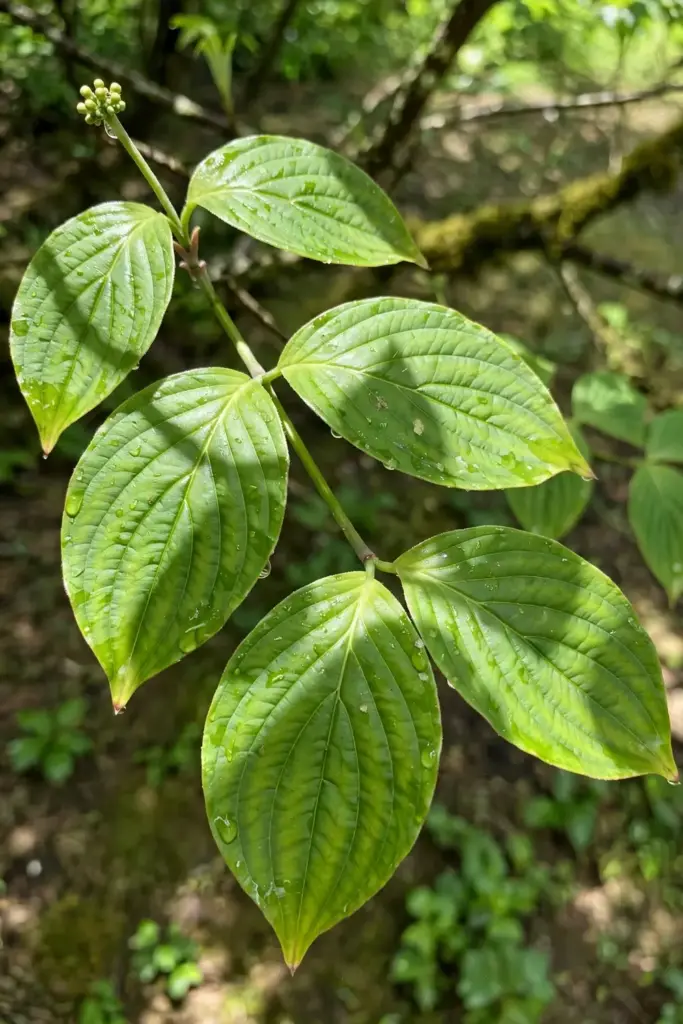
New Hampshire Extension gives the spray schedule: start at bud break, repeat every 10 to 14 days until the leaves are fully open, then spray again in late summer when the flower buds form. Use a fungicide labeled for dogwood anthracnose, and read the label for the rate and safety rules in your state. Ask your local extension office for current product names, since registrations change.
Cover the whole tree on every spray pass, including the undersides of the lowest leaves. Those undersides carry the fruiting dots, and a spray that only hits the top of the canopy leaves the spore supply untouched. A heavy rain after a spray pass washes protectant off the leaves. Watch the forecast and reapply on the schedule rather than counting a washed-off pass as done.
Skip high-nitrogen fertilizer on a sick tree. It pushes soft growth that the fungus invades fast. Water the tree through summer droughts instead, since a tree short of water walls off cankers poorly. Keep a mulch ring around the base to hold soil moisture and to keep mowers off the trunk. The guide to what mulching does for weed control, pest control, and moisture retention covers mulch depth and placement.
Thin the canopy for airflow while you spray. Open gaps let leaves dry after rain, which breaks the wet-leaf cycle the fungus needs. Sunlight on the inner branches is worth as much as the spray program, and it costs nothing after the pruning is done.
11. Step 4: Replace a Lost Tree With a Resistant Dogwood
Plant the replacement in a sunnier spot than the tree you lost. Morning sun dries leaves early in the day and breaks the wet-leaf cycle. A site that holds standing water after rain is the wrong site for any dogwood. Pick ground that drains well and gives the canopy room to breathe.
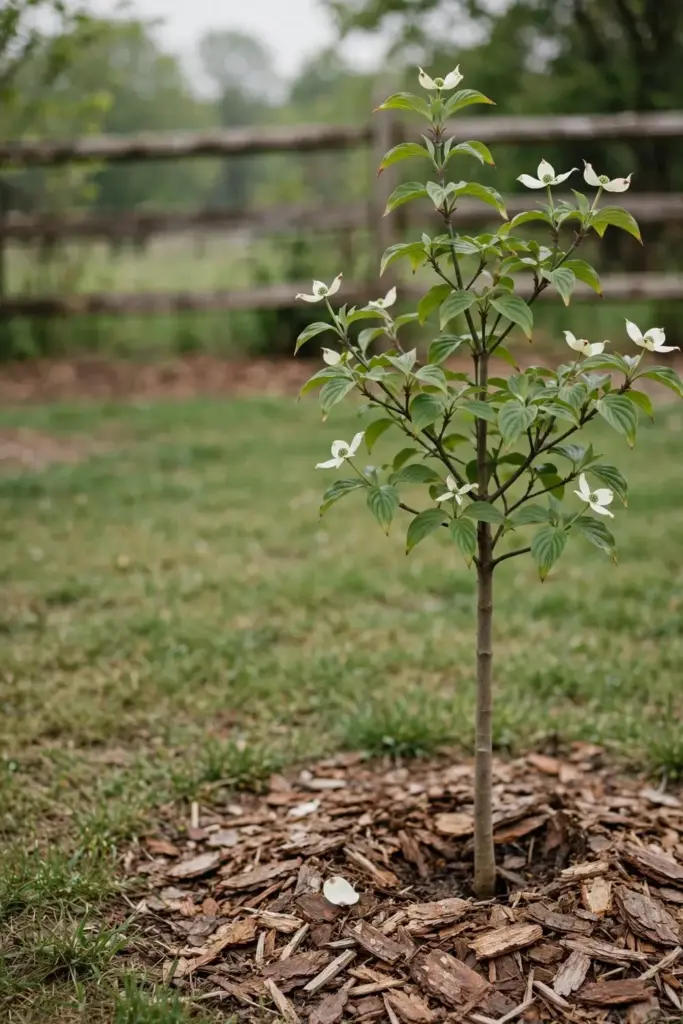
Buy a resistant species. A flowering dogwood with a promising name still carries flowering dogwood vulnerability. Kousa dogwood is the standard replacement, and it tolerates the fungus in the ground where a flowering dogwood failed. Cornelian cherry works where you want early yellow flowers, while Stellar hybrids keep the flowering dogwood flower shape with kousa toughness behind it. Pagoda dogwood and silky dogwood suit wetter or shadier corners where a kousa would struggle.
Inspect the tree before you buy it. Look for tan spots with purple borders on the lowest leaves, and check the twigs for cankers. A nursery tree that already carries spots brings the fungus home with it. Reject it and ask for a clean tree.
Do not transplant a dogwood from the woods into the landscape. Wild flowering dogwoods may carry the fungus without showing it, and the move stresses the tree at the exact moment it needs strength. Buy nursery stock that was grown under clean conditions.
12. Living With a Dogwood That Already Has Damage
A dogwood with dead lower branches and a living upper canopy can keep going for years. The tree will never look like it did before the disease, but it can still flower and leaf out. Judge the tree by its living canopy, not by its scars.
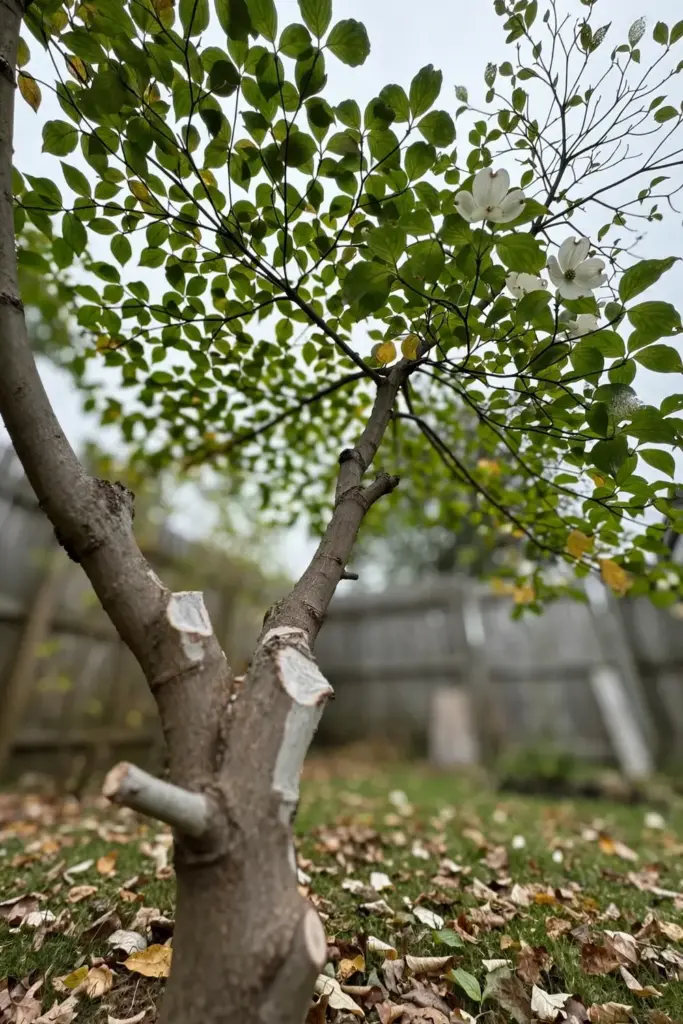
Keep pruning dead wood out every dry season. Dead branches feed spores and shade the living wood. Cut them back to sound tissue, disinfect the blade between cuts, and dispose of the cuttings off site. The cleanup never ends, but each year of cleanup lowers the spore load and gives the living canopy more air and light.
Check the new growth each spring for fresh spots on the lowest leaves. Fresh spots mean the fungus survived the winter in a canker you missed. Find the twig above the spotted leaves, run the bark check, and prune it out before the spots climb. A tree that goes a full spring with clean lower leaves is a tree winning the fight.
Keep watering through droughts and keep the mulch ring in place. A damaged tree needs steady water more than a healthy one. It also needs the mower kept away from its trunk. Every new bark wound is a fresh entry point for the fungus.
Lower your expectations for the lower canopy. The bottom branches are the wettest and the first to go, and they are usually the first to go again. Let the tree grow upward into drier air. A dogwood that holds a healthy upper canopy above a thinned lower trunk is a win, not a failure, because the upper canopy is the part the fungus reaches last.
Replace the tree when the living canopy drops below half, or when trunk cankers girdle the base. That call is Step 1 applied again a season later. A tree that cannot feed its canopy is firewood with leaves on it, and a resistant replacement in a sunnier spot is the better use of the ground.
13. Frequently Asked Questions About Dogwood Anthracnose
Dogwood anthracnose spreads between dogwoods. It does not spread to your oak, maple, or sycamore. Anthracnose fungi on those trees are different fungi that stay on their own hosts. Your ash and oak anthracnose problems are separate diseases. Clean up dogwood leaves and prune dogwood cankers, and the dogwood fungus stays a dogwood problem.
Spray if the spots sit on the lowest leaves and the twigs are still clean. A protectant spray at bud break shields the new growth while you clean up fallen leaves. Skip the spray if the spots already cover the canopy and cankers girdle the branches, since spray cannot heal cankered wood. Put the effort into pruning and cleanup instead, or into a resistant replacement.
A single small canker on the trunk leaves room to act. Prune nearby dead wood, clean up fallen leaves, and watch the canker through the season. Several cankers ringing the trunk leave no room. The tree cannot move water past girdled trunk wood. Remove a girdled tree and plant a resistant dogwood in a sunnier spot rather than spraying a trunk that cannot recover.
Dogwood anthracnose rarely kills a mature tree in one season. The disease climbs from the lower canopy upward, and an unchecked tree can die within two to three years. Young saplings die faster, since a few cankers girdle their thin stems quickly. The slow climb is good news. It gives you seasons to prune, clean up, and spray before the tree runs out of living canopy.
Plant a kousa dogwood for the same landscape role with far less risk. Cornelian cherry suits gardeners who want early yellow flowers. Stellar hybrids keep the flowering dogwood flower shape with kousa toughness behind them. Pick a sunnier spot with good drainage. Inspect the tree for spots and cankers before you buy it, and never transplant a wild dogwood into the yard.
14. Where to Go From Here
Start with the lowest branches. Check the leaf undersides for the printed-period dots, scrape bark over suspect twigs for the dark-brown canker check, and count the living canopy. Those three checks tell you whether the tree earns treatment or needs removal.
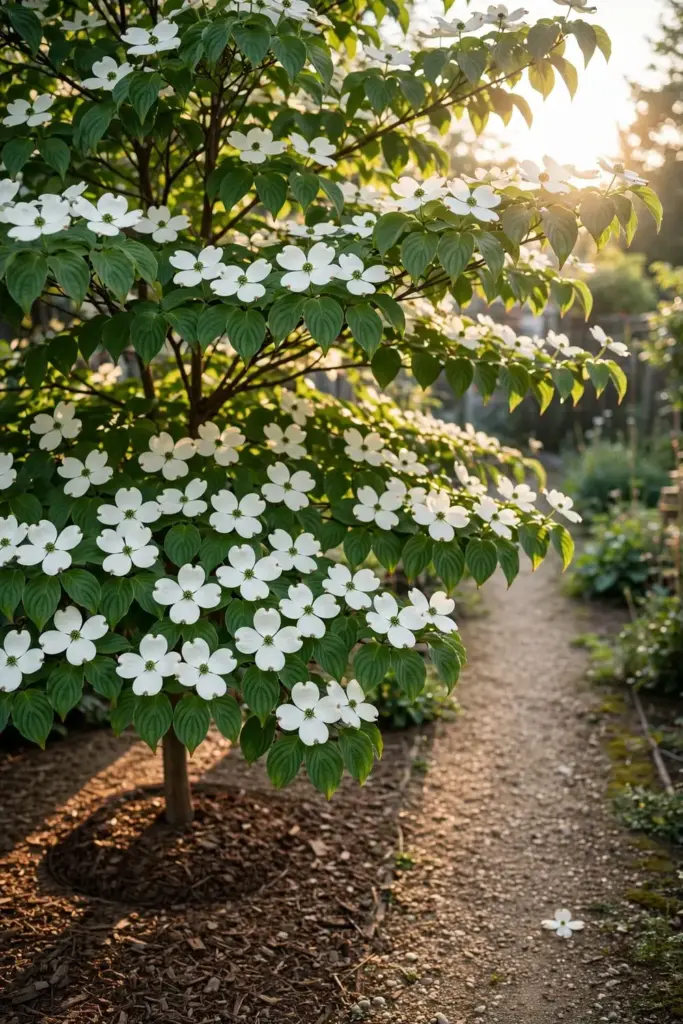
If the tree earns treatment, prune on a dry day, clean up every fallen leaf, and spray on the bud-break schedule through the wet season. If the tree goes, plant a resistant dogwood in a sunnier spot and inspect it before it leaves the nursery. Either path beats watching the disease climb for another season.
Other trees in the yard get their own anthracnose fungi, and those fungi stay on their own hosts. The guide to anthracnose plant disease covers the genus-level picture for oak, maple, ash, and sycamore. Your dogwood fungus does not spread to those trees, and their fungi do not spread to your dogwood.