
Rusts of goldenrod are not one disease. The label “goldenrod rust” cannot be verified to one specific disease, and this article does not pretend it can. The rust actually on goldenrod belongs to the Coleosporium complex of 3 named species, the asterum-vs-solidaginis taxonomy is disputed, and other rusts on goldenrod carry other names. The 5 strategies below tell you how to read the rust, why the name does not resolve, and how to run the grouping-level response.
Start with the honesty. Clemson lists “Puccinia grindeliae: Goldenrod rust” under Aster, not under Solidago. Puccinia grindeliae is the rust of Grindelia (gumweed), not goldenrod, and Clemson under Solidago carries only “Coleosporium sp.: Rust”. The literal entry contradicts the pathogen’s identity. This article covers the rusts of goldenrod as a group. It does not resolve the group to one species.
What Rusts of Goldenrod Actually Are
Rusts of goldenrod are rust fungi on Solidago. The rust actually on goldenrod in the research literature is Coleosporium asterum, used on Solidago canadensis and Solidago rugosa. Clemson’s Solidago entry (“Coleosporium sp.: Rust”) is consistent with this, but Clemson gives no species epithet and no “Goldenrod rust” common name for it. The group is the Coleosporium rusts. The name is the label.
The Coleosporium name itself is disputed. Older usage treats Coleosporium solidaginis as a synonym of Coleosporium asterum. Current molecular work treats them as genetically distinct species. Coleosporium solidaginis is closely related to Coleosporium asterum, the causative agent of rust on Aster species. In the past, the two were synonymized but are now recognized as genetically distinct species. The dispute is live. The article does not settle it.
The Coleosporium complex is heteroecious. Coleosporium asterum, Coleosporium montanum and Coleosporium solidaginis are heteroecious rusts that alternate between two different hosts to complete their full life cycle, and Coleosporium asterum infects Aster species, Coleosporium montanum infects Symphyotrichum species, and Coleosporium solidaginis infects Solidago species (goldenrod). The pine stage is the other host, the goldenrod stage is the telial host, and the two hosts are the cycle.
Other sources call other rusts “goldenrod rust” too. Wikipedia: “Puccinia dioicae is a plant pathogen that causes rust on goldenrod” (heteroecious with Carex, Iceland context), and a Japanese weeds-disease catalogue lists “Disease of Golden rod: Rust: Puccinia extensicola”. Neither matches Clemson’s entry or the North American Coleosporium literature. The label is shared. The diseases are not shared. The group is the honest frame.
How to Identify Rusts on Your Goldenrod
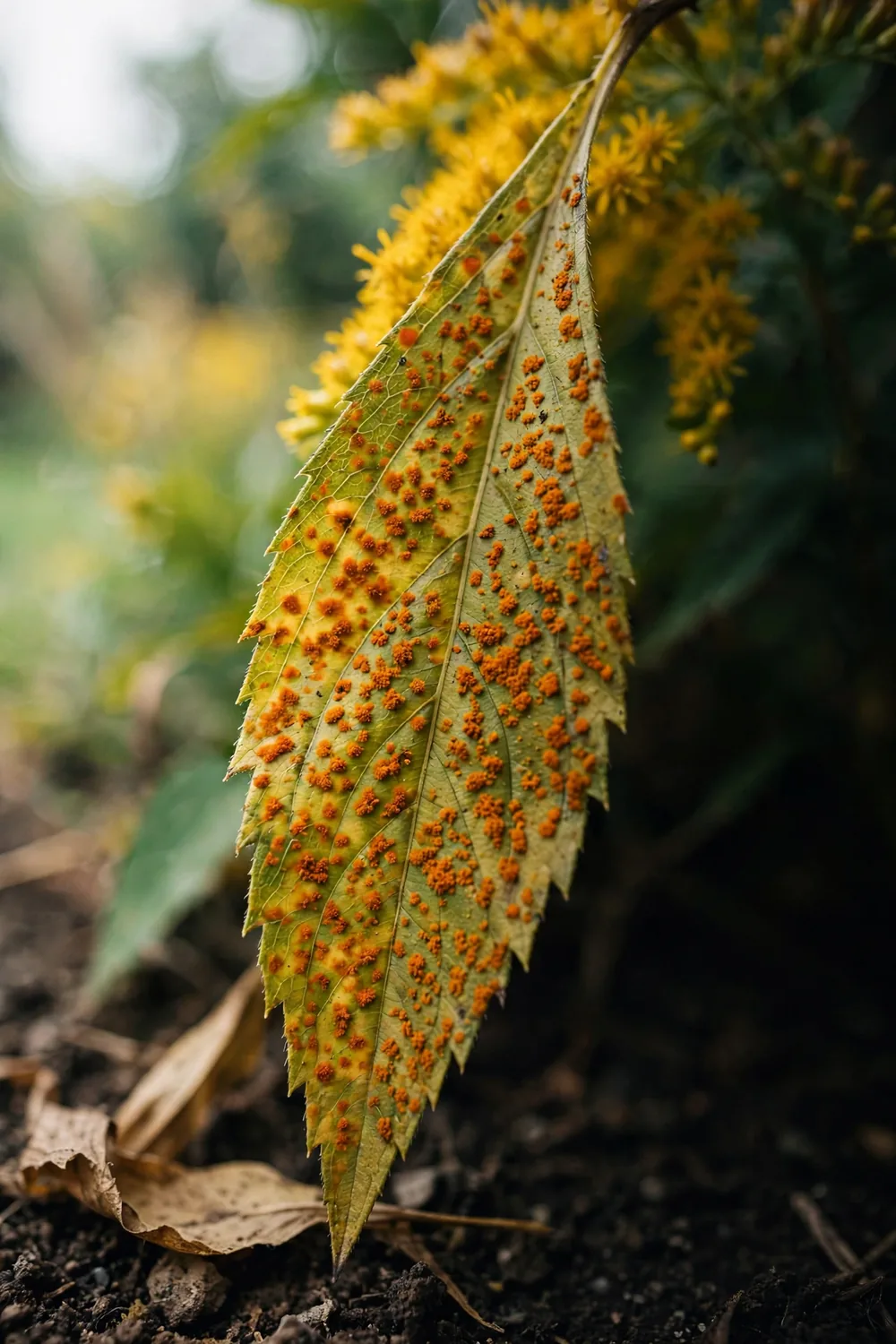
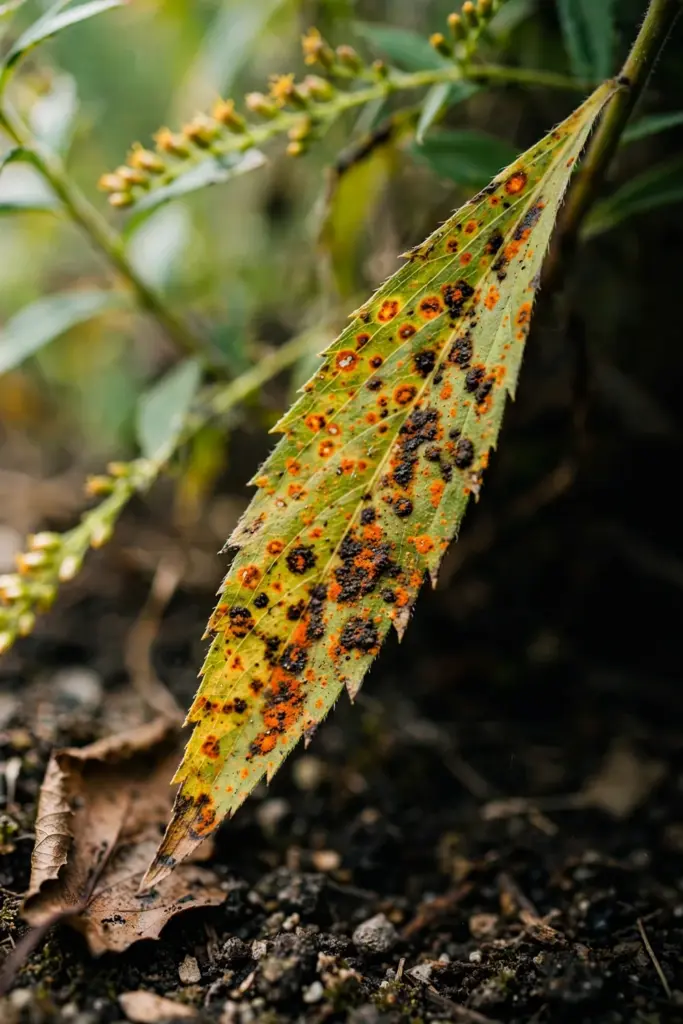
Look for bright-orange pustules on the leaves. Coleosporium Rust: bright-orange pustules (uredinia) develop on the leaves then become reddish-brown and crusty (telia), and defoliation may follow severe infections. The orange pustules are the rust, the crusty telia are the later stage, and the leaves are the place.
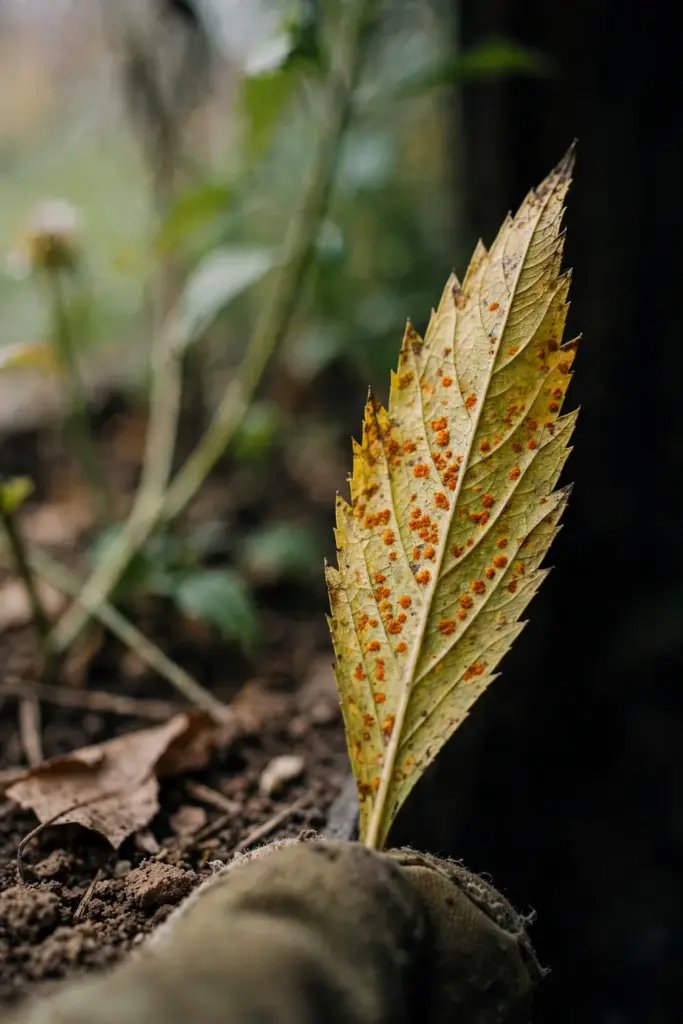
Look on the lower leaf surfaces. Rust can be identified by the minute, circular to elongate, golden or reddish brown to cinnamon brown pustules that usually form on the lower leaf surfaces, and these pustules eventually break through the leaf surface and release rust-colored, powdery spores, so the lower surface is the check and the powdery spores are the rust.
Check the season. Disease severity is often quite weather-dependent, so in drier years (around the late spring to early summer timeframe), infection rates on goldenrod should be low. The wet spring is the risk, the dry spring is the relief, and the weather is the lever.
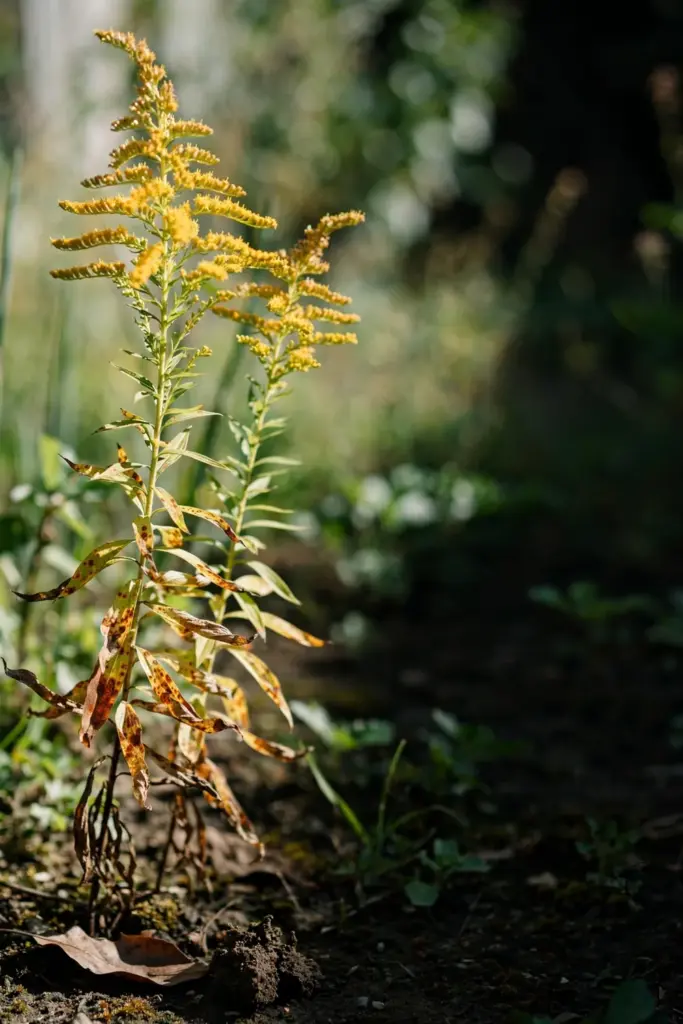
Do not expect the rust to kill the plant. We have not encountered reports of these rust fungi causing the death of goldenrod, though as with any foliar infection, successive years of heavy leaf damage might weaken a plant. The rust is cosmetic in most years. The weakening is the long-term risk. The death is not the norm.
Do not confuse with goldenrod leaf spot or powdery mildew. Goldenrod leaf spot and goldenrod powdery mildew are different diseases on the same host. The leaf spot is the spot. The mildew is the powder. The rust is the pustule, and the pustule is the separator.
Why the Name Does Not Resolve
Picking any one candidate contradicts an authoritative description. Pick Puccinia grindeliae (literal Clemson entry) and it contradicts the pathogen’s gumweed identity and the Aster host block; pick Coleosporium asterum or Coleosporium solidaginis (rust actually on goldenrod) and it contradicts Clemson’s literal entry and inherits the asterum-vs-solidaginis taxonomy dispute; pick Puccinia dioicae or Puccinia extensicola and it contradicts both Clemson and the North American Coleosporium literature, so the label cannot be verified to one disease and the article does not force it.
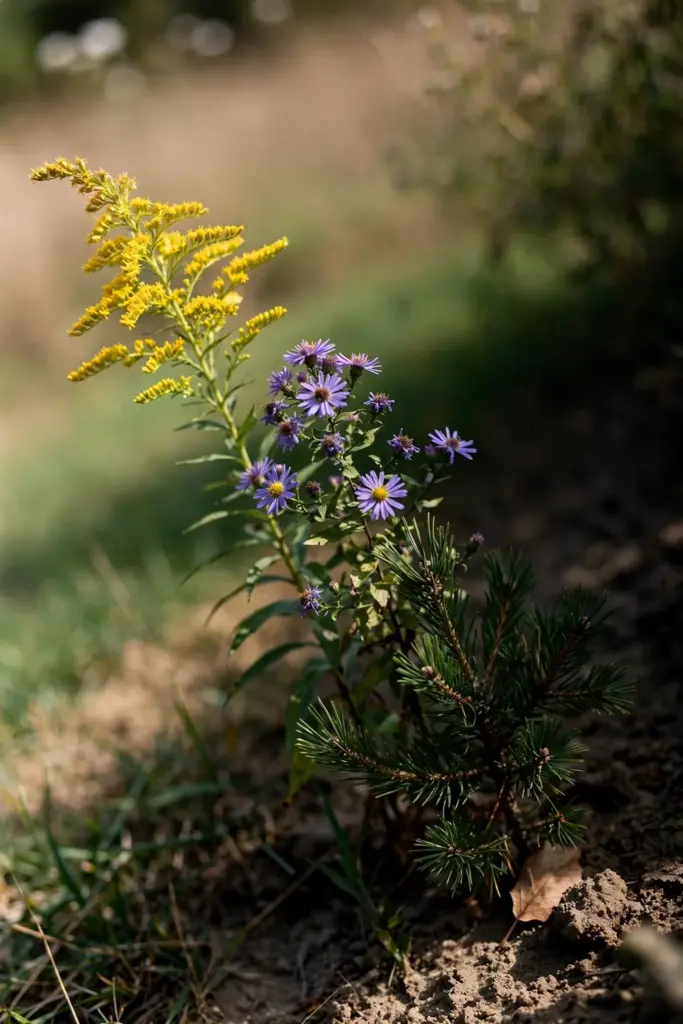
Do not treat Clemson’s three rust entries as one disease. Clemson’s Aster-block entry, Clemson’s Solidago “Coleosporium sp.: Rust” entry, and Clemson’s Solidago rugosa “Puccinia sp.: Rust” entry are three separate entries, so the entries are the fence and the merging is the trap. The Plant Care archive carries the site’s other grouping-level explainers for readers who want the pattern across crops.
Do not borrow other rust rows’ evidence. Tier 2 #95 Hollyhock Rust, Tier 2 #65 Heuchera Rust, Tier 3 #15 Hibiscus Rust, Tier 3 #31 Guava Rust are host-specific companions, never merged, so the rusts are host-specific, the borrowing is the trap, and the group is the frame.
Strategy 1: Read the Pustules, Then Check the Pines
Read the pustules. Bright-orange pustules on the lower leaf surfaces, turning reddish-brown and crusty, are Coleosporium rust. The orange is the uredinia, the crusty is the telia, and the lower surface is the check.
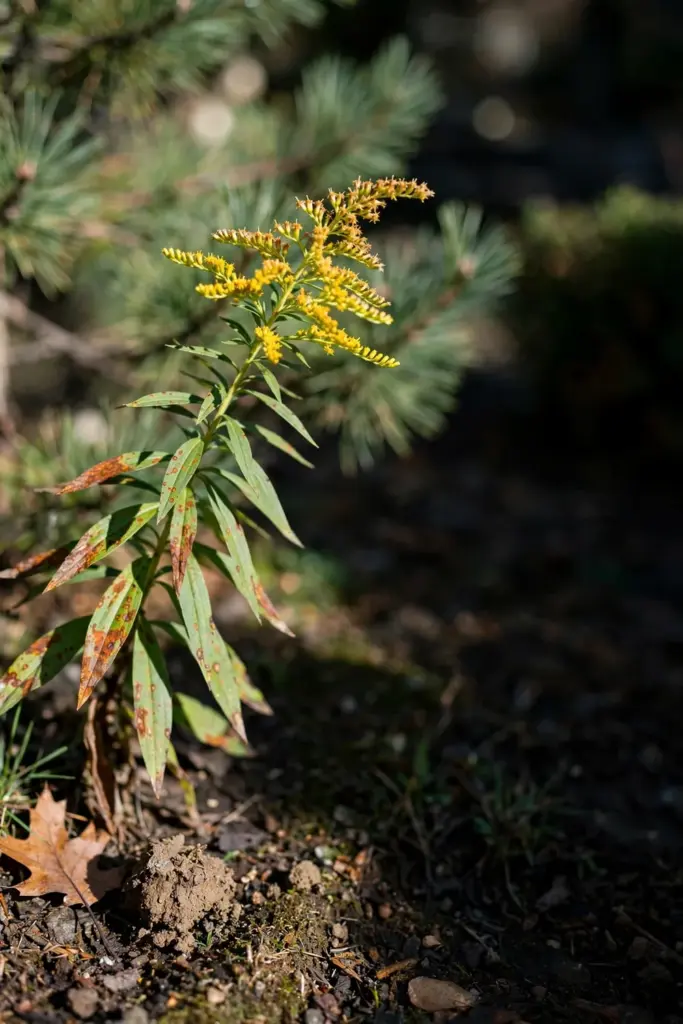
Check the pines nearby. The Coleosporium complex alternates between pine and goldenrod, so the pine stage is the other host and the goldenrod stage is the telial host. The nearby pines are the cycle.
Know that the autumn spores only infect pine. When that particular rust infects aster-family plants, the spores produced in summer can re-infect other aster-family plants, but the spores produced in autumn only infect pine, so the summer spores are the re-infection, the autumn spores are the pine infection, and the season is the switch.
Strategy 2: Remove Infected Foliage Promptly
Remove the infested plant as soon as rust pustules are found. The removed plant is the removed inoculum. The left plant is the spread. The removal is the cut.
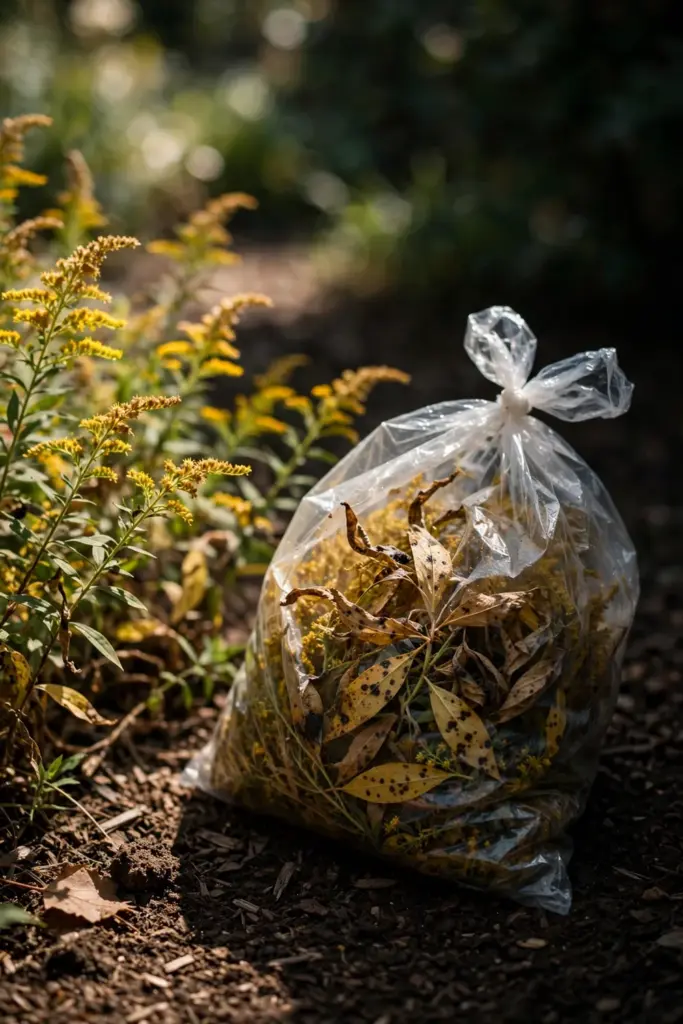
Remove and destroy infected plants or plant parts. The removed parts are the removed inoculum, the left parts are the spread, and the destruction is the disposal.
Do not compost infected material. Compost spreads the spores, the compost pile is a distribution route, and the composted foliage is the next infection. The trash is the disposal.
Strategy 3: Clean Up After Killing Frosts
Clean up and dispose of infected material after killing frosts. Since that fungus is reported to survive the winter in infected foliage at or near the crown of the plant (where stems emerge from soil), a thorough clean-up and disposal of infected material after killing frosts would be recommended to help try to break the disease cycle. The crown foliage is the overwintering site. The cleanup is the break. The frost is the timing.
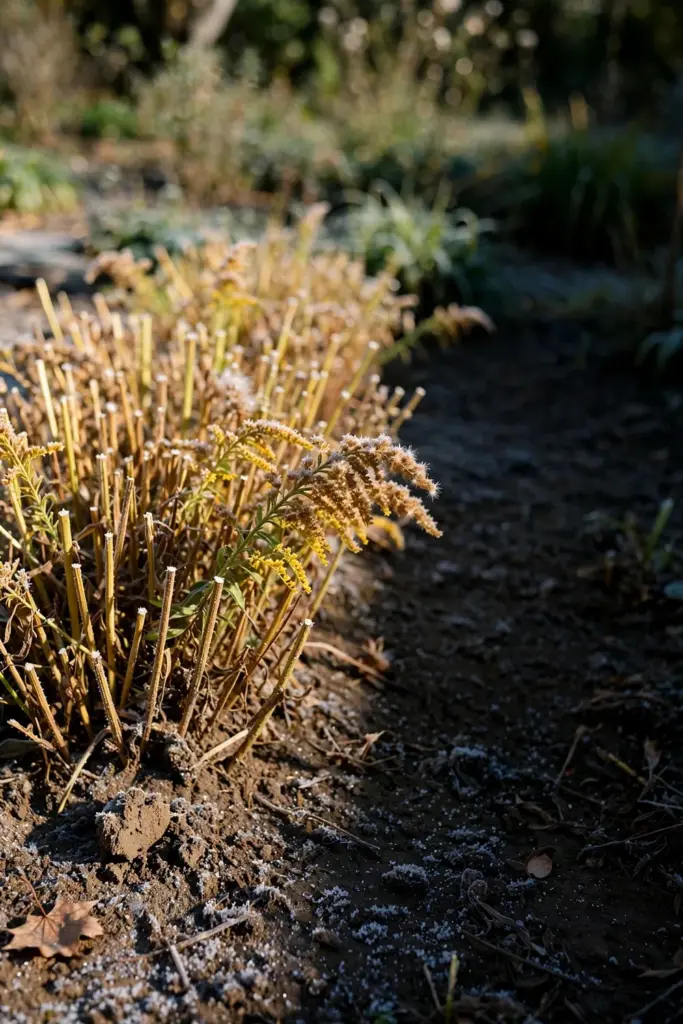
Know that cleanup is not a sure fix. It can also overwinter in infected pine needles, so this control measure is not a sure fix. The pine needles are the second reservoir. The cleanup is the best effort. A sure fix is not available.
Cut back severely if needed. An established goldenrod plant should be vigorous enough to withstand a periodic complete cut-back of stems midseason in the event a rust outbreak is severe. The cut-back is the reset. The vigorous plant is the recovery. The severe outbreak is the trigger.
Strategy 4: Keep Foliage Dry
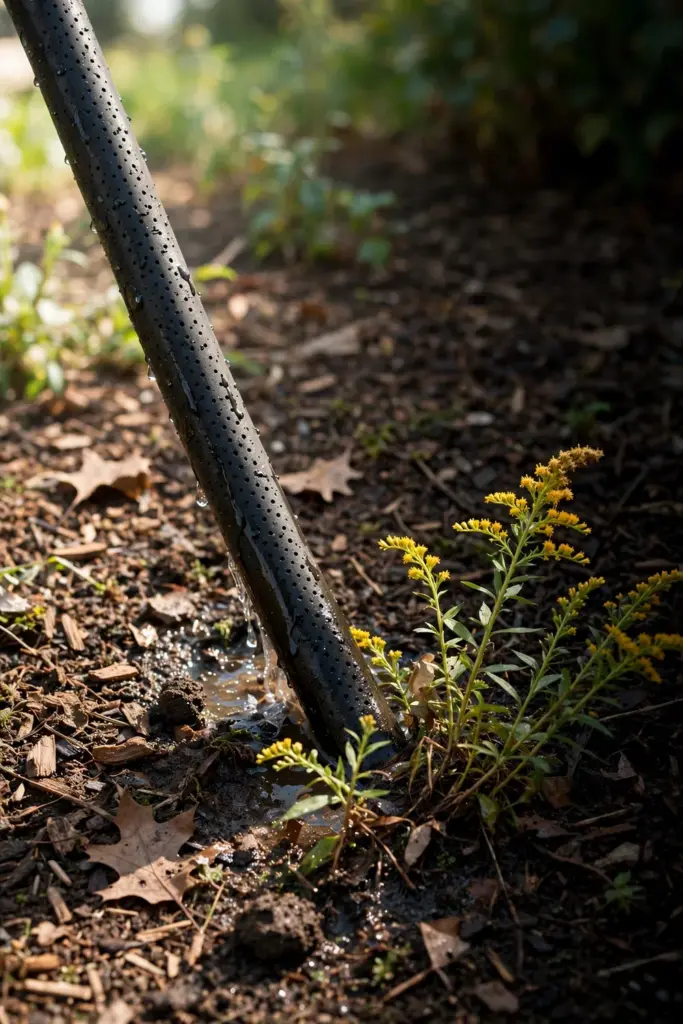
Avoid sprinkler irrigation. Overhead watering wets the leaves, so the soaker is the safe water, the sprinkler is the spreader, and the base is the watering place.
Do not plant in wet areas. Wet areas keep leaves wet longer, so the wet area is the incubator, the dry area is the defense, and the drainage is the fence.
Water early in the day. Morning watering gives the leaves the day to dry. Evening watering leaves the leaves wet overnight. The morning is the watering time. The evening is the risk.
Strategy 5: Use Fungicide Last, Preventive Only, Never as a Cure
Know that fungicide use tends not to be practical. For any rust disease exhibiting symptoms, fungicide use tends not to be practical and affected foliage can be removed and disposed of instead. The removal is the answer. The spray is the backup. The practical is the removal.
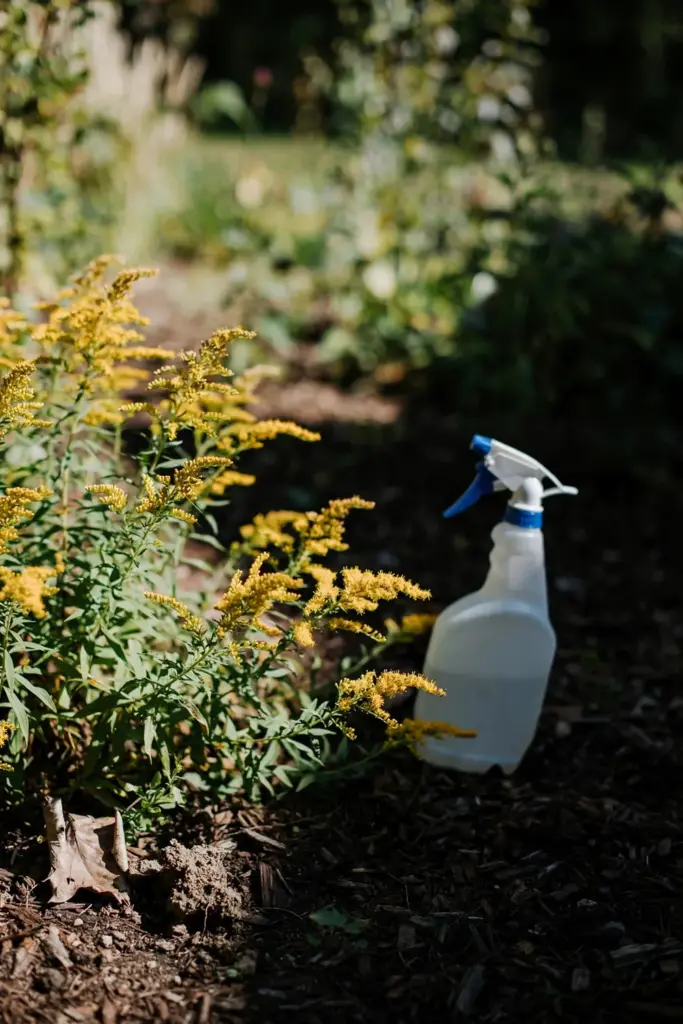
Know that timing is critical. Fungicides might work to prevent infection of healthy growth in early summer, but timing of application is critical and compounds used in broad-spectrum treatments (like copper) may have negative impacts on soil life and other organisms. The early summer is the window. The critical timing is the condition. The soil life is the cost.
Do not carry commercial programs as home advice. Commercial fungicide programs with per-acre rates are production guidance, not home advice. The label governs. The rate is the label rate. The label is the law.
Living With Rusts on Goldenrod You Already Grow
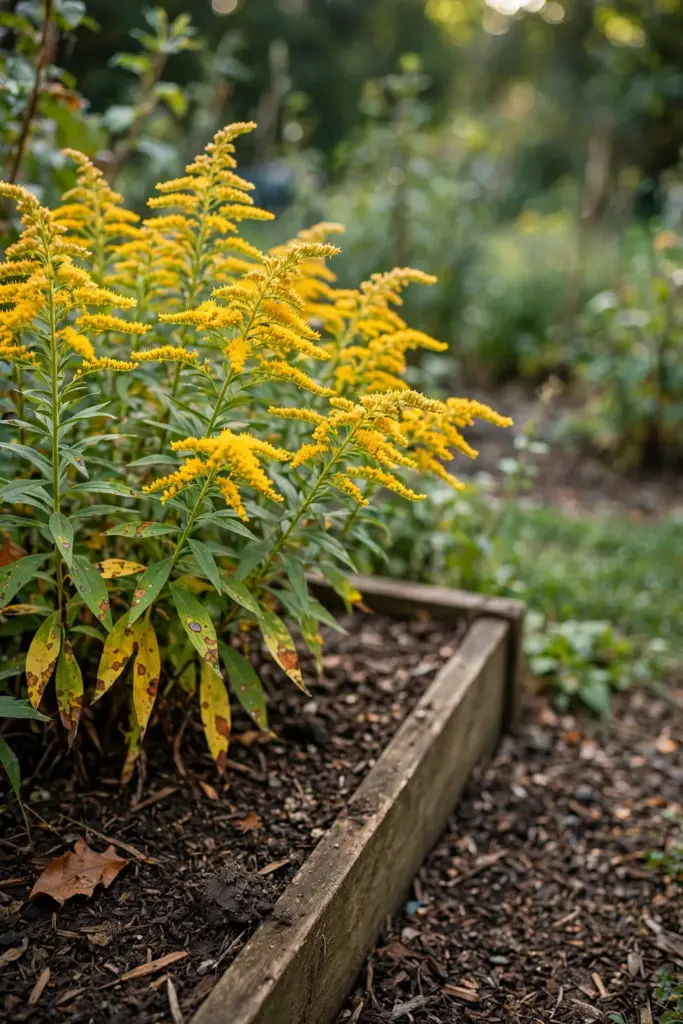
A goldenrod bed with rust is a bed to manage, not a bed to abandon. Read the pustules, remove infected foliage promptly, clean up after killing frosts, keep foliage dry, and use fungicide last, preventive only. The rust will still appear, but it will appear as a few orange pustules, not as a defoliated bed.
Stop three habits. Do not leave infected foliage in the bed. Do not water overhead in the evening. Do not skip the after-frost cleanup. Keep those three lines unbroken and the rust stays cosmetic. The Plant Care archive collects the site’s disease coverage for the next problem the garden throws up.
Frequently Asked Questions
No. The label “goldenrod rust” cannot be verified to one specific disease. The rust actually on goldenrod belongs to the Coleosporium complex of 3 named species, the asterum-vs-solidaginis taxonomy is disputed, and other rusts on goldenrod carry other names. This article covers the rusts of goldenrod as a group. It does not resolve the group to one species.
Bright-orange pustules (uredinia) develop on the leaves then become reddish-brown and crusty (telia). The pustules usually form on the lower leaf surfaces. These pustules eventually break through the leaf surface and release rust-colored, powdery spores. Defoliation may follow severe infections. The orange pustules are the rust.
Usually no. We have not encountered reports of these rust fungi causing the death of goldenrod, though as with any foliar infection, successive years of heavy leaf damage might weaken a plant. An established goldenrod plant should be vigorous enough to withstand a periodic complete cut-back of stems midseason in the event a rust outbreak is severe.
Usually no. Removal and cleanup lead. For any rust disease exhibiting symptoms, fungicide use tends not to be practical and affected foliage can be removed and disposed of instead. Fungicides might work to prevent infection of healthy growth in early summer, but timing of application is critical. The removal is the answer. The spray is the backup.
It can, if the debris stays. That fungus is reported to survive the winter in infected foliage at or near the crown of the plant, so a thorough clean-up and disposal of infected material after killing frosts would be recommended to help try to break the disease cycle. It can also overwinter in infected pine needles, so this control measure is not a sure fix.
Where to Go From Here
Rusts of goldenrod reward the gardener who reads the pustules, removes infected foliage promptly, cleans up after killing frosts, keeps foliage dry, and sprays last, preventive only. Read the pustules, remove infected foliage, clean up after frosts, and keep foliage dry.
Next season, start with a clean bed. A bed with removed debris, spaced plants, base watering, and dry leaves will hold rust to a few orange pustules. The PNW Handbooks page on aster leaf spots is a useful companion for the full Extension picture, since it sets the home-garden response here against the university evidence behind it.