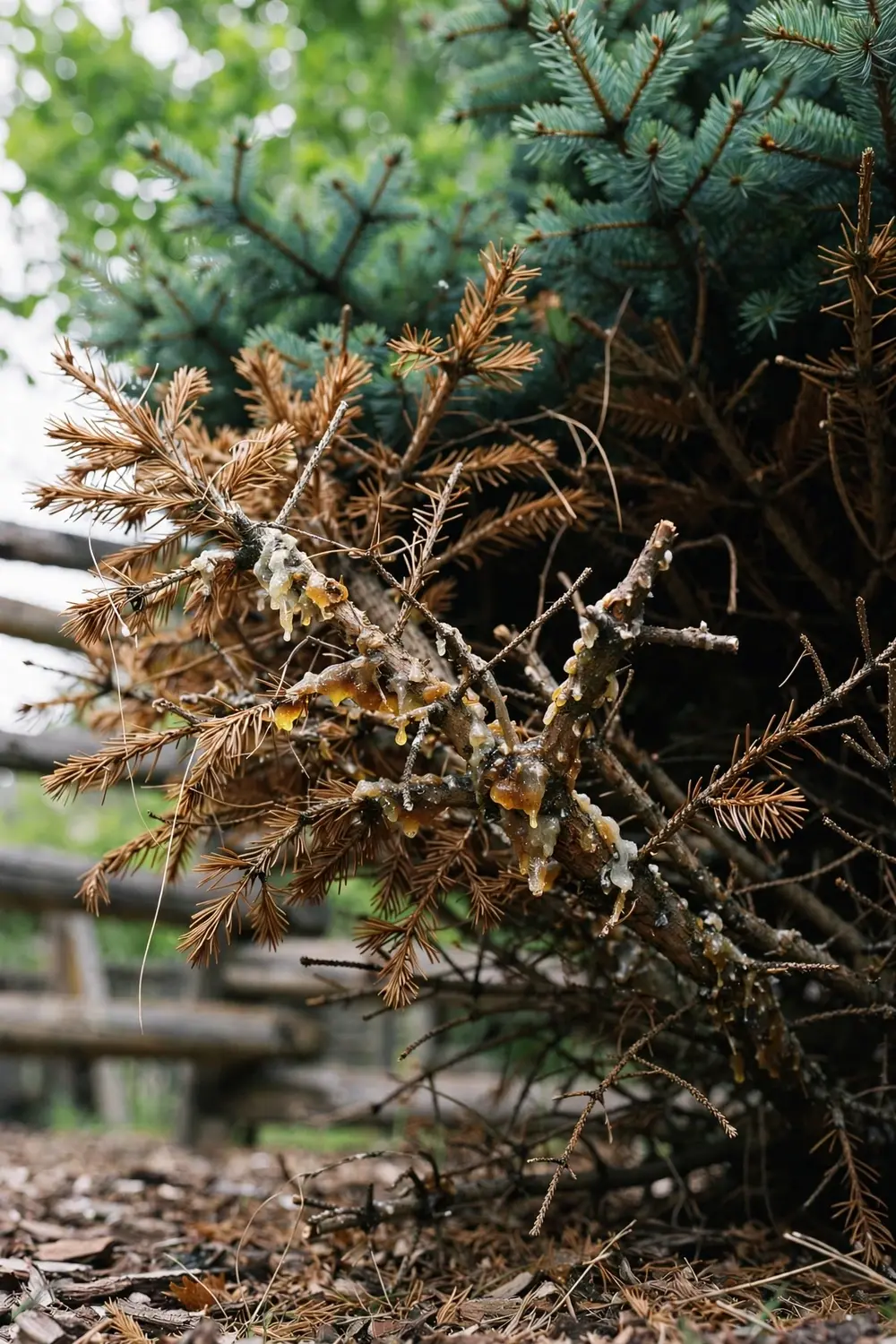

Cytospora canker kills branches from the lowest limbs upward, and no spray cures a canker that already sits under the bark. The fungus enters through wounds on stressed trees, then girdles branches over years. Spruce past 15 years of age takes the hardest hit, and the lowest branches die first. Catch it early, cut it out in dry weather, and the tree can wall off the rest.
I have learned to start at the lowest branches, since the damage shows there first.
The rest of this page covers identification on spruce and stone fruit, the lookalikes that fool gardeners, and three steps that separate trees worth saving from trees that need removal.
What Cytospora Canker Actually Is
Cytospora canker is a fungal canker disease. Fungi in the genus Cytospora invade wounded bark on stressed trees and kill the cambium in a widening ring.
The sexual stages carry the names Leucostoma and Valsa. One name covers one life stage of the same fungus, so extension pages use Cytospora, Leucostoma, and Valsa for the same disease. The UMass Extension fact sheet on Cytospora canker lists maple, blue spruce, aspen and poplar, and willow as the hosts that take the most damage across North America.
Cytospora canker is an opportunist. Healthy bark resists it. Cold-injured wood, pruning cuts, borer holes, mower nicks, and sunscald cracks let it in. The fungus grows in the living bark and the wood beneath, and it kills by girdling the branch or the trunk. A girdled branch starves above the canker, so the needles or leaves yellow, then brown, then drop.
Spores leave the fruiting bodies after rain wets them. Rain splash and wind carry the spores to fresh wounds. The fungus overwinters in cankered bark and dead twigs, so an infected branch keeps releasing spores until it leaves the site. In dry climates the fruiting bodies sometimes never form, since the cankered tissue dries too fast. A canker with no visible fruiting bodies still spreads.
How to Identify Cytospora Canker on Spruce and Conifers
On spruce, Cytospora canker shows as browning needles and dying lower branches first. Resin patches and a scrape test confirm it.
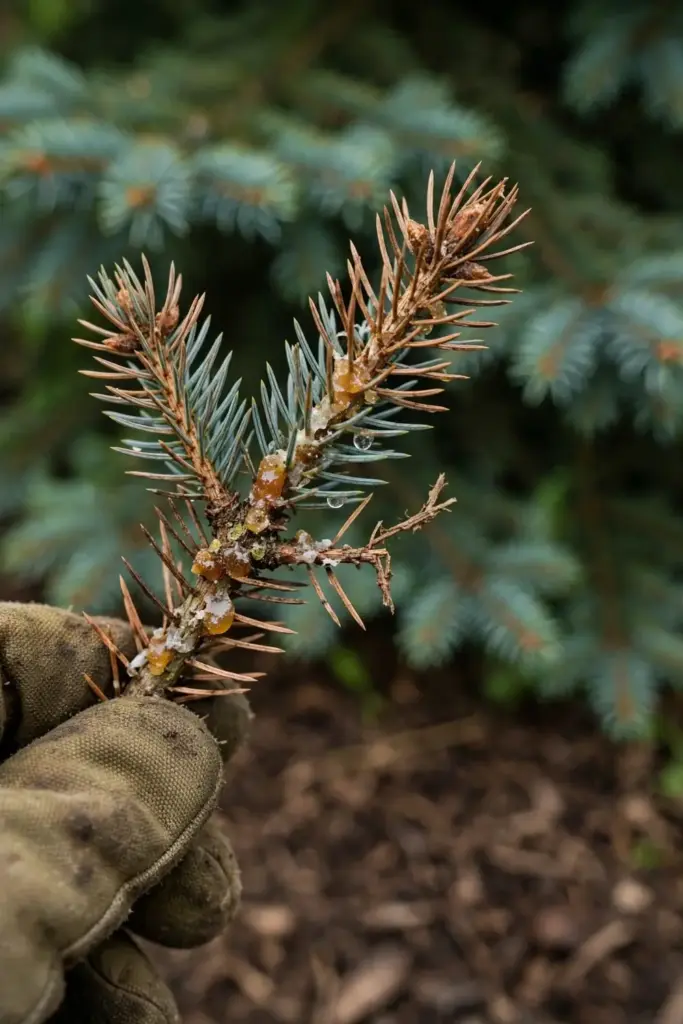
Illinois Extension calls Cytospora canker the number one killer of Colorado blue spruce grown outside its native range, and notes the disease hits hardest on trees over 15 years old.
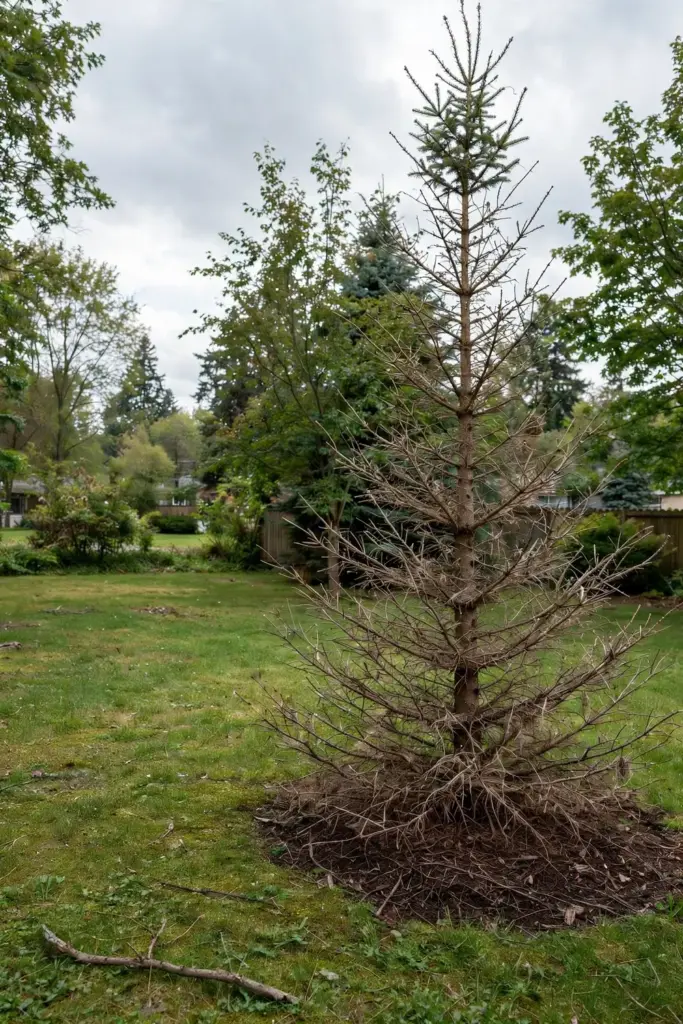
Damage starts low and climbs. The lowest branches brown first, then higher branches follow in later years. Needles may drop at once or hang on for months. Dead branches turn dry and brittle, and they stand out against healthy green limbs. Trunk cankers can girdle the whole tree and kill it.
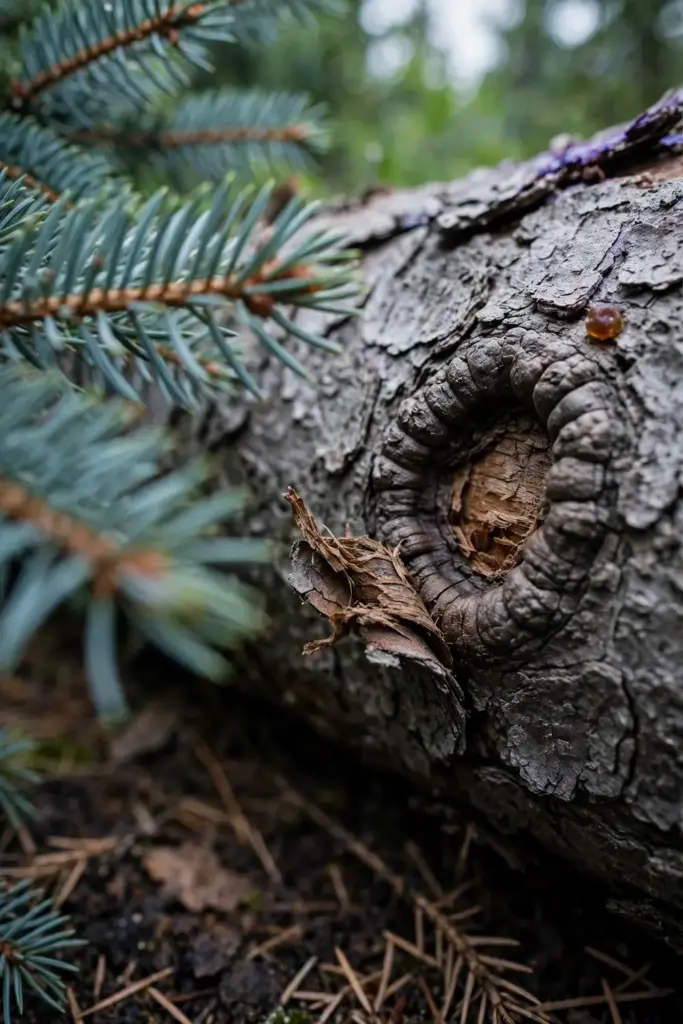
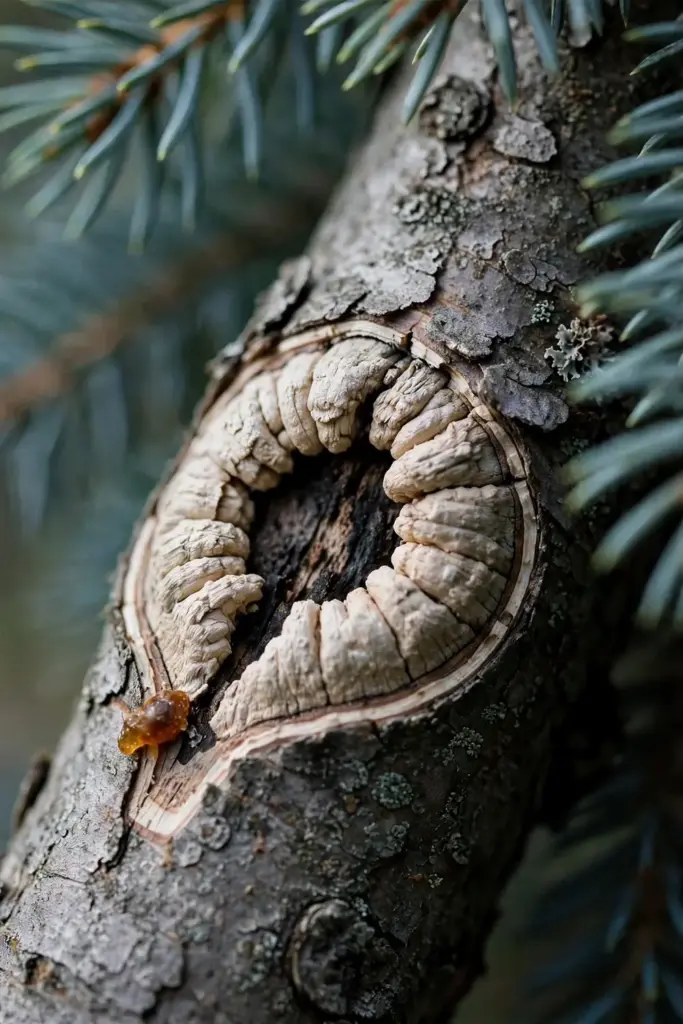
Resin gives the second clue. Amber, purplish-white, or white patches of resin appear on the bark where cankers have formed. The color shifts with the amount of air mixed into the resin. Fresh resin runs clear, then hardens into a white crust as it dries.
Resin alone does not prove Cytospora canker. Colorado State University Extension notes on Cytospora canker warn that resin flow on spruce can point to other stresses, diseases, or insects unless sunken areas with swollen callus sit beside it.
Run the Scrape Test
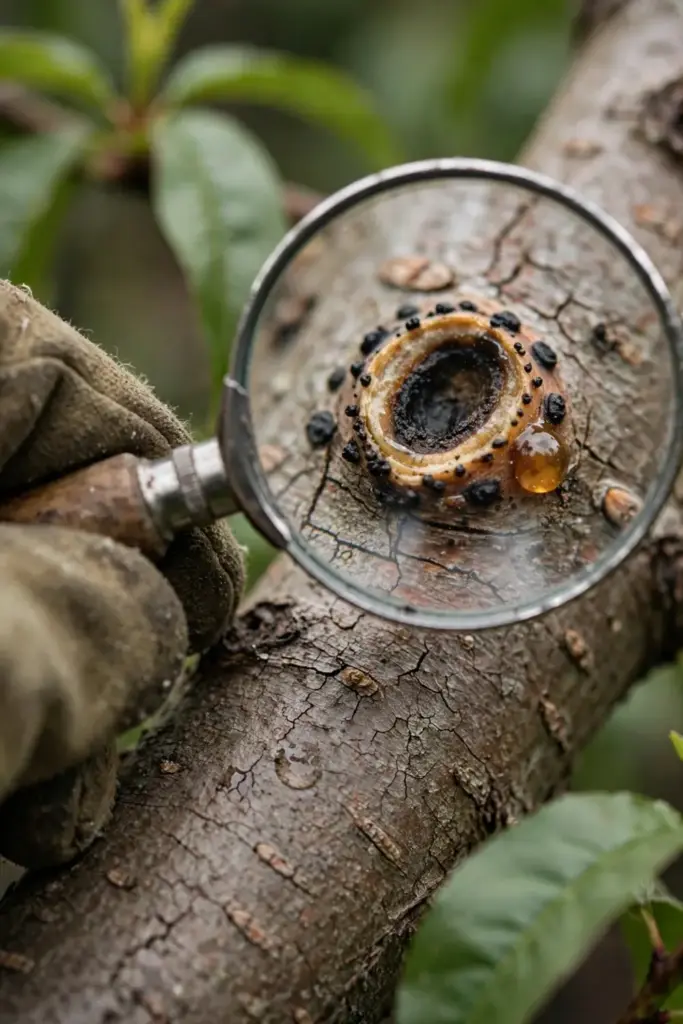
The scrape test settles the diagnosis. Pick a spot where diseased bark meets healthy bark. Shave away a thin layer of outer bark with a clean knife. Tiny black pinhead fruiting bodies in the diseased bark confirm Cytospora canker. Healthy inner bark looks light. Diseased inner bark looks brown. Work on one branch, then clean the knife before touching another branch.
How to Identify Cytospora Canker on Stone Fruit and Hardwoods
On stone fruit, Cytospora canker shows as gum oozing from a bark wound, then a canker that widens each year. On hardwoods, the signs run from liquid ooze to sunken bark with black speckling.
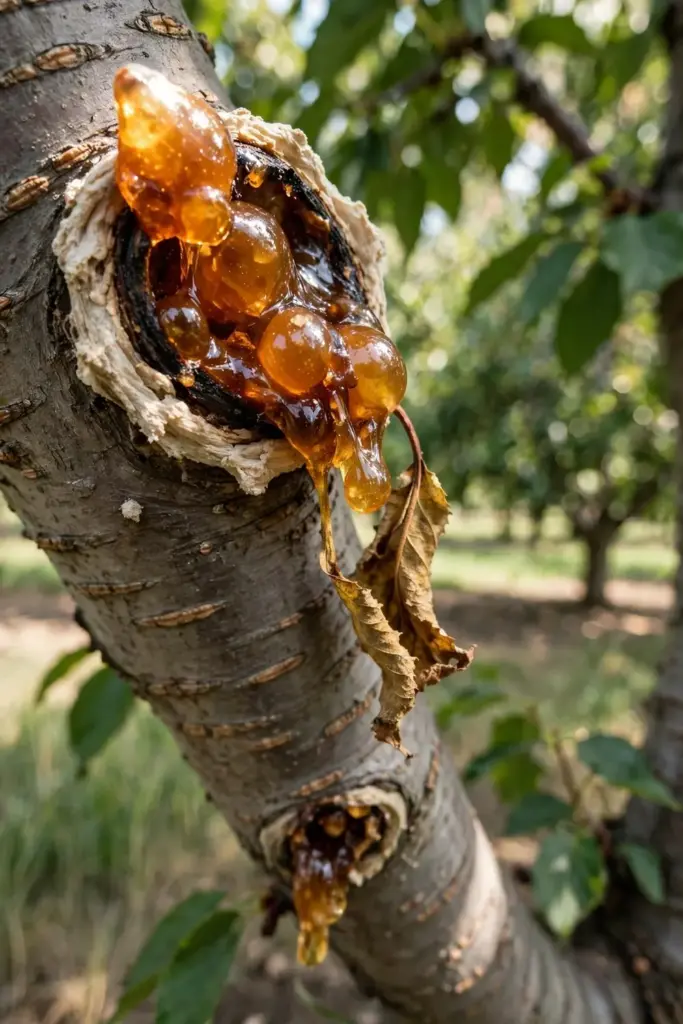
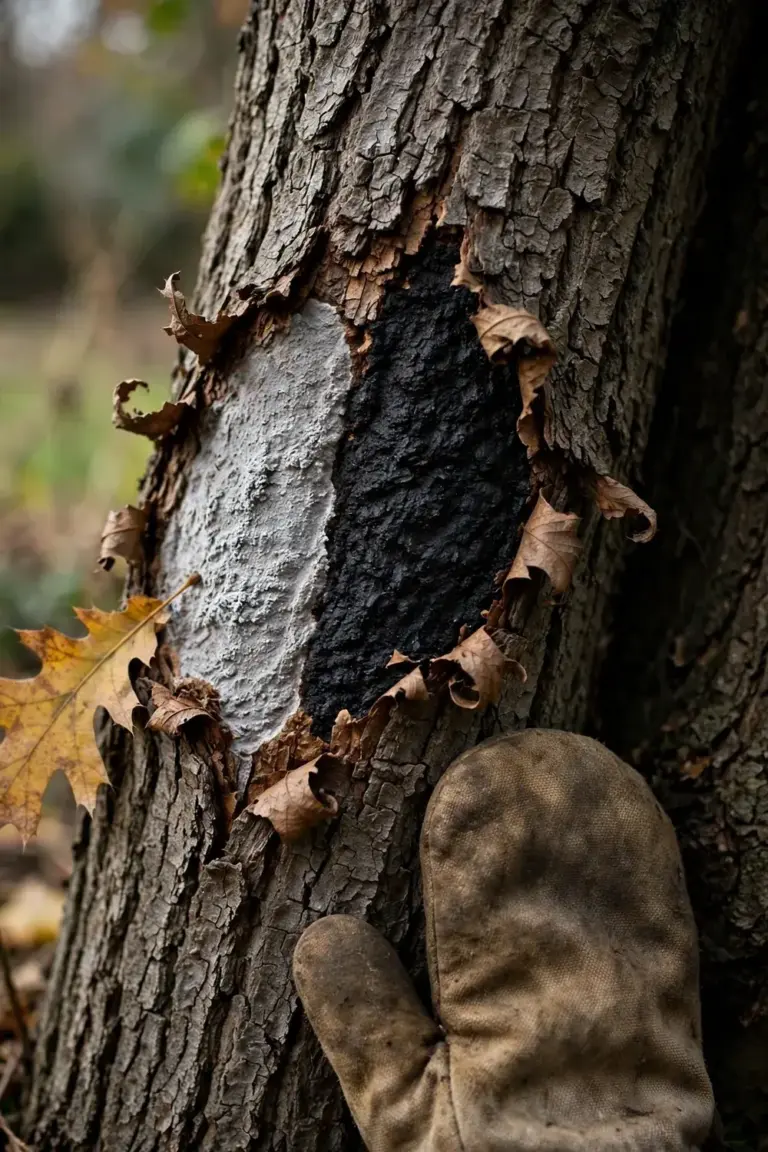
Gum appears first on peach, cherry, plum, and apricot. The fungus enters through a bark injury, a pruning cut, a dead shoot, or a damaged bud. The canker starts as a small dead center, then widens as the inner bark collapses. Cankers grow more along the length of the branch than across it, so older cankers look oval or elongated. The outer bark of a new canker often stays intact except where gum escapes. Older cankers crack open in the center and turn black from repeated wetting and drying.
Each spring the tree builds a callus ring around the canker as a defense. That ring holds the fungus back in a vigorous tree. The lesser peachtree borer can break the ring by burrowing through it into healthy tissue, and the canker then expands again.
Read the Gum on Stone Fruit
Amber gum is a defense response, not a diagnosis by itself. Bacterial canker also causes gummosis, and the two diseases share hosts. The gum test narrows the field. It does not settle the diagnosis. The canker edge, the fruiting bodies, and the pattern of spread give the verdict. The differential table below lays out those clues side by side.
On hardwoods the ooze changes with the host. Aspen and poplar weep a thin liquid, while peach and cherry ooze thick gum. Cankers on stems and branches look elongated, slightly sunken, and discolored. The fungus can kill bark so fast that no sunken canker forms at all. Bark splits along the canker margin as the tree defends itself, and callus builds. Diseased inner bark and cambium turn reddish-brown to black, and the tissue turns watery and foul as it breaks down. Wood below the cambium stains brown. Black pinhead speckling marks the bark where fruiting bodies sit. In wet weather, orange coiled thread-like spore tendrils ooze from those pimples.
Which Trees Get Hit Hardest
Blue spruce takes the worst hit among conifers, and stone fruit takes the worst hit among fruit trees. Maple, aspen, poplar, and willow follow close behind.
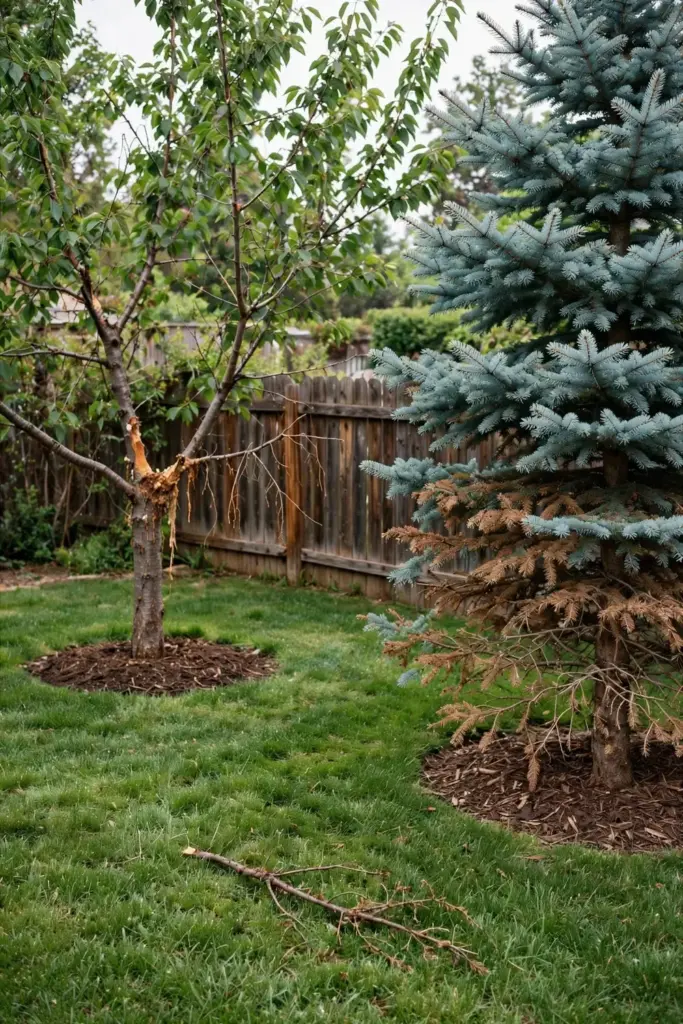
Colorado spruce and Norway spruce top the conifer list. Koster’s blue spruce and Douglas fir catch it on occasion. The same Illinois notes put the peak risk past 15 years of age, though younger trees can catch it too.
Across North America the heaviest damage falls on maple, blue spruce, aspen and poplar, and willow. Southern New England lab samples add true fir, Japanese maple, pine, cherry and peach, eastern hemlock, and American elm to the host list. Cytospora canker also lives on recently dead trees as a saprophyte, so dead wood on the site keeps the fungus fed.
Stone fruit carries no immune tree. Peach, nectarine, sweet cherry, apricot, and plum all catch it, and the disease hits harder in cooler climates and northern fruit regions. Apple and other pome fruit catch it too, though the damage runs lighter there.
Cottonwood buyers get a choice. Colorado State lists Noreaster, Platte, Mighty Mo, and Ohio Red as resistant cottonwood cultivars, and names Lombardy, Bolleana, and Sioux Land as ones to avoid.
Host lists mislead when read as fate. A stressed tree of a resistant cultivar still catches Cytospora canker. A vigorous tree of a susceptible species often walls it off. Host ranking sets the watch list. Tree vigor decides the outcome.
Planting a replacement starts with the site, not the species. Pick ground with deep, well-drained soil and open air movement, and give the tree room to grow without crowding its neighbors. A tree that never sits in wet soil and never fights for light keeps its defenses up for decades. Resistant cultivars help, and a good site helps more.
Cytospora Canker vs Bacterial Canker vs Other Lookalikes
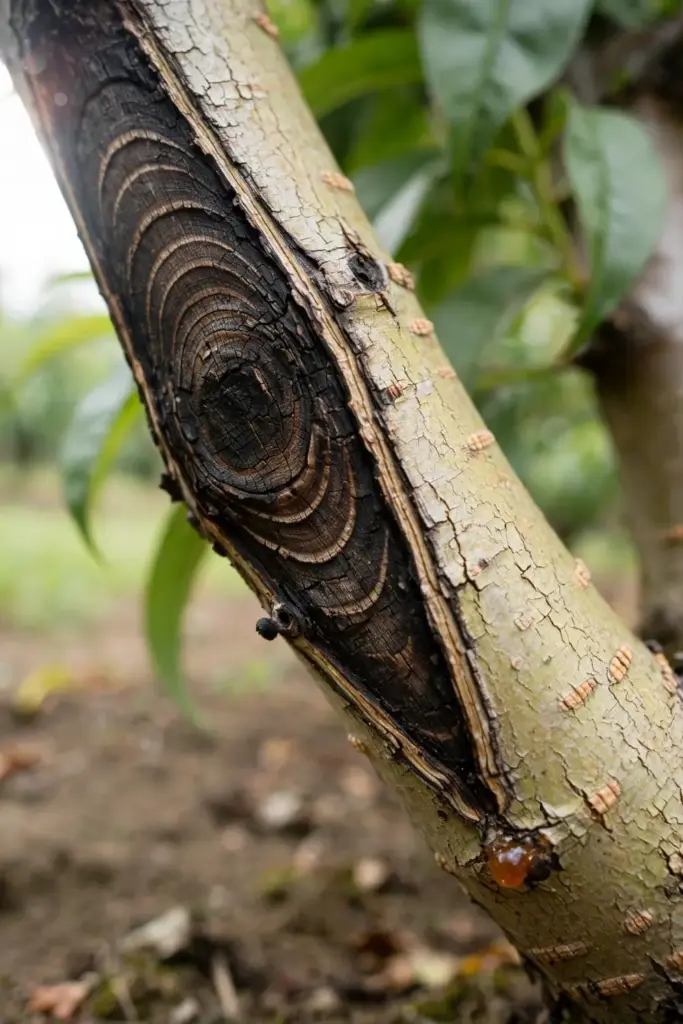
Cytospora canker is a fungus. Bacterial canker is a bacterium. Sunscald and winter injury are weather damage, not infection. The table below separates them by the clues you can see.
The bacterial canker guide covers the bacterial side in full. Use it when the clues below point to bacteria.
| Clue | Cytospora Canker | Bacterial Canker | Sunscald or Winter Injury | Cytospora Dieback |
|---|---|---|---|---|
| Cause | Fungus in the genus Cytospora | Bacterium Pseudomonas syringae | Cold or heat damage to bark | Same genus, faster syndrome |
| Gum or ooze | Amber gum on stone fruit, liquid ooze on aspen | Amber gum, often wet and oozing | None unless infection follows | None in most cases |
| Canker edge | Clear border, often with a zonate pattern | Edge blurs, streaks run into healthy wood | No fungal margin, bark cracks or peels | No canker forms |
| Fruiting bodies | Tiny black pinheads, orange spore tendrils in wet weather | None | None | None, twigs die too fast |
| First move | Prune in dry weather, disinfect tools | Confirm with a lab, prune in dry weather | Protect the trunk, watch for infection | Prune dead twigs, same sanitation |
Cytospora dieback needs a clear line. The twigs die too fast for a canker to form, so the scrape test finds no canker edge. The sanitation steps match, and the diagnosis differs.
Nectria canker is a separate canker disease with its own diagnosis. If a lab names Nectria, follow the lab’s advice.
Why Stress Decides Whether Cytospora Canker Takes Hold
Cytospora canker is a stress disease. The fungus waits for a wound on a weakened tree, then moves in.
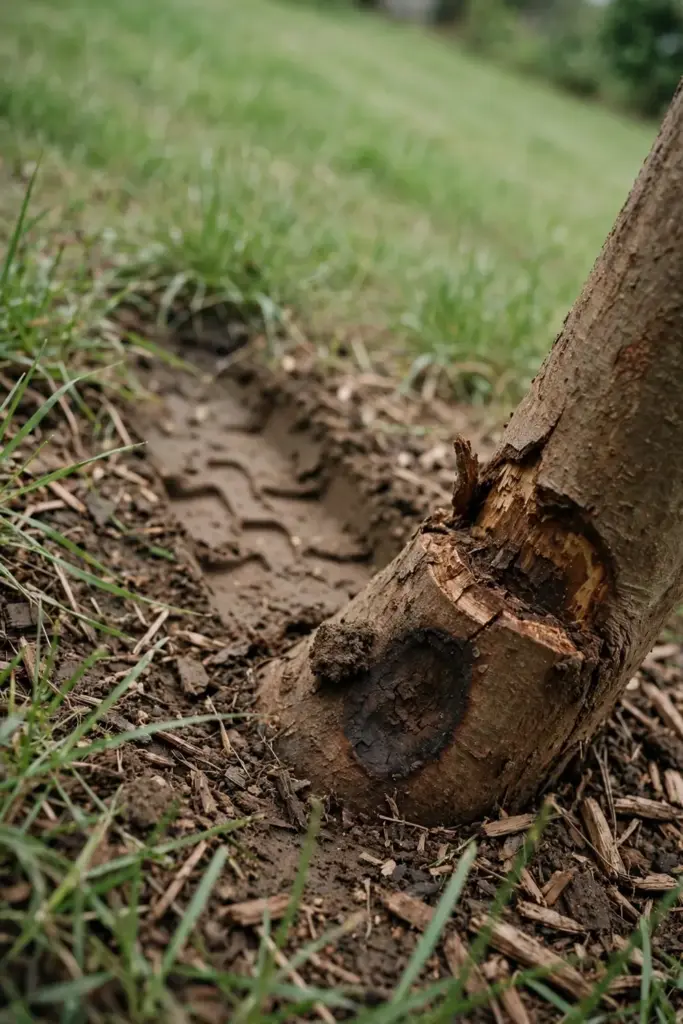
Cytospora canker kills the cambium, the thin living layer under the bark that builds new wood. A canker that rings the full circumference cuts the flow of water and sugars past that point. Everything above the ring starves. That is why a branch dies from the tip back toward the canker, and why a trunk canker kills the whole tree. Each year a tree adds a new ring of wood around the old one, as the guide to how trees add a new ring of wood each year explains. A canker breaks that ring at one point, and the break widens while the tree stays weak.
The fungus attacks when the tree cannot fight back. It moves into bark during fall, winter, and early spring, when temperatures run warm but the tree sits dormant. Infections rarely start while a tree grows vigorously. They start in early spring, fall, and winter, when growth has paused. Cold-injured buds and wood, pruning cuts, borer holes, sunscald cracks, hail wounds, leaf scars, and mower nicks all open the door. Healthy bark and healthy buds resist the fungus.
Once the fungus settles in, it forms a canker by invading the healthy tissue around the wound. The canker widens each year. The tree answers with a callus ring each spring. The race between the canker and the callus decides the branch.
What Makes Cytospora Canker Worse in a Home Garden
Drought and flooded roots top the risk list. Both starve the tree of the vigor it needs to wall off the fungus.
Drought and oxygen starvation from flooded soil are the two stresses that predispose trees to Cytospora canker most often.
Transplant shock opens a window. A tree moved in the last year or two has cut roots and a small canopy, and it defends wounds poorly. Construction damage does the same. A trench through the root zone, a grade change that buries the root flare, or soil compaction from heavy equipment all weaken the tree for years.
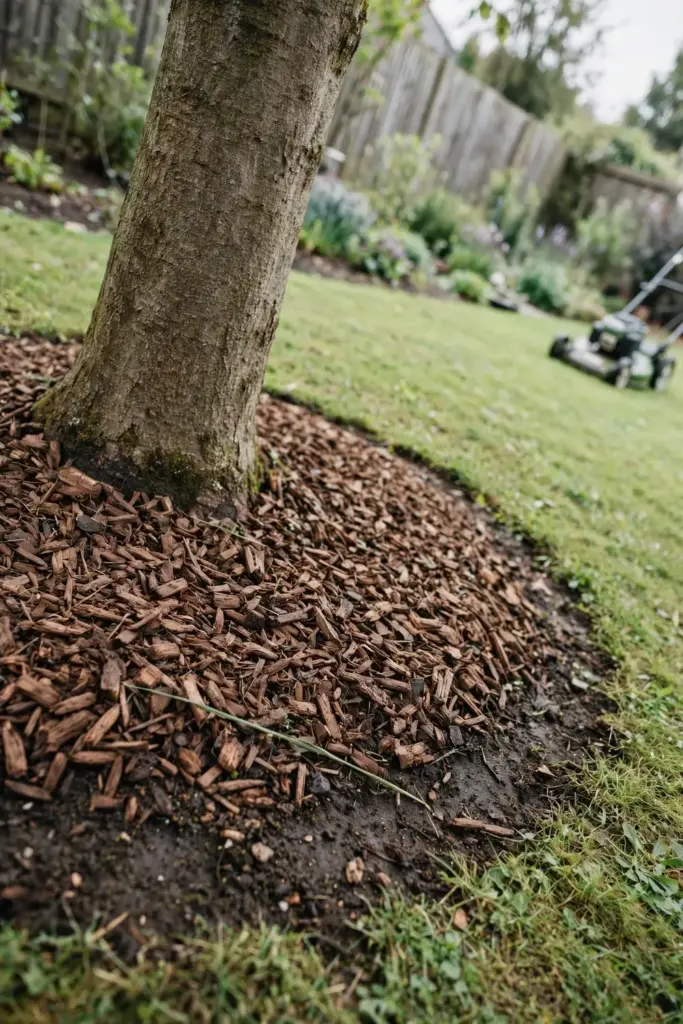
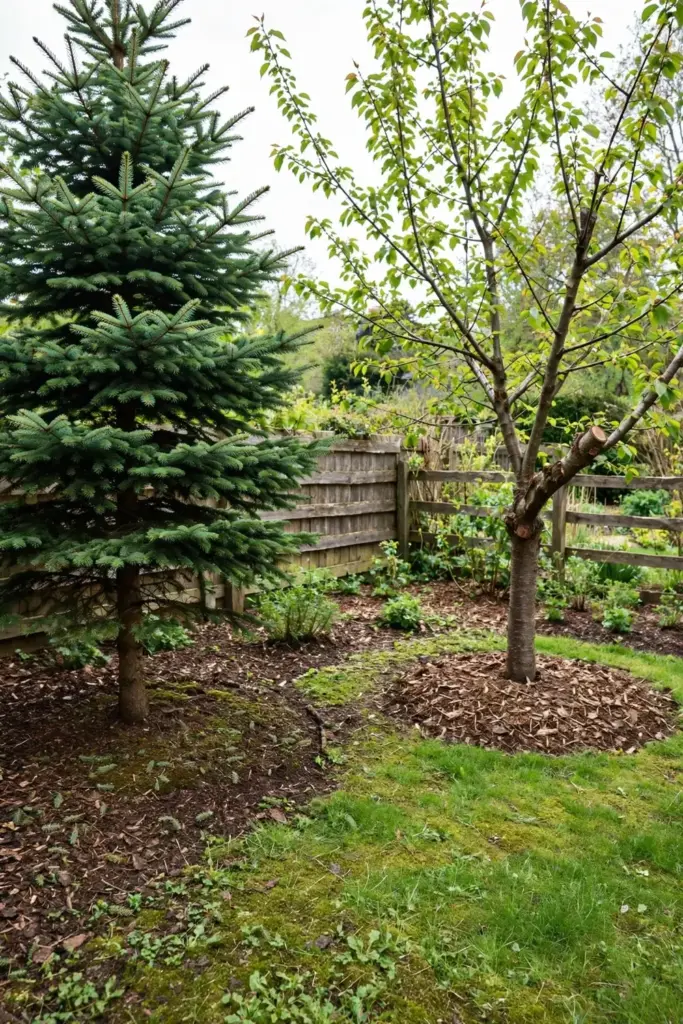
Mower and trimmer wounds rank high in home gardens. A nick at the trunk base gives the fungus a direct entry point. Keep blades and string away from bark. Mulch around the base keeps equipment at a distance and holds soil moisture.
Insects add a second stress layer. Oystershell scale drains a tree and predisposes it to Cytospora canker. Borers drill the entry holes the fungus uses. Brown rot cankers on stone fruit serve as infection sites too.
Feeding mistakes feed the fungus. Heavy nitrogen late in the season pushes soft growth that hardens off late. An early frost then injures that growth, and cold-injured tissue catches Cytospora canker fast. Feed in late winter or early spring, and keep nitrogen moderate.
Site choice sets the baseline. Deep, well-drained soil with good air drainage cuts winter injury. Tight spacing holds moisture on bark and slows drying after rain. Soil that stays wet starves roots of oxygen. Building soil health with organic matter and drainage work pays off here, since a vigorous root system is the tree’s first defense.
Step 1: Decide Whether the Tree Is Worth Saving
Count the cankers and check the trunk before you cut. A tree with a girdled trunk or a dead crown costs more to save than it returns.
| Situation | Call |
|---|---|
| One or two cankered branches, crown vigorous | Prune and monitor |
| Trunk canker girdling the stem | Plan removal, since trees with trunk cankers do not recover |
| Young stone fruit tree, a few small cankers | Canker surgery in May or June |
| Lower third of a spruce dead, upper crown thin | Removal usually beats years of pruning |
| Diagnosis unclear, or the tree stands near a house | Send a sample to your local extension lab first |
Removal is a real option, not a failure. A spruce with a girdled trunk will not recover, and it will keep shedding spores onto its neighbors. A stone fruit tree with cankers on every scaffold limb will decline no matter how much you cut. Replacement with an adapted species or a resistant cultivar ends the cycle. Give a new tree space, drainage, and mulch, and keep mower blades off its bark.
When the call is close, weigh the hours. A young orchard with a few cankers justifies surgery time. A large shade tree with a dozen cankers spread through the crown does not. Set a limit before you start cutting, and stop when you pass it.
Step 2: Prune Out Cankered Wood in Dry Weather
Prune only when the wood is dry. Wet weather spreads spores from the cut to the next wound.
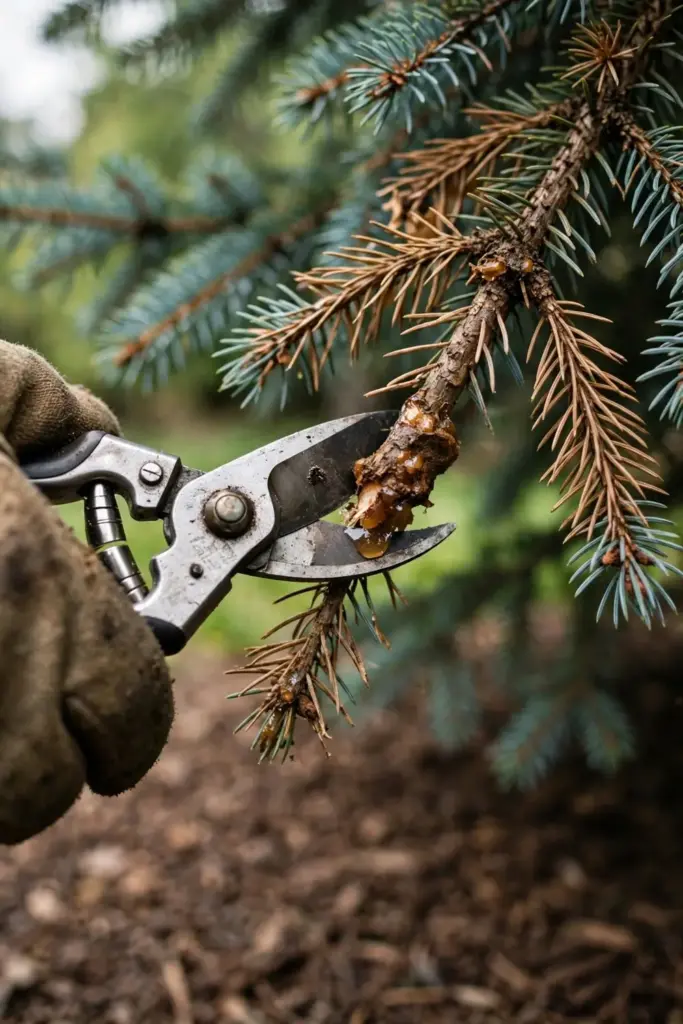
Cut at least 15.2 to 30.5 cm away from the blighted tissue where the branch allows it, the margin the same UMass notes give for landscape trees. The margin matters because diseased tissue often extends past the visible canker edge. Make a smooth cut at the base of the limb, close to the trunk, without damaging the branch collar. Jagged cuts invite infection.
Disinfect tools after each cut. Wipe blades with ethyl alcohol, Lysol, or a mix of 1 part household bleach to 9 parts water. The same Colorado notes give that 1 to 9 mix. Clean tools before moving from a diseased branch to healthy wood. A dirty blade plants the fungus in the next cut.
Fresh wounds need a different hand from old ones. A wound one month old or less gets a careful cut back to live, healthy tissue with a sharp knife. An older wound gets loose bark removed only. Never cut, remove, or damage the callus forming at the canker edge. Callus looks like swollen bark growing across the dead area. Scrape the wound surface clean of loose bark, and leave no sharp angles.
Never paint a cleaned wound with tar, oil-based paint, or any wound dressing. Drying is the treatment. A dressing traps moisture and slows healing.
Stone fruit pruning follows a tighter rule. Penn State Extension guidance on Cytospora canker of stone fruits puts the cut at least 10.2 cm below the margin of the canker on small branches, and sets pruning during or after bloom, when actively growing trees can protect the cut. Leave no stubs. Stubs die and harbor the disease, which then infects healthy branches.
Bag or burn the cut wood where burning is allowed, and get it off the site. A pile of cankered branches beside the tree keeps spores within splash range. Spring pruning techniques cover clean-cut basics for the rest of the tree, and the same dry-weather rule applies there too.
Step 3: Cut Out Small Cankers on Young Stone Fruit Trees
Canker surgery saves young stone fruit trees with a few small cankers. It does not save spruce, and it does not save a branch the canker already half girdled.
May and June are the best months for surgery. The tree grows actively, and the cut heals fast. Penn State Extension guidance on Cytospora canker of stone fruits reports surgery runs 1 to 5 minutes per canker, and that proper surgery is nearly 100 percent effective. Improper surgery almost never eradicates the canker. The gap between those two outcomes is the margin and the cleanup.
Know When Surgery Is Off the Table
Skip surgery on any canker that wraps more than half the branch circumference. Diseased tissue often extends past the visible margin, so a canker that looks half-girdled usually runs deeper. Surgery on that branch fails, and the knife work spreads spores. Prune the branch out instead.
Cut with a 1.3 to 2.5 cm margin beyond the canker. Place the knife at the top of the canker, 1.3 to 2.5 cm above visible diseased tissue. Outline the area to remove with a point at the top and a point at the bottom. Press the blade straight through the bark into the wood. Slide the blade beneath the bark and lift the diseased tissue away. Digging into the hardwood is unnecessary.
Check the margin. If brown diseased tissue reaches the edge of the cut, widen the margin until only healthy green tissue shows. Keep the cut edge clean. Torn tissue heals poorly. Never paint the cut surface with wound dressing. The same Penn State guidance states that standard wound dressings have not proven useful in wound healing.
Canker surgery is a stone-fruit technique. On spruce, stick to pruning, vigor, and sanitation. The surgery numbers above come from stone fruit trials, and they do not transfer to spruce.
Living With Existing Damage
A tree with a few old cankers can live a long life. Vigor, watchfulness, and clean pruning keep the damage cosmetic.
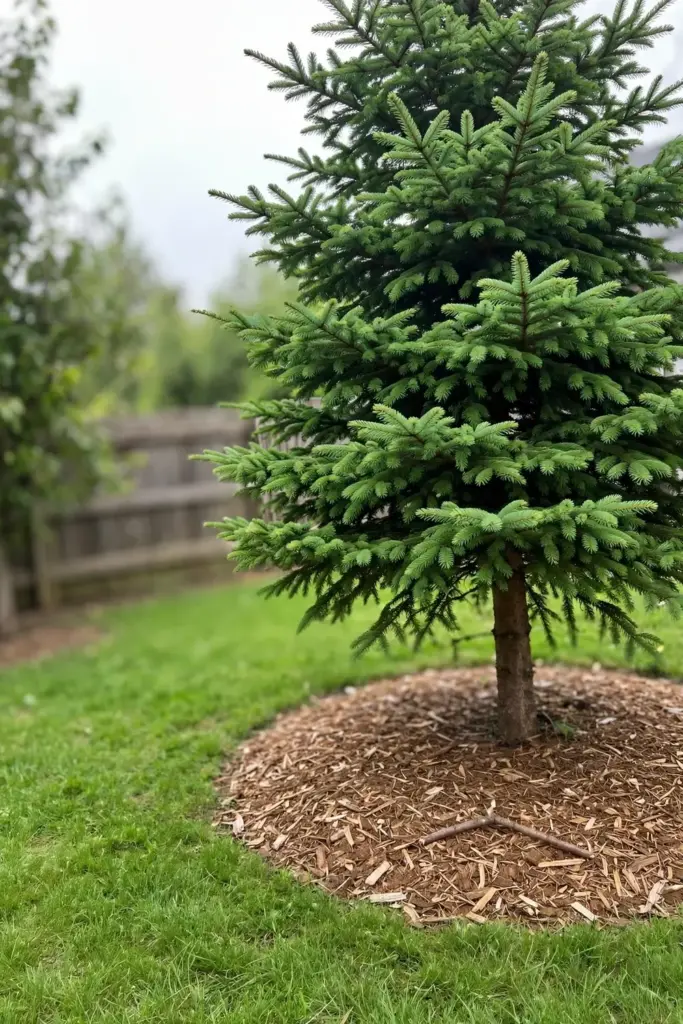
Feed the tree, not the fungus. Water during dry spells, and keep a mulch ring around the base to hold soil moisture. Mulch also shields the lower trunk from mower and trimmer nicks. Water slowly and deeply, and let the soil dry between waterings. Flooded roots invite the disease as surely as drought does.
Inspect once a year in late winter, when bare branches show every canker, mark cankered limbs with flagging tape, and prune them on the next dry day. Repeated scouting and pruning are often required. Complete eradication is hard to achieve. Set that expectation early. The goal is a stable tree, not a sterile one.
Sprays cannot cure a canker that already sits under the bark. Fungicide treatments alone do not control Cytospora canker. The fungus lives beneath the bark, beyond the reach of a surface spray. The same Penn State guidance states that plainly.
One nuance deserves a line. The same UMass notes list protectant fungicides that may help on large, mature trees, applied as new growth develops in spring. They suppress the pathogen. They do not eradicate it. Skip sprays on flowering plants, since the chemicals harm pollinators. If pruning removes all cankered stems, a spray adds nothing. Keep a written log of each inspection, with the date, the limbs cut, and the cankers left to watch, so next year’s pruning starts from facts instead of memory.
When a tree keeps declining despite clean pruning and steady water, stop spending hours on it. Remove it, and plant an adapted species or a resistant cultivar in its place. Generous spacing, deep well-drained soil, and a mulch ring give the replacement a start the old tree never had.
Frequently Asked Questions
Yes. Spores leave cankered bark after rain wets the fruiting bodies, and wind and rain splash carry them to wounds on nearby trees. The fungus overwinters in cankered bark and dead twigs, so infected branches keep releasing spores until they leave the site. Remove cankered wood, disinfect tools after each cut, and avoid pruning in wet weather to break the cycle.
No. No spray cures a canker that already sits under the bark, since the fungus lives beyond the reach of a surface spray. Fungicide treatments alone do not control the disease. Protectant sprays may help on large, mature trees when applied as new growth develops in spring, but they suppress the pathogen rather than eradicate it. Pruning and vigor do the real work.
Rarely. A trunk canker that girdles the stem cuts the flow of water and sugars to the whole crown, and trees with trunk cankers do not recover. A small trunk canker on a vigorous tree deserves one season of watchful waiting, with no knife work into the callus. If the canker widens, the needles thin, or the crown fades, plan removal and plant an adapted species in its place.
Prune only in dry weather, when the wood and the bark are dry. Wet weather spreads spores from the cut to the next wound. Late winter suits spruce, since bare branches show every canker and the tree still sleeps. Stone fruit pruning fits during or after bloom, when actively growing trees can protect the cut. Disinfect tools after each cut, whatever the season.
No. Never paint a cleaned wound with tar, oil-based paint, or any wound dressing. Drying is the treatment, and a dressing traps moisture and slows healing. Cut the diseased bark back to healthy tissue, scrape the wound clean of loose bark, leave no sharp angles, and let the tissue dry. The tree seals the wound with callus on its own schedule.
Where to Go From Here
Start at the lowest branches. Look for browning needles, resin patches, gum, and sunken bark. Run the scrape test where diseased bark meets healthy bark. Cut out what you find on the next dry day, and disinfect the blade after each cut.
If the clues point to bacteria instead of fungus, treat it as bacterial canker and confirm with a lab.
Keep the tree vigorous after the cut. Water in dry spells, hold the mulch ring, and keep mower blades off the bark. Inspect once a year in late winter. One dry-weather pruning session a year holds Cytospora canker to a cosmetic problem on most trees.