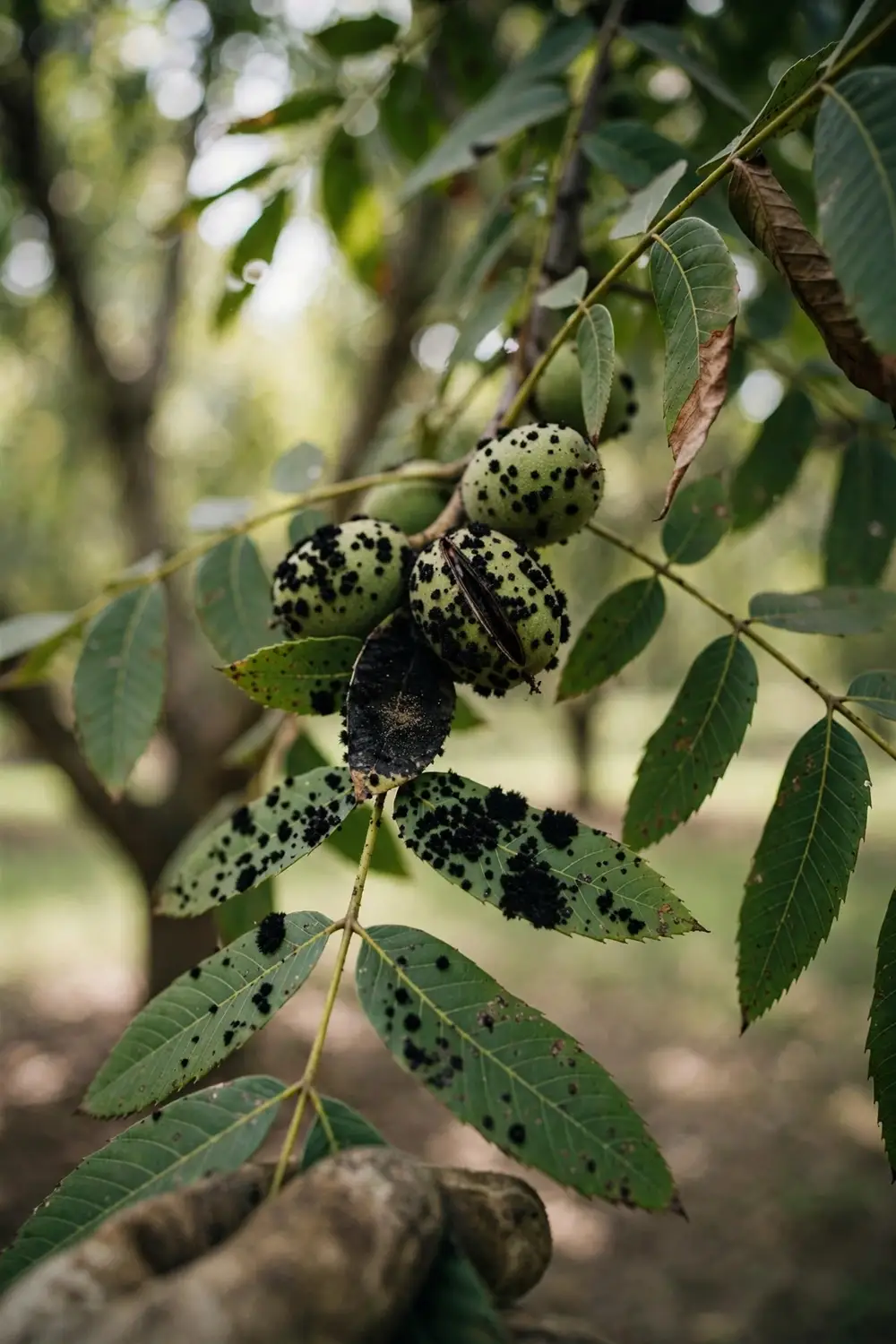

Pecan scab turns a backyard pecan crop black before it ever fills. The fungus spots leaves, twigs, and shucks, drops nuts early, and can wipe out a whole season on a susceptible tree. 10 strategies below protect the crop, starting with the honest call on whether spraying a tall backyard tree is worth it at all.
Pecan scab is the most damaging disease pecans face. It hits pecans and other hickories across the Southeast and the lower Midwest, wherever warm rain keeps leaves wet. The rest of this page is 10 moves, from the spray decision to the harvest sort.
Read the identification sections first if the tree still stands. Start at Step 1 if the nuts already dropped.
What Pecan Scab Actually Is
Pecan scab is a fungal disease of pecan. The pathogen is Venturia effusa, a true fungus that older guides called Fusicladium effusum or Cladosporium caryigenum. It attacks pecan and other hickories, and it hits only young, actively growing tissue.
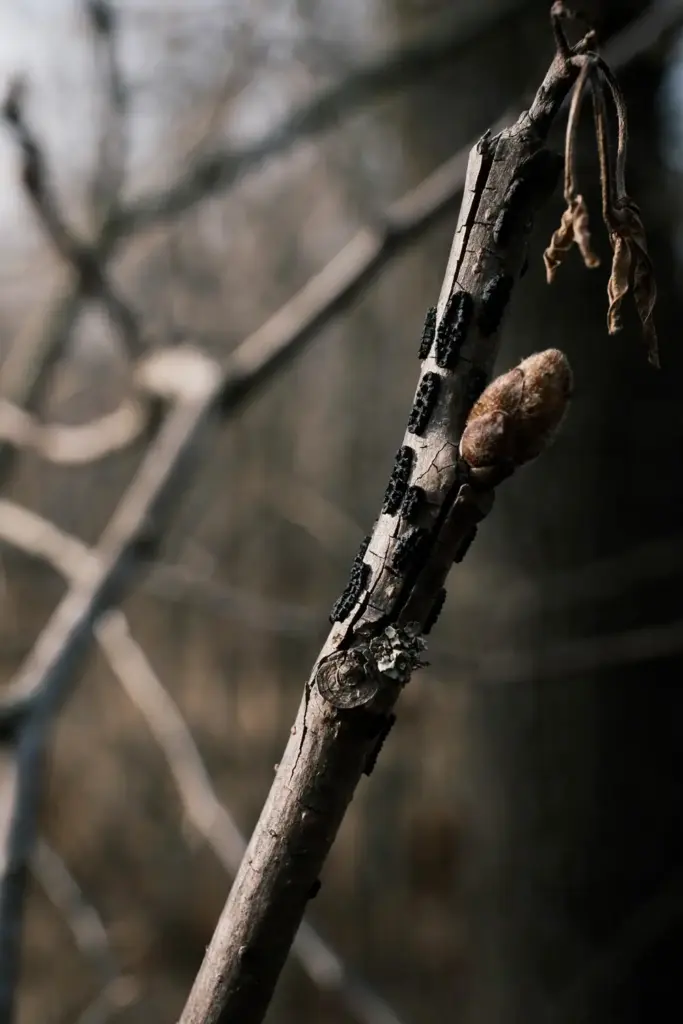
The fungus lives through winter as dark resting bodies inside old lesions on leaves, shoots, and shucks. Spring rain and wind move its spores onto fresh growth. Each spore needs wet tissue to germinate, and a leaf that never stays wet never catches it. Dry leaves stay clean. Wet leaves do not.
Infection stays invisible for days. Spots show up about one to two weeks after infection, according to the American Phytopathological Society review of the disease, which means the infection happened during a wet spell you already forgot. Rain you barely noticed did the damage.
The damage runs on a clock, and shell hardening is the hour hand. Shuck infections before shell hardening cause the greatest loss, because the nut stops filling and drops. Infection after the shell hardens is cosmetic. That split decides every spray choice in this plan.
Resistance helps, and resistance ends. Mississippi State University Extension notes that pecan trees can survive for 100 or more years, and that scab resistance may not last for the life of the tree. The fungus adapts. A cultivar that stood clean for a decade can start spotting. Plan for that day now.
How to Identify Pecan Scab on Leaves and Twigs
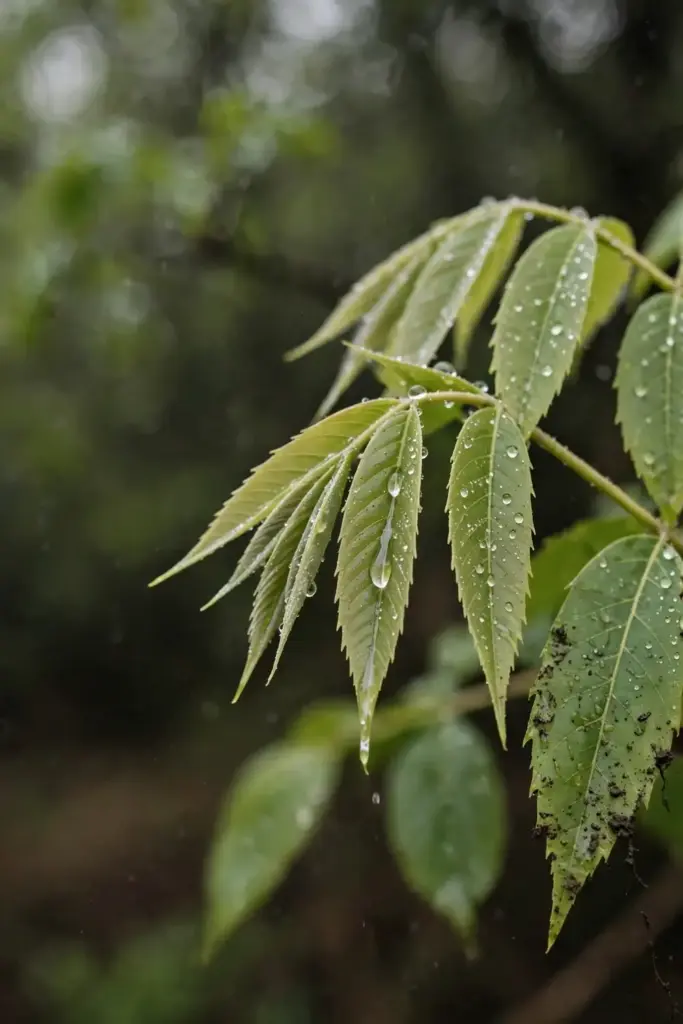
Pecan scab on leaves starts as small olive green spots that turn black. The spots sit along veins, often on the undersides of leaflets first. They range from pinpoint size to about 12 millimeters across, and the American Phytopathological Society review puts most lesions at 3 millimeters or less. Heavy infections merge into large dead patches.
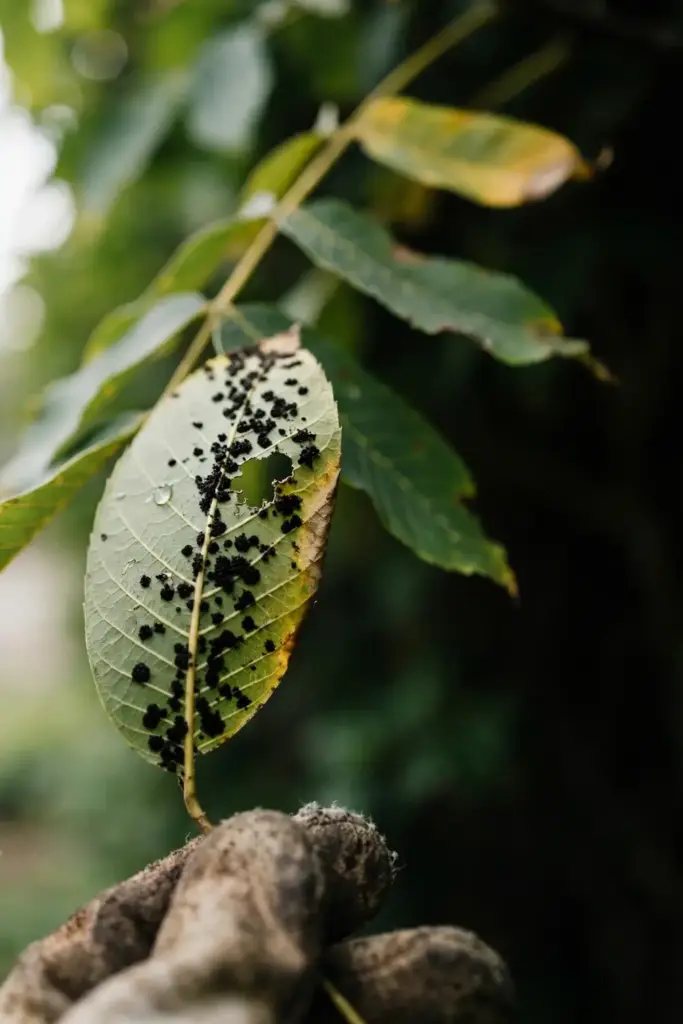
Old spots crack and fall out. That leaves a shot hole effect in the leaflet, a round hole where dead tissue dropped away. Leaflets with many merged spots yellow and drop early. A tree that defoliates in midsummer loses the leaves that feed the crop.
Check the undersides. Pecan leaflets hang in pinnately compound leaves with 9 to 17 leaflets, according to the Arbor Day Foundation. Flip a leaflet and look along the veins. Scab favors those veins. A leaf that looks clean on top can carry a full infection below.
Twigs tell the same story in a longer shape. Green twigs carry round or elongated black fuzzy lesions. The fuzz is the fungus fruiting. Older twig lesions turn crusty and black. Severe twig infection stunts the shoot and kills the buds at the tip.
New growth is the target. The fungus infects only immature tissue, so fresh spring growth and the current season shoots carry the load. Mature hardened leaves and wood resist infection. That is why the first flush after bud break matters more than any later flush.
How to Identify Pecan Scab on Shucks and Nuts
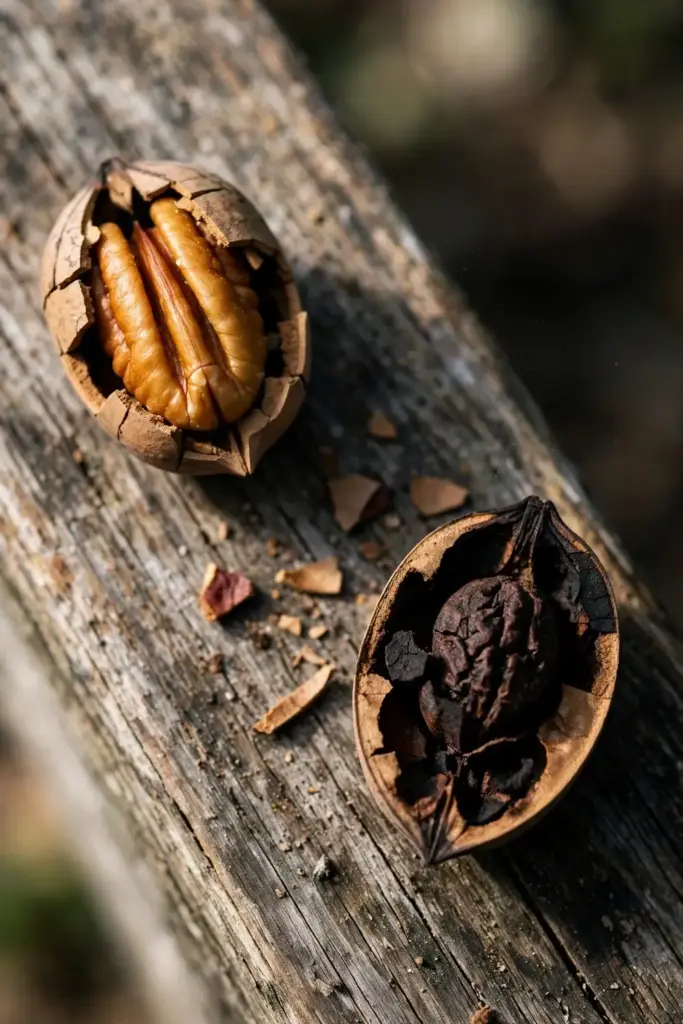
Pecan scab on shucks starts as small olive green to black sunken spots on the green husk. The spots grow together. A heavily infected shuck turns almost fully black. The nut inside stops filling.
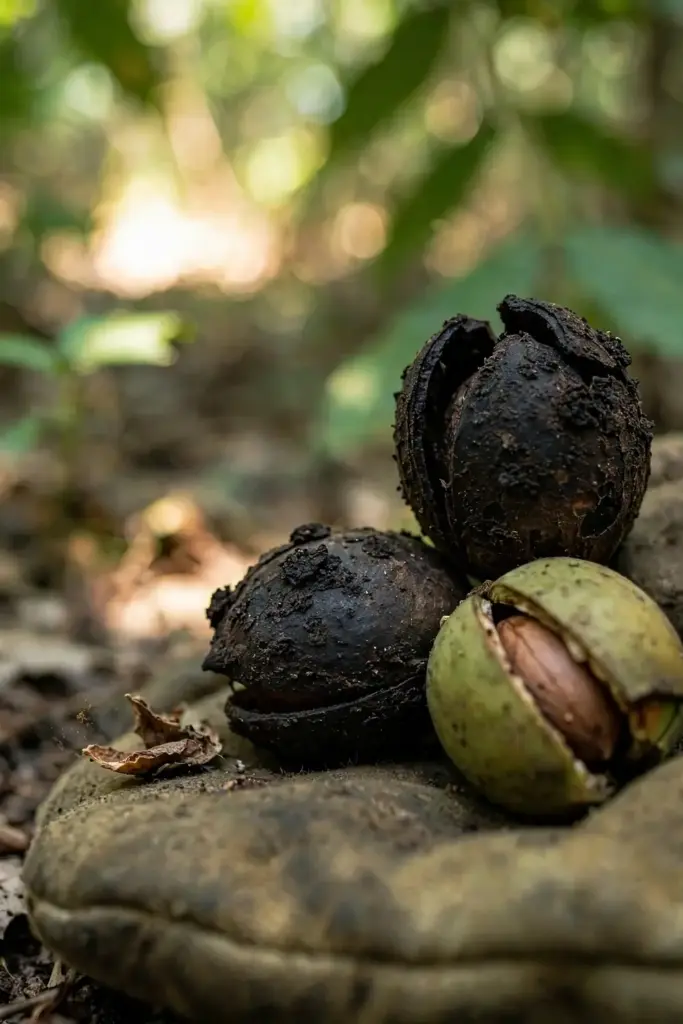
Shuck infection decides the harvest. Nuts infected early abort or drop. Nuts infected after shell hardening keep their kernels, with blackened shucks that look far worse than the damage inside. Crack a late infected nut before you judge it. The kernel often eats fine.
Watch for stick tights. A shuck that dies from scab can refuse to split and separate from the nut at harvest. The nut hangs on the tree in a dead black shuck. The University of Arkansas Extension describes stick tights as a direct result of shuck infection. Pick those nuts by hand. They will not drop clean.
Pink mold follows scab. The pink mold fungus enters through scab cracks and covers shuck surfaces with masses of pink spores. It can invade thin shelled kernels and leave an oily shell and a rancid smell, according to the University of Georgia Bugwood IPM toolbox. Control scab and pink mold stays away. Pink mold on its own almost never starts the trouble.
Harvest timing reads off the shuck. Healthy shucks split open and release the nut. Scab killed shucks stay shut. When more than a few shucks refuse to split, the crop already took its hit. The work shifts to cleanup and next season.
Which Pecans Get Hit Hardest by Pecan Scab
Susceptible cultivars sit at the top of the risk list. Desirable, Stuart, Pawnee, and Wichita carry heavy scab pressure in most years. A Desirable tree in a wet county without a spray program loses much of its crop. The tree survives. The nuts do not.
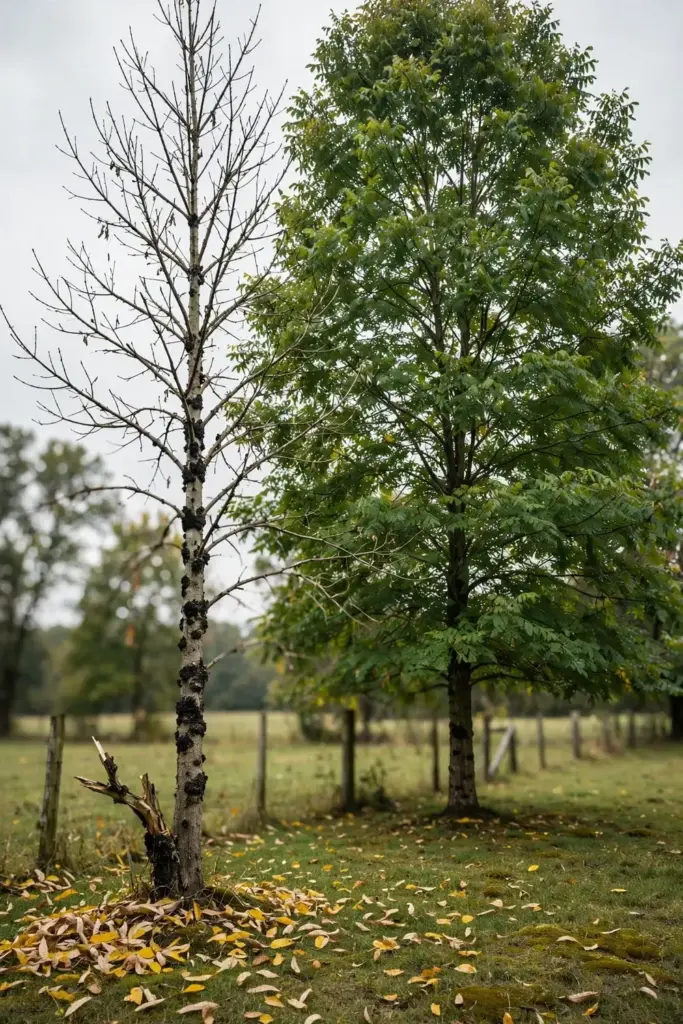
Resistant cultivars hold the bottom of the list. Elliott, Kanza, Lakota, Excel, Avalon, and McMillan sit in the low input group in the University of Georgia Extension fungicide schedules. Those trees need little or no scab spray in most years. Resistance is the single best decision a backyard grower makes.
Seedling and native pecans sit in the middle. Native trees carry mixed genetics, so some seedlings shrug scab off while neighbors defoliate. A native tree that fruits well for years without spray earned its place. A native tree that drops every crop did not.
Young trees carry less risk than bearing trees. A young nonbearing tree loses leaves to scab and keeps growing. A bearing tree loses leaves and nuts together. The University of Georgia Extension notes that most young nonbearing trees do not need fungicide applications. Feed and water the young tree. Save the spray decision for the bearing years.
Crowded trees carry more risk than open trees. A tree packed against a fence or a second pecan holds wet air in its canopy. Leaves stay wet longer after rain. Infection needs that wetness. Spacing and pruning cut risk before any product does.
Pecan Scab vs Powdery Mildew
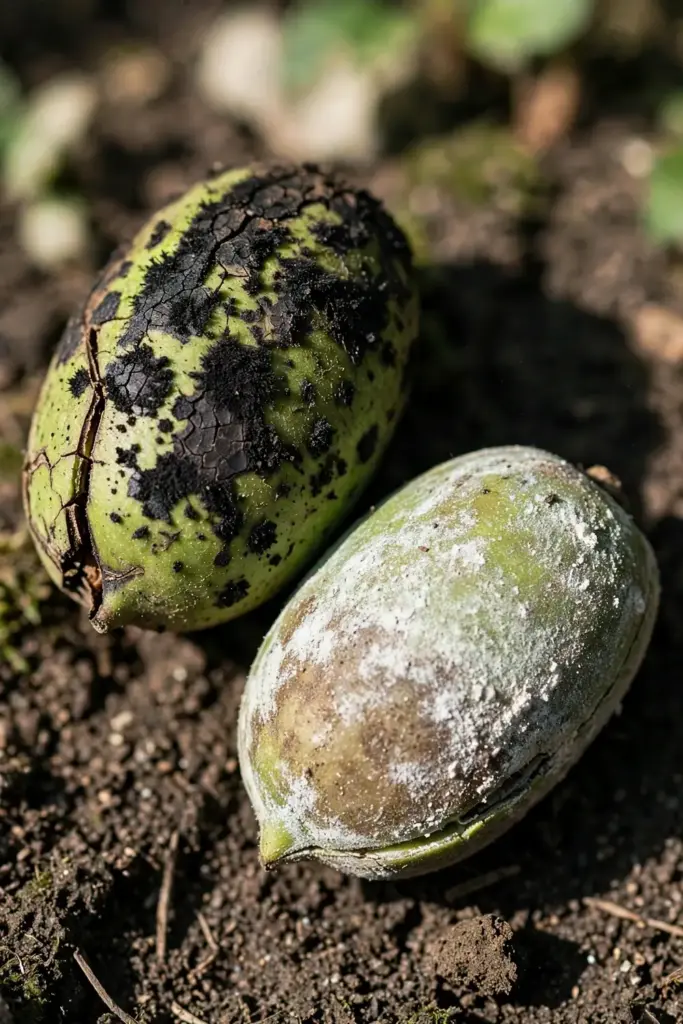
Color splits them first. Pecan scab makes black fuzzy lesions on leaves, twigs, and shucks. Powdery mildew makes a white powdery coating, mostly on nut shucks. A black spot is scab until proven otherwise. A white dusting is mildew.
| Clue | Pecan Scab | Powdery Mildew |
|---|---|---|
| Pathogen | Venturia effusa | Microsphaera penicillata |
| First sign | Olive green spots that turn black and fuzzy | White powdery coating on shucks |
| Plant parts hit | Leaves, green twigs, shucks, nuts | Mostly shucks, sometimes leaves |
| Lesion shape | Round or elongated spots, often along leaf veins | Flat surface coating, no sunken spots |
| Leaf loss | Heavy infection defoliates the tree | Rarely defoliates |
| Nut damage | Early infection aborts or shrivels nuts | Early infection can stunt nuts, late infection is cosmetic |
| Weather driver | Wet leaves, rain, high humidity | High humidity with mild temperatures, needs less free water |
| Economic weight | Most damaging pecan disease | Sporadic, rarely a significant economic problem |
| Control focus | Resistant cultivars, sanitation, timed fungicide | Scab program controls it by default, no separate spray usually needed |
| Season peak | Bud break through shell hardening | Mid to late summer |
Powdery mildew stays a minor player. The LSU AgCenter notes that the white growth fades within weeks, the shucks take a brownish cast, and specific fungicide application for powdery mildew is not usually recommended. A regular scab program handles it. A white coating alone never justifies a separate spray schedule.
Downy spot is the third leaf spot to know. Downy spot makes greenish yellow spots, about one eighth to one quarter inch across, that show on leaf undersides in late summer. The University of Arkansas Extension home pecan guide describes downy spot as a leaves only disease that appears in late June or early July. It never touches nuts. Spots on nuts rule downy spot out.
Late season shuck blackening has two more causes. Shuck dieback blackens the shuck from the tip down, and stem end blight blackens it from the stem end up. Both arrive from mid August through October. The LSU AgCenter notes that stress such as heavy crop load, low sunlight, and crowding drives shuck dieback, and that season long fungicide applications do not reduce it. Shuck dieback nuts stay stuck on the tree. Stem end blight nuts drop or pull loose with ease.
Sunken oozing cankers point away from scab entirely. The bacterial canker guide shows what true cankers look like on fruit trees. Scab lesions sit on the surface and feel crusty. Cankers sink in and ooze. The two need different responses.
Why Wet Leaves Drive Pecan Scab
Pecan scab is a wetness disease. The spore lands, germinates in free water, and enters the young tissue. No wetness means no infection. Every control in this plan either keeps tissue dry or protects tissue during wet hours.
Temperature sets the speed. The University of Georgia Extension puts the optimum range for scab infection at 59 to 77 degrees Fahrenheit, with about 12 hours of leaf wetness. Cooler weather slows it. Hot dry weather stops it. The danger window is warm rain.
Scab hours turn wetness into a number. The Arkansas Agricultural Experiment Station defines one pecan scab hour as one hour with temperature above 70 degrees Fahrenheit and relative humidity above 90 percent. Oklahoma State University Extension advises a spray for highly susceptible cultivars after 10 scab hours accumulate, for moderately susceptible cultivars after 20, and for resistant or native trees after 30, each measured over 14 days or since the last spray.
Leaf age sets the window. In a 1998 Phytopathology study, Wichita leaves stayed susceptible to infection from 2 to 23 days after bud break, while resistant Sumner leaves stayed susceptible from 2 to 18 days. Infection frequency, lesion size, and spore production all fell as leaves aged. Young leaves catch it. Old leaves shrug it off.
Repeat cycles build the epidemic. One lesion produces spores that infect the next flush. Warm wet weeks stack cycles on top of each other. That is why a wet May does more damage than a wet September. May has young tissue everywhere. September has hardened tissue and hardening shells.
What Makes Pecan Scab Worse in a Home Garden
Rainy springs top the list. Frequent rain keeps leaves wet through the susceptible weeks after bud break. Heavy fog adds wetness without a single raindrop. Mississippi State University Extension notes that heavy fog alone can supply the moisture infection needs. A foggy spring is a scab spring.
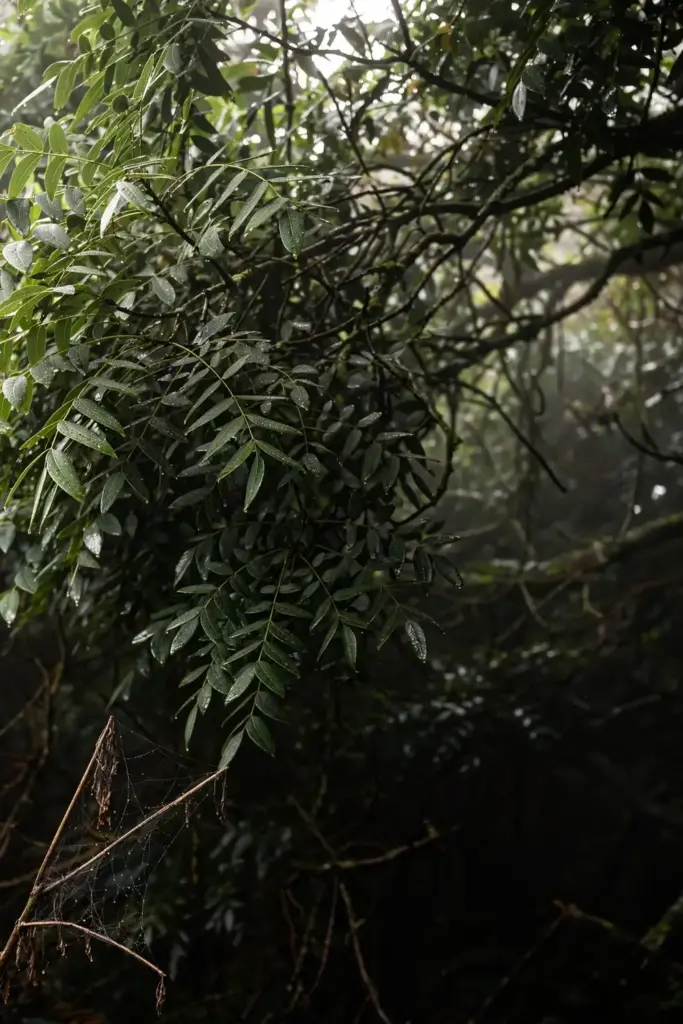
Crowded canopies come next. Branches that touch hold damp air. Leaves in the interior of a dense canopy dry hours later than leaves on the outside. The interior becomes the infection nursery. Thinning the canopy dries it from the inside out.
Low vigor adds risk. A tree short on water or nutrients grows weak tissue and drops leaves early. The University of Arkansas Extension notes that low fertility makes trees more susceptible to disease and reduces fruit set. A hungry tree fights scab with one hand tied.
Fallen debris carries the fungus forward. The fungus overwinters in infected leaves, shucks, and twigs on the ground and on the tree. A yard that keeps last season’s fallen shucks under the tree hands the fungus a starting position in spring. Raking breaks that chain.
Susceptible cultivar choice locks the pattern in. A Desirable tree in a wet county needs a full spray program every year. An Elliott tree in the same yard needs little. The cultivar decision, made once at planting, outweighs every spray decision that follows.
Step 1: Decide Whether Spraying Your Pecan Tree Is Worth It
Measure the tree before you buy a sprayer. A mature pecan reaches 70 to 100 feet tall with a spread of 40 to 75 feet, according to the Arbor Day Foundation. No homeowner sprayer covers that canopy. Coverage decides fungicide success. A half covered canopy is a half protected canopy.
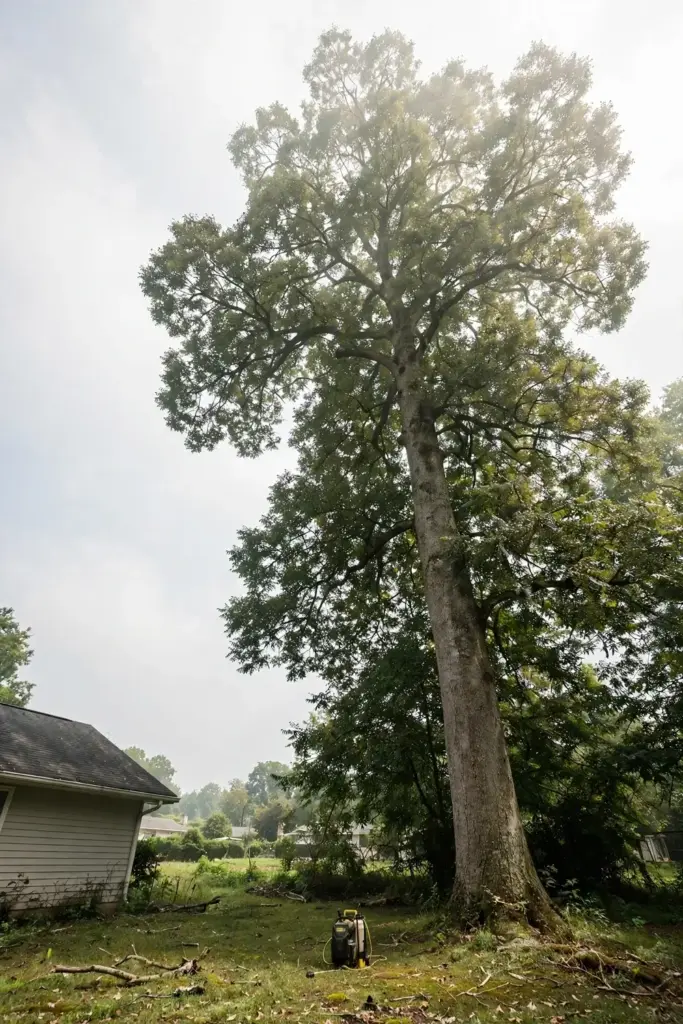
Mississippi State University Extension states the limit plainly. Due to limits with fungicide and equipment availability, a homeowner spray program for pecan scab is generally not feasible, and this is particularly true for large trees. Read that twice before spending money. The extension service is telling backyard growers that spraying a big pecan rarely works.
Run the honest math. A young tree under 20 feet can take a backpack sprayer and full coverage. A mature tree needs an air blast sprayer, a ladder, and a calm windless morning, repeated from bud break through shell hardening. Most homeowners own none of that. Hiring an arborist changes the math, and the bill lands every season.
Choose the lane that fits the tree. A small young tree can run a spray program. A tall mature susceptible tree cannot. The rest of this plan serves the second tree: resistant replanting where it counts, sanitation, airflow, and harvest discipline. Those moves cost labor, not equipment.
Keep the tree for shade if the nuts fail. A pecan that drops its crop still shades a yard, feeds squirrels, and drops leaves for compost. A tree that earns its place as shade does not need to justify itself with nuts. The spray decision gets easier once shade counts as a win.
Step 2: Plant a Resistant Cultivar Before You Plant Anything Else
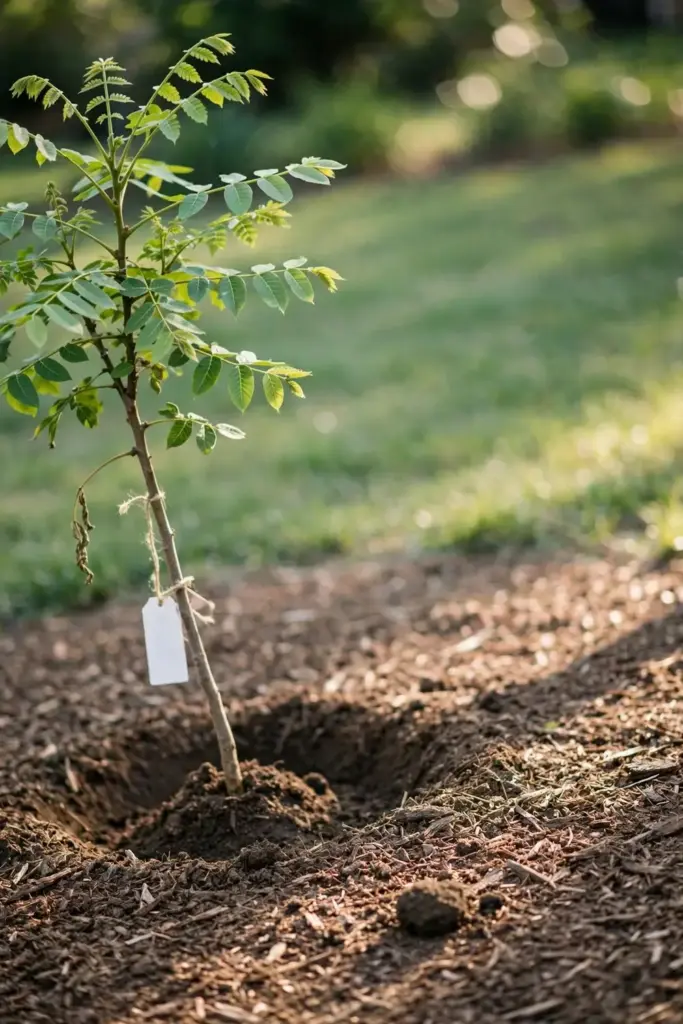
Start with the low input list. The University of Georgia Extension groups Avalon, Elliott, Excel, Kanza, Lakota, and McMillan as low input cultivars with a high degree of scab resistance. Those trees need at most 3 fungicide applications in a season, mostly for minor diseases rather than scab. Plant one of those and the scab problem shrinks to a side note.
Skip the high input list for backyard planting. The same schedules group Byrd, Cunard, Desirable, Morrill, Pawnee, and Treadwell as high input cultivars. Those trees need a full commercial spray program to hold a crop. A backyard without an air blast sprayer cannot deliver it. Buying Desirable for a backyard is buying a spray bill.
Match the cultivar to the county. Mississippi State University Extension lists Elliott, Melrose, Owens, and Kiowa among scab resistant picks for home landscapes in Mississippi, with notes on which fit north and south regions. Local extension lists beat national catalogs. A cultivar that resists scab in Georgia can struggle in a wetter county.
Buy from a nursery that names the cultivar. A bin labeled pecan tree hides the one fact that matters. The tag must carry the cultivar name. No name means no resistance claim. Walk away from unnamed trees.
Expect resistance to fade. Mississippi State University Extension warns that resistance is not a forever guarantee across a tree that can live a century. A resistant tree that starts spotting after years of clean performance is normal. Sanitation and airflow then carry more weight, and a second cultivar choice looms in the far future.
Step 3: Rake and Remove Fallen Leaves, Shucks, and Nuts
Rake the ground under the tree every fall. Fallen leaves, shucks, and nuts carry the fungus into winter. The fungus waits in that debris and releases spores onto spring growth. Removing the debris removes the starting inoculum.
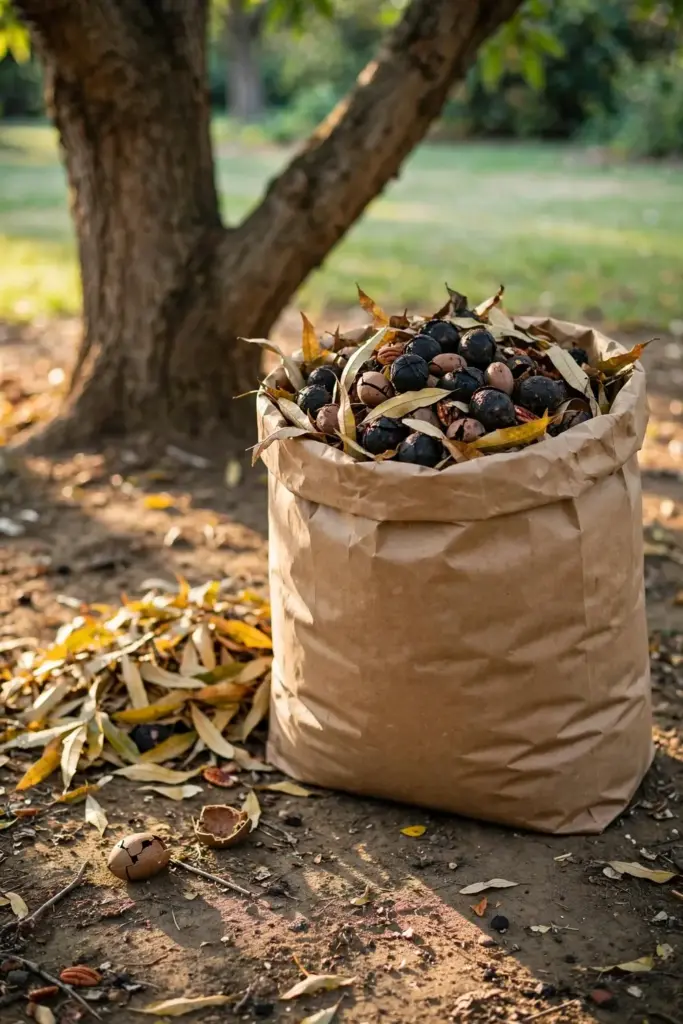
Bag the debris for municipal waste. Home compost piles rarely sustain the heat that kills fungal resting bodies. Composting scabby leaves and shucks seeds next season’s beds with the same fungus. The pile feels tidy. The fungus survives it.
Strip stick tights and mummified nuts from the tree. Shucks that died and clung to branches through winter hold the fungus above ground. Pull them down during dormant pruning. A tree that enters spring clean starts the season behind on infection, and behind is where you want it.
Clean the ground before bud break. Spring spores launch from debris within days of bud break. A late winter cleanup beats an early spring cleanup. Set the rake date by the buds, not by the calendar. When buds swell, the debris must already be gone.
Work the drip line, not just the trunk, because fallen leaves drift outward to the canopy edge and the debris ring there holds as much fungus as the pile near the trunk. Rake the full circle.
Step 4: Prune for Sunlight and Airflow
Prune in late winter while the tree stands bare. Bare branches show the structure. Crossing limbs, dead wood, and inward growing shoots stand out. Cut those first. Sunlight must reach the interior leaves.
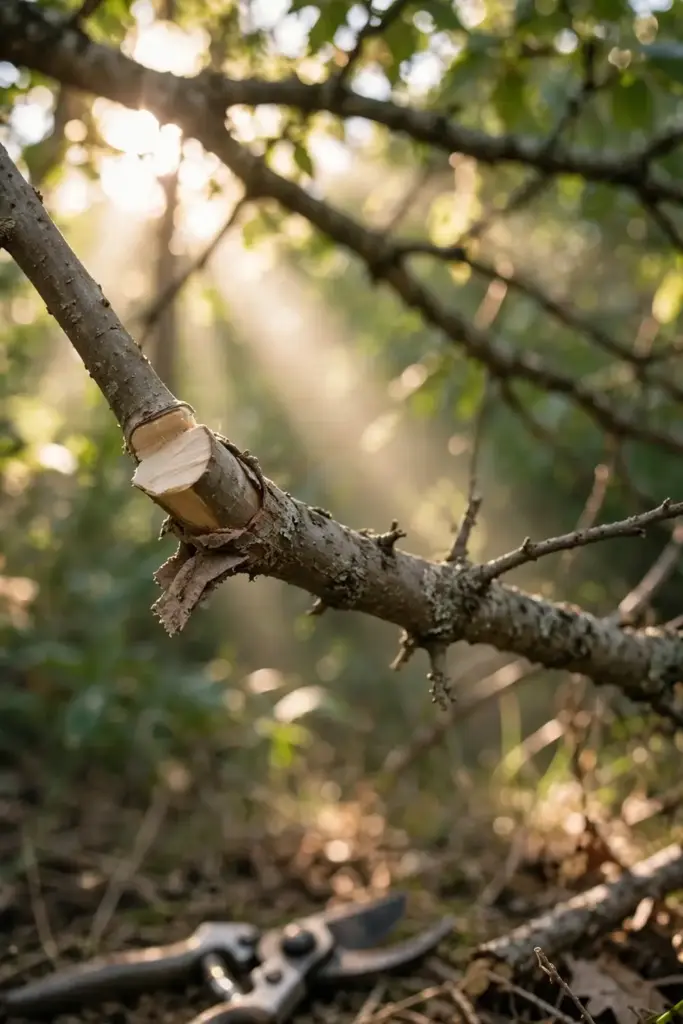
Open the center. A pecan canopy needs air moving through it. Remove one or two large crossing limbs rather than a dozen small twigs. Big cuts open real airflow. Small cuts tidy the outline and change nothing.
Keep cuts clean and small, cutting at the branch collar with no stubs left behind. A stub dies back. The wound heals slowly. The spring pruning techniques guide walks through clean cut placement for fruit trees in practical detail.
Sanitize tools between trees. Wash soil and sap off blades, then wipe with a disinfectant. A pruning saw that carried sap from a sick tree can carry fungus to the next tree. Clean tools cost two minutes. Dirty tools cost a season.
Step back after every third cut. A pruned tree should look open, not stripped. If sky shows through the canopy in patches, the cut count is right. If the tree looks like a pole, stop. Overpruning pushes weak regrowth that scab colonizes with ease.
Step 5: Give the Tree Full Sun and Room to Dry
Plant new trees in full sun. Mississippi State University Extension advises choosing a site with good sunlight when planting new pecan trees in the landscape. Sun dries leaves fast after rain. Shade holds dew past noon. A tree in full sun dries hours earlier than a tree under a fence shadow.
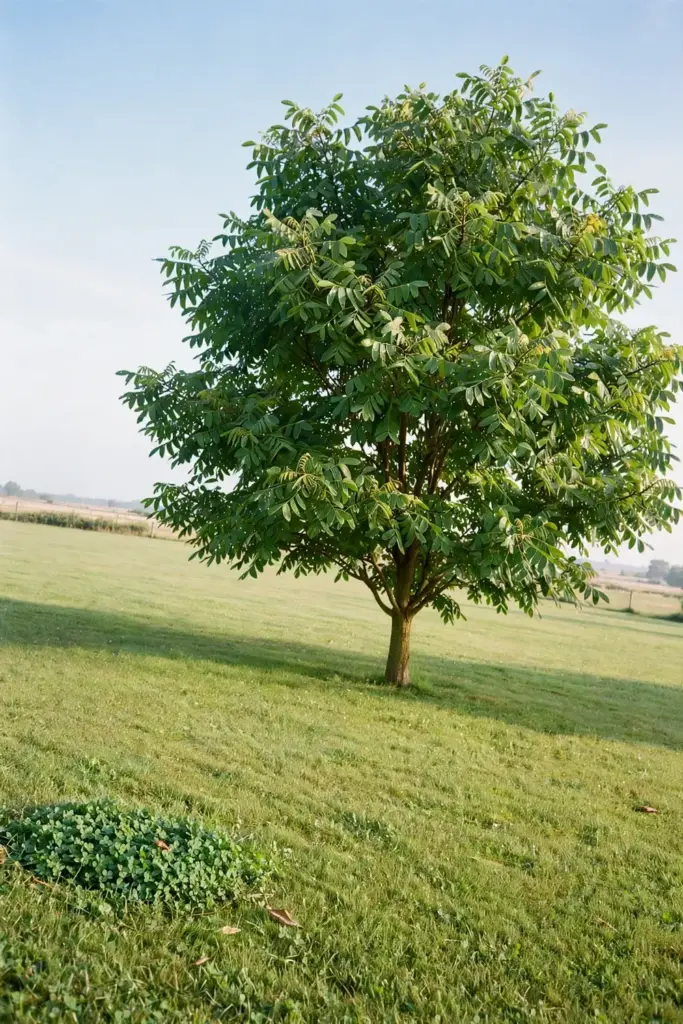
Space trees wide. A mature pecan spreads 40 to 75 feet, according to the Arbor Day Foundation. Two trees planted 30 feet apart grow into one damp canopy. Plant at 60 feet or more between pecans, and keep the canopy clear of buildings and other trees. Airflow is spacing.
Clear the understory. Shrubs and tall grass under the canopy trap humid air at ground level. Mow under the tree. Keep mulch thin and away from the trunk. A clear floor lets morning air move through and dry the lower leaves.
Thin a crowded grove. A grove planted too tight needs thinning, not spraying. Remove the weakest tree and the remaining trees dry faster. The cut tree becomes firewood and mulch. The standing trees gain light, air, and a real harvest.
Step 6: Time Sprays Around Bud Break and Scab Hours
Start at bud break. The first susceptible tissue appears with the first leaves. A spray program that starts at full leaf already missed the first infection cycle. Bud break is the starting gun. Mark it on the calendar each spring.
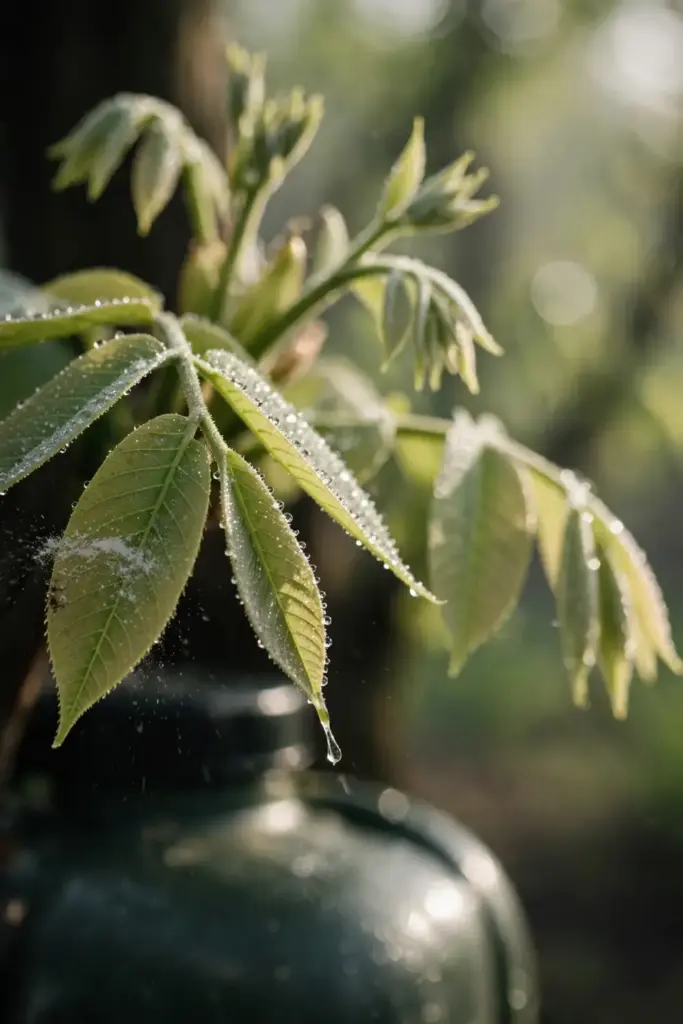
Protect tissue until shell hardening. Mississippi State University Extension notes that immature tissue stays present through most of the season until fall, when nuts stop increasing in size. Sprays must cover that whole window on susceptible cultivars. A gap in June invites the July epidemic.
Use scab hours to time sprays. Count hours above 70 degrees Fahrenheit with relative humidity above 90 percent. Oklahoma State University Extension advises a spray for highly susceptible cultivars after 10 such hours, for moderately susceptible cultivars after 20, and for resistant or native trees after 30, each tallied over 14 days or since the last spray. A county scab hour tool, where one exists, does the counting for you.
Space applications 2 to 3 weeks apart. A 2024 study in BMC Genomics describes fungicide application at 2 to 3 week intervals through the growing season as the main management practice for pecan scab. Rain washes protectant fungicides off. A heavy storm can end an interval early. Reapply after a washout rain on a susceptible tree.
Match the program to the cultivar. University of Georgia Extension fungicide schedules put low input cultivars at 3 applications at most, while high input programs run far longer through the season. A resistant tree needs a short program. A susceptible tree needs a long one. Spraying a resistant tree on a susceptible schedule wastes money and chemistry.
Rotate fungicide groups. Repeated use of one fungicide group breeds resistant fungus. The American Phytopathological Society review documents fungicide resistance in Venturia effusa as a live field problem. Alternate chemical groups across the season, and read the label for the group number. One group all season is a resistance program, not a control program.
Step 7: Add Nickel to the Spray Program
Spray nickel with the fungicide. Nickel is a pecan micronutrient, and timely foliar nickel sprays raise the tree’s own resistance to scab while poisoning the fungus on the surface. It is a nutrition move that doubles as disease work.
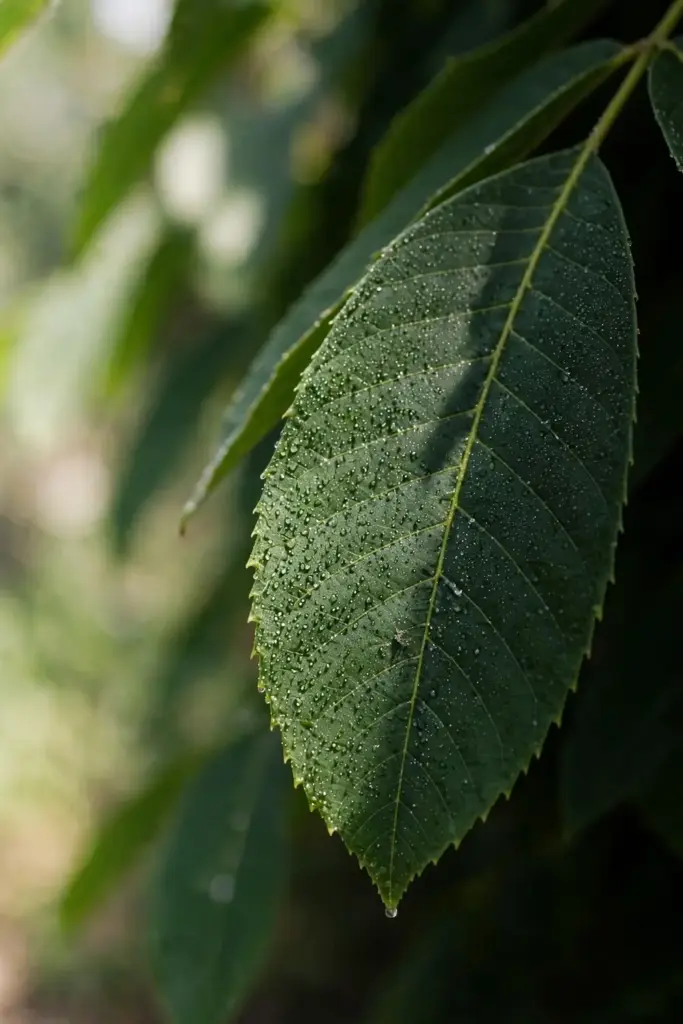
The numbers come from USDA research. USDA Agricultural Research Service scientists found that adding nickel to fungicide sprays cut scab severity on Desirable fruit by 6 to 52 percent, and that fruit weight and kernel filling improved with the disease control. The wide range reflects cultivar and timing. Nickel helps most on trees with intermediate resistance. Highly susceptible trees respond least.
Apply nickel early and on schedule. ARS work used foliar sprays timed with the fungicide program, starting around bud break and continuing through the season. A single nickel spray is a token. Nickel rides the same schedule as the fungicide, or it does not earn its keep.
Ask the local extension office about rates. Nickel products and rates vary, and excess nickel burns leaves. A soil or leaf tissue test shows whether the tree even needs nickel. A tree with adequate nickel gains less from the spray. Test first, then spray.
Keep nickel in its lane. Nickel supports the spray program. It never replaces it. A nickel spray on an unsprayed susceptible tree still loses the crop in a wet year. Nickel is the assist, not the team.
Step 8: Feed the Tree and Fix the Soil
Test the soil before you feed it. A soil test reports pH and nutrient levels, and pecan trees want fertile, well drained soil. A ten dollar test beats a season of guessing. Retest every two to three years.
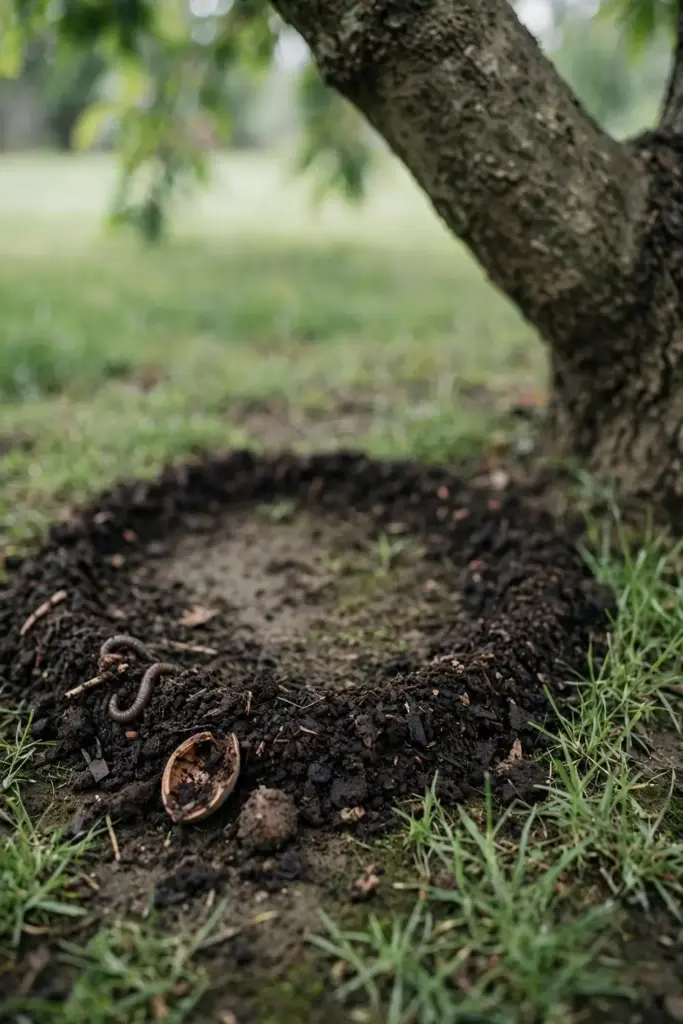
Feed by the test, not by habit. The University of Arkansas Extension notes that low fertility makes trees more susceptible to disease and cuts fruit set. A hungry tree drops nuts early and grows thin leaves that scab colonizes fast. The test result sets the fertilizer rate. The calendar does not.
Water through dry spells. A pecan in drought stress drops nuts and stops filling kernels. Deep watering during hot dry weather keeps the tree vigorous. Vigor is disease defense. A wilted tree fights nothing.
Build the soil under the tree. The soil health guide walks through structure, organic matter, and drainage in practical detail. Compost spread in a thin ring under the drip line feeds the soil food web. Mulch holds moisture. Both keep the root zone steady through summer heat.
Skip heavy nitrogen in a scab year. Fast soft growth from excess nitrogen gives the fungus fresh susceptible tissue. Feed for steady growth. A tree that grows evenly through the season presents less soft tissue at any one time.
Step 9: Harvest Early and Sort Hard
Pick up nuts the day they drop. Nuts on damp ground mold fast. Wet ground grows pink mold on scab cracked shucks within days. A daily pickup during peak drop keeps the crop clean. A weekly pickup surrenders the first nuts to rot.
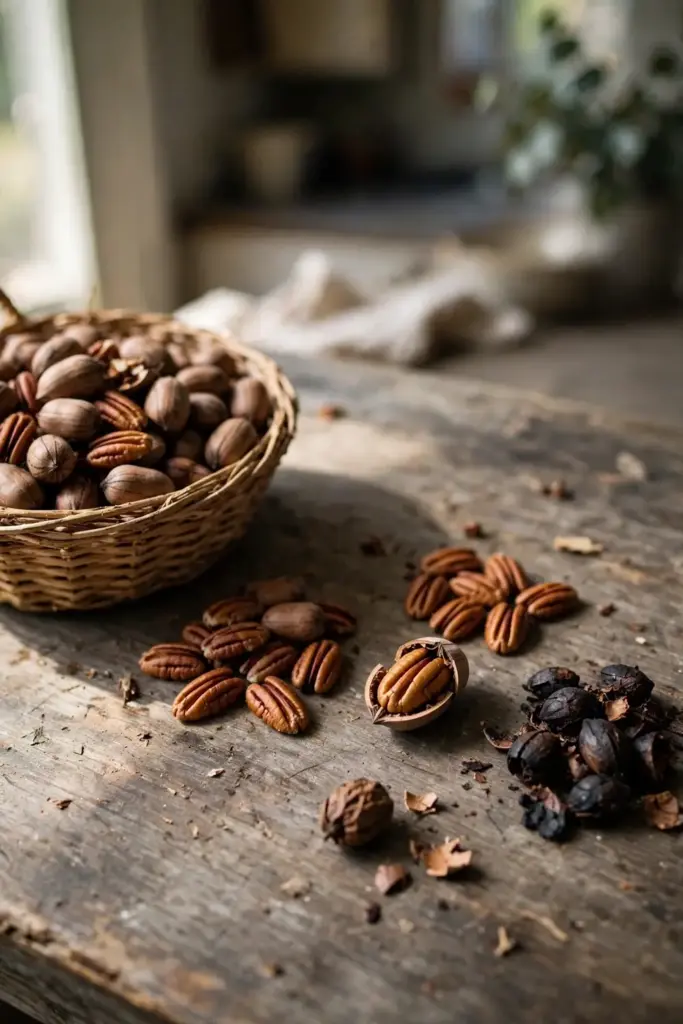
Dry nuts fast after harvest. Spread nuts in a thin layer in a dry airy room. Turn them daily. Pecans that stay damp in a sack grow mold and turn rancid. Dry nuts keep for months. Damp nuts keep for days.
Sort hard at the table. Crack a sample from each batch. Discard nuts with shriveled kernels, pink spore masses, or rancid smell. Scab blackened shucks alone do not condemn a nut. The kernel decides. A plump clean kernel from a blackened shuck eats fine.
Separate the suspect batch. Nuts from a heavily scabbed tree go in their own bag. Taste and crack a larger sample before mixing them with clean nuts. One moldy nut in a storage bag spreads its smell to the rest. Keep suspect nuts apart until they prove themselves.
Freeze the keepers. Shelled pecans freeze well for a year. In shell pecans hold for months in a cool dry room. Heat and air are the enemies. A freezer bag with the air pressed out beats a bowl on the counter.
Step 10: Confirm the Diagnosis With Your Local Extension Office
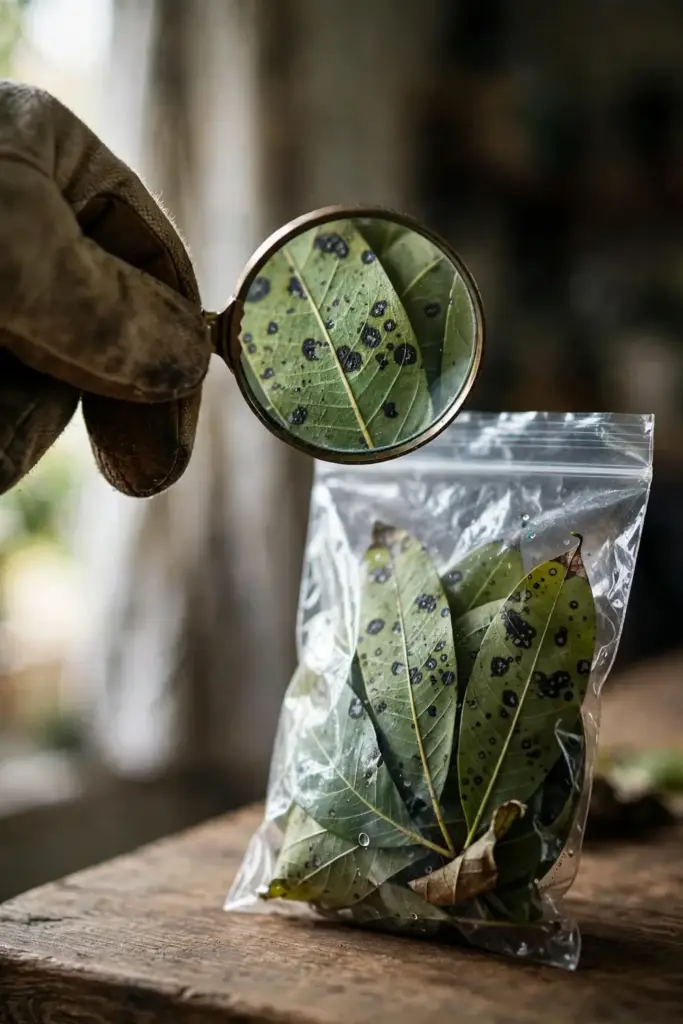
Send a sample before you spend. A county extension office or plant diagnostic clinic names the disease from a real specimen. Bag fresh symptomatic leaves and shucks in a sealed plastic bag. Keep the sample cool. Include a note on the cultivar, the tree age, and when the spots first appeared.
Ask for the cultivar list. The local office knows which cultivars hold up in the county and which fail. County data beats catalog copy. A cultivar that resists scab in Georgia can fail in a wetter county two states away. Local lists carry that difference.
Ask about spray rules. Some towns restrict sprayer use near neighbors, wells, and waterways. Some fungicides carry buffer rules. The extension office knows the local rules. A spray program that breaks a local rule costs more than the nuts are worth.
Bring the whole picture. Tell the office about the tree height, the spray equipment available, and the budget. The advice for a 15 foot tree with a backpack sprayer differs from the advice for a 90 foot tree with no equipment. Honest constraints produce usable advice. Vague questions produce vague answers.
Living With Pecan Scab on a Tree You Already Own
A scabby pecan is not a dead pecan. It is a managed pecan. The tree still shades the yard, still drops leaves for compost, and still fruits in dry years. A bad scab year is a bad nut year, not a dead tree.
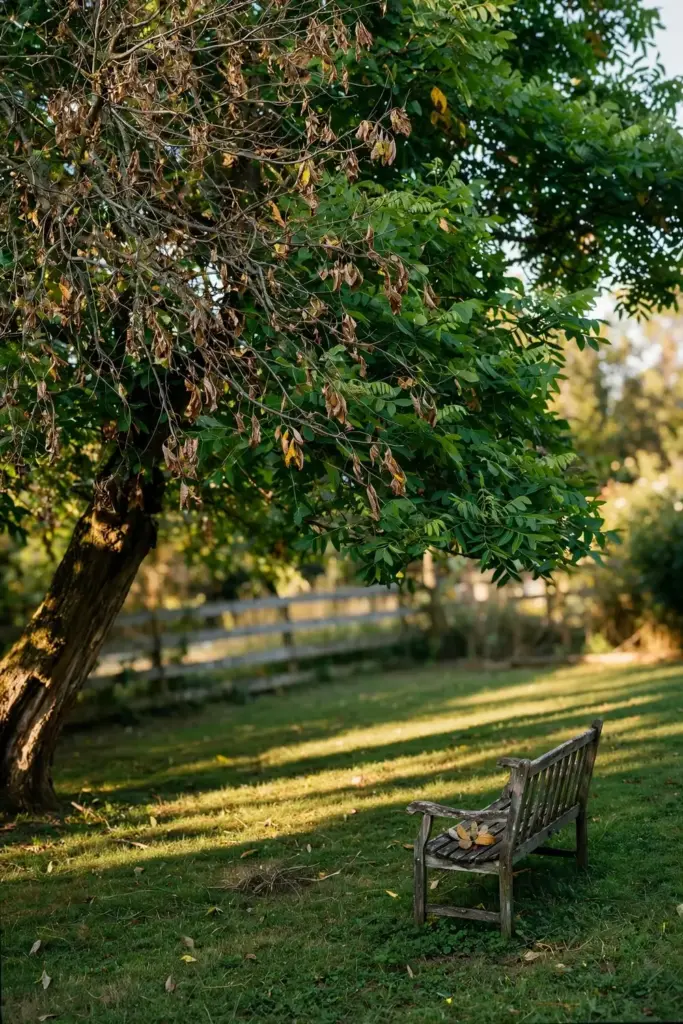
I have learned that a backyard pecan tree pays back patience, not spray volume.
Shift the goal from clean nuts to good years. A susceptible tree gives a real crop in dry springs and a thin crop in wet springs. Accept that rhythm. Plant a resistant cultivar nearby for the wet years. Two trees with different resistance levels beat one tree sprayed halfway.
Stop three habits. Do not leave fallen shucks under the tree through winter. Do not spray a 90 foot tree with a garden hose sprayer and call it coverage. Do not plant a second susceptible cultivar next to the first one. Each habit feeds the same cycle.
Keep a tree notebook. Write down the cultivar, the first spot date, the spray dates, and the harvest weight. Memory fades. The fungus does not. A notebook that shows three wet springs in a row argues for a resistant replant louder than any article can.
If the shuck blackening starts at the tip in late summer and no spray helps, the late season shuck disorder complex fits that problem better than scab. Shuck dieback answers to stress relief, not fungicide.
Frequently Asked Questions
Rarely. Pecan scab defoliates trees, stunts shoots, and wipes out nut crops, but established trees survive and leaf out again the next spring. Repeated severe defoliation weakens a tree over years and cuts growth. Young trees suffer more than mature trees. Death from scab alone is uncommon. The real loss is the crop, not the tree.
Yes, if the kernel looks and smells sound, because pecan scab is a plant disease, not a human one. Crack the nut and inspect the kernel. Discard kernels that are shriveled, pink, moldy, or rancid. A blackened shuck alone does not condemn the nut. Late season shuck infection is cosmetic and leaves the kernel intact, so wash and dry the keepers as usual.
No. Fungicides protect healthy tissue from new infection. They cannot heal lesions that already formed. A sprayed tree still shows old spots. The new growth after the spray stays clean if coverage holds. That is why timing beats chemistry. A spray that lands before a wet spell protects. A spray that lands after the spots appear only guards the next flush.
Every 2 to 3 weeks from bud break through shell hardening on susceptible cultivars, with reapplications after washout rains. Low input resistant cultivars need at most 3 applications in a season, mostly for minor diseases. Tall trees that cannot be covered fully should not run a spray program at all. Sanitation, airflow, and a resistant cultivar carry those trees instead of a sprayer.
Data not available. No university extension program lists neem oil as a pecan scab control. Extension schedules use protectant and systemic fungicides with proven activity against Venturia effusa, timed from bud break through shell hardening. Home remedies get asked about every season. The honest answer is that neem has no trial data behind it for this disease. Do not rely on it for a susceptible tree.
Replace the tree when it loses most of its crop in most years despite sanitation and airflow work, and when the tree is small enough that removal costs less than a decade of failed crops. Keep a big shade tree even if the nuts fail. Shade is a real return. Plant the replacement as a resistant cultivar nearby, and let the old tree shade the yard while the new tree grows into production.
Where to Go From Here
Pecan scab rewards fast identification and honest equipment math. Confirm the black fuzzy lesions on leaves, twigs, and shucks. Decide whether the tree can actually be sprayed. Then work the sequence: rake, prune, space, time sprays by scab hours, add nickel, feed the soil, and sort the harvest hard.
Next season, start clean. Raked ground, an open canopy, and a resistant cultivar will prevent more pecan scab than any product treats. The blossom blight guide is a useful companion read if you are building a broader disease identification habit, since it trains the same look closely at symptoms approach.