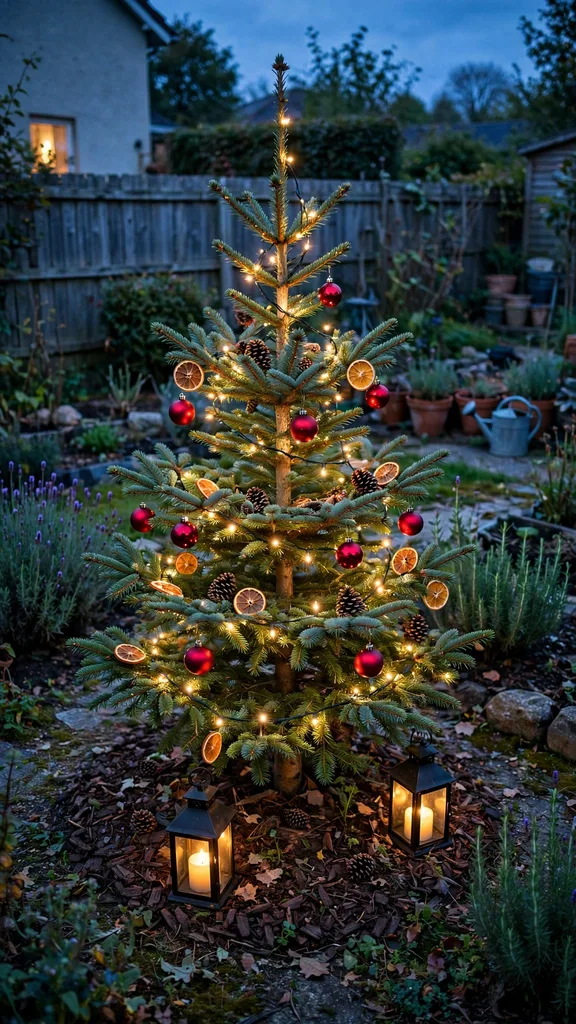
A living Christmas tree in the garden takes decoration differently from a cut tree indoors: everything on it must be light, loose, weatherproof, and kind to bark, buds, and the birds that use the tree all winter. These 45 ways to decorate a living Christmas tree in your garden follow three rules all the way through. Nothing screws, nails, or cuts into the tree. Nothing heavy hangs on young growth. And everything comes off in January without a trace, leaving the tree to grow on as if December never happened.
Choose a tree that can carry the show: a young spruce, fir, pine, or holly with sturdy lower branches and a shape worth lighting. Work from the lights outward, because lights are the hardest layer to adjust once ornaments go on, and decorate the side the house and street actually see rather than spending ornaments on the back. I decorate the garden spruce the first dry weekend of December and take it down on the first dry weekend of January, and the tree has never noticed either event. Every idea below names its weather limit, because a living tree stands in real weather for a month.
| Decoration | Best For | Tree Impact | Weather Limit |
|---|---|---|---|
| LED string lights | Every living tree | None when wrapped loose | Outdoor-rated sets only |
| Solar string lights | Trees far from outlets | None | Needs winter sun on the panel |
| Suet and seed ornaments | Bird gardens | None, removed as eaten | Cold weather only |
| Dried citrus slices | Sunny, sheltered trees | None | Fade and soften in long rain |
| Shatterproof baubles | Windy gardens | Light if kept small | Storm-proof when wired on |
| Lanterns at the base | Dark garden corners | None | Real candles need watching |
1. LED String Lights, Wrapped Loose and Wide
Lights are the base layer, and LED strings are the only sensible choice on a living tree: they run cool, shrug off knocks, and draw so little power that several strings run from one outdoor outlet. Wrap them in wide, loose spirals from the trunk outward along the branches, never winding tight around a branch, because a tight wrap becomes a girdle as the tree grows and the wire bites. Leave every loop slack enough to slip two fingers under.
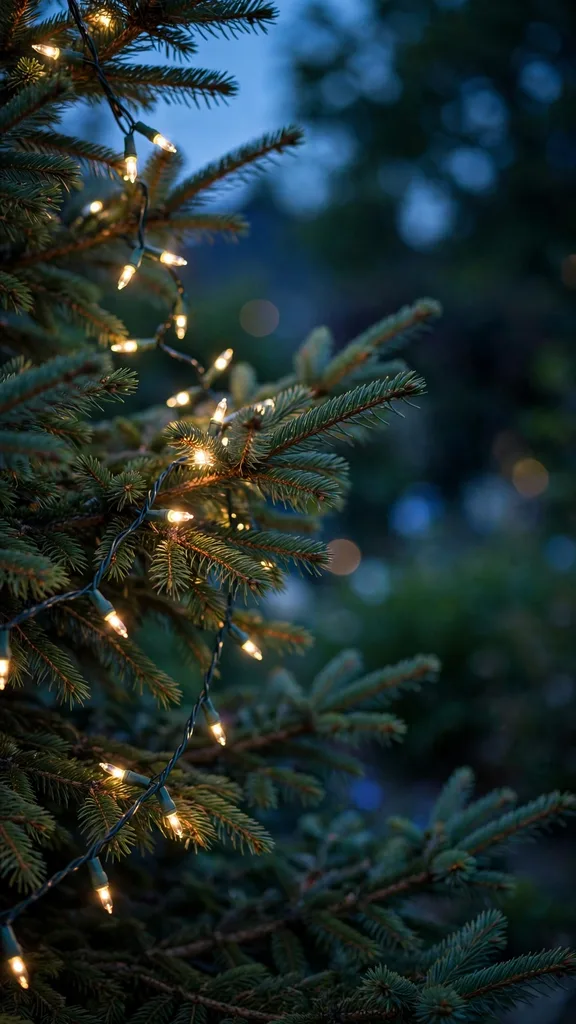
The U.S. Consumer Product Safety Commission’s holiday safety guidance sets the electrical rules that apply outdoors: use only lights tested by a recognized laboratory, check the label certifies the set for outdoor use, and plug outdoor displays into circuits protected by ground fault circuit interrupters. Fasten strings to supports securely against wind rather than pinning them with anything that pierces bark. Follow those rules and the lights are the safest layer on the tree.
2. Solar String Lights for Trees Far From Outlets
A tree at the garden’s far end has no outlet, and solar strings solve it: a small panel on a stake at the tree’s sunny side charges by day and the string lights the tree at dusk. December sun is weak and days are short, so expect four to six hours of light rather than all night, and place the panel where it catches midday sun clear of the tree’s own shade. Clean the panel weekly; a film of grime halves its charge.
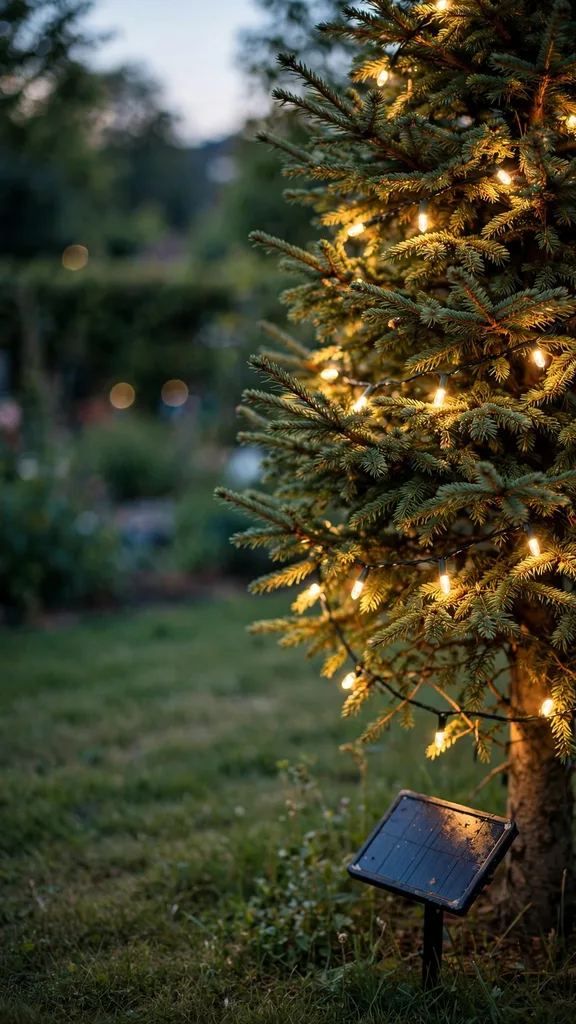
Solar strings suit gentle displays rather than bright ones, and their dimmer glow flatters a living tree. Choose sets with replaceable batteries and outdoor ratings, and bring the battery pack under a branch junction or a small cover so rain does not sit in it. In very dark northern gardens, solar strings work best as the second layer over a wired main string on a nearer tree, marking the far tree as part of the scene.
3. Net Lights Draped Over Small Conifers
Net lights were made for shrubs, and a small conifer wears one like a lit blanket: drape the net over the top and let it fall evenly on all sides. The even spacing that takes an hour to fake with strings comes free with a net, and removal in January is one lift. Keep the net off the very top growth so the leader is not bent under the mesh, and anchor the bottom corners with stones rather than pins in the ground near roots.
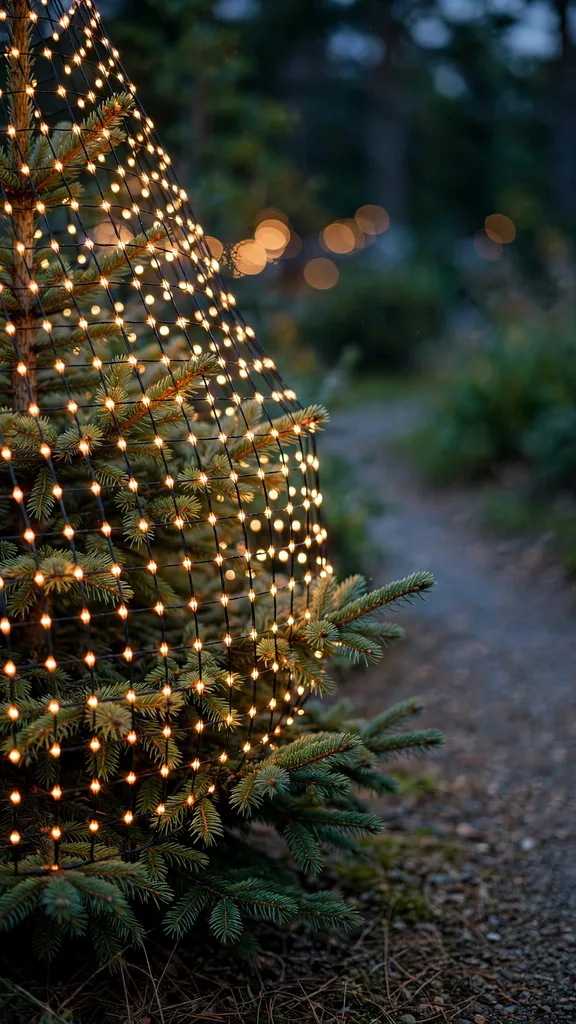
Nets suit dwarf spruces, young hollies, and any conifer under about six feet. On taller trees a net reaches only the bottom, which reads as a mistake; use strings instead. Check the net’s rating for outdoor use like any other set, and store it rolled around a board so next year’s drape takes minutes. A net over a pair of matching conifers flanking a door is the fastest formal display in this list.
4. Icicle Strands on the Outer Canopy Edge
Icicle strands hang short drops of light from a horizontal run, and on a living tree they belong on the outer edge of sturdy lower branches, where the drops hang clear of the foliage. Clip them to the branch with the plastic clips in the box, spaced wide, and never let a strand rest its weight on young side shoots. The effect is a lit fringe around the tree’s skirt, prettiest on spruces whose branches already layer.
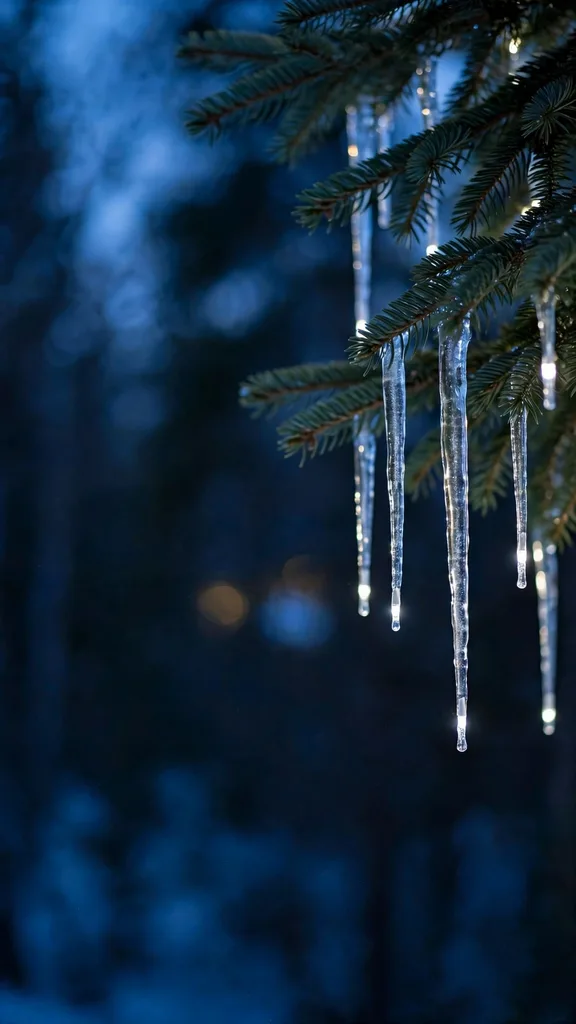
Keep icicle strands off the tree’s top half: the weight is small but the wind’s pull on a thin upper branch is not, and a strand torn loose in a storm whips. One or two strands on the garden side of the tree is plenty. When they come down, coil each strand separately; icicle sets tangle worse than any other light ever made, and January patience is short.
5. A Loose Rope-Light Spiral Up the Trunk
A rope light wound up the trunk in a wide spiral outlines the tree’s structure and leaves the branches free for ornaments. Fix it with soft ties or reusable hook-and-loop straps at long intervals, each one loose enough to slide, and stop the spiral where the trunk forks. The trunk carries weight easily, so this is the one lighting layer that can be generous, and its steady line contrasts with the sparkle in the branches.
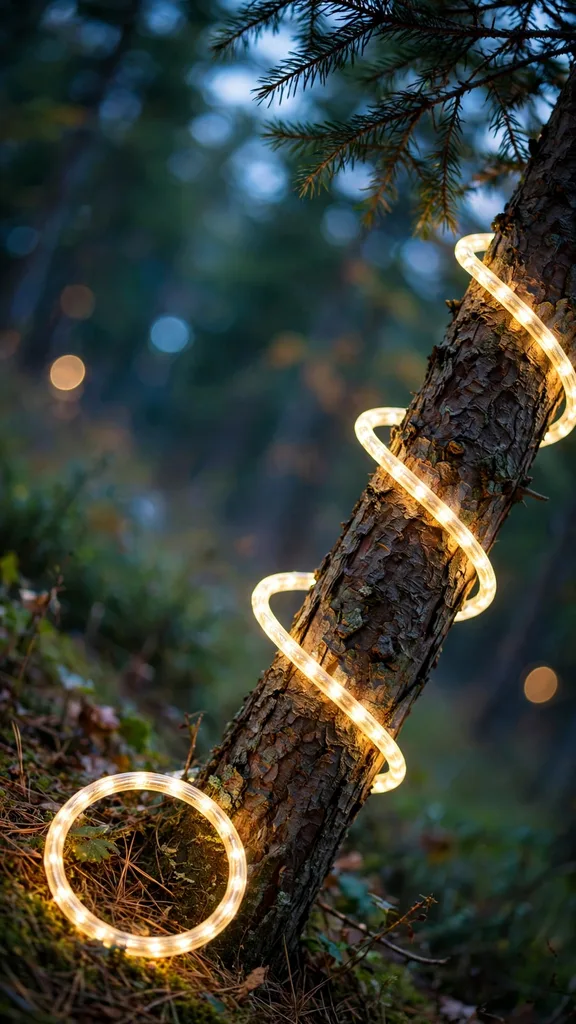
Rope lights rated for outdoors handle rain well because the bulbs sit inside a sealed tube. Avoid the stiffest ropes on young trunks with thin bark, and never strap a rope tight at any point: the spiral should hang on the trunk, not hug it. From the street, a lit trunk with a dark canopy reads as elegant; add branch strings only if the tree is the garden’s main event.
6. A Ground Projector for a Zero-Touch Tree
A projector staked in the ground throws moving points or patterns of light onto the tree without touching it at all: no weight, no ties, no ladders, nothing to remove from the branches in January. It is the right answer for very old, very young, or very brittle trees, and for any tree whose owner would rather not climb. Set the projector far enough back that the pattern covers the canopy, and angle it to keep the beam out of neighbors’ windows.
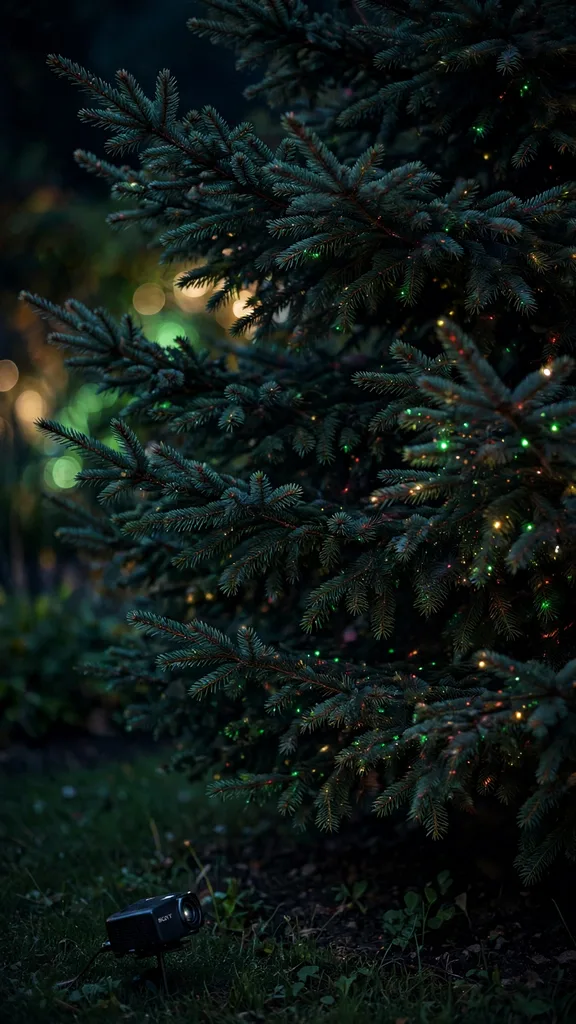
Projected light reads as atmosphere rather than decoration, so pair it with a few real ornaments on the lowest branches to ground the display. Stake projectors firmly, because a knocked projector paints the fence instead. In snow country the lens needs a wipe after every fall. On its own, a projector on a big dark conifer is the lowest-effort tree in the neighborhood and one of the prettiest.
7. Timers So the Tree Gets Its Dark Hours
Put every wired string on a timer set for dusk to about 11 pm. The tree’s birds roost in it, and a canopy lit all night disturbs them and wastes power; a display that ends at a civilized hour is better manners and a smaller bill. Outdoor timers with light sensors handle the dusk end automatically, which matters in December when sunset moves and the weather turns.
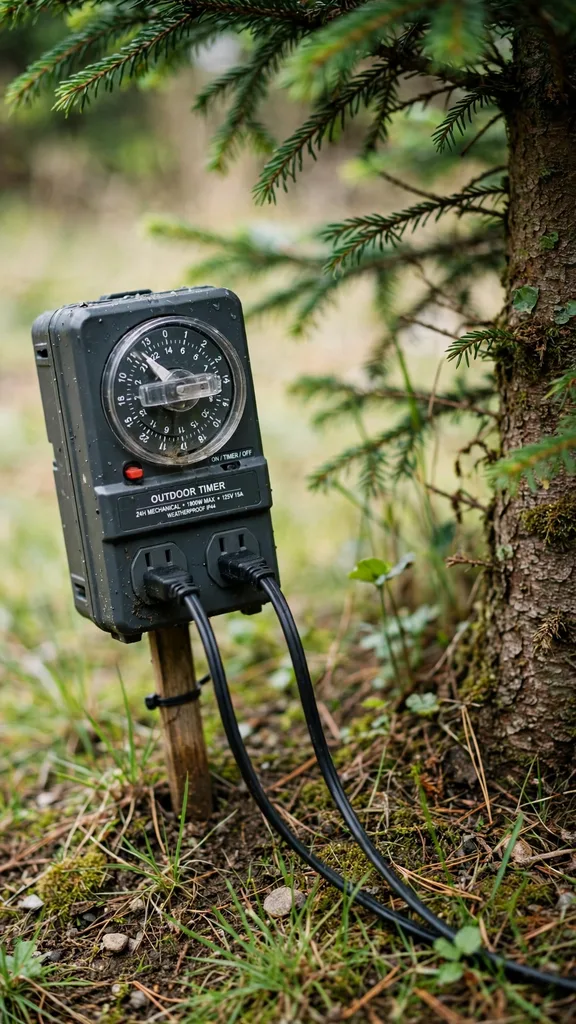
Timers also protect the display: lights that rest survive longer, and a fault in an unattended string at 3 am helps nobody. Set solar strings to their shorter runtime mode if they offer one, for the same roosting reason. When the season ends, the timer’s schedule is the reminder the whole display runs on, and switching it off is the official start of the January takedown.
8. Big C9 Bulbs on Sturdy Lower Branches
Oversized C9-style LED bulbs give a living tree the vintage look that small strings cannot: big points of warm color spaced along the strongest lower branches. Their weight is the limit, so clip each bulb’s socket to a branch at least thumb-thick, near the trunk where the strain is low, and keep the count modest. Twenty big bulbs placed well beat sixty scattered.
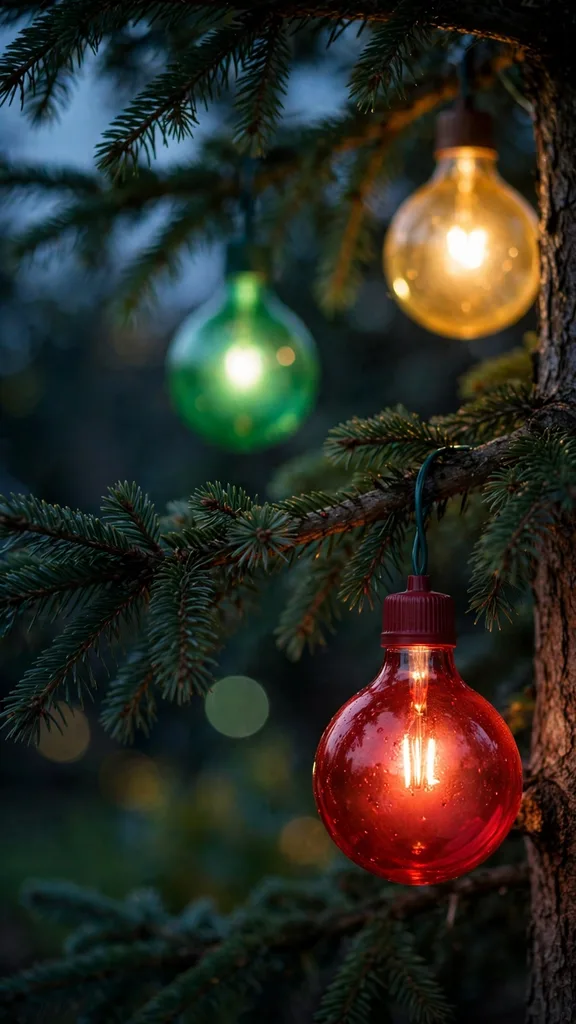
Use LED versions only; old incandescent C9s run hot enough to scorch foliage they rest against, and their glass breaks in wind. Modern LED C9s are plastic, cool, and nearly unbreakable. Space them by eye from the viewing side, stepping back to the house door to judge, because branch-side decorating always crowds the front. A tree lit only with big bulbs and nothing else has a calm, old-fashioned dignity.
9. Shatterproof Baubles in Outdoor Finishes
Plastic shatterproof baubles are the workhorse outdoor ornament: light, cheap, and unhurt by falls onto frozen ground. Choose matte, metallic, and glitter finishes rated for outdoor use, and hang them with wire or twine loops long enough to swing clear of the branch below. Small and medium sizes suit living branches; the giant baubles belong on the house, not on growth that must carry them through storms.
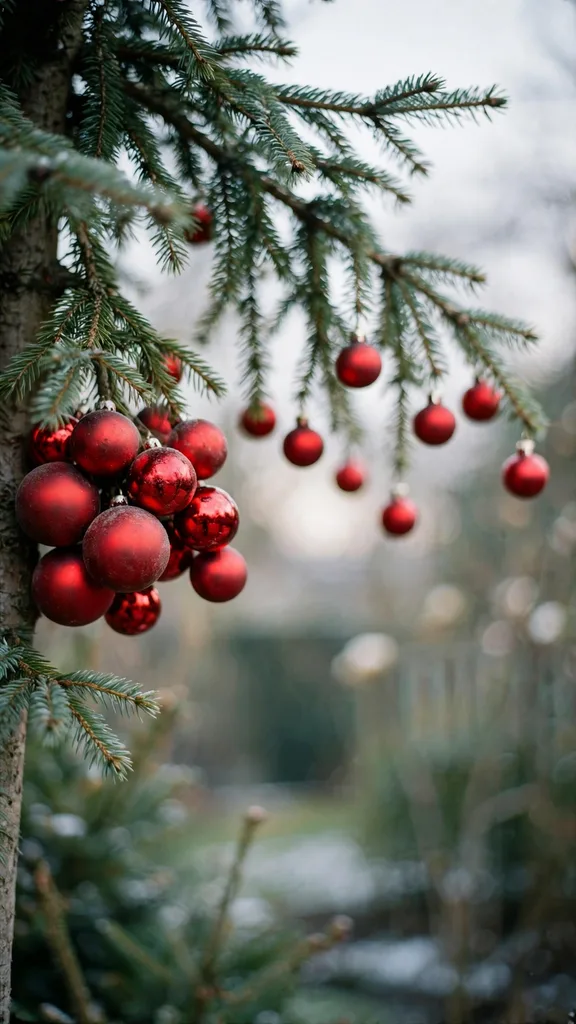
Wire every bauble on rather than trusting the cap loop, because December wind tests every hanging thing on the tree nightly. Cluster baubles toward the trunk where branches are strongest, thinning toward the tips. A single color family reads as designed; the classic garden choice is red against dark green, with gold for the second tree. Store them in their tray and they will decorate a decade of trees.
10. Galvanized Stars, Bells and Hearts
Galvanized metal ornaments, stars, bells, hearts, and simple animal shapes, shrug off weather entirely and gain character from it. They are heavier than plastic, so hang them on sturdy branches close to the trunk, one per branch, and let their plain silver-gray stand against the green. Bells add the only sound effect on this list, a faint tinkle when the wind works the tree.

Metal ornaments suit the natural garden style better than gloss and glitter, and they never fade. Check edges on cheap stampings before hanging at face height along a path. A tree done entirely in galvanized shapes and warm white lights is the quiet display that photographs best, and the ornaments store flat in a box with no breakage worries at all.
11. Wooden Slice Ornaments, Sealed
Log slices and flat wooden shapes, stars, reindeer, trees, become outdoor ornaments after two coats of exterior varnish or sealant, an adult job done on a dry day. Hang them with twine through a drilled hole. The wood echoes the tree it hangs on, and painted details in outdoor acrylic hold their color for several seasons. Keep slices thin; a thick round of hardwood is heavier than it looks on a branch tip.
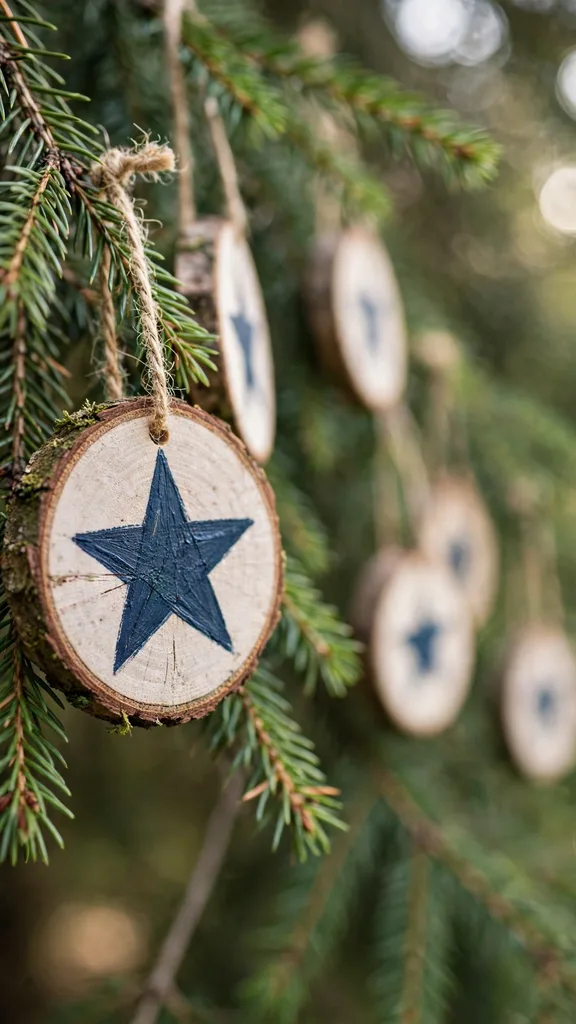
Unsealed wood ornaments swell, crack, and grow mold by January, so the sealing is the craft. Children paint the designs and an adult seals and drills. A set of wooden ornaments made from the prunings of the same garden closes a satisfying loop: last year’s hedge trim hangs on this year’s tree. Store them dry and they last for years.
12. Pinecone Ornaments, Weather-Sealed
The garden’s own pinecones hang on the tree they fell from, or a better-looking one nearby. A coat of exterior sealant or a dip in melted wax, adult work, keeps a cone from closing up in the rain and shedding its scales. Tie twine around the top scales or screw a small eye into the stem end, and hang cones singly or in clusters of three at different lengths.
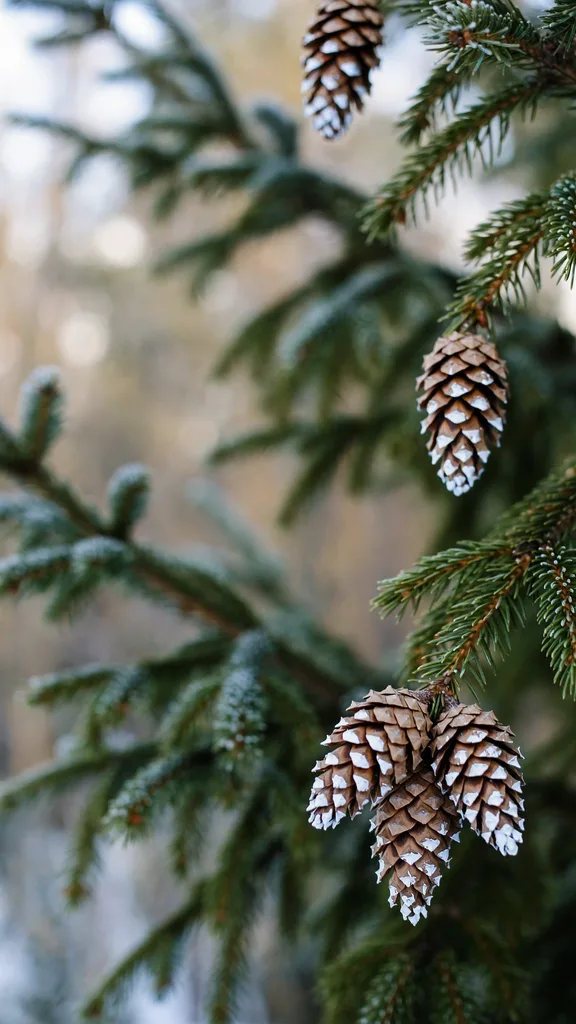
Plain cones read as texture; cones tipped with white paint read as snow; cones rolled in a little glitter read as party. All three belong on the same tree in different zones. Because cones are free, use them generously to fill the gaps baubles leave, especially low where breakage would matter with anything fragile. In January the sealed cones go back in the craft box for next year.
13. Dried Citrus Slices on the Sunny Side
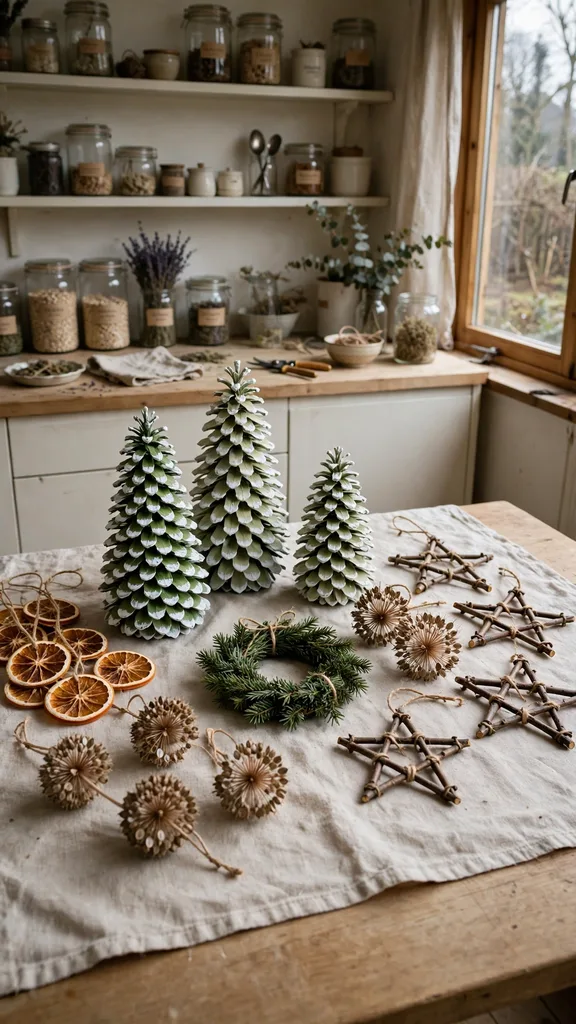
Dried orange and lemon slices glow when the low winter sun or the tree lights shine through them, and a living tree near a window or path shows them at their best. Thread each slice with twine near the rind and hang them on the tree’s sunny side, spaced like small stained-glass windows. Fully dried slices keep all season outdoors; under-dried ones mold within weeks, so this ornament rewards the patient drying described in any good citrus guide.
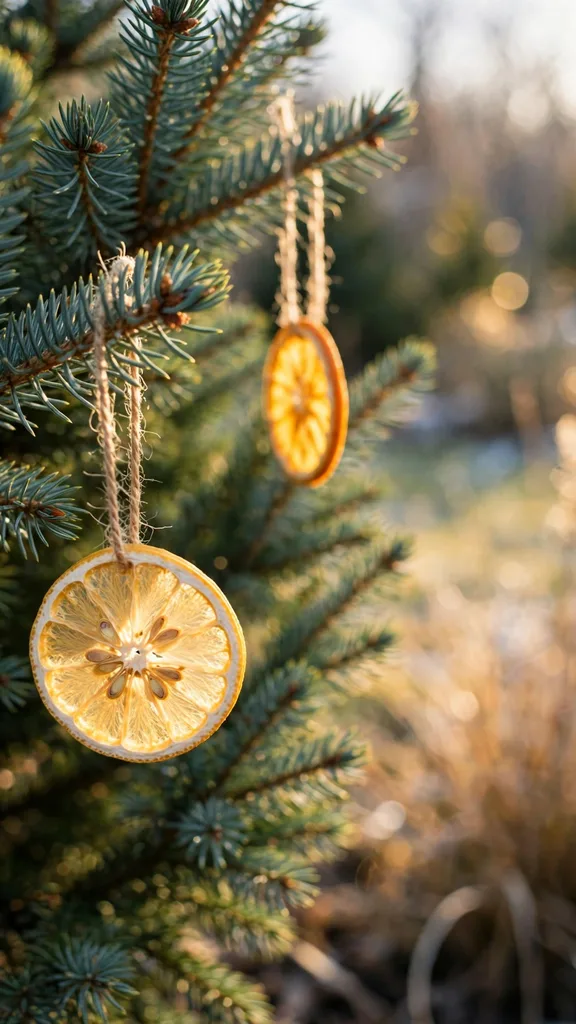
Expect gentle fading by January, which suits the natural look. Citrus slices are light enough for the thinnest branches and harmless when they eventually fall, going straight to the compost. Birds ignore dried citrus, so these are pure decoration. A tree hung with citrus and plain cones needs no other color, and the slices you hang this year were last month’s kitchen project.
14. Outdoor Ribbon Bows That Shed Rain
Big bows in wired outdoor ribbon dress a living tree faster than any other ornament: one bow per main branch, tied where the branch meets the trunk. Choose ribbon sold for outdoor use, in polyester or similar synthetics that shed rain and hold their loops; velvet and cotton ribbons soak, sag, and stain the branches they touch. Red is classic, burlap-look is rustic, and gold wire-edge catches light like a bulb.
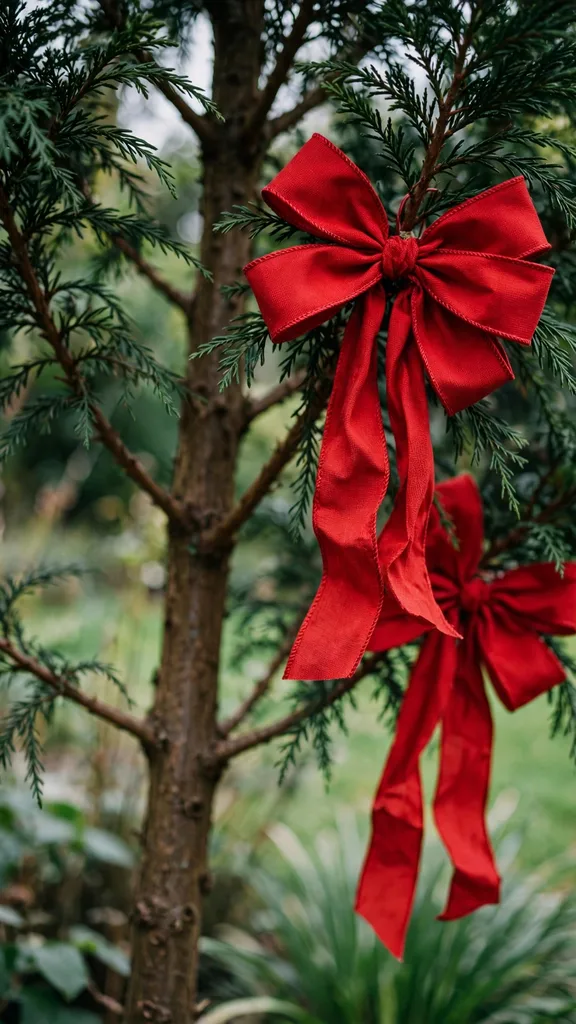
Tie bows on with their own tails or a separate tie so removal is one snip. A bow at the top under the topper finishes the silhouette. Because bows are light and soft, they can go on younger growth than any bauble, which makes them the filler for the tree’s upper half where nothing else is safe. Nine to twelve bows dress a medium tree completely when the lights are already on.
15. Burlap and Hessian Bows
Burlap bows bring the rustic note and cost almost nothing: cut wide strips, form two loops and two tails, pinch the middle, and bind with twine. The open weave sheds water better than solid cloth and dries fast after rain. Burlap frays at the edges, which reads as texture outdoors; a line of outdoor glue along the cut edges, adult-applied, slows the fraying for a second season.
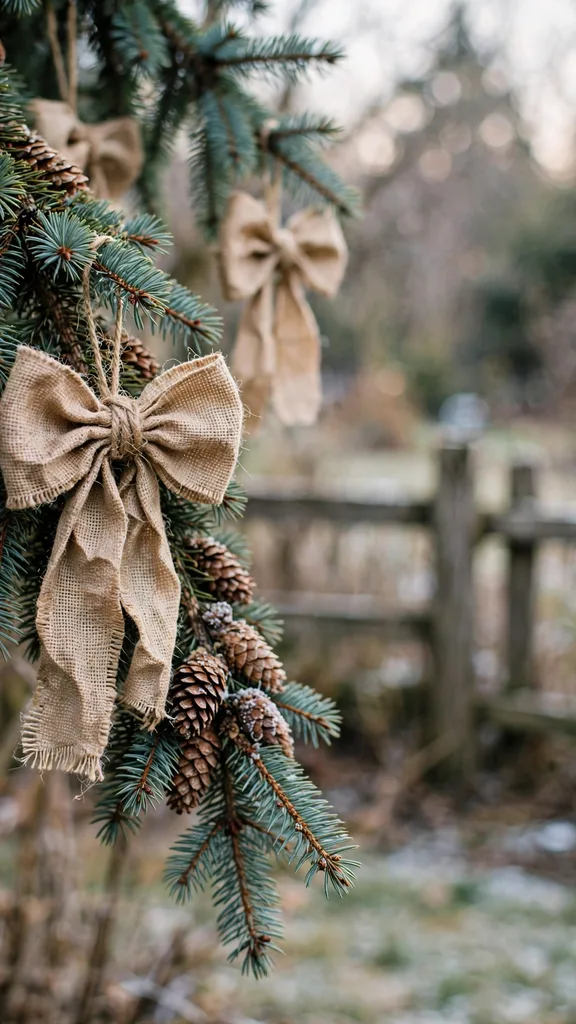
Mix burlap bows with cones and citrus for the full garden-material tree, or use them alone on a tree near a rustic fence or a vegetable garden where gloss would look lost. Their tan color warms under warm-white lights. Store bows flat with the loops reshaped by hand next year; burlap forgives crushing better than any wired ribbon.
16. Felt Garlands Rated for Outdoors
A garland of felt shapes, stars, trees, circles, strung on twine winds loosely through the branches and adds color with almost no weight. Use synthetic craft felt or wool felt sold for outdoor projects, and wind the garland in the same wide, slack spiral as the lights, never pulling it tight around a branch. Felt drinks rain and dries slowly, so this is a sheltered-tree or dry-climate decoration; in wet gardens, hang it for party weeks rather than the whole season.
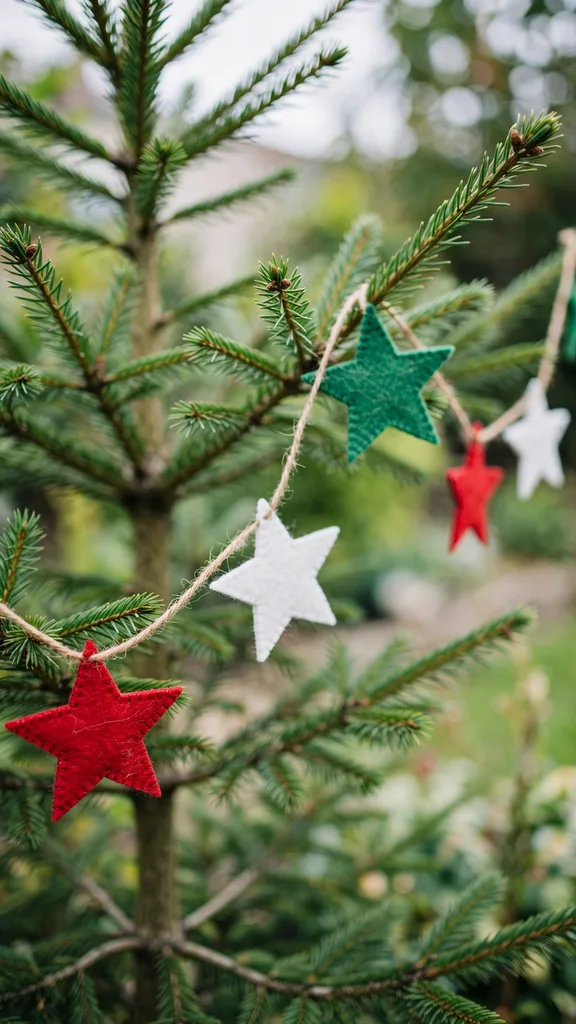
Felt garlands are the safest decoration for very young trees, whose branches can carry almost nothing. The shapes can echo the household’s indoor theme at garden scale. When the garland comes down, dry it indoors before storing or it will mildew in the box. A felt garland at child height on the lowest branches is also the layer small visitors may touch, which settles the question of what on the tree is touchable.
17. Cookie-Cutter Ornaments in Galvanized Metal
Large metal cookie cutters, stars, trees, gingerbread shapes, hang by a ribbon through the top as open-frame ornaments that read as silhouettes against the foliage. Galvanized or stainless cutters ignore the weather, and their hollow shape keeps them light for their size. Group them in threes at different heights on the tree’s front, or run a matching set along one branch like bunting.
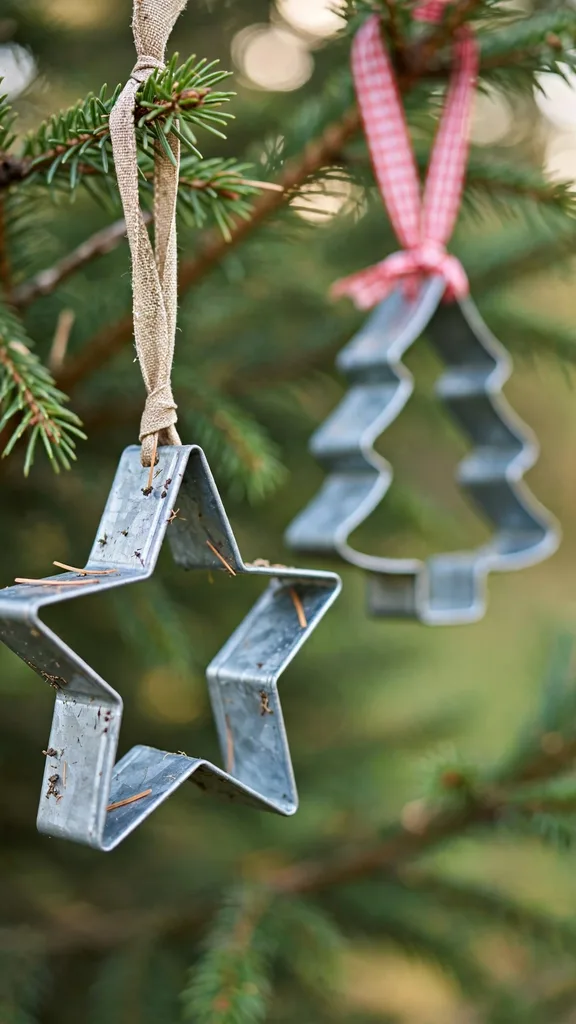
Because they are kitchen tools in April, these ornaments cost nothing extra and store in the baking drawer. Avoid cutters with sharp folded edges at face height on path-side branches. A silhouette set in copper darkens beautifully outdoors and suits the galvanized stars elsewhere on the tree. Children enjoy choosing which shapes the tree wears, and the choosing is the whole of their work here.
18. Acrylic Mirror Discs That Flash at Noon
Small acrylic mirror discs and stars, sold as craft mirrors with a hanging hole, catch the low winter sun and throw moving flashes across the garden as the tree stirs. They weigh almost nothing, never break into shards, and work hardest on dull days when the tree lights are off. Hang them on the sunny side at varied lengths so the flashes scatter rather than repeat.
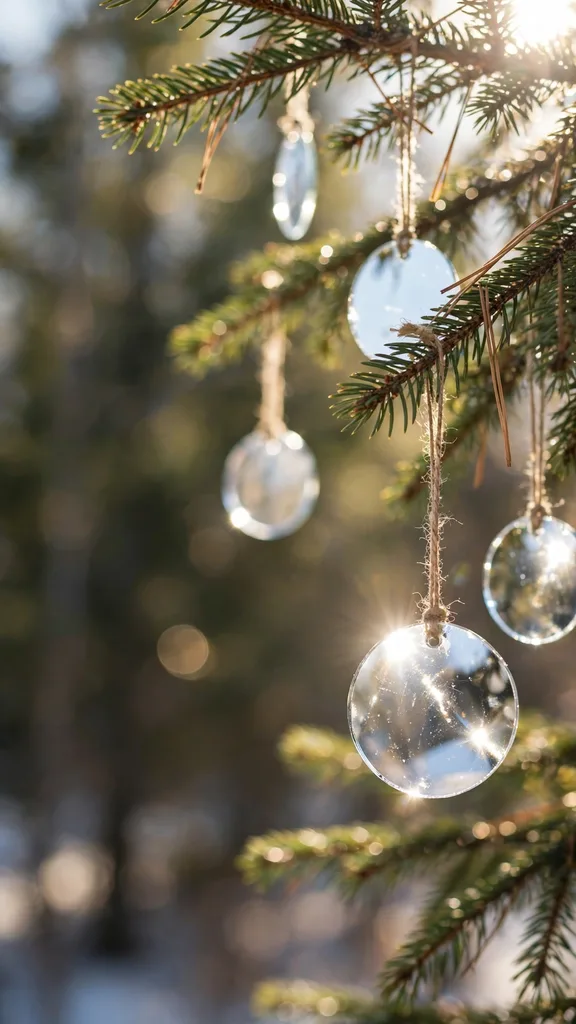
Mirror discs are a daylight ornament, the tree’s daytime shift while the lights wait for dusk. Keep them off the street side if drivers pass close, since a flash at eye level distracts. A dozen discs are plenty; the effect multiplies itself in motion. In January they wipe clean and store in an envelope, the smallest storage footprint on this list.
19. Popcorn and Cranberry Garlands
The edible garland does double duty on a living tree: decoration for two weeks, then bird food exactly where the birds already are. Thread plain popcorn and fresh cranberries on strong thread and wind the garland loosely through the outer branches, where birds can reach it and viewers can see the red. Expect it to be eaten unevenly, which is the point; the tree gets more natural as December goes on.
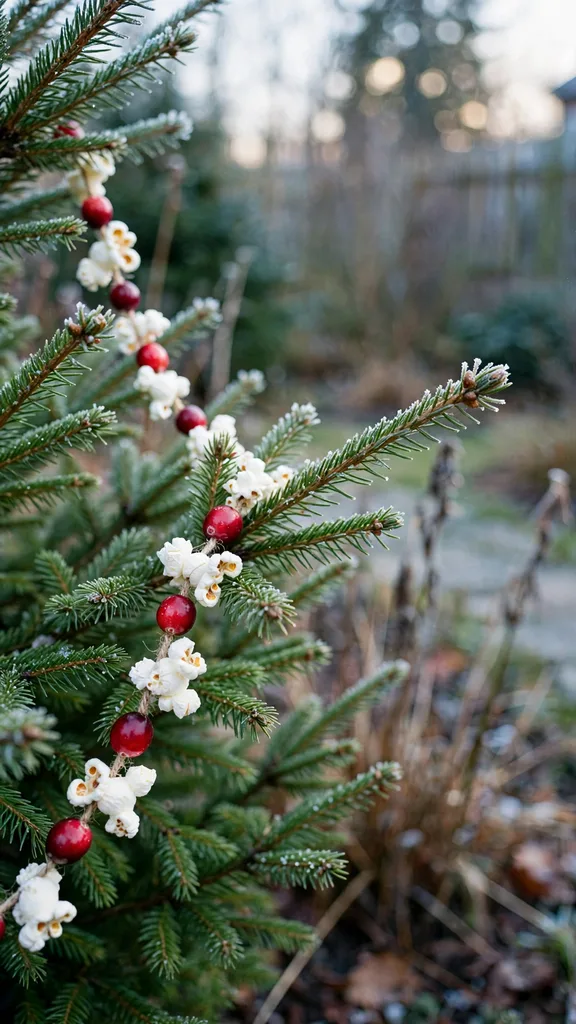
Hang edible garlands after the main decorating, since they last days to weeks rather than the season, and replace a stripped section if the display needs it for a party. Day-old popcorn threads without crumbling. Once the garland is up, keep cats indoors at dawn if your household has them; the tree becomes the busiest bird table in the garden, and that traffic is the reward for this decoration.
20. Suet Ball Ornaments
Suet balls and fat cakes, hung in small mesh bags or tied in netting at branch ends, are ornaments the birds unwrap themselves. Woodpeckers, titmice, and nuthatches work them for days, and the tree gains moving, living decoration no shop sells. Penn State Extension’s guidance on caring for birds in the winter covers the winter feeding basics behind this idea, including the foods that sustain birds in cold weather and the hygiene that keeps feeding stations healthy.
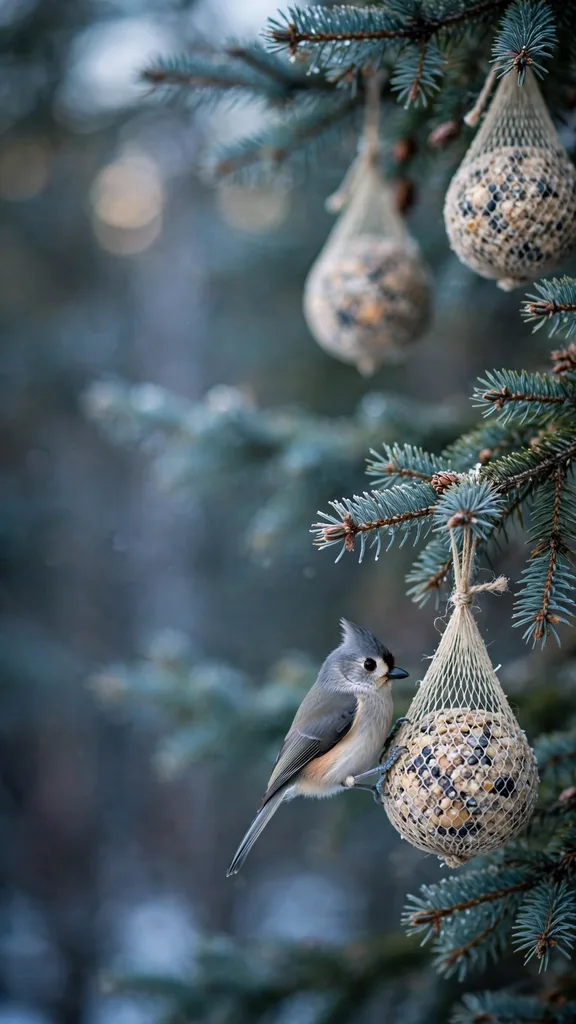
Hang suet only in cold weather; in a warm spell it softens, drips, and can smear the feathers of the birds it feeds, so bring balls in during a thaw and rehang them when the cold returns. Keep suet ornaments on the tree’s outer branches away from the trunk, where drips miss the bark. Two or three balls are a display; ten are a feeding station, which is also fine if the garden is ready for the traffic.
21. Molded Seed Ornaments
Birdseed molded with gelatin or suet into stars, bells, and wreaths hangs on the tree as both ornament and slow-release feeder. The molds set in the fridge overnight and unmold with a straw hole already in place for the twine. Press the seed mix firmly; a crumbly ornament sheds its shape in the first rain and ends as ground feed, which the ground-feeding birds will still thank you for.
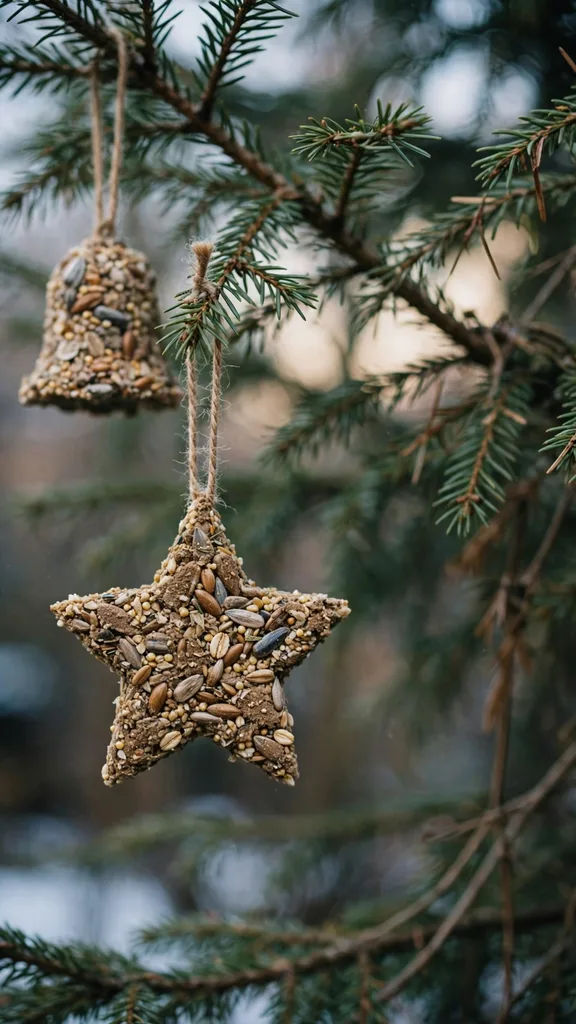
Seed ornaments suit the tree’s mid-height branches, heavy enough to need real wood under them but light enough for any healthy branch near the trunk. In wet climates they soften within a week or two, so make them in small batches through December rather than one batch for the season. Their plain seed color reads as texture against the green, and the birds provide the color and movement.
22. Pinecone Feeders Among the Baubles
A pinecone spread with unsalted peanut butter or suet and rolled in seed hangs exactly like the sealed ornamental cones, and the birds cannot tell the decorations from the dinner. Mix feeder cones among ornamental ones at the same heights and the tree feeds and decorates in one layer. Chickadees work a cone for an hour, hanging upside down under it in a way no bauble imitates.
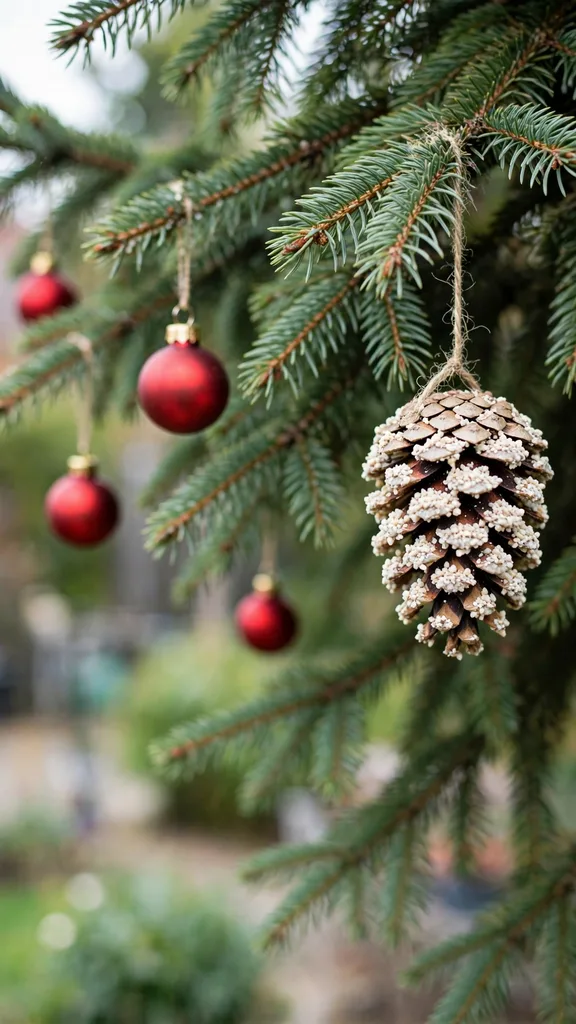
Make feeder cones through the season in small batches, because a stripped cone is just a cone again and wants re-spreading. Wash hands after making them, and hang them where falling seed lands on ground you do not mind feeding, since sprouted seed under the tree in spring is the only cost. This is the decoration children most want to check every morning, binoculars optional.
23. Orange Cup Feeders
Half an orange shell, the fruit scooped out for the kitchen, fills with seed or suet mix and hangs from three twine strings tied around its rim as a small swinging cup feeder. The orange cup is biodegradable, bright, and free, and small birds perch on its rim to feed. It lasts one to two weeks outdoors before the shell softens, at which point the whole thing composts.
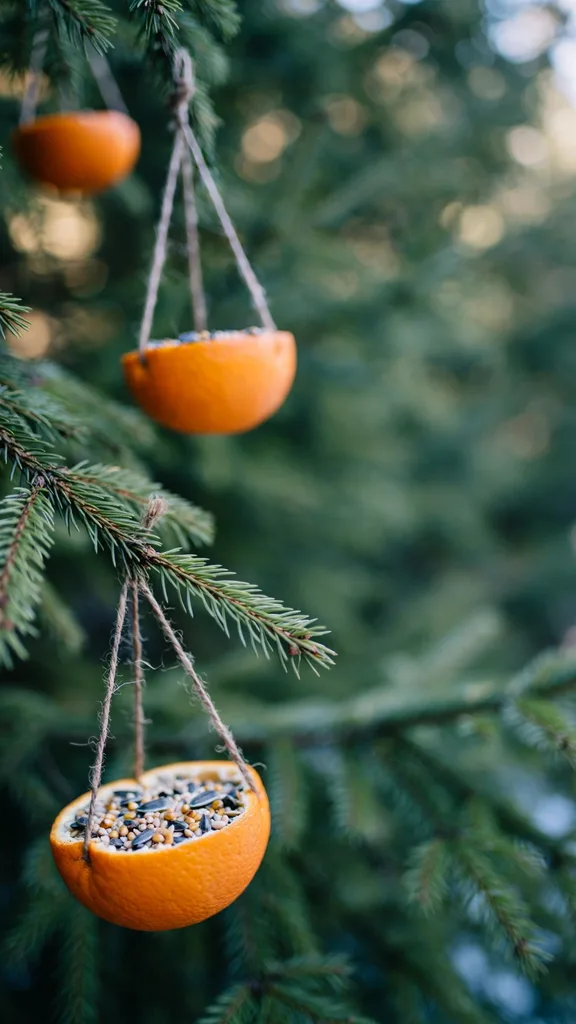
Orange cups hang best from sturdy branches at eye height where their color shows and their swinging stays clear of the trunk. A tree with orange cups, dried slices, and peel anywhere it fits becomes the citrus tree, a theme strong enough to carry the whole display. In hard frosts the cups freeze solid and the birds peck through; in thaws, replace them before they slump.
24. Unshelled Peanut Garlands
Thread unshelled peanuts through their shells with a needle and strong thread to make a garland that jays, titmice, and woodpeckers prize above everything else on the tree. The shells protect the nuts from rain, so a peanut garland lasts for weeks, thinning nut by nut as the birds work it. Wind it through the outer branches in the same loose spiral as the other garlands.
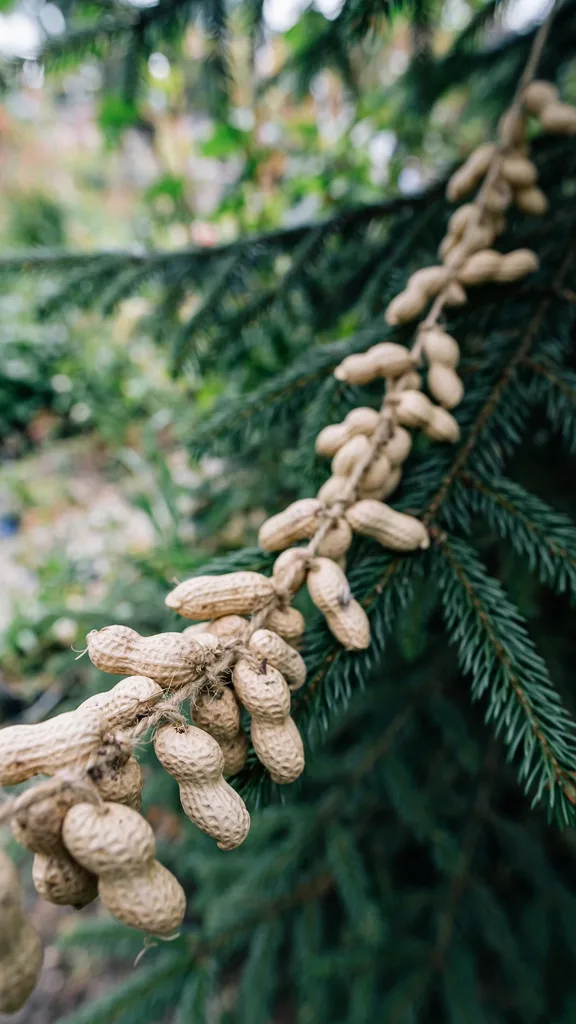
Peanut garlands are heavy for their length, so run them along strong branches and tie the ends rather than trusting the thread. Keep them for gardens without peanut-allergic households’ concerns at ground level; fallen shells announce themselves and clear up in minutes. The sight of a jay hanging under a peanut garland, working a shell open, is the living tree’s best argument against every plastic ornament ever molded.
25. Millet and Sorghum Spray Bundles
Bundles of millet sprays and sorghum heads, tied with twine and hung upside down, are ornaments shaped by the seed garden itself. Sparrows and finches pick them clean over weeks, perching on the bundle and stripping it grain by grain. The sprays’ gold and rust colors suit the season, and their texture fills gaps between baubles with something softer.
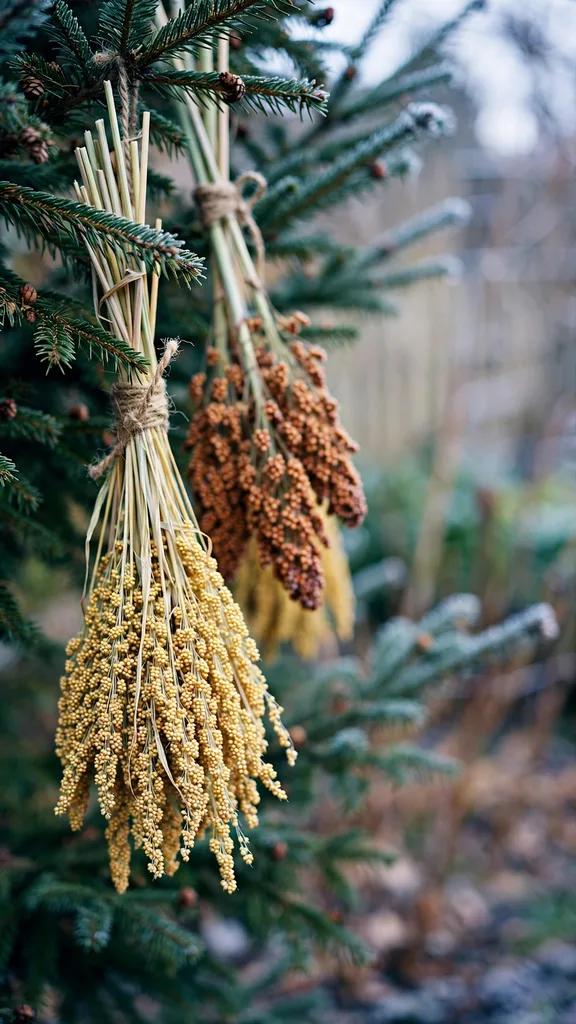
Grow millet for the birds once and the bundles become an annual harvest. Tie bundles firmly at the stem end, because a bundle picked apart drops in days while a tight one feeds for a month. Hang them at mid-height on the tree’s sheltered side, where wind does not thresh the seed out before the birds arrive. After Christmas the bare stems compost and the twine goes back in the drawer.
26. Fresh Cranberry Strands
A strand of fresh cranberries alone, threaded on twine, reads as a string of red beads with a gloss no plastic copies, and it holds that gloss for weeks in cold air. Run cranberry strands along the front branches where their color counts, doubled over the popcorn garland’s line or solo against dark conifer green. The berries are firm enough to thread raw with a needle, adult-guided for young threaders.
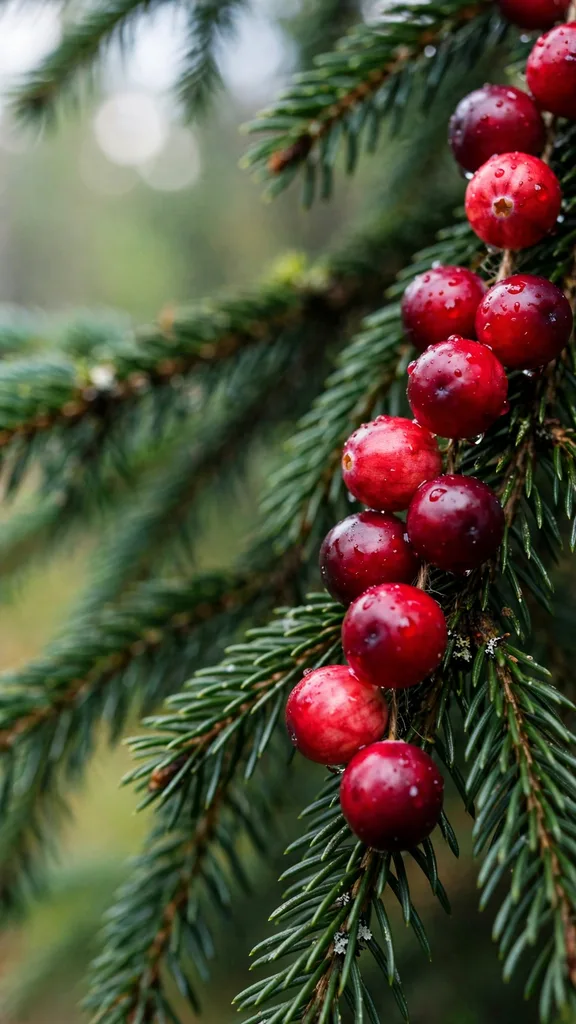
Cranberries eventually soften and the birds and the compost take them, so this strand belongs to the season’s first half or gets renewed for the Christmas week itself. Frozen cranberries thread more easily and thaw on the tree. A cranberry strand over a doorway swag and another on the tree tie the garden’s decorations together with one material, which is the oldest decorating trick there is.
27. Dried Apple Ring Ornaments
Dried apple rings, cored before drying so they keep a natural hole, thread straight onto twine with no needle at all and hang as pale gold circles. Their color deepens outdoors to amber over the month. Rings are light, unbreakable, and safe on the thinnest twigs, so they fill the tree’s top where heavier ornaments cannot go. A cinnamon stick tied at the top of each ring adds scent when the sun warms it.
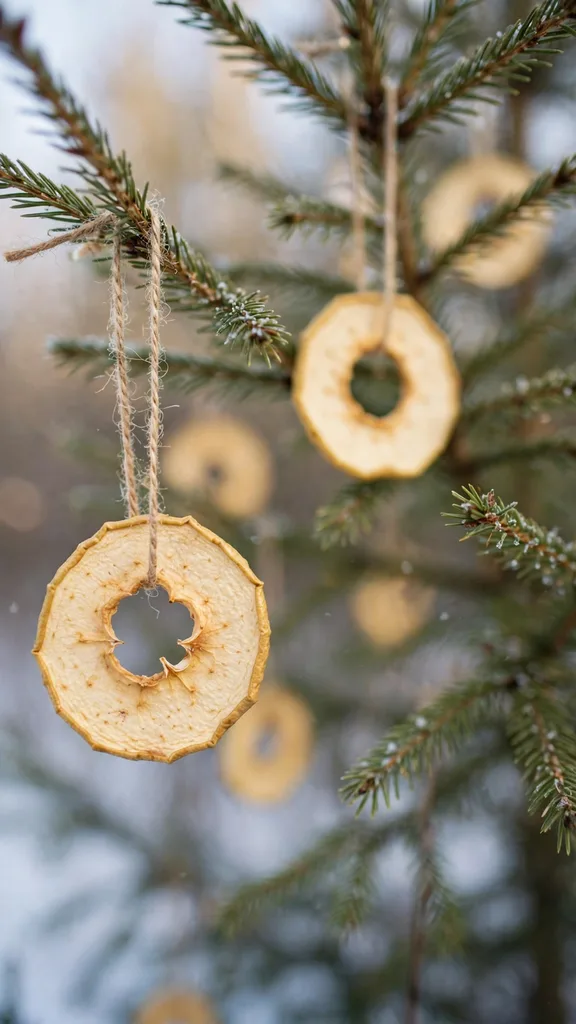
Dry rings fully or they mold on the tree, the same rule as citrus. Apple rings pair with citrus slices for a dried-fruit tree, or with cones for the all-garden version. Birds peck at them occasionally, which does no harm either way. Stored dry in a tin, last year’s rings hang again this year, slightly darker and none the worse.
28. Winterberry and Holly Sprays Tucked In
Cut sprays of winterberry, holly, or any berried branch from the garden and tuck them into the tree’s branches, stem down into the foliage, where they sit as if they grew there. The red berries give the tree the classic Christmas note with no plastic at all, and a conifer that fruits nothing borrows fruit from its neighbors. Push sprays in at angles that follow the branch lines, and step back often; tucked sprays crowd easily.
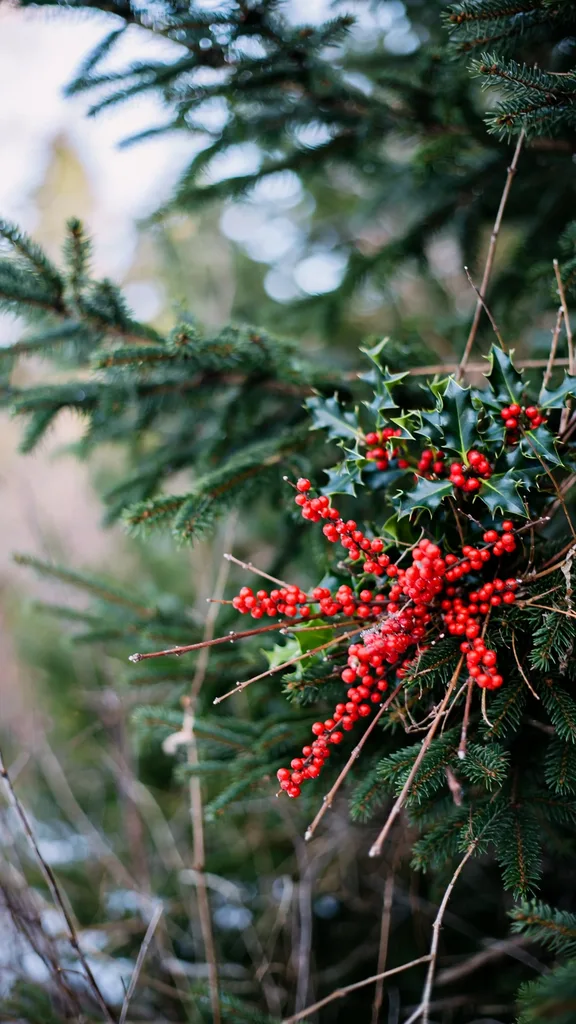
Berried sprays last two to four weeks outdoors before the birds strip them, which many gardeners count as the second act rather than a loss. Keep holly sprays off low branches where toddlers and dogs graze, since the berries are not food for people or pets. A tree decorated with lights, cones, and borrowed berries only is fully dressed, and everything on it came from within the fence.
29. Gold-Sprayed Seed Head Sprays
Allium, teasel, poppy, and echinacea heads on their stems, sprayed gold or left natural, tuck into the canopy like the berry sprays and catch light with their structure. Paint them in a batch on newspaper outdoors, adult work, and let them dry before tucking. Their shapes, stars, cones, and crowns, read as ornaments the tree grew for itself, because it nearly did.
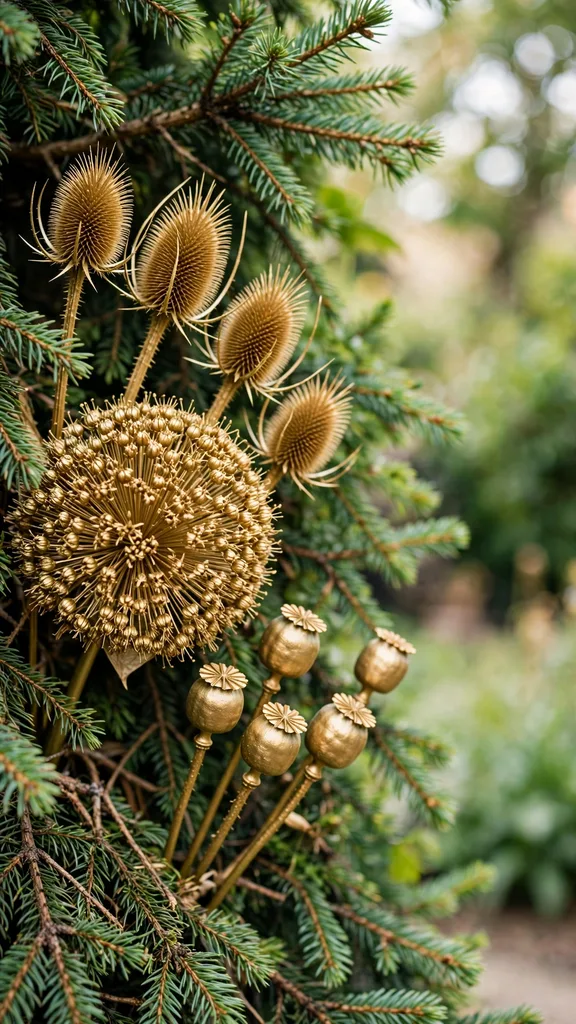
Seed head sprays are weightless, so they can dress the upper tree and the leader’s neighbors where nothing else is safe. They shed seed as they weather, which the birds and next year’s borders both accept. A gold allium head at the top, wired loosely to a side branch near the leader, makes a topper that never touches the leader itself, and that restraint is the whole ethic of this list in one ornament.
30. Ornamental Grass Plumes Tied in Bunches
The plumes of ornamental grasses, pampas, miscanthus, and fountain grass, tied in small bunches and tucked or tied into the tree, add softness and movement that no rigid ornament gives. They glow when backlit by low sun or the tree’s own lights. Tie bunches at the stem with twine, add a loop, and hang them where wind moves them freely; a plume that cannot sway is just stuffing.
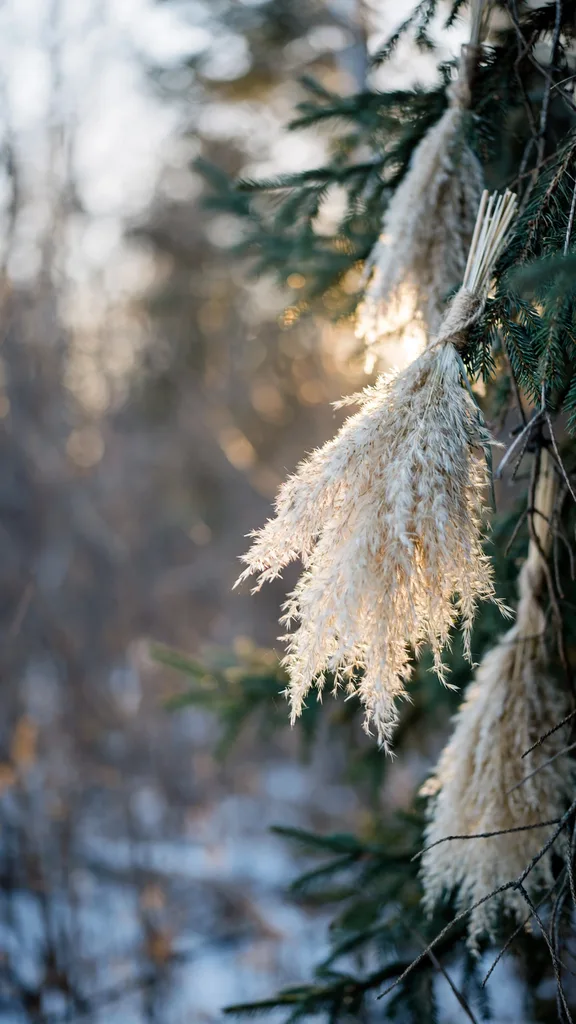
Grass plumes shed in rough weather, so place them on the sheltered side and expect to renew a few. Their pale gold suits the natural tree and the rustic one. Cut plumes for decorating in autumn and store them dry indoors, because plumes cut in December are often already weather-beaten. In January the plumes compost, having spent the year as plant, ornament, and mulch in turn.
31. Ivy Trails Wrapped Up the Trunk
A living tree with ivy already at its base can wear its own ivy: lift long trails gently and wind them in a loose spiral up the trunk, tying them at two or three points with soft ties. The dark glossy leaves against the bark give the trunk the dressed look the rope light gives at night, and the combination of both is the finished column the branches hang from. Never pull trails tight or strip them from the bark they cling to.
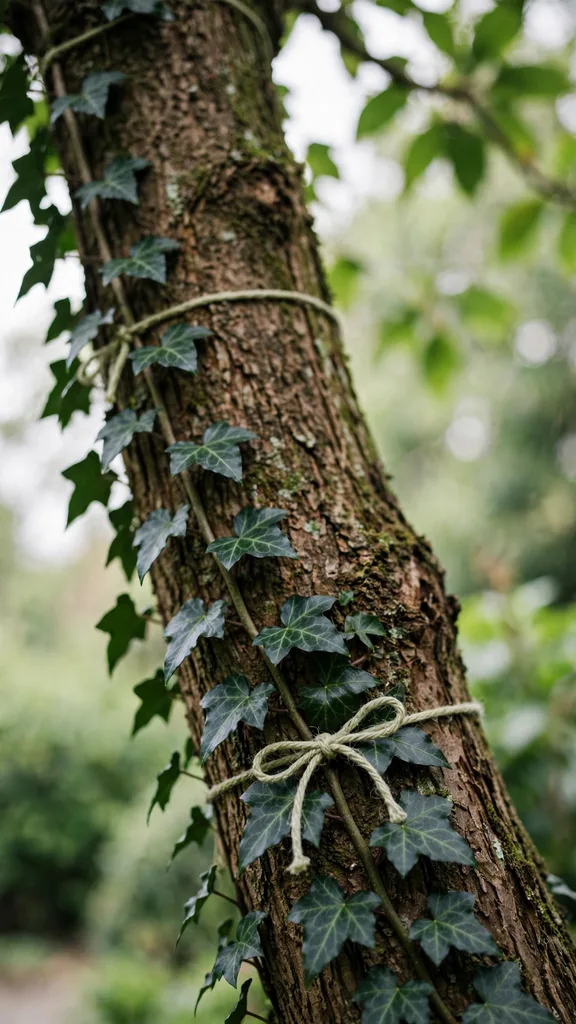
Only use ivy that is already growing on or under the tree; importing cut ivy trails works too but they wilt within days without roots. This is a decoration for mature trees with trunks worth showing. In January the ties come off and the trails settle back. A tree whose trunk is dressed needs less in its branches, which is the budget decorator’s favorite sentence in this whole list.
32. Dried Hydrangea Heads Wired Lightly
Dried hydrangea heads, the garden’s biggest dried flowers, wire onto a living tree’s branches as pale, full ornaments with real presence. Their size makes them look heavy; their weight is almost nothing, so they can hang on mid-strength branches if the wire loop is short and the head sits against the branch rather than swinging. Natural tan and faded green suit the woodland tree; a light gold spray suits the formal one.
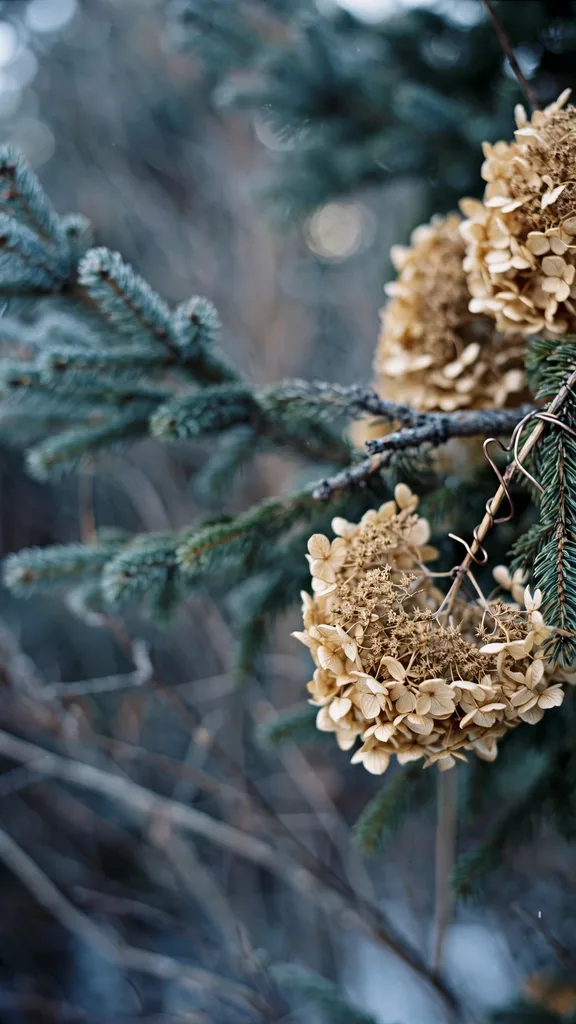
Hydrangea heads are brittle and shatter in storms, so place them on the sheltered side and accept a few losses. Wire them with green florist wire twisted loose, never cinched into bark. A tree with hydrangea heads and warm lights has a softness the neighbors will ask about. The heads that survive come indoors for vases; the rest compost where they fall.
33. Log Slice Ornaments With Bark On
Thin log slices with the bark left on, drilled and hung with twine, are the rustic bauble: a ring of bark around pale wood, ready for a painted star, initial, or year. Slices from pruned branches of the same garden carry their own story, and a dated slice per year becomes a family record hanging on one tree. Seal them like the wooden ornaments or accept a season’s weathering as part of the look.
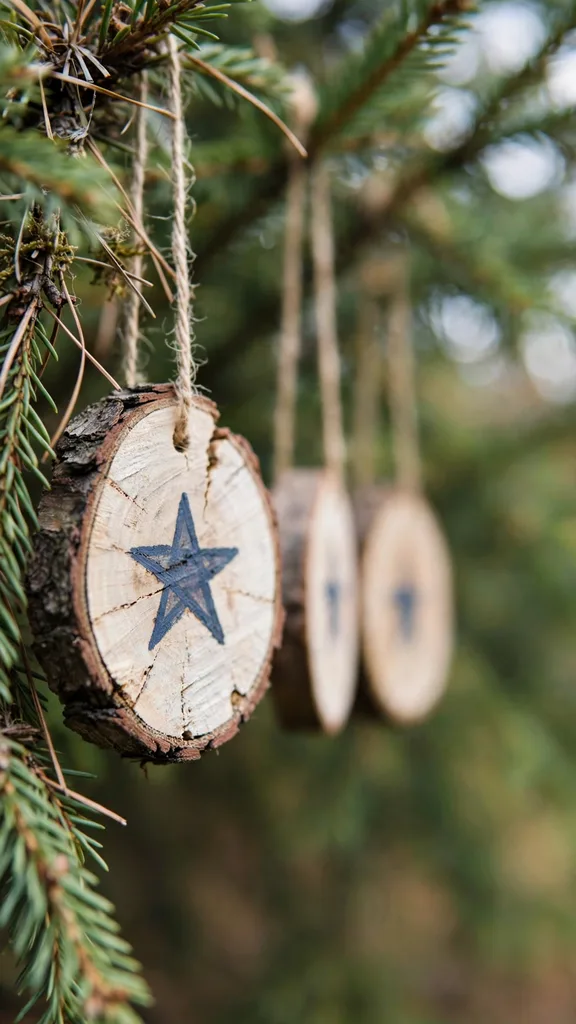
Keep slices under about four inches across on living branches, since hardwood is dense. Paint with outdoor acrylic and let children do the designs; the bark frame forgives wobbly stars. These ornaments store in a shoebox and stack without tangling, the tidiest storage on the list. A tree hung with its own garden’s slices and cones is decorated entirely by itself, which is a fine trick.
34. Twig Stars at Every Height
Twig stars, five straight twigs tied at the crossings, scale from hand-sized to door-sized, and a living tree wears the small ones through its branches like a constellation. Tie them with red yarn for color or twine for none, and hang them by one point so they turn slowly in the air. Their lightness lets them reach the upper branches that baubles cannot, balancing the tree’s dressing top to bottom.
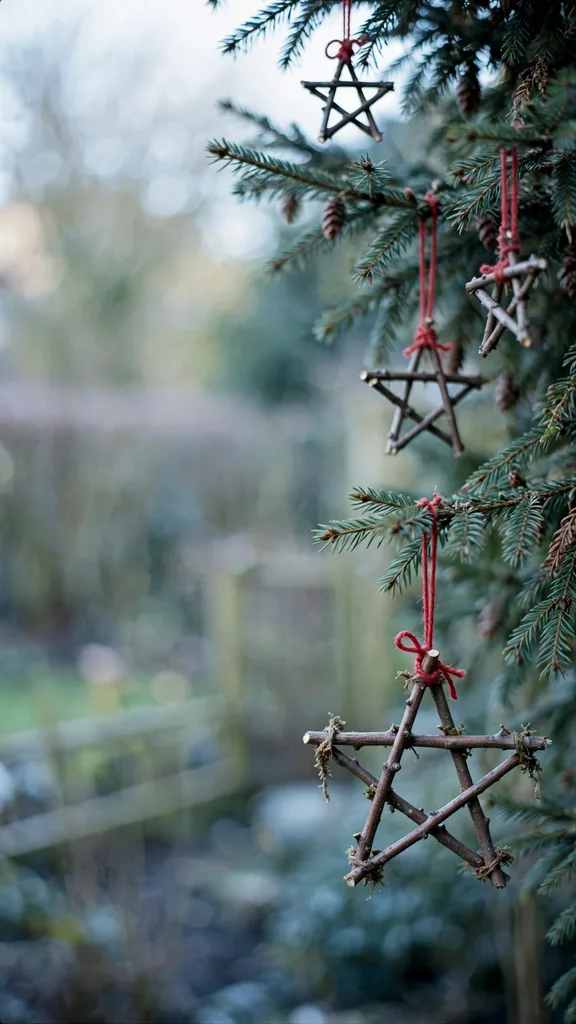
Make stars from prunings: willow, dogwood, and hazel give straight, workable twigs. A star at the very top can serve as the topper if it is tied to a side branch beside the leader rather than forced onto the leader itself. Twig stars store flat in a stack tied together, and a broken point re-ties in a minute, making them the most repairable ornament here.
35. Rosemary and Bay Bundles
Small bundles of rosemary, bay, and other sturdy herbs, tied with twine and hung through the branches, scent the tree’s immediate air whenever the sun or a passerby brushes them. They are the ornament you smell before you see, and on a tree near the front door they greet every arrival. Herb bundles are light enough for any branch and free from the garden’s winter-surviving herbs.
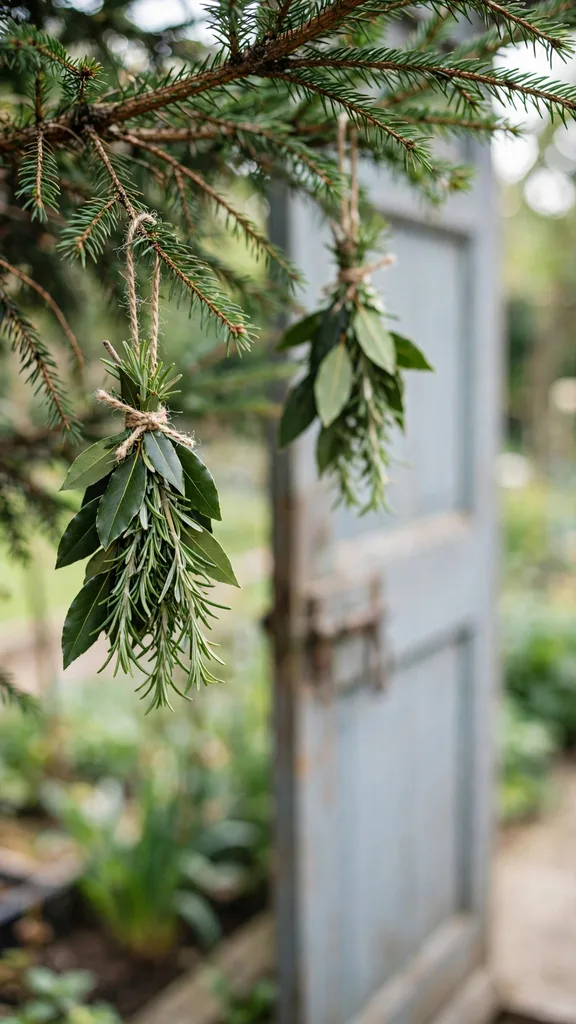
Bundles dry on the tree and keep their shape all season, fading from green to gray-green. Renew the scent with a gentle squeeze when you pass. At takedown, the bundles go to the kitchen for a last use in winter cooking if they hung clean, or to the compost if the weather got to them. A tree dressed with herbs, citrus, and cones is edible-looking from top to bottom, which suits a kitchen garden’s tree exactly.
36. Red Dogwood Stem Fans
Stems of red-twig dogwood, cut fresh, fan out in bright red arcs when three or five stems are tied at the base and pushed into the canopy or tied along a branch. The color is the most intense natural red in the winter garden, and against dark conifer green it reads as pure decoration. Cut stems from the garden’s own dogwoods, which need the pruning anyway, since their brightest color is on young wood.
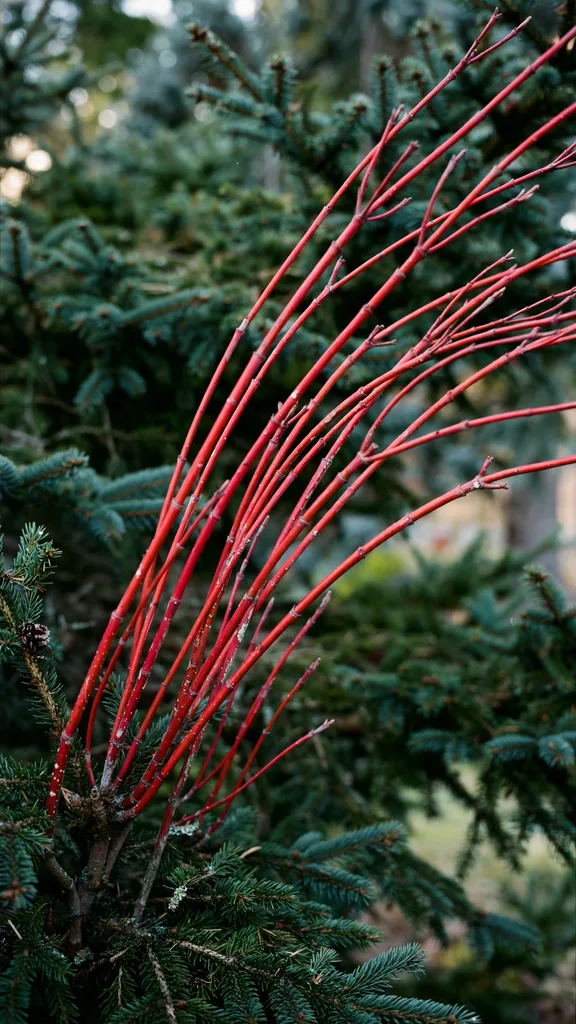
Dogwood fans hold their color outdoors all season and into spring if left, though January takedown keeps the habit. Push the fan’s base deep into the foliage so wind cannot work it loose. A tree with red dogwood fans and white lights has a two-color discipline that looks professionally planned, and the pruning shears did all the shopping.
37. A Bark Mulch Tree Skirt
A living tree’s skirt is the ground itself, dressed: a fresh ring of bark mulch or wood chips spread under the canopy tidies the base, darkens the soil line, and gives fallen ornaments a soft landing. Rake the ring wider than the drip line looks untidy; a ring about two thirds of the canopy width reads as intentional. Keep mulch a few inches clear of the trunk flare, as always.
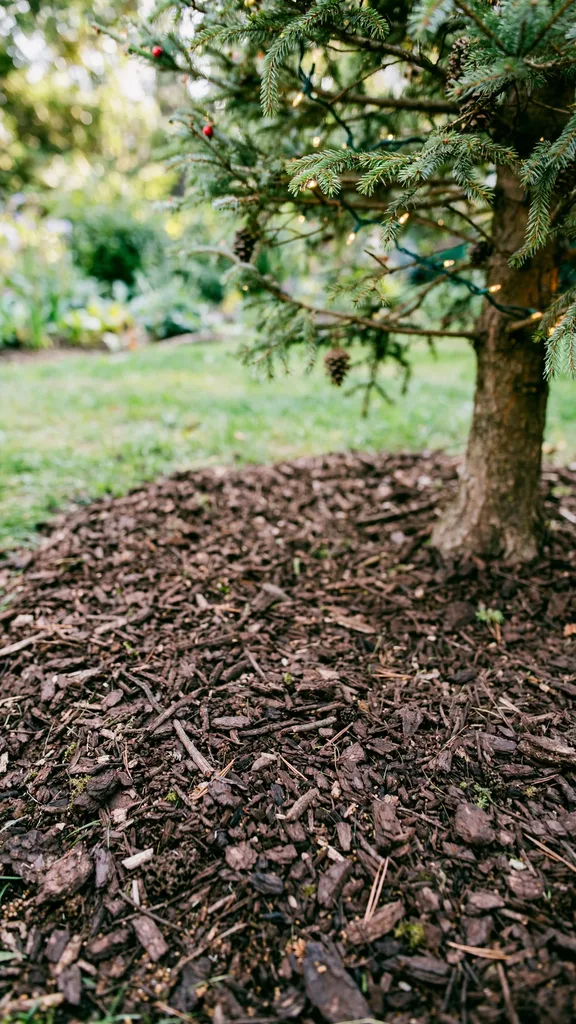
The mulch ring is the one decoration that stays after January as a genuine improvement to the tree, feeding the soil as it breaks down. In snowy regions the dark ring frames the snow line beautifully. Children can spread mulch with buckets and take pride in the neatest part of the display. If the tree stands in lawn, the ring also saves the grass beneath from a month of trampling feet.
38. Burlap Wrap Around the Base
A band of burlap wrapped around the trunk base or around the mulch ring’s edge gives the tree the finished, parcel-like base that indoor trees get from a skirt. Pin or tie it loosely; it is a collar, not a bandage, and it comes off in January with the rest. Burlap weathers to a soft tan and suits the natural and rustic displays, hiding the plain ground where presents-shaped decorations will sit.
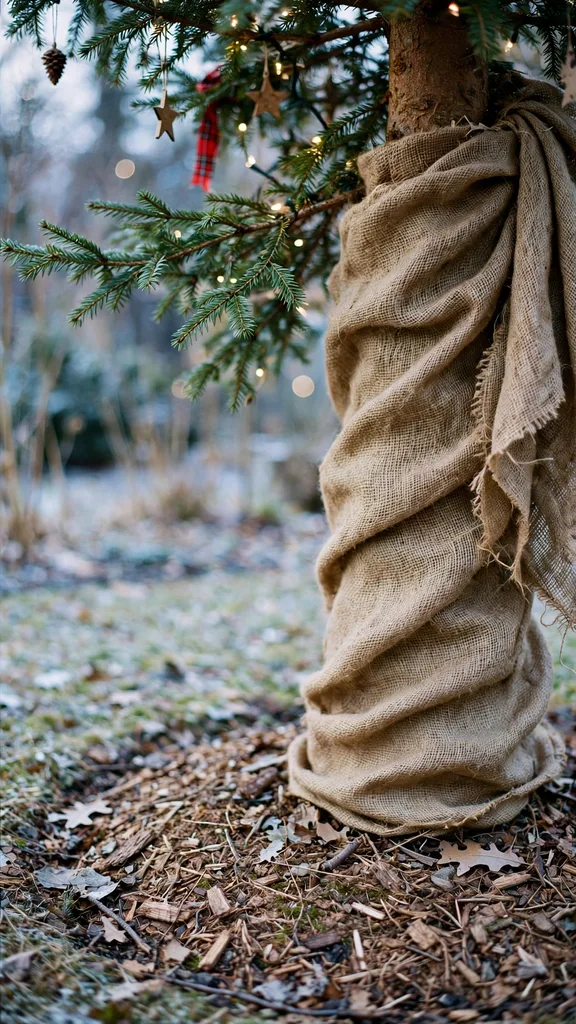
For a young tree in a pot or a newly planted one, burlap around the container does the same dressing job and adds a layer of frost protection to the pot as a bonus. Keep burlap off wet ground where it wicks and rots; a stone or brick edge lifts it. One roll of burlap dresses the tree base, the swags, and the bows, which is why it appears three times in this list.
39. Lanterns Ringed Around the Trunk
Lanterns set on the ground around the trunk light the tree from below, the most flattering angle any tree gets, and they need no contact with the tree at all. Use LED candle lanterns or solar lanterns for a set-and-forget ring; real flame lanterns belong only where they will be watched and kept clear of fallen needles and mulch. Three to five lanterns in a loose ring, unevenly spaced, look gathered rather than installed.
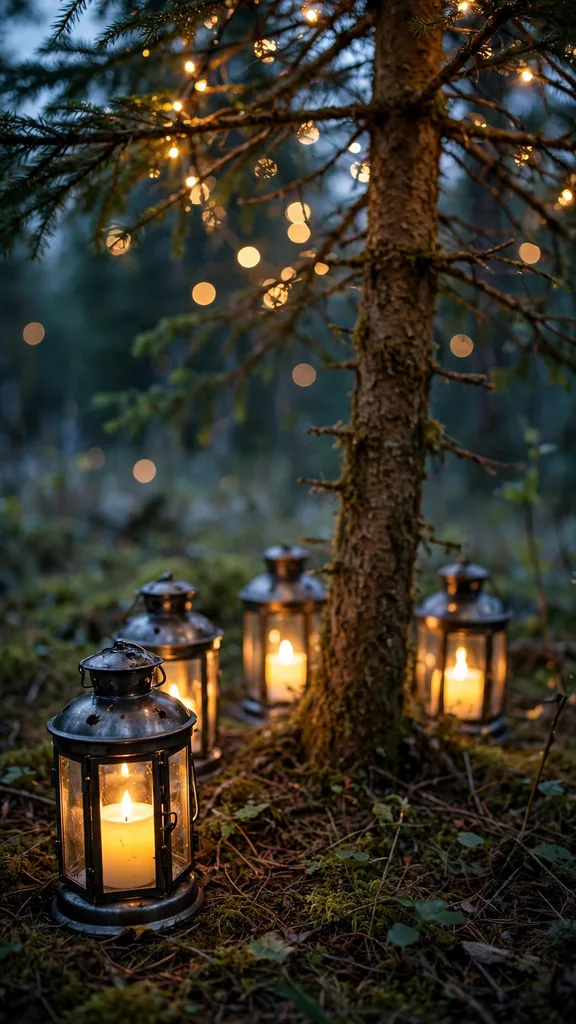
Lanterns at the base pair with the outdoor Christmas urns flanking a path or door, carrying the same warm points of light across the garden at ground level. After the season, the lanterns move to the patio table without a day of storage. A tree lit from below and within, by lanterns and strings together, glows like a stage set from the house windows.
40. Solar Stake Lights in a Ring
Solar stake lights pushed into the ground in a ring around the canopy edge mark the tree’s territory after dark and light the lowest ornaments from below. December sun charges them weakly, so expect a gentle few hours of glow, not a blaze, and site their small panels in the ring’s sunniest gaps. The ring reads as a fairy circle from the house, which children consider the correct description.
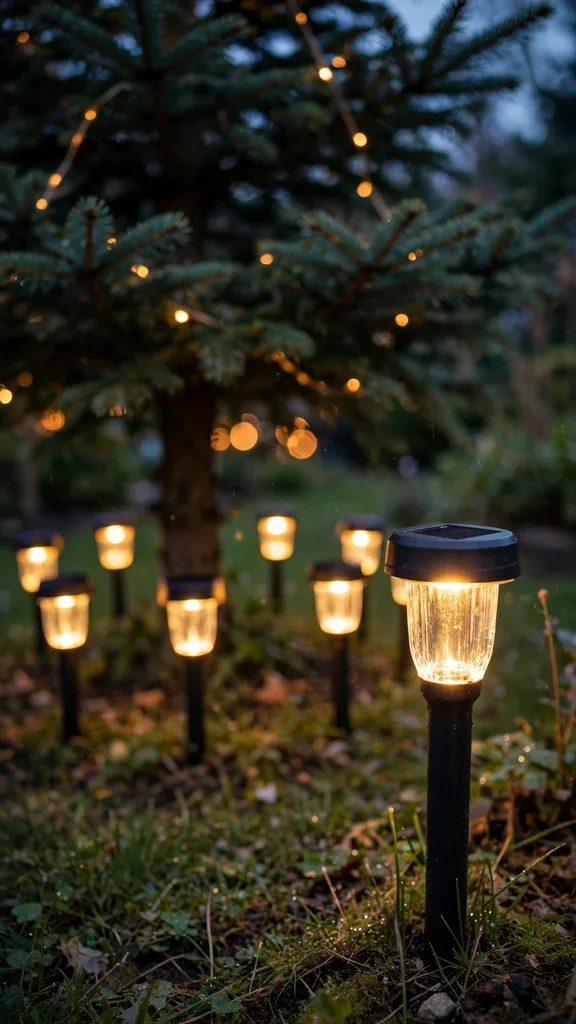
Stake lights double as the garden’s path safety for the season of early dark. Choose warm-white stakes to match the tree strings. Because they touch nothing on the tree, they suit the most delicate specimens in the garden. In January they pull up in minutes and store in a bucket, ready to ring a different plant next year.
41. Weatherproof Gift Boxes at the Base
Empty boxes wrapped in outdoor-rated paper or fabric, weighted with a brick inside, and set around the base give the tree its present pile without risking a single real gift to the weather. The boxes anchor the display visually, fill the awkward gap between trunk and ground decorations, and delight every child who shakes one and finds it suspiciously light. Wrap them in the same palette as the tree’s ornaments.
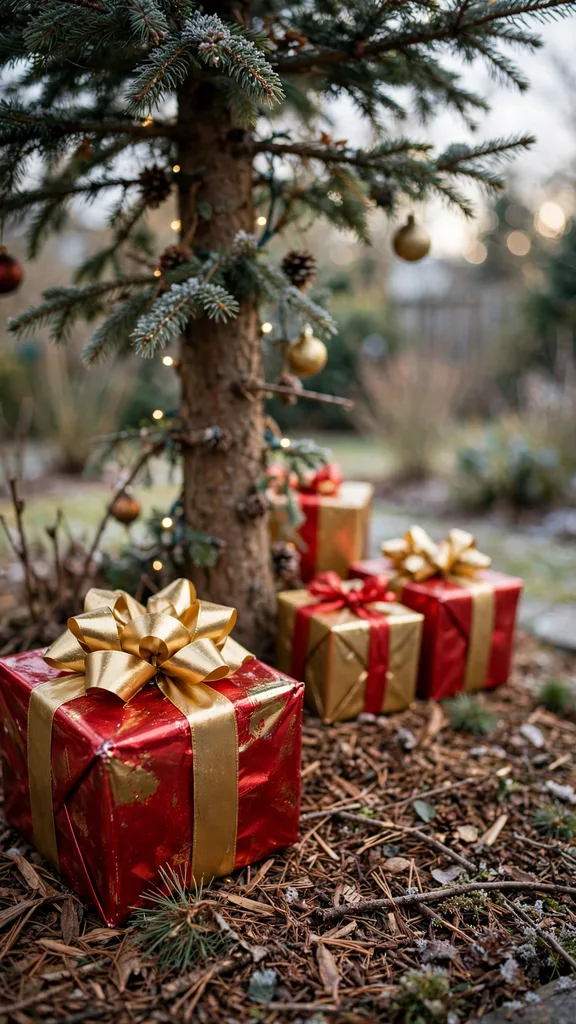
Use plastic storage boxes as the forms in wet climates, since cardboard sags by the second rain. A big box wants a big bow, which the ribbon offcuts provide. Real presents join the pile only in photographs. When the season ends, the boxes flat-pack or nest, and the bricks go back to the path edge they came from.
42. A Lightweight Star on a Clamp, Not a Cut Leader
The topper is where living trees get hurt: forcing a heavy star onto the leader, or worse, cutting the leader to fit one, deforms the tree’s growth for years. Instead, clamp or tie a lightweight star, twig, metal, or acrylic, to a sturdy side branch just beside the leader, at the same height, so the silhouette reads as topped while the leader grows on untouched beside it. From the ground, no viewer can tell the star is an inch off center.
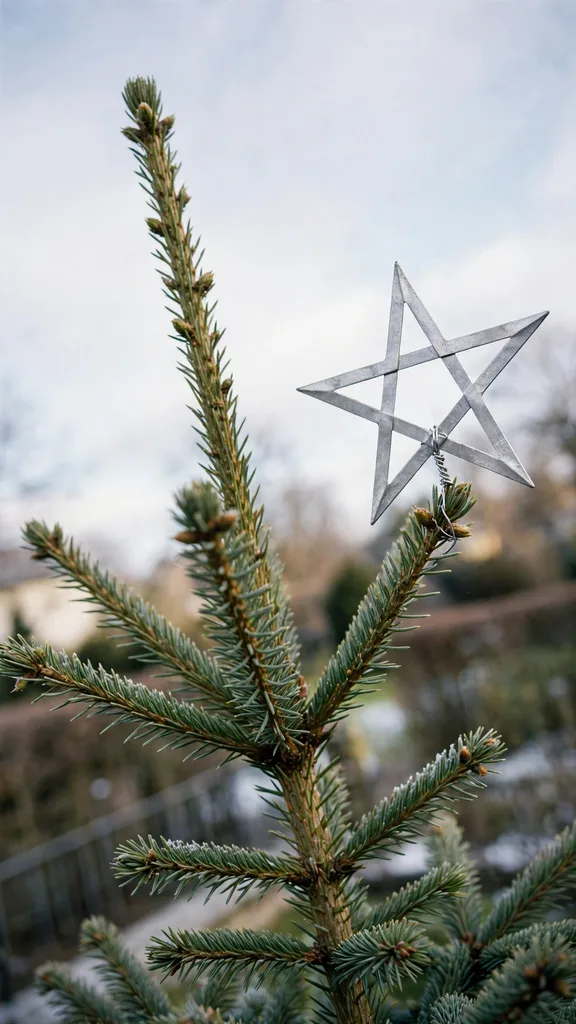
Keep the topper under a few ounces and its fixing loose and padded, and remove it in January with everything else. A topper that sways slightly with the tree is safer than one fixed rigid, which levers against its branch in storms. This single habit, repeated yearly, is the difference between a tree that hosts Christmas and a tree that is consumed by it.
43. Ribbon Streamers From the Top Branches
Long ribbon streamers tied to the top branches fly in the wind like a maypole’s ribbons, adding movement and color at the height where ornaments are unsafe. Outdoor ribbon in two or three colors, cut long, tied once at the branch, and left to stream, turns a still tree into the garden’s weather vane. The streamers announce wind direction and speed all December, which gardeners find themselves checking like a forecast.
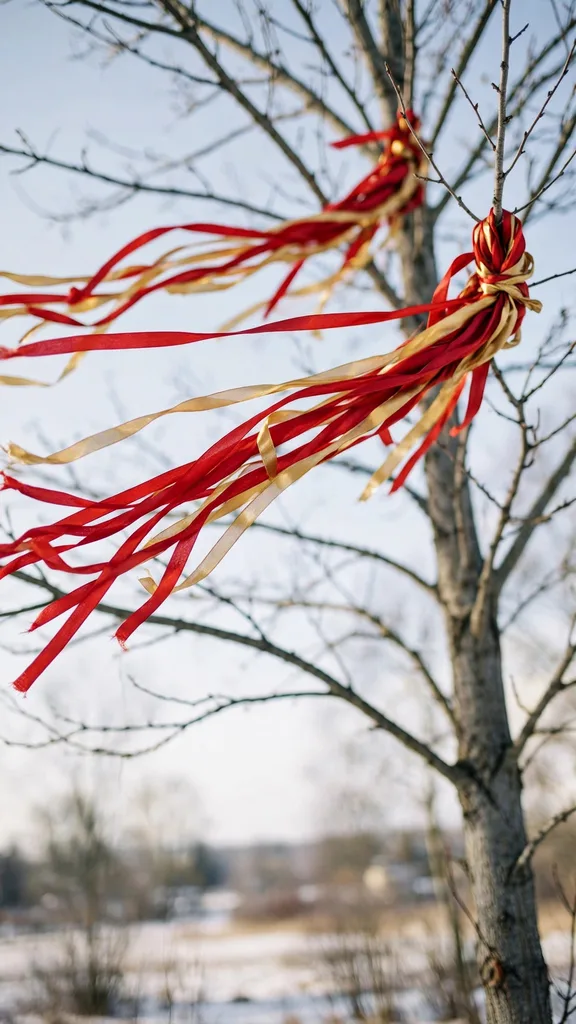
Streamers tangle in storms, so keep them to a handful and trim any that wrap themselves into the branches at takedown rather than pulling. They suit tall trees whose tops cannot be reached for anything heavier. A tree with streamers, lights, and nothing else is the minimalist’s tree, and on a windy ridge it is the most alive-looking display in this list.
44. Outdoor-Rated Berry Garland Wound Loose
A garland of artificial winterberries rated for outdoor use gives the tree permanent red that no bird strips and no frost dulls, wound in the same loose spiral as the lights. It is the one bought decoration in the natural sections of this list, admitted because real berry sprays are seasonal and this garland backs them up in the weeks after the birds feast. Choose matte berries; gloss reads as plastic from the path.
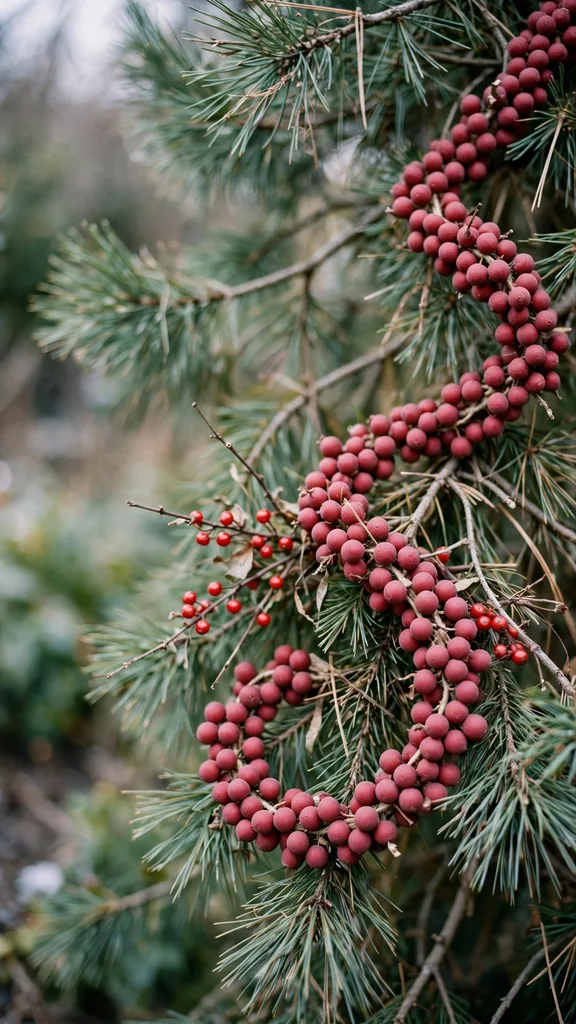
Wind the garland slack and tie it at three points at most, so the tree’s growth is never ringed tight. When real winterberry sprays are tucked in alongside, the eye cannot separate the two, and the garland carries the color through January alone. Store it coiled in a wreath box. Used this way, as scaffolding for the real thing, it earns its place.
45. The Finished Tree at Dusk
The finished tree is judged at dusk, when the lights come on and the garden goes blue around it. Walk to the house door, the gate, and the street, and look from each: move one bauble cluster, straighten one strand, and then stop, because a living tree’s decoration is supposed to look like the tree is wearing it lightly. Photograph it on the first clear evening; frost on the branches with the lights on is the portrait of the whole project.
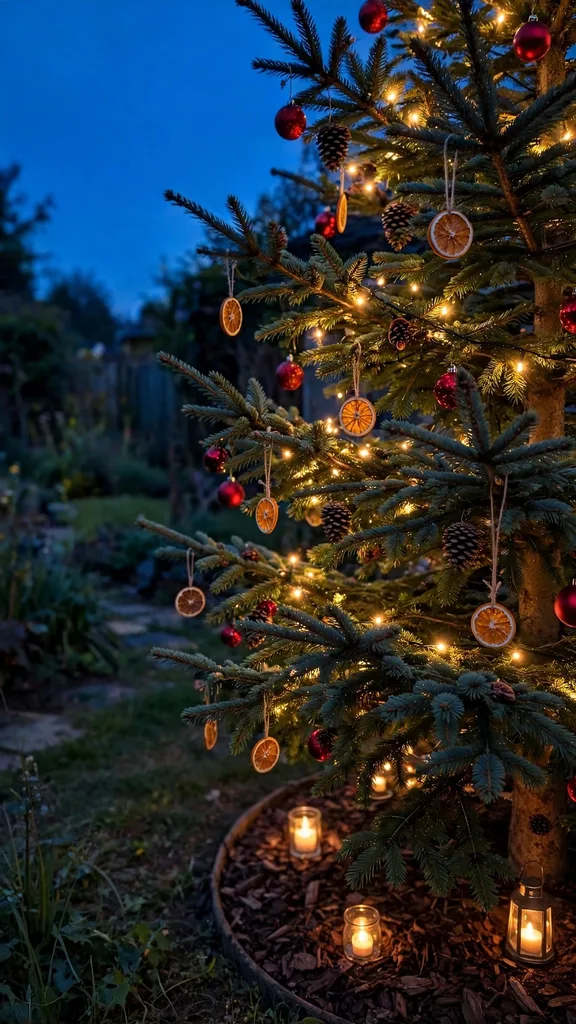
Then leave it alone for the month, apart from rehanging what storms drop and refreshing the bird food. The tree will grow a fraction even in December, loosen a tie here and there, and host more life than any cut tree indoors. In January, everything comes off in an hour, the mulch ring stays, and the tree goes back to being a tree, which was the plan from the first ornament. For the rest of the 100 ideas, the Christmas garden ideas pillar holds the full collection.
Frequently Asked Questions
Not if three rules hold: nothing pierces or cuts the tree, nothing heavy hangs on young growth, and nothing wraps tight around branches or trunk. Lights, ornaments, and garlands in this list are all light, loose, and removed in January. The real risks are heavy toppers forced onto the leader, tight wire that girdles as the tree grows, and decorations forgotten until spring, so the takedown matters as much as the hanging.
LED strings rated for outdoor use, plugged into a ground fault protected circuit. LEDs run cool, so they cannot scorch foliage they touch, and their plastic lenses survive knocks and falls. Check every set for a recognized testing laboratory’s mark and an outdoor certification on the label, inspect for damaged cords before hanging, and put the strings on a timer so the tree and its roosting birds get dark hours overnight.
Tinsel is the one common decoration to leave indoors. Outdoors it blows off strand by strand all month, littering the garden with plastic foil that wildlife can swallow and that never breaks down in the soil. It also tangles into branches and is nearly impossible to remove completely in January. Ribbon streamers, felt garlands, and berry sprays give the same movement and shine, come off cleanly, and leave nothing behind.
Spruces, firs, and pines carry the classic look and the branch strength for lights and baubles, and hollies add their own berries to the show. Young trees under about five feet should take only the lightest layers: solar strings, felt, citrus, and cones. Very old or brittle trees suit the zero-touch options, a projector and lanterns at the base. Whatever the species, decorate the side the house and street see and leave the back to the birds.
Take everything down in early January, on a dry day, before winter storms test every tie and before the tree’s spring growth starts. Work in reverse order, ornaments first and lights last, and check each branch as you clear it for anything wrapped or caught. Decorations left into spring girdle new growth and litter the garden. The mulch ring at the base is the only layer that stays, as feed for the soil.