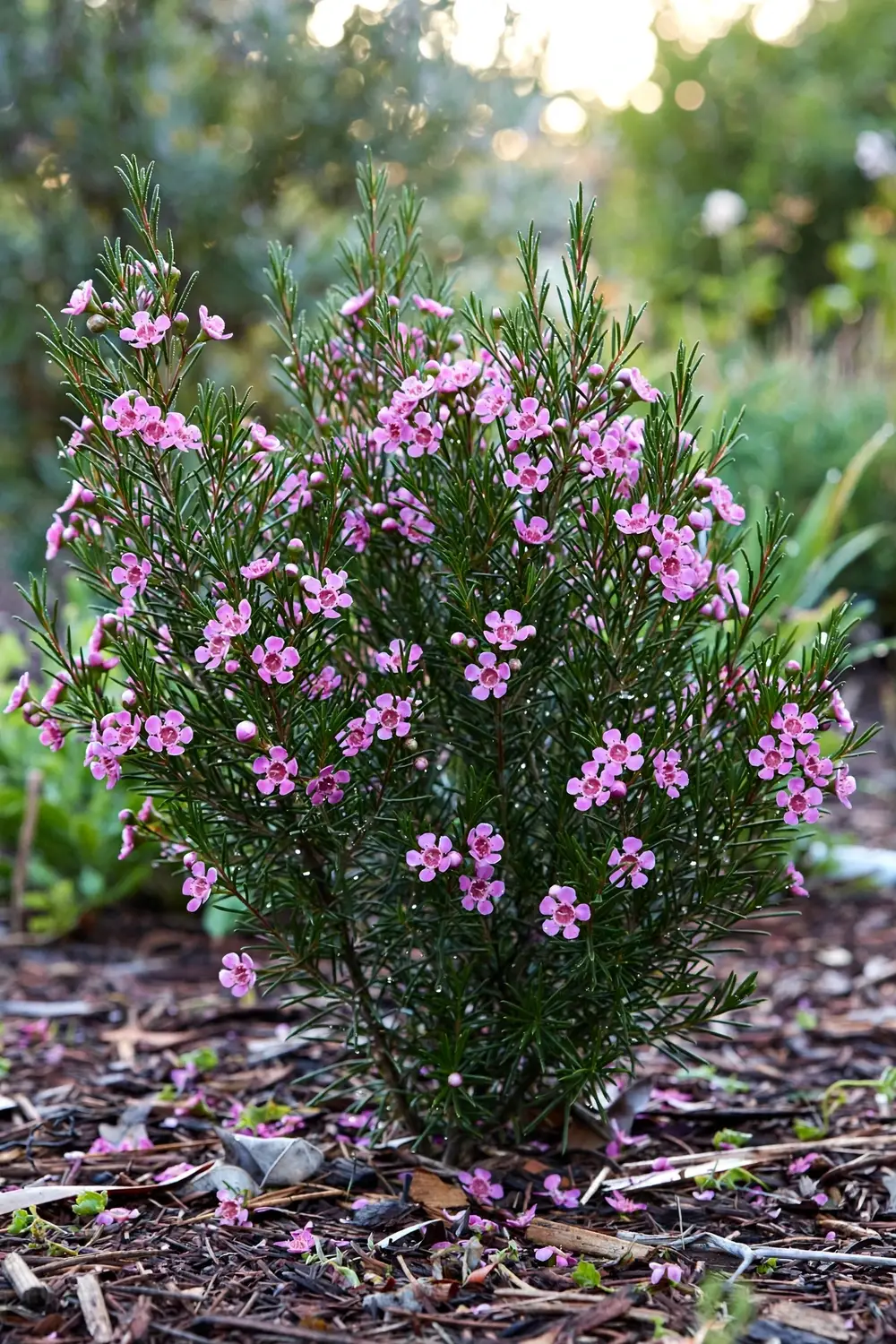

Geraldton wax is Chamelaucium uncinatum, a Western Australian shrub with wild flowers spanning 9 mm to 28 mm. You name it by its hooked leaf tips first and its flowers second. The species name uncinatum means “hooked” in Latin, a direct reference to the tiny hook at the end of every needle leaf. If the leaf tips hook, and the flowers carry five waxy petals, you are holding Geraldton wax. I check the leaf tip with a fingertip first, because the hooked tip names Geraldton wax faster than any flower photo.
This is an identification key, not a growing guide. It walks a decision path: first confirm the plant is a waxflower at all, then separate Geraldton wax from its four closest Chamelaucium relatives, then rule out the two lookalikes gardeners confuse it with, then narrow the cultivar or wild form. Every deciding trait below comes from published sources, and where sources disagree or stay silent, the text says so plainly.
The naming honesty for this article is fixed upfront. “Geraldton wax” means Chamelaucium uncinatum and nothing else. “Waxflower” means the genus Chamelaucium, all fourteen species. “Identification” means telling apart by observable traits, not by label or reputation. These three definitions hold through every section that follows, from the first leaf-tip check to the final cultivar shortlist.
1. Run the Waxflower Test: 5 Waxy Petals and Needle Leaves
A waxflower passes three checks at once. The flowers carry five waxy petals arranged in a star, the leaves are narrow needles held opposite on the stems, and crushing a leaf releases a sharp aromatic scent from oil glands in the tissue. All three traits place the plant in the genus Chamelaucium, a group of about 14 species restricted to the south-west of Western Australia, according to the genus overview on Wikipedia.
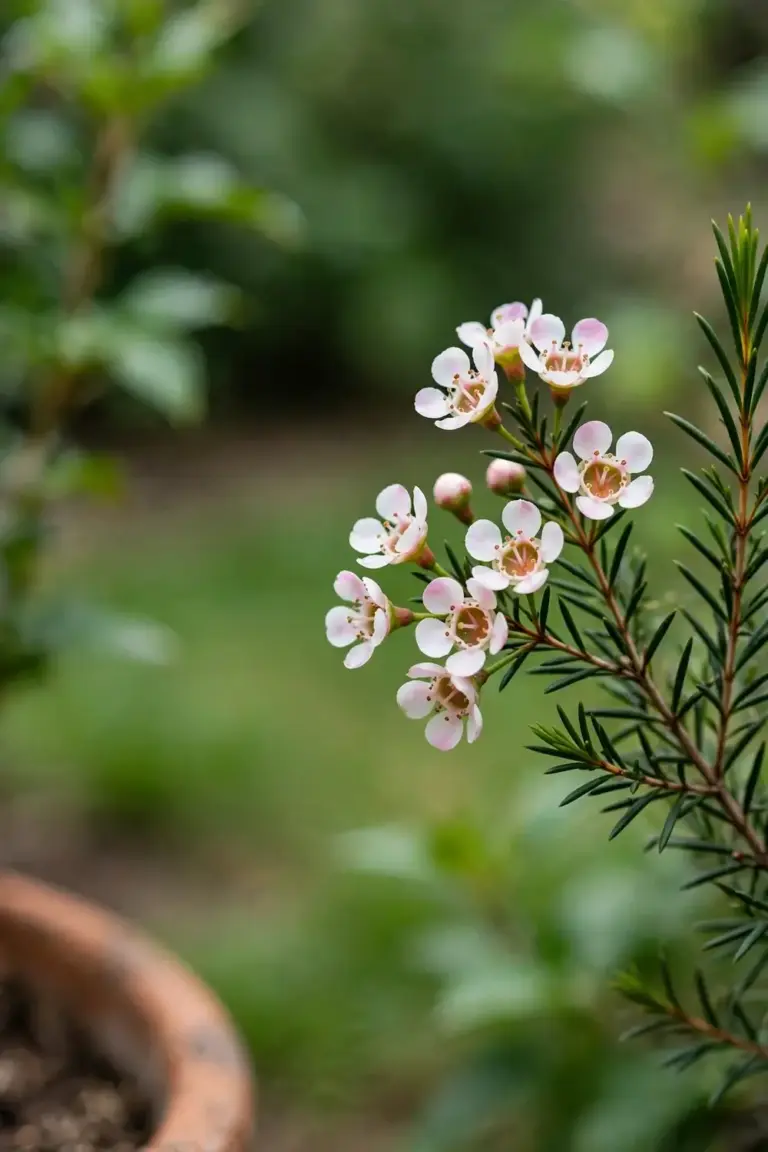
The family matters because it explains the lookalikes. Chamelaucium sits in Myrtaceae, the myrtle family, alongside eucalyptus and tea tree. That shared family is why Geraldton wax flowers resemble tea tree flowers at a glance. The Royal Horticultural Society profile describes the habit as an evergreen shrub with an open, spreading form that becomes denser with age, reaching 2.5 to 4 metres tall with a similar spread.
The same profile notes a time to maturity of 10 to 20 years, a reminder that the open young shrub and the dense mature specimen are the same plant at different ages. Do not let habit alone sway the identification. A leggy young plant and a dense old one both carry the hooked leaf tips that settle the matter.
Fail any one of the three checks and the plant is not a waxflower. Broad leaves rule it out. Flowers with more or fewer than five petals rule it out. Leaves with no scent when crushed point away from Myrtaceae entirely. The three checks take under a minute and they prevent every misidentification that follows.
The scent check deserves a moment because beginners skip it. Myrtaceae leaves carry oil glands that release aromatic compounds when the tissue breaks. Eucalyptus, tea tree, and waxflower all share this trait, which is why a crushed waxflower leaf smells sharp and clean rather than green and grassy. A plant with the right flowers and leaves but no scent when crushed is waving a red flag. Trust the nose as a backup to the eyes.
2. Check the Leaf Tip: Hooked Means Geraldton Wax
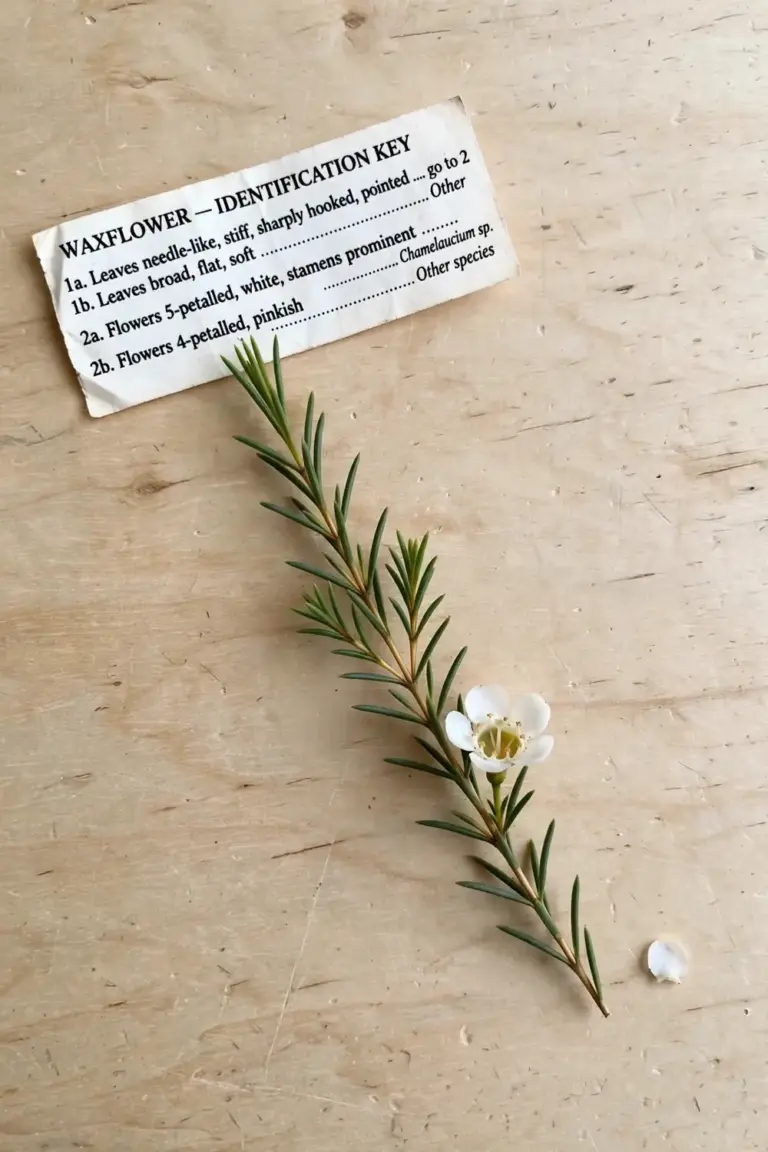
The single fastest test for Geraldton wax is the leaf tip. Chamelaucium uncinatum carries a small but distinct hook at the tip of each needle leaf, and the species name records exactly that trait. The species page on Wikipedia states that uncinatum means “hooked” in Latin, in reference to the tips of the leaves. No other common waxflower carries this exact combination of fine needle leaves with hooked tips.
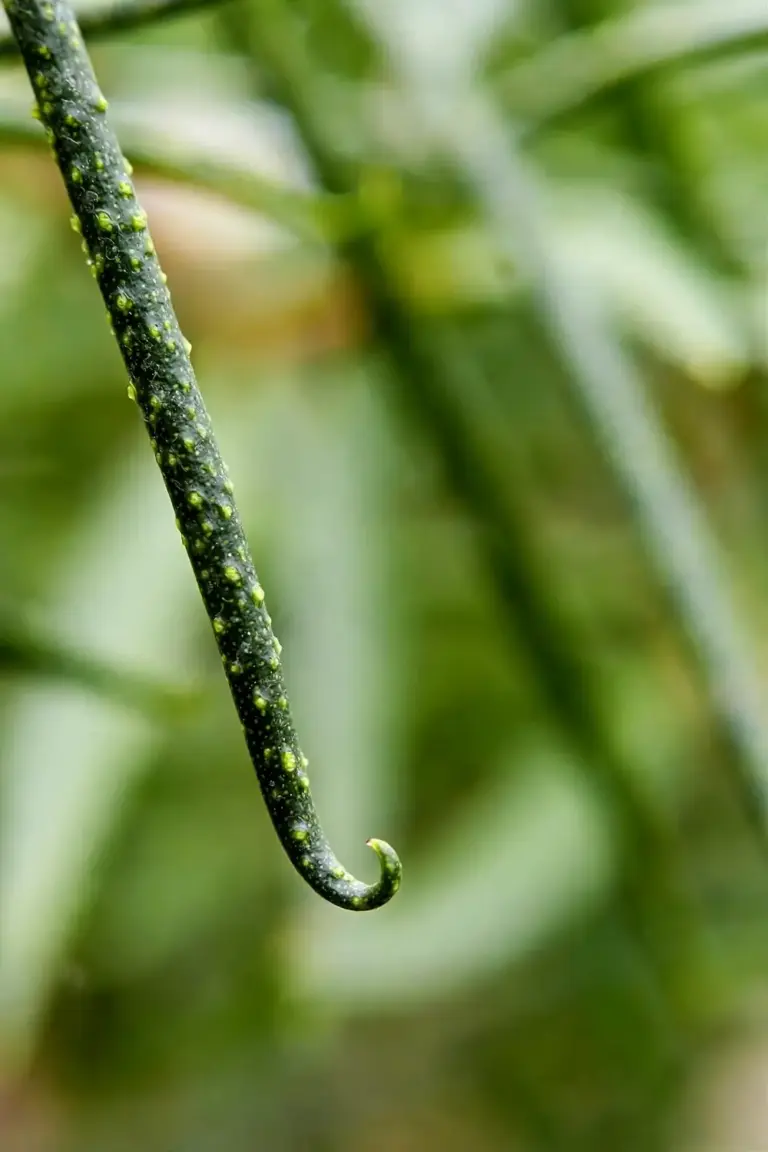
Run a fingertip along the end of a leaf. The hook catches the skin lightly, like a tiny barb. The RHS profile confirms the description, noting dark green leaves that are very fine and narrow with hooked tips. This test works year-round, flowers or not, which makes it the most reliable field mark in the whole key.
A smooth, unhooked needle leaf points to a different Chamelaucium species. The hooked tip is the uncinatum signature, and it is the reason the first-person check above starts at the leaf rather than the flower. Flowers vary with cultivar and season. The hook does not.
Young growth can mislead. Fresh spring shoots may carry soft, not-yet-hardened tips where the hook is hard to feel. Test a mature leaf from the previous season’s wood, not the soft new tip. Damaged or chewed leaf tips also lose the hook, so check three or four leaves across the plant before deciding. A consistent hook on mature foliage is diagnostic. An absent hook on one damaged leaf means nothing. When every mature leaf on the plant carries the hook, the identification is secure before a single flower opens.
3. Measure the Flower: 9 mm to 28 mm Names the Wild Form
Wild Geraldton wax varies enormously in flower size, and that variation maps to geography. The City of Greater Geraldton’s “Waxing Lyrical” guide by Digby Growns records that the Geraldton wax in its many wild forms varies in flower size from 9 mm to 28 mm, in flower color across white, pink, mauve and magenta, in flowering time from June to November, and in plant size from 20 cm to 5 m. The guide is available as a council PDF on wild wax forms.
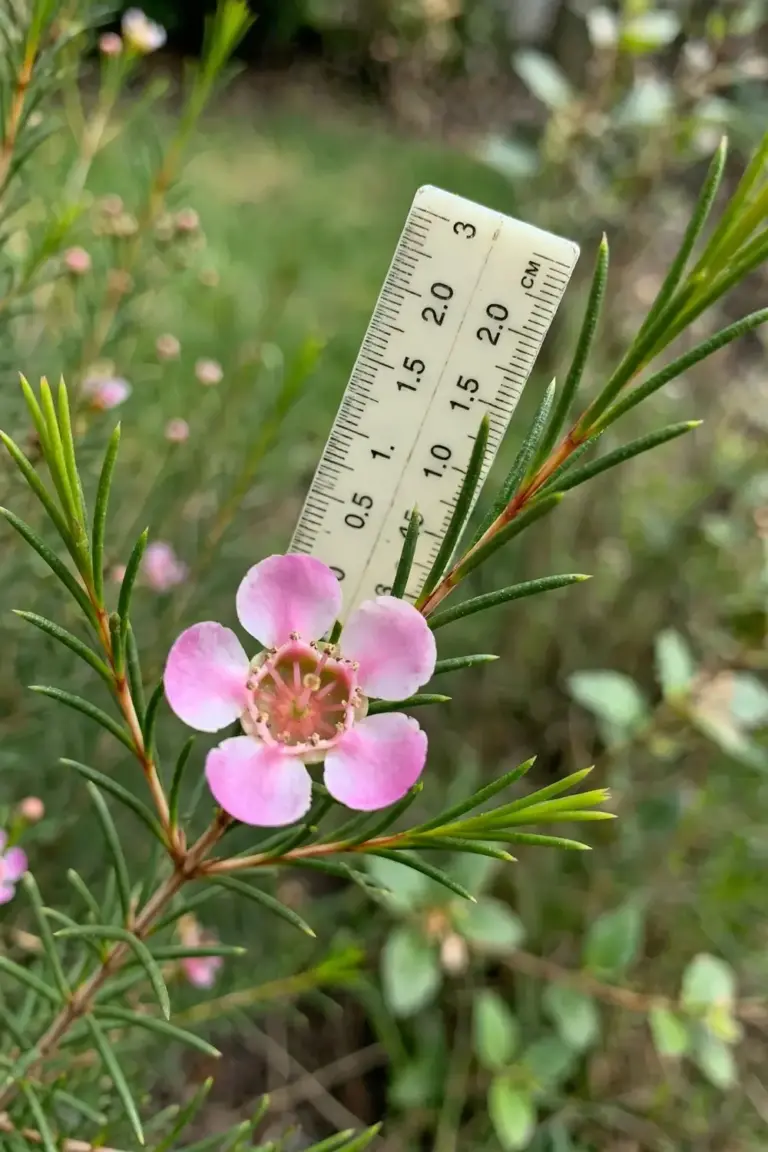
Measure one fully open flower across its widest point. Flowers near 28 mm with large, colorful petals and early flowering point to the Geraldton form, the most popular of the wild waxes and the source of many nursery cultivars. The same guide notes that cultivars sold in nurseries often originate from the Geraldton form, including the popular ‘Purple Pride’, ‘CWA Pink’ and the white-flowered ‘Alba’, flowering from late winter into spring.
Smaller flowers point south. The Jurien Bay form, from about two hours south of Geraldton on the coast, carries smaller, cupped flowers and blooms in September. Southern populations near Lancelin and Wembley in Perth flower from late September through to November. The Kalbarri form breaks the size rule in the other direction: longer, thicker leaves and large flowers, usually with pale, almost white petals and dark centers, flowering early to mid spring. The Hutt River population near Northampton grows in sandstone rather than sand, carries prominent horns on its buds, thicker and longer leaves, and large flowers in mid spring.
Flower size alone never settles a cultivar name. It narrows the wild form, and it tells you whether a nursery plant leans toward a northern or southern origin. The honest limit is stated in the cultivar section below.
Measure with a ruler, not by eye. Hold the ruler behind a fully open flower and read the widest petal-to-petal span. Measure three flowers on different branches and take the middle value, because individual blooms vary with position and age. Buds measure small and mislead, so only open flowers count. A plant consistently flowering at 25 mm or above sits at the Geraldton end of the range. One flowering at 12 mm sits at the southern end.
4. Meet 4 Other Waxflowers That Are Not Geraldton Wax
Four Chamelaucium species reach gardens often enough to cause confusion, and each fails at least one Geraldton wax test. The genus page lists the recognised species with their common names, and the distinctions below follow that taxonomy.
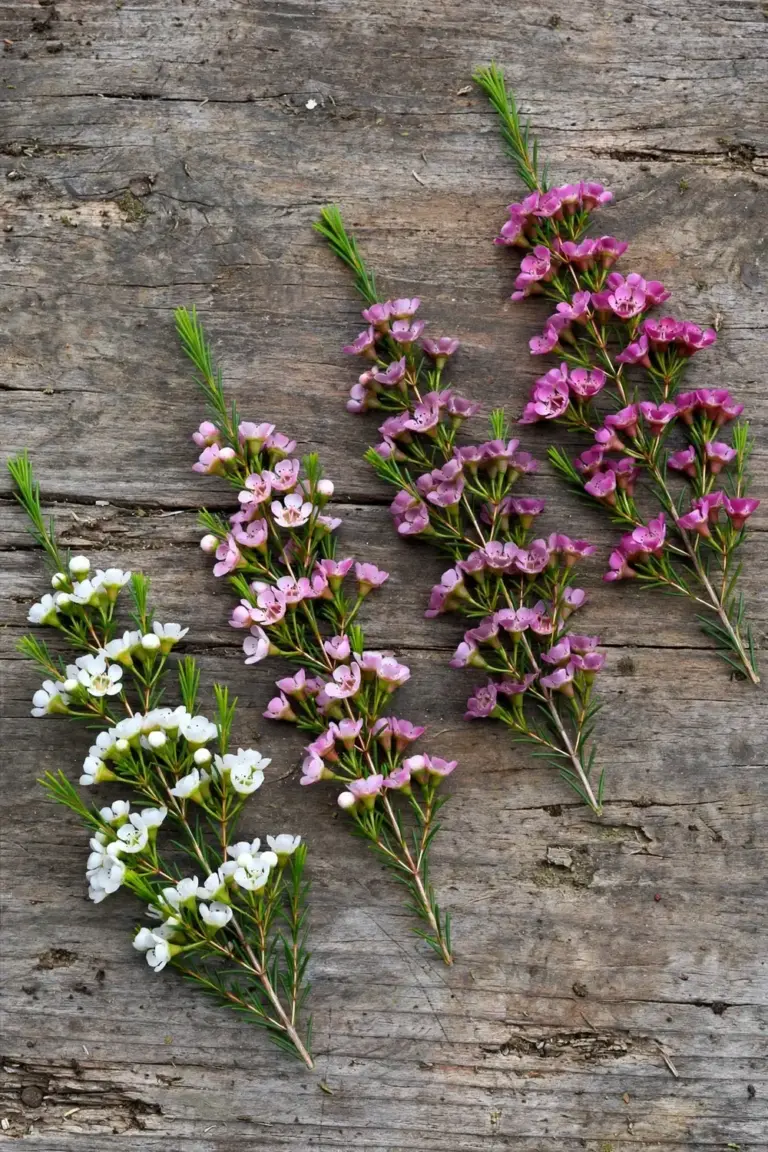
Chamelaucium ciliatum, the Sterling wax, grows lower and more compact than Geraldton wax. Its flowers are smaller and its habit stays dense without the open, leggy spread of uncinatum. If the plant never exceeds about a metre and the flowers sit tight in the foliage, ciliatum belongs on the shortlist.
Chamelaucium megalopetalum, the large waxflower, earns its name from flower size. Its blooms run larger than typical uncinatum and the plant carries a bolder flower display. Measure the flower: consistently oversized blooms on a strongly growing shrub point to megalopetalum rather than a large-flowered uncinatum form.
Chamelaucium axillare, the Esperance waxflower, flowers white to red and comes from the Esperance region on the south coast. Its natural range sits far from the Geraldton wax heartland, so a plant of known south-coast provenance with red-toned flowers deserves an axillare check.
Chamelaucium floriferum, the Walpole wax, is the least common of the four in cultivation but appears in nursery lists. It resembles uncinatum in general habit, so the hooked leaf tip test from section 2 becomes the deciding trait. No hook means no uncinatum.
Geography helps when provenance is known. A plant collected or sourced from the Esperance region with red-toned flowers leans axillare. One from the Walpole area leans floriferum. A low, dense plant from a nursery specialising in compact forms leans ciliatum. Provenance never replaces the morphological key, but it orders the suspects when several species seem plausible.
None of these four carries the exact hooked-tip plus 9 to 28 mm flower combination of Geraldton wax. Work the key in order: waxflower test, hook test, flower measurement. The species that survives all three is uncinatum.
Nursery labels complicate the picture. A plant sold as “waxflower” with no species name is most likely uncinatum, because it dominates cultivation, but the label alone proves nothing. Run the key on the plant in front of you rather than trusting the tag. Mislabelled stock is common enough that the key earns its keep in the nursery aisle as well as in the garden.
5. Rule Out Tea Tree: Same Flowers, Different Leaves
Tea tree, Leptospermum, is the most common misidentification, and the family explains why. Both genera sit in Myrtaceae, so both produce five-petalled, cup-shaped flowers in white and pink. The species page notes that Geraldton wax flowers somewhat resemble those of the tea tree. The resemblance ends at the foliage.
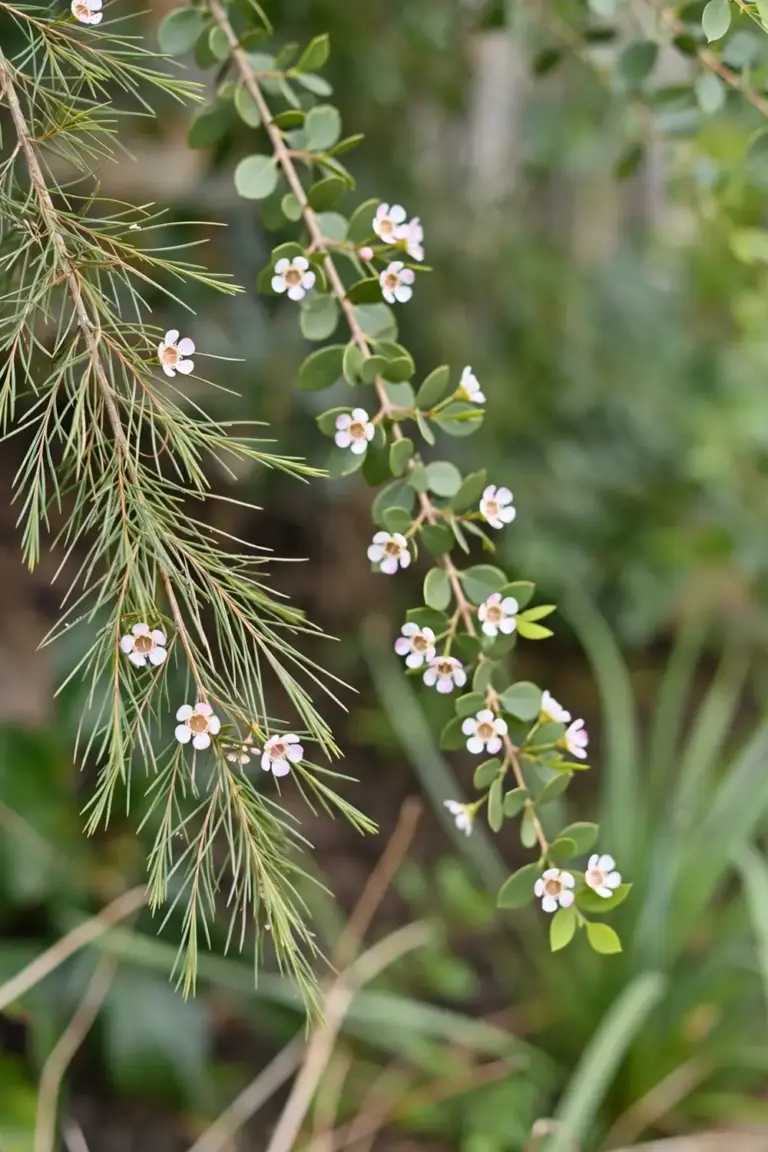
Tea tree leaves are small, flat, and varied in shape, but they are never the fine needles of a waxflower. They lack the hooked tip entirely. Crush a tea tree leaf and the scent differs too, often sharper and more medicinal than the waxflower’s aromatic oil. If the leaves are flat rather than needle-like, the plant is not Chamelaucium at all.
Flowering time overlaps, which is why the confusion persists. Both bloom through spring in Australian gardens. The leaf test settles it in seconds: needles with hooks mean waxflower, flat leaves mean tea tree. Do not trust the flower alone when the two genera share a family.
The two often grow side by side in native gardens, which is exactly when the confusion bites. A mixed Myrtaceae border in spring shows pink and white five-petalled flowers on every shrub, and only the foliage separates them. Walk the border leaf by leaf. The waxflowers declare themselves by needle foliage, the tea trees by flat leaves, and the whole planting sorts itself in one pass.
6. Rule Out Featherflower: Feathery Petals Give It Away
Featherflower, Verticordia, sits in the Chamelaucium alliance, the group of closely related Myrtaceae genera that also includes Darwinia, Thryptomene, Calytrix and Baeckea. The genus overview names these alliance members and notes that Geraldton wax, C. uncinatum, is the best known and most widely cultivated member of the genus. Alliance membership means shared ancestry, and shared ancestry means similar flowers.
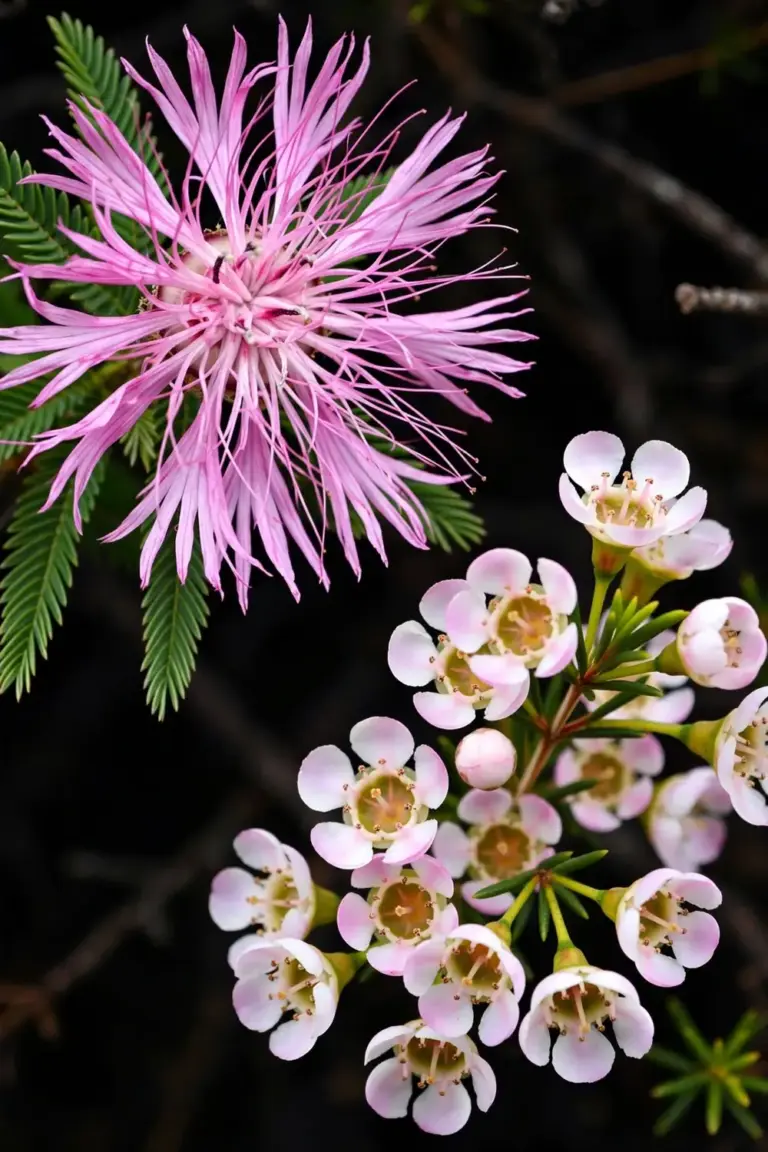
The petals decide. Verticordia flowers carry deeply divided, feathery petals that look fringed or plumed even at a glance. Chamelaucium petals are smooth, waxy, and entire, with clean edges. Hold one flower up: feathery fringe means featherflower, smooth waxy petal means waxflower. No other test is needed.
Darwinia and Thryptomene, two more alliance members, cause less confusion because their flowers read differently at garden distance. Darwinia bells cluster into dense heads, and Thryptomene flowers are tiny by waxflower standards. If the flower is large, waxy, and smooth-petalled, the plant stays in Chamelaucium. The alliance matters mainly as a reminder that similar flowers do not mean the same genus.
Verticordia earns extra attention because Geraldton wax serves as its grafting rootstock. The species page notes that the hardy characteristics of uncinatum have led to its use as a rootstock species for grafting featherflowers of the genus Verticordia. A grafted plant therefore carries uncinatum roots and Verticordia top growth. Identify by the flowers and foliage of the top growth, not by any suckers from below the graft.
7. Read the Cultivar: Single or Double, Frilly or Smooth
Nursery cultivars are identified by flower form, not by wild-form geography. The key traits are petal count, petal edge, and color behaviour with age. Single flowers carry the standard five petals. Double flowers carry extra petals, sometimes many, giving a fuller, rose-like bloom. The council PDF records ‘Purple Pride’ with deep purple-magenta flowers, ‘CWA Pink’ in pink, and ‘Alba’ in white, all originating from the Geraldton wild form.
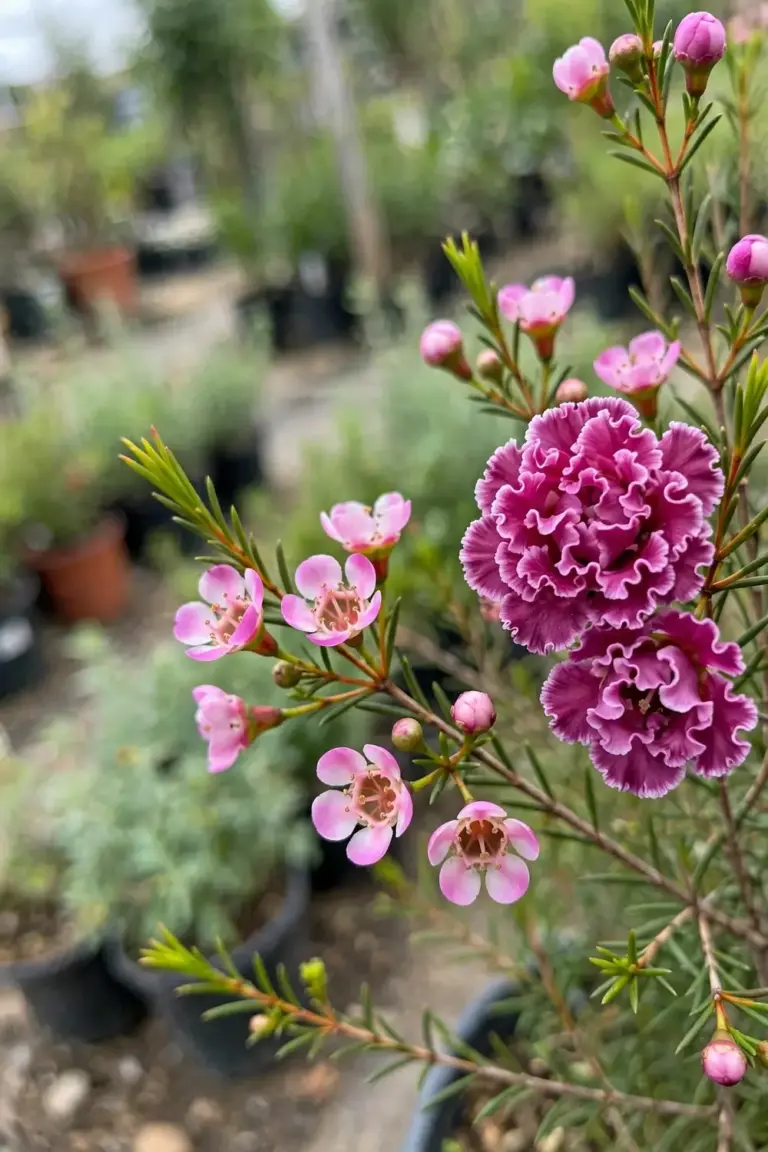
Petal edge separates the frilly from the smooth. Some cultivars, such as ‘Chantilly Lace’ types, carry ruffled or frilly petal edges. Others hold smooth, clean petal margins. Color change with age is a third trait: some flowers open white and deepen to pink or red as they mature, while others hold one color throughout. Note the color of a fresh flower and a week-old flower on the same plant.
Honesty matters here more than anywhere in the key. Many hybrids share colors, and cultivar identification from the flower alone produces a shortlist, not a verdict. The scout evidence for this article states plainly that numerous hybrids exist and that flower-only identification gives candidate names rather than certainty. A nursery label remains the only definitive cultivar identification. Use this section to narrow the field to two or three candidates, then confirm against the label or the nursery’s catalogue.
Double flowers deserve a special note. The double-flowered forms carry extra petals that can obscure the standard five-petal structure, and at a glance a double waxflower can resemble a small rose. Count the outer petal ring: five outer petals in the standard positions confirms the waxflower ground plan even when the center is crowded with extras. The waxy texture and needle foliage confirm the genus when the petal count gets confusing.
8. Note the Flowering Month: June to November Narrows the Field
Flowering time is a supporting trait, never a deciding one alone. Wild Geraldton wax flowers from June to November, with the exact window shifting by form and latitude. The council PDF places the Geraldton form from late winter into spring, the Jurien Bay form in September, and the southern populations from late September through to November.
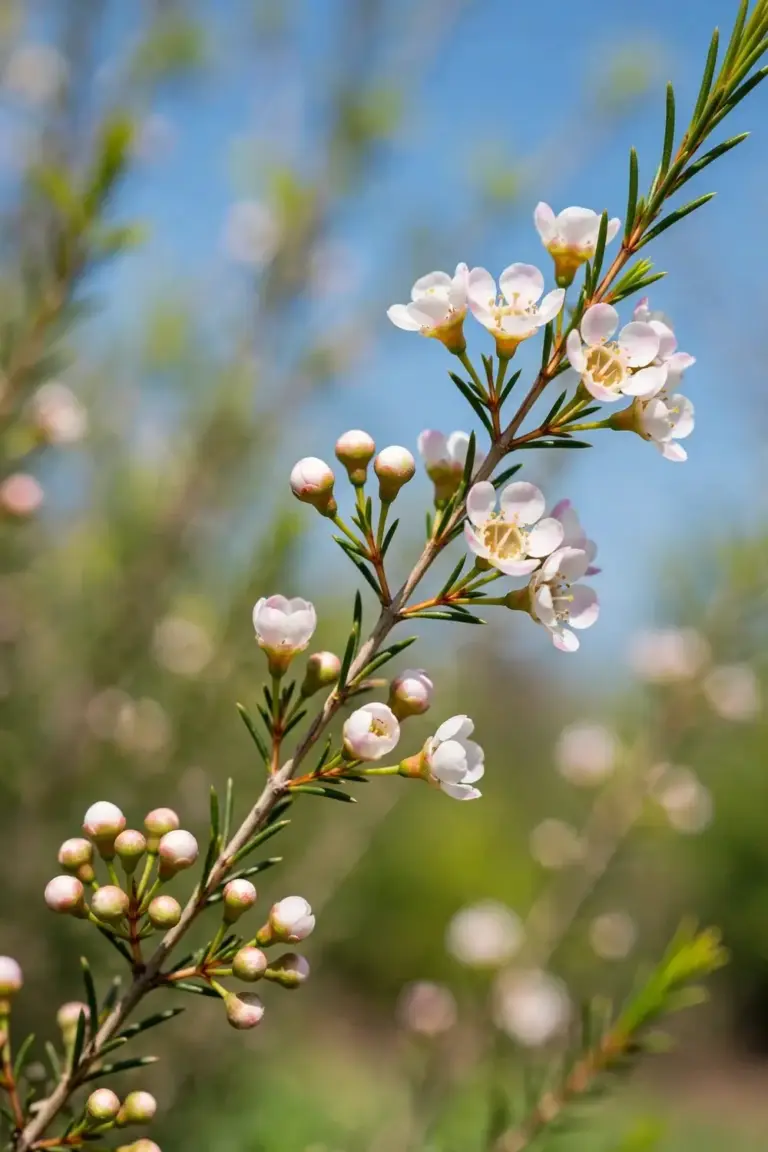
Record the month the first flowers open. A plant flowering in June or July leans toward a northern form or an early cultivar. A plant starting in October or November leans southern or late. Cultivars bred for the cut-flower trade may flower outside the wild windows entirely, because selection targets market timing rather than natural season.
Combine the month with flower size and color from sections 3 and 7. Three traits agreeing on one form is a strong identification. One trait alone is a hint. The key works by accumulation, and the flowering month is the trait that costs nothing to observe.
Cut-flower cultivars follow market calendars, not wild seasons. Commercial growers select and schedule for stem harvest windows, so a cut-flower cultivar in a home garden may open weeks before or after the wild forms. Do not force a market cultivar into the wild-form geography. If the plant came from a cut-flower nursery, treat the flowering month as a cultivar trait and lean harder on the hook test and flower form.
9. Beware the Nursery Name Trap: Waxflower Labels Lie
Common names at nurseries are unreliable, and waxflower is one of the worst offenders. A plant tagged “waxflower” with no species name could be any Chamelaucium species, and a tag reading “Geraldton wax” is a claim, not proof. The nursery trade moves plants faster than botanists revise names, so old or approximate labels persist for years. Run the key on the plant, not the tag.
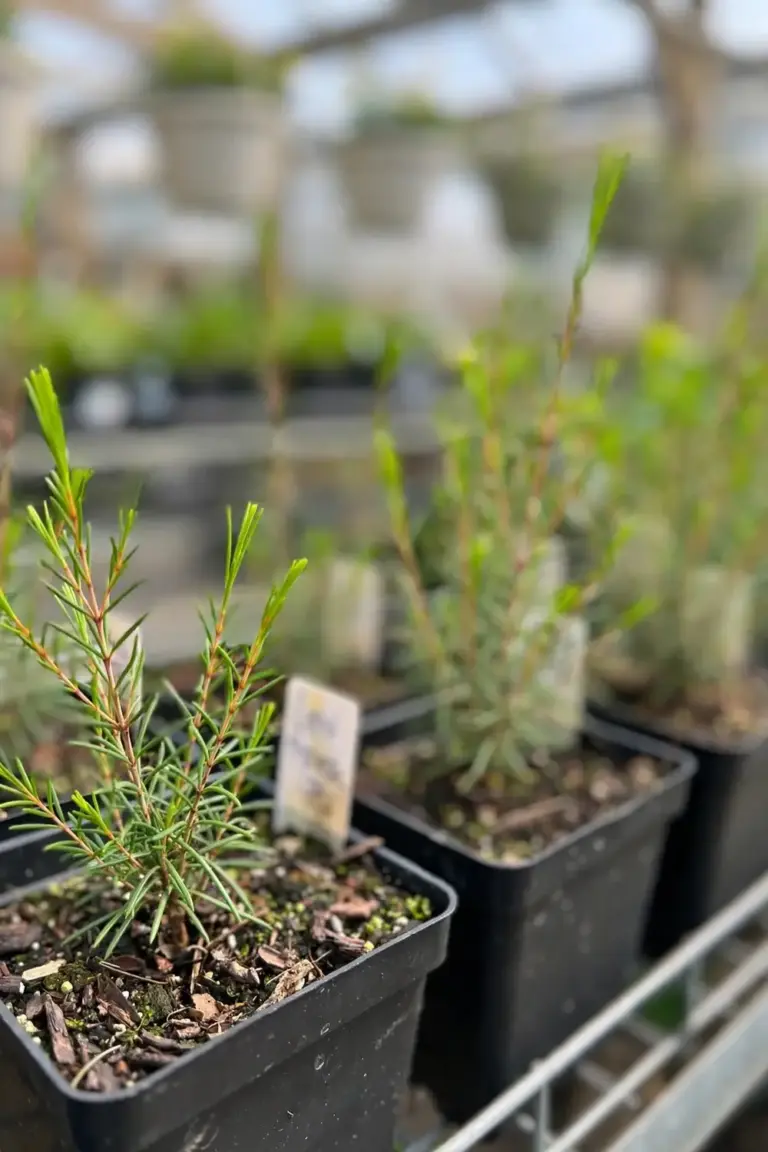
The “waxflower” name also escapes the genus. Florists apply it loosely to any waxy white or pink filler flower, and some of those fillers are not Chamelaucium at all. A bouquet labelled “waxflower” might contain Thryptomene or a Baeckea relative. The botanical name on a nursery label is the only name that carries weight. Chamelaucium uncinatum on the tag, confirmed by the hooked leaf tip on the plant, is an identification. “Waxflower” alone is a rumor.
Cultivar names add a second layer of confusion. The same cultivar can travel under different names in different states, and seedling-grown plants sold under a cultivar name may not match the original clone. A plant sold as ‘Purple Pride’ grown from seed is not ‘Purple Pride’ in the strict clonal sense. For identification purposes, treat an unverified cultivar name as a hypothesis and test it against the flower traits in section 7.
10. The Master Waxflower ID Table
The full decision path fits in one table. Work it top to bottom on any unknown plant.
| Trait | Geraldton Wax (C. uncinatum) | Other Waxflower | Tea Tree | Featherflower |
|---|---|---|---|---|
| Leaf shape | Fine needles with hooked tips | Needles, tips unhooked | Flat, varied, no hook | Fine, no hook |
| Petals | 5, waxy, smooth-edged | 5, waxy, smooth-edged | 5, not waxy | 5, deeply feathery |
| Flower size | 9 to 28 mm | Varies by species | Varies | Usually smaller |
| Flowering | June to November | Varies | Spring | Spring |
| Scent (crushed leaf) | Aromatic oil | Aromatic oil | Sharper, medicinal | Mild |
| Origin | South-west WA | South-west WA | Widespread | Mainly WA |
Start at the top row and move down. The first row that eliminates a candidate removes it permanently. Most garden plants are resolved by row two: the hooked tip test. The table exists so no step gets skipped when the answer feels obvious early.
Keep the table handy on a phone for nursery visits. The rows are ordered by speed: leaf shape first because it needs no flowers, petals second because one bloom suffices, flower size third because it needs a ruler. A plant that survives all three rows as Geraldton wax is identified. One that fails early is eliminated without further work.
Frequently Asked Questions
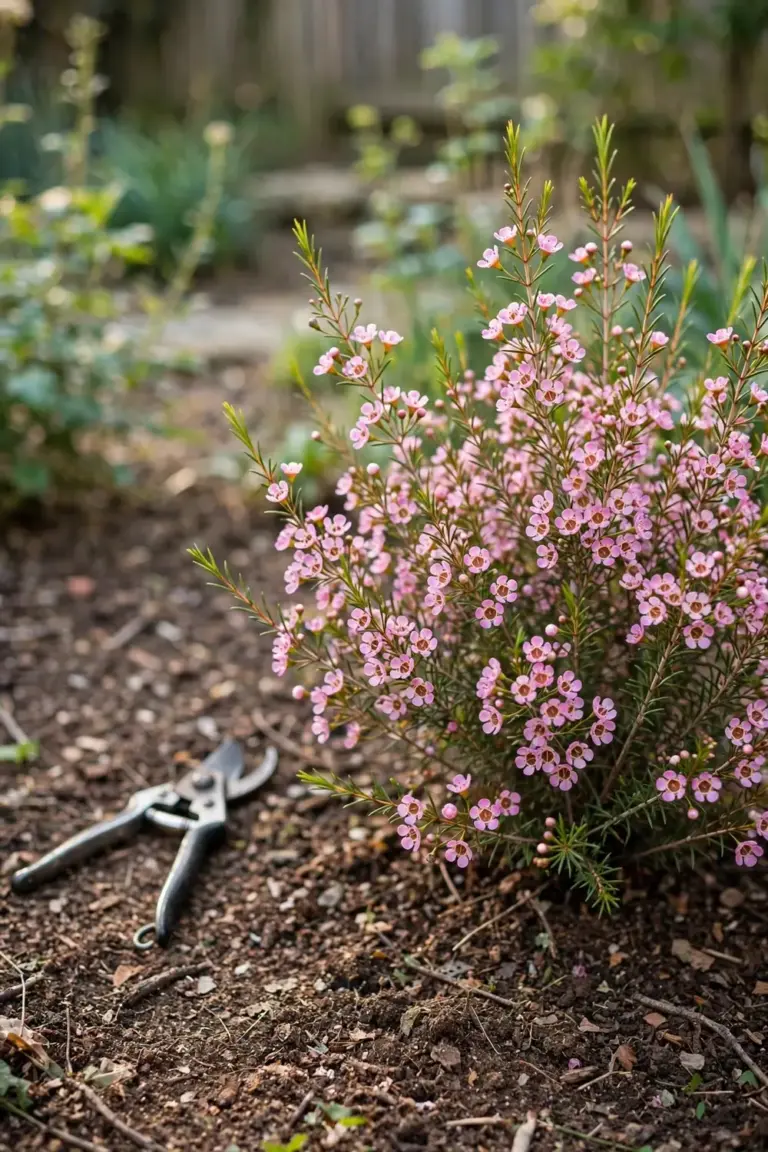
Start at the leaf tip. In Geraldton wax, Chamelaucium uncinatum, every needle leaf ends in a small hook, and the species name itself means “hooked” in Latin. Four garden relatives grow in Australian nurseries, C. ciliatum, C. megalopetalum, C. axillare and C. floriferum, and not one of them carries this exact hook. That single trait is diagnostic. Add flowers measuring 9 to 28 mm with five waxy petals, and the identification is complete.
The hook is a small, sharp curve at the very end of each needle leaf, visible to the naked eye and catchable on a fingertip. The RHS profile describes the leaves as very fine and narrow with hooked tips. It is not a curl along the leaf length or a bent stem. One hooked tip per leaf, on every leaf, is the pattern to confirm.
Flower-only cultivar identification gives a shortlist, not a verdict. Note single versus double flowers, frilly versus smooth petal edges, and whether the color deepens with age, then match against known cultivars such as ‘Purple Pride’, ‘CWA Pink’ and ‘Alba’. Many hybrids share colors, so the nursery label remains the only definitive answer. Use the flower traits to narrow to two or three candidates.
Wild forms map to geography and flower size: large flowers near 28 mm suggest the Geraldton form, small cupped flowers flowering in September suggest Jurien Bay, and late September to November flowering suggests southern populations. Nursery cultivars are selected for color, doubleness, and market timing, and they may flower outside wild windows. A plant with a cultivar name on its label is a cultivar regardless of appearance.
Look at the leaves, not the flowers. Both genera sit in Myrtaceae and both produce five-petalled flowers, so blooms alone mislead. Waxflower leaves are fine needles with hooked tips in Geraldton wax. Tea tree leaves are flat and lack hooks entirely. Crushed-leaf scent differs as well. Needles mean waxflower, flat leaves mean tea tree.
Write the Name Down Before You Walk Away
Identification sticks when it is written down at the plant. Record the botanical name, Chamelaucium uncinatum, the wild form or cultivar shortlist, the flower measurement, and the flowering month. A label in the garden or a note on the phone turns a one-time keying into a permanent record.
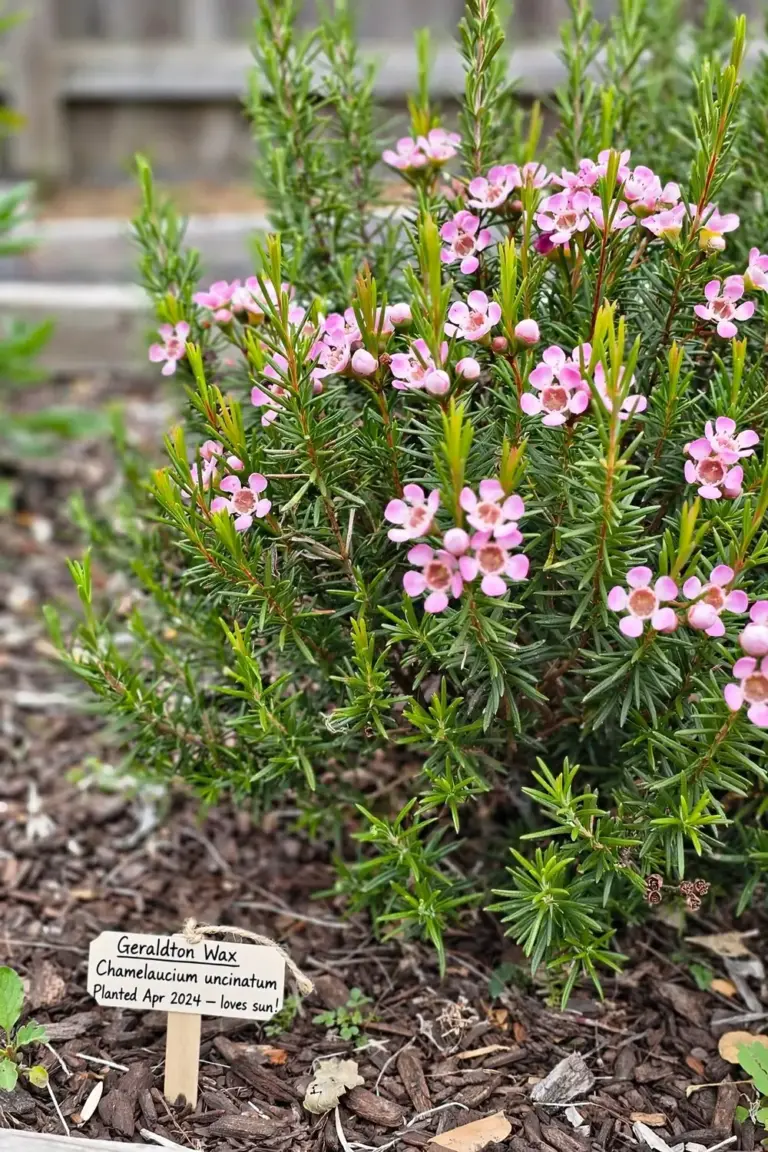
Geraldton wax was Australia’s first great native export flower, and it remains the waxflower every other is measured against. The hooked leaf tip is the fastest test in the native garden. Learn it once and every waxflower after it sorts itself. For gardeners building a native collection in containers, the site’s best Australian native plants for container gardens covers which species suit pots. Its Myrtaceae relatives share the family traits: the glacier eucalyptus growing guide shows how oil-rich foliage behaves in a close cousin.
One last field habit seals the identification. Photograph the leaf tip, one open flower with a ruler, and the whole plant, all on the same visit. The three photos together answer every question in this key without a return trip. Future you, comparing a nursery label against the photos, will be grateful. The hook, the measurement, and the habit: three images that name any waxflower.