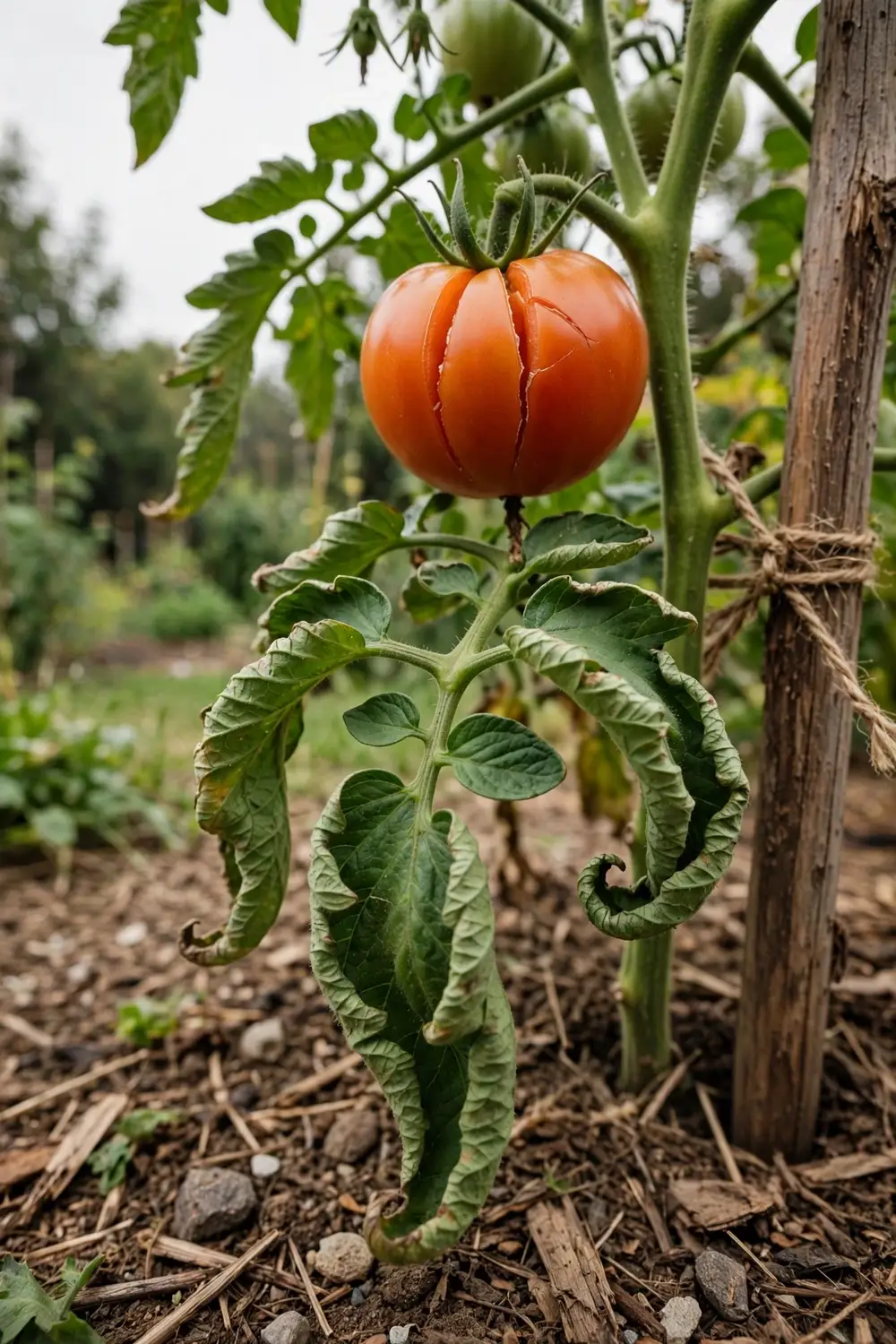

Curling leaves and splitting fruit on the same tomato plant share one root cause in most home gardens: uneven water. Leaves roll to cut water loss when roots run dry, then fruit skin splits when a sudden soak swells the fruit faster than the skin can stretch. A 3-step check settles it: roll direction, crack pattern, and whiteflies. This page diagnoses tomato leaf curl and fruit splitting together, then fixes the water rhythm.
Tomato leaf curl means leaves rolling inward. Fruit splitting means skin cracking as fruit swells. Both symptoms trace to water stress and heat in most cases. A short differential test separates harmless physiological roll from virus and herbicide drift before you pull a plant or spray anything.
I have learned that the plant I water steady through a heatwave keeps its leaves flat, while the one I soak after a dry week curls and splits. The rest of this page runs the five-step diagnosis, then the steady-water fix and the heat fix. Healthy soil holds water evenly between waterings, so start with building soil health if your beds dry out fast.
1. Trace Both Symptoms to One Root Cause First
Uneven water drives both symptoms. A dry spell slows leaf growth and tightens leaf tissue. A heavy rain or a deep soak after that dry spell floods the roots. The plant pulls water fast. Leaves that already rolled stay rolled. Fruit that already set swells fast and its skin cracks. The two symptoms look unrelated. They share one trigger.
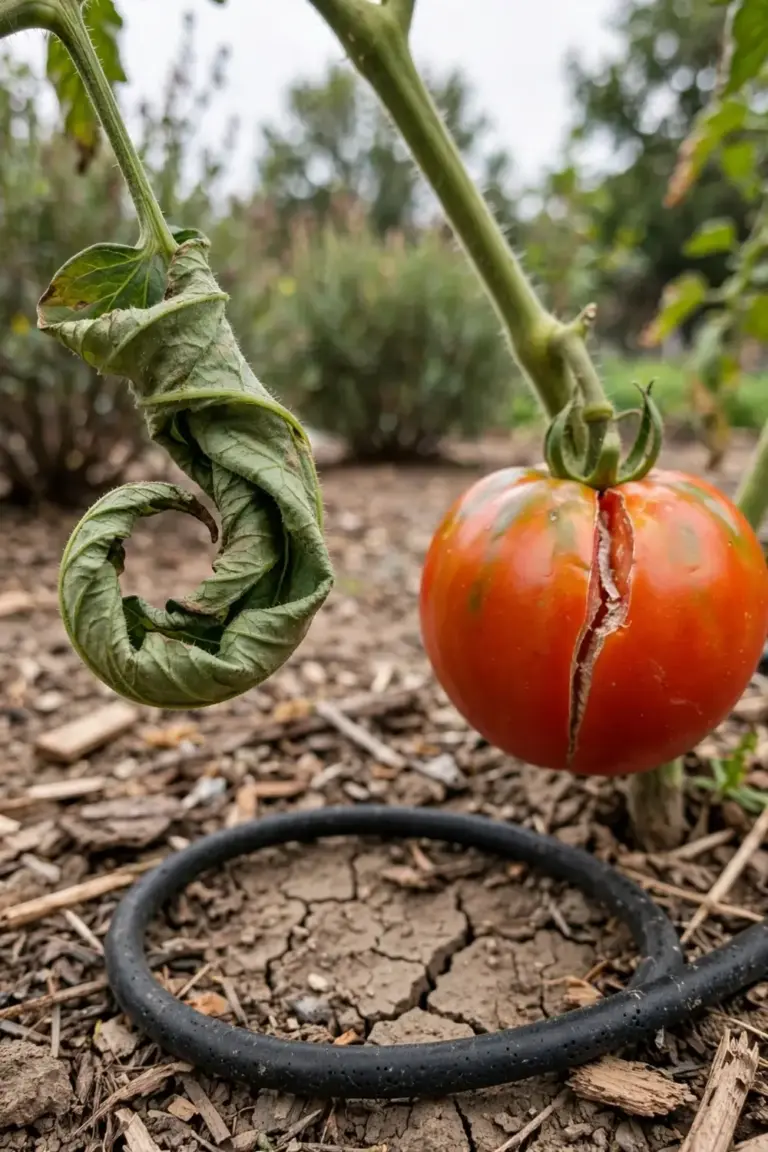
The mechanism runs through the roots. Roots pull water into the plant, leaves lose water through transpiration, and fruit takes water as it grows. When soil dries, the plant closes leaf pores and rolls leaves to slow water loss. When water floods back, the plant pulls hard. Leaves cannot unroll. Fruit skin cannot stretch fast enough. The skin splits. The tear starts small and widens as the fruit colors.
Read the pair together. Curl on lower leaves plus radial splits after a storm points at water, not disease. Curl on new growth plus yellow margins and stunting points away from water. The pair saves you from two mistakes: spraying a plant that needs water, and watering a plant that carries virus. Check water first. Check the differential second.
Timing helps the diagnosis. In Australian summers, symptoms usually appear in late spring or early summer, when heat rises and watering turns irregular. A storm after a dry week is the classic trigger. A heatwave with shallow watering runs second. If the curl and the splits both arrived after the same weather event, water is the likely cause. If curl arrived alone and spread plant by plant, look at virus and drift.
The fix follows the same order. Steady water stops new splits. Mulch holds soil moisture between waterings. Shade cuts heat load on exposed fruit. None of these repairs rolled leaves or healed splits, but new growth comes out flat and new fruit stays whole. Old damage stays visible and harmless.
Steady water across a week looks like this. The soil stays moist at 5 cm down from Monday to Sunday. The plant gets one deep soak when the top layer dries, not a sprinkle every evening. Mulch holds the moisture between soaks. A storm passes without a flood, because the soil never dried out first. The plant never swings. Leaves stay flat. Fruit skins stretch slowly and hold. That rhythm is the whole fix, and everything else on this page serves it.
2. Read Leaf Curl: Roll Direction Tells the Cause
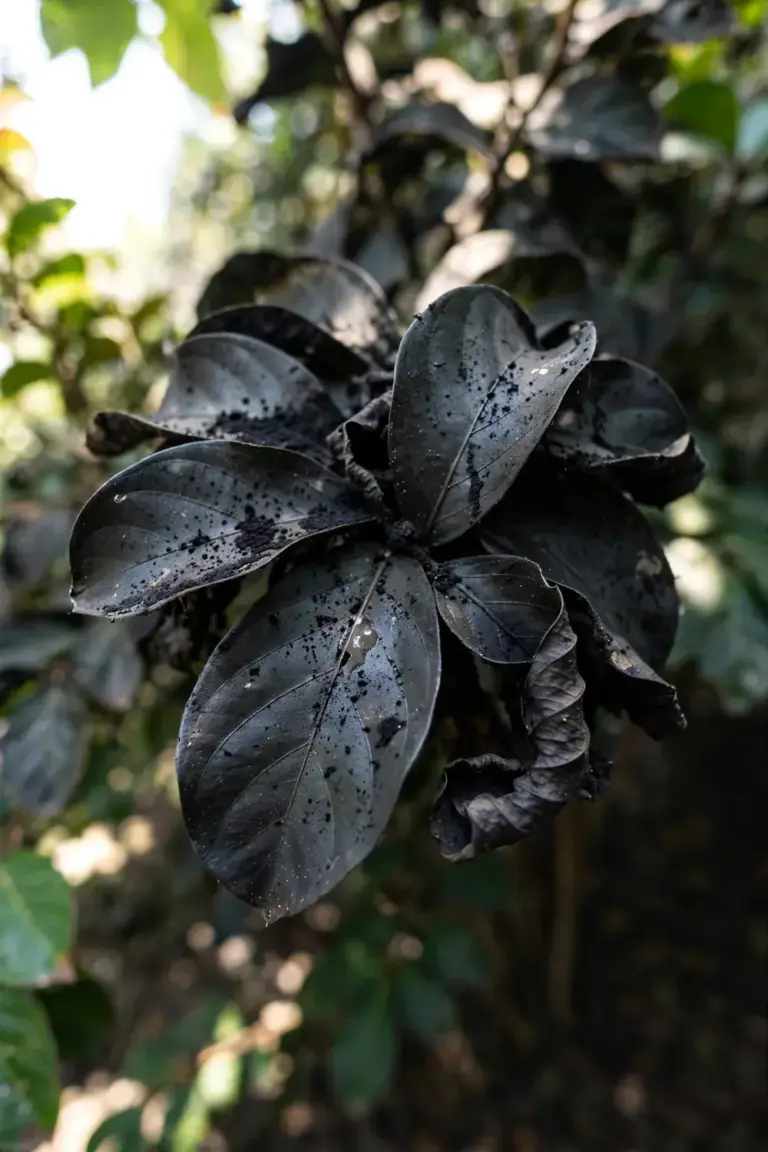
Physiological leaf roll starts on lower leaves first. Leaflets cup upward, then roll inward lengthwise toward the midvein, turning thick and leathery while keeping a normal healthy green color. Over time every leaf on the plant may roll. University of Georgia Cooperative Extension lists excessive moisture and nitrogen, heat, drought, severe pruning, root damage, and transplant shock among the environmental factors behind this roll.
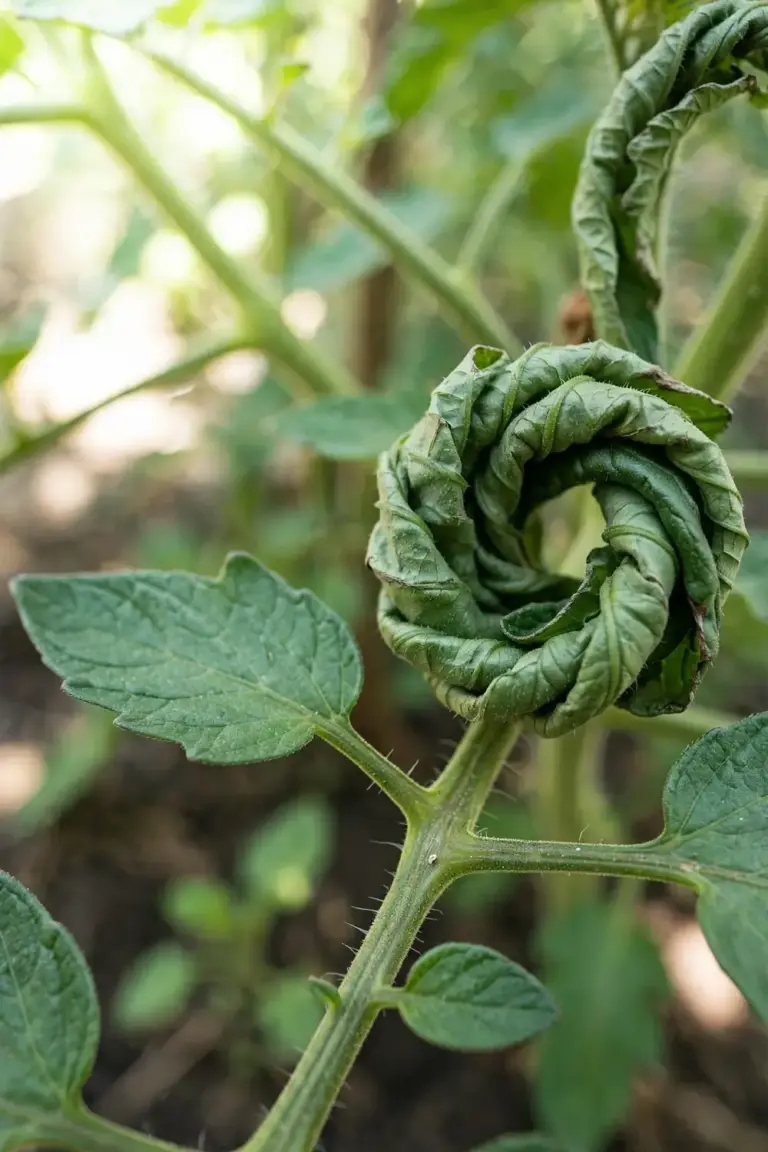
Inspect the plant in order. Start with the lowest leaves. Note the roll direction. Upward cupping with green color points at physiological roll. Then check the newest growth at the top. New leaves that open flat mean the stress passed or the cause sits low on the plant. New leaves that curl too mean the stress continues or a different cause drives it. Feel the leaf. A rolled leaf feels thick and leathery. A diseased leaf feels thin, brittle, or spotted. Color settles the question. Green means stress. Yellow margins mean virus or nutrient trouble.
Indeterminate varieties roll more often than determinate varieties. Some varieties stay more sensitive than others. None resists leaf roll completely. The condition usually shows in late spring or early summer. It carries little impact on fruit production and plant growth. That sentence matters. A plant with rolled lower leaves and normal fruit still produces. Do not pull it.
Heat and drought drive the roll through water loss. The leaf cuts its exposed surface and slows transpiration. The plant survives the hot afternoon. The roll looks like disease but acts like shade. Water the plant deeply, mulch the root zone, and leave the rolled leaves alone. New leaves open flat when the water steadies.
Containers roll harder than beds. A pot holds little soil. The soil dries fast in sun and wind, and roots hit the pot wall and stop. A container plant in a small pot may roll every afternoon and recover each night. Move the pot to afternoon shade. Water twice on hot days. Mulch the pot surface. A larger pot holds moisture longer and rolls less. The same plant in a bed with mulch rarely rolls at all.
Check the plant after rain, not only in drought. A storm after a dry week splits fruit and rolls leaves in the same visit. Walk the bed the morning after a storm. Look at the lowest leaves first. Look at the fruit shoulders next. Note which plants rolled and which split. That one walk tells you which plants need steadier water and which need shade. Write nothing down. The pattern stays obvious for the next storm.
3. Read Fruit Splitting: Two Crack Patterns, One Trigger
Fruit splitting shows two patterns. Radial cracks start at the stem and run downward toward the blossom end. Concentric cracks form rings around the stem end of the fruit. Both types signal inconsistent water content in the plant. Mississippi State University Extension lists uneven watering, very fast growth, excessive moisture after a dry period, high temperature, a large difference between daytime and nighttime temperatures, and inadequate nutrition among the promoters of cracking.
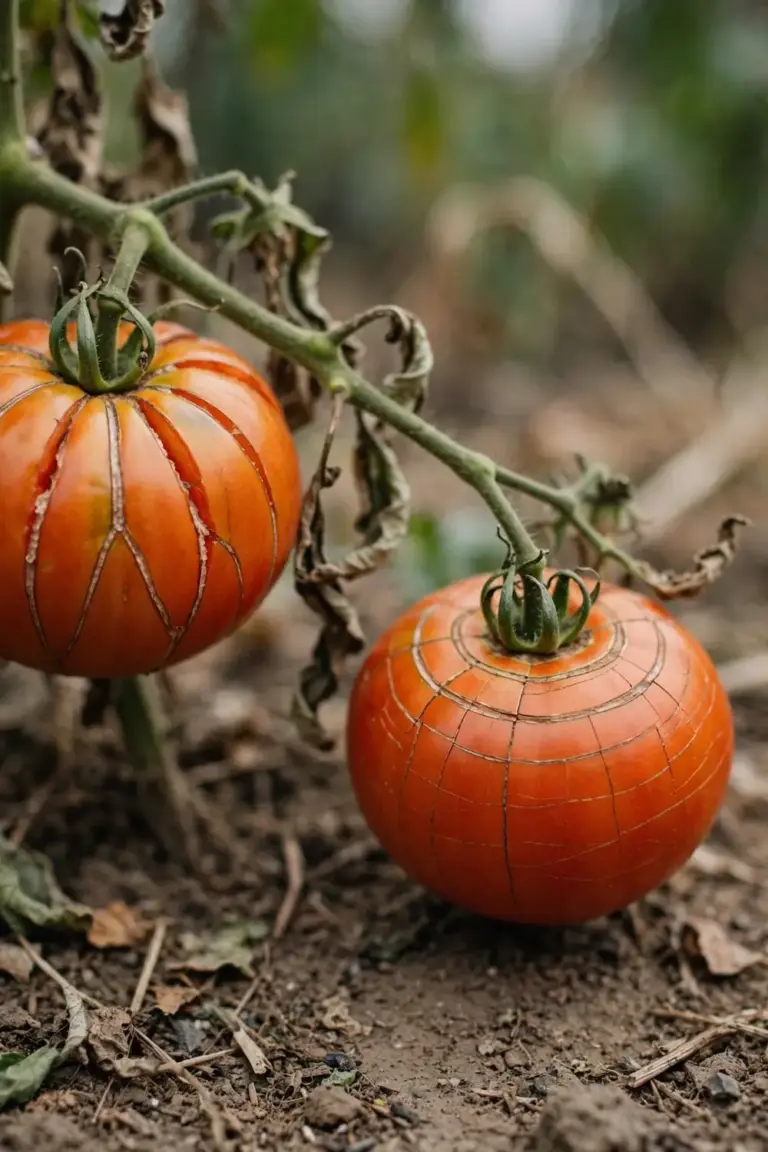
The mechanism is simple. Dry soil holds fruit growth back. A sudden soak or a heavy rain floods the roots. The fruit swells fast. The skin cannot stretch fast enough. The skin splits. A crack can start while the fruit is still green. The split turns visible as the fruit colors. Ripening does not cause the crack. The earlier moisture swing does.
The crack pattern tells the story, with radial splits running like spokes from the stem down the shoulders after a sudden water surge. Concentric cracks circle the shoulders in rings after water surge plus heat on exposed shoulders. Both patterns can appear on one fruit. Either pattern points at water, not at a pest, since pests leave holes, spots, and chewed edges instead of clean splits.
Temperature swings widen the gap. A hot day followed by a cool night stresses the skin. The fruit expands by day and contracts by night. The skin fatigues. A storm then tears it. Large day-night differences in late summer set up the worst splits. Shade and mulch narrow the swing. Steady water removes the trigger.
Night temperature matters as much as day heat. Warm nights keep the plant respiring fast and slow the skin’s recovery from daytime expansion. Cool nights let the skin rest and firm up. A run of hot nights after a storm leaves fruit tender for days. Mulch cools the root zone overnight and steadies the plant through those nights. Shade cloth left on through a hot night traps warm air, so pull it off at dusk when the day cools.
Sun exposure raises the risk. University of Missouri Extension notes that tomatoes exposed to direct sun absorb more heat during the day than shaded fruit and split more readily. Fruit left on vines too long also cracks at the stem end. Pick fruit at first color during a wet spell. Shade the plant through the hottest afternoon hours. Keep the water steady.
Fruit at breaker stage splits most readily. Breaker stage means first color showing at the blossom end. The fruit grows fast at this stage. The skin stretches thin at this stage, so a storm at breaker stage splits a whole truss overnight. Pick at breaker stage when rain threatens. The fruit ripens indoors on the bench, and flavor stays close to vine-ripened fruit, so a picked fruit beats a split one.
4. Rule Out Virus, Herbicide Drift, and Nutrient Gaps
Run the differential before you act. Most curl is physiological roll. Three lookalikes need different answers. The table below sorts them by what you see, what you test, and what you do.
| Symptom | Cause | Test | Fix |
|---|---|---|---|
| Lower leaves roll upward and stay green | Physiological leaf roll | Newest growth looks normal; color stays uniform | Steady water and mulch |
| New growth twists and cups; plant stalls | Herbicide drift | Check nearby spraying; other plants show the same twist | Stop the exposure; no spray cures drift |
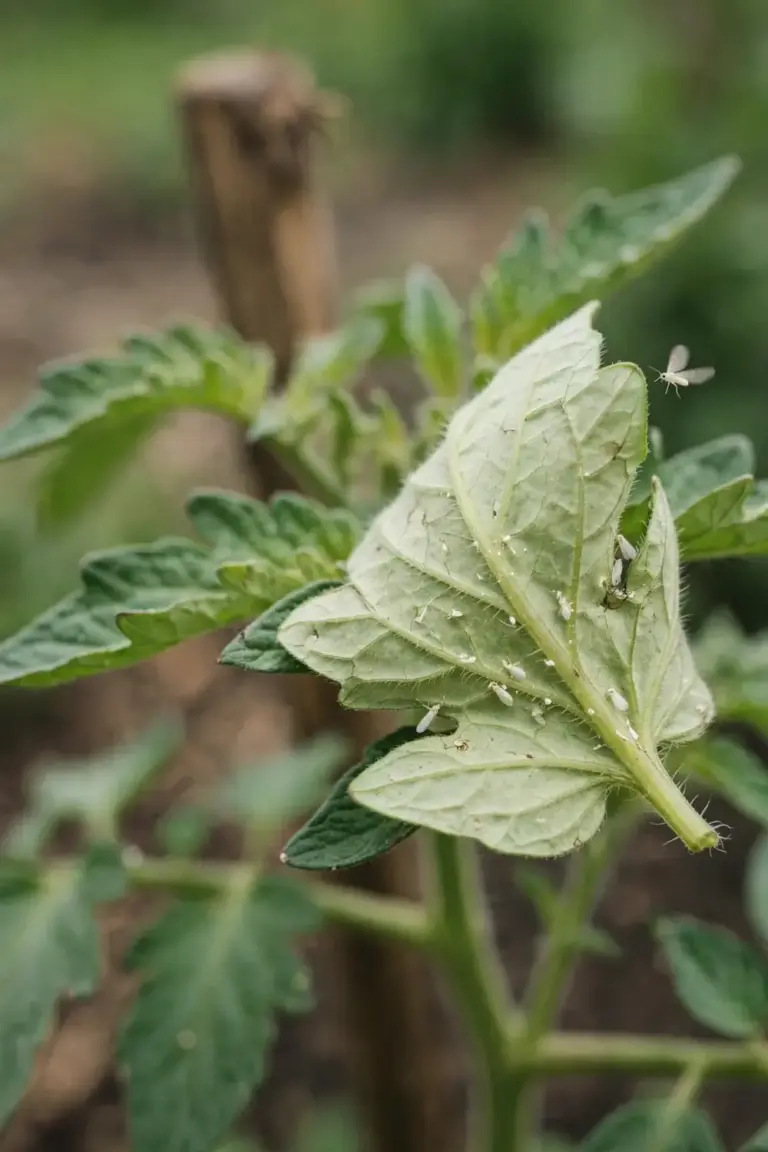
| Young leaves curl down; margins yellow; plant stunts | Tomato yellow leaf curl virus | Whiteflies cloud off the plant when brushed | Remove the plant; control whiteflies |
| Leaves cup; growth turns soft and rank | Excess nitrogen | Soil test shows high nitrogen; heavy feeding history | Feed to the soil test; stop extra nitrogen |
| Fruit splits in radial lines from the stem | Water surge after dry soil | Recent rain or heavy watering after a dry spell | Steady water; pick before rain |
| Fruit cracks in rings around the shoulders | Water surge plus heat | Rings on sun-exposed shoulders | Shade; steady water |
Herbicide drift twists new growth into cupped, narrow shapes. The damage often hits several plants at once after a neighbor sprays. Drift reaches tomatoes from lawn treatments and weed spraying on calm days that turn breezy. The twisted leaves look nothing like the upward roll of water stress. They look pinched, narrow, and uneven. One side of the plant may twist harder than the other, on the side facing the spray. No spray cures drift. Stop the exposure. The plant may outgrow light drift on new growth. Heavy drift stunts the plant for the season. Do not compost drift-damaged plants. Bag them and bin them.
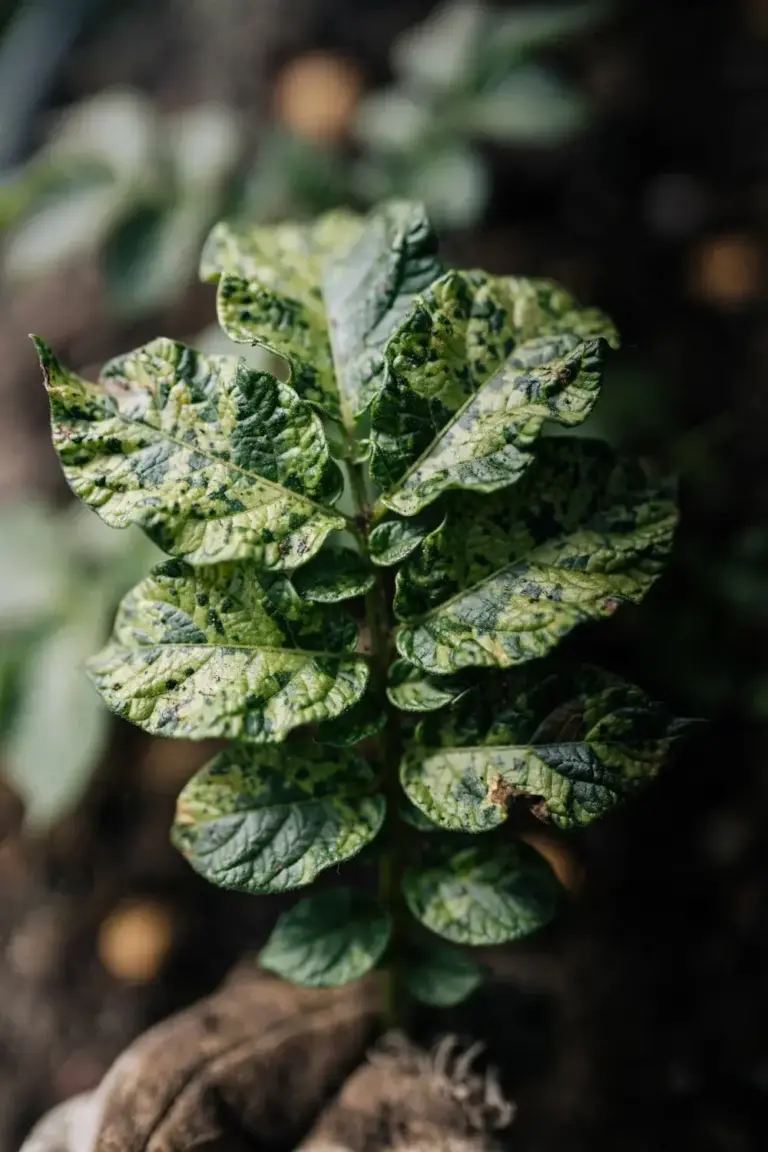
Virus behaves differently: tomato yellow leaf curl virus stunts young leaves and shoots, yellows leaf margins, and cuts fruit set. Infected plants stay short and bushy. Leaves shrink. Flowers drop. Fruit that sets stays small. The virus travels by silverleaf whitefly, a serious pest of tomatoes in the coastal and some inland areas of Queensland and New South Wales. Queensland Government reports that silverleaf whitefly adults need at least 15 minutes of feeding on an infected plant to acquire the virus, then 15 to 30 minutes of feeding on a healthy plant to transmit it. The virus persists in the insect for life. The virus does not travel in seed, soil, or handling. A plant with virus plus whiteflies needs removal. A plant with roll and no whiteflies needs water.
Check for whiteflies before you decide by brushing the plant gently, and watch for a cloud of tiny white insects lifting off, which means whiteflies feed there. Check leaf undersides, where whitefly adults and nymphs sit on young leaves. No whiteflies means virus is unlikely, while whiteflies plus yellow margins plus stunting means virus is likely. Pull the plant, bag it, and bin it. Do not compost it; wash your hands and tools after handling it.
Excess nitrogen pushes soft growth that rolls. Heavy feeding grows soft leaves fast. The leaves outgrow their own strength and cup. A soil test settles the question, so feed to the soil test, not to the calendar. Stop extra nitrogen once the test shows high levels. The plant steadies as the nitrogen drops. New growth opens flat.
5. Steady the Water With Mulch and Deep Watering
Steady water beats total water. A plant that gets the same moisture every day splits less than a plant that swings between dry and soaked. Water deeply at the root zone. Water in the morning so leaves dry by night. Check the soil with a finger before you water. The top 5 cm should feel moist, not wet and not dusty. Water when the top 5 cm dries. Skip the calendar.
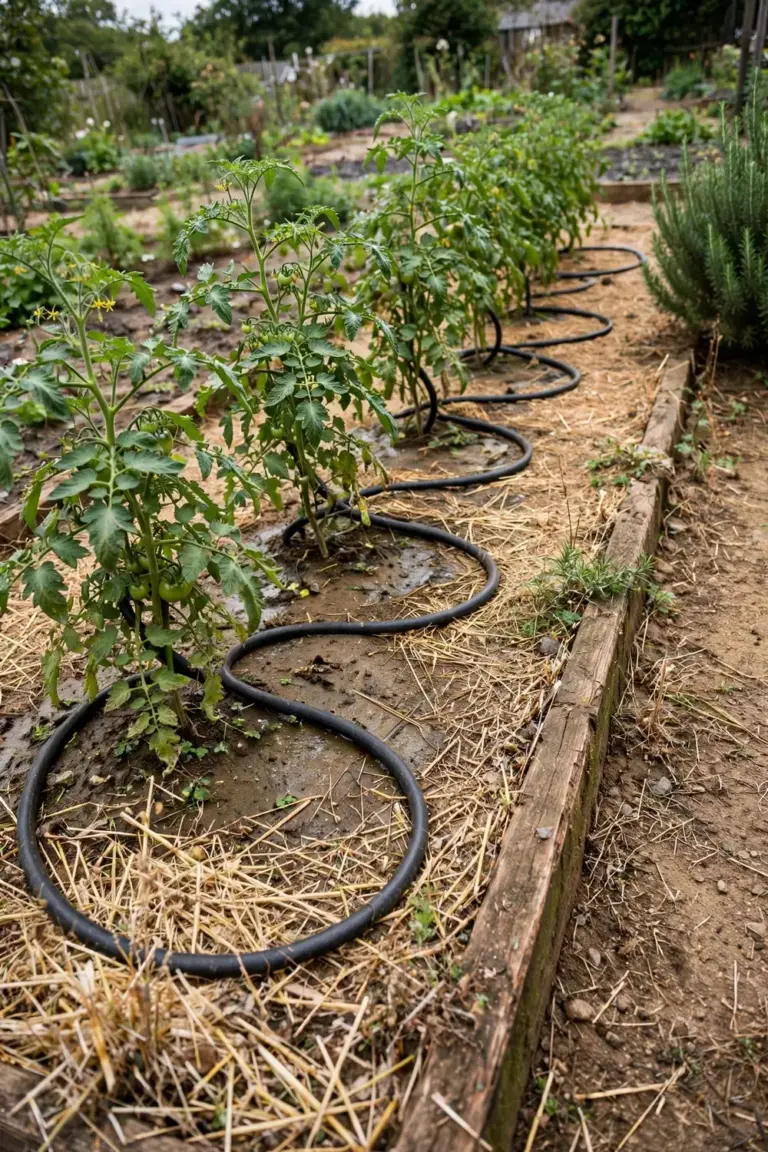
Deep watering means soaking the root zone, not sprinkling the surface. A light sprinkle wets the top 2 cm and leaves roots dry below. Roots stay shallow. Shallow roots swing harder between wet and dry. A deep soak reaches 15 to 20 cm down. Roots grow deep. Deep roots ride out a hot afternoon. Water slowly so the soil absorbs it. Fast water runs off baked soil. A slow soak sinks in.
Mulch holds the rhythm between waterings, so spread straw or compost 5 to 8 cm deep around the plant. Keep mulch 5 cm clear of the stem. Mulch slows evaporation, cools the root zone, and keeps soil moisture even after a hot day. Mulching for moisture retention covers materials and depth in full. Replenish mulch when the layer drops below 3 cm. Straw breaks down fastest. Compost feeds the soil as it breaks down. Bark lasts longest but adds little nutrition.
Soaker hoses deliver water at the root zone without wetting leaves. Lay the hose in a loop around the plant, 15 to 20 cm from the stem. Run it until the top 15 cm of soil feels moist. Soaker hoses for easy garden watering covers layout and timing. Drip lines work the same way. Overhead sprinklers waste water on leaves and swing soil moisture harder. Skip them for tomatoes.
Containers need a tighter rhythm. A pot dries faster than a bed. Check container soil daily in summer. Water when the top 3 cm dries, and keep a saucer under the pot for a little reserve. Empty the saucer after an hour so roots do not sit in water. A pot on hot paving dries fastest. Move pots off paving onto soil or mulch. The soil underneath cools the pot.
Watch the weather. A storm after a dry week splits fruit. Pick fruit at first color before the storm. Fruit ripens indoors on the bench while the plant keeps the rest of the crop safe, so one picked fruit beats five split ones. Check the forecast each evening through an Australian summer. A storm warning means a picking round.
6. Cut the Heat Load on Exposed Fruit
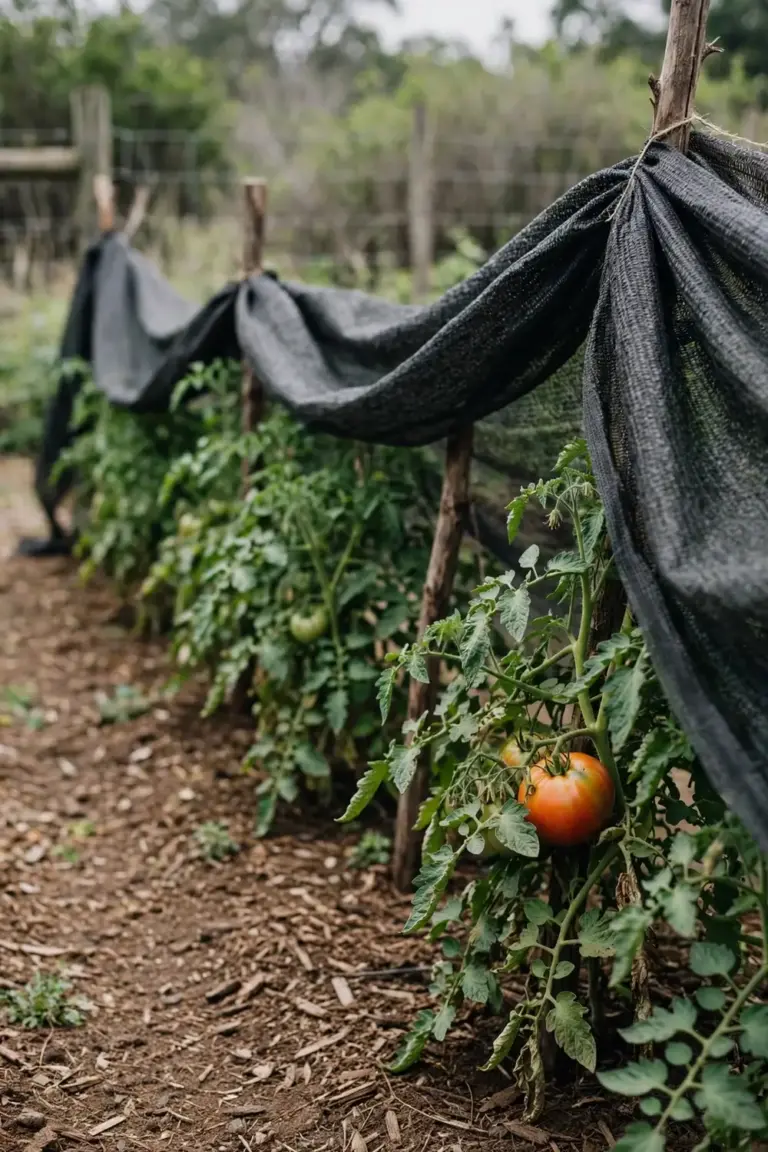
Heat makes splitting worse, because sun-exposed fruit runs hotter than shaded fruit and hot skin loses elasticity, so a water surge cracks it sooner. Shade cloth breaks the cycle. Drape shade cloth over the plant through the hottest weeks. Tie it to stakes, not to the plant. Air must move under the cloth. A sealed cover cooks the plant. Remove the cloth when the heat breaks, since the plant needs full sun in mild weather.
Time your pruning. Severe pruning strips leaves and exposes fruit to direct sun. Prune lightly through summer. Leave enough leaf cover to shade the fruit. A plant with bare shoulders splits first. A plant with leaf cover splits less. The University of Georgia notes severe pruning among the factors behind leaf roll. Pruning hard in heat gives you curl and splits together. Prune in the cool of the morning. Remove one or two suckers at a time, and stop when fruit starts to show through the canopy.
Water the root zone in the morning. Wet leaves in hot sun scorch. Wet leaves at night invite fungal problems. Morning watering gives roots a full day of steady moisture, so the plant faces the afternoon with water in hand. Leaves stay flatter. Fruit stays whole. A plant watered at noon loses half the water to evaporation before roots take it up. A plant watered at night sits wet and invites disease.
Afternoon shade helps in hot Australian climates. A plant that gets morning sun and afternoon shade splits less than a plant in all-day sun. Place new beds where a fence or a tree shades the afternoon. A bed against a west-facing brick wall cooks in reflected heat. Move the bed or shade the wall. The hottest hours run from early afternoon to late afternoon. Shade those hours first.
Mulch doubles as heat control. Bare soil bakes in sun and radiates heat up into the canopy. A mulch layer shades the soil surface and keeps the root zone cooler by several degrees on a hot afternoon. Cooler roots pull water steadily. Steady roots mean flatter leaves and whole fruit. The same 5 to 8 cm mulch layer that steadies water also steadies temperature. One layer does two jobs.
7. Use Split Fruit Now and Never Store It
Split fruit is still edible. Cut out the split portion. Eat the rest the same day. A split opens a path for rot and insects, so the fruit will not keep. The University of Missouri advises harvesting cracked or split fruit immediately and using it quickly before rot develops. Discard any sour-smelling, diseased, or rotted portions.
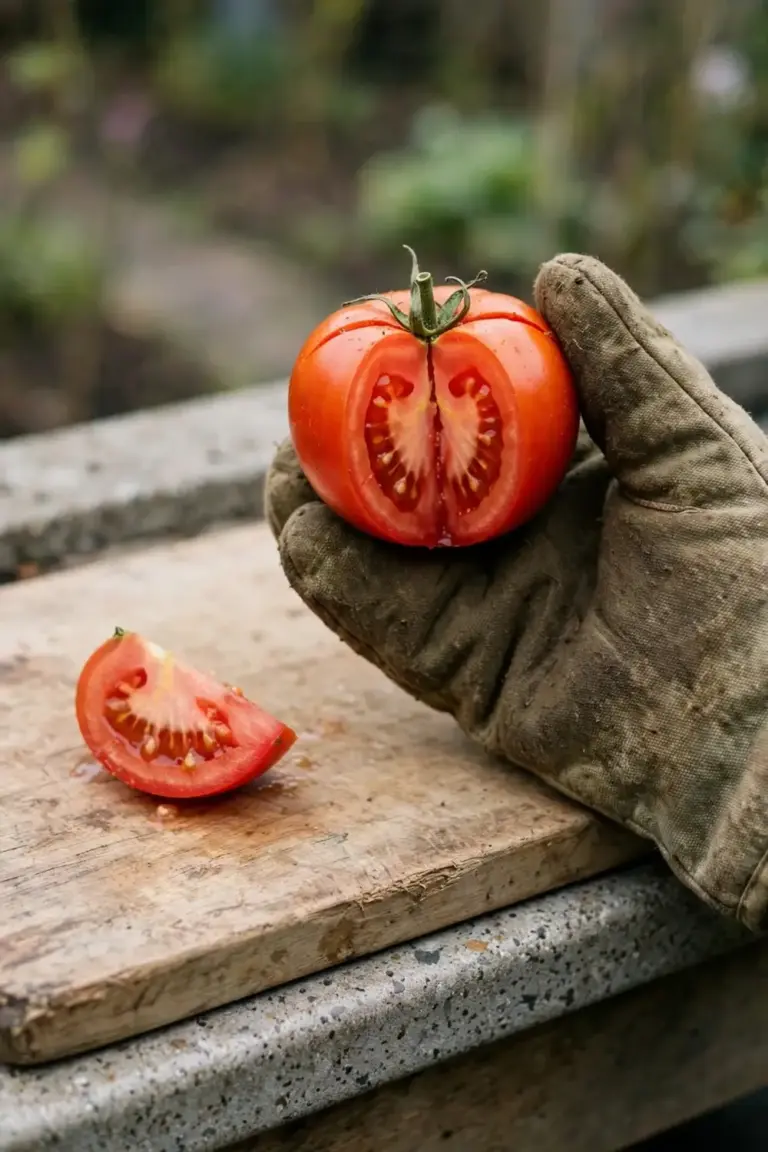
Pick split fruit off the plant fast. A split fruit left on the vine rots and draws insects to healthy fruit. Check the plant after every storm. Pick every split fruit you find. Bring it inside. Cut away the crack and use the sound flesh. Do not compost split fruit with rot on it. Rot carries spores back to the bed. Bin rotted fruit. Keep the bed clean.
Use split fruit in cooked dishes. Sauce, soup, and roast trays hide a cut edge. Fresh salads suit whole fruit better, since a split fruit sliced for salad looks ragged and leaks juice. A split fruit simmered into sauce tastes the same as a whole one. Cook split fruit the day you pick it. Do not hold it for tomorrow.
Store whole fruit only. A fruit with a hairline crack looks fine and rots overnight. Check each fruit before it goes in the bowl. Press gently near the stem. A soft spot means rot started. Cut it out or discard the fruit. Whole fruit ripens on the bench for days. Split fruit does not. Keep the bench check quick. A daily pass over the bowl catches soft fruit before it spoils the rest.
Sort the harvest at the bench into three piles. Whole fruit goes in the bowl for ripening. Split fruit with no rot goes straight to the pan. Rotted fruit goes in the bin. The sort takes two minutes and saves the bowl. A single rotted fruit left in the bowl softens its neighbors overnight. A clean bowl keeps whole fruit sound for days.
Frequently Asked Questions About Tomato Leaf Curl and Fruit Splitting
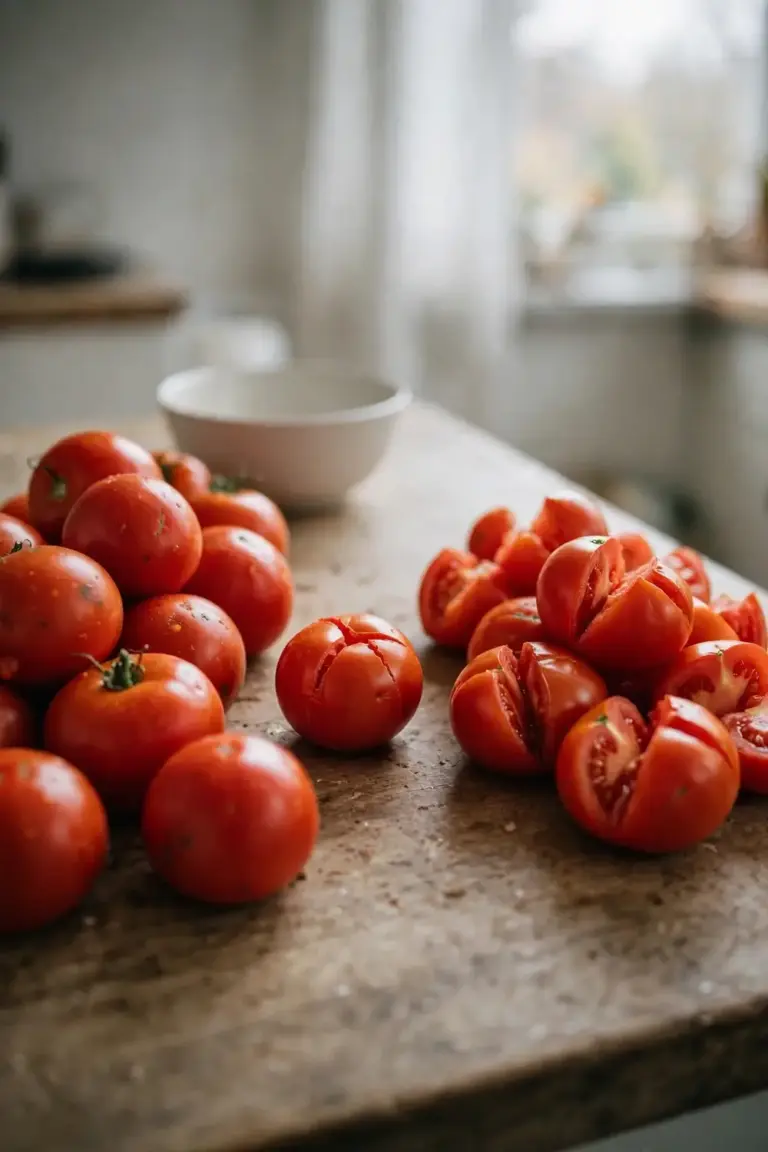
Yes, if the fruit smells fresh and shows no rot, cut out the split portion and eat the sound flesh the same day. A split opens a path for rot and insects, so split fruit never stores well. Discard any fruit that smells sour or shows soft rotted patches. Pick split fruit fast after a storm so rot does not spread to healthy fruit on the same plant.
No. Physiological leaf roll rarely affects fruit production or plant growth. Rolled lower leaves with normal green color signal water stress, not disease. Steady water and mulch keep new leaves flat. Pull the plant only when curl pairs with yellow margins, stunting, and whiteflies, which point at virus. Most curled plants keep cropping through the season.
Physiological leaf roll does not spread. It is a water stress response, not an infection. Virus curl spreads through silverleaf whitefly, not through touch or soil. Herbicide drift hits several plants at once because the spray drifts, not because the damage spreads. Check whiteflies and nearby spraying before you blame a spreading disease.
No. Rolled leaves still photosynthesize and feed the plant. Removing them strips shade from fruit and exposes more skin to sun. Leave rolled leaves on the plant. New growth opens flat once water steadies. Remove leaves only when they turn yellow, dry, or carry clear disease spots. Pruning hard in heat worsens both curl and splitting.
Some varieties roll more readily than others. University of Georgia Cooperative Extension notes that indeterminate varieties exhibit physiological leaf roll more often than determinate varieties. No variety resists roll completely. A sensitive variety on the same watering rhythm as a steady variety still rolls. Match the water to the sensitive plant. Mulch and steady watering close the gap.
Fix the Water First, Then Watch the New Growth
Curl and splits on one plant usually mean uneven water. Run the differential first. Roll on lower green leaves means water stress. Curl on young growth with yellow margins and whiteflies means virus. Twisted new growth after spraying means drift. Match the answer to the symptom.
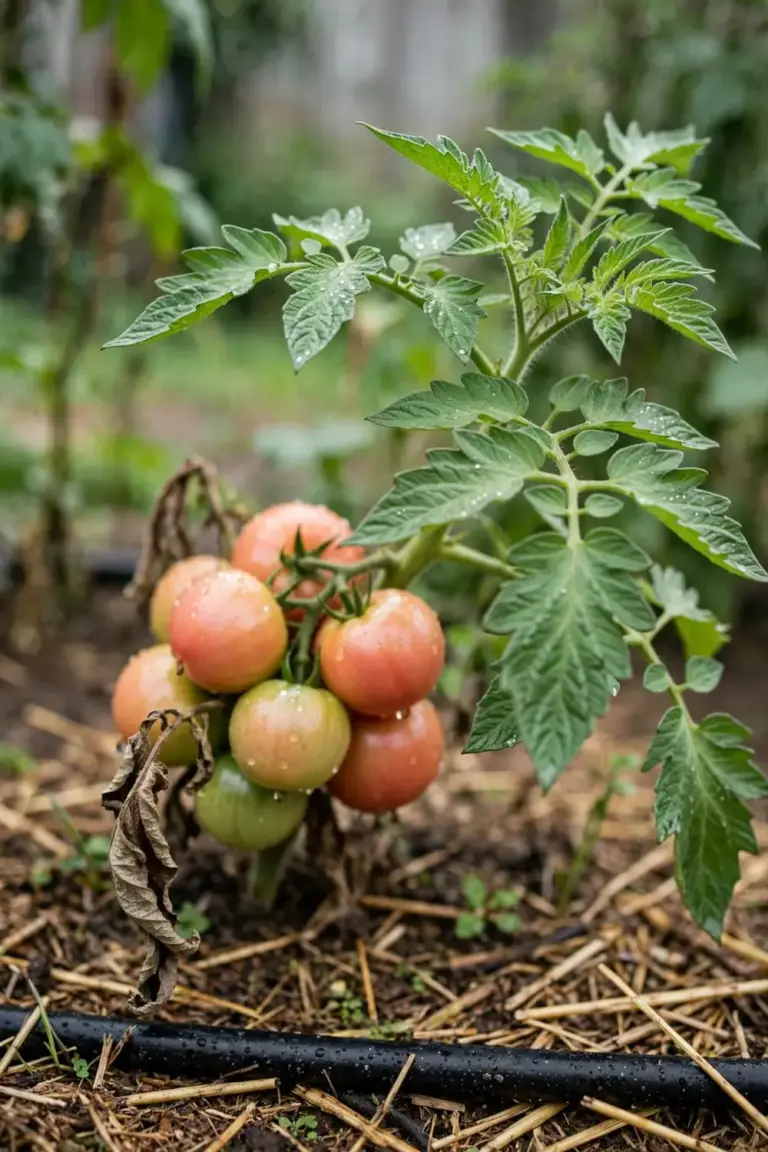
Steady the water next. Mulch 5 to 8 cm deep. Water deeply at the root zone in the morning, and pick fruit at first color before storms. Shade exposed fruit through the hottest weeks. New growth comes out flat. New fruit stays whole. Old damage stays visible and harmless. For the full season routine, see how to grow juicy tomatoes.