
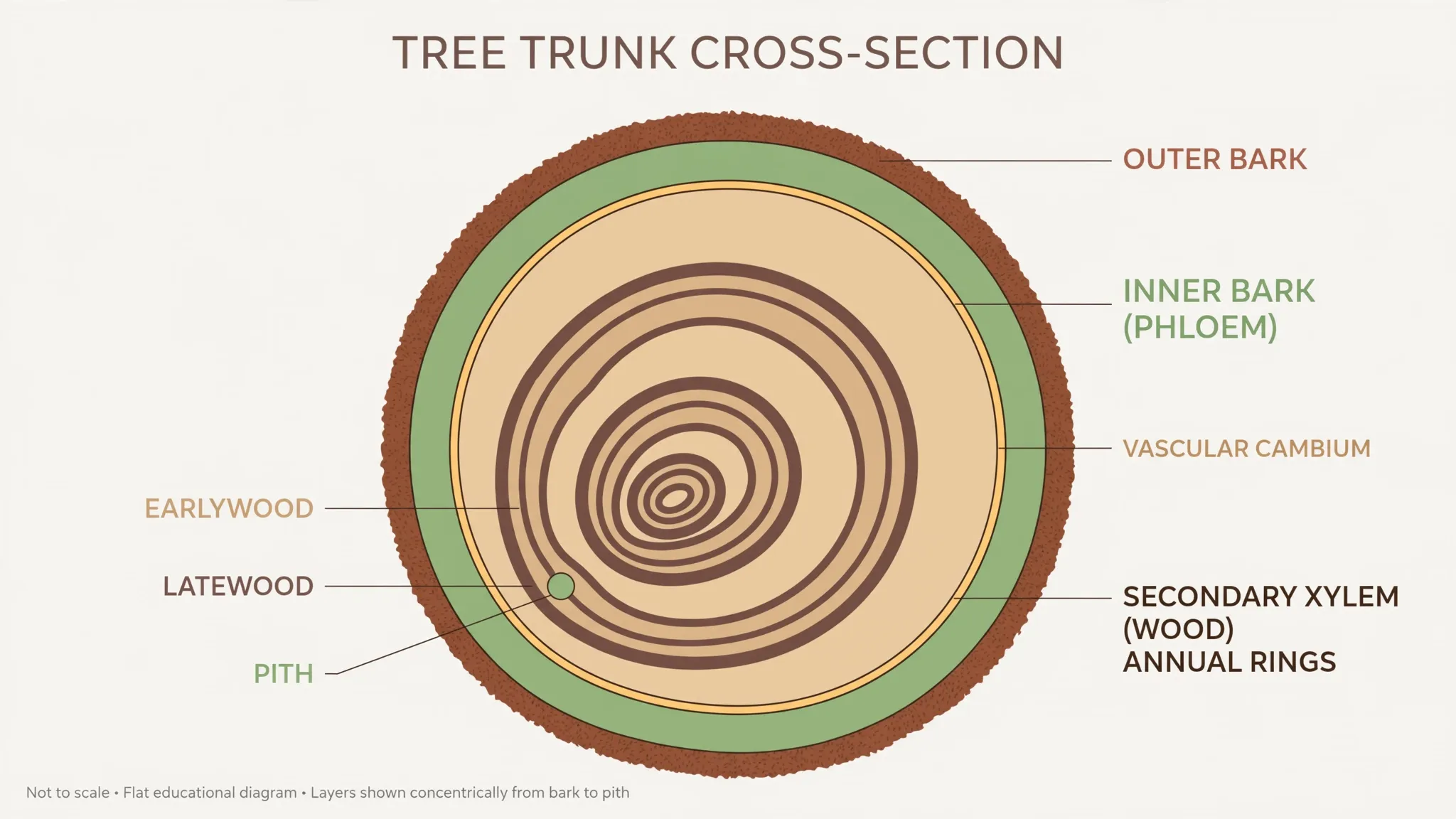

Trees grow thicker each year because a thin layer of living cells called the vascular cambium adds new wood (secondary xylem) to the inside of the trunk and new inner bark (secondary phloem) to the outside. When cambium activity speeds up in spring and slows down later in the growing season, it creates a visible pattern: a light earlywood band followed by a darker, denser latewood band—together forming one growth ring in many (but not all) climates. (In short: this is how trees grow thicker every year and why you often see annual rings.)
Key takeaways
- Trees get taller from apical meristems (at shoot tips), but get thicker from the vascular cambium (a cylinder under the bark).
- One “annual ring” is usually earlywood + latewood from the same growing season.
- Rings are not always yearly: false rings, missing rings, and many tropical trees can break the “one ring = one year” rule.
- You can estimate age without felling a tree using an increment borer (most accurate) or DBH-based estimates (rough).
The Two Different Ways Trees grow: taller vs. thicker
A common mistake is thinking the same growth process makes a tree both taller and thicker. In reality, trees use two different meristem systems:
- Growing taller (primary growth): happens at apical meristems at the tips of shoots and roots. This is where new length is added each season.
- Growing thicker (secondary growth): happens in a continuous ring of tissue called the vascular cambium, located between the wood (xylem) and the inner bark (phloem).
If you remember only one thing: height growth happens at the ends; thickness growth happens around the trunk.
What cambium actually does (and why it creates rings)
The vascular cambium is a very thin layer of dividing cells. It acts like a living “factory line” wrapped around the stem.
Its outputs go in two directions:
- Inward: cambium produces secondary xylem (this becomes the wood you see in a log).
- Outward: cambium produces secondary phloem (living tissue that helps move sugars; older phloem eventually becomes part of bark as it gets compressed and replaced).
Because most of the new tissue is added inward as xylem, the trunk’s diameter increases mostly because of wood accumulation, not because bark keeps getting thicker forever.
Why one ring has two colors: earlywood vs. latewood
In many temperate climates, cambium activity changes over the growing season:
- Earlywood (springwood): formed when growth is fast (often spring). Cells tend to be larger with thinner walls, so it looks lighter and is less dense.
- Latewood (summerwood): formed later when growth slows (often summer into early fall). Cells are smaller and/or have thicker walls, so it looks darker and denser.
That contrast—light band followed by dark band—is what your eyes pick up as a single ring.
Important nuance: “springwood/summerwood” can be misleading in places without a classic spring/summer. Many wood science texts prefer “earlywood/latewood” because the timing can shift.
A visual model: from bark to pith (where rings really sit)
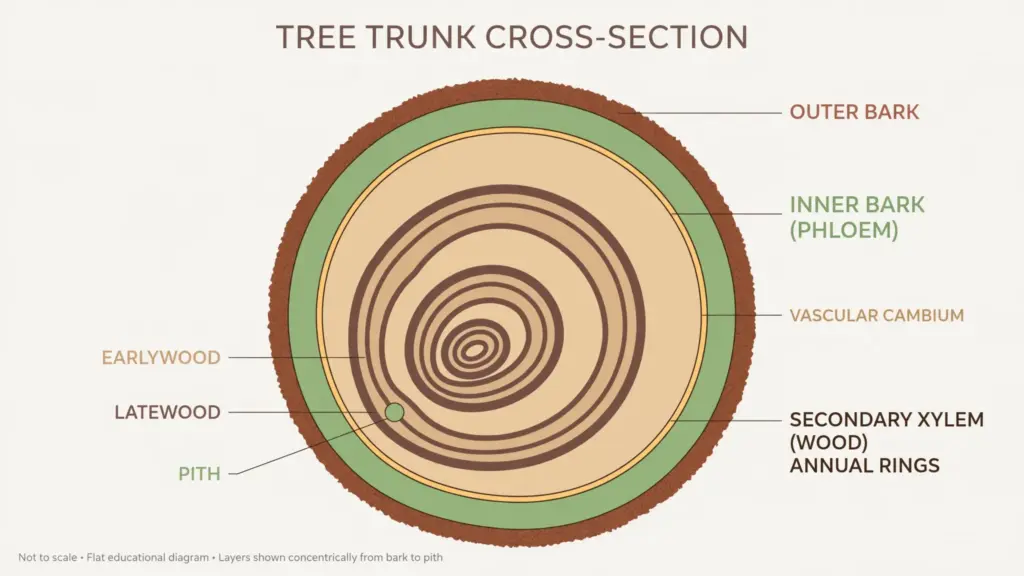
Here’s the simplest way to picture a trunk cross-section:
- Outside air
- Outer bark (mostly dead protective layers)
- Inner bark (secondary phloem)
moves sugars - Vascular cambium
thin living ring of dividing cells - Secondary xylem (wood)
annual rings form here - Pith (center)
And here’s the key: rings are in the wood (xylem), because that’s where cambium adds layer after layer over time.
Does “one ring = one year” always hold?
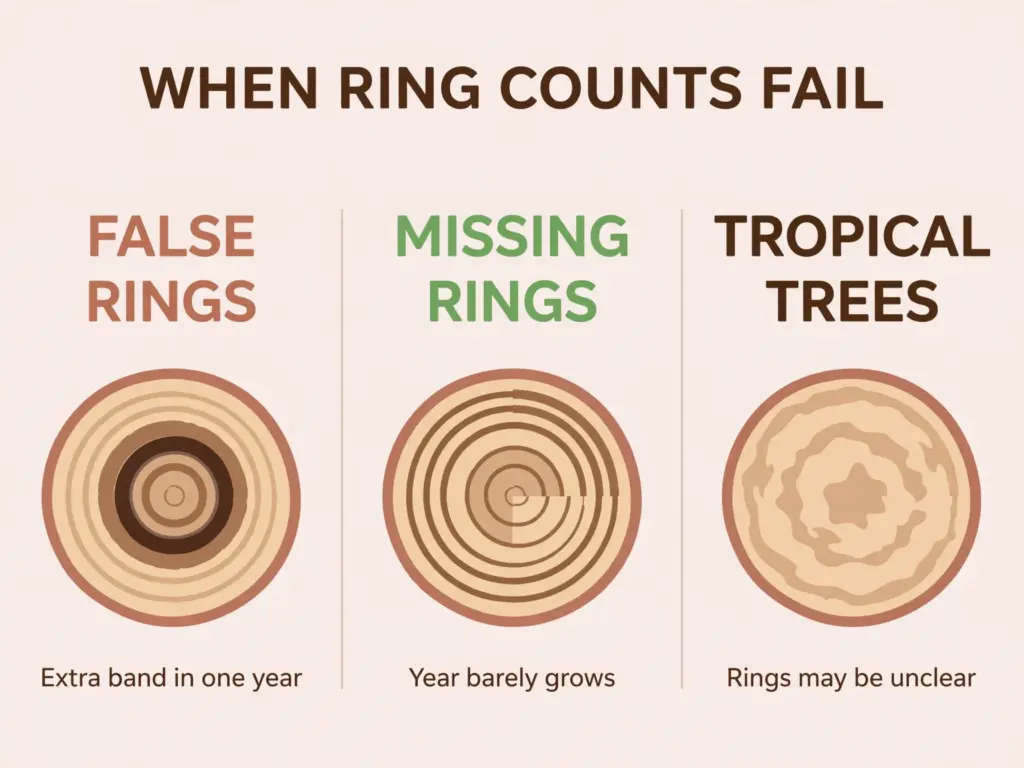
No. It’s often true in places where trees have a clear annual cycle (cold winters or strong wet/dry seasons), but there are several common exceptions.
1) False rings (extra bands within one year)
A false ring happens when conditions temporarily mimic “end of season” stress (for example a midsummer drought), so the tree produces denser latewood-like tissue—then conditions improve and it goes back to earlywood-like growth again. Visually, that can look like two rings in one year.
Clue: false rings often don’t have the same sharp boundary patterns across the whole trunk the way a true annual boundary might.
2) Missing rings (a year that barely grows)
A missing ring can happen when growth is extremely suppressed (severe drought, cold, defoliation, shading, or damage). The cambium may produce so little wood that the ring is absent in parts of the stem—or effectively invisible without lab methods.
3) Tropical trees (rings may be unclear or not annual)
In many tropical climates, trees don’t experience a strong temperature-driven dormancy. Some species may grow for much of the year, which can make rings:
- indistinct, or
- not annual, or
- absent (especially in some evergreen tropical forests).
Some tropical regions with strong wet/dry seasons can still produce annual-looking rings, but you cannot assume annual rings without additional evidence.
What ring width can (and can’t) tell you about climate
Many people learn: “wide ring = good year, narrow ring = bad year.” That can be directionally useful, but it’s not universal.
Ring width reflects whatever most limited growth for that tree, in that site, in that year, such as:
- water availability
- temperature extremes
- insect damage
- competition (shade)
- soil nutrients
- storm injury
This is why dendrochronology researchers typically compare many trees and “cross-date” patterns rather than trusting a single trunk slice.
How to estimate a tree’s age without cutting it down
If your goal is “How old is this living tree in my yard?” you have a few options, with different trade-offs.
Option A (most accurate): use an increment borer
An increment borer removes a pencil-thin core from the trunk, ideally reaching close to the pith. You then count rings on the core under magnification. Done correctly, this usually does not kill the tree, but it is still a wound—so technique and aftercare matter.
Best for:
- serious estimates
- when species and site matter
- when you can accept a small drilled hole
Limitations:
- you may miss the exact pith (underestimates age)
- rings can be very narrow and hard to count without sanding and magnification
- not ideal for very small, stressed, or high-value ornamental trees unless done by an arborist
Option B (rough): estimate age from trunk diameter (DBH)
Foresters often measure DBH (diameter at breast height): trunk diameter at about 1.3–1.4 m (4.5 ft) above ground.
A common rough workflow is:
- Measure circumference at breast height.
- Convert to diameter: diameter = circumference ÷ π.
- Multiply by a species-specific growth factor (or use a local growth rate).
This can be useful, but accuracy varies a lot because growth depends on:
- species genetics
- irrigation vs. drought
- spacing and competition
- soil quality
- climate and latitude
Use it as a ballpark, not a precise answer.
Option C (species-dependent): count growth whorls (some conifers)
Some conifers produce one clear “whorl” (ring of branches) per year, so counting whorls can estimate age—especially in younger trees. This is less reliable on older trees where lower branches are lost.
Common misunderstandings (and when the simple story fails)
- “The tree grows thicker because the bark stretches.” Bark does stretch some, but long-term thickening comes from new xylem produced inward by cambium.
- “The rings are under the bark, so bark thickness shows age.” Rings are in the wood; bark thickness is affected by species and environment and is not a reliable age indicator.
- “Every species makes clear annual rings.” Many do; many don’t—especially in the tropics or in species with weak seasonality.
Edge cases that change the answer
- Multiple growth flushes in one year (some climates/species): can increase the chance of false rings.
- Irrigation cycles in managed landscapes: can create growth patterns that don’t match natural seasons.
- Trees with heart rot or hollows: even with an increment borer, the center may be missing, which makes ring counting impossible past a point.
- Very old trees: the earliest rings near the pith may be extremely tight and hard to separate.
FAQ
Do trees always form one ring per year?
Often, but not always. False rings can add extra bands in one year, missing rings can erase a year, and many tropical trees don’t form clearly annual rings.
Why is earlywood lighter than latewood?
Earlywood tends to have larger cells with thinner walls (lower density), while latewood has smaller and/or thicker-walled cells (higher density). That density difference changes how light reflects, so it looks like two colors.
If I count rings on a stump, is that the exact age?
It’s close, but still not perfect. The first years of growth may be above ground level, and the stump cut height matters. Also, missing or false rings can mislead counts.
Can I estimate age without drilling or cutting at all?
You can estimate from DBH and species growth rates, but it’s rough. For a living tree, the most reliable non-felling method is usually an increment borer (ideally done by someone experienced).
Are rings useful for understanding climate history?
They can be, but it depends on the species and site. Researchers usually compare many trees and match patterns across samples to avoid being fooled by local damage or unusual growth years.
Conclusion (what to do next)
If you want to know why trees grow thicker every year, focus on the vascular cambium: it adds new xylem inward and creates earlywood/latewood bands that often appear as annual rings. If you want to estimate the age of a living tree, the most accurate path is an increment borer; if you just need a quick ballpark, DBH-based estimates can be good enough—just treat them as estimates, not facts.








