
Growing nutmeg at home takes 8 to 10 years from seed before the first fruit, and about half of the seedlings you raise will never bear a single one. That is not a discouragement. It is the information that separates growers who harvest from growers who quit in year six. The nutmeg tree is dioecious, which means individual trees are male or female, and only the females carry fruit. You cannot tell them apart until the first flowers open, usually around year six. Plant with that reality in your head, and every decision after it gets easier.
Nutmeg and mace come from the same tree, and that fact shapes this whole approach to how to grow nutmeg from India. The seed inside the fruit is the spice called nutmeg. Wrapped around that seed is a lacy red-orange aril, and when you dry it, it becomes the spice called mace. One tree gives you two spices, and India grows it in the humid hills of Kerala, where growers in the Western Ghats have made it a real commercial crop. The tree itself is native to the Banda Islands in the Moluccas of Indonesia, not India, and Indonesia still leads world production. Your home tree is an Indonesian plant raised with Indian know-how.
This guide covers both spices from one planting. You will learn how to buy seed that can still sprout, how to beat the male-tree problem, how to keep a tropical evergreen alive in a container if your winters are cold, and how to harvest and dry the nutmeg and the mace separately. It is a long game. A nutmeg tree reaches peak production after 15 to 20 years and can keep bearing for 30 to 40 years or more, so the decades you put in pay you back for decades.
1. The Dioecious Problem: Why Half Your Seedlings May Never Fruit
Nutmeg trees are male or female, and only female trees produce fruit. Plant a handful of seeds and roughly half of the seedlings that survive will turn out male. Male trees make pollen and nothing else. You cannot identify the sex of a seedling. The trees reveal their sex at first flowering, which usually happens about six years after planting. A grower who plants two seeds, raises them with care for six years, and discovers both are male has lost six years to a perfectly avoidable mistake.
Professional growers handle this by planting two or three seedlings in the same spot and removing the males once the flowers show. About 10 percent of male trees distributed through a planting secures good pollination, so the extra males are cut out. If you have room for only one tree, seed planting is a coin toss, and the honest move is to buy a grafted female tree or graft a known female scion onto a seedling rootstock. Vegetative propagation is how the nursery trade guarantees a fruiting tree, and the Kerala Agricultural University recommends epicotyl grafting for exactly this reason.
There is one wrinkle worth knowing. Nutmeg is not strictly dioecious in the absolute sense. Male trees show different degrees of femaleness, ranging from no fruits at all to as many fruits as a good female tree. You cannot count on this. Treat every seedling as a coin toss and plan accordingly.
2. Nutmeg, Mace, and the Pretenders: What You Are Actually Growing
Before you buy seed, make sure the tree you are planting is the real thing. True nutmeg is Myristica fragrans, and true mace is the dried aril of that same species. The market is full of other plants sold under nutmeg-adjacent names, and none of them give you the two spices this guide covers. A comparison table makes the differences impossible to miss.
| Species | Common Name | Real Nutmeg? | Real Mace? | Notes |
|---|---|---|---|---|
| Myristica fragrans | True nutmeg | Yes | Yes | The only source of commercial nutmeg and mace. Banda Islands origin. |
| Myristica malabarica | Wild nutmeg | No | No | Native to the Western Ghats of India. Different species, inferior spice. |
| Monodora myristica | Jamaica nutmeg | No | No | African tree. Seeds used locally, never the traded spices. |
| Cryptocarya moschata | Brazilian nutmeg | No | No | Lauraceae family. Aromatic seeds, not related to true nutmeg. |
| Laurelia aromatica | Peruvian nutmeg | No | No | South American tree. A different plant entirely. |
| Ravensara aromatica | Madagascar nutmeg | No | No | Madagascar endemic. Aromatic but a separate species. |
| Torreya californica | California nutmeg | No | No | A conifer. The name is a curiosity, not a spice source. |
Myristica malabarica deserves a special warning because it grows wild in the same Western Ghats region where Kerala farmers cultivate true nutmeg. Its seeds look similar enough to confuse a buyer, but the spice quality is poor. Buy seed only from a seller who names the species Myristica fragrans in writing. Seed packets that say only “nutmeg” without a Latin name are a gamble.
The other point the table makes is the heart of this guide. Mace is not a second plant. The dried flesh surrounding the seed is the source of the spice mace, and it is harvested from the same fruit as the nutmeg. When someone sells you a “mace tree,” they are selling you a nutmeg tree, because no separate mace tree exists.
3. Can Nutmeg Survive Outside the Tropics?
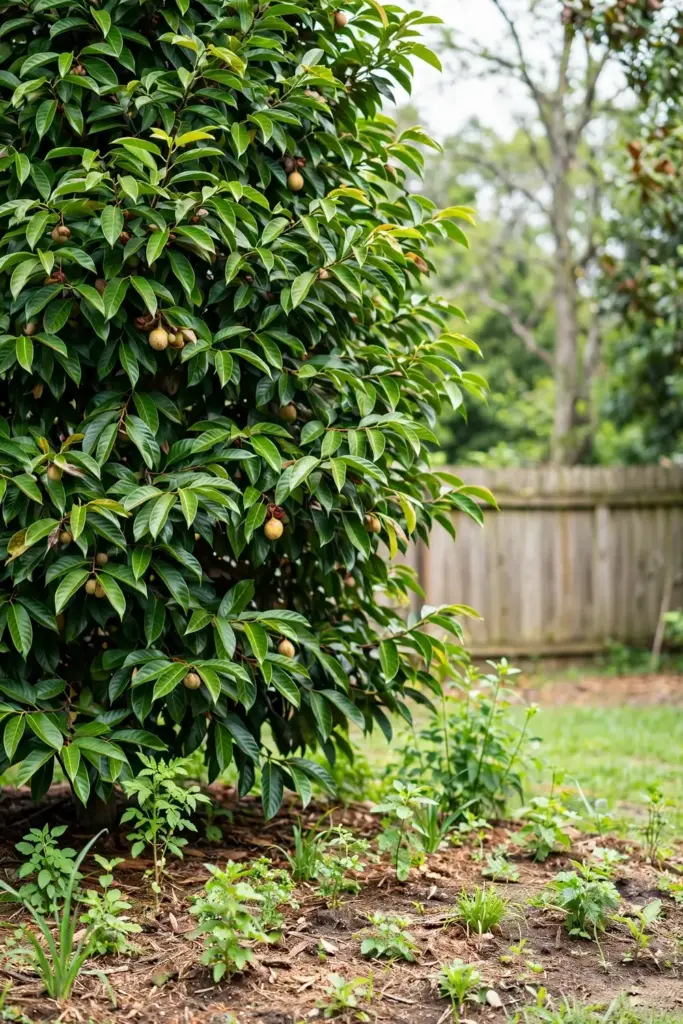
Nutmeg is a tropical evergreen that evolved in humid volcanic lowlands with even rainfall through the year. This slow-growing evergreen tree with its dense, conical crown usually grows 3 to 15 metres tall. It grows best where annual daytime temperatures sit between 22 and 34 degrees Celsius, though it tolerates 12 to 38 degrees. Frost damages it, and a hard freeze kills it. When dormant it can survive temperatures down to about 5 degrees Celsius, but that is survival, not growth. If your winter regularly drops below that, nutmeg is a greenhouse or indoor project, not a garden tree.
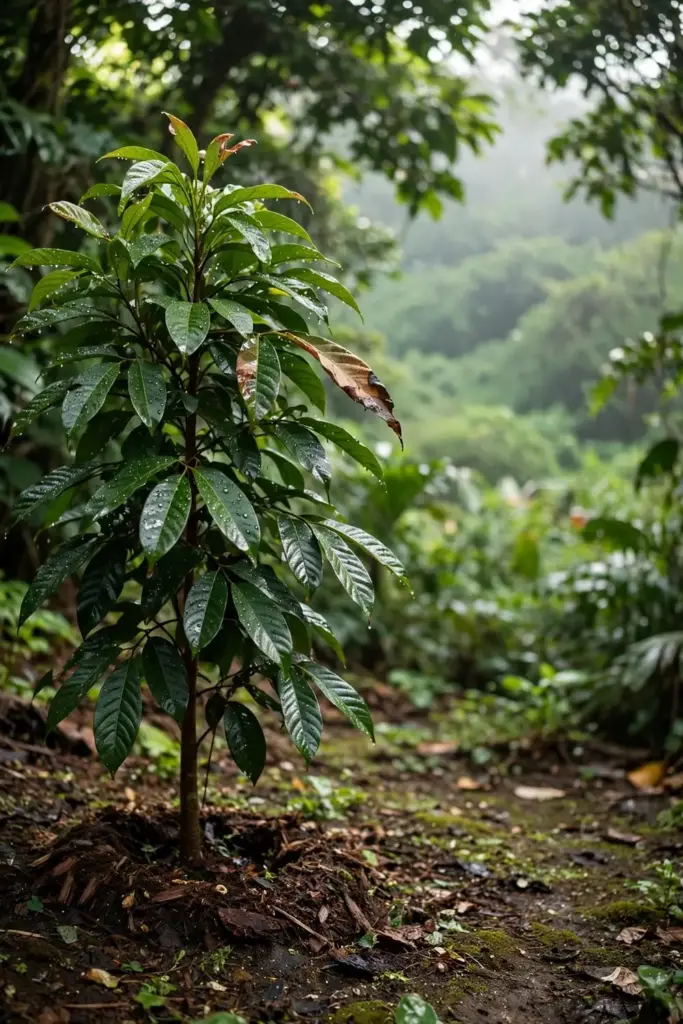
Rainfall matters as much as temperature. The tree prefers a mean annual rainfall between 1,500 and 3,500 millimeters and does best in areas without a pronounced dry season. It succeeds in full sun and in dappled shade, and it wants soil that drains well, rich in organic matter, ideally with a pH between 6.5 and 7.5. The root system is superficial, which means two things for you. Water must reach the shallow root zone consistently, and the tree needs shelter from strong winds that can rock it loose.
In India, nutmeg cultivation concentrates in Kerala and the Western Ghats, where the monsoon climate matches these needs. Indian growers there work with released varieties like Vishwashree and Konkan Sugandha, selected by the Indian Institute of Spices Research. If you live in a temperate climate, the container method in H2 8 is your realistic path, and you should read it before you buy seed.
4. Seed vs Grafted: Two Roads to the First Harvest
The single most important purchase decision is whether to start from seed or buy a grafted tree. Seed is cheap and satisfying. A grafted female tree is expensive and certain. The table below lays out the trade.
| Option | Years to First Fruit | Sex Certainty | Cost | Best For |
|---|---|---|---|---|
| Seedling from fresh seed | 8 to 10 | Coin toss, about 50 percent male | Low | Growers with space for 3 or more trees and patience |
| Grafted female tree | 4 to 5 | Known female | Higher | Growers with room for one tree who want guaranteed fruit |
| Air-layered or epicotyl-grafted plant | 4 to 5 | Known female | Medium to high | Growers wanting certainty plus a compact start |
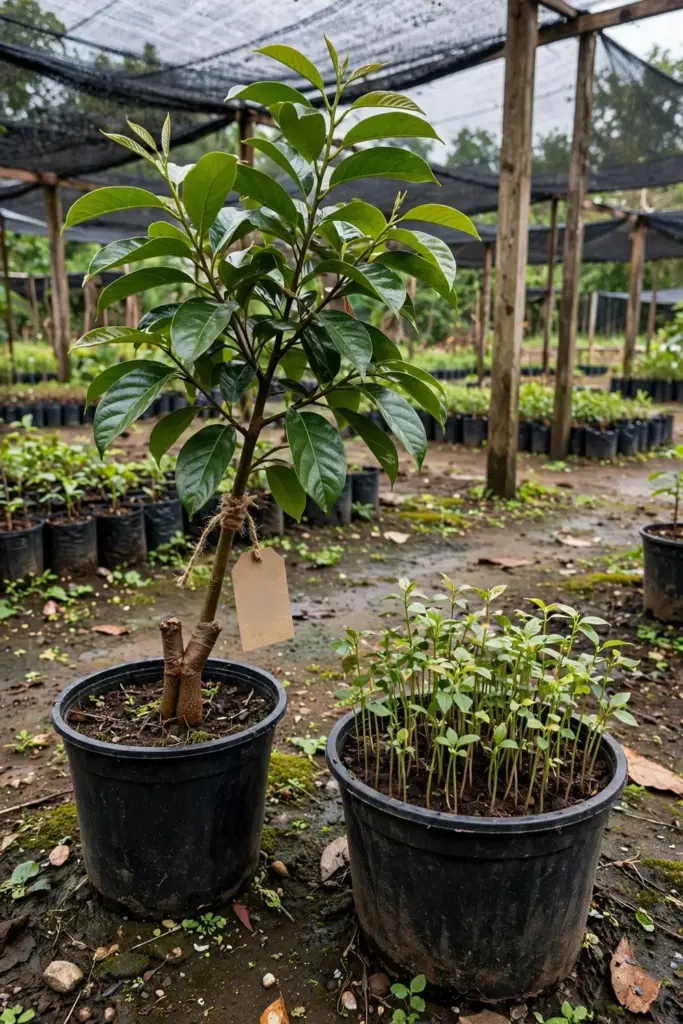
Seedling trees begin fruiting when they are about 8 to 10 years old, while grafted trees can fruit at 4 to 5 years. The difference is not just time. A grafted tree skips the dioecious lottery entirely, because the scion comes from a known female parent. For a home grower with space for one tree, grafting turns an eight-year gamble into a five-year plan.
If you go the seed route, plant two or three seedlings in the same planting spot and remove the males after the first flowering. This is the traditional plantation practice, and it works at backyard scale too. A grower who wants the mango-style decision spelled out for another tropical fruit can compare the timelines in our guide to growing mango fruit, which covers the same seed-versus-grafted trade from a different tree.
5. Buying Seed That Can Still Sprout
Nutmeg seed loses viability fast. Sow it fresh, ideally within days of collecting it from a ripe fruit. Seed left at room temperature in the open can die within a week. Kept in a sealed bag in the refrigerator, it stays viable for up to 45 days. Every week you wait is germination you lose, so buy from a seller who harvests to order or ships seed still in the shell with the mace removed.
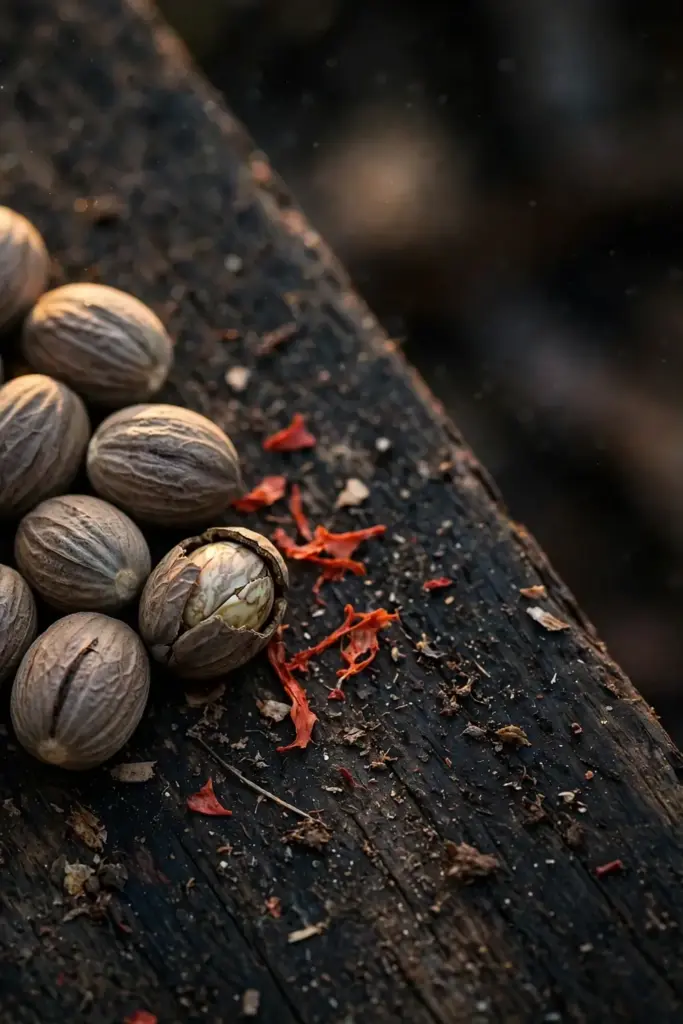
Crack-free shells matter. The seed coat protects the kernel, and damaged seed rots instead of sprouting. Reject seed that rattles loosely inside the shell, smells musty, or shows mold. Whole dried nutmeg from a spice jar is not planting seed. It has been dried for the spice trade, often heat-treated, and its viability is gone. Buy planting seed from a tropical nursery or seed specialist, and ask for the harvest date.
Soak the seed for 24 hours in warm water before sowing. The soak softens the shell and wakes the embryo, and it is the one preparation step every grower agrees on. Sow immediately after soaking. Fresh seed sown the same day gives you the best chance.
6. How to Germinate Nutmeg Seed
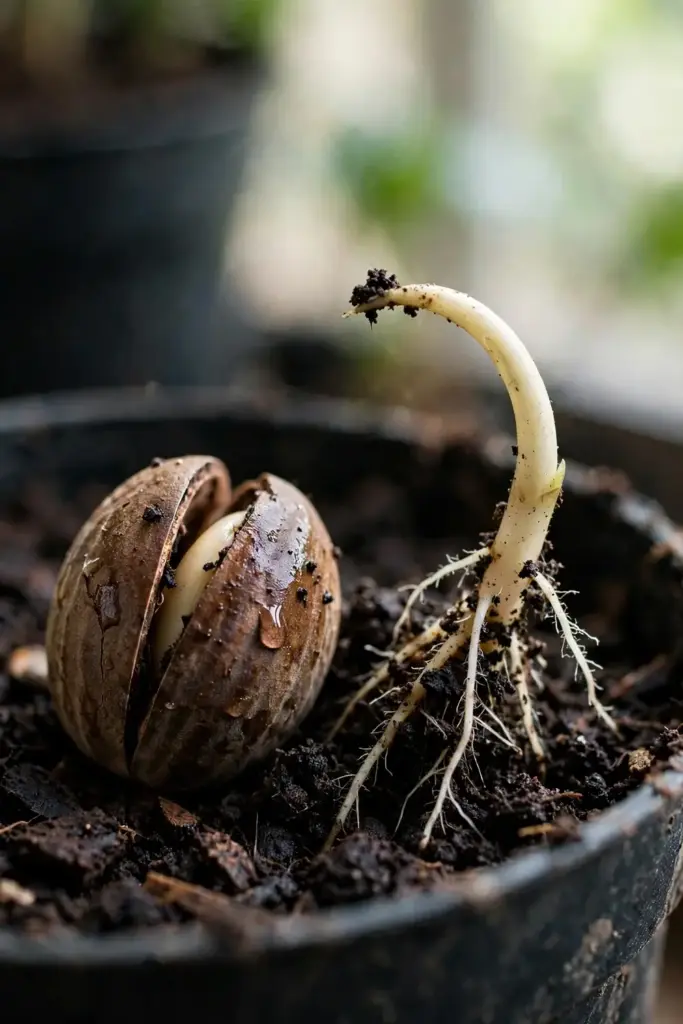
Nutmeg germinates slowly and unevenly, so set up for patience. Use deep pots, at least 20 centimeters tall, because the seedling sends down a delicate taproot that resents disturbance. Fill them with a loose, well-drained mix of coir, compost, and coarse sand. Sow the seed about 2 to 3 centimeters deep with the scar end down, water it in, and keep it warm.
| Step | Action | Time |
|---|---|---|
| 1. Soak | Soak fresh seed 24 hours in warm water | Day 0 |
| 2. Sow | Plant 2 to 3 cm deep in deep pots, warm spot at 25 to 30 degrees Celsius | Day 1 |
| 3. Wait | Keep evenly moist, never soggy, bottom heat helps | Weeks 1 to 6 |
| 4. Emerge | Seedling breaks the surface, first leaves unfold | Weeks 4 to 8 |
| 5. Protect | Keep in dappled shade, protect from wind and slugs | Months 2 to 6 |
Germination usually takes place in 5 to 6 weeks, though seed in the shell can take 4 to 6 weeks and some seed takes much longer. One botanical database notes that seed can take up to 30 months to germinate in the worst case, though that is the extreme, not the norm. Most home growers see sprouts between week four and week eight. Keep the pots evenly moist through the whole wait. A seed that dries out mid-germination rarely recovers.
Bottom heat in the range of 25 to 30 degrees Celsius speeds things noticeably. A heat mat under the tray is the simplest way to provide it. Our seed starting guide covers tray setups and heat-mat basics that transfer directly to nutmeg, and the same principles apply to any slow tropical seed.
7. Seedling Care in the Slow First Years
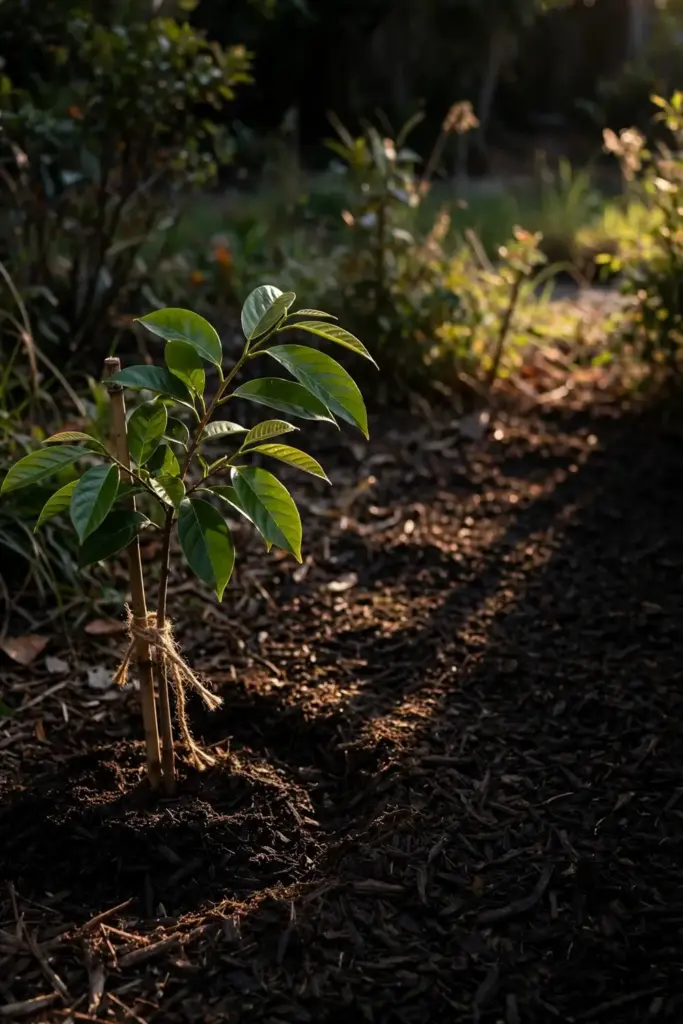
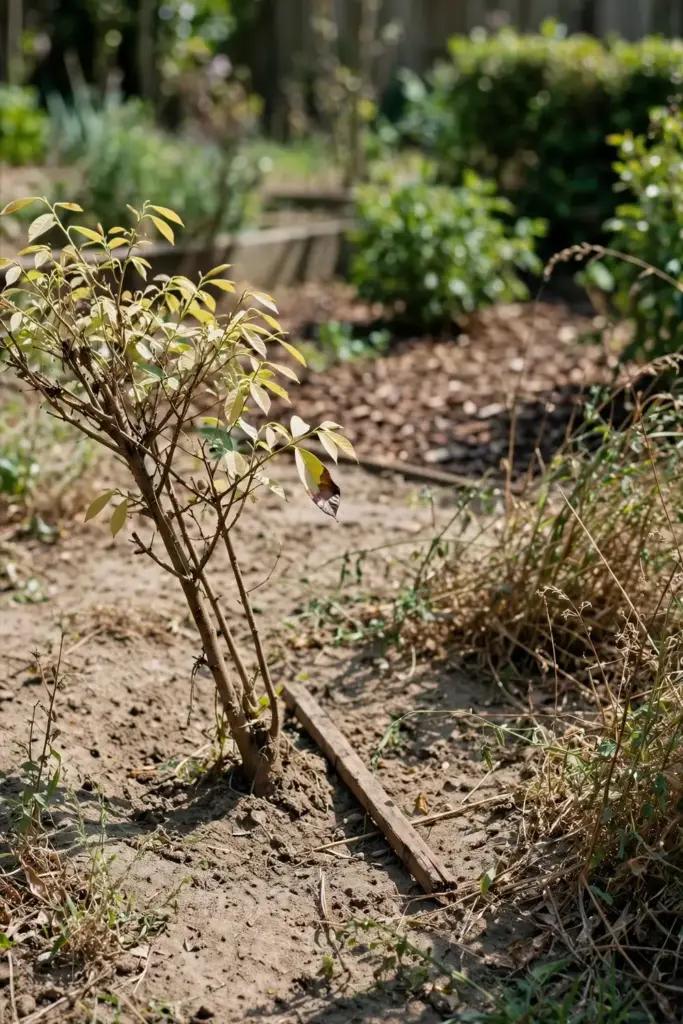
Nutmeg is a slow grower, and the first two years test your patience more than your skill. Keep seedlings in dappled shade for the first year. Direct midday sun scorches young leaves, while deep shade stalls growth. A spot under a shade cloth or on the north side of a larger plant works well. Move them toward more sun gradually in year two.
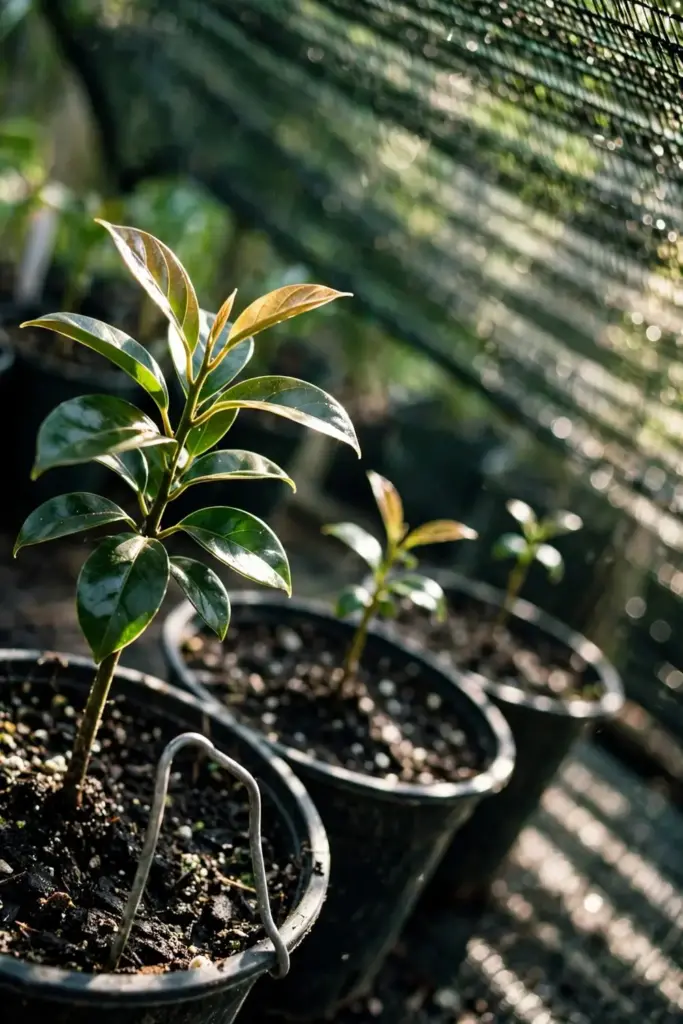
Transplant carefully and rarely. Seedlings develop a delicate taproot, and damage to it sets the plant back badly. When a seedling outgrows its pot, move it up one pot size with the root ball intact. Never pull a seedling by the stem. In the ground, plant the seedling at the same depth it grew in the pot and mulch lightly around it, keeping mulch away from the stem.
Water consistently through the dry season. The superficial root system means the tree feels drought quickly, and a stressed young tree stalls for months. A deep watering twice a week in dry weather beats a daily sprinkle. Feed lightly with compost or a balanced organic fertilizer every two to three months in the growing season. Heavy feeding pushes soft growth that pests love.
8. Growing Nutmeg in Containers: The Temperate-Climate Path
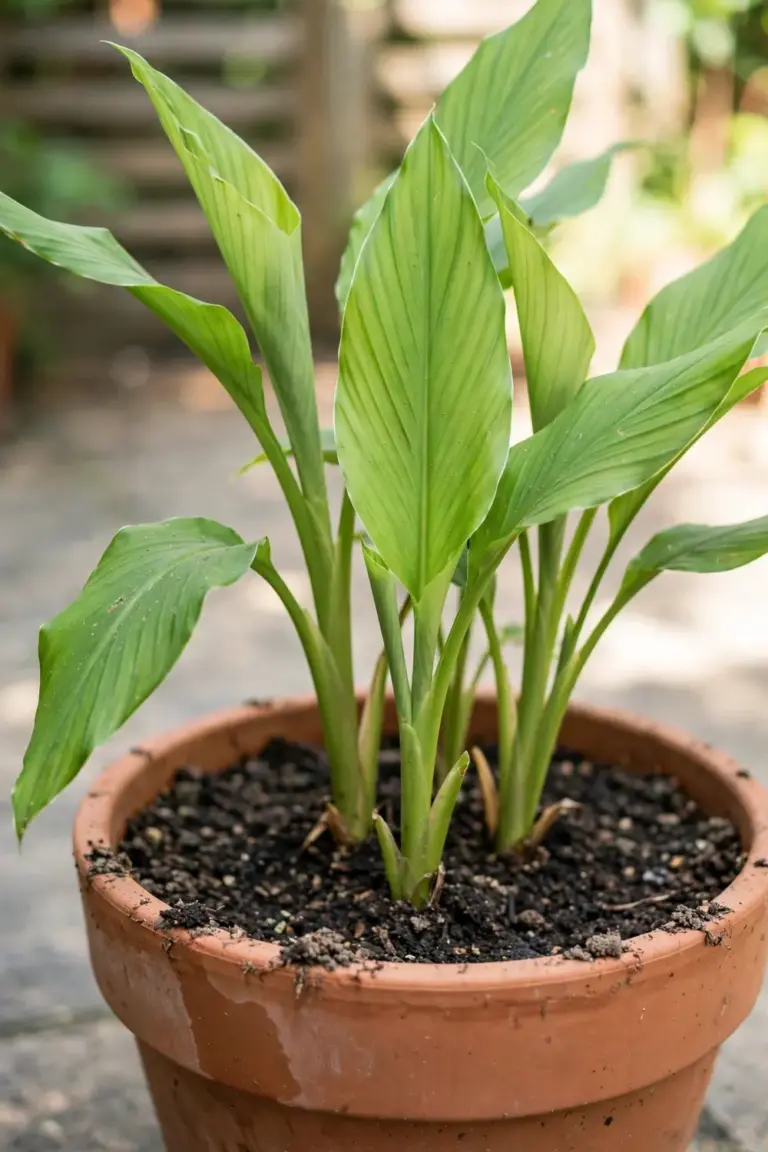
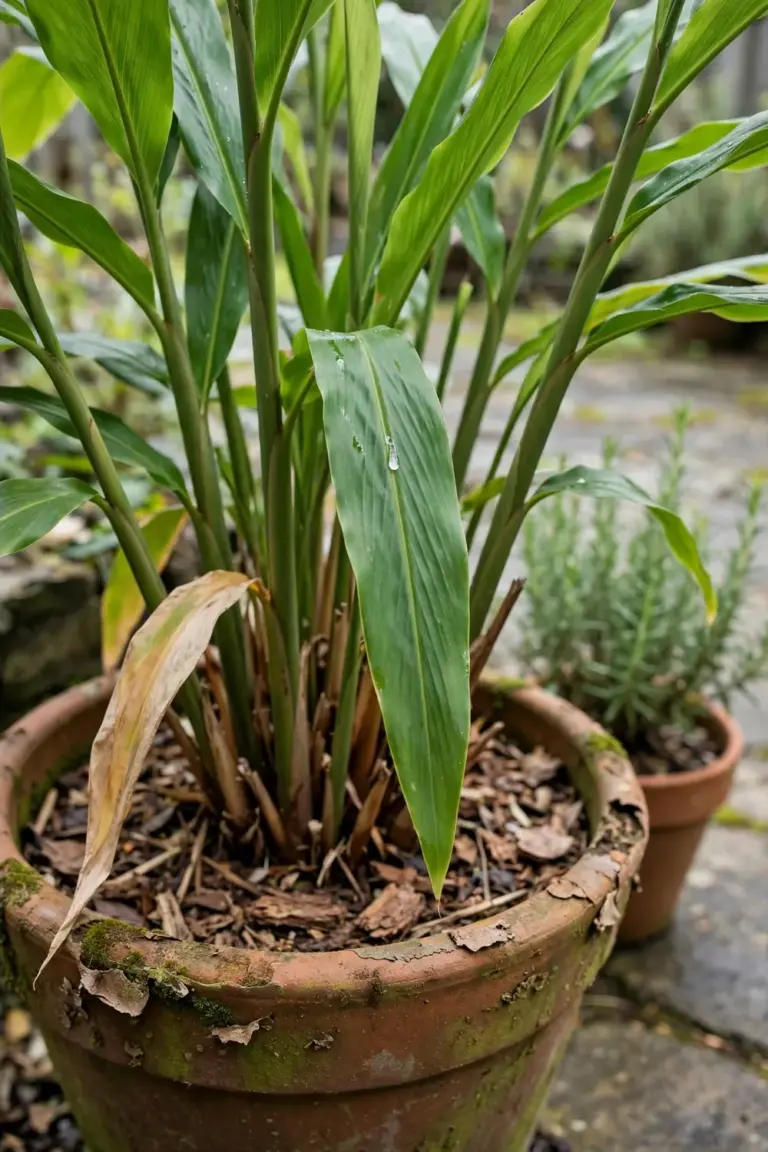
If your winter drops below 5 degrees Celsius, a container is how you grow nutmeg. Start in a 5-gallon pot and plan to move up to a 10-gallon container for the long term. The pot must drain freely, because nutmeg roots rot in standing water, and a heavy terracotta or concrete pot anchors a tree that the wind wants to push around.
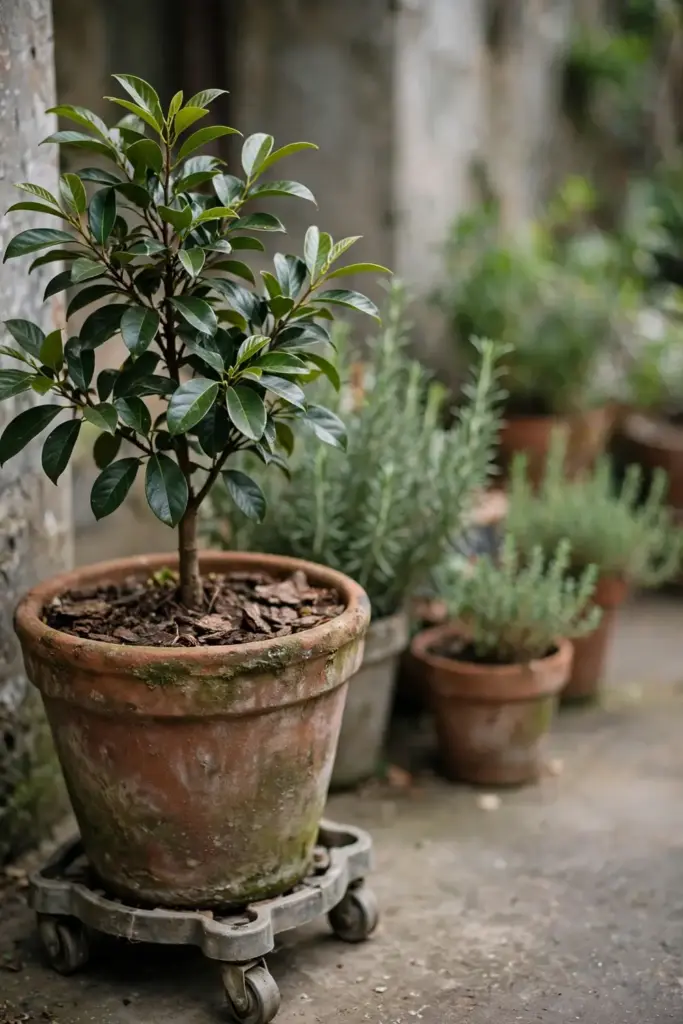
Use a rich, loose mix with plenty of organic matter: composted bark, coir, and perlite in roughly equal parts, with a handful of slow-release organic fertilizer worked in. Keep the tree outdoors in warm weather in a spot with morning sun and shelter from strong afternoon sun and wind. Four to six hours of direct sun is plenty. When night temperatures approach 10 degrees Celsius, move the tree inside to a bright room.
Indoors, give it the brightest window you have and keep humidity up. A pebble tray or a nearby humidifier helps, because heated indoor air is far drier than the tree’s native climate. Water when the top 3 centimeters of mix feel dry, and cut feeding back to nothing through winter. Container trees fruit later than ground trees and may stay smaller, which is fine. A smaller tree in a pot is still a real nutmeg tree. Our indoor herb gardens guide covers the light and humidity routines that container tropicals need through a cold winter. This is also the heart of how to grow nutmeg from India when your climate is nothing like Kerala.
9. Soil That Mimics a Humid Volcanic Lowland
Nutmeg grows on any soil that holds enough water, provided the drainage is good. The preferred soils are volcanic in origin with a high content of organic matter, at a pH between 6.5 and 7.5, though the tree tolerates 5.5 to 7.5. You do not need volcanic soil. You need the properties volcanic soil provides: moisture retention, air in the root zone, and steady organic nutrition.
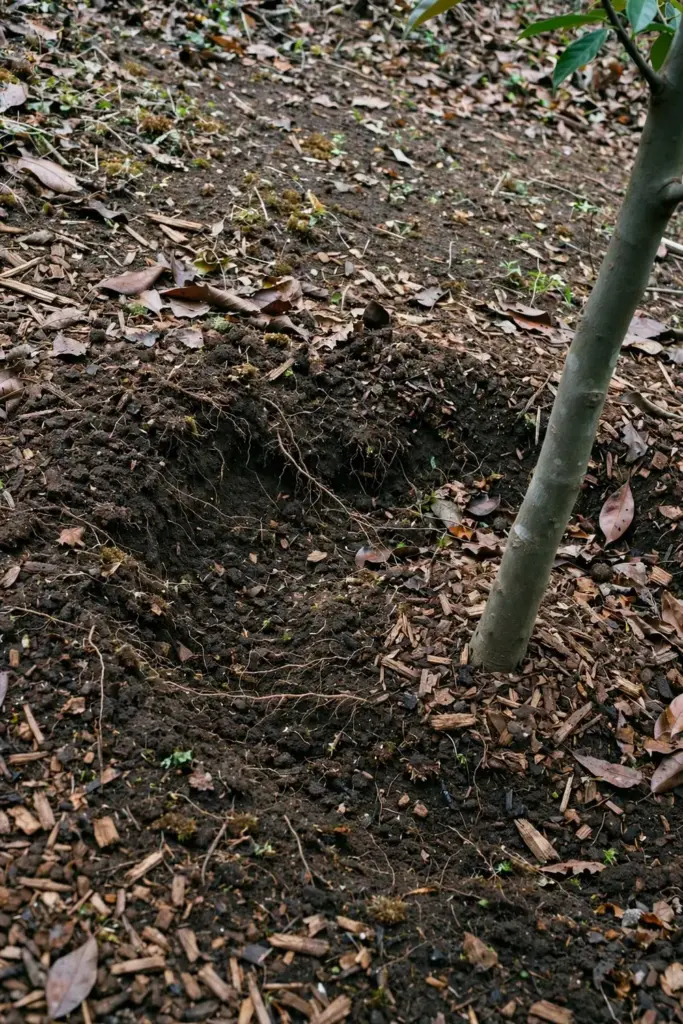
In the ground, dig a planting hole twice as wide as the root ball and mix the excavated soil with compost at roughly one part compost to two parts soil. On heavy clay, plant on a low mound so water never ponds around the stem. On sand, double the compost. Mulch the surface with 5 to 8 centimeters of leaf litter or wood chips, kept a few centimeters clear of the trunk, and renew it as it breaks down. The mulch feeds the shallow roots and keeps the soil evenly moist, which is exactly what the tree evolved with.
Test your pH before you plant. A simple kit is enough. Below 5.5, work in lime. Above 7.5, add compost and sulfur. The tree tolerates a range, but it grows best near neutral, and correcting pH once is easier than fighting chlorosis for years. Our soil health and pest resistance guide walks through building the living soil this tree wants, and the same foundation serves every tropical tree in your garden.
10. Watering and Feeding an Evergreen Spice Tree
Water for even moisture, not saturation. In the humid tropics the tree gets 1,500 to 3,500 millimeters of rain a year with no long dry season, so your job is to imitate that. In the ground, deep-water weekly through dry spells. In containers, water when the top few centimeters dry out. Leaves that yellow from the edges inward usually signal drought stress in a shallow-rooted tree, while overall yellowing with soggy soil signals overwatering.
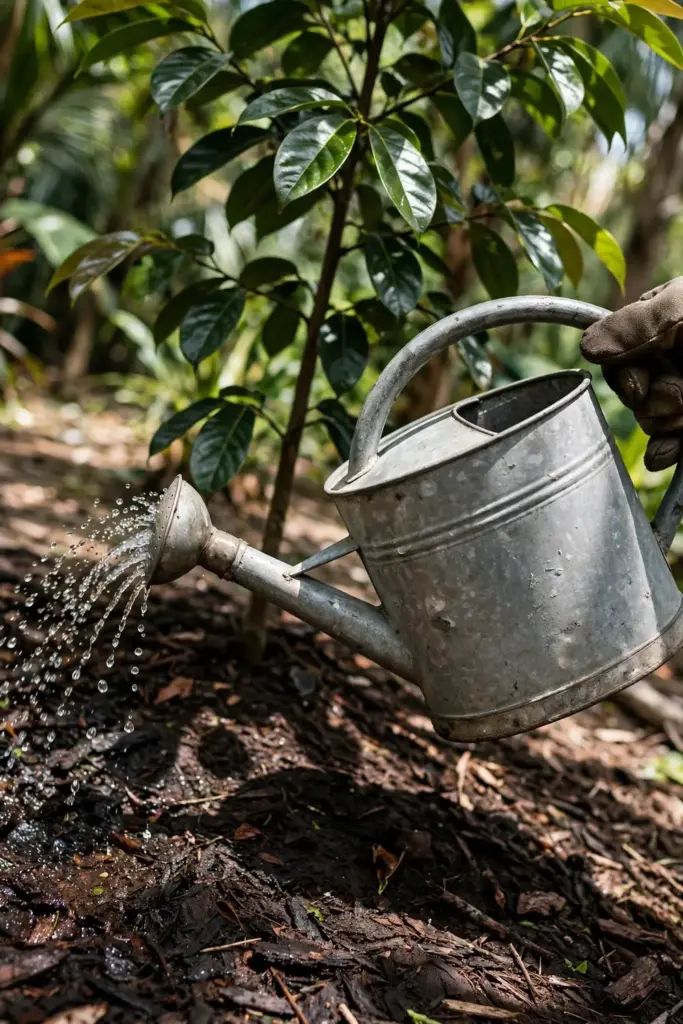
Feed modestly and steadily. A mature tree in the ground does well with 2 to 3 kilograms of compost or well-rotted manure twice a year, applied at the start and middle of the rainy season, plus a balanced organic fertilizer if growth looks pale. Young trees need less: a handful of compost around the base every three months. Avoid piling fertilizer against the trunk. Spread it under the canopy where the feeder roots live.
Watch the leaves as your guide. Deep green, glossy leaves mean the nutrition is right. Pale new growth asks for nitrogen. Purpling or poor fruit set asks for phosphorus and potassium. A slow-growing evergreen forgives a missed feeding, but it never forgives waterlogged roots.
11. Pruning and Shaping the Canopy
Nutmeg naturally forms a dense, conical crown, and it needs little shaping. Prune to remove dead, crossing, and inward-growing branches, and to keep the center open enough for air to move. Good airflow matters because the humid conditions the tree loves also invite fungal problems. Make cuts just outside the branch collar and never leave stubs.
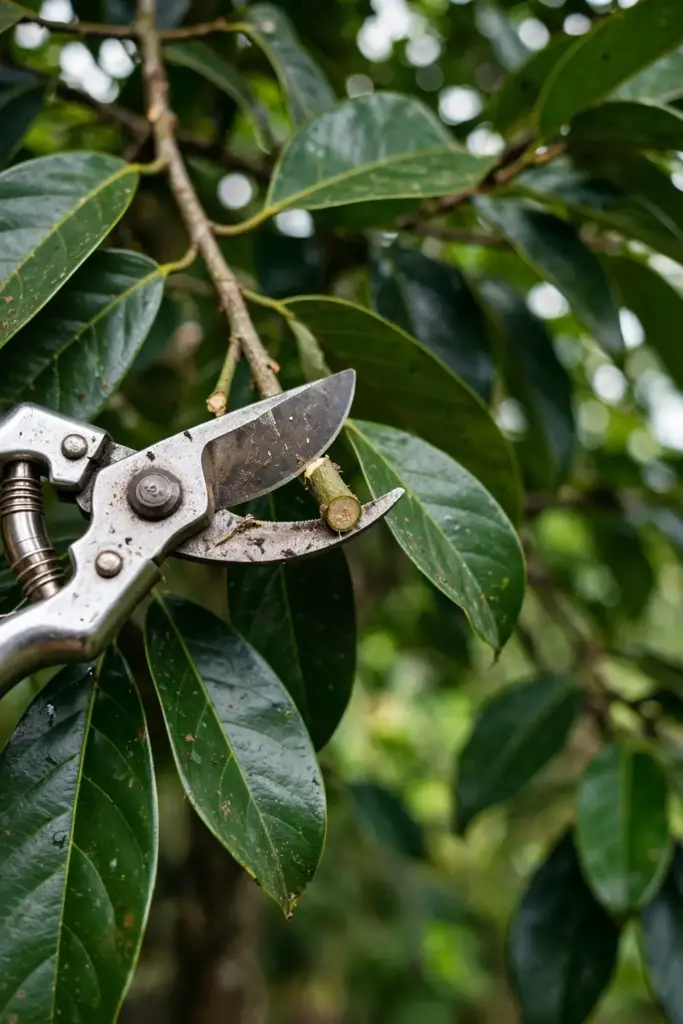
Do your structural pruning in the dry season when the tree is growing slowly. Remove no more than a fifth of the canopy in one year. A young tree benefits from one clear central leader, so cut competing upright shoots while they are small. On a container tree, prune to keep the size manageable, and heavy pruning delays fruiting. Every branch you remove is a branch that will not carry fruit in year eight.
Clean your tools between trees. Home gardeners see few serious diseases on nutmeg. Wounds still invite infection, so a quick wipe with diluted bleach or alcohol costs nothing. Burn or bin diseased prunings rather than composting them.
12. Overwintering: Keeping Nutmeg Alive Through a Cold Season
Overwintering is the make-or-break skill for temperate growers. Nutmeg is very susceptible to frost damage, and exposure below 30 degrees Fahrenheit can kill the tree. Bring container trees inside before the first frost, when nights start dipping toward 10 degrees Celsius. Do not wait for the forecast to say frost. By then the tree is already stressed.
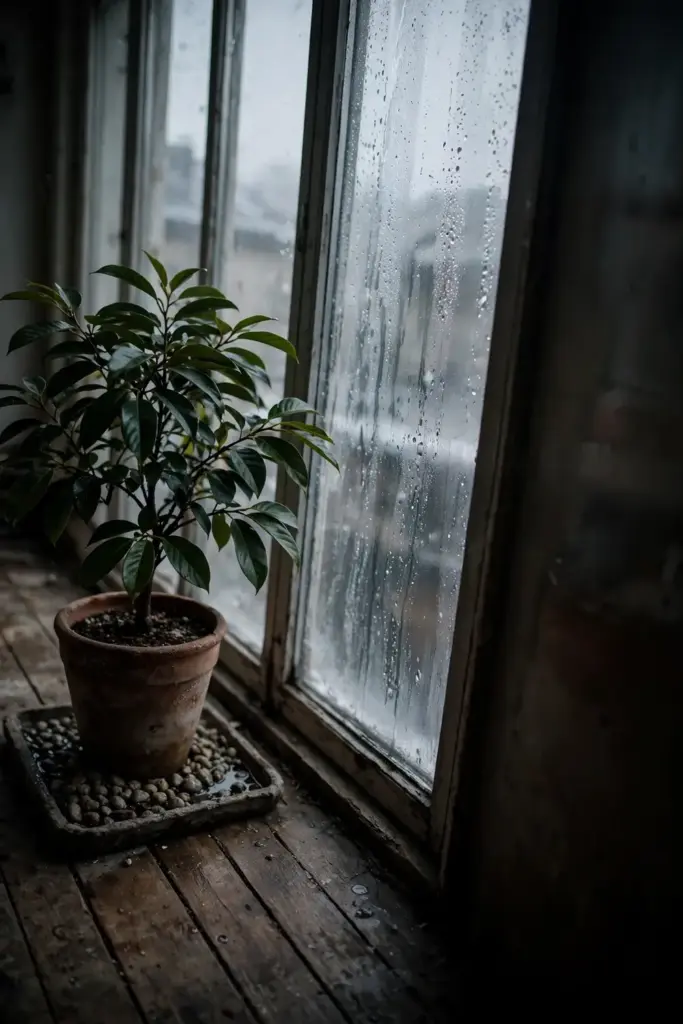
Inside, place the tree in your brightest spot. A south-facing window or a grow light on a 12-hour timer keeps it growing slowly through winter. Keep the room above 10 degrees Celsius, ideally 15 or warmer. Cut watering back: the tree uses far less water in low light, and cold wet soil rots roots. Mist the leaves or run a humidifier, because winter heating drops humidity to desert levels and nutmeg leaves crisp at the edges in dry air.
Watch for scale insects and spider mites, the two pests that love a stressed indoor tropical. Check leaf undersides weekly. A strong jet of water knocks off light infestations, and insecticidal soap handles the rest. In spring, move the tree back outside gradually over one to two weeks, hardening it off to sun and wind. A tree rushed into full sun burns its winter leaves.
13. Pests and Diseases of the Nutmeg Tree
Nutmeg has few serious enemies in a home garden, but the humid conditions it needs invite a short list of problems. Scale insects cluster on stems and leaf undersides, draining sap and dripping honeydew. Thread blight and fruit rot appear in wet seasons with poor airflow. Seedling dieback strikes in the nursery when pots stay too wet. Root rot follows waterlogged soil everywhere.
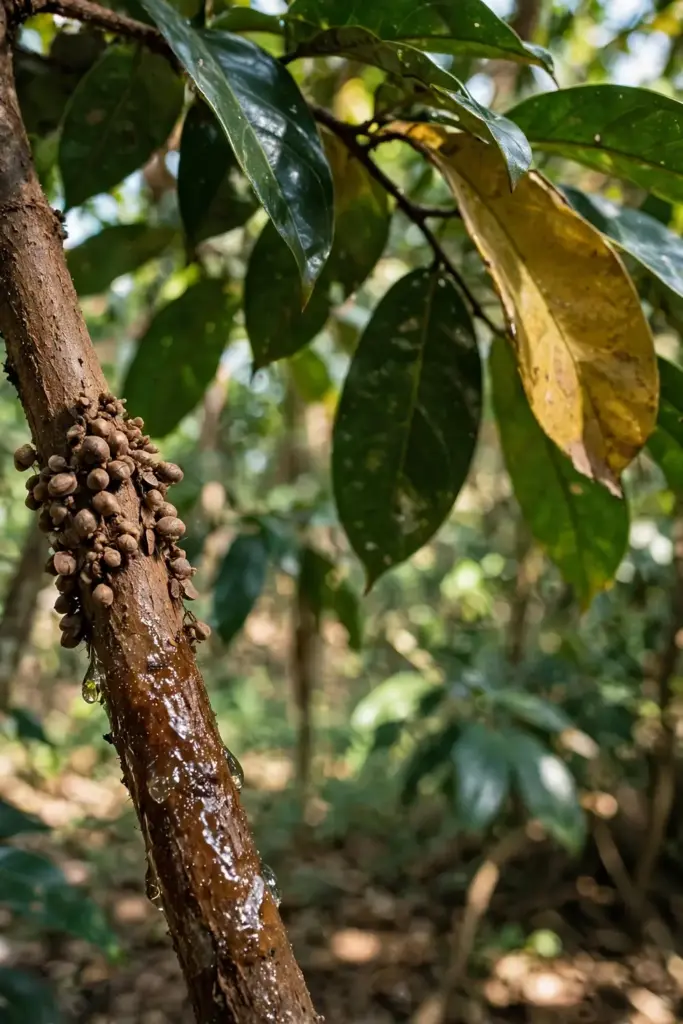
Prevention beats treatment. Space trees so air moves, prune for an open canopy, water the soil and not the leaves, and mulch without piling it against the trunk. For scale, prune out heavy infestations and treat the rest with horticultural oil. For fungal issues like thread blight, remove affected material promptly and improve drainage and airflow before reaching for a fungicide. A healthy tree in the right spot outgrows most problems.
One pest worth naming is the nutmeg weevil group, which can bore into developing fruit in production regions. Home growers rarely see it, but inspect fallen fruit and destroy any with holes. Good sanitation, removing fallen fruit and prunings, breaks the life cycle of most fruit pests.
14. Flowering, Pollination, and the Male Question
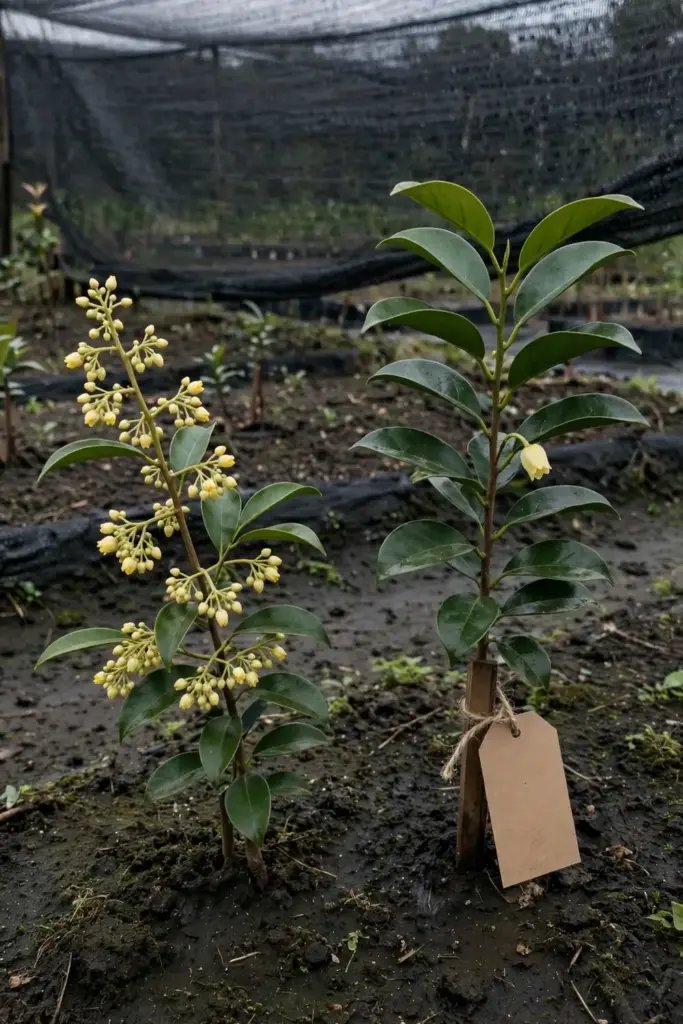
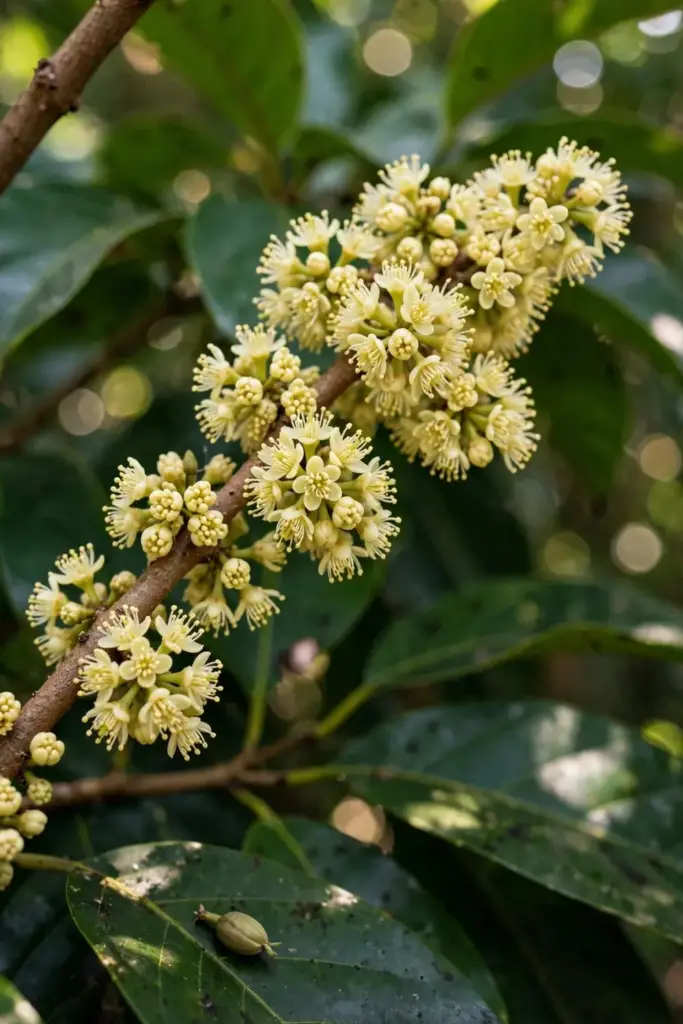
First flowering usually arrives about six years after planting in a vigorous tree, and this is the moment of truth for seed-grown plants. Female flowers are small, pale yellow, and single. Male flowers cluster in groups. If your tree flowers male, it will never carry fruit, though it still serves as a pollinator for female trees nearby.
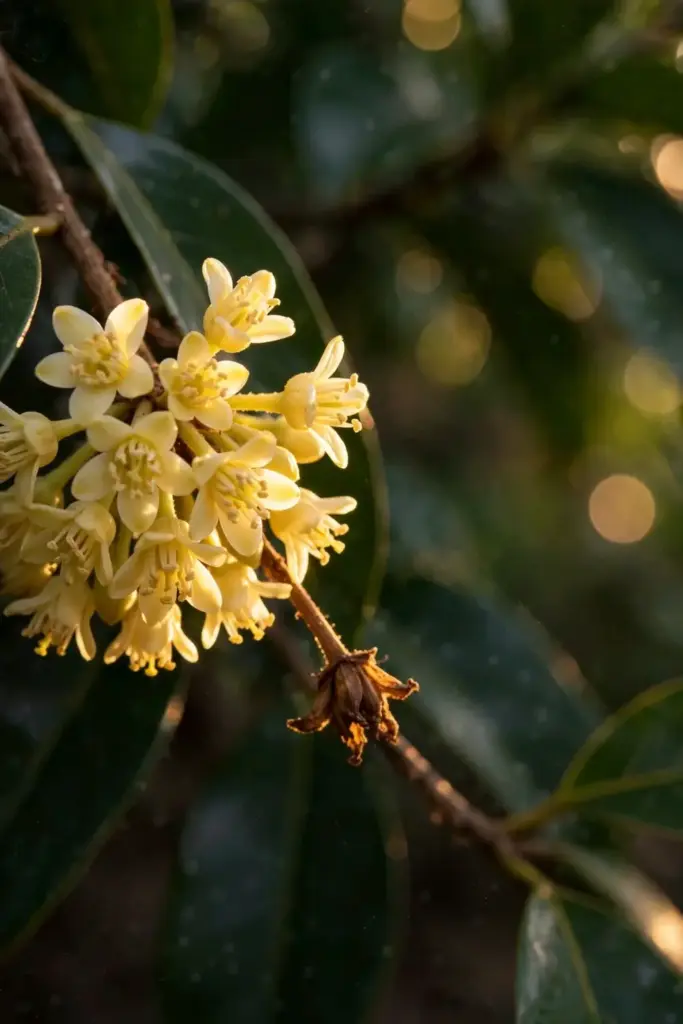
Pollination is done by insects, especially moths, with flowers opening in the very early morning hours. In a home garden with a single female tree and no male nearby, fruit set may be poor. This is why plantations keep about 10 percent male trees distributed through the planting. For the home grower, the practical options are a grafted female plus a male seedling kept small, or a neighborhood with another nutmeg tree. Hand pollination is possible but fiddly at the scale of a tree.
After pollination, the fruit develops over 6 to 9 months. Flowering is often triggered by short dry periods, and fruiting turns more seasonal in regions with a pronounced dry season. Do not panic if the first flowers drop without setting fruit. Young trees often flower for a season or two before they hold a crop.
15. Harvesting Nutmeg: When the Fruit Splits Open
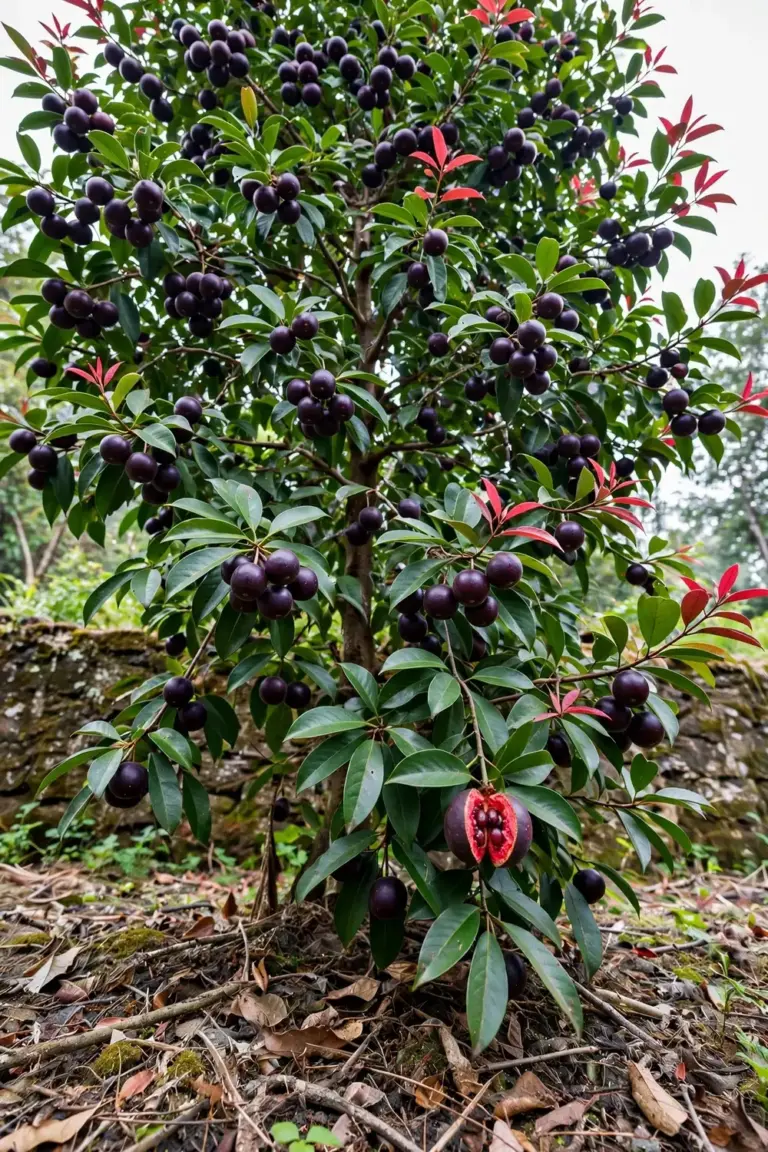
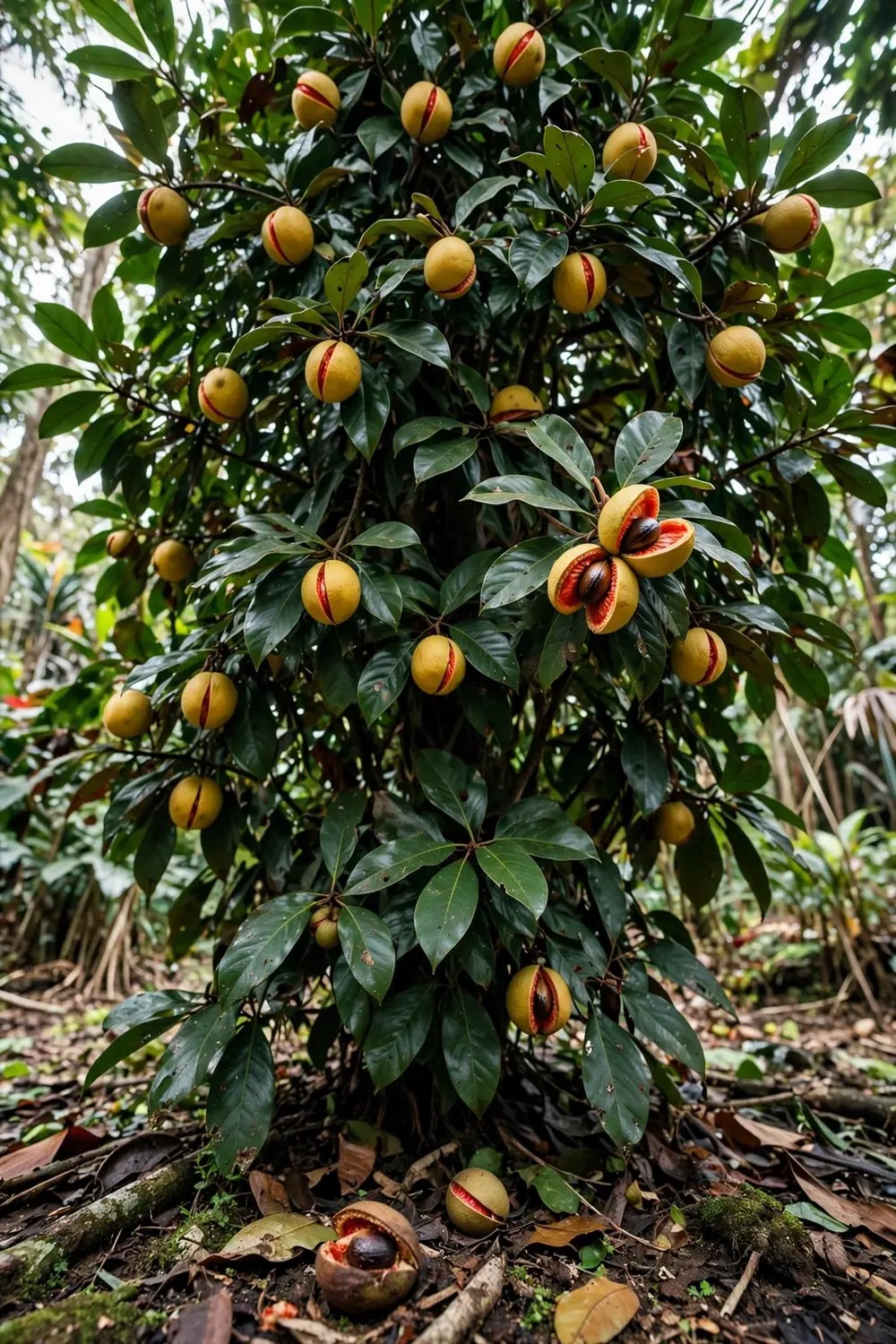
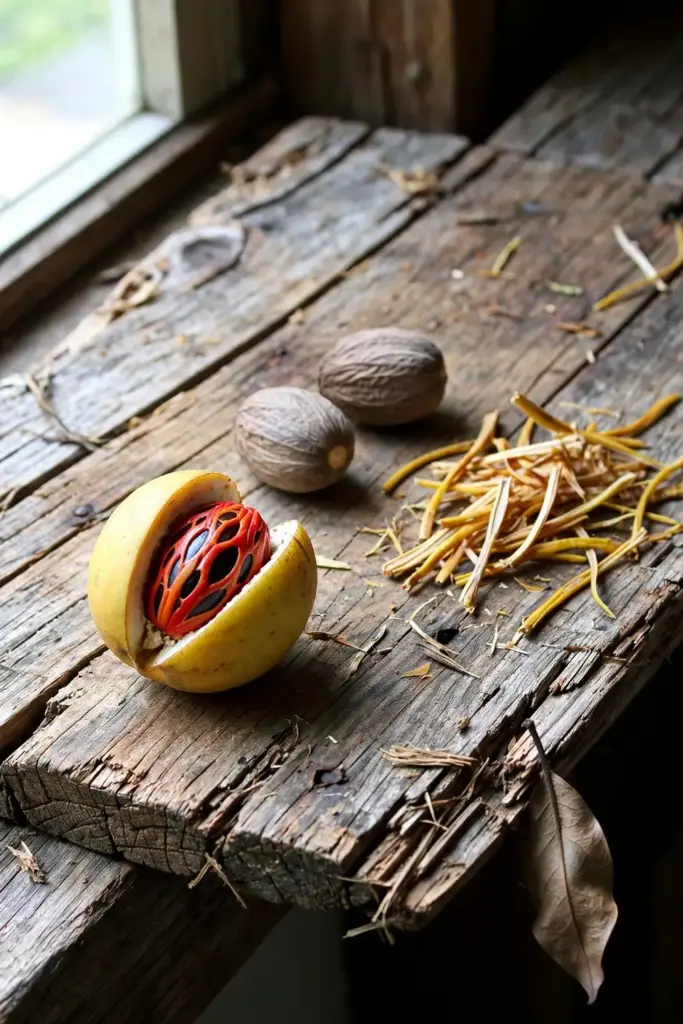
A ripe nutmeg fruit tells you it is ready. The round yellow fruit, about the size of an apricot, splits open along a seam to reveal the dark seed wrapped in its red aril. Harvest by hand, picking the split fruit from the tree or gathering fresh falls daily. Do not let ripe fruit sit on wet ground, because the seed inside molds quickly.
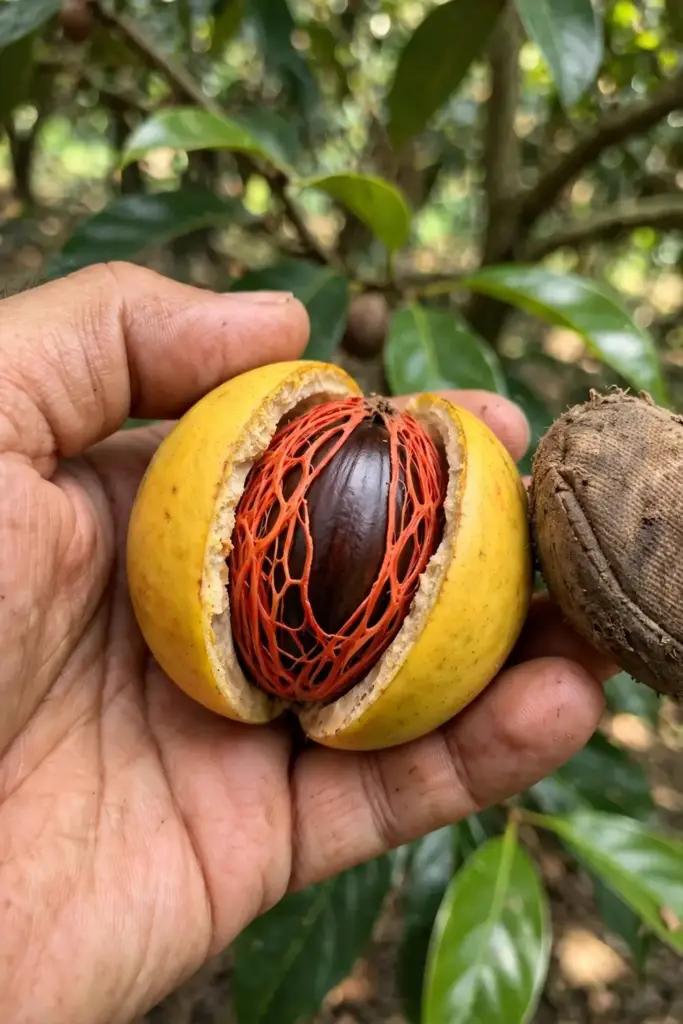
Crack the fruit open and separate the parts. The outer flesh can be sliced and eaten as a delicacy or made into preserves, a common use in West Java and Malaysia. The seed, still wrapped in its aril, goes to the processing step for nutmeg. The aril itself goes to the mace lane in the next section. One fruit gives you both spices, and handling them separately from the start keeps both clean.
A mature tree can produce 1,000 to 5,000 fruits per year, with yields of 500 to 1,200 kilos per hectare in commercial plantings. Your home tree will produce less, especially in the first bearing years, and that is normal. Peak production arrives after 15 to 20 years. The tree is a long investment, and the harvest grows with it.
16. Harvesting Mace: The Second Spice From the Same Tree
Mace is the dried aril, the lacy red-orange covering wrapped around the nutmeg seed. At harvest it is bright red and fleshy. Peel it away from the seed carefully by hand as soon as you open the fruit. Work gently. Torn aril dries unevenly and grades lower. This is the step that turns one harvest into two spices, and it takes only minutes per fruit once you learn the motion.

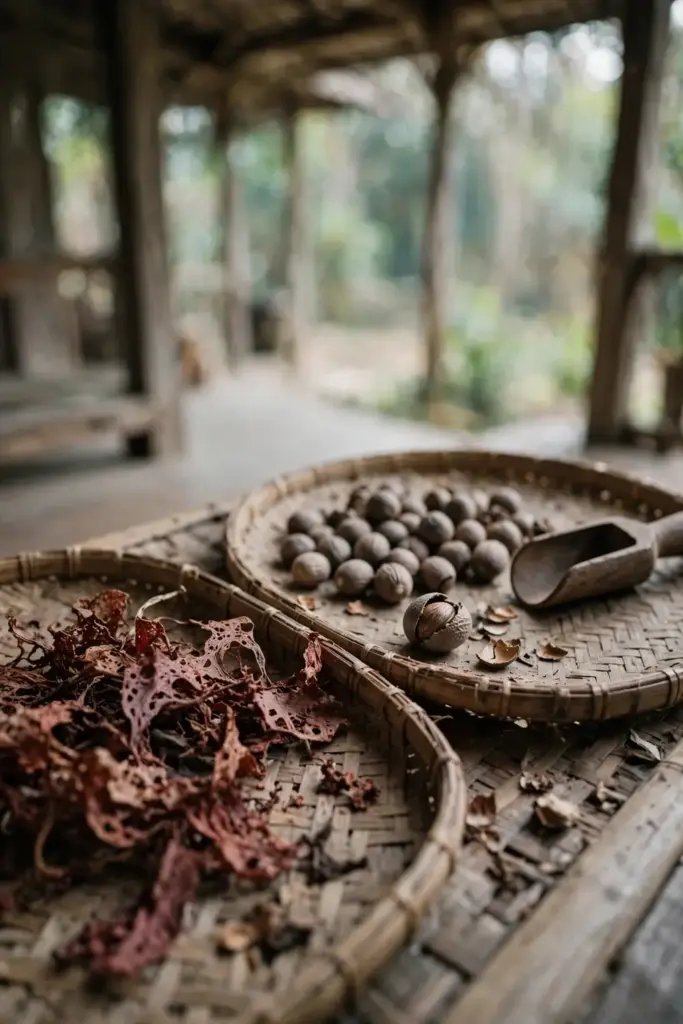
Fresh mace is perishable, so move it to drying the same day. Spread the arils in a single layer on a clean mat or tray in a shaded, airy spot. Direct sun bleaches the color and cooks off aroma. Turn them daily. Over about two weeks the aril shrinks, hardens, and turns from red to a yellowish brown. That color change is your sign that drying is working.
Grade the dried mace by eye. Whole, unbroken blades with even color are the top grade. Broken pieces still cook fine and go into your own jar. Store dried mace in airtight containers away from light, and it keeps its aroma for a year or more. Mace is the smaller fraction of the harvest by weight, and the more delicate half of what your tree gives you.
17. Drying and Processing Both Spices
Nutmeg seed needs longer, slower drying than mace. After removing the aril, dry the seeds in their shells in a shaded, ventilated spot for 6 to 8 weeks, turning them regularly. The seed is ready when it rattles inside the shell. Then crack the shell and take out the kernel, which is the nutmeg of commerce. Dry the kernels a few more days, then store them whole in airtight jars.
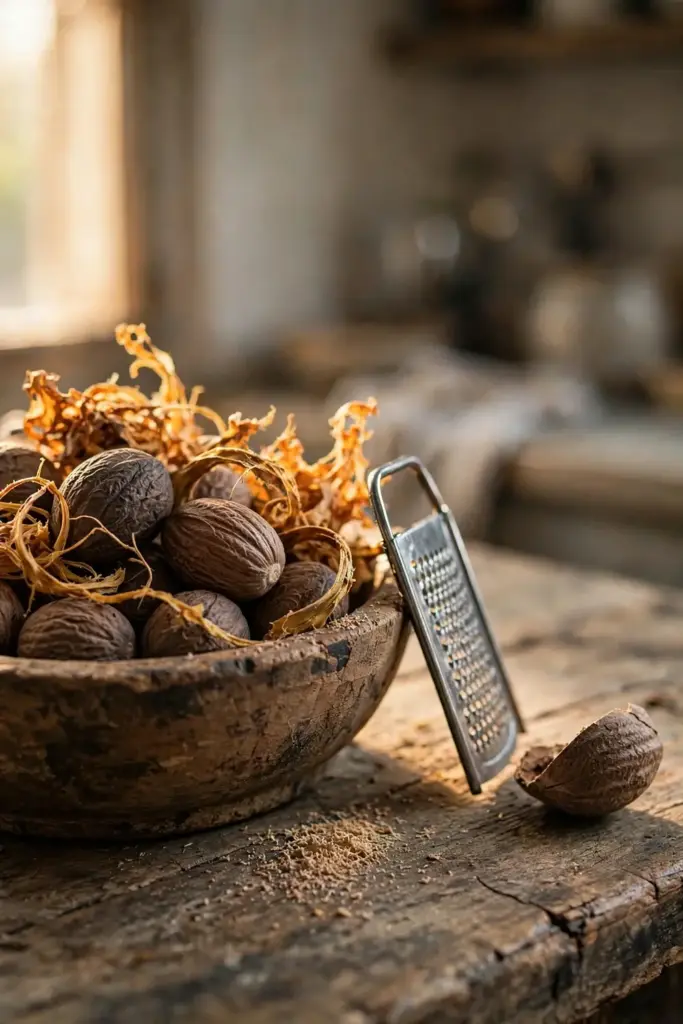
Always store nutmeg whole and grate it fresh. The essential oils that give nutmeg its aroma evaporate quickly once ground, and pre-ground nutmeg from a jar is a pale echo of the fresh kernel. A small grater or a dedicated nutmeg mill lives next to the jar in any serious kitchen. Whole kernels keep for years if they stay dry.
One safety note belongs here. Nutmeg is a warming digestive spice in normal culinary amounts, and traditional systems from Ayurveda to European herbalism have used it that way for centuries. Taken in excess, the seed can cause severe headache, nausea, dizziness, and delirium, so treat it as a spice, not a supplement. If you take medication or have a health condition, talk to a clinician before using nutmeg beyond the kitchen.
18. Culinary Uses: Two Spices, Two Different Jobs
Nutmeg and mace share a family resemblance but do different work in the kitchen. Nutmeg is warm, sweet, and slightly woody, and it goes into custards, sauces, cakes, puddings, and bechamel, where a few gratings transform the dish. In Europe it also seasons savory food: spinach, potatoes, and creamy soups all take nutmeg well. Freshly grated over eggnog or a white sauce, it is unmistakable.
Mace is more delicate and more aromatic, with peppery and slightly bitter notes. It flavors soups, sauces, curries, pickles, and baked goods, and it suits fruit salads and cakes where nutmeg would dominate. A pinch of mace in a curry or a pickle brine adds complexity without the weight of nutmeg. Because mace is the thinner, more volatile spice, add it later in cooking so its aroma survives to the plate.
Use them from your own harvest with confidence. Your home-dried mace and your freshly grated nutmeg will out-aromatize anything from a supermarket jar, because the volatile oils are still in the spice instead of in the warehouse air. Start with small amounts. Both spices are potent, and a light hand is the difference between warmth and bitterness.
19. Mistakes That Cost Years
The most expensive mistake is planting one seed and hoping it is female. With roughly half of seedlings turning out male, a single-seed planting is a coin toss that resolves in year six. Plant two or three seedlings per spot, or buy a grafted female. The second mistake is planting old seed. Nutmeg seed dies fast, and seed of unknown age is the main reason germination fails. Buy fresh, sow the same week.
The third mistake is impatience with water. The tree wants even moisture and punishes both drought and waterlogging, and beginners usually err on one side or the other. Mulch, check the soil with your finger, and water deeply but infrequently. The fourth mistake is skipping the wind shelter. The superficial root system cannot anchor a young tree in an exposed spot, and a wind-rocked tree never establishes properly.
The fifth mistake is treating mace as an afterthought. Growers who toss the aril with the husks throw away the second spice. Peel and dry the aril from every harvest, and your tree pays you twice. The sixth mistake is storing ground nutmeg. Grate fresh, every time, and the difference will convert you permanently.
20. Troubleshooting: Why Your Nutmeg Tree Is Not Fruiting
A nutmeg tree that grows well but never fruits has a short list of usual causes, and the male tree leads it. If your seed-grown tree is over six years old, flowers, and sets nothing, check the flowers. Clustered male flowers mean the tree will never fruit. Replace it with a grafted female or graft a female scion onto it, and keep one male nearby for pollination.
A young female that flowers but drops everything is usually just young. Trees often flower for a season or two before they hold fruit, and impatience is not a diagnosis. Check pollination next. A lone female with no male tree and few night-flying insects nearby sets poorly. Plant a male seedling, even a small one, within pollinating distance.
Stress drops fruit too. Drought during fruit development, waterlogging, nutrient deficiency, and wind damage all cause the tree to shed its crop. Walk through the basics: even water, mulch, feeding, shelter. If the tree is in a container, consider that pot culture delays and reduces fruiting, and a tree that fruits lightly in a pot is performing normally.
Frequently Asked Questions
Seedling trees begin fruiting when they are about 8 to 10 years old, while grafted trees can fruit at 4 to 5 years. Peak production arrives after 15 to 20 years, and a healthy tree keeps bearing for 30 to 40 years or longer. The tree is a genuine long-term investment, so plant it where it can stay for decades.
Yes, with honest expectations. Use a 5-gallon pot to start and move up to 10 gallons for the long term, keep the tree outdoors in warm weather, and bring it inside before nights drop toward 10 degrees Celsius. Container trees stay smaller and fruit later than ground trees, and in cold climates the tree may never fruit heavily.
Both come from the same fruit of Myristica fragrans. Nutmeg is the dried kernel of the seed. Mace is the dried aril, the lacy red covering wrapped around the seed inside the fruit. One tree and one harvest give you both spices, which is why this guide covers them together.
You cannot tell until the first flowers open, usually about six years after planting. Female flowers are small, pale, and single, while male flowers grow in clusters. This is why growers plant two or three seedlings per spot and remove the males, or buy grafted female trees.
Yes, in normal culinary amounts, nutmeg is a safe and classic spice. The caution is about excess: large amounts of nutmeg can cause headache, nausea, dizziness, and delirium. Use it as a spice in cooking, grate it fresh, and keep the jar away from children. Talk to a clinician before medicinal use.
Buy fresh planting seed from a tropical nursery or seed specialist that names the species Myristica fragrans and gives a harvest date. Sow within days of arrival. Spice-jar nutmeg is dried for the trade and will not sprout, and seed sold without a species name may be the inferior Myristica malabarica.
Where to Go From Here
You now know the whole arc: the dioecious lottery and how to beat it, the climate the tree demands, the slow honest timeline, and the two-spice harvest that makes the wait worthwhile. The next step is small. Source fresh seed or a grafted female tree, prepare a warm sheltered spot, and plant. The tree will do the slow part. Your job is to give it the years it needs and to be there with a basket when the first fruits split open, red mace glowing inside, eight or ten years from the day you started. That is how to grow nutmeg from India, one patient season at a time.