
Fire blight has no cure once the bacteria enter wood. The 10 strategies below save the tree around the infection, starting with the triage call that tells you whether cutting is worth it at all.
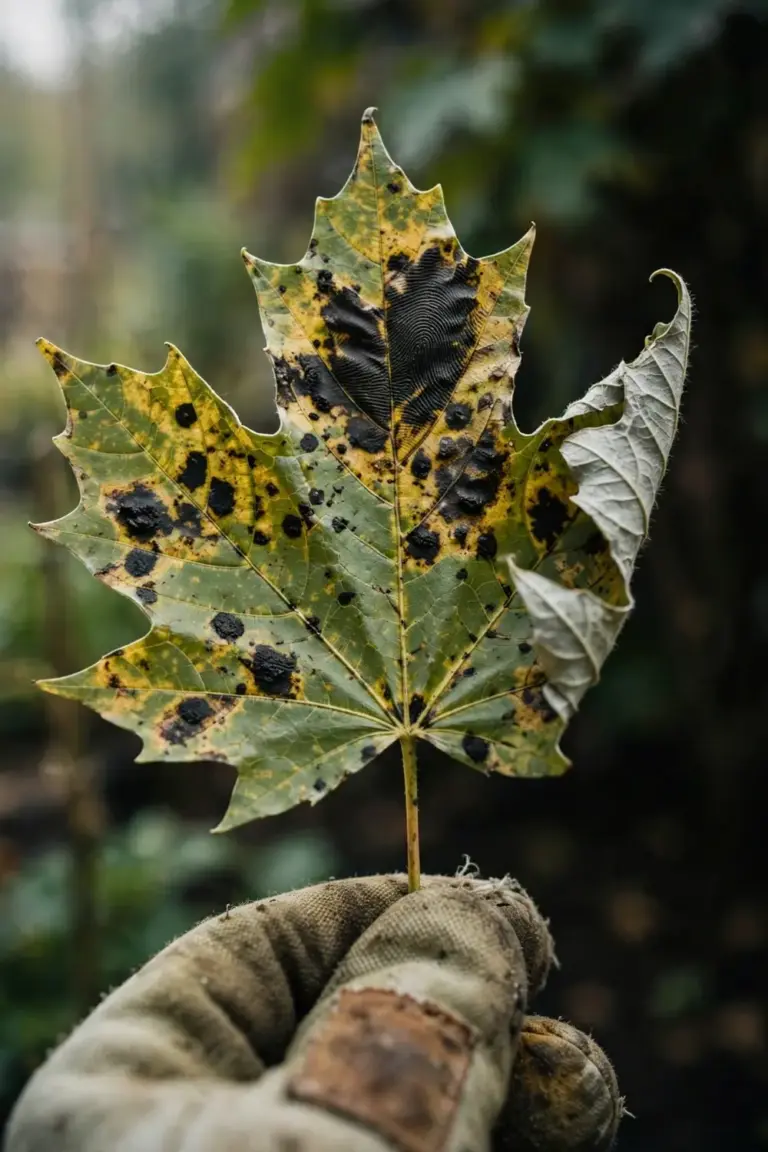
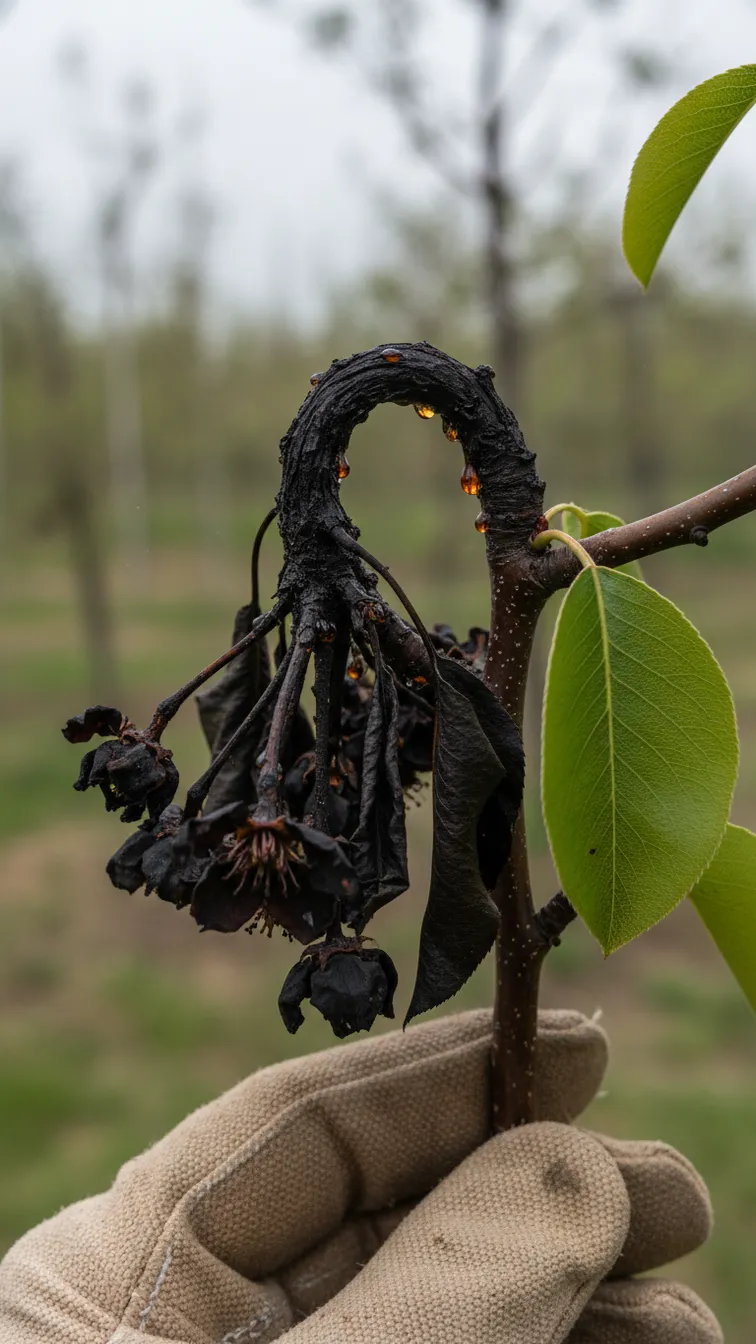
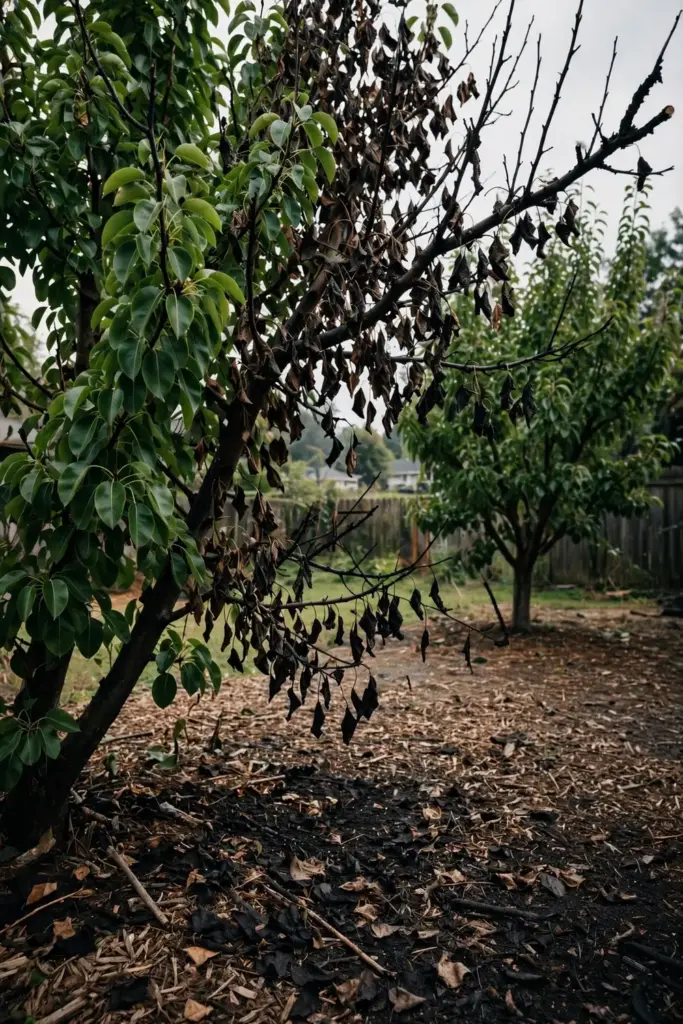
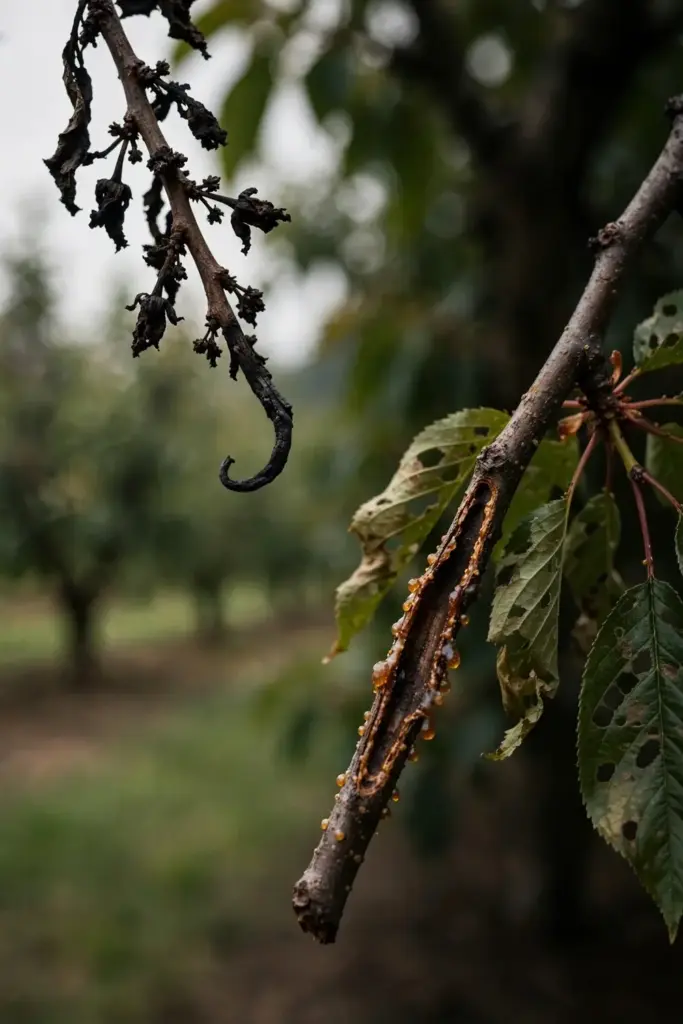
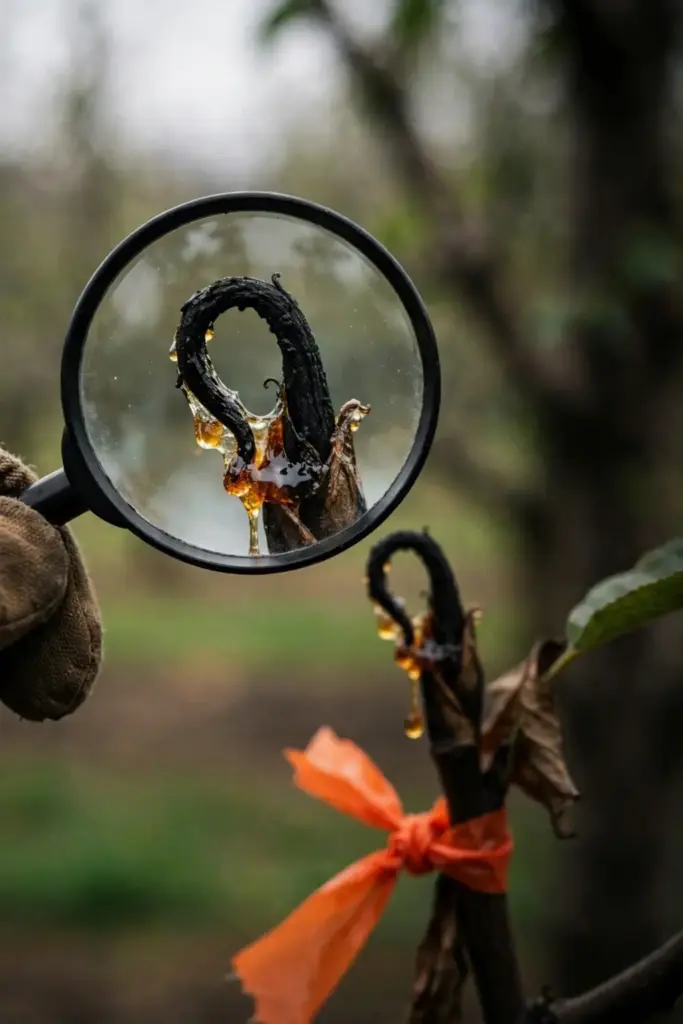
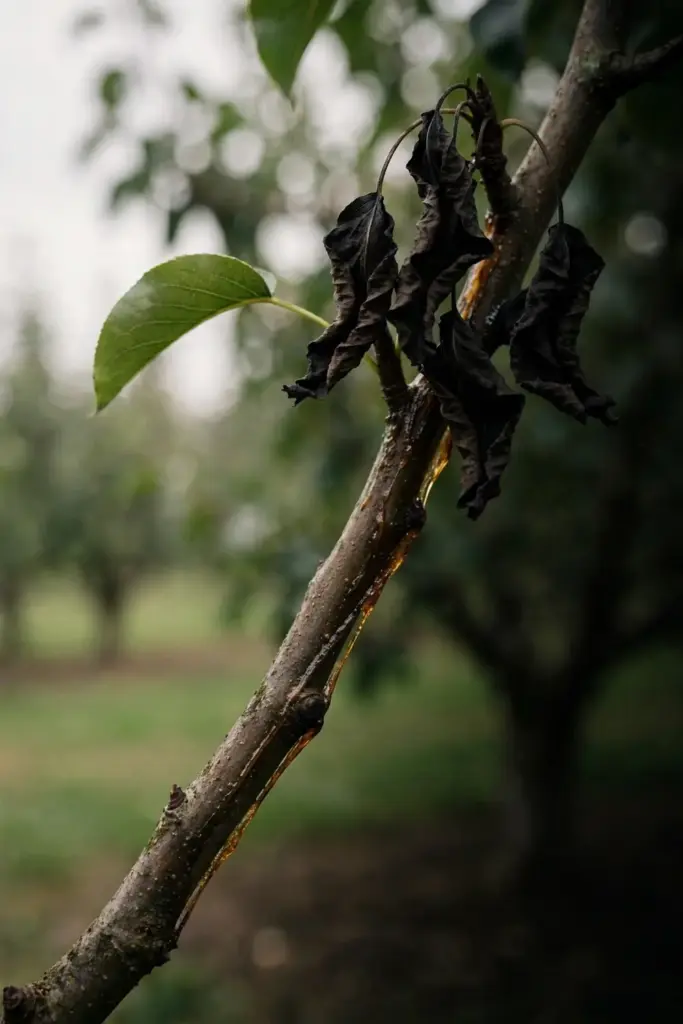
The signature is a shoot tip that wilts, blackens, and bends into a shepherd’s crook, with blossoms that shrivel and stay attached. Leaves on the struck shoot turn dark orange-brown on apple and black on pear, and they hang on the branch long after they die.
The rest of this page runs the order a gardener should follow. Identify the disease first, then decide whether the tree is worth treating, then work the 10 steps from the first cut to next-season scouting. I have learned that the cut made in dry weather matters more than any spray bought after symptoms show.
What Fire Blight Actually Is
Fire blight is a bacterial disease of pome fruits. The bacterium Erwinia amylovora causes fire blight.
The Cornell fire blight fact sheet describes fire blight as a destructive disease in apple and pear production. Fire blight occurs worldwide in all regions where apples and pears grow, with the exception of China and Australia. Under conditions that favor disease, fire blight can infect, blight, and kill trees across large acreages over the course of only a few weeks. Estimated economic losses in the United States exceed 100 million dollars annually.
Erwinia amylovora enters through open blossoms and wounds. The bacterium cannot penetrate cells directly, so it needs a natural opening or damaged tissue to enter the host. Once inside the plant, Erwinia amylovora moves systemically through vascular tissue ahead of visible symptoms. That hidden advance is why a shoot can look healthy above a canker that already carries bacteria below.
Insects carry ooze from cankers to open blossoms. Ooze droplets range from pale yellow to dark amber. Pollinators, flies, and ants visit the sweet ooze and move bacteria to flowers and wounds on nearby trees. Rain splash moves bacteria the same way. One overwintering canker can seed a whole planting in a warm wet spring.
How to Identify Fire Blight on Blossoms and Shoots
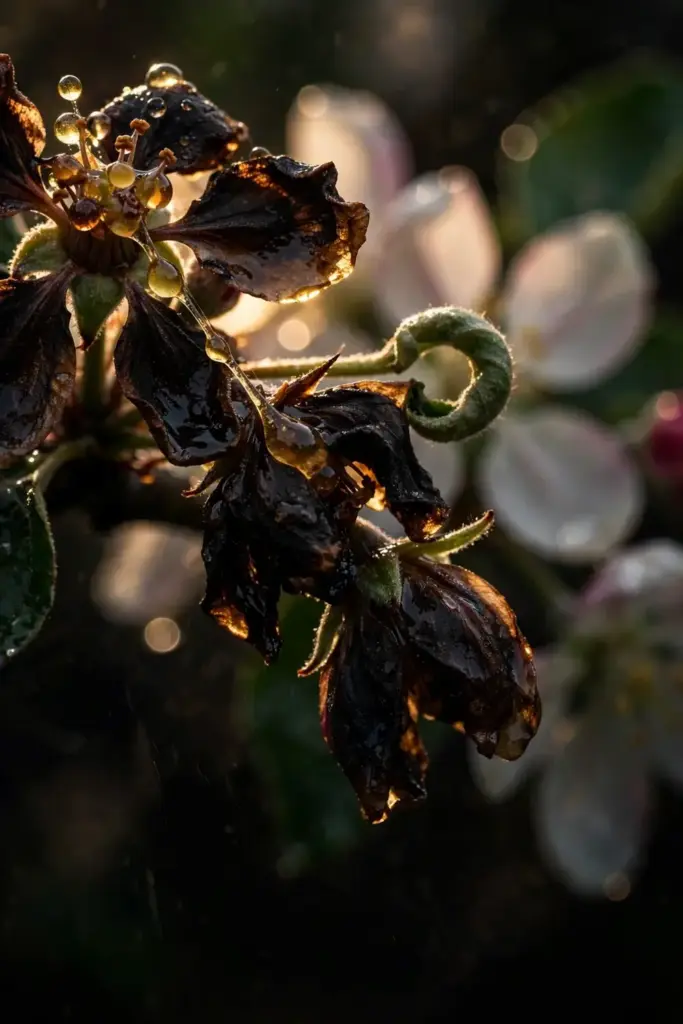
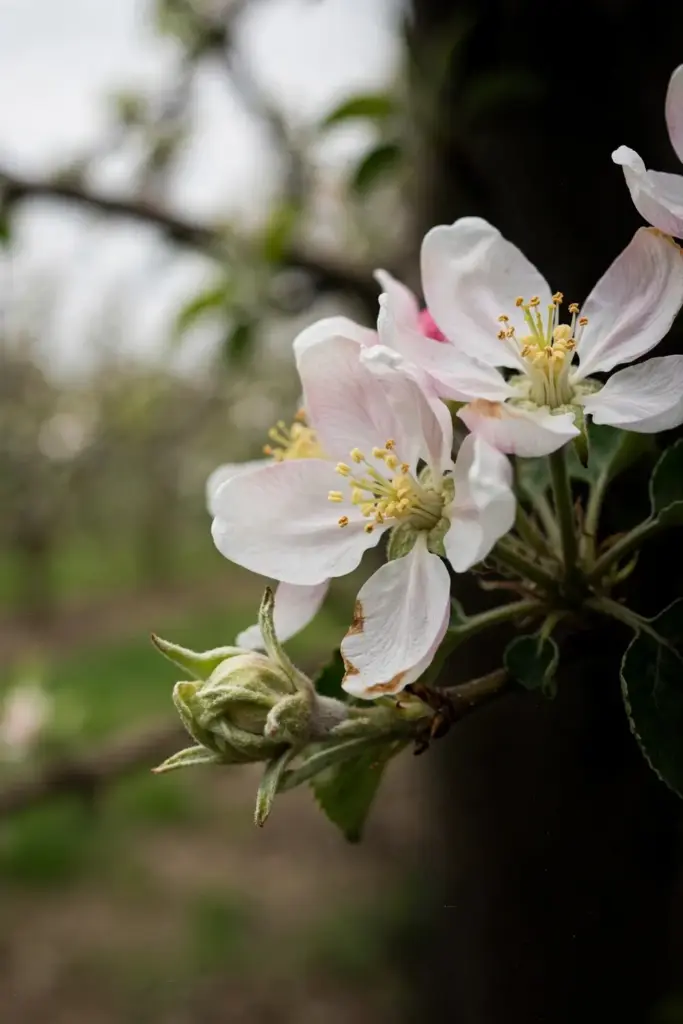
Blossom blight starts the infection. Flowers wilt, shrivel, darken, and stay attached.
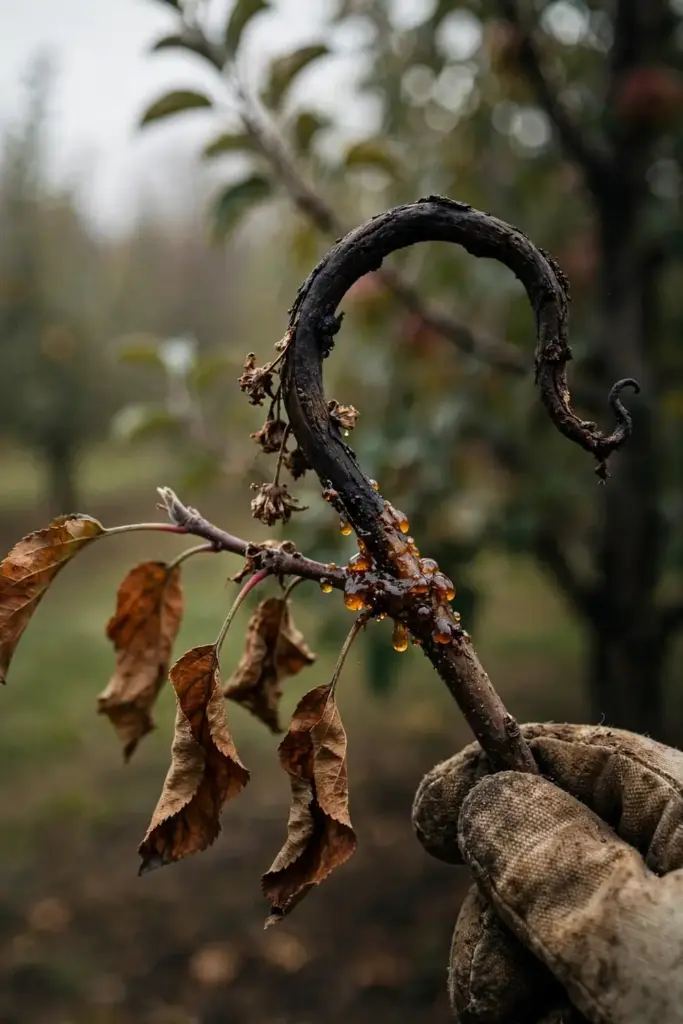
The UC Agriculture and Natural Resources guide to fire blight in apples and pears states that fire blight does best when daytime temperatures run 75 to 85 degrees Fahrenheit and nighttime temperatures stay above 55 degrees. Pollinators and splashing water drops spread the disease to open blossoms and growing shoots. Infected flowers and shoots wilt, shrivel, and turn dark brown or black. Infected shoot tips wilt and form a shepherd’s hook shape.
Shoot blight follows blossom blight. The shoot tip bends into a crook. Apple leaves on a struck shoot turn dark orange-brown. Pear leaves on a struck shoot turn black. Blighted tissue first looks water-soaked, then wilts and turns black or brown within 1 to 3 weeks, according to the Cornell fact sheet.
Check for ooze on warm humid days. Droplets of bacterial ooze form on infected blossoms, shoots, and fruit. Ooze turns dark after exposure to air and leaves streaks on bark. Ooze on a blackened shoot tip confirms a bacterial infection. A shoot that only wilts, without ooze or a crook, needs a closer look before you call it fire blight.
How to Identify Fire Blight on Branches, Trunks, and Fruit
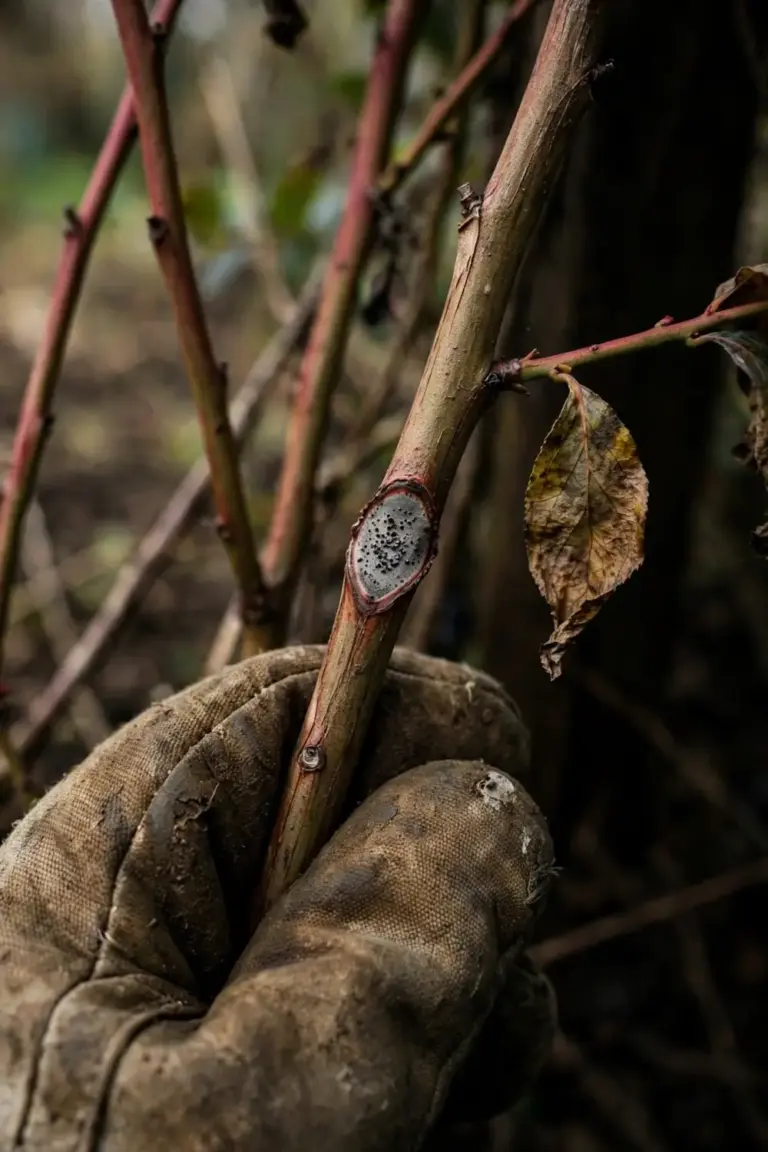
Canker blight shows in wood. Bark sinks, cracks, and dries over reddish-brown wood.
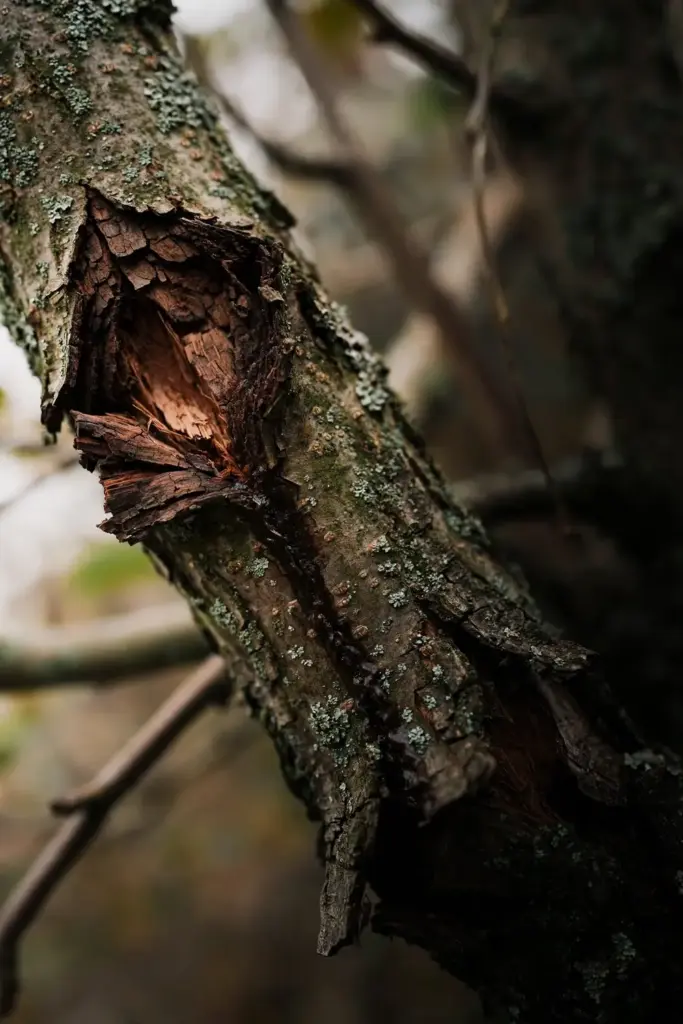
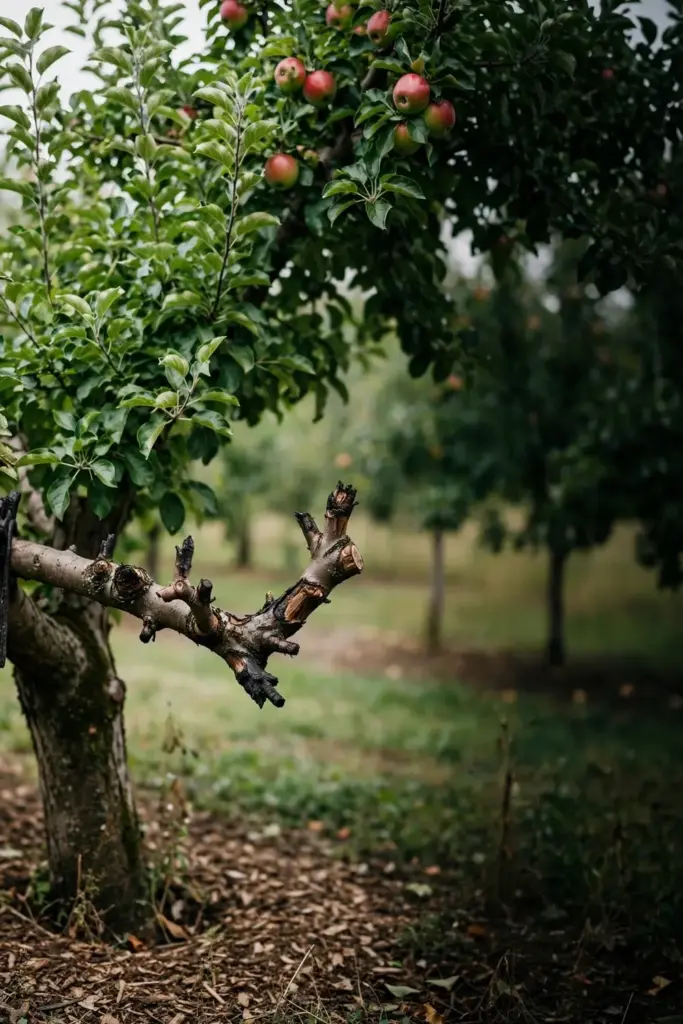
Fire blight survives winter in cankers on branches and trunks. Cankers turn active in spring when warm wet weather returns and new growth begins. Cankers release a light tan watery ooze that turns dark and streaks the bark. Newly infected wood appears pink, orange, or reddish. Cut the bark away from the edge of an active canker and reddish flecking shows in the wood beside the canker margin. Expanding cankers kill wood, turning it dark brown, sunken, dry, and cracked.
Rootstock blight is the fourth infection type and the deadliest. Bacteria travel systemically from a shoot or branch into the rootstock. A rootstock canker girdles the tree and kills it in one season. Susceptible rootstocks M.9 and M.26 sit at the top of the risk list, according to the University of Illinois fire blight report. A tree with a trunk canker or a rootstock canker earns removal. Pruning cannot chase bacteria that already ring the trunk.
Fruit tells the same story in miniature. Infected fruit shrivels, darkens, and stays attached to the spur, and ooze may form on it in humid weather. A single blackened fruit beside healthy fruit points at fire blight only when crooked shoots and cankers show on the same branch.
Dieback alone proves nothing. Drought stress, freeze injury, and root problems also kill shoots and brown leaves. Look for the full set: blackened blossoms that stay attached, a crooked shoot tip, ooze, and a sunken canker. A tree with one sign needs watching. A tree with three signs needs cutting.
Which Apple and Pear Trees Get Hit Hardest by Fire Blight
Pears take the worst of it. The UC agriculture advisors call fire blight the most serious disease in pears in California. Most pear cultivars show high susceptibility. Bartlett and Bosc rank as highly susceptible, according to the University of Arizona fire blight bulletin. Seckel shows somewhat less damage than Bartlett, according to University of Minnesota fire blight guidance.
Apples vary by cultivar. The Cornell fact sheet lists Fuji, Gala, Gingergold, Idared, Jonathan, Lady Apple, Paulared, Rome, and SweeTango as highly susceptible apple cultivars. Jonafree, Prima, Priscilla, RedFree, Empire, Delicious, Honeycrisp, Jonagold, Liberty, McIntosh, and Northern Spy rank as resistant choices on the same list. A susceptible cultivar on a susceptible rootstock is the most dangerous combination in a home orchard.
Young trees and dwarf trees suffer fastest. The Cornell fact sheet notes that young trees and dwarf trees grown in high-density systems carry less woody tissue and wall off infection less well. Infection spreads more readily into the trunk or rootstock on a young tree and kills the tree. An older tree with a full canopy often survives branch strikes that would kill a two-year-old tree.
Ornamental pome fruits carry fire blight too. Crabapple, hawthorn, pyracantha, cotoneaster, mountain ash, serviceberry, loquat, and quince all host Erwinia amylovora. An infected pyracantha hedge beside an apple tree feeds bacteria into the orchard every spring. If you grow apple fruits at home, check the ornamental pome fruits near the orchard with the same walk you give the fruit trees.
Fire Blight vs Bacterial Canker vs Blossom Blight
Check the host and the season first. Fire blight strikes pome fruits in warm wet bloom weather. Bacterial canker strikes stone fruits in cool wet weather.
| Sign | Fire Blight | Bacterial Canker | Blossom Blight |
|---|---|---|---|
| Pathogen | Bacterium. Erwinia amylovora | Bacterium. Pseudomonas syringae | Fungus. Monilinia species |
| Hosts that show it clearest | Apple, pear, quince, crabapple, hawthorn, pyracantha | Cherry, plum, peach, apricot, lilac | Peach, plum, cherry, apricot |
| Weather that favors it | Warm wet bloom weather. Days 75 to 85 degrees Fahrenheit | Cool wet weather. Autumn, winter, and early spring | Wet bloom weather with rain and slow drying |
| First sign | Blossoms wilt, blacken, and stay attached. Shoot tip bends into a crook | Buds fail to open and shrivel. Dead bud form in spring | Blossoms brown and cling to the spur. Twig tips die back |
| Canker and ooze | Sunken canker. Amber bacterial ooze. Reddish wood beneath bark | Vertically elongated cankers. Gumming and gummosis at canker margins | Cankers may form on twigs. No bacterial ooze. Fruit rots brown with spores |
| Leaf and fruit signs | Blackened leaves stay attached all season. Fruit shrivels and blackens | Leaf spots and shot-hole leaves. Fruit spots and gumming | Fruit rots brown and soft. Gray spore tufts on rotted fruit |
| First move | Prune strikes in dry weather. Disinfect tools. Never spray after symptoms | Prune cankers in dry weather. Protect fresh wounds. Copper at leaf fall on stone fruit | Prune blighted twigs. Remove rotted fruit. Protect bloom next season |
The journal review of bacterial canker in stone fruits confirms the bacterial canker column: Pseudomonas syringae infects cherry, plum, peach, apricot, and related stone fruits, causes cankers with gummosis, and increases during cool wet weather. Bacterial canker cankers run vertically along branches and trunks, and girdled branches die in spring or summer.
Blossom blight needs its own response. The guide to blossom blight on fruit trees covers the Monilinia blossom and twig blight of stone fruits in full. Fire blight and blossom blight both blacken blossoms, so the host decides the call. Pome-fruit blossoms point at fire blight. Stone-fruit blossoms point at blossom blight or bacterial canker.
Bacterial canker needs its own response too. The guide to bacterial canker in fruit trees separates bacterial cankers from fungal ones. Fire blight stays a pome-fruit disease. Stone-fruit dieback is far more likely bacterial canker or blossom blight. Fire blight is occasionally recorded on Prunus species, but cherry and plum dieback points at bacterial canker first.
Why Warm Wet Bloom Weather Drives Fire Blight
Warm wet bloom weather opens every door at once. Open blossoms, tender shoot tips, and active insects arrive together.
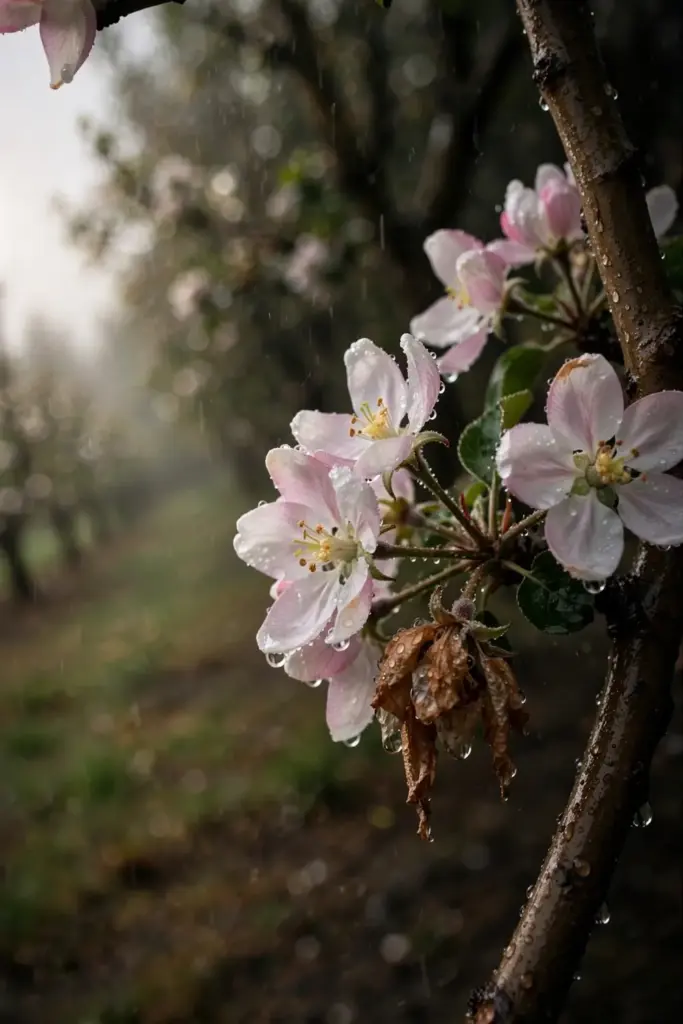
Warmth above 65 degrees Fahrenheit lets Erwinia amylovora multiply fast. The University of Illinois fire blight report states that the bacteria reproduce only when the temperature runs warmer than 65 degrees. Bloom in warm wet weather gives bacteria the exact window they need. Bloom in cool dry weather starves the same bacteria.
Rain splash moves bacteria from cankers to open blossoms, where bacteria multiply on flower stigmas and enter through floral nectaries. Pollinators carry ooze from canker to flower. Sucking insects wound shoot tips and open a second door. Wind whipping and hail wound tender shoots and open a third one.
Bacteria move through vascular tissue ahead of visible symptoms, so a shoot can carry bacteria well below the last blackened leaf. That hidden advance sets the pruning rule in Step 2. Cut well below visible damage, because visible damage marks only the part of the infection you can see.
Shoot susceptibility ends at terminal bud set. The Cornell fact sheet notes that bacterial invasion ends when terminal buds set, though entire shoots may blight before that point. Growth that stops early escapes late-season shoot blight. Growth pushed late by nitrogen or water stays open to infection longer. Forecast models track this window. MaryBlyt 7.1, Cougarblight 2010, and the NEWA network predict infection events from temperature and moisture during bloom, according to Cornell.
What Makes Fire Blight Worse in a Home Garden
Excess nitrogen grows the exact wood fire blight eats. Soft succulent shoot growth invites shoot blight.
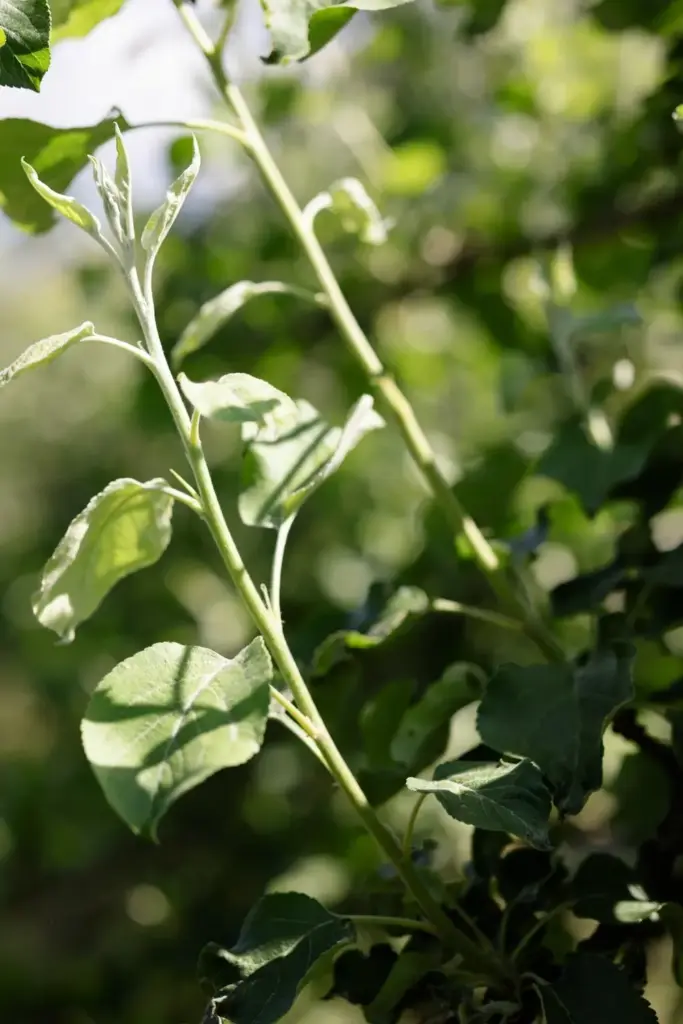
Heavy nitrogen feeding, especially in summer, pushes long soft shoots that stay susceptible late into the season. The University of Georgia fire blight guide warns against heavy nitrogen fertilization, especially in summer, when succulent growth is most susceptible to infection. Aggressive winter pruning forces the same soft regrowth. A tree pruned hard in winter answers with a flush of tender shoots in spring, and those shoots catch fire blight first.
Overhead watering and splash spread bacteria from cankers to blossoms. Water that hits the canopy moves ooze the same way rain does. A sprinkler that wets the canopy every evening keeps blossoms and shoot tips wet through the infection window. Drip or soaker watering keeps the canopy dry and starves the splash route.
Nearby hosts feed the cycle. Pyracantha, hawthorn, cotoneaster, and wild crabapple near the orchard carry Erwinia amylovora through winter. An ornamental hawthorn hedge beside a pear tree is an inoculum source, not a backdrop. Remove infected ornamental hosts or treat them with the same prune and disinfect routine you give the fruit trees.
Sucking insects wound shoot tips. Aphids, leafhoppers, tarnished plant bugs, and pear psylla pierce tender growth and open entry wounds. Root suckers and water sprouts give bacteria a direct path to the trunk. A water sprout that blights can carry bacteria straight into the main stem. Remove root suckers and water sprouts during dormant pruning.
Wet-weather pruning spreads bacteria on the blade. Prunings left in the orchard keep bacteria alive beside healthy trees. A dirty blade moves bacteria from a strike to the next cut. Each of these habits turns a small outbreak into a tree-killing one.
Step 1: Decide Whether Treatment Is Worth It
Count the strikes before you reach for a spray. A tree with a few strikes earns pruning, and a tree with trunk cankers earns removal.
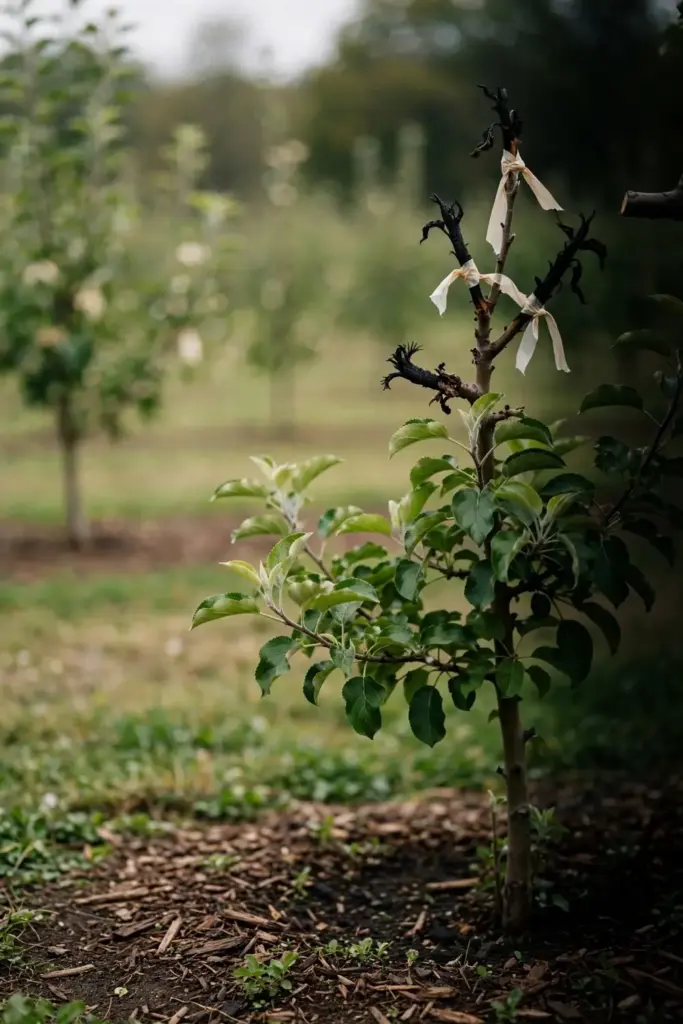
Preventive spraying is not a reasonable default for most homeowners. The North Carolina State University Onslow County center states the split outright. A preventive spray program runs every 3 to 4 days during bloom and must cover the entire canopy. That schedule costs money and time through the whole bloom period, and it still fails if cankers stay on the tree.
Use a simple triage rule. A mature tree with a few branch strikes is worth the work. Prune the strikes, disinfect the tools, and destroy the wood. Skip a young tree with strikes reaching the trunk. Skip a dwarf tree with a blighted central leader. University of Wisconsin guidance notes that a central leader infection on a high-density tree calls for removal of the tree.
Spraying after symptoms appear wastes money. Streptomycin protects blossoms before infection. Streptomycin does not cure wood that already shows strikes. The honest order is prune first, sanitize second, and spray only as a bloom preventive in a year when warm wet weather meets bloom. A tree that returns strikes every season despite pruning tells you the answer. Remove it and replant resistant.
Step 2: Prune Out Infected Wood in Dry Weather
Cut 8 to 12 inches below visible damage, in dry weather. That clearance is the consensus across Extension guidance.
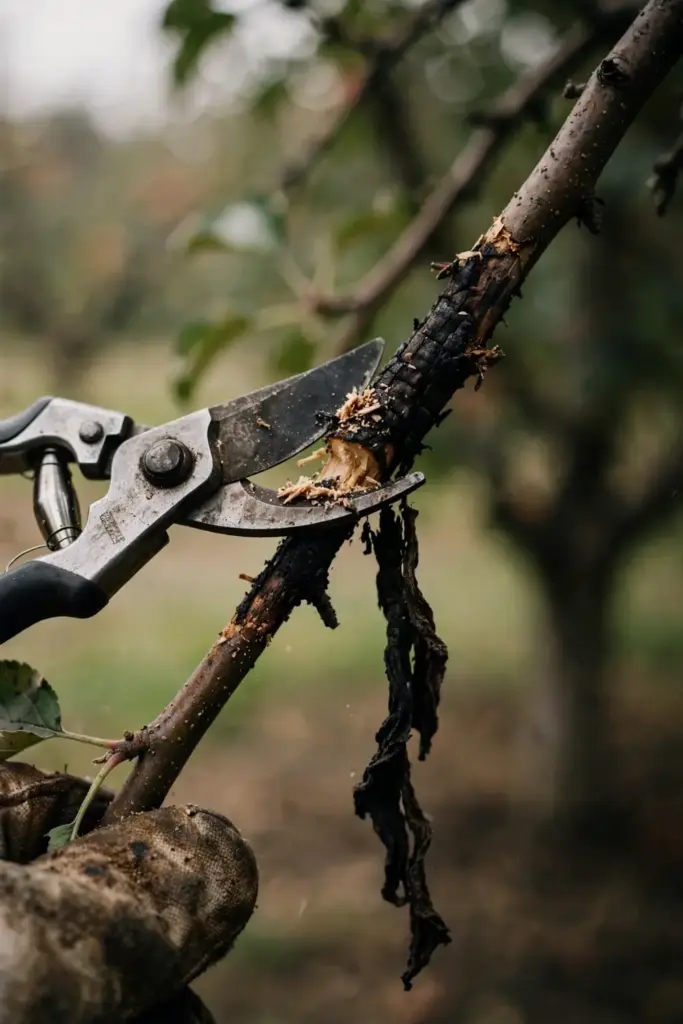
The University of Georgia fire blight guide sets the working rule: prune out infected branches 8 inches below the damage during spring and summer, and avoid pruning when the plants are wet. Cornell guidance extends the clearance to 8 to 12 inches. A Cornell presentation on fire blight pruning raises the clearance to 18 to 24 inches for low strike counts, where bacteria have run furthest ahead of visible damage.
Cut into 2-year-old wood where you can. Bacteria multiply less readily in older wood. Cut back to a healthy branch junction without harming the branch collar. The collar is the swollen ring where the branch meets its parent limb. A clean cut at the collar closes fastest.
Prune on a cool dry day, since dry weather limits bacterial spread from the cut. Walk the tree first and flag every strike with tape. Cut the worst strikes first, then work outward to the lightest ones. Do not drag prunings through the orchard. Carry a bag or a tarp to the tree and drop every cutting straight into it. The spring pruning techniques guide covers clean cut placement for fruit trees in full.
Step 3: Disinfect Tools Between Every Cut
Disinfect between every cut. A dirty blade carries bacteria from a strike to healthy wood.
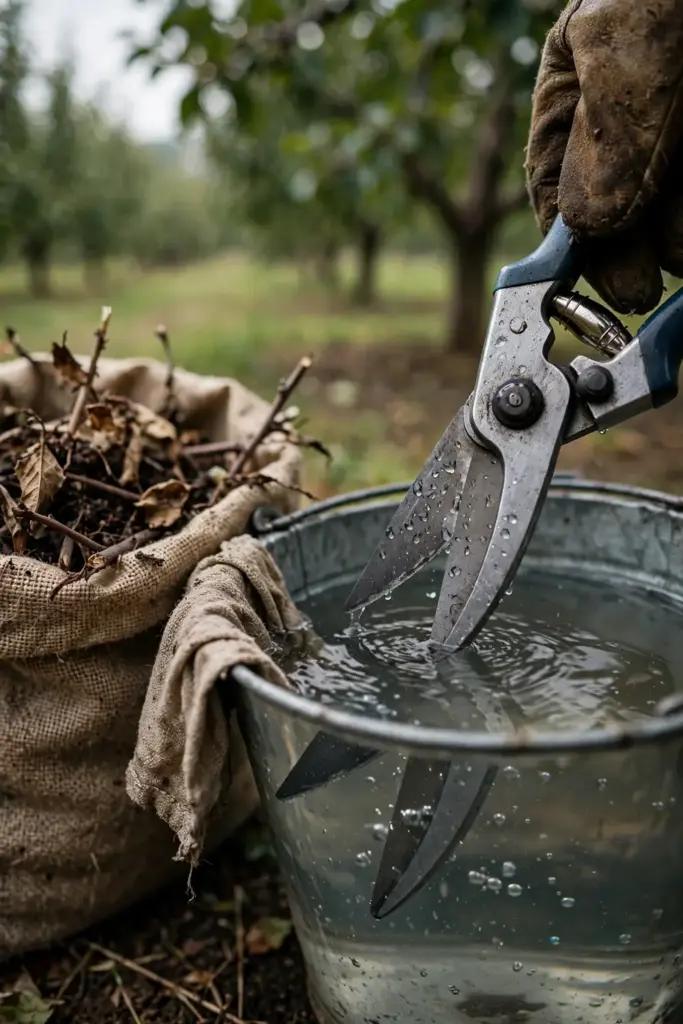
Dip pruning tools in 70 percent isopropyl alcohol or a 10 percent bleach solution, mixed at 1 part bleach to 9 parts water, between each cut, as the University of Georgia guide directs. A household disinfectant spray works as a third option, according to Montana State University Extension guidance. Pick one and keep it at the tree.
Wash and oil shears when you finish. The Georgia guide gives that order: wash and oil the shears after the last cut. Bleach corrodes steel fast. Oil after bleach stops the corrosion. Rinse the bucket and the rag after the last cut, and let the tools dry before storage.
Do not prune through ooze and keep cutting. Ooze loads the blade with bacteria. A blade that passes through ooze needs disinfecting before the next cut, without exception. Keep the disinfectant bucket within arm’s reach of the tree. A bucket left at the shed does not get used.
Step 4: Destroy Every Cutting and Fallen Branch
Burn prunings or bag them for trash. Never compost blighted wood.
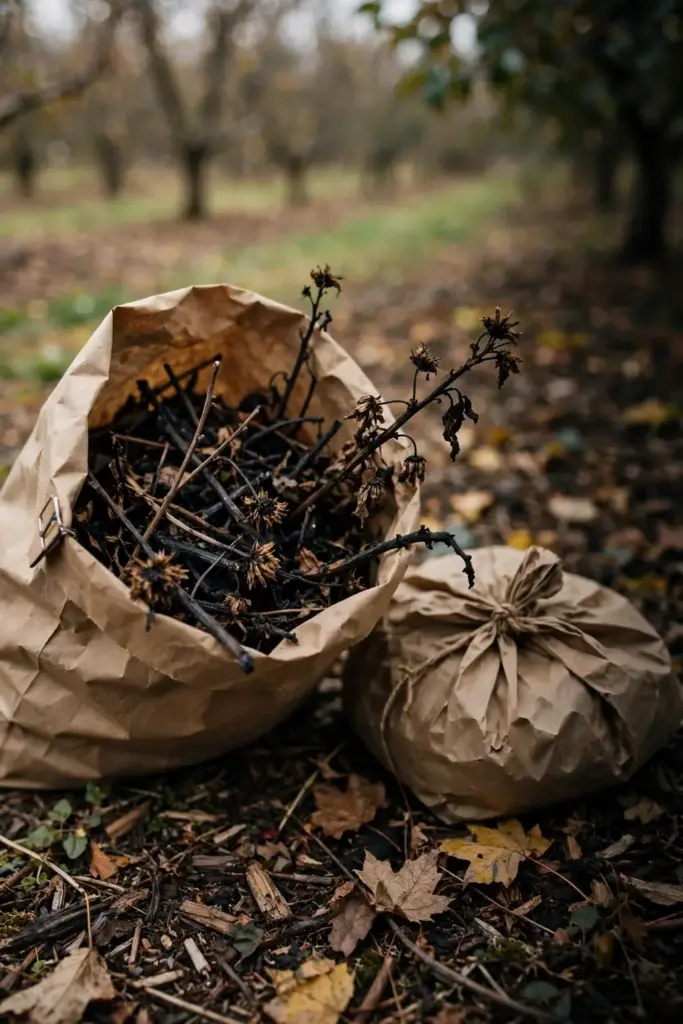
Cornell guidance gives two options for prunings: burn them, or let them dry and then flail them. Either option removes live bacteria from the orchard. Composting does not. A compost pile runs too cool to kill Erwinia amylovora in thick wood, and the pile then feeds bacteria back into the garden. Bagging for trash works when burning is not allowed.
Clean the ground under the tree. Fallen blighted shoots and fruit carry bacteria. Pick up every cutting that missed the bag. Rake the ground under a heavily struck tree and remove the debris. Do not drag prunings through the orchard on the way out. Dragging smears ooze and bacteria across healthy bark.
Work from the sickest tree to the healthiest tree, and prune the worst tree last if you can. That order keeps the blade and the bag away from healthy trees until the end of the job. Wash hands and tools after the job, and change gloves before touching a healthy tree.
Step 5: Cut Cankers Out in Dormant Season
Dormant season is canker season. Bacteria rest in cankers, and dry winter air limits spread.
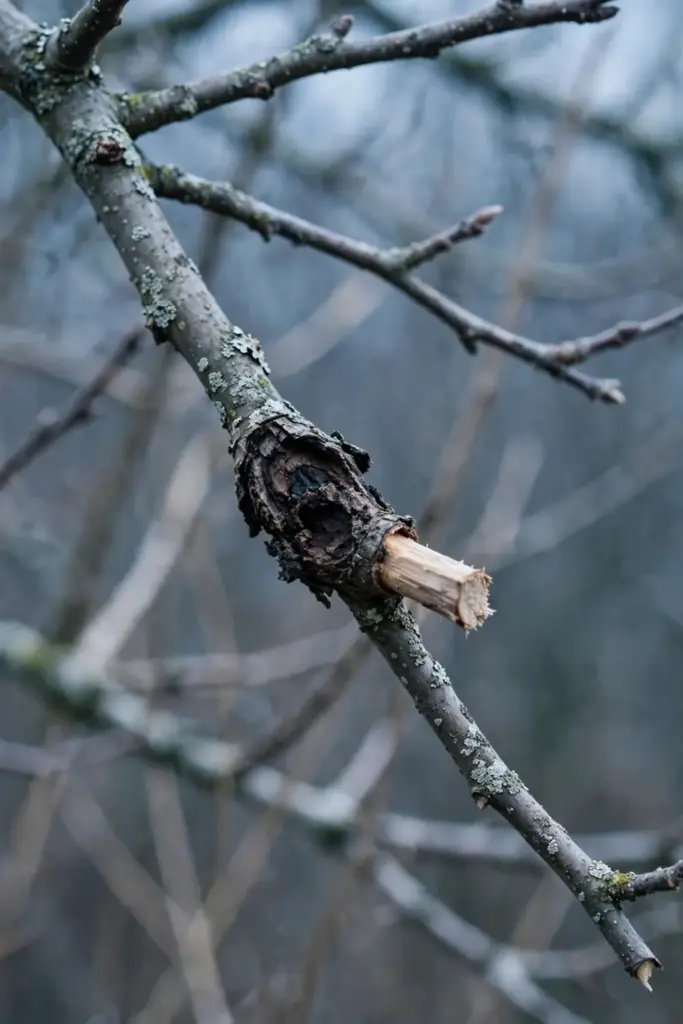
Remove overwintering cankers during dry winter weather. Cornell guidance lists dormant canker removal as a core part of any fire blight program. A canker left through winter oozes in spring and seeds the next bloom. A canker cut out in winter never gets the chance.
Cut 8 to 12 inches below any sign of dead bark, into healthy wood past the canker margin. The ugly-stub technique leaves a short stub on structural wood and removes it the next winter. New Brunswick agriculture guidance describes the method: leave a 5-inch stub, then remove the stub the following winter. The stub keeps bacteria away from the main limb while the cut heals.
Do not apply wound dressing. Dressings trap moisture against the cut and slow healing. A clean cut at the collar heals on its own. A trunk canker that girdles the trunk ends the job. Remove the whole tree. A tree with a girdled trunk cannot move water and nutrients past the canker, and no pruning cut fixes that.
Step 6: Hold Back Nitrogen and Vigorous Growth
Feed for steady growth, not soft growth. Heavy nitrogen grows succulent shoots that fire blight colonizes fast.
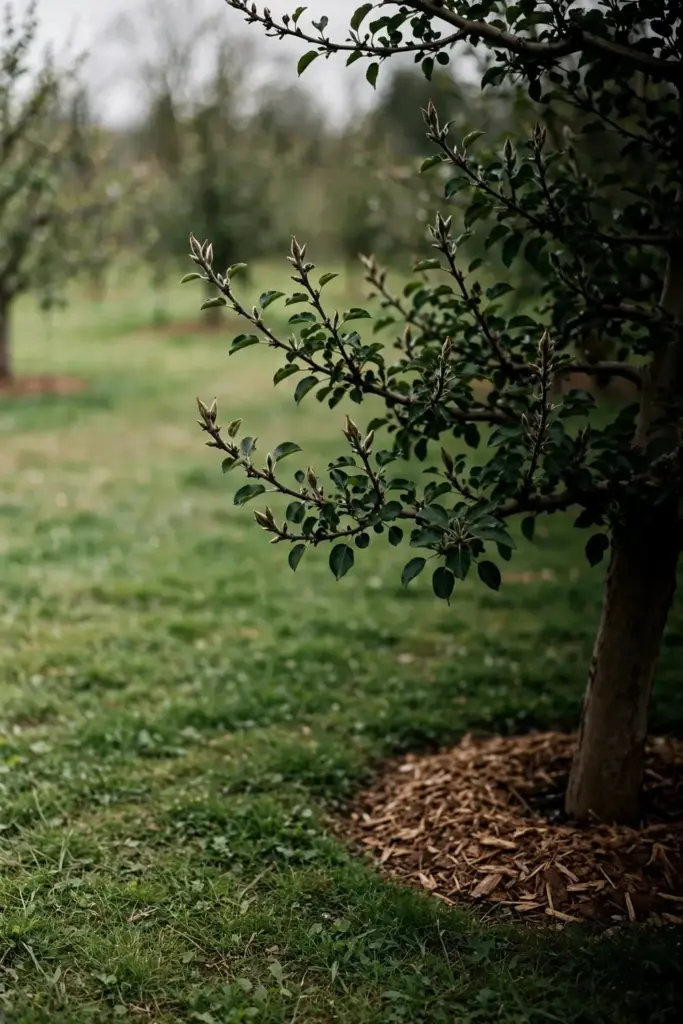
Base nitrogen fertilization on soil and tissue tests. West Virginia University Extension guidance gives that order: test foliage nitrogen levels, then fertilize to the test result. A test stops the guesswork that leads to overfeeding. A tree fed to its test result grows steady wood with short internodes and early terminal bud set.
Avoid heavy nitrogen, especially in summer. The Georgia guide warns against heavy nitrogen fertilization in summer, when succulent growth is most susceptible to infection. Late fertilizer pushes a second flush of tender growth in late summer. That flush stays open to shoot blight long after spring shoots have set terminal buds.
Avoid aggressive winter pruning. The Cornell fact sheet warns that excessive winter pruning forces vigorous regrowth. A tree cut hard in winter answers with long soft shoots in spring. Light annual pruning keeps shoot growth moderate and shortens the infection window. Do not fertilize a blighted tree into recovery. Let the tree set terminal buds and harden off.
Step 7: Use Copper Only at Dormant and Green Tip
Copper protects bark before bloom. Copper cures nothing after infection.
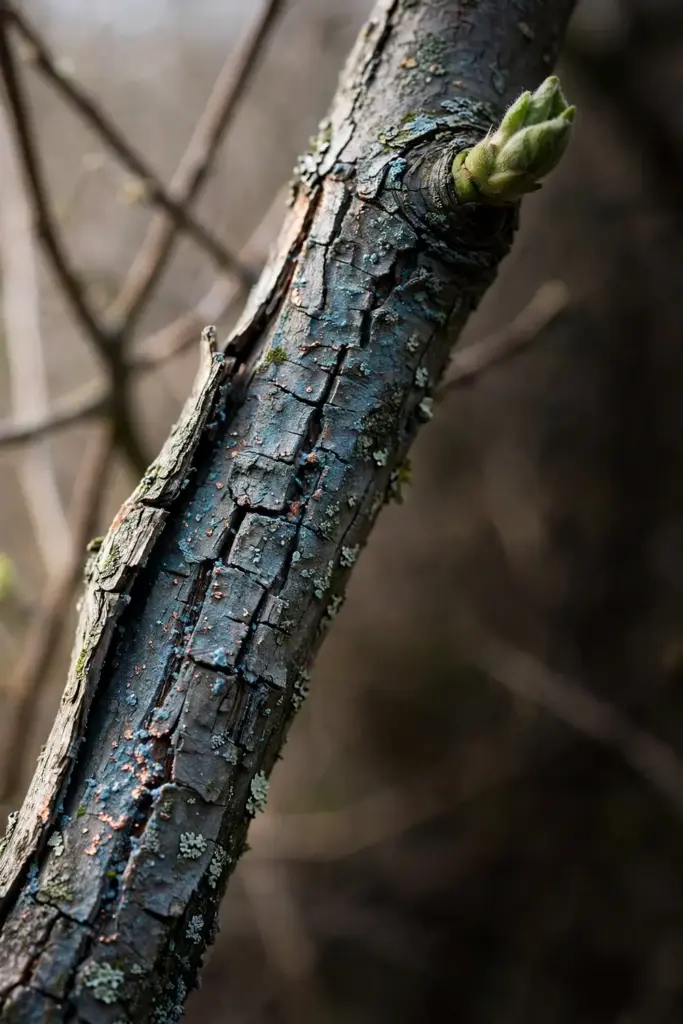
Apply copper at late dormant, green tip, or silver tip stage. Intermountain Fruit guidance and Cornell guidance both place copper at those early stages. West Virginia University Extension guidance adds the reason: copper applied at or shortly after green tip lowers the number of new fire blight bacteria produced from overwintering cankers. Copper reduces surface bacteria before bloom. Copper does not reach bacteria already inside wood.
Do not use copper every year. Montana State University Extension guidance warns against yearly copper use, citing harm to soil organisms and groundwater. Copper accumulates in soil. A tree with no fire blight history does not need copper every dormant season. Reserve copper for years after an outbreak, or for trees with a canker history.
Do not apply copper to Anjou pears. Intermountain Fruit guidance gives that warning: copper russets Anjou pear fruit. Copper applied in summer can cause fruit russeting on other cultivars too, according to New Brunswick agriculture guidance. Keep copper in the dormant and green-tip window. Keep copper off open blossoms and off fruit.
Follow the product label for rate and timing. Fixed copper and Bordeaux mixture both appear in Extension guidance. The label sets the legal rate for your state and crop, and a label rate on a dormant tree is a different job from a label rate on a blooming tree. Do not carry a dormant rate into bloom.
Step 8: Treat Bloom Sprays as a Last Resort, Not a Default
Bloom sprays prevent blossom blight. Bloom sprays do not cure strikes.
Ohio State University Extension guidance takes a firm line for backyard growers. Streptomycin is available to backyard gardeners, but Ohio State does not recommend it as a default, because resistance risk runs high. Serenade Garden Defense, built on Bacillus subtilis, is the backyard alternative Ohio State names. Prohexadione-calcium, sold as Apogee, is a commercial-only tool. Ohio State states that Apogee is not for backyard use.
Resistance honesty sets the limits. Erwinia amylovora can share antibiotic-resistance genes on plasmids, according to the Cornell fact sheet. Resistance spreads through bacterial populations when antibiotics get overused. The University of Illinois fire blight report caps streptomycin at no more than 4 applications per season. Streptomycin must never go on after symptoms appear. Streptomycin protects blossoms before infection and does nothing for wood that already shows strikes.
The Georgia guide gives the bloom spray schedule for growers who do spray. Agrimycin applications begin at the start of blooming and continue every 3 to 4 days during the bloom period. Kocide applications begin at bloom and continue every 7 days during bloom. Reapplication after rain may be needed. Kasugamycin covers orchards where streptomycin resistance is reported, according to Intermountain Fruit guidance.
The homeowner default stays prune, sanitize, and plant resistant. Copper at green tip plus Serenade at bloom covers most home orchards without antibiotics. A homeowner who sprays streptomycin every bloom, every year, on a tree full of cankers buys resistance and keeps the cankers. Cut the cankers first. Spray only in a year when warm wet weather meets bloom and the forecast models flag an infection event.
Step 9: Scout on a Forecast Schedule After Bloom
Scout three times a week after a predicted infection. Symptoms show 90 to 100 degree-days above a 55 degree Fahrenheit base after an infection event, according to a Cornell fire blight presentation.
Forecast models turn weather into a decision. MaryBlyt 7.1, Cougarblight 2010, and the NEWA network predict infection events from temperature and moisture during bloom, according to Cornell. A model that flags an infection event starts the clock. A model that flags no event saves a spray.
Walk every branch after a flagged event and look for wilted blackened shoots, ooze, and cankers. Flag each strike with tape. Prune on the next dry day. A strike pruned in the first weeks after bloom removes bacteria before they reach the trunk. A strike left through summer reaches the trunk.
Keep a short log. Write the date, the weather, and the strike count for each tree. A log shows which tree catches fire blight every year and which tree stays clean. The log decides the Step 1 triage call next season. A tree with rising strike counts across two seasons earns removal, even when the canopy still looks full.
Step 10: Plant Resistant Varieties and Rootstocks Next Time
The cheapest fire blight control is the tree you plant. Resistant varieties stop most infections before they start.
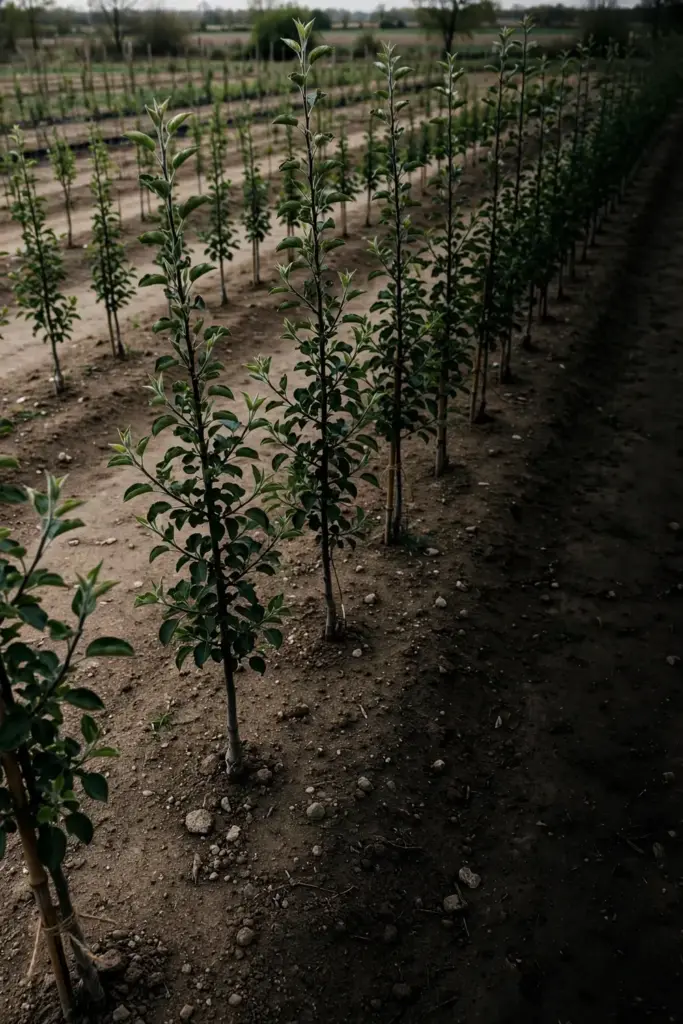
The Georgia guide lists resistant apple varieties as Enterprise, Freedom, Liberty, Prima, and Priscilla. The same guide lists resistant pear varieties as Kieffer, Moonglow, Orient, and Seckel. Resistant crabapple varieties include Adams, Dolgo, Jewelberry, and Liset. Resistant ornamental choices include Laland’s firethorn for pyracantha and Washington hawthorn for hawthorn.
The Cornell fact sheet adds a second resistant list. Jonafree, Prima, Priscilla, RedFree, Empire, Delicious, Honeycrisp, Jonagold, Liberty, McIntosh, and Northern Spy rank as resistant apple cultivars. The same list names Fuji, Gala, Gingergold, Idared, Jonathan, Lady Apple, Paulared, Rome, and SweeTango as highly susceptible. A susceptible cultivar on a susceptible rootstock is the combination to avoid.
Rootstocks decide the worst case. Geneva series rootstocks carry an acceptable level of resistance, according to Cornell. M.9 and M.26 rootstocks rank as susceptible. A resistant scion on a susceptible rootstock still dies when rootstock blight girdles the base. Buy the resistant combination: resistant scion on a Geneva rootstock.
Resistance is not immunity. Resistant trees still need pruning, sanitation, and dormant canker removal. Resistance lowers the odds and slows the spread. Resistance does not remove the need for the other nine steps. Buy clean stock from nurseries away from known infested sites, according to the University of Arizona fire blight bulletin. Site new trees with sun and air flow. Remove wild crabapple and infected ornamental hosts near the planting.
Living With Fire Blight Damage You Cannot Prune Out
Some damage stays. A tree with a few dead spurs still crops. A tree with a girdled trunk does not.
Fruit without symptoms is fine to eat, since fire blight does not make sound fruit unsafe. Discard fruit that shrivels, darkens, or oozes. Wash sound fruit before eating, as with any orchard fruit. A light strike year costs a few spurs and a few fruit. A heavy strike year costs branches.
Keep a tree with light canopy loss. Prune dead wood in the dormant season, feed steady, and hold nitrogen to the soil test. Scout three times a week after the next warm wet bloom. A tree that loses a few branches a year and holds a full crop earns its place.
Remove a tree with a girdled trunk or rootstock. Remove a tree that returns strikes every year despite pruning and sanitation. Remove a young susceptible tree on M.9 or M.26 with trunk cankers. Replant with a resistant variety on a Geneva rootstock. General bacterial blight care follows the same order: cut, disinfect, destroy, then replant resistant. The guide to bacterial blight simple solutions covers that order for bacterial blight problems across the garden.
Do not plant a susceptible variety in the same spot and expect a different result. The cankers are gone. The weather and the rootstock risk stay. A resistant tree in the same spot faces the same spring with better armor, and that swap is the whole point of Step 10.
Frequently Asked Questions
Yes. Bacteria move from blossoms into shoots, then into branches, trunk, and rootstock. A trunk or rootstock canker girdles the tree and kills it in one season. Young and dwarf trees die fastest, since infection reaches the trunk sooner. A few branch strikes rarely kill a mature tree, so prune strikes fast and remove any tree with trunk cankers.
Branch strikes respond to pruning. Cut 8 to 12 inches below visible damage in dry weather, disinfect tools between cuts, and destroy the prunings. Trunk or rootstock cankers do not respond to pruning. Remove a tree with trunk cankers. No spray cures infected wood. Resistant varieties and dormant canker removal keep the next season lighter.
Ohio State University Extension guidance does not recommend streptomycin as a homeowner default, because resistance risk runs high. Serenade Garden Defense, built on Bacillus subtilis, is the backyard alternative Ohio State names. Streptomycin caps at 4 applications per season and must never go on after symptoms appear. Most homeowners do better with pruning, sanitation, copper, and resistant varieties.
Cut 8 to 12 inches below visible damage during the active season. Severe cases with low strike counts call for 18 to 24 inches of clearance. Dormant canker cuts go 8 to 12 inches below dead bark. Cut into 2-year-old wood where you can. The ugly-stub technique leaves a 5-inch stub on structural wood and removes it the next winter.
Fire blight stays on pome fruits: apple, pear, quince, crabapple, hawthorn, and pyracantha. Stone-fruit dieback points at bacterial canker or blossom blight instead. Fire blight is occasionally recorded on Prunus species, but cherry and plum dieback is far more likely bacterial canker. Check the host first, then match the treatment to the disease.
Scout after warm wet bloom weather. MaryBlyt and Cougarblight flag infection events from temperature and moisture data. Walk every branch three times a week after a flagged event. Symptoms show 90 to 100 degree-days above a 55 degree Fahrenheit base after infection. Flag each strike with tape, then prune on the next dry day.
Where to Go From Here
Start with the walk. Check every apple and pear tree for crooked black shoots, ooze, and sunken cankers.
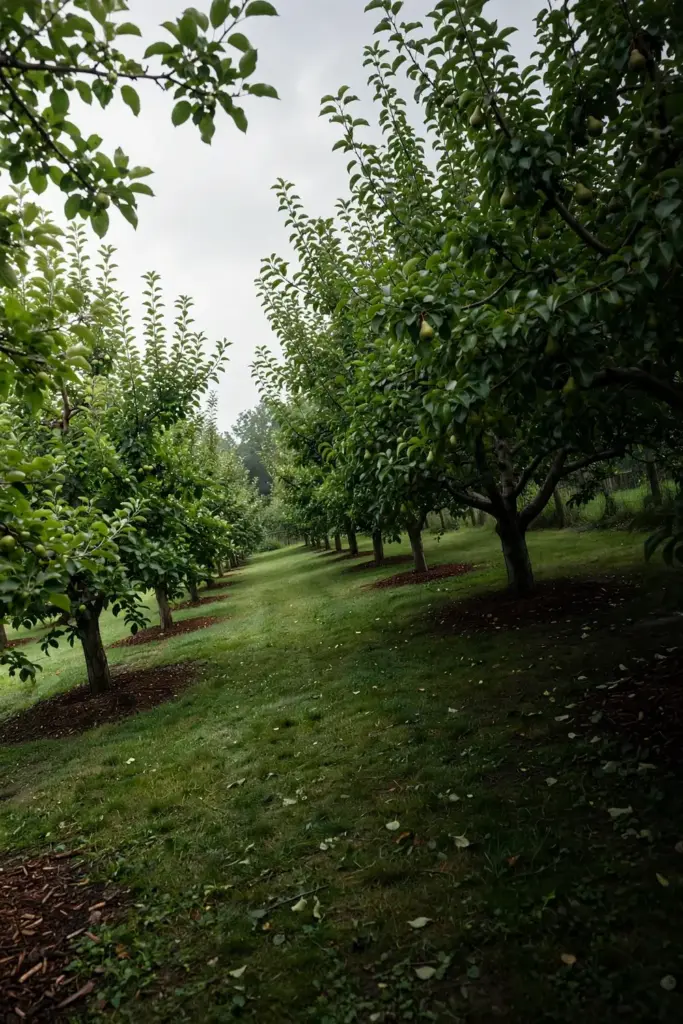
The order is identify, decide, prune, disinfect, destroy, feed steady, copper at green tip, spray only as a last resort, scout on forecast, and plant resistant. One next action beats ten good intentions. Walk the trees today. Flag every strike with tape. Prune on the next dry day.