
Sphaeropsis dieback is Diplodia tip blight. The two names describe one disease, one fungus, and one set of symptoms on pines with 2 and 3 needles per bundle. The fungus now carries the name Diplodia pinea. Older books and labels call it Sphaeropsis sapinea. The disease kills the current year’s shoots, and a pine can lose most of a spring’s new growth in one wet season.
Gardeners who know the disease as Diplodia tip blight are looking at the same fungus. The Diplodia tip blight name is the current label for this exact disease. There is no separate Sphaeropsis disease to tell apart from Diplodia. The names changed. The fungus did not.
This article covers the pine disease only. It walks through identification on shoots, cones, and branches, the pines that suffer most, the lookalikes that cause false alarms, and the three moves that carry real weight: pruning in dry weather, one protective spray window in spring, and steady tree vigor. I have learned that a pine that stays watered through a dry summer shows fewer dead candles the next spring than a pine that went thirsty.
1. What Sphaeropsis Dieback Actually Is
Sphaeropsis dieback is a fungal disease of pines. The fungus Diplodia pinea causes it. The same fungus also appears in references as Sphaeropsis sapinea and Diplodia sapinea. All three names point at one organism.
The word dieback describes what the reader sees. Shoot tips die. Branches die back from the tips. Cankers girdle older wood. The damage starts at the growing points and works inward. A tree that suffers repeated attacks loses vigor year by year, and a heavily attacked tree can die.
The fungus lives through winter on the tree. It waits in small black fruiting bodies called pycnidia. Pycnidia sit in dead shoot tips, in bark, and on cone scales. Wet spring weather wakes them. Spores ooze out of the pycnidia during rain and splash onto the new growth. The new shoots are the target. The fungus enters young buds and young needles, then grows fast through the soft tissue.
One naming trap deserves a plain line. A different fungus, Sphaeropsis pyriputrescens, causes Sphaeropsis rot of stored apples and twig canker on apple and crabapple trees. That apple fungus is a separate species. It does not infect pines. It does not answer pine questions. Do not carry apple Sphaeropsis advice into a pine problem, and do not carry pine advice into an orchard.
2. How to Identify Sphaeropsis Dieback on New Shoots
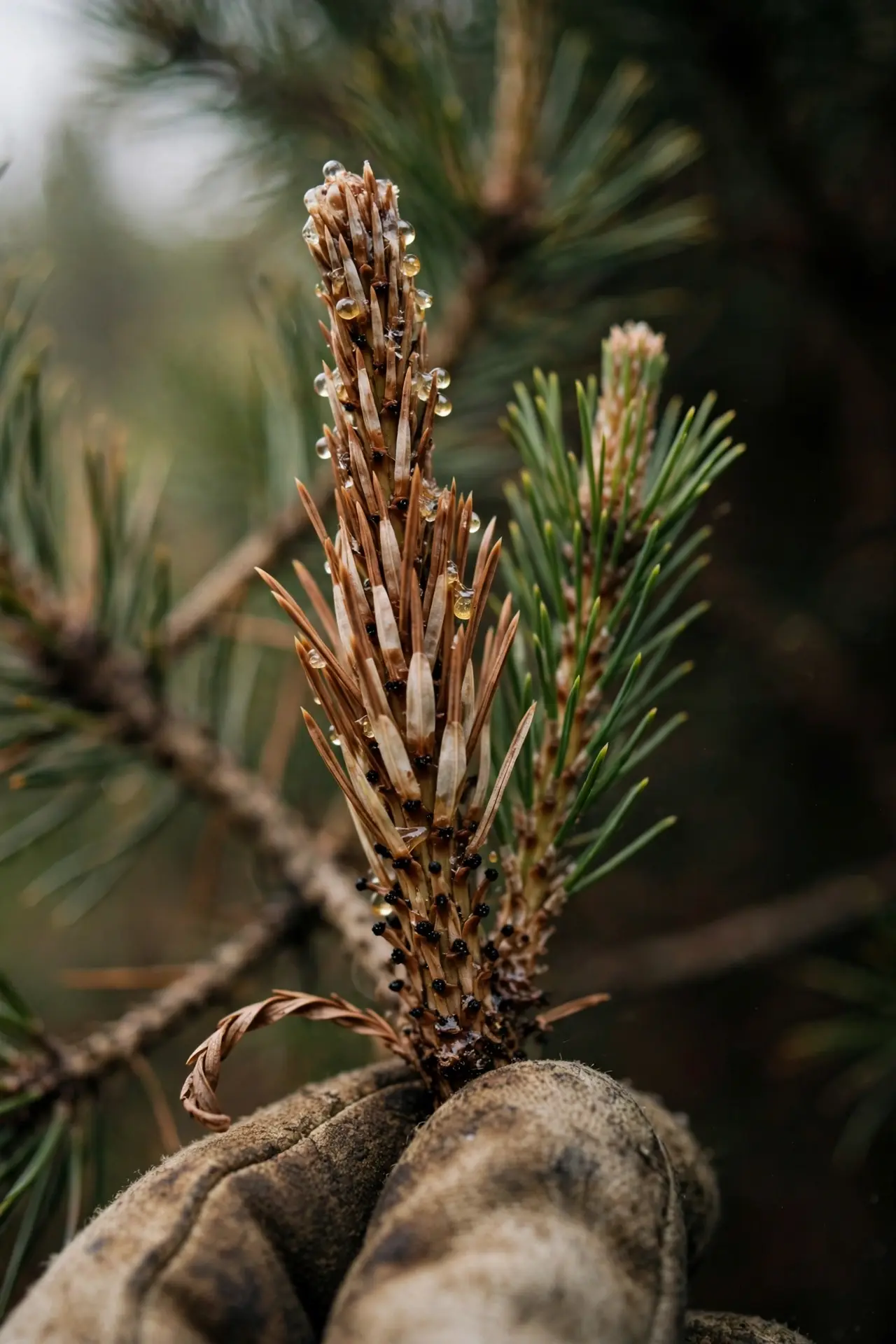
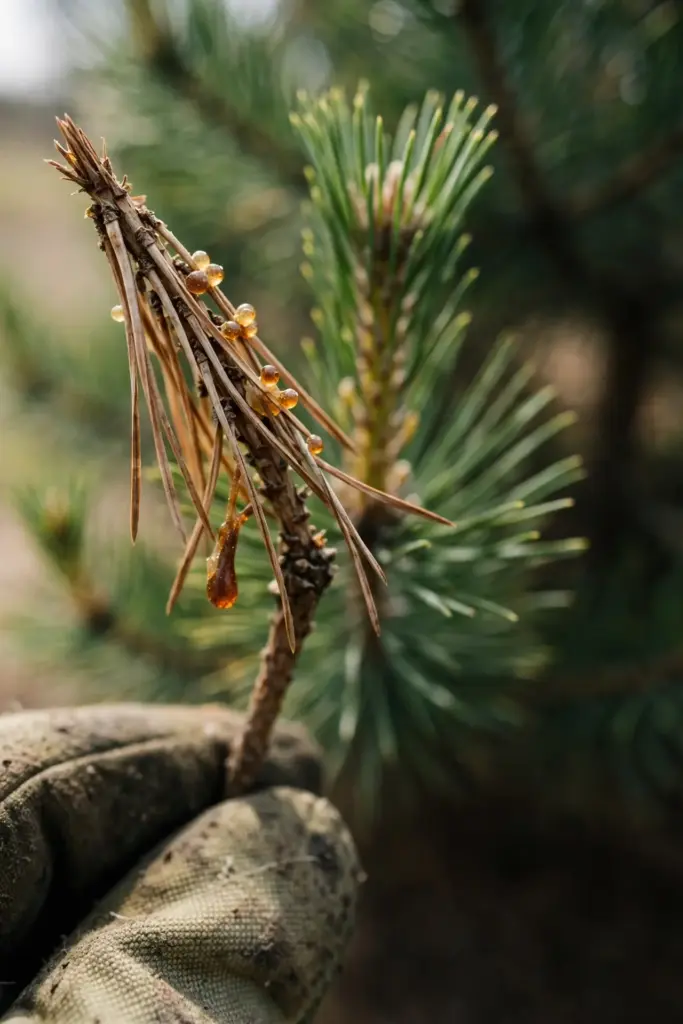
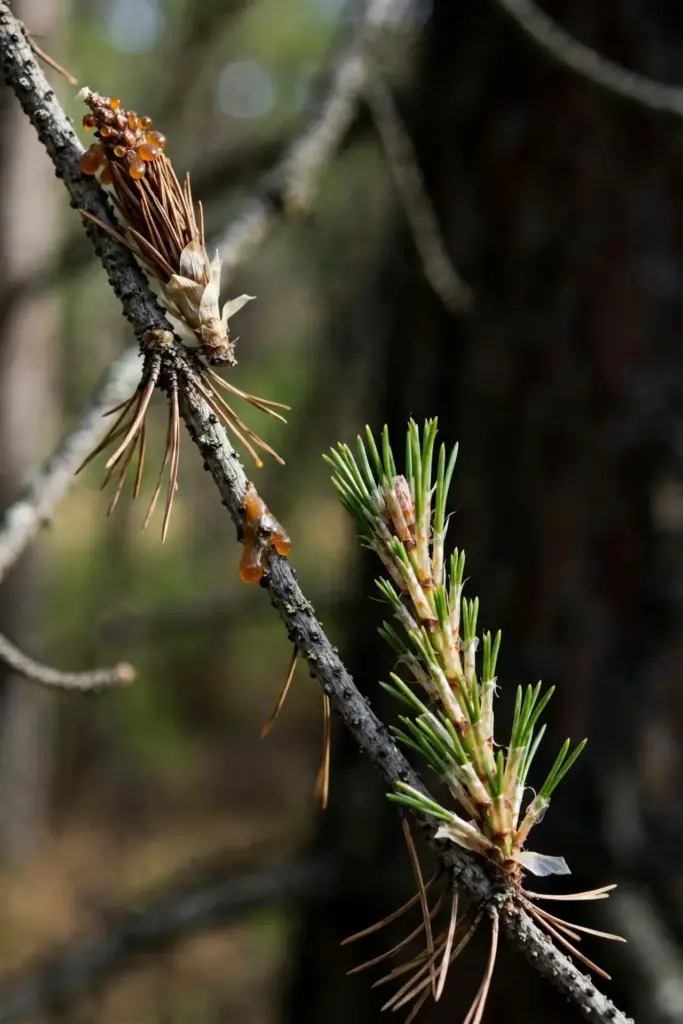
Look for new shoots that stop growing, turn brown, and stay short. The first sign is often a bead of resin on a shoot bud as growth starts in spring. The shoot then stalls. The needles on that shoot turn brown while they are still short and still tucked in their fascicle sheaths.
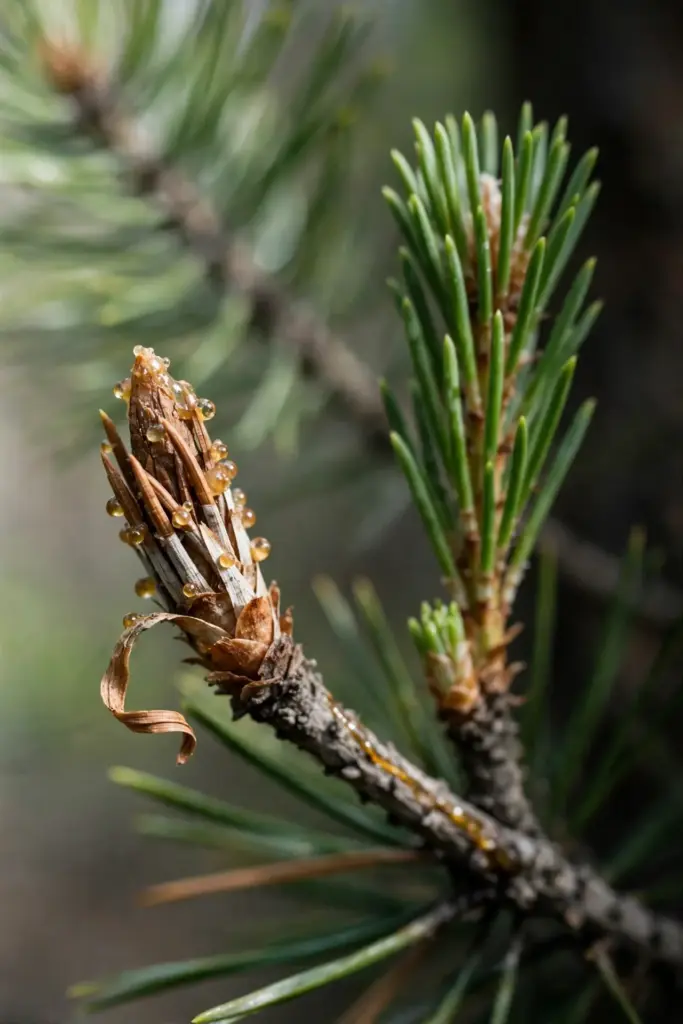
The pattern is the tell. Penn State Extension describes shoots that die as the needles grow from the fascicle sheath, with resin oozing from the shoot buds as growth begins in early spring. A healthy candle stretches and opens. An infected candle stops, browns, and stays short. New buds may push out to replace the dead bud, and those buds can catch the infection in turn.
Dead needles stay attached. That detail separates this disease from needle casts that drop needles. The dead shoot keeps its brown needles through the season, and the needles fade to gray over time. The shoot may curl or twist as it dies. The lower crown usually shows damage first, and the damage climbs the tree over successive seasons.
Check the timing. Symptoms show up as the candles elongate in spring. A shoot that looked fine at bud break and then browned during a wet spell fits the pattern. A shoot that died before the new needles emerged points somewhere else, and the comparison section below covers that case.
3. How to Identify Sphaeropsis Dieback on Cones, Branches, and Stems
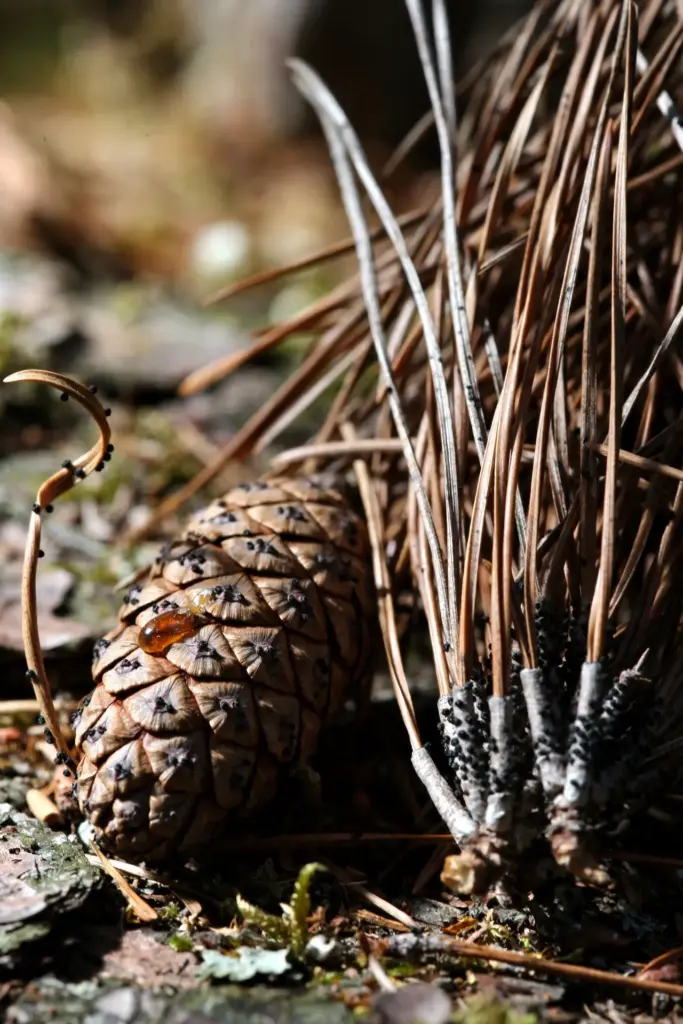
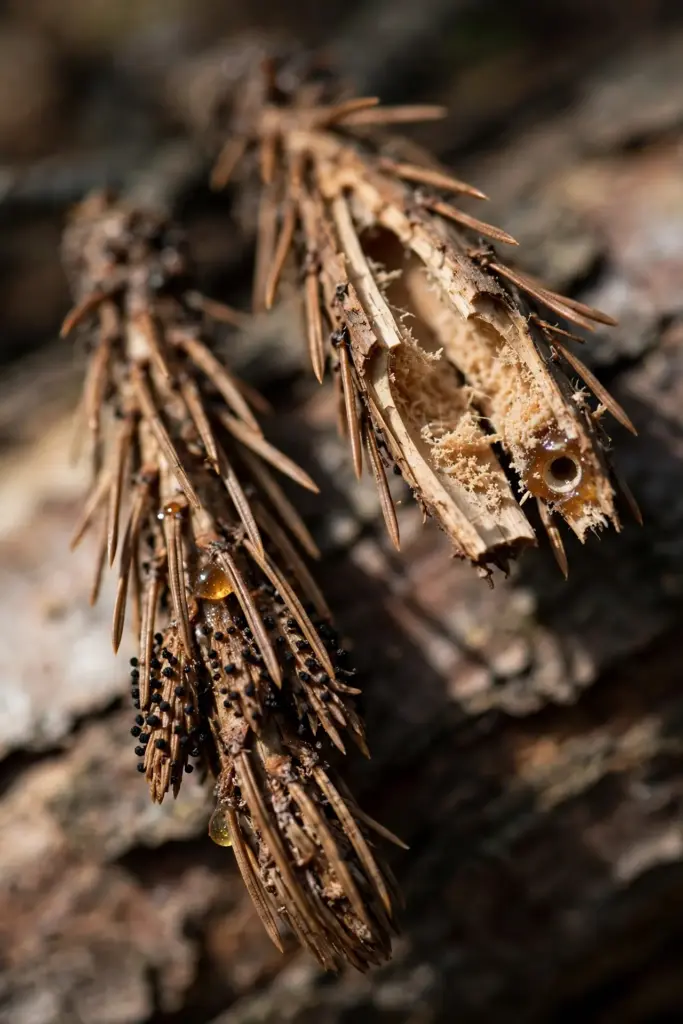
Sphaeropsis dieback is more than a shoot disease. The same fungus attacks cones, branches, and stems. The sign to hunt for is the fruiting body. Small black pycnidia erupt through the surface of infected needles, especially below the sheath at the base of the needles. Similar black structures develop on the scales of second-year cones.
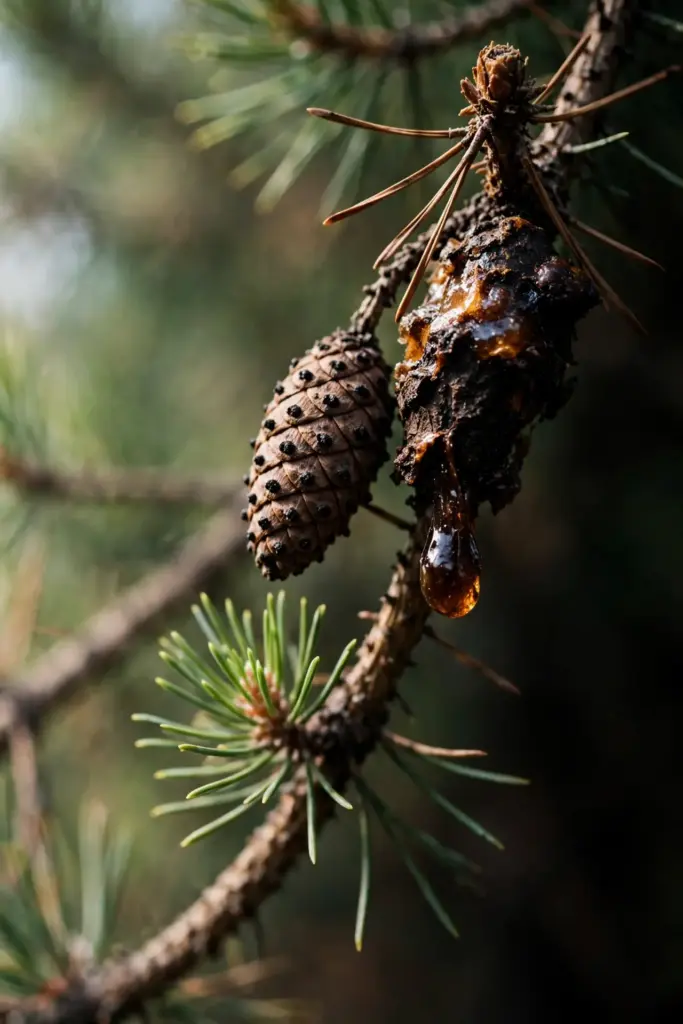
Cones tell the story early. Infected cones die. Their scales carry the black fruiting bodies, and the cones stay on the tree as a spore source for the next spring. Old dead cones are the main reason older trees carry more disease than young trees. A tree with years of dead cones hanging in the crown holds a standing spore bank above every new candle.
Branches die back when the fungus moves past the shoot. Illinois Extension notes that twigs of trees weakened by stress, such as drought, compacted soil, root injury, excess shade, and wounds from hail, pruning tools, or insects, are also infected. The fungus girdles a branch through a resinous canker. Resin soaks the bark and wood of the dead tissue, and the color of that tissue runs from amber to nearly black. The dead branch tip usually holds the current year’s shoot, and it may also hold part of the previous year’s growth.
Stems carry cankers too. The fungus causes resinous cankers on main stems and branches, misshapen tops, death of cones, blight of seedlings, and basal cankers. Seedlings die fast when the fungus girdles the stem at or near the soil line. A seedling that wilts and dies at the base in a bed near old infected pines fits this disease, and it needs a different response than a seedling that dried out.
4. Which Pines Get Hit Hardest
Austrian pine gets hit hardest. Scots pine, ponderosa pine, mugo pine, and red pine follow close behind. The disease favors pines with two and three needles per bundle. White pine largely escapes the tip blight phase, though a wound can open the door to the canker phase on white pine.
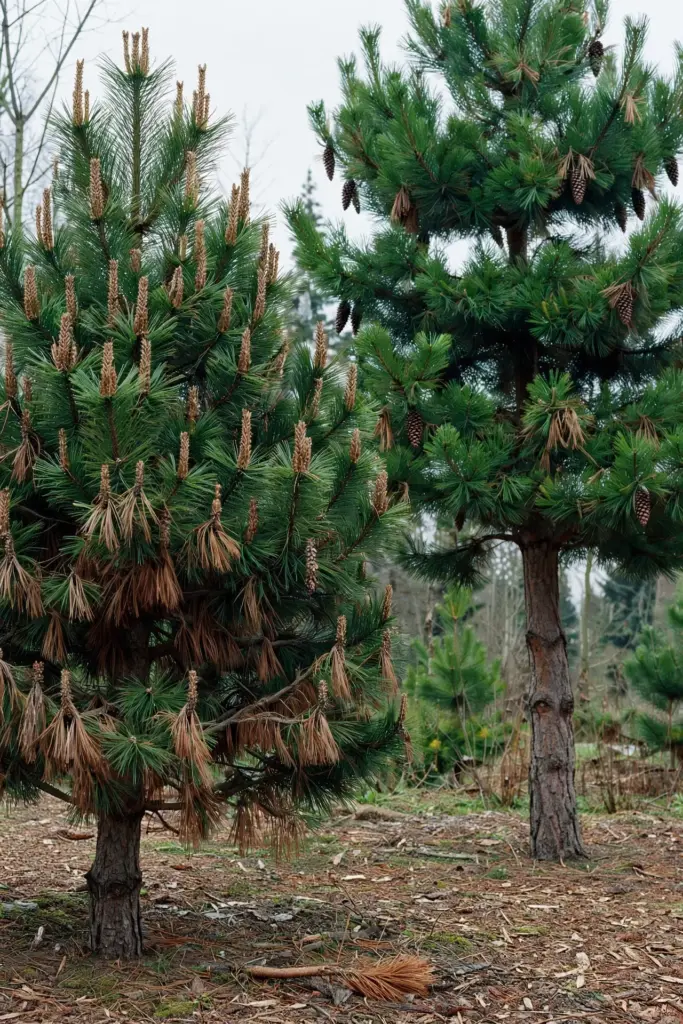
Age matters. Penn State Extension reports that trees of all ages are susceptible, and that disease severity increases as trees reach 20 to 30 years of age. Young trees carry few old cones, so they carry little inoculum. A 25 year old Austrian pine with a crown full of old cones sits in the highest risk group. Seedlings and young trees can still catch the disease if they grow near older infected trees.
Stress decides how bad an infection gets. Trees weakened by drought, insects, or mechanical injury from hail or frost are prone to attack. High nitrogen fertilization also predisposes trees to attack. A pine that is already short of water, or a pine that was pushed with heavy fertilizer, meets the spring spore shower with weak defenses.
Site matters too. Pines planted outside their natural range, pines crowded by other trees, and pines growing in reflected heat near walls and roofs suffer more. The fungus colonizes any pine growing under unfavorable conditions. A comfortable pine in open ground with steady water fights the disease better than a stressed pine in a tight, hot corner.
5. Sphaeropsis Dieback vs Pine Tip Moth vs Winter Damage
Three problems produce dead pine shoot tips. The treatment differs for each one, so the ID has to come first. The table below separates them on evidence a gardener can check in the yard.
| Clue | Sphaeropsis Dieback | Pine Tip Moth | Winter Damage |
|---|---|---|---|
| Dead shoot interior | Solid, hard, brittle, soaked with resin | Hollowed out, pith eaten away, frass inside | Solid, dry, no resin soaking |
| Fruiting bodies | Small black pycnidia on needles, cone scales, and bark | None | None |
| Larvae or tunneling | None | Larvae or a cocoon sometimes present inside the shoot, exit hole with pitch around it | None |
| Timing | Shoots brown as candles elongate in spring, during wet weather | Shoot death follows moth feeding, more common in young trees | Shoot or needle death before the new needles emerge in spring |
| Pattern on the tree | Starts in the lower crown, climbs over seasons | Scattered shoot tips, often on young trees | Sometimes limited to one side of the tree, the side facing the prevailing wind |
| What to do | Prune dead tissue in dry weather, protect new growth in spring | Remove and destroy infested tips, treat the insect, not the fungus | Wait for new growth, improve winter protection, no fungicide |
The shoot interior is the fastest check. Illinois Extension states that shoots killed by Sphaeropsis blight are solid, hard, brittle, and infiltrated with resin, while twigs hit by the pine shoot moth show frass and hollow piths eaten out by the larvae. Snap a dead tip open. A solid resinous core points at the fungus. A hollow core with frass points at the moth.
Kansas State Extension adds that tip moth damage causes a hollowed-out area in the tip and bud area, with larvae sometimes present, and that winter damage usually causes shoot or needle death before the new needles emerge in spring. Winter damage also favors one side of the tree. A pine that browned on the windward side in late winter, before growth started, is a winter case. A pine that browned shoot by shoot during spring rain is a fungus case.
One more check closes the ID. Look for the black pycnidia with a hand lens. They sit at the base of the dead needles, under the sheath, and on the cone scales. No insect and no winter event makes those dots. Pycnidia on the dead tissue settle the question.
6. Why Wet Springs and Stress Drive Sphaeropsis Dieback
Wet springs drive Sphaeropsis dieback because the fungus moves on water. Spores ooze from pycnidia during rain and splash onto the new growth. A dry spring starves the infection. A wet spring feeds it.
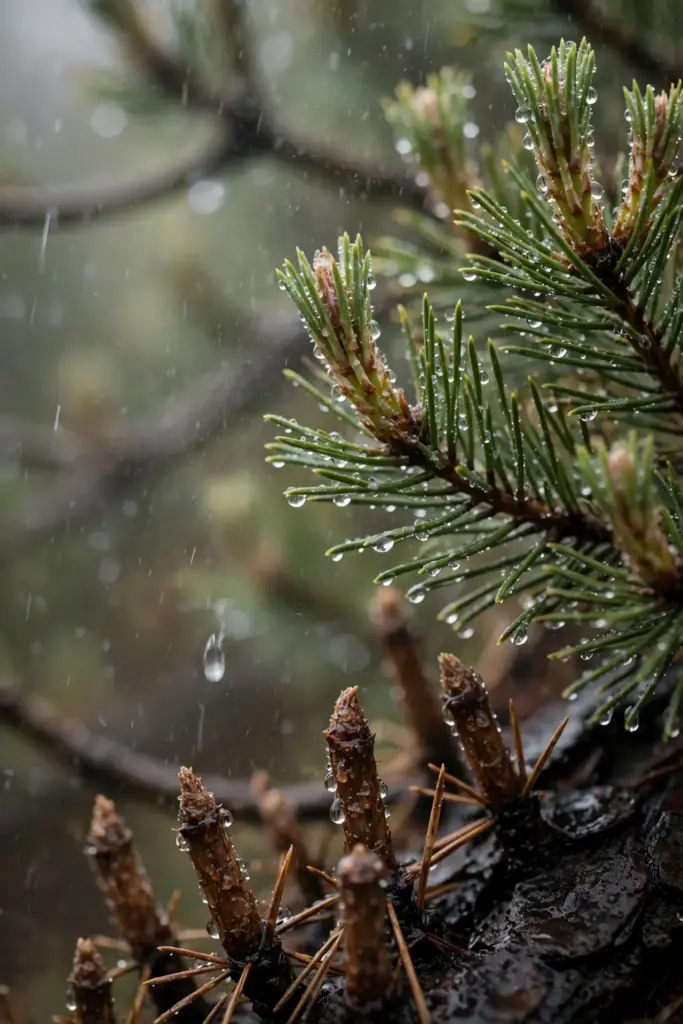
The infection window is short and specific. Illinois Extension reports that conidia germinate within a few hours at temperatures between 53 degrees F and 96 degrees F, and that a wet period of 12 hours is sufficient for spore germination and infection. In warm weather, symptoms appear 3 to 4 days after infection takes place. The fungus makes its most rapid growth at about 82 degrees F.
The susceptible period is short too. Young shoots are highly susceptible during the stretch from bud swell to the point when the needles are about half grown. Most infections occur in mid to late spring. Second-year seed cones stay susceptible longer, and their window starts later and runs later into the season. A spray or a pruning decision that misses this window misses the disease.
Stress opens the second door. The fungus infects young, healthy, unwounded needles on its own. It also enters through wounds and through tissue weakened by drought, compacted soil, root injury, excess shade, and heat reflected from nearby roofs and walls. Hail, pruning tools, and insects wound the tree and hand the fungus entry points. A stressed tree carries infections that a vigorous tree shrugs off.
The cycle then feeds itself. Dead shoots and dead cones stay on the tree and carry pycnidia into the next spring. Each wet spring adds a fresh layer of inoculum. A tree that loses a few shoots one year holds more spores the next year, and the damage climbs. Breaking that loop is the whole management job, and the steps below do it in order.
7. What Makes Sphaeropsis Dieback Worse in a Home Garden
Old cone-bearing trees make Sphaeropsis dieback worse. Young pines planted near old infected trees catch the disease early. The old tree rains spores onto the young one each spring. A new planting downhill or downwind of an infected Austrian pine inherits the problem before it grows a single cone of its own.
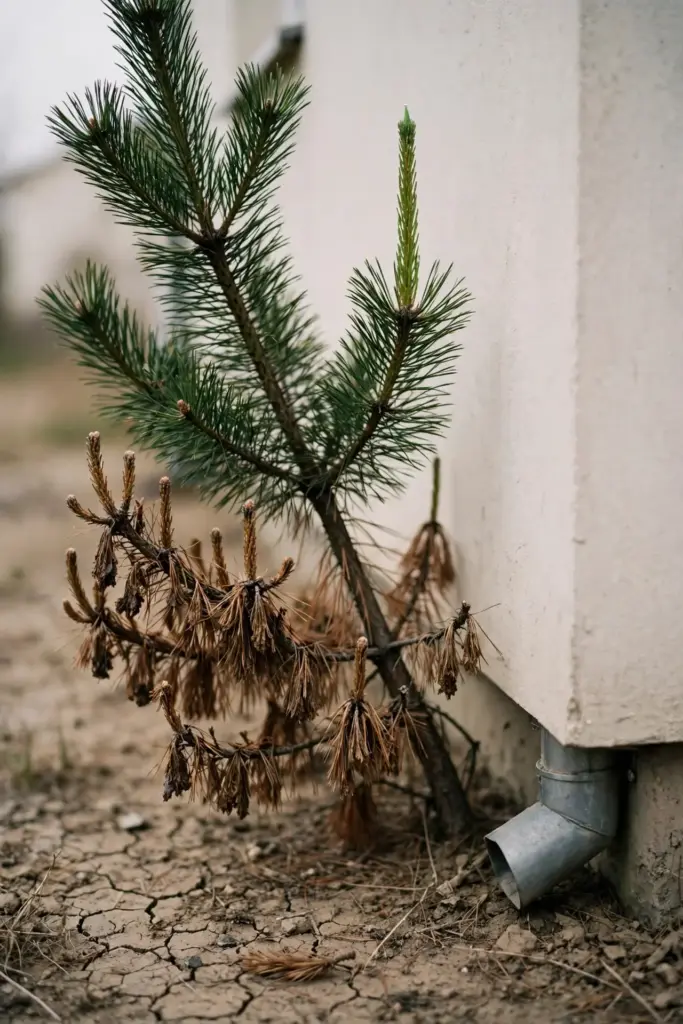
Overhead watering makes it worse. Sprinklers that wet the candles during the susceptible window do the same work as spring rain. The 12-hour wet period that the fungus needs is easy to reach under a sprinkler that runs at dusk. Water at the base. Keep the candles dry. The tree gets the water it needs without the leaf wetness the fungus needs.
Pruning and shearing in wet weather make it worse. Fresh cuts are entry points. Tools carry spores from a dead shoot to a live one. Prune when the foliage is dry. Clean tools between trees. The spring pruning guide covers clean cutting practice for the whole garden, and the dry-weather rule inside it applies with full force to infected pines.
Heavy fertilizer makes it worse. High nitrogen fertilization predisposes trees to attack. A pine that is pushed into soft, fast growth meets the spore shower with tender tissue. Feed a pine to correct a proven deficiency, not to force growth. A soil test settles the question before any bag opens.
Drought makes it worse. A pine that goes thirsty through a dry summer enters the next spring weakened, and the fungus exploits that weakness. Building soil health helps the soil hold water through dry spells, and a deep watering during drought keeps the tree’s defenses up. The soil link is not a disease cure. It is the mechanism behind steady vigor, and steady vigor is the tree’s own defense.
8. Step 1: Decide Whether Sphaeropsis Dieback Is Worth Treating
Sphaeropsis dieback is worth treating when the tree still holds most of its crown and the infection is young. It is not worth a spray program when the tree is already mostly dead. The table below turns that judgment into a yard call.
| Observation | Call | Why |
|---|---|---|
| A few dead shoot tips in the lower crown | Prune in dry weather, watch, skip the spray | Light infection on a vigorous tree often stays light with sanitation alone |
| Dead tips scattered through the crown after a wet spring | Prune, then protect the next flush of new growth | The spray window protects new candles, and pruning cuts the spore bank |
| Dead tips returning every year and climbing the crown | Prune hard, spray on schedule, fix the stress | Repeat infection means the cycle is established and needs the full response |
| Cankers on the main stem or major branches | Prune out what is safe to cut, get an arborist assessment | Stem cankers threaten the structure of the tree, and a spray cannot heal dead tissue |
| Most of the crown dead for two or more seasons | Consider removal and replacement with a less susceptible species | A tree that far gone rarely pays back a spray program, and it seeds the yard with spores |
Fungicide protects new growth. It does not heal tissue that is already dead. Spraying after the candles have browned buys protection for shoots that are already lost. The timing rule is preventive or not at all, and the economics rule is the same. A tree with a few dead tips needs shears and patience. A tree with a dying crown needs an honest removal conversation.
A spray program also needs a stress fix beside it. A pine that keeps going thirsty, keeps getting sheared in the rain, or keeps getting pushed with nitrogen will keep catching the disease. The spray buys one clean season. The stress fix buys the seasons after that.
9. Step 2: Prune Out Dead Shoots and Sanitize in Dry Weather
Prune out dead shoots, dead branches, and dead cones in dry weather. The fungus overwinters in that dead tissue. Removing it removes the starting inoculum for next spring. Every dead cone left in the crown is a spore bank above next year’s candles.
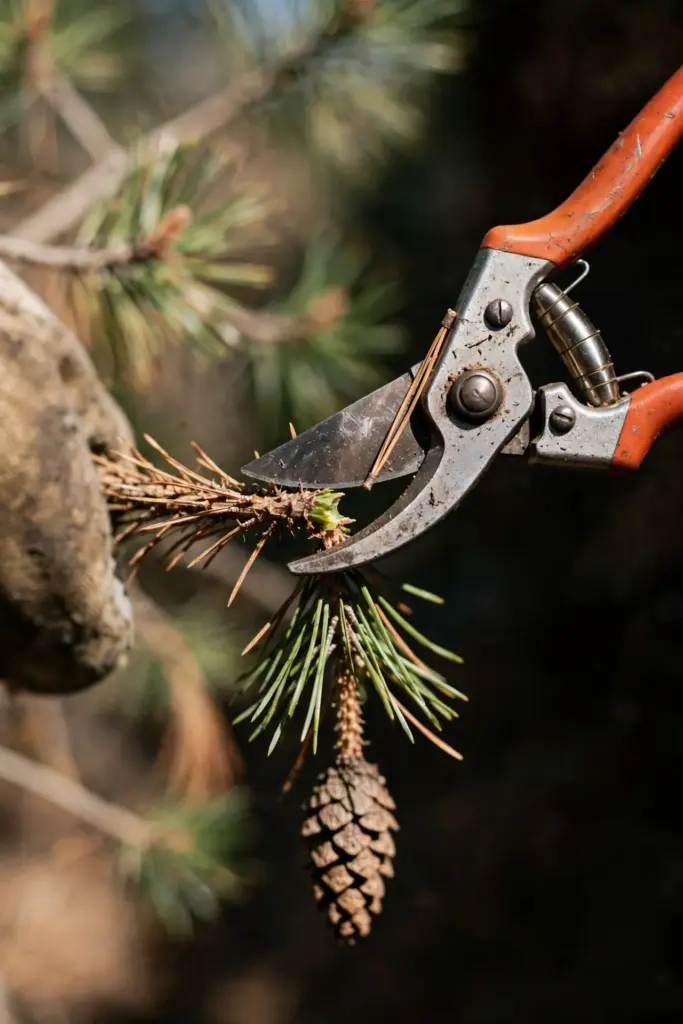
Cut back to live wood. Follow a dead shoot down to sound tissue and cut there. A stub of dead wood left behind keeps its pycnidia. A cut into live wood removes the whole infection point. Drop the cuttings onto a tarp, not onto the soil under the tree, and carry them out of the yard. Burn them where burning is legal and safe, or bag them for municipal green waste. Do not compost infected pine material on site.
Work dry. Prune when the foliage is dry and no rain is forecast for the day. Wet foliage spreads spores on hands, tools, and boots. A dry-weather pruning pass does the sanitation job without starting new infections. A wet-weather pass undoes its own work.
Clean tools between trees. Wipe blades with rubbing alcohol or a household disinfectant between one tree and the next. A blade that cut a dead infected shoot carries spores to the next cut. The wipe takes seconds. The skipped wipe can start a new infection in a healthy tree.
Mind the seedlings. Young pines near old infected trees catch the disease early. Move a seedling bed away from an infected crown when the yard allows it. A seedling that grows up under a shower of spores from an old Austrian pine starts life at a disadvantage, and no spray schedule fixes a bad planting position.
10. Step 3: Time Protective Fungicide From Bud Break Through Candle Elongation
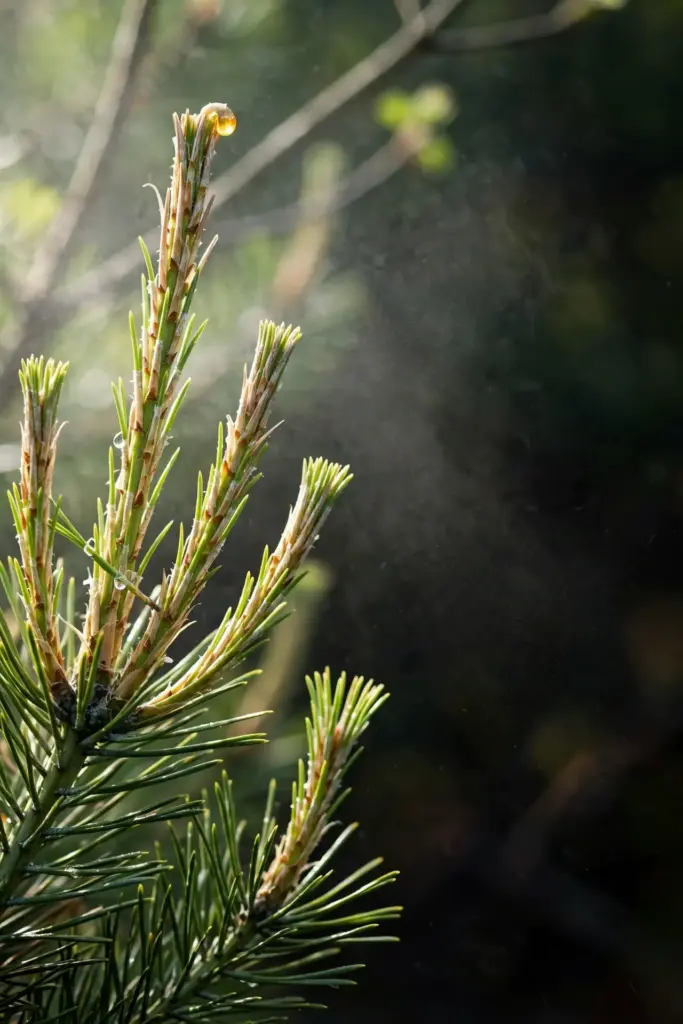
Time protective fungicide from bud break through full candle elongation. That window is the whole spray program. Michigan State University Extension directs growers to time fungicide applications to protect new growth from bud break through full candle elongation. A spray that lands before bud break protects nothing yet. A spray that lands after the candles harden off protects tissue the fungus has already passed.
Use a labeled protective fungicide for Diplodia tip blight on pines. The label names the tree, the disease, the rate, and the interval. Read the label. The label is the law on rates and timing. A product labeled for another pine disease is not automatically labeled for this one. A rate that worked on a small shrub does not scale to a mature pine by guessing.
Cover the new growth, because the spray has to reach the candles the fungus targets. A light mist over the outer crown misses the inner candles, and a drench that runs off the needles wastes product and pollutes the soil. Full coverage of the new growth, applied in calm dry weather, is the standard. A large tree may need a professional applicator with the equipment to reach the full crown.
Repeat only inside the window. The label sets the interval. The program ends when candle elongation ends. Spraying through the summer after the candles harden off spends money on tissue the fungus cannot enter. Spraying in fall, when the pycnidia sit quiet on dead cones, does nothing to the overwintering fungus. Sanitation owns the fall. Spray owns the spring window.
Do not expect the spray to cure cankers. The spray protects new growth. It does not heal a canker on a branch or a stem. A tree with stem cankers needs pruning and an arborist assessment, not another spray pass. The spray and the shears do different jobs, and neither one replaces the other.
11. Living With Sphaeropsis Dieback After the Damage Is Done
After the damage is done, Sphaeropsis dieback needs no rescue work in the same season. The dead shoots are dead. The living crown is the asset. The job shifts to next spring: sanitation, one spray window, and steady vigor.
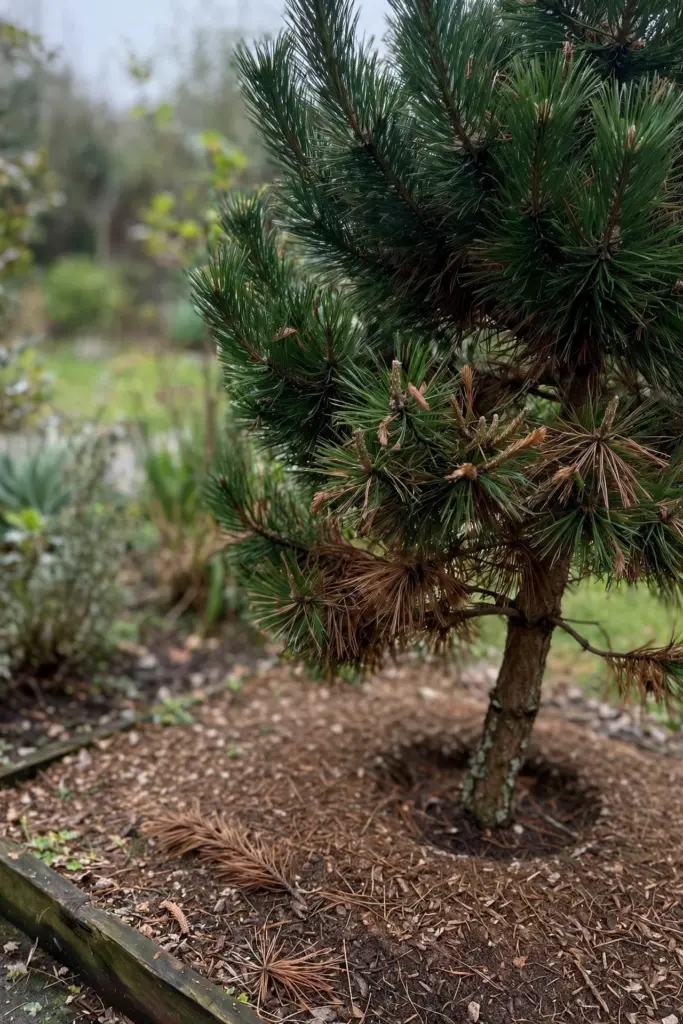
Dead needles stay attached, and the tree looks worse than it is for months. A pine that lost some of its candles still carries most of its crown. New buds push out to replace dead buds, and those buds need protection in the next spray window, not grief in this one. Judge the tree by the live crown, not by the brown tips.
Water through drought. A pine that goes thirsty through a dry summer enters the next spring weakened. A deep watering during a dry spell keeps the tree’s defenses up. Mulch the root zone to hold soil moisture, and keep the mulch off the trunk. A trunk buried in mulch rots. A root zone under a thin mulch layer stays cool and damp.
Skip the fertilizer push. High nitrogen fertilization predisposes trees to attack, so a pine recovering from Sphaeropsis dieback is the wrong tree to push. Test the soil first. Feed only to correct a proven deficiency. A recovering pine wants steady growth, not a flush of soft tissue.
Plan the next spring now. Mark the calendar for bud break. Order the labeled product early. Line up the pruning day for a dry week. The trees that recover best are the ones whose owners treat the quiet months as preparation, and the spray window as execution.
12. Frequently Asked Questions
Yes. Sphaeropsis dieback and Diplodia tip blight are two names for one disease. The fungus Diplodia pinea causes it. Older references call the same fungus Sphaeropsis sapinea. The symptoms, the cycle, and the treatment are identical. There is no difference to manage. Use whichever name your local extension uses, and follow the same advice.
Yes, over time. One bad spring kills shoots, not trees. Repeated infections year after year strip the crown, cut vigor, and open the tree to cankers. Seedlings die fast when the fungus girdles the stem near the soil line. A mature tree with most of its crown dead for two or more seasons rarely recovers, and removal becomes the honest call.
Spray from bud break through full candle elongation in spring. That window covers the susceptible period, from bud swell until the needles are about half grown and the candles finish elongating. A protective fungicide applied in that window shields the new growth. Sprays outside the window waste money. Read the label for the rate and interval.
No. The apple disease is a separate species, Sphaeropsis pyriputrescens. It causes Sphaeropsis rot of stored apples and twig canker on apple and crabapple trees. It does not infect pines. Pine Sphaeropsis dieback comes from Diplodia pinea. The shared genus name is a naming overlap, not a shared disease. Keep the two apart.
Usually no. A pine with a few dead shoot tips and a mostly live crown is worth pruning, spraying, and watering. Removal enters the picture when most of the crown has died for two or more seasons, when stem cankers threaten the structure, or when the tree seeds the yard with spores faster than sanitation can clear them. Get an arborist assessment before cutting a large tree.
13. Where to Go From Here
Sphaeropsis dieback is Diplodia tip blight under an older name. The fungus kills new pine candles each spring, waits out the winter in dead cones and dead shoots, and returns on the next wet spring. The response fits that reality: prune dead tissue in dry weather, protect the new growth from bud break through candle elongation, and keep the tree vigorous through drought.
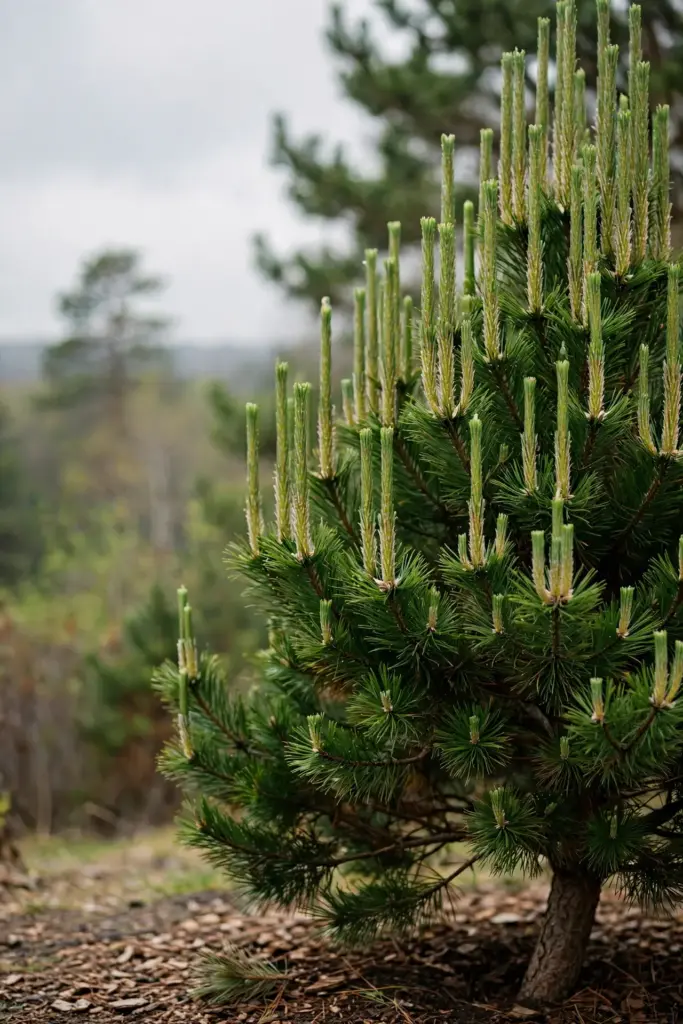
The one next action is a walk. At bud break in spring, walk the lower crown of every pine. Look for resin beads on the shoot buds. Look for candles that stall and brown. Catch the first dead tips early, prune them out dry, and the tree enters the spray window with a smaller spore bank above it. That walk, repeated each spring, is the whole early warning system for a disease that rewards early eyes.