
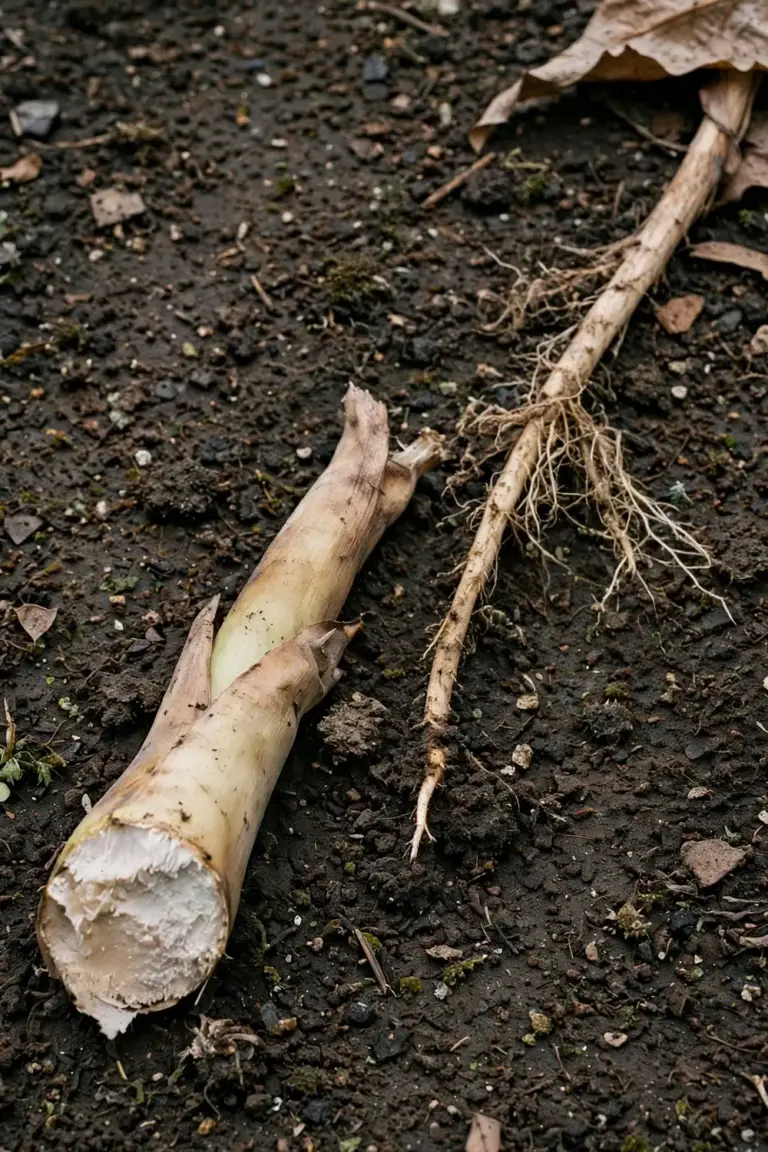
Dig up one rhizome before you eat any canna. A thick, starchy rhizome the size of your fist, from a clump up to 61 cm long, marks the edible type. A thin, fibrous rhizome marks an ornamental canna grown for flowers. I have learned that the canna I check by its rhizome feeds my table, while the canna I judge by its flower only decorates it. The rest of this page answers canna edulis vs ornamental canna in 7 checks, from the rhizome to the label, plus the one question to ask the seller.
Canna edulis is the edible canna, sold in Australia as Queensland arrowroot. Ornamental canna is Canna x generalis, a group of hybrids grown for large, showy flowers. The two plants look alike above ground. The rhizome underground tells them apart.
The name itself needs care. Botanists do not all agree on where Canna edulis ends and Canna indica begins. Call Canna edulis the food-trade name for the edible selected form, and Canna x generalis the name for the ornamental hybrids. The checks below work on plants in the ground, not on labels alone.
1. Dig One Rhizome and Read Its Thickness
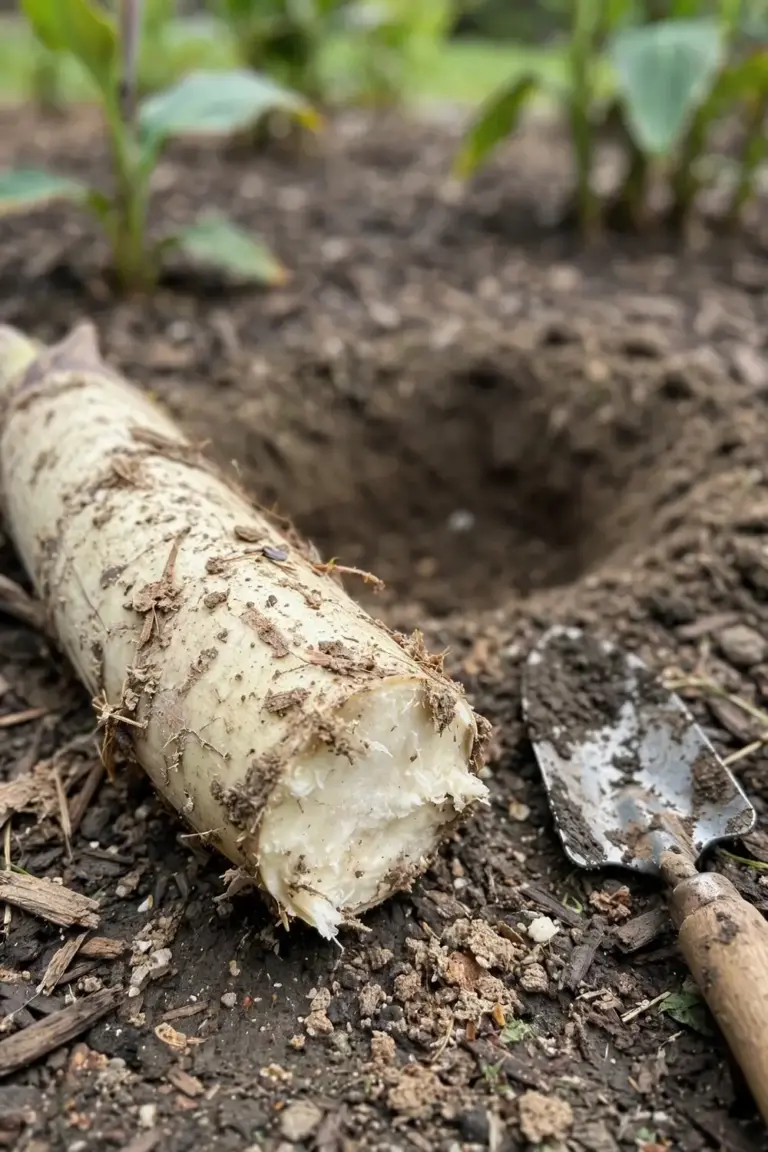
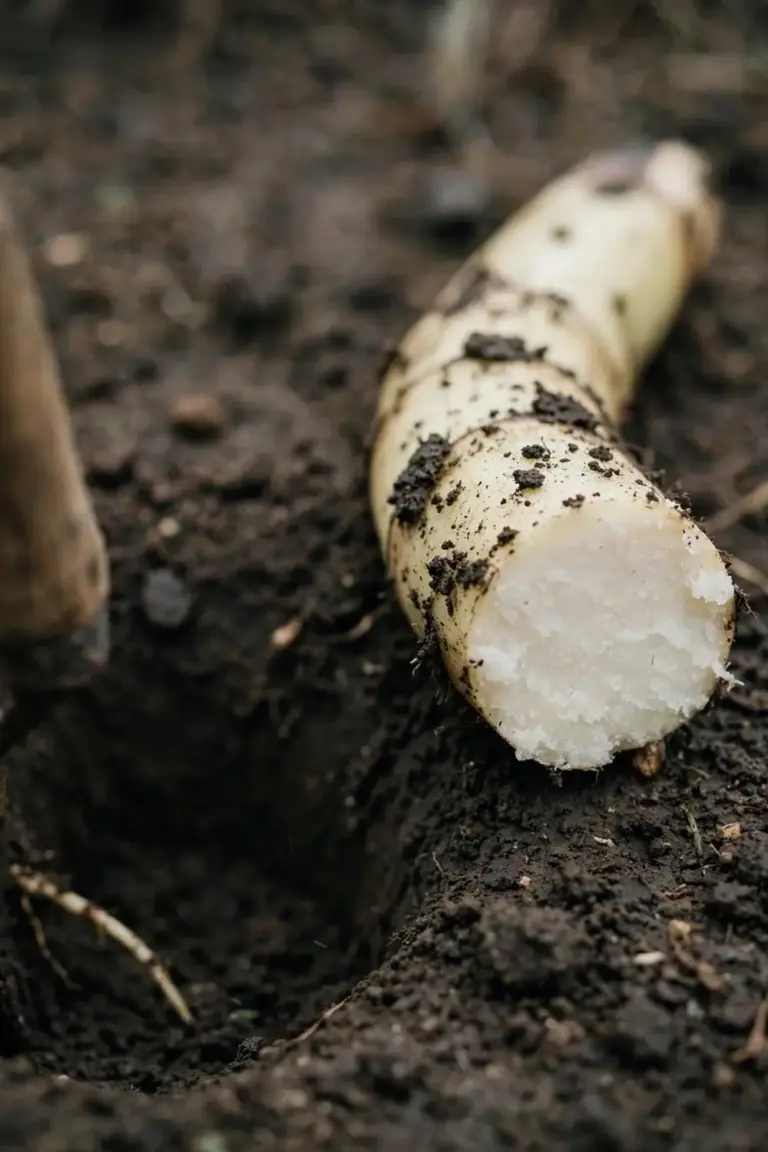
The rhizome decides the question. Dig at the edge of the clump, lift one rhizome, wash the soil off, and feel it. An edible canna carries a very large, thick, tuber-like rhizome, and its clumps of stems reach up to 3 meters tall with leaves reaching 60 cm long and 18 cm wide, according to Useful Temperate Plants. A rhizome clump of the edible type can run two feet long, about 61 cm, per foraging notes from Eat The Weeds. That mass is starch storage, not decoration.
An ornamental canna carries a thinner rhizome with more fiber and less starch. The plant puts its energy into flowers, not into a food store. Dig in autumn, after the tops die back, when the rhizome is at its fullest. Digging in full leaf tells you less, because the plant is still spending starch on growth.
A canna grows from a rhizome, not from a true bulb. A rhizome is a horizontal underground stem with growing points along its length. A bulb is a compressed bud with fleshy scales. The distinction matters at buying time, because a seller who calls a canna rhizome a bulb may not know which canna it is. The site’s bulbs to plant in fall guide covers true bulbs; canna needs the rhizome check below.
Measure the rhizome with a ruler, not with your memory. A rhizome thicker than your thumb, firm all the way through, and heavy for its size points to the edible type. A rhizome thinner than your little finger, stringy when you cut it, and light for its size points to an ornamental. One rhizome from the edge of the clump is enough. Do not dig the whole clump to answer one question.
Cut the lifted rhizome and read the cut face. A starchy rhizome shows a dense, pale interior that snaps cleanly under the knife. A fibrous rhizome shows strands that pull and string when you cut it. The cut face test backs up the thickness test. A thick rhizome with a dense cut is the edible pattern. A thin rhizome with a stringy cut is the ornamental pattern. A thick rhizome with a stringy cut stays unknown, and an unknown plant stays ornamental.
Replant the test piece the same day. Push it back into the hole at the same depth, firm the soil around it, and water it in. A rhizome left on the bench dries out and dies. The test costs the plant nothing when the piece goes straight back into the ground.
2. Measure the Flower Before You Trust the Color
Flower size separates the two types better than flower color does. The species flowers of Canna indica run 4.5 to 7.5 cm long, red to yellow-orange, never pure yellow except in some hybrid cultivars, according to the Flora of North America account. Edible canna flowers sit in that range: small, narrow, red or orange, with three petal-like staminodes of different lengths. Ornamental hybrids carry much bigger blooms. Field descriptions of garden canna record petals to 100 mm long and 55 mm wide, per the Plants of South Eastern New South Wales flora. A flower wider than your palm belongs to a hybrid bred for show.
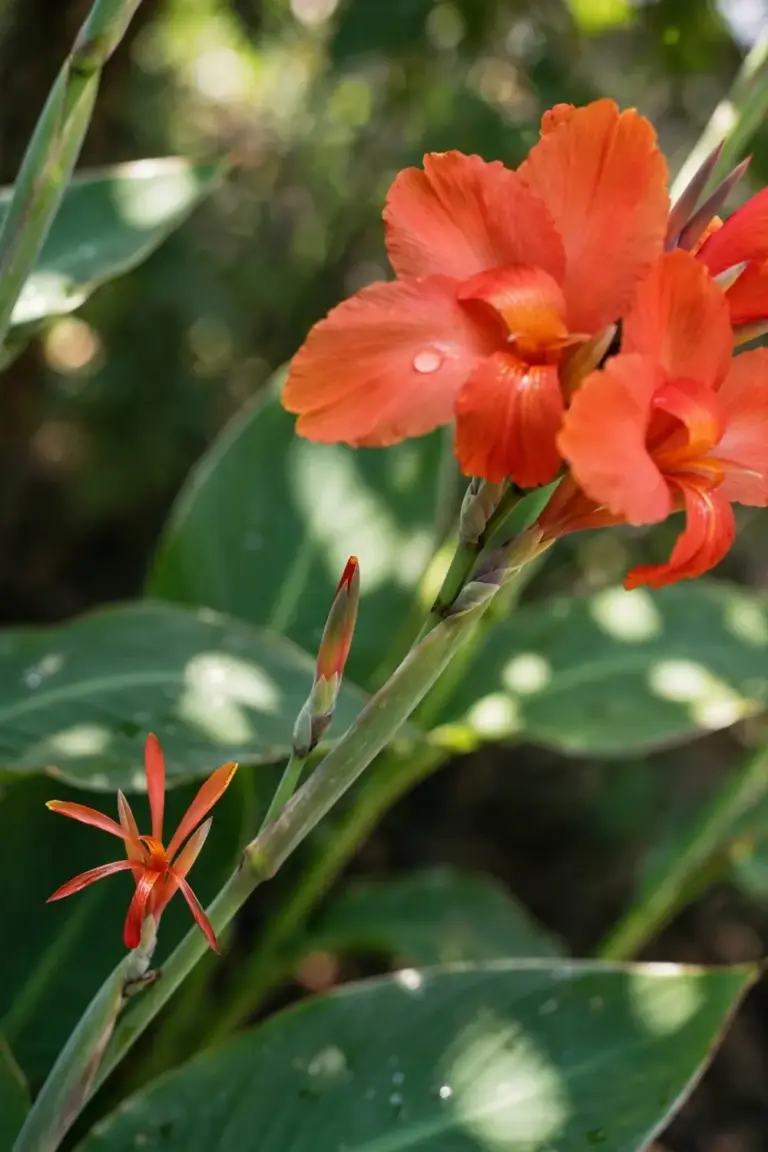
Two color traps catch growers. A yellow flower does not prove a canna is inedible. Hybrid cultivars can carry pure yellow flowers, and the species itself ranges from red to yellow-orange. A green stalk on a seedling of a red-stalk edible plant does not prove the seedling changed type. Seedlings vary. Stalk color is a hint, never a verdict.
Measure one open flower from petal tip to petal tip. Write the number down. A flower under 8 cm long with narrow petals fits the edible species type. A flower over 10 cm across with broad, overlapping petals fits an ornamental hybrid. Flowers between those sizes need the rhizome check above, because flower size alone leaves a middle band where the two types overlap.
Read the flower parts, not just the outline. What looks like petals on a canna are mostly staminodes, sterile stamens shaped like petals. The Flora of North America records 3 to 4 staminodes, 4.5 to 7.5 cm long, with a free part 0.3 to 0.5 cm wide, alongside true petals 4 to 6.5 cm long and sepals 0.9 to 1.7 cm long, in its Canna indica account. Edible-type flowers show narrow staminodes with clear gaps between them. Ornamental hybrids show broad, overlapping staminodes that fill the whole flower face. The gap between the staminodes is the tell. Wide gaps mean a species-type flower. No gaps mean a hybrid bred for show.
Hybrid color range runs far past the species range. Compact hybrid series carry flowers in red, orange, yellow, and pink, with some bronze-tinted leaves, per RHS descriptions of the Cannova Series. A pink or white flower proves a hybrid at once, because the species never makes pink or white. A red or orange flower proves nothing on its own, because both types make red and orange. Use color as a one-way test. Pink, white, or bi-color means ornamental. Red or orange means measure the flower and dig the rhizome.
3. Read Height, Leaf, and Stalk Together
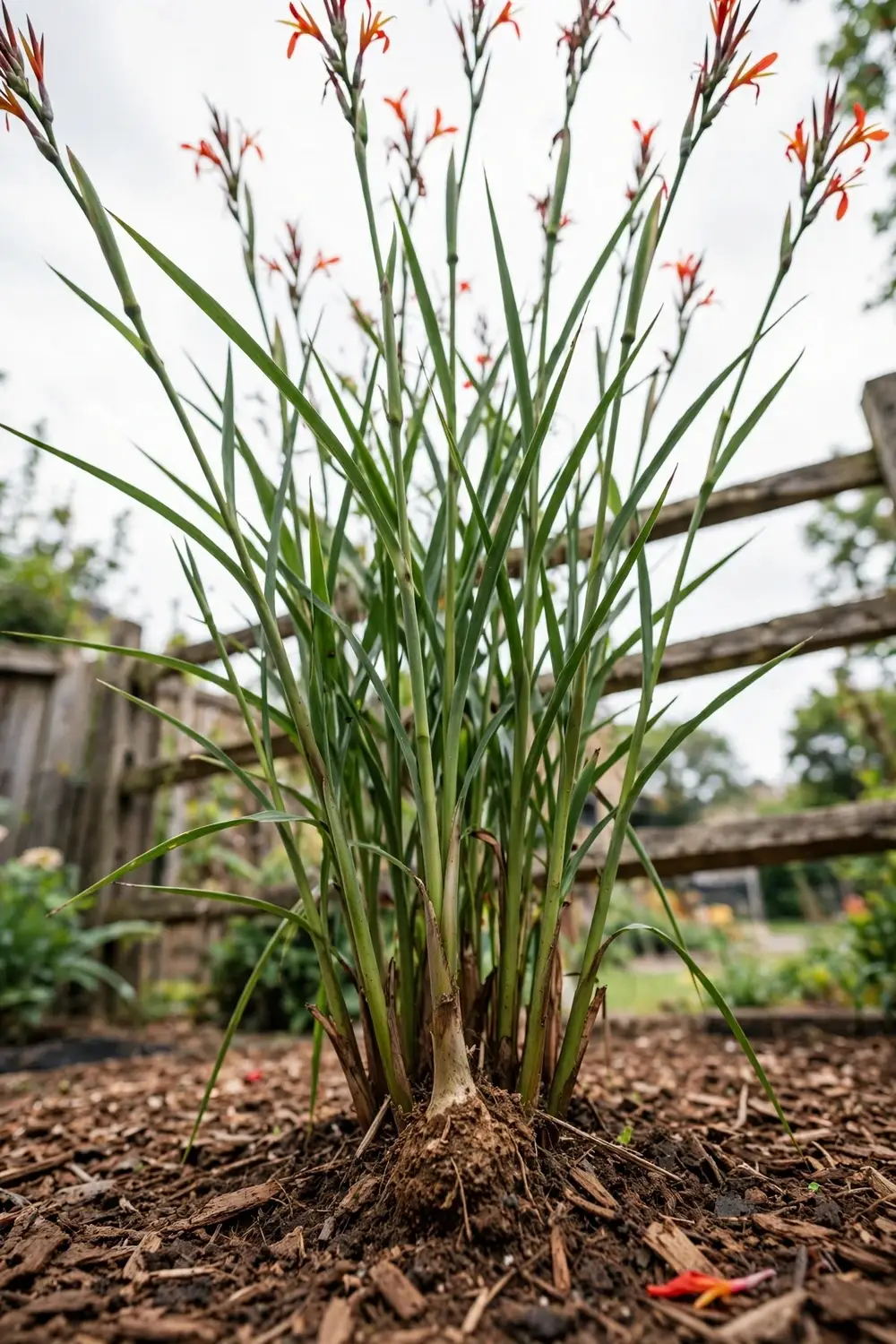
Height helps, but height alone never decides. Edible canna grows tall, with clumps of stems reaching up to 3 meters and leaves reaching 60 cm long and 18 cm wide, according to Useful Temperate Plants. Ornamental garden canna grows up to 6 feet tall, about 183 cm, according to the North Carolina Extension Gardener Plant Toolbox. Field descriptions of garden canna record plants to 2 meters tall with leaves to 45 cm long and 250 mm wide, per the Plants of South Eastern New South Wales flora. A plant over 2.5 meters tall with narrow leaves leans edible. A plant under 2 meters with broad leaves leans ornamental. A plant between those marks needs the rhizome and flower checks.
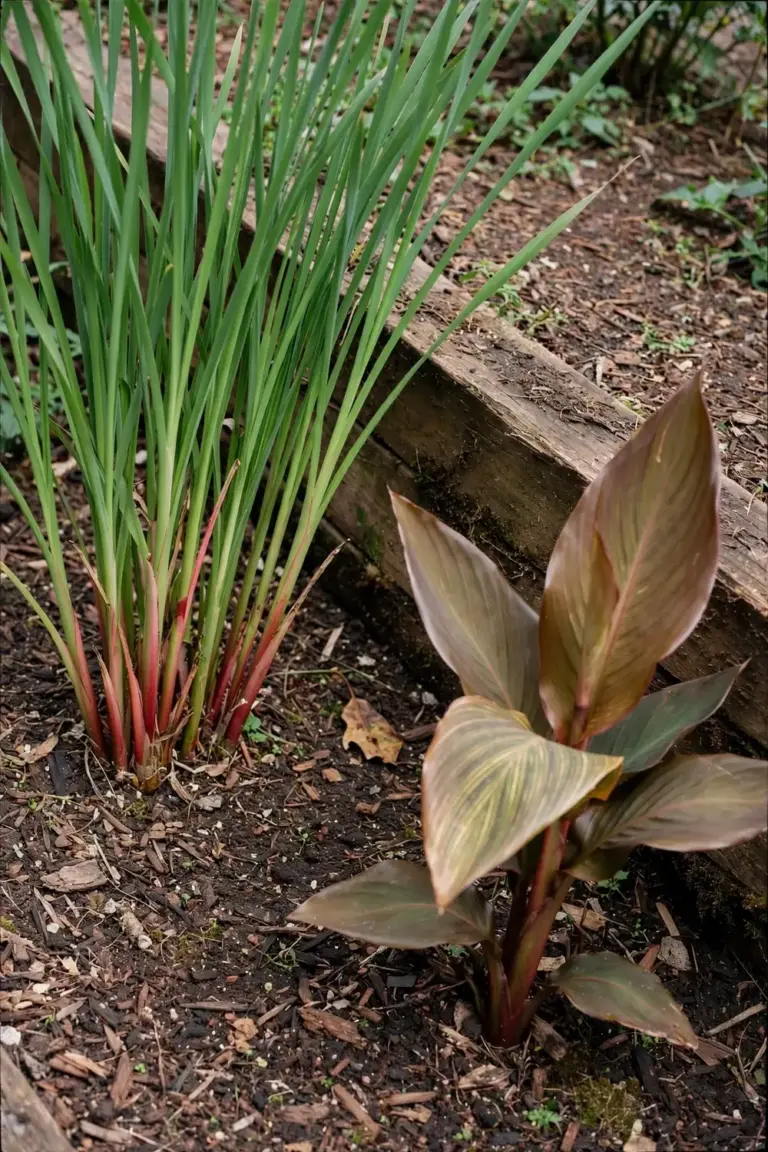
Leaf shape adds a second vote. Edible canna leaves run long and narrow, reaching 60 cm long and 18 cm wide, with a banana-like look. The sheath wraps the stem. Ornamental leaves run broader for their length, to 45 cm long and 250 mm wide, and many cultivars carry bronze, purple, or striped leaves bred for show. A plain green leaf proves nothing on its own. A bronze or variegated leaf proves the plant is a selected ornamental cultivar, because the edible food form is sold green.
Stalk color adds a third vote. Edible canna often carries a red-flushed stalk. Ornamental canna stalks run green, red, bronze, or striped by cultivar. Red stalk plus thick rhizome plus small flower is a strong edible pattern. Green stalk alone proves nothing, because seedlings of red-stalk edible plants can come up green. Stack all three clues. One clue is a hint. Three matching clues are an identification.
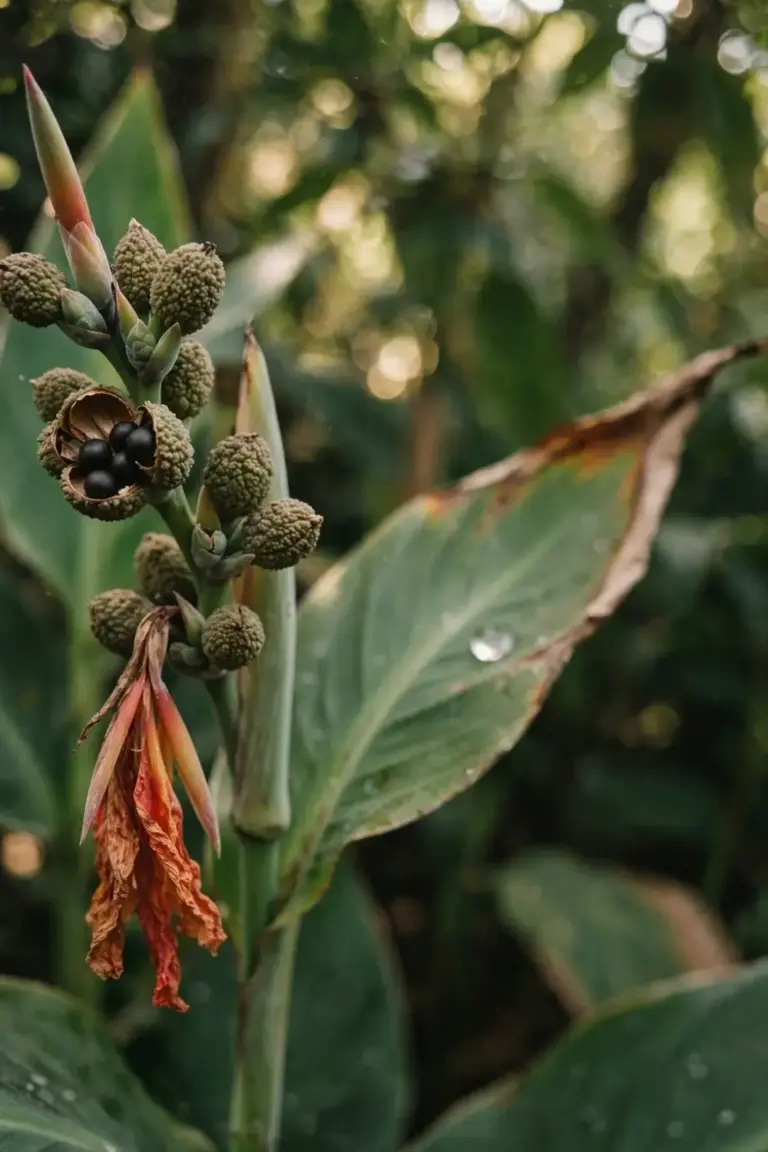
Check the seed capsules after flowering for a fourth vote. The Flora of North America records capsules ellipsoid to nearly globose, 1.5 to 3 cm long and 1.5 to 2 cm wide, with black seeds globose to nearly globose, 5 to 8 mm long and 4 to 6.7 mm across, in its Canna indica account. Species-type plants set these small, warty capsules freely. Many ornamental hybrids set few capsules or none, because breeders select for flowers, not seed. A stem crowded with small capsules leans species type. A stem with no capsules after a full flowering season leans hybrid. Capsules never override the rhizome check. They add weight to a close call.
Rich, loose soil grows a bigger plant of either type. A plant starved in poor soil stays short whatever its genes say. The site’s soil health guide covers the groundwork that lets any canna reach its true size. Judge the plant against others in the same bed, not against a number in a book.
4. Check the Label, Because the Trade Mixes Names
The trade mixes canna names. The botanical record explains why. The Flora of North America lists Canna edulis Ker Gawler as a synonym of Canna indica Linnaeus, alongside Canna coccinea, Canna discolor, Canna lutea, and Canna warscewiczii, in its Canna indica account. The PROSEA plant-use database lists Canna edulis Ker-Gawler as a synonym of Canna indica, with Queensland arrowroot among its common names, in its Canna indica entry). One European seller even labels an ornamental cultivar “Canna edulis” under the name Pacific Beauty. A label that says Canna edulis does not guarantee an edible plant.
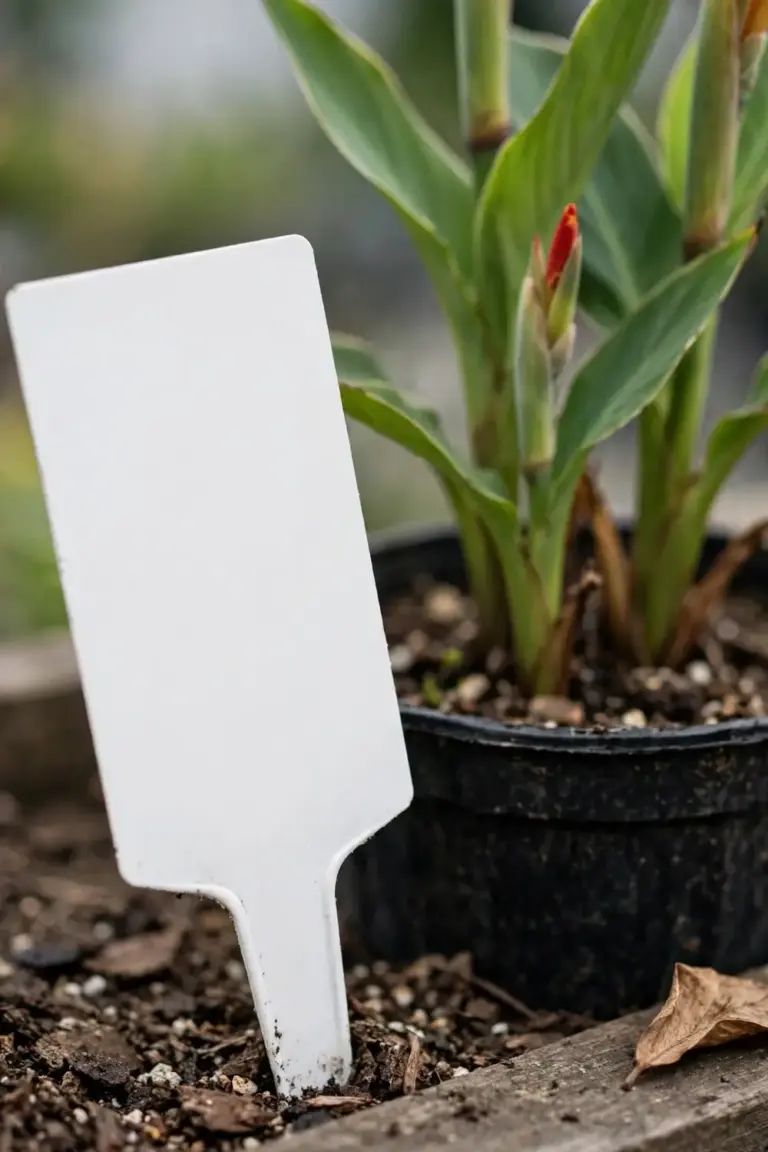
Read the full label, not just the first two words. A sound edible label names Canna edulis and adds Queensland arrowroot or achira, and the seller sells it as a food plant. A sound ornamental label names Canna x generalis and adds a cultivar name in single quotes, such as Canna x generalis ‘Tropicanna’. A label that says only “Canna” or “Canna Lily” names the genus, not the plant. Treat an unlabelled plant as unknown until the rhizome and flower checks speak.
Canna x generalis is a hybrid group, not one species. The North Carolina Extension Gardener Plant Toolbox records that garden canna is most likely the hybrid of Canna indica and Canna glauca or Canna iridiflora, and that all canna hybrids now sit under the scientific name Canna x generalis, in its Canna x generalis entry. Hybrids are bred for flowers, and their rhizomes run thin and fibrous. That is the core of the whole identification: edible canna is a selected food form, ornamental canna is a hybrid bred for show, and the label must say which one you hold.
A label that says Canna indica alone tells you almost nothing. Nurseries sell Canna indica both as a species plant and as a parent of hybrids, and the name on the pot may describe the species, the seed line, or the breeder’s shorthand. Ask the food-use question anyway. “Is this sold as a food plant?” splits the stock cleanly even when the botanical name stays the same. A yes with a rhizome photo to match is an edible plant. A no, or a shrug, is an ornamental plant whatever the label says.
Keep the tag when you buy. Write the seller, the date, and the name on the tag into a notebook. A plant with a kept tag is identified. A plant with a lost tag goes back through the checks above.
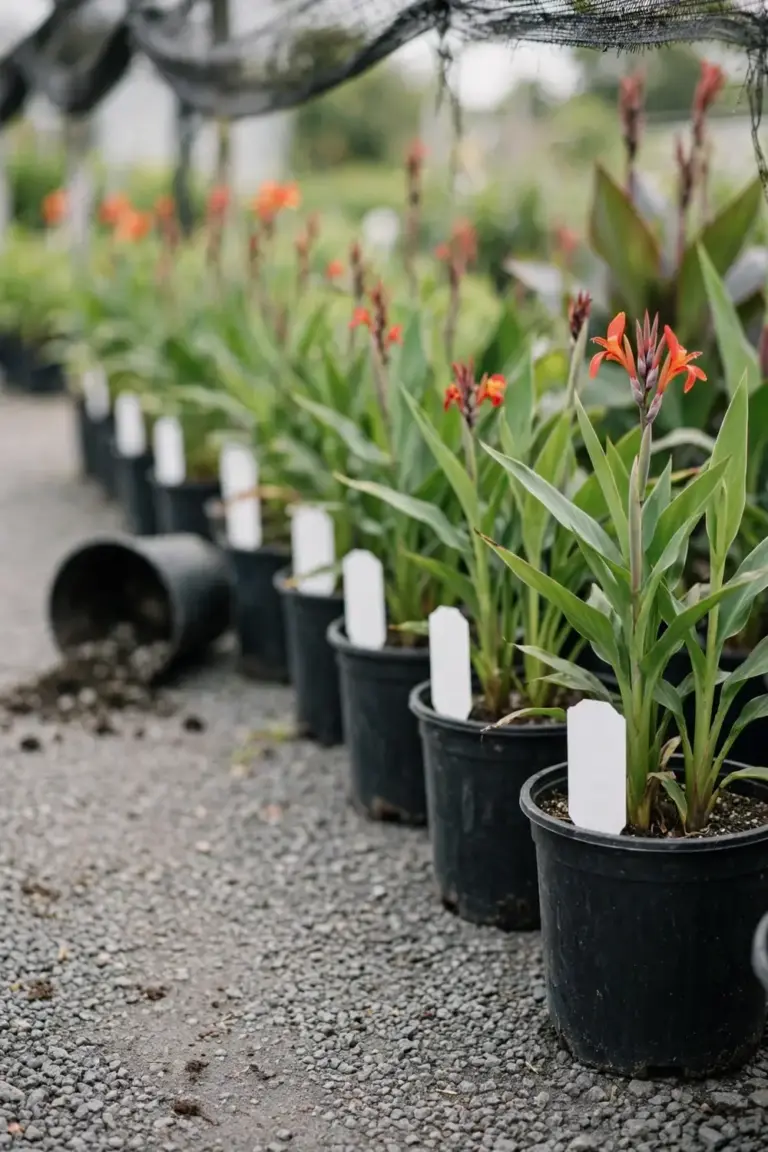
Buying online needs one extra step. Ask the seller for a photo of the rhizome before you pay. A seller who grows the edible type will show a thick rhizome without fuss, because the rhizome is the product. A seller who shows only flowers is selling looks, not food. Check that the listing says food plant, edible rhizome, or Queensland arrowroot. A listing that says canna lily, garden canna, or tropical flower is selling an ornamental even when the botanical name in the fine print reads Canna edulis.
5. Buy Named Edible Stock Before You Eat Any Canna
The safety rule is short. Buy from a named edible source. Never eat an unlabelled ornamental. Australian sellers list the edible type as Arrowroot Edible Plants under Canna edulis, with Queensland Arrowroot as the other name, and give a max height of 1 to 2 meters in the ground under good conditions, per Daleys Fruit Tree Nursery. Queensland once ran a real arrowroot industry: starting in 1870, by 1892 there were 300 acres under production at Coomera and Pimpama, and by 1908 the region supplied the whole country, per Beelarong Community Farm. The same farm describes the edible rhizome as a large red-skinned round rhizome, often larger than a clasped fist, on a plant up to 2 meters tall. That is the plant to buy.
Ornamental cannas are not proven poisonous. That claim appears in thin online articles, and it is wrong. Canna indica rhizomes are also edible, per foraging notes from Eat The Weeds, and so are the rhizomes of Canna coccinea. The honest difference is starch and fiber, not toxicity. Ornamental rhizomes run thin and fibrous, with little starch worth eating. Eating one will disappoint you. It will not poison you. An unlabelled plant may be a hybrid with unknown parentage. The safe move is to eat only plants bought as named edible stock.
Ask the seller one question before you pay: “Is this Canna edulis sold as a food plant, or is it an ornamental Canna x generalis?” A seller who answers with the botanical name and the food use is selling the edible type. A seller who answers with a cultivar name or a flower color is selling an ornamental. A seller who cannot answer is selling an unknown plant. Walk away from the unknown plant if you want food.
Queensland arrowroot carries real Australian history. The crop’s flour was the basis of the well-known Arrowroot biscuits. The Queensland industry died out because the crop was not big enough to mechanise, and hand harvest stayed uneconomic, per Beelarong Community Farm. The plant survived in home gardens and permaculture plots, where growers value it for mulch, fodder, and biomass as well as food. That history is why the name Queensland arrowroot still means the edible type in Australia, and why an Australian seller who uses that name is usually selling the right plant.
Do not taste-test your way to an answer. Taste does not separate the types. Starch content does, and starch content needs a rhizome in hand and a label you trust. No recipes and no cooking steps follow. Identification is the whole job here.
If you already ate from an unlabelled plant, the record is reassuring. Ornamental canna rhizomes carry no proven poison record, and Canna indica rhizomes are eaten in foraging tradition. Treat the meal like any unfamiliar food. Note what you ate and how much. Do not repeat the meal from the same unlabelled clump. Buy named edible stock for the next meal, and tag the old clump as ornamental so the question never comes up again.
6. Compare Canna Edulis vs Ornamental Canna Side by Side
| Trait | Canna edulis (Edible) | Ornamental Canna (Canna x generalis) |
|---|---|---|
| Rhizome | Very large, thick, tuber-like, starchy | Thin, fibrous, little starch |
| Flower size | Small, 4.5 to 7.5 cm, narrow petals | Large, petals to 100 mm long and 55 mm wide |
| Flower color | Red to yellow-orange | Red, orange, yellow, pink, white, bi-color |
| Height | Stems to 3 meters | To 2 meters, hybrids to 183 cm |
| Leaf | Long and narrow, to 60 cm by 18 cm, plain green | Broad, to 45 cm by 250 mm, often bronze or striped |
| Name on label | Canna edulis, Queensland arrowroot, achira | Canna x generalis plus a cultivar name in single quotes |
| Grown for | Starch rhizome | Flowers and foliage |
Read the table down one column, not across one row. No single row decides the plant. The rhizome row carries the most weight. The flower-size row carries the next most. The color row carries the least, because color ranges overlap across both types.
Run the table on a real plant in three steps. First, dig one rhizome and weigh it in your hand. Second, measure one open flower. Third, read the label. Two of three checks pointing the same way settles the plant. One check pointing one way and two pointing the other way means the plant stays unknown. An unknown plant stays ornamental, and nothing from it goes in the pot.
Score the table honestly when the votes split. A thick rhizome with a big flower and no label is a split vote: the rhizome says edible, the flower says ornamental, and the missing label breaks the tie toward unknown. A thin rhizome with a small flower and an edible label is also a split vote: the label says edible, but the rhizome says the plant is not the food form it claims to be. In both cases the plant stays ornamental. The table rewards agreement. It never lets one strong clue overrule two weak ones.
Write the verdict down with the date. A notebook line that reads “March: thick rhizome, small red flower, label says Queensland arrowroot, verdict edible” settles the plant for every season after. Memory fades. A tag fades. A dated notebook line stays readable, and it stops the same question from coming back every autumn.
7. Grow an Unnamed Canna as an Ornamental and Eat Nothing
A plant with no label and mixed clues is an ornamental. Grow it for flowers and foliage. Eat nothing from it. That decision costs nothing and removes all risk. The plant still earns its place. Canna flowers feed pollinators, the leaves shade the soil, and the clump screens a fence by midsummer.
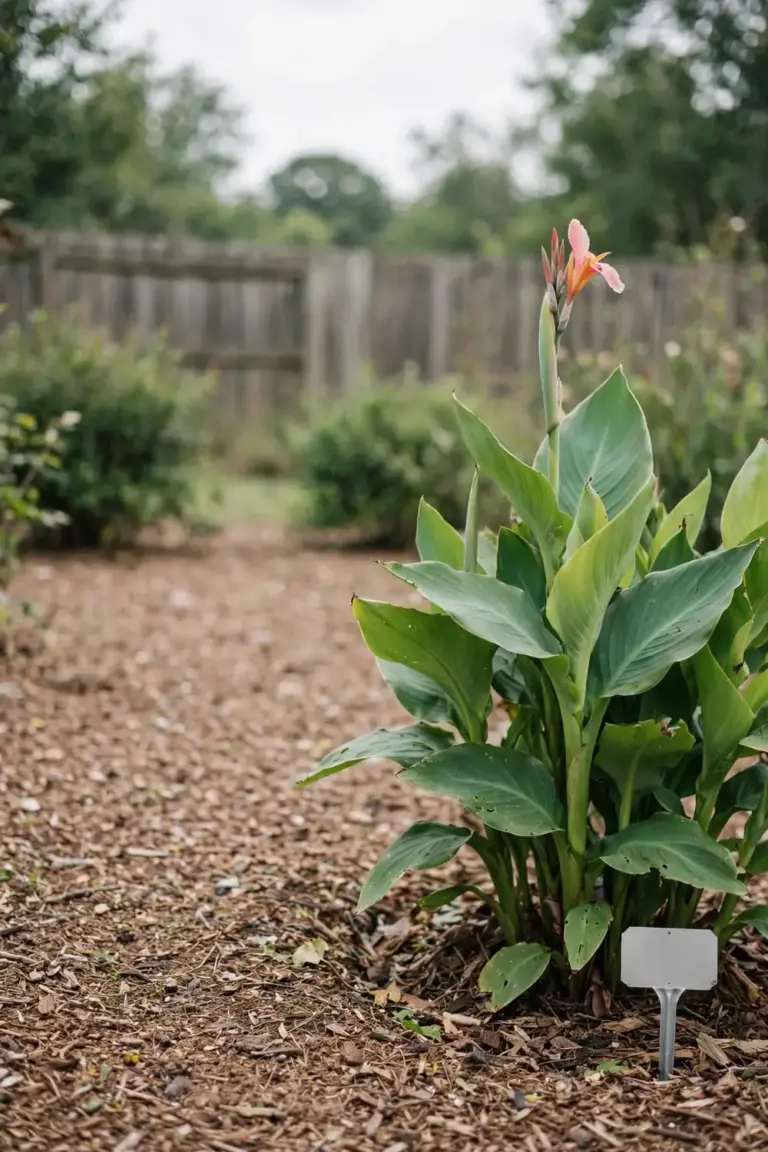
Give the unnamed plant sun and steady water. Canna likes a warm, sunny spot and soil that stays moist. Mulch holds that moisture through dry weeks. The site’s what is mulching guide covers materials and depth. Keep the mulch off the stems. A mulch collar piled against a stem holds moisture where rot starts.
Digging and dividing stays pointer-level here. The key identifies cannas. It does not teach a growing regime. If you divide a clump, keep one growing point per piece, replant at once, and water the pieces in. If you want a full growing method, look for a dedicated canna growing guide rather than guessing from an identification key.
Label the plant yourself once you decide. Write “ornamental, do not eat” on a metal tag and push it into the soil at the clump edge. Future you will thank present you. A plant with a clear tag never gets eaten by mistake.
Replant any rhizome you lifted for the checks. A test piece left on the bench dries out within hours. Push it back into the hole at the same depth, firm the soil, and water it in. The clump recovers in days. The identification stands for the life of the clump, and the tag keeps it standing.
Frequently Asked Questions
No. Eat only rhizomes from plants bought as named edible stock, sold as Canna edulis or Queensland arrowroot. Ornamental canna rhizomes carry no proven poison record. They run thin and fibrous with little starch. An unlabelled plant may be a hybrid with unknown parentage. Grow unlabelled plants as ornamentals and eat nothing from them.
No. Flower color never decides the question. The species flowers range from red to yellow-orange, and hybrid cultivars add pure yellow, pink, white, and bi-color blooms. A yellow-flowered plant can be an ornamental hybrid or a yellow form of the species. Dig one rhizome and measure the flower. The rhizome thickness and the flower size answer the question, not the color.
Seedlings vary, so stalk color alone proves nothing. A green-stalk seedling of a red-stalk edible plant can still carry the edible rhizome type, because seedlings do not copy the parent stalk for stalk. Check the seedling the same way as any other plant. Dig one rhizome when the plant is old enough, measure one flower, and read the label. Let the three checks vote together.
Taxonomy is unsettled. The Flora of North America lists Canna edulis as a synonym of Canna indica. Other sources treat achira as a cultivated form of Canna discolor. The trade keeps the name Canna edulis for the edible selected form. Read Canna edulis as the food-trade name for that form, not as a claim that the species boundary is settled science.
Treat it as an ornamental and eat nothing from it. Run the three checks anyway: dig one rhizome, measure one flower, and note the height and leaf shape. Two of three checks pointing the same way settles the plant for your own records. Tag the clump with your verdict. A plant with a clear tag never gets eaten by mistake in a later season.
Start With the Rhizome Check This Weekend
Canna edulis vs ornamental canna comes down to one move. Dig one rhizome. A thick, starchy rhizome the size of your fist marks the edible type. A thin, fibrous rhizome marks an ornamental grown for flowers. Measure one flower, read the label, and buy named edible stock before you eat any canna. The rhizome check takes ten minutes and settles a question that flower color never will. Tag the clump when you decide, so next season starts with an answer instead of a question.