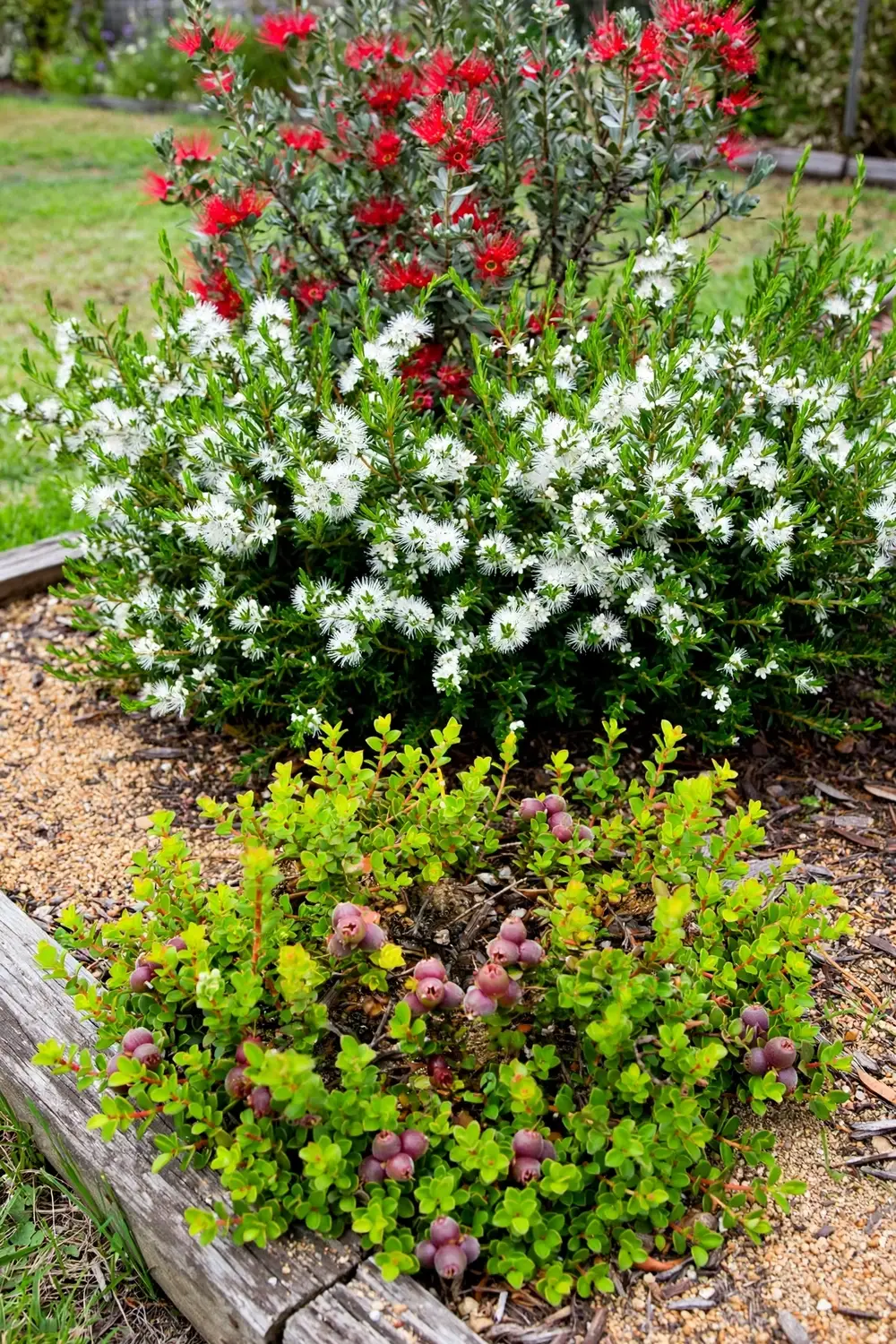

Growing kunzea in Australia starts with one decision: the job. Muntries covers ground and fruits, tick bush screens at 3 meters, and scarlet kunzea flowers scarlet red. Pick by the job and the plant fits.
Kunzea is a large Australian genus, and every Australian species is endemic, according to the Australian Plants Society. The three compared here are the ones home gardeners meet most: a fruiting groundcover, a screening shrub, and a showpiece flower shrub. They share a genus and little else. Their heights run from 30 cm to 4 meters. Their flowers run from white to scarlet. Their jobs in a garden do not overlap.
Kunzea flowers carry the Myrtaceae signature: five petals, five sepals, and a burst of stamens. That burst is the identification key for the whole article. Count the stamens against the petals and the genus answers itself. The rest of this page compares the three, separates kunzea from tea tree with one flower test, and ends with a chooser table. Buy by botanical name. Common names blur across nurseries, and the botanical name is the part that stays still.
1. Muntries (Kunzea pomifera): Edible Groundcover That Spreads 2 to 4 Meters
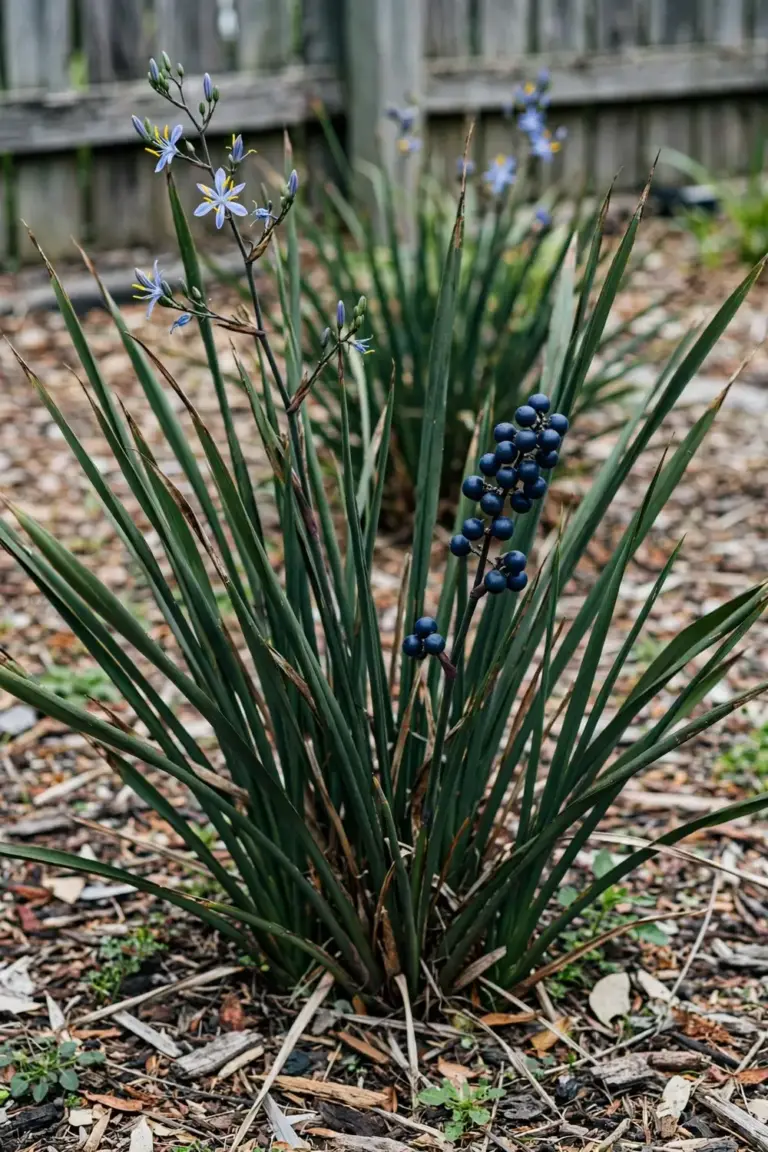
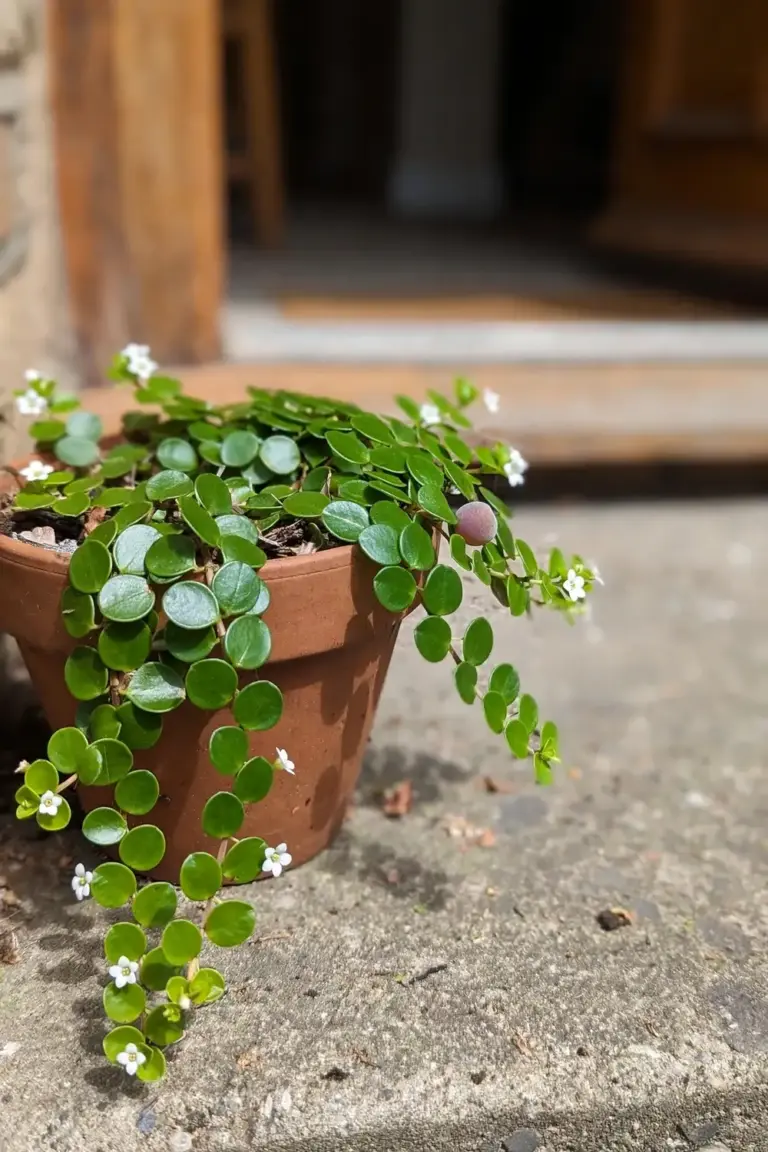
Muntries is the edible one. It stays near 30 cm high and spreads 2 to 4 meters, with mauve to purple berries you can eat fresh, according to the Nurseries Online muntries guide. The plant forms a thick mat. It suits banks, edges, and any bare patch that needs covering.
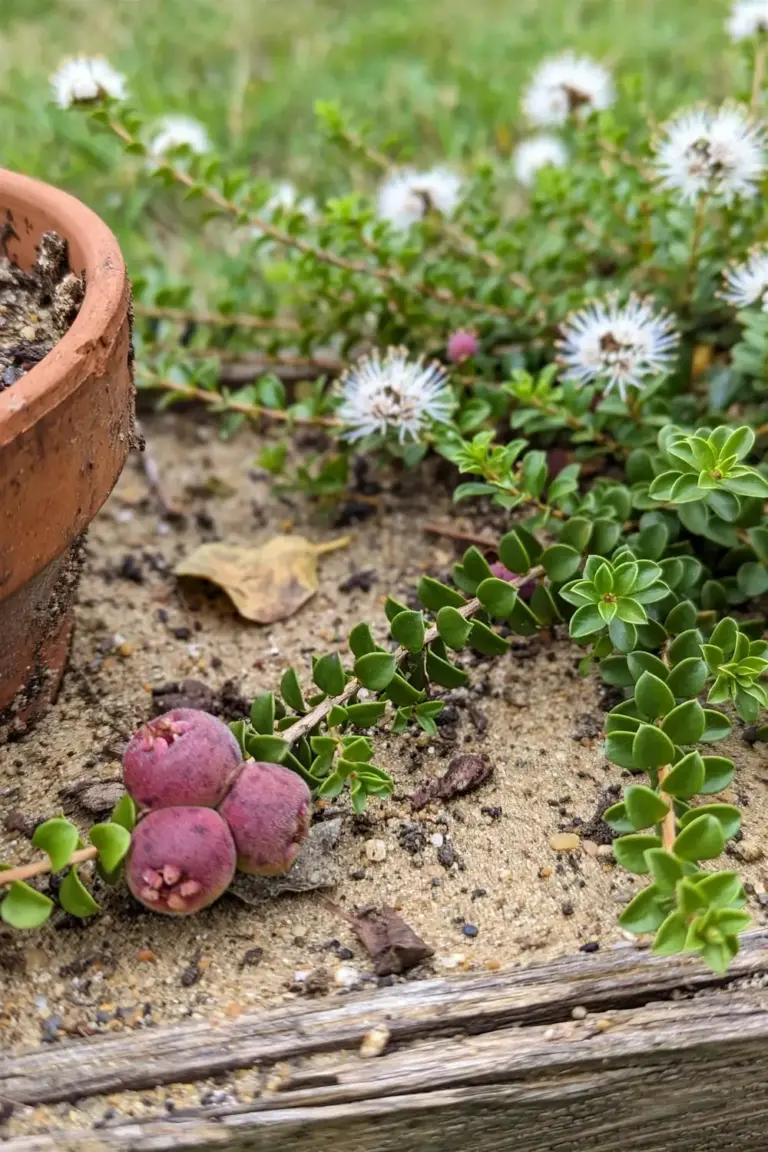
The berries taste like spiced apple. They ripen from green to red, and they carry a fragrance when ripe. Aussie Green Thumb puts fruiting in the second or third year after planting. Some forms keep green berries even when ripe, so color alone does not settle ripeness. Squeeze gently and smell. A fragrant berry that gives a little is ready.
Muntries climbs as easily as it spreads. Aussie Green Thumb notes it can climb a trellis, and Bunnings notes training it up a trellis makes harvest easier. I have learned that the muntries I train up a trellis fruits where I can reach it, while the one I leave on the ground hides its berries. A trellis also lifts fruit off damp soil. The same guide rates frost tolerance as moderate and coastal tolerance as excellent. Muntries comes from the southern coast of South Australia and Victoria, so salt air and sandy soil suit it. Give it full sun to part shade and well-drained soil. Water moderately while it settles. Once established, it asks little beyond occasional water in long dry spells and removal of damaged growth.
Propagation runs four ways. The Nurseries Online guide lists cuttings, layering, grafting, and seed. Cuttings from semi-hardwood growth root fastest for a home gardener. Seed suits a patient grower. Layering suits a plant that already sprawls, since a low stem roots where it touches soil. Pin a low stem down with a brick, cover the middle with soil, and check for roots in a few months.
Site the plant where it can sprawl. Muntries suits banks, edges, rockeries, and pots. Local Food Connect notes it also grows in pots and hanging baskets. A pot keeps the spread in check on a balcony. A bank lets it run and hold soil. Either way, the soil must drain. Heavy clay that stays wet after rain kills muntries faster than any dry spell.
Plant in spring or autumn and dodge the coldest and hottest months. Australian Seed gives that timing for muntries seed, and the same window suits transplants. Dig a hole twice the pot width, set the plant at the same depth it sat in the pot, and water it in. A seedling that starts in mild weather roots before summer heat or winter cold tests it. Bunnings notes berries ripen from February, so a spring planting fruits within its first two seasons.
Pests rarely trouble muntries. The Australian Plants Society calls kunzeas trouble free as a genus. Birds and insects visit the flowers, and the berries feed birds too. The fruit suits fresh eating, drying, jams, chutneys, and preserves. Local Food Connect lists chutneys, preserves, syrups, juices, and sauces among the uses. Pick a little at a time across the season. The plant fruits over weeks, not in one rush.
Water with a rhythm, not a calendar. New plants want steady moisture through the first summer, so check the soil with a finger before watering. Water when the top 5 cm feels dry, and skip the water when it feels damp. Established plants handle dry spells, and the same guide notes only occasional watering in long dry periods. Overwatering kills more muntries than drought does, since wet roots rot in soil that never drains.
2. Tick Bush (Kunzea ambigua): Screening Shrub That Reaches 3 Meters
Tick bush is the screening one. It reaches around 3 meters, carries masses of white flowers from spring through summer, and forms a dense shrub for hedges and windbreaks, according to the Nurseries Online tick bush guide. Plants grow larger in kind conditions. Lower-growing forms reach around 2 meters, and a prostrate form reaches 30 to 50 cm.
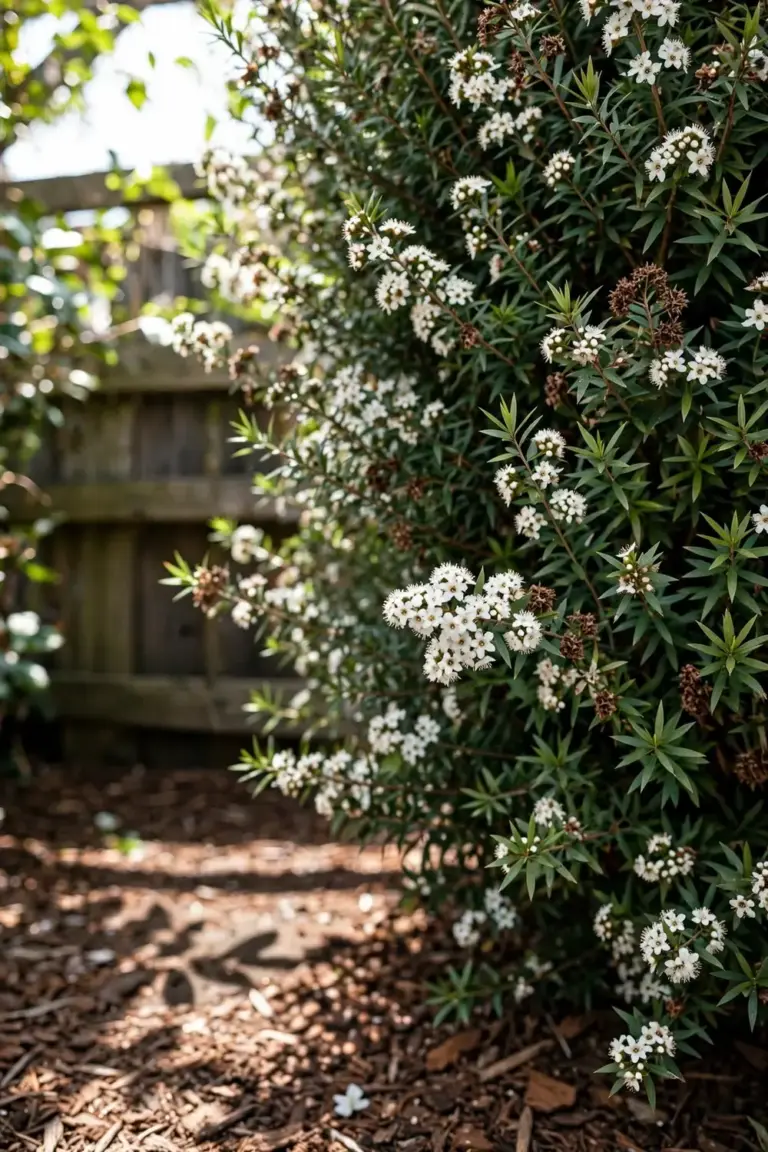
Tick bush wants full sun and well-drained soil. New plants need a little extra water and some protection from full sun through the first summer. Once established, the plant handles drought. Sequoia Valley Farms puts its soil pH range at 5.5 to 7.5, which covers most garden soils. Good drainage matters more than exact pH. Water that sits around the roots kills faster than any dry spell.
Prune after flowering. The same guide recommends tip pruning after flowering to push a bushy, compact habit. A light tip prune each year keeps a hedge dense from the base up. Skip the prune and the shrub opens out, with bare stems below and flowers only at the tips. Propagation runs best from semi-hardwood cuttings. Seed also works, and the plant self-seeds freely where it suits the site.
Space a hedge by mature spread. Plants set at the mature spread close into a screen without crowding. Crowded plants compete for light and thin out at the base. A hedge that starts with room ends dense. A hedge that starts crowded ends gappy. Water the line through the first summer, then ease off once roots settle.
The foliage carries a second use. The same guide notes that kunzea ambigua foliage is distilled for essential oil. Aussie Green Thumb notes the oil turns up in pharmacies and health food stores for pain relief. Grow the plant for the screen first. The oil belongs to distillers, not to home stills. A home gardener gets the scent by brushing past the foliage, and that scent is the point of the common name.
The common name comes from the foliage oils. The same guide explains that aromatic oils released from the plant carry the traditional link to tick-repelling use. Treat that as folklore, not a guarantee. The plant does not repel ticks on its own. Its real value sits in the screen it builds and the flowers it throws. Tick bush grows wild in eastern Australia, and it suits temperate and coastal gardens across the south-east.
Forms matter when buying. The same guide lists lower-growing cultivars that reach around 2 meters and a prostrate form that reaches 30 to 50 cm. A hedge wants the tall form. A rockery wants the prostrate form. A mixed border suits the lower-growing cultivars. Ask the nursery which form the pot holds, since seedlings of the three forms look alike. A prostrate form planted as a hedge stays ankle-high and never screens anything.
Windbreaks and coastal gardens suit tick bush well. The dense growth breaks wind without turning brittle, and the plant handles salt air on coastal blocks. Set the windbreak row on the windward side of the garden, with room for the full spread. A windbreak that starts with room ends dense. A windbreak squeezed against a fence ends thin where the wind hits hardest.
3. Scarlet Kunzea (Kunzea baxteri): Showy Red Flowers on a 4-Meter Shrub
Scarlet kunzea is the showpiece. Plants grown from seed may take over 5 years to flower, while plants grafted onto tick bush flower more quickly, according to the Australian Plants Society scarlet kunzea profile. That single fact decides how to buy. A grafted plant costs more and flowers sooner. A seed-grown plant costs less and tests patience.
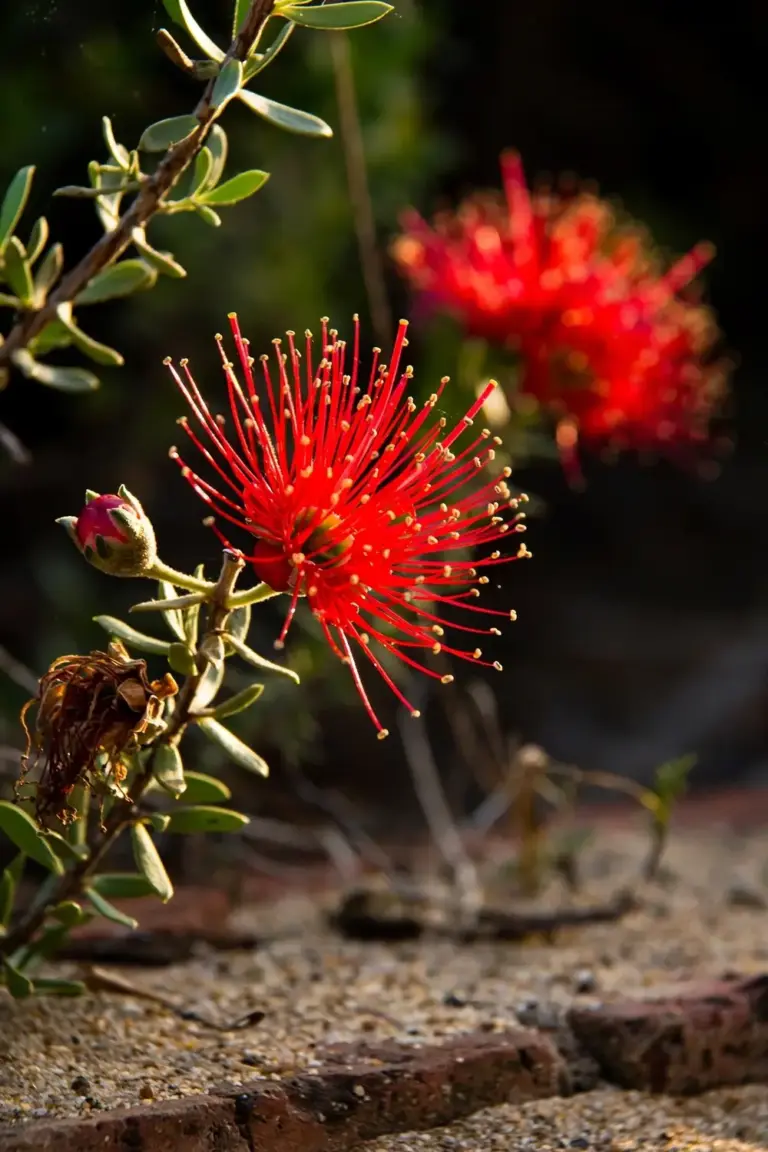
The shrub grows upright to 4 meters, with scarlet flowers that draw nectar-loving birds. The same profile says it attracts birds, especially parrots, when in full flower. Nurseries Online lists it as an upright shrub to 4 meters with spectacular scarlet flowers and aromatic foliage. Give it room to spread. A cramped corner hides the flower display and starves the lower growth of light.
Scarlet kunzea comes from south-west Western Australia, and it carries a provenance warning. The same profile reports that the species has naturalised in coastal Victoria, and it has gone weedy in parts of Western Australia outside its home range. Do not plant it near bushland outside its home range. In a town garden with no bushland edge, the risk drops. Near a reserve or a coastal strip, pick one of the other two kunzeas instead.
Growing needs stay plain. The same profile recommends well-drained soil in full sun, with room to spread. Prune after flowering to push a denser, tidier plant with more flowers. A slow-release native-plant fertilizer can help growth and health. Water while the plant settles, then ease off. Established plants handle dry spells, and the genus tolerates frost in most cases.
A Sydney grower backs that up with a field note. The profile editor reports two shrubs growing well after two years on sandy soil in southern Sydney, near 2 meters tall with some pruning, and not yet flowering. Two years without flowers on a seed-grown plant is normal. The grafted route exists for gardeners who want flowers sooner.
Grafting and cuttings beat seed for speed. The same profile notes that cuttings from semi-hardwood tips, taken from late spring through to early autumn, could produce flowers in one year or two at the latest. Grafting onto a suitable rootstock such as Kunzea ambigua can produce flowers within a very short period of time, and grafting creates strong, long-lived plants. Seed suits a patient grower with room for a slow shrub. Cuttings suit a gardener who wants flowers next season.
Flower season runs through the warm months. The Australian Native Plants Society genus notes say many kunzea species are most floriferous in spring and summer. Scarlet kunzea follows that rhythm. Flowers open in clusters at the branch tips, and the scarlet stamens carry the color. A plant in full flower stops traffic. Prune once the display fades, and the shrub sets the next season’s wood.
4. Kunzea vs Tea Tree: Stamens Longer Than Petals Tell Them Apart
Kunzea and tea tree are separate genera, and one flower test separates them. Kunzea stamens run longer than the petals. Leptospermum stamens run shorter than the petals, according to the Australian Native Plants Society Kunzea profile. Hold a flower up. If the stamens stick out past the petals like a fringe, the plant sits in Kunzea. If the stamens sit inside the petal ring, the plant sits in Leptospermum.
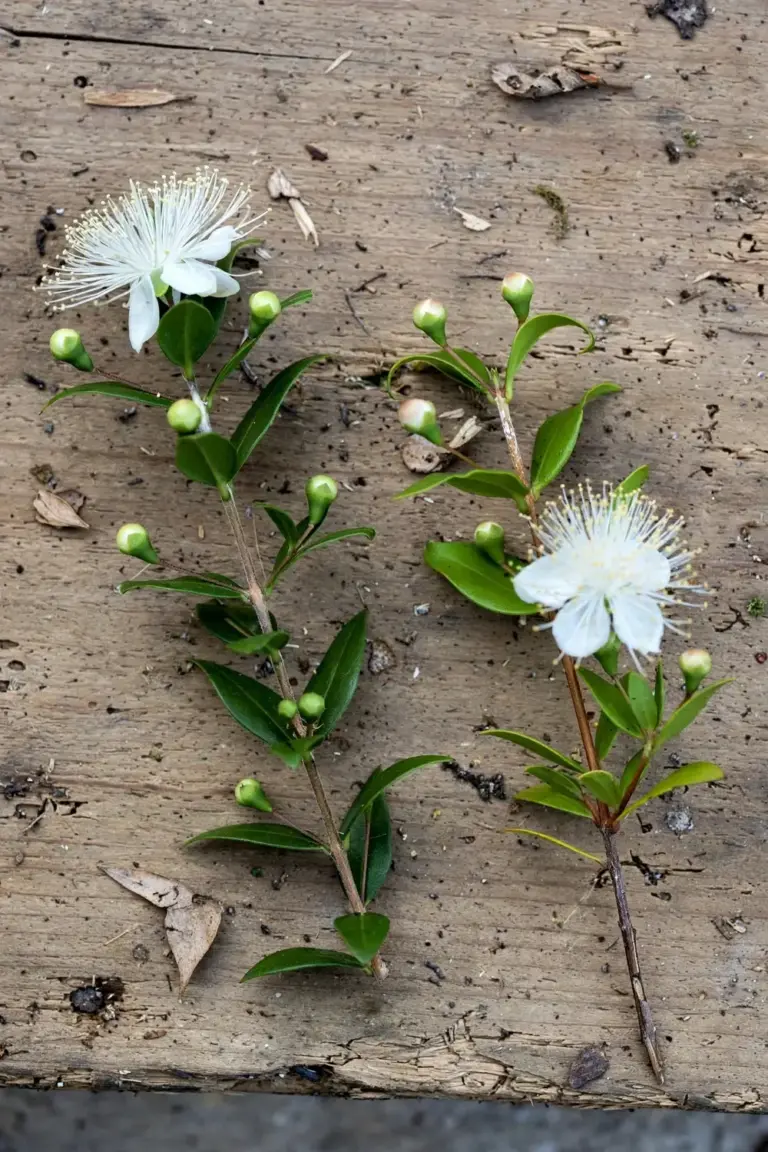
Three more differences back up the test. Kunzea sepals and petals fall off as the flower ages, while Callistemon keeps them. Kunzea stamens stand free, while Melaleuca stamens join into five bundles. Kunzea releases seed from ripe fruit each year, while the other three genera usually hold seed on the plant. The same profile lists each difference. Learn the stamen test first. The other three settle arguments.
Tea tree is a common name, not a genus. It covers Leptospermum species and Melaleuca species, and neither one is a Kunzea. A nursery label that reads “tea tree” can mean several plants. A label that reads Kunzea ambigua means one plant. Check the flower test on any plant sold as tea tree, and check the botanical name before following growing advice written for a different genus. Growing needs differ across the genera, and advice for one can mislead on another.
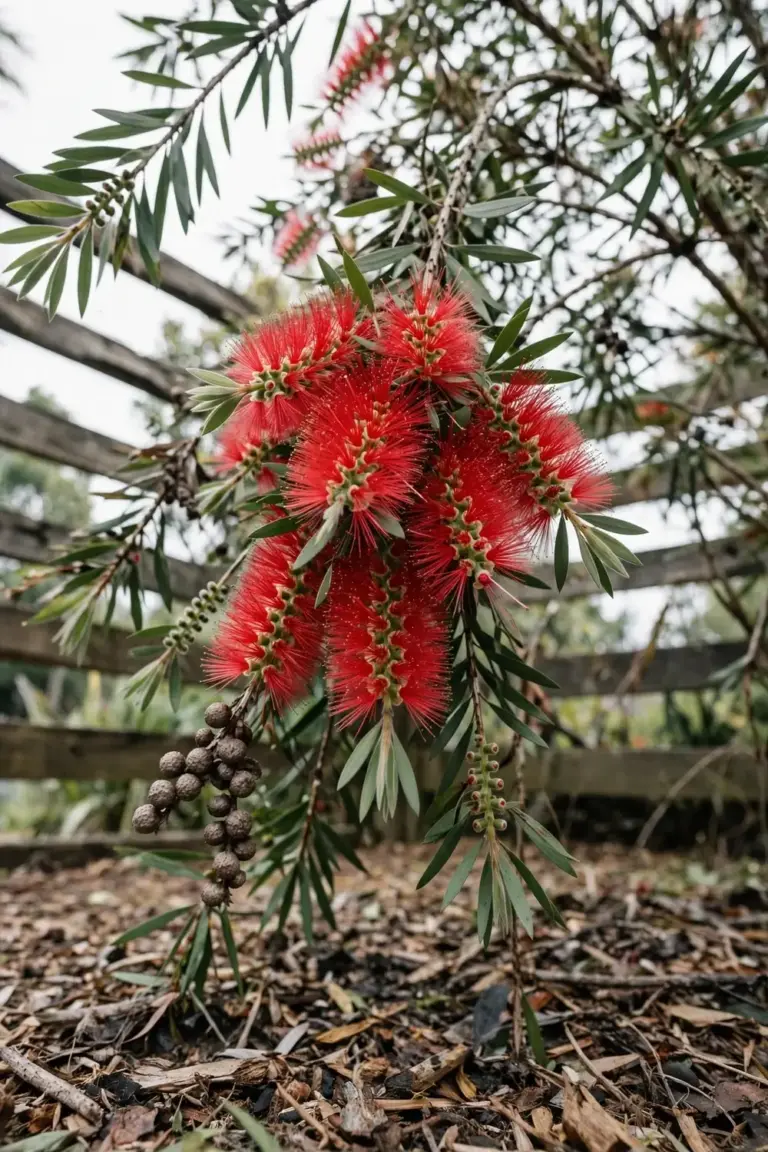
Scarlet kunzea adds a second confusion. Amber Leaf Landscaping notes that Kunzea baxteri can look like a bottlebrush and be mistaken for a Callistemon. The flower heads carry the same brush shape. The stamen test settles it again. Callistemon keeps its sepals and petals on the flower, while Kunzea sheds them. A bottlebrush that drops its petals points to Kunzea. A bottlebrush that holds them points to Callistemon.
The family tree explains the confusion. The same Australian Native Plants Society profile places Kunzea close to Callistemon, Melaleuca, and Leptospermum. All four sit in Myrtaceae, the myrtle family. All four carry five-petaled flowers with a stamen burst. The genera split on small parts: stamen length, stamen bundles, petal persistence, seed release. Gardeners meet the confusion at the nursery bench, where four genera share one flower shape and several common names.
Run the test at the nursery bench. Pick one open flower and hold it at eye level. Look at the stamens against the petals. Long stamens that clear the petals mean Kunzea, while short stamens that sit inside the petal ring mean Leptospermum. The test takes ten seconds and beats any common-name label. A plant that fails the test is not a kunzea, whatever the tag reads.
5. Pick the Right Kunzea for Your Job, Soil, and State
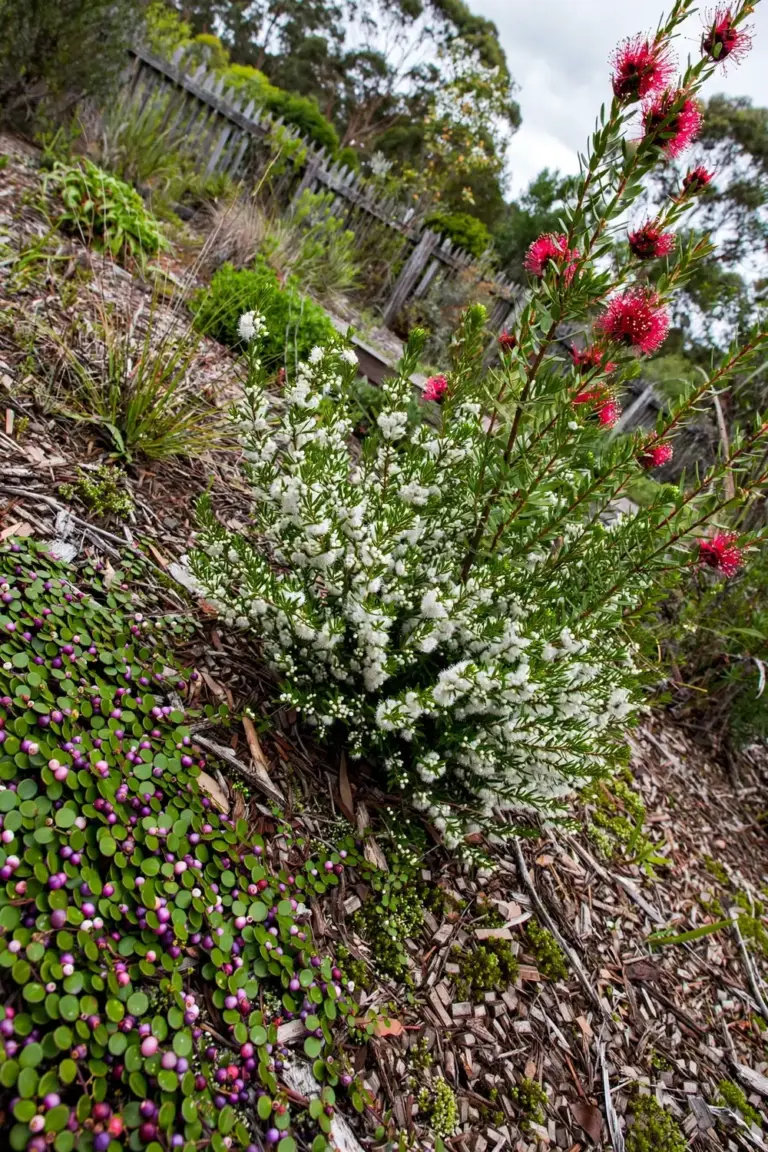
Match the plant to the job first, then the soil, then the state. Groundcover and fruit means muntries. Screening means tick bush. Red flowers means scarlet kunzea. The chooser table below lines up the three side by side.
| Species | Height | Spread | Flowers | Best Job | Home Range |
|---|---|---|---|---|---|
| Muntries (Kunzea pomifera) | Near 30 cm | 2 to 4 meters | White, fragrant | Edible groundcover, trellis fruit | SA and VIC southern coast |
| Tick bush (Kunzea ambigua) | Around 3 meters | 2 to 4 meters | White, massed | Screening, hedge, windbreak | Eastern Australia |
| Scarlet kunzea (Kunzea baxteri) | To 4 meters | Room to spread | Scarlet, showy | Feature shrub, bird garden | South-west Western Australia |
Soil decides whether any of the three thrives. All three want well-drained soil. Muntries tolerates alkaline soil, with Bunnings putting its range at pH 6.0 to 8.0. Tick bush sits in pH 5.5 to 7.5, per Sequoia Valley Farms. Scarlet kunzea wants well-drained soil in full sun, per the Australian Plants Society profile. If your soil holds water after rain, fix drainage before planting. Building soil health starts with drainage, and a kunzea in wet soil fails no matter how well you feed it.
Mulch helps new plants settle. A mulch layer holds moisture through the first summer and keeps weeds down while roots spread. What is mulching covers the depth and the trunk gap. Keep mulch off the stems. A mulch collar around a stem rots bark.
Pruning follows one rule across the three: prune after flowering. Spring pruning techniques cover the cut itself. Muntries needs only damaged growth removed, a five-minute job once a year. Tick bush needs a tip prune to stay dense, or it opens out with bare stems below. Scarlet kunzea needs a post-flowering prune for a tidier plant with more flowers next season. One light prune a year beats a hard cut every three years, and the plant never sulks.
Buy with a checklist. Read the botanical name on the label, not the common name. Ask whether a scarlet kunzea is grafted or seed-grown, since the answer sets the wait for flowers. Ask which form a tick bush holds, since the tall, low, and prostrate forms look alike in pots. Ask whether a muntries is a groundcover form or a trellis form, since both exist. A label that answers all three questions is worth more than a label with a glossy photo.
First-year care follows one calendar. Plant in spring or autumn. Water through the first summer. Mulch around the base and keep it off the stems. Tip prune after the first flowering. Skip fertilizer in year one. A plant that roots well in year one flowers well in year two. A plant pushed with feed in year one grows soft stems that dry out in the first heatwave.
Seed suits a patient grower. Seed starting steps cover the tray, the mix, and the water. Kunzea seed germinates on a porous mix with light covering. Cuttings beat seed for speed. Semi-hardwood cuttings root well for tick bush, and grafting onto tick bush rootstock brings scarlet kunzea into flower fastest. Buy grafted scarlet kunzea when flowers matter this season.
Wildlife value runs across all three. The Australian Plants Society notes that kunzeas attract beneficial insects and nectar-loving birds. Muntries flowers feed nectar-eating birds and insects, per Aussie Green Thumb. Tick bush flowers draw bees. Scarlet kunzea draws parrots and honeyeaters. A kunzea hedge feeds the garden while it screens it. Plant one near a vegetable bed and the pollinators spill over.
Pots suit two of the three. Muntries grows in pots and hanging baskets, per Local Food Connect. Tick bush suits pots too, with Daleys Fruit listing pot suitability as yes. Scarlet kunzea wants room to spread, so a pot cramps it. Pick a wide pot for muntries and a deep pot for tick bush, and keep both in full sun with free drainage.
State and site set the last filter. Muntries suits the southern coast and cool to warm temperate gardens, per Bunnings. Tick bush suits subtropical, warm temperate, and cool temperate climates, per Daleys Fruit. Scarlet kunzea suits dry-summer, wet-winter climates and adapts to humid areas with moderate frost, per the Australian Plants Society profile. Near bushland, scarlet kunzea drops out on provenance grounds. The other two carry no such warning.
A wrong kunzea is fixable. A muntries planted as a screen stays ankle-high and never blocks a view. A tick bush planted as a groundcover swallows the bed. A scarlet kunzea planted near bushland risks spreading beyond the fence. Move the plant in autumn while it is small, or give it away to a gardener with the right job for it. A kunzea in the wrong job still grows. It grows into a problem, not a feature.
Frequently Asked Questions
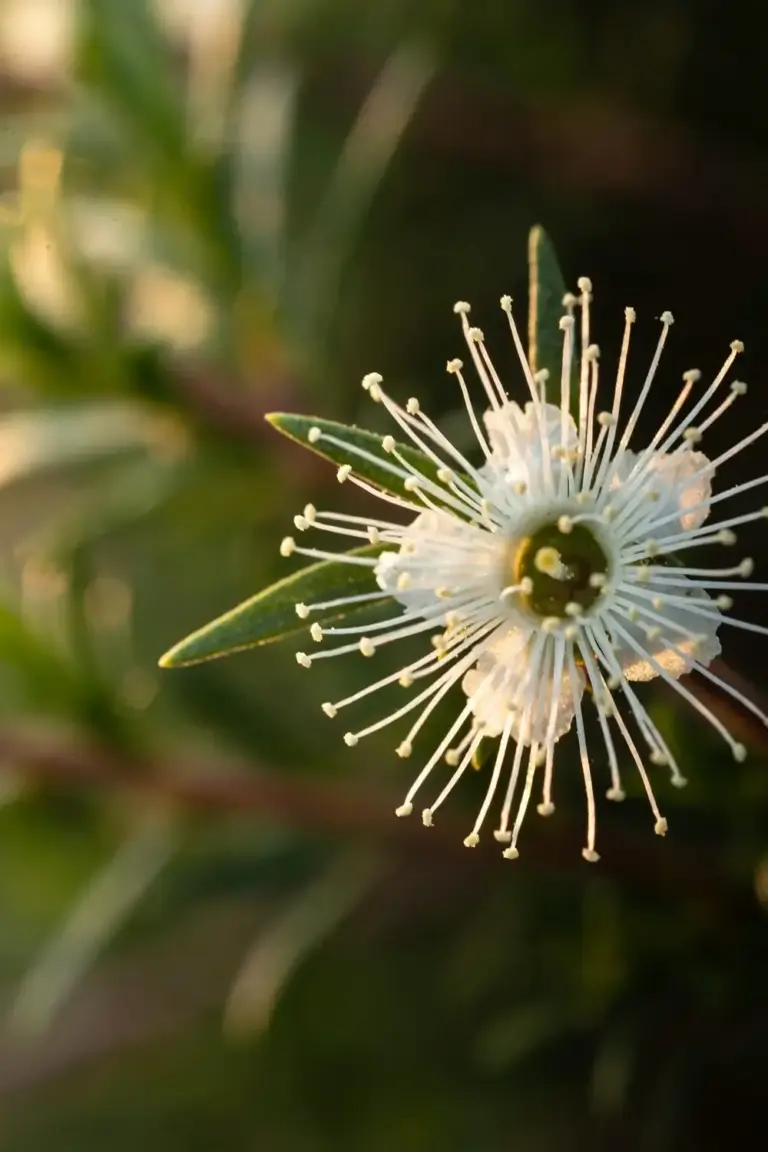
No. Kunzea and tea tree sit in separate genera. Tea tree covers Leptospermum and Melaleuca species, and neither one is a Kunzea. The flower test separates them fast. Kunzea stamens run longer than the petals. Leptospermum stamens run shorter. Check the flower and the botanical name before following advice written for a different genus.
Tick bush grows fastest for screening. Aussie Green Thumb reports that Kunzea ambigua can regrow about 1 to 1.5 meters tall each year, and young plants can reach 1 to 2 meters in their first year. Tip prune after flowering to keep the hedge dense from the base. A hedge that grows fast still needs that yearly prune, or it opens out with bare stems below.
Yes. Muntries berries are edible, eaten fresh or dried, with a spiced apple flavor. They ripen from green to red and turn fragrant when ripe. Some forms stay green even when ripe, so color alone does not settle ripeness. Smell the berry and squeeze gently. A fragrant berry that gives a little is ready. Wash fruit before eating, as with any garden crop.
Yes, in temperate and coastal gardens with well-drained soil and full sun. The Australian Plants Society profile notes it adapts to humid areas with moderate frost, so eastern gardens suit it. The caution is ecological, not climatic: the species has naturalised in coastal Victoria and gone weedy in parts of Western Australia outside its home range. Do not plant it near bushland outside its home range.
Established kunzeas need little feeding. The Australian Plants Society profile notes that a slow-release native-plant fertilizer can help the growth and health of scarlet kunzea. Apply lightly, once, in the growing season. Skip heavy feeding. A kunzea in well-drained soil with mulch around it grows steadily without a fertilizer program.
Start Growing Kunzea in Australia This Weekend
Pick the job first. Muntries for fruit and groundcover. Tick bush for screening. Scarlet kunzea for red flowers. Buy by botanical name, and check the flower test on anything sold as tea tree. Plant in well-drained soil in full sun, mulch around the base, and water through the first summer. Prune after flowering. The plant does the rest.
Start with one plant, not three. A single muntries on a trellis teaches the genus in one season. A single tick bush shows how fast the screen closes. A single grafted scarlet kunzea shows the flower display. Learn the genus on one plant, then add the other two next season with a full year of notes behind you.
Check the pot before buying. Roots circling the base mean a plant that sat too long. A firm root ball with white tips means a plant ready to grow. Leaves should look fresh, with no brown edges and no wilt. A plant that looks tired in the pot rarely recovers fast in the ground. Pick the freshest plant on the bench, not the biggest one sitting in the back row.