Water 1 ring of soil under the outer edge of the canopy instead of the trunk. That ring is the drip line, the circle on the ground below the tips of the longest branches, where rain drips off the leaves.
A tree sheds rain like an umbrella. Water runs off the leaves and falls at the canopy edge, and the roots that drink it grow in that same ring. The trunk itself has almost no feeding roots around it. Water aimed at the trunk soaks bark and starves the tree at the same time.
Stand under the tree on a rainy day and watch where the drops land. That wet ring on the soil marks the line.
| Feature | Detail |
|---|---|
| What it is | The circle on the ground below the outermost branch tips |
| Where the roots feed | At the line and past it, near the soil surface |
| Where to water | Slowly, at the line and beyond it |
| What to avoid | Water and mulch piled against the trunk |
What Is Drip Line?
A drip line is the imaginary circle on the ground directly below the outermost tips of a tree or shrub canopy. Rain falls off the leaf edge and lands on that circle, so the ground there stays wetter than the ground near the trunk. The line moves as the tree grows. A young tree has a small ring close to the trunk. A mature tree has a wide ring far from it.
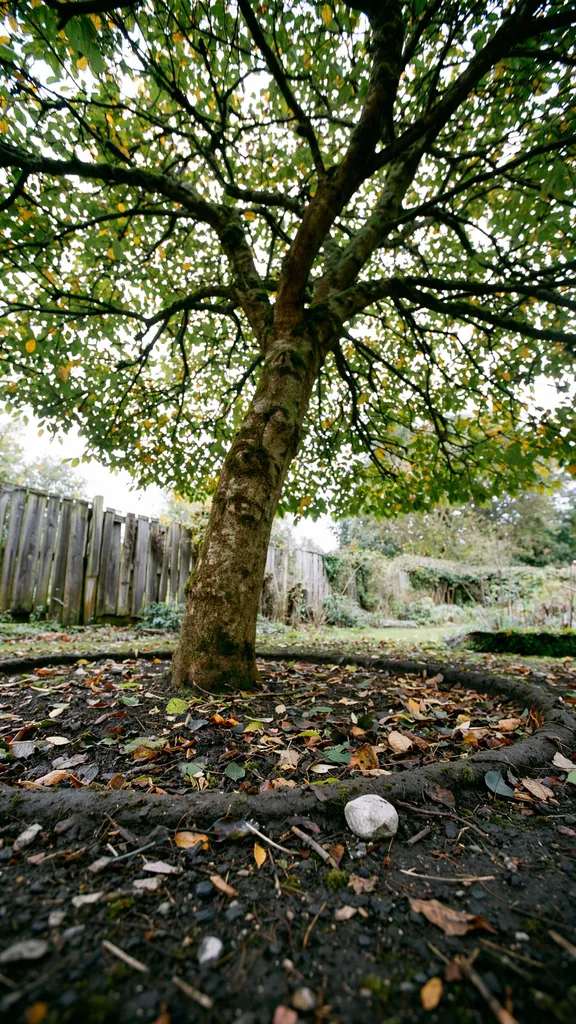
The most active water absorption area sits at the drip line and beyond it, not close to the trunk. The University of Arizona watering guide states that most tree roots spread 1.5 to 4 times as wide as the plant canopy, so the feeding roots reach far past the branch tips. The trunk anchors the tree. The ring feeds it.
A drip line is a place in the soil. Drip irrigation is a watering system. Drip irrigation uses tubing and emitters to deliver water drop by drop, and its emitters belong out at the drip line as the plant grows. The two share a word and a location. They are different things, and this page stays on the line in the soil.
Drip line belongs in the gardening glossary beside the other structure and protection terms, because it decides where water, mulch, and fertilizer go for every tree and large shrub in the garden.
How Drip Line Works
A drip line works because tree roots grow outward, not downward. A mature tree has no deep taproot doing the drinking. It has a wide, shallow mat of roots, and the fine feeder roots at the ends of that mat do the absorbing. Those feeder roots grow where rain lands and where the soil stays moist, which is the ring below the canopy edge and the soil just past it.
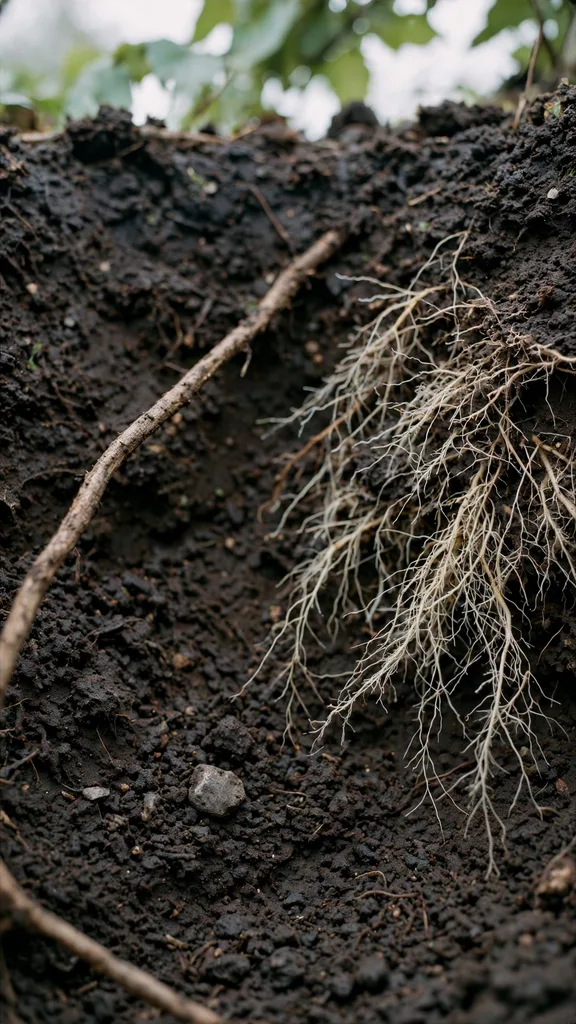
The University of Maryland planting guide notes that feeder roots extend 50 percent or more past the dripline, and that the majority of roots sit in the top 30.5 to 45.7 cm of soil. The root map is wide and shallow. Water must soak that shallow layer across a wide ring, not pour down one deep hole at the trunk.
| Layer | Where the roots live |
|---|---|
| Feeder roots | Top 30.5 to 45.7 cm of soil, at the line and past it |
| Root zone depth | 45.7 to 91.4 cm for trees, reached by slow deep watering |
| Anchor roots | Larger roots near the trunk, holding the tree upright |
| No-drink zone | Soil right against the trunk, with almost no absorbing roots |
Water at the line soaks the feeder mat. Water at the trunk soaks bark. Bark kept wet invites rot, and a trunk with rot cannot carry water up to the leaves. The tree then shows drought stress in the canopy while its trunk stands in wet soil. The fix is a change of place, not a change of amount. Move the water out to the ring.
Mulch follows the same map. A flat ring of mulch out to the drip line keeps the feeder roots cool and moist, and it keeps grass from stealing water from the same soil. Mulch spread in that ring does the work. Mulch piled against the trunk does the opposite, so the ring stays flat and the trunk stays bare.
Drip Line vs Drip Irrigation
Gardeners mix up drip line and drip irrigation because both involve water arriving drop by drop. The table below separates them. One is a natural line in the soil. The other is a system of pipes a gardener installs.
| Feature | Drip line | Drip irrigation |
|---|---|---|
| What it is | A circle on the ground below the canopy edge | Tubing with emitters that release water slowly |
| How it forms | Rain drips off leaves and marks the ring | A gardener lays pipe and sets emitters in place |
| What it does | Shows where feeder roots drink | Delivers water to chosen spots in the soil |
| Where it sits | Under the outermost branch tips | Anywhere the tubing runs, in beds, pots, or rows |
| What it needs | Nothing, it appears as the tree grows | Pipe, emitters, a water supply, and upkeep |
| How it changes | Widens as the canopy grows | Emitters move outward as plants grow |
The two meet at one rule. Drip irrigation emitters belong at the drip line and past it, where the feeder roots live. A new tree has a small canopy, so its emitters start close in. A growing tree pushes its canopy outward, so its emitters move outward with it. An emitter left at the trunk waters bark for years while the roots go thirsty at the ring.
How to Recognize and Measure a Drip Line
Find the drip line on a dry day with a tape and a helper. Stand at the trunk and walk out to the tip of the longest branch. Drop a marker on the soil below that tip. Walk around the tree and mark the tip of each long branch the same way. Join the markers. That ring is the drip line.
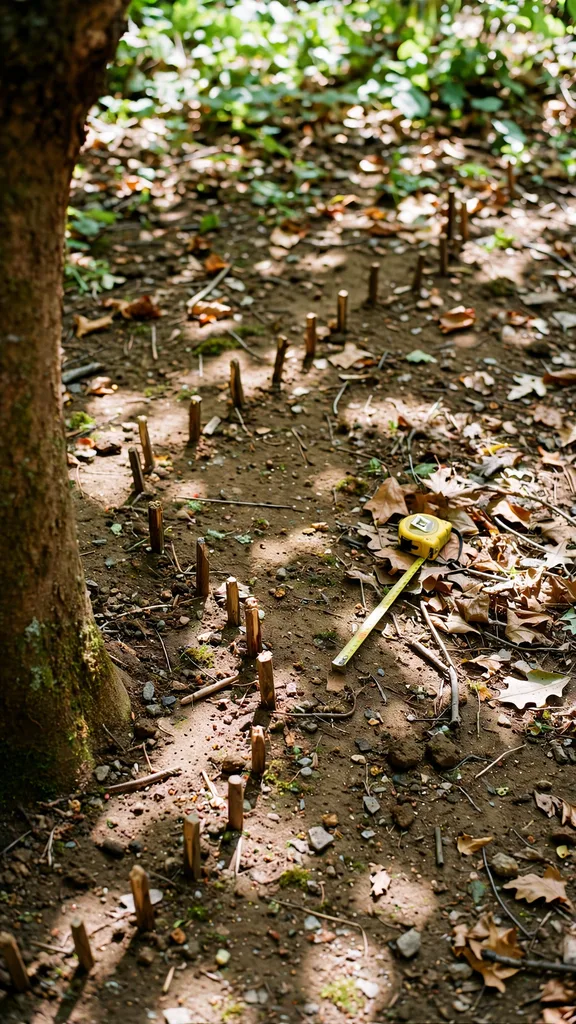
Measure the ring in 2 numbers. The first is the radius, the distance from the trunk to the line. The second is the reach past the line, the band of soil where feeder roots still drink. Water the ring and the band past it.
Check the line after rain too. The soil under the canopy edge darkens first, and the soil past the line darkens next. The soil near the trunk stays lighter, because the canopy sheds water outward like an umbrella. That wet pattern confirms the tape measurement without any digging.
Young trees break the rule in one way. A newly planted tree has roots only in its root ball, and its canopy is small, so its drip line sits close to the trunk. Water the root ball and the soil just past it for the first 2 years. The ring widens as the tree grows, and the watering ring widens with it.
Common Mistakes With Drip Line
Watering at the trunk is the first mistake. A hose left running at the base soaks bark and misses the feeder mat. The tree shows dry leaves while the trunk stands wet. The fix is a move, not more water. Shift the hose out to the ring and let the water soak in slowly.
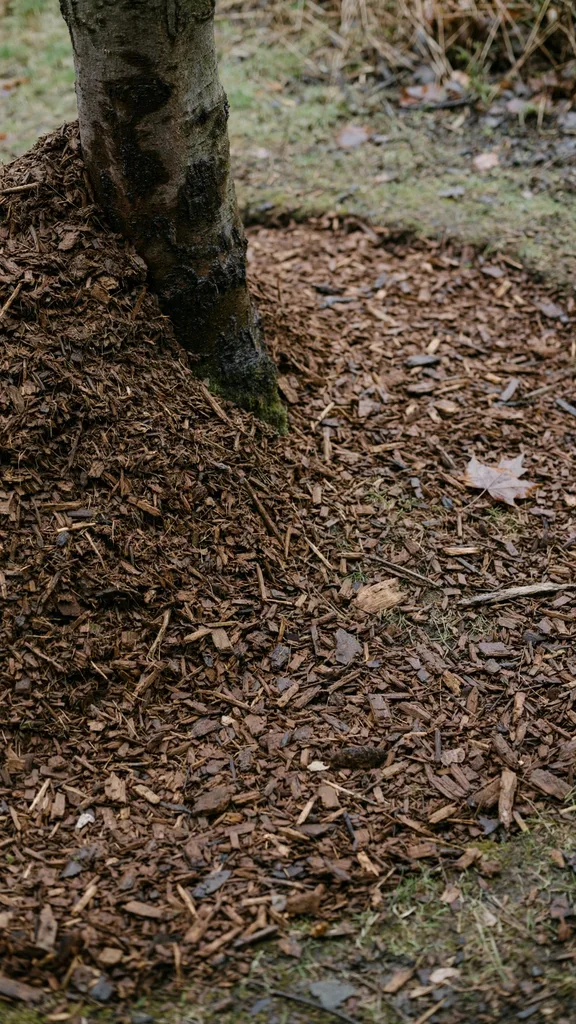
Piling mulch against the trunk is the second mistake. A mulch volcano traps moisture on bark, and bark kept wet rots. The tree then loses the tissue that carries water up to the leaves. Spread mulch flat out to the line, and leave a bare gap of soil around the trunk so bark stays dry.
Digging deep beds inside the line is the third mistake. A spade cuts feeder roots, and a deep bed severs the mat that feeds the tree. Shallow planting inside the line still harms roots if the digging cuts them. Plant groundcover at the line with a hand trowel and shallow holes, or leave the ring to mulch and grass-free soil.
Feeding at the trunk is the fourth mistake. Fertilizer scattered at the base sits where almost no roots drink, and rain washes it past the trunk into soil the tree cannot use. Scatter fertilizer in a band at the line and past it, where the feeder roots wait. The band follows the same map as the water.
When Drip Line Matters in Your Garden
Drip line matters every time a tree gets watered, fed, or mulched. A gardener who waters lawn sprinklers near a tree already waters part of the ring by accident, and a gardener who waters the trunk by hand misses it on purpose. The line decides whether the water reaches roots or bark. Drought makes the line matter more, because a thirsty tree with water at the wrong place still goes thirsty.
It matters when planting under a tree. The soil inside the line holds a dense root mat, and a thirsty shrub planted there competes with the tree for the same shallow water. Plant shade lovers at the line with shallow holes, or plant them outside the line where roots run thinner. A raised bed built under a tree sits on top of that root mat, and the tree roots will rise into its loose soil and drink its water first.
It matters during building work. A trench cut through the line severs feeder roots on one side of the tree, and the canopy above that side thins within a season. Fence the line before digging, and keep machines and soil piles outside it. A tree can lose a quarter of its root mat and still stand, but it will show the loss in the canopy.
It matters least for a new seedling with no canopy yet. A seedling has no ring to mark, and its roots live in the planting hole. Water the hole until the canopy forms, then find the line and move the water out to it. The line grows with the tree, and the watering habit grows with the line.
FAQ
A young tree has a small canopy, so its drip line sits close to the trunk, below the tips of its longest branches. Its roots still live mostly in the root ball, so water the root ball and the soil just past it for the first 2 years. As the canopy widens, mark the line again each season and move the water outward with it.
Water at the drip line and beyond it, because feeder roots reach well past the line into the soil outside the canopy. Soak the ring and a band past it slowly, so water sinks into the shallow root layer instead of running off. Watering only inside the line misses the outer half of the feeding roots.
Planting inside the drip line is possible with shallow holes and shade-tolerant plants, but the root mat competes hard for water. Use a hand trowel, keep holes shallow, and water the new plants often until they settle in. Leave the soil near the trunk bare, and skip deep digging that cuts feeder roots.
Mulch belongs in a flat ring out to the drip line, where it keeps feeder roots cool and moist and holds grass back from the same soil. Spread it evenly and keep it off the trunk, with a bare gap of soil around the bark. A mulch pile against the trunk traps moisture on bark and invites rot.
A drip line and drip irrigation are different things that share a word. A drip line is the natural circle on the ground below the canopy edge, where rain drips off the leaves. Drip irrigation is a watering system of tubing and emitters. Its emitters belong at the drip line, because the feeder roots drink there.