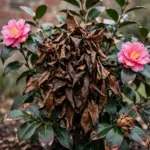

Quince rust has no cure once orange spore horns cover the fruit. The 10 strategies below break the two-host cycle that keeps the fungus alive, starting with the triage call that tells you whether spraying is worth it at all.
The signature is fruit covered in pinkish-orange tubes, with twigs that swell, crack, and die back. Leaves stay nearly clean, which is the first clue that this rust is not the leaf-spotting cedar-apple rust. A juniper or eastern red cedar nearby carries the other half of the cycle, often with no visible sign until spring rain turns its branch swellings to orange gel.
The rest of this page runs the order a gardener should follow. Identify the disease first, then decide whether the tree is worth treating, then work the 10 steps from the first cut to next-season scouting. I have learned that the spring walk past the junipers matters more than any spray bought after symptoms show.
What Quince Rust Actually Is
Quince rust is a fungal disease of pome fruits. The fungus Gymnosporangium clavipes causes quince rust.
Quince rust and cedar-quince rust are the same disease under two names. Nurseries and older guides say quince rust, while botanic gardens and Extension pages say cedar-quince rust. Both names point at Gymnosporangium clavipes and at nothing else. The “cedar” in the second name refers to eastern red cedar, which is a juniper, not a true cedar. The “quince” in the name refers to the namesake host, and the disease reaches far beyond quince alone.
The Missouri Botanical Garden cedar-quince rust page states that cedar-quince rust has the broadest host range of the three cedar rusts, reaching apple, crabapple, pears, quince, hawthorn, serviceberry, mountain-ash, flowering quince, cotoneaster, chokeberry, and photinia. The fungus needs two hosts to complete its life cycle: one juniper or eastern red cedar, and one rose-family plant in the pome group. Spores from one host group can only infect the other group, so spores from a pome host never infect another pome host.
No spray cures an infected fruit or twig. Every treatment below either protects healthy tissue before infection or removes the inoculum that starts the next round. The Missouri Botanical Garden lists living with the disease as one of its five management strategies, and that honesty sets the tone for this article. A hawthorn grown for flowers and fall color can carry quince rust for years without dying. An apple tree grown for eating needs the full program.
How to Identify Quince Rust on Fruit and Twigs
Check the fruit first, then the twigs. Quince rust attacks fruit and twigs on the pome host. Leaves seldom show symptoms.
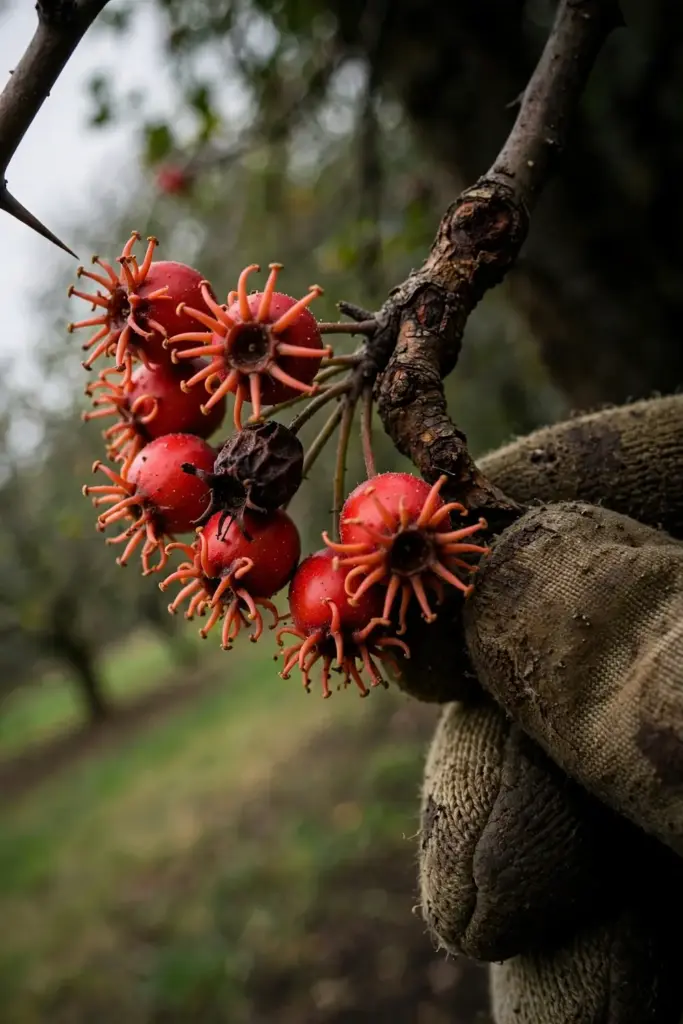
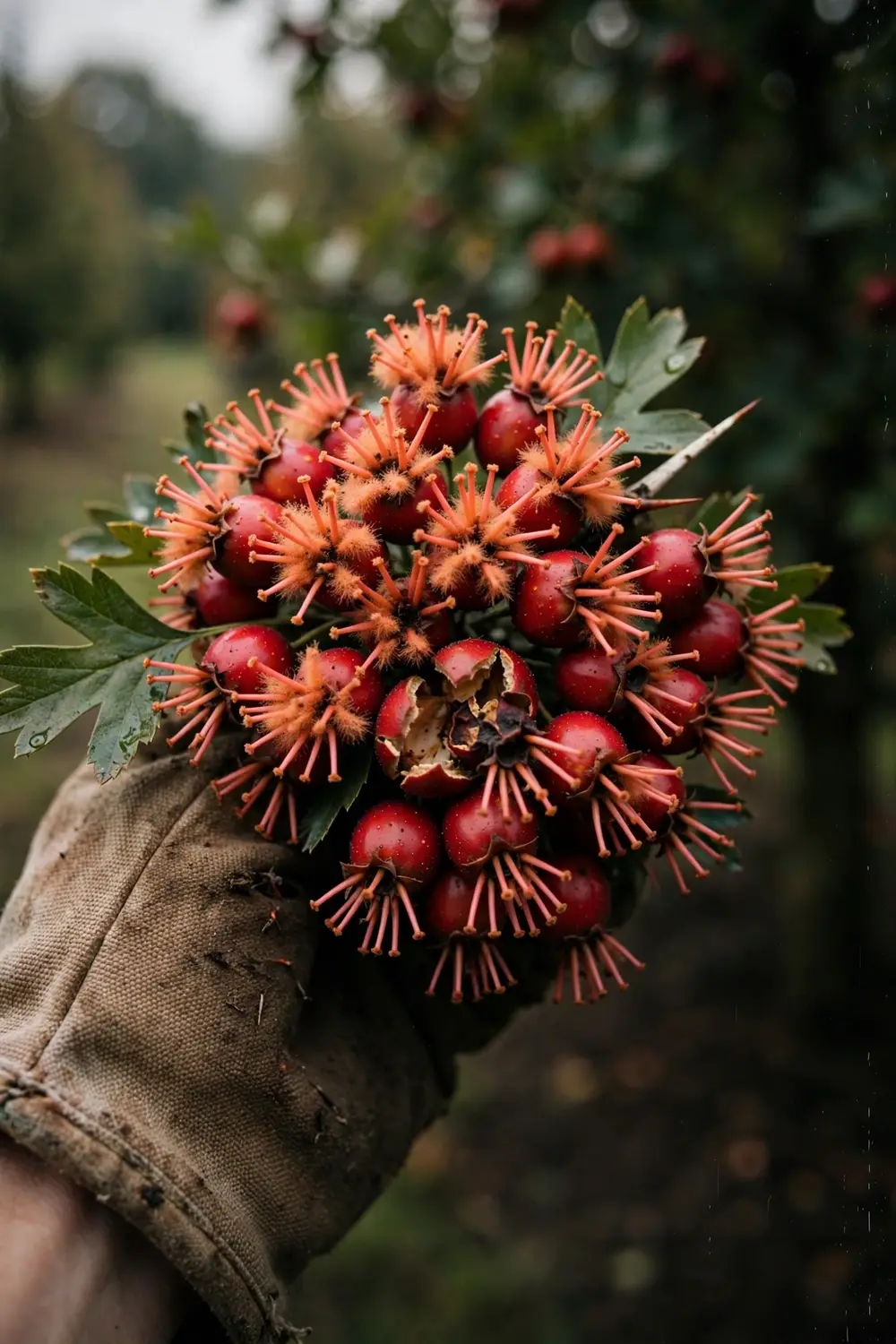
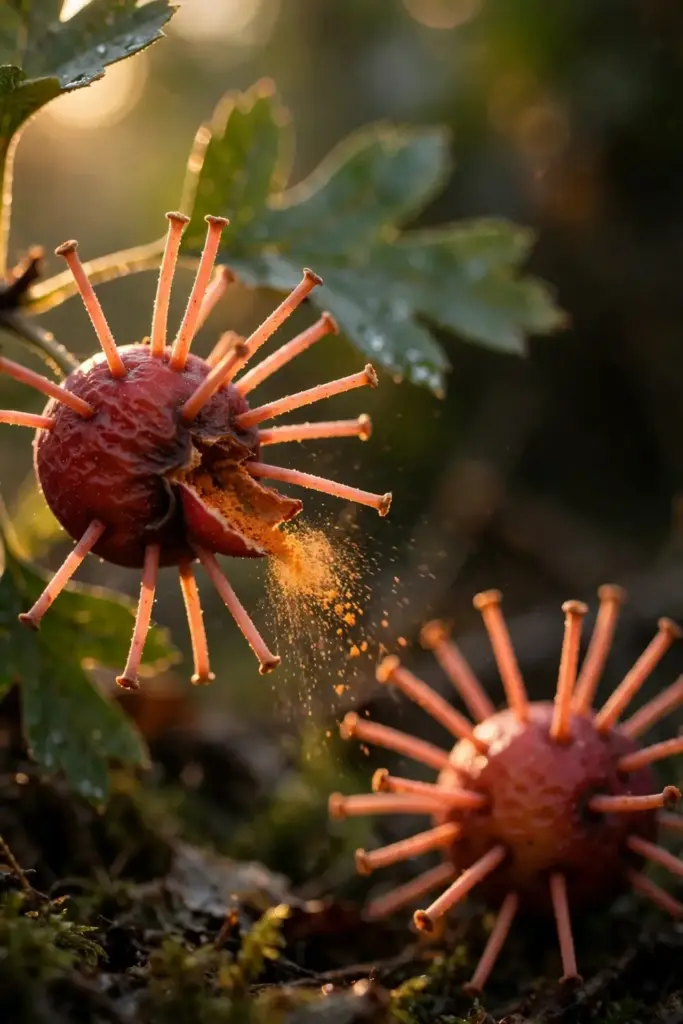
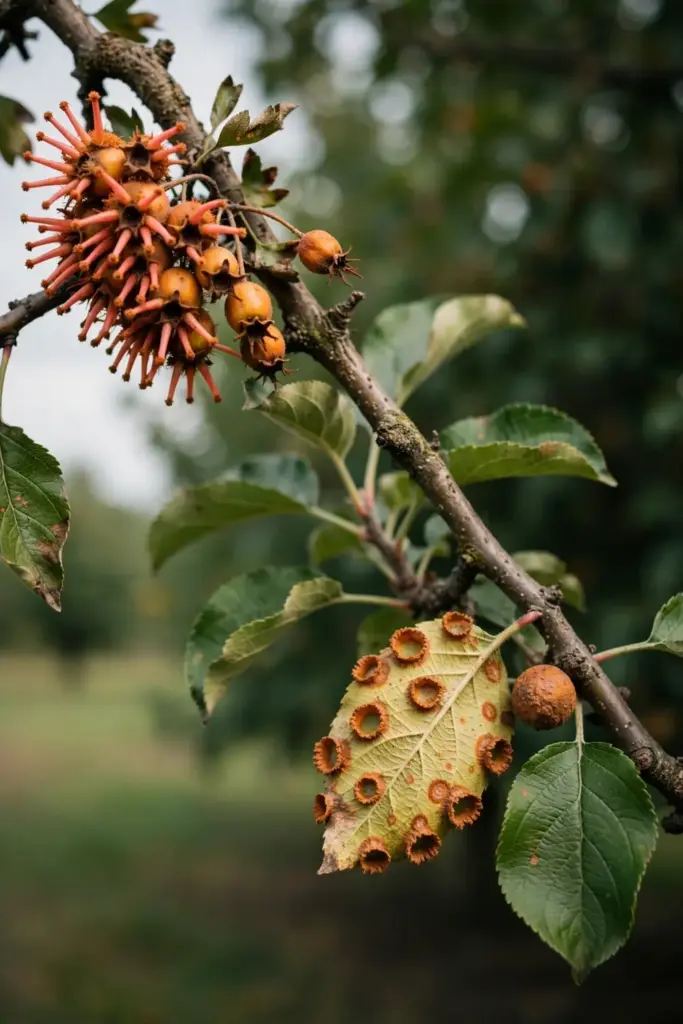
Infected fruit stops growing, deforms, and often dies on the branch. Purple lesions mark the skin early. Cup-like structures then push out of the fruit and release orange rust spores. On hawthorn, the fruit turns into a pincushion of pinkish-orange tubes. On serviceberry, the fruit often ends up heavily covered with the same tubes. The Iowa State University Yard and Garden quince rust page states that the fungus may stunt and kill fruit, that cup-like structures producing orange rust spores form on the fruit, and that leaves seldom show symptoms.
Twigs tell the second half of the story. Infected twigs develop rough, swollen, canker-like areas that stand out after leaves fall. The swellings distort the twig and kill tissue past the infection point. Petioles distort and die too. On hawthorn, branch and thorn infections grow into spindle-shaped perennial cankers that expand each growing season. Most infected branches are girdled by the canker during the second season, causing dieback to a bud or side shoot. A twig that swells, cracks, and dies back while the leaves stay nearly clean points at quince rust. A twig that only wilts, without swelling or spore tubes, needs a closer look before you call it rust.
How to Identify Quince Rust on Junipers and Cedars
Check the juniper in spring, after rain. Quince rust on juniper hides as elongated branch swellings until wet weather exposes it.
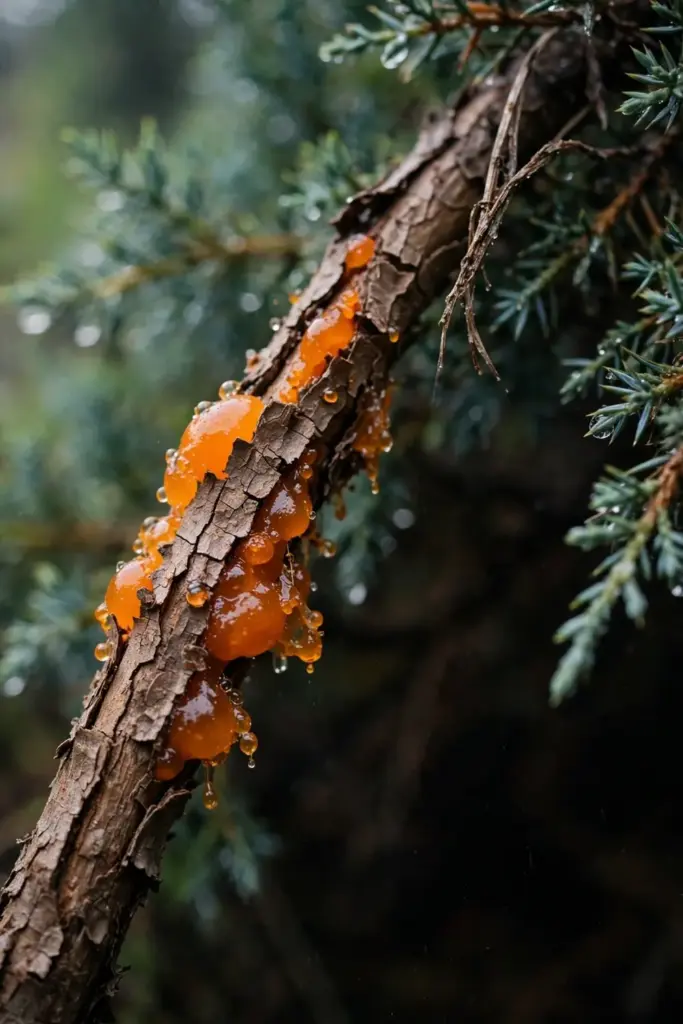
The swellings sit on twig tips and small branches. They run along the branch rather than forming a round ball. They may crack and form cankers as they age. In damp spring weather, cushion-shaped orange gelatinous blisters burst through the bark where the branch is swollen. The Missouri Botanical Garden cedar-quince rust page describes perennial, elongated swellings on the tips of twigs and branches, which may crack and form cankers, with orange gelatinous blisters bursting through in damp spring weather.
The Iowa State page calls the same structures rough swellings and notes that reddish-orange jelly-like masses of spores ooze from the cankered areas in spring and blow to the pome host. Small twigs and branches girdle and die where swellings ring them. Cankers on the main trunk weaken the plant and can kill young branches outright. The swellings stay easy to miss until the orange gel appears. The Illinois Extension cedar-quince rust page notes that most people do not notice the branch swellings until the telia become wet, swell, and gelatinize to a bright orange color.
A juniper with round woody galls and long orange tendrils points at cedar-apple rust instead. A juniper with elongated swellings and a flat cushion of orange gel points at quince rust. Mark the branch with tape when you find a swelling. The same swelling can release spores again next spring, so the mark saves a second hunt.
Which Pome Fruits and Ornamentals Get Hit Hardest
Hawthorn takes the worst of quince rust. Crabapple and serviceberry come next for fruit damage. Apple sits lower on the list.
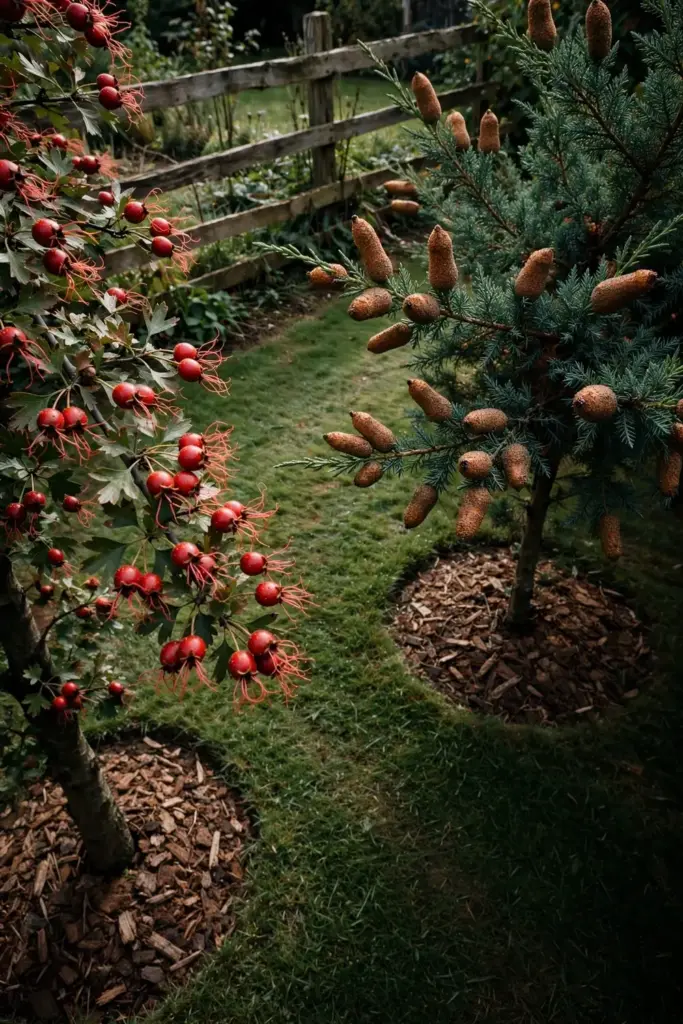
Hawthorn shows the full syndrome. Fruit gets covered in spore tubes, twigs swell into perennial cankers, thorns carry infections, and branches girdle and die back. Crabapple fruit deforms and dies the same way. Serviceberry fruit often ends up heavily covered with spore tubes. Apple trees catch quince rust, though the Illinois Extension cedar-quince rust page notes that apples are somewhat resistant. Pear, quince, flowering quince, mountain ash, mayhaw, cotoneaster, chokeberry, and photinia all host the fungus too.
If you grow apple fruits at home, check the ornamental pome fruits near the orchard with the same walk you give the fruit trees. A hawthorn hedge beside an apple tree feeds spores into the orchard every spring. The guide to growing crabapple fruits covers the crabapple side of the same planting. The guide to growing hawthorn herbs covers hawthorn as a garden plant. All three hosts share one fungus, so one infected plant in the group puts the rest at risk.
Junipers carry the other half of the cycle. Eastern red cedar, common juniper, prostrate juniper, Rocky Mountain juniper, and savin juniper all serve as evergreen hosts. A juniper that looks healthy in winter can still carry perennial swellings that release spores in spring. The evergreen side of the planting deserves the same spring inspection as the fruit side.
Quince Rust vs Cedar-Apple Rust vs Cedar-Hawthorn Rust
Check the tissue first, then the juniper gall. Quince rust attacks fruit and twigs and leaves the leaves nearly clean. Cedar-apple rust attacks leaves first. Cedar-hawthorn rust sits between them.
| Sign | Quince Rust | Cedar-Apple Rust | Cedar-Hawthorn Rust |
|---|---|---|---|
| Pathogen | Fungus. Gymnosporangium clavipes | Fungus. Gymnosporangium juniperi-virginianae | Fungus. Gymnosporangium globosum |
| Pome host tissue hit first | Fruit and twigs. Leaves seldom show symptoms | Leaves. Orange spots on upper surfaces, fringed cups below. Fruit also infected | Leaves. Spots much like cedar-apple rust. Green twigs occasionally deformed |
| Juniper gall shape | Elongated, flaky swellings along twigs. Cushion-shaped orange gelatinous blisters in wet spring weather | Round to kidney-shaped galls. Orange gelatinous horns and tendrils in wet spring weather | Smaller galls than cedar-apple rust. Similar orange gel in wet spring weather |
| Gall infectious period | Perennial. Swellings stay infectious for 4 to 6 years or more, up to 20 | One year only. Spent galls dry and fall | More than one year. Cedar-hawthorn and cedar-quince galls both outlast cedar-apple galls |
| Damage | Heaviest of the three to ornamental hosts. Fruit stunted and killed. Twigs girdled and dead | Mostly cosmetic leaf spots on ornamental hosts. Commercial apple fruit damage where pressure runs high | Leaf spots and twig deformation. Lighter fruit damage than quince rust |
| First move | Break the two-host cycle. Prune cankers, remove infected fruit, separate hosts, protect bloom | Protect leaves in spring. Prune spent galls off juniper | Protect leaves in spring. Prune galls off juniper |
The Missouri Botanical Garden cedar-quince rust page states that cedar-quince rust galls may remain infectious for 4 to 6 years or more, up to 20, whereas the cedar-apple gall is only infectious for one year. The Illinois Extension cedar-quince rust page confirms the same split and adds that only cedar-hawthorn and cedar-quince rust galls produce spores for more than one year.
One more lookalike deserves a short note. The Missouri Botanical Garden notes that quince rust damage superficially resembles bacterial fire blight. Fire blight blackens shoot tips into a crook and produces bacterial ooze. Quince rust swells twigs and covers fruit with spore tubes. The two diseases need different responses, so match the symptom set before you cut. Pear rust, caused by Gymnosporangium sabinae, is a fourth rust and a different disease again. It belongs to Europe and to pear leaves, not to this article.
Why the Two-Host Cycle Makes Quince Rust So Persistent
The fungus must alternate hosts. That single fact decides which controls work.
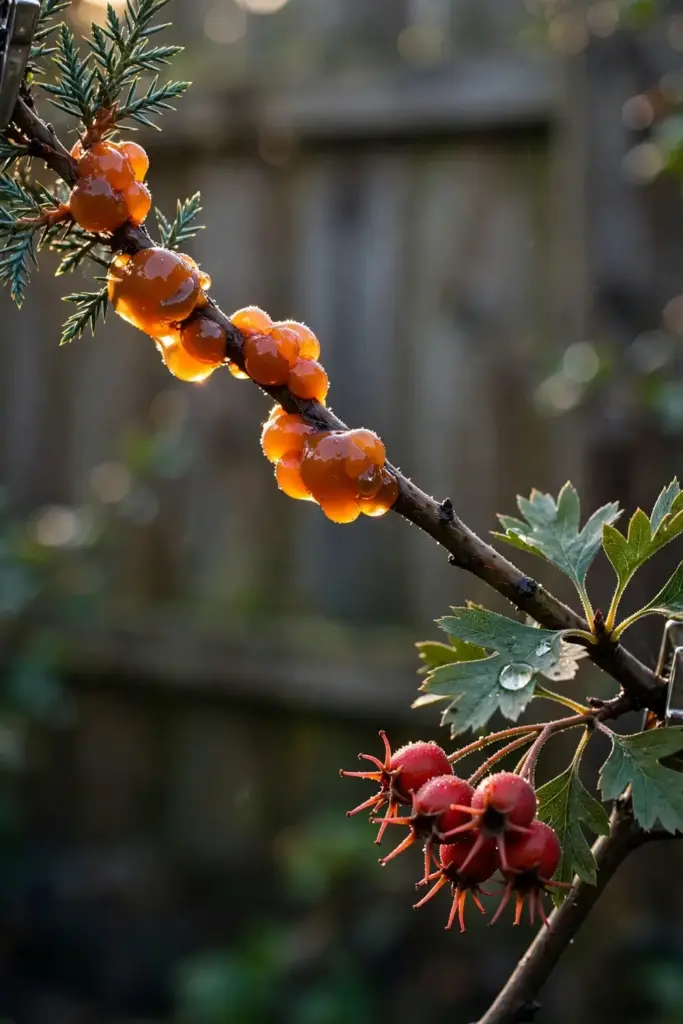
Basidiospores released from the juniper gall telial swellings infect stems and fruit of quince and the other pome hosts. Seven to 10 days after infection, spots or swellings develop, followed a few days later by tiny black dots within the spots. Four to 7 weeks later, aecia form. Aeciospores released from the aecia during rain or as morning humidity lowers become airborne and infect susceptible junipers during late summer and fall. The Missouri Botanical Garden cedar-quince rust page lays out this sequence and adds the spring trigger. The following spring, swellings develop on the juniper host. When the swellings are mature, a few hours of wet, cool spring weather at 74 to 78 degrees Fahrenheit are sufficient for repeated telial swelling and the release of basidiospores that infect quince and other pome hosts.
The full round trip takes close to two years. Juniper gel in spring infects pome fruit and twigs. Summer aecia on that fruit infect junipers. The next spring brings new swellings, and the spring after that brings mature gel again. No stage repeats on the same host group. That gap is the opening. Every spore that lands on the wrong host group dies without starting an infection.
The perennial gall is the reason one bad spring echoes for years, while a cedar-apple gall fires once and falls. A quince rust swelling on juniper stays infectious for 4 to 6 years or more, up to 20. One swelling seeds a hawthorn planting through several springs. Pruning that swelling out removes years of future inoculum in a single cut. Leaving it guarantees another round next spring, and the spring after that.
What Makes Quince Rust Worse in a Home Garden
Planting pome fruits beside junipers feeds the cycle. The two host groups need each other, and a mixed planting hands the fungus both halves in one bed.
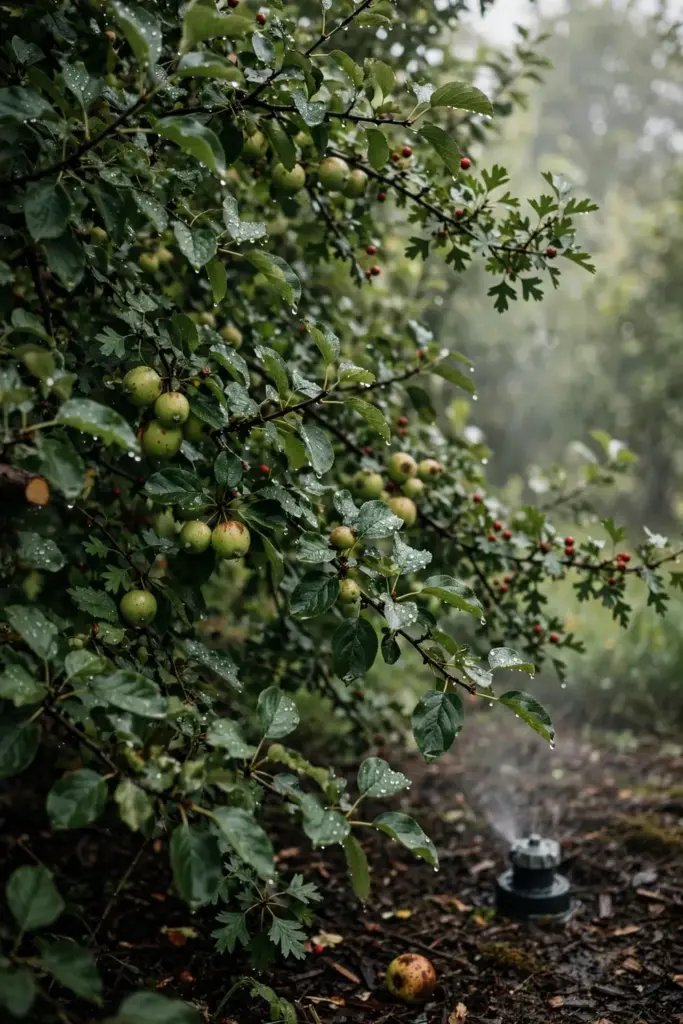
Overhead watering keeps the infection window open. Wet leaves and wet fruit give basidiospores the moisture they need to germinate. A sprinkler that wets the canopy every evening holds the pome host wet through the exact hours when juniper gel releases spores. Water at the base and let the canopy dry.
Skipping the spring juniper check wastes the whole season. The orange gel stage lasts several weeks, and that stage is the only time protective sprays help. A gardener who first notices the disease on fruit in summer has missed the spray window. The fruit is already infected. The work left is sanitation and next-spring timing.
Leaving infected fruit on the tree or the ground feeds the return trip. Aecia on that fruit release aeciospores that infect junipers in late summer and fall. Every fallen fruit left under the tree becomes next spring’s juniper swelling. Picking up fruit costs minutes and removes a full season of inoculum.
Dense canopies and tight spacing slow drying. A crowded planting holds morning humidity long after an open planting dries. Thin the canopy for airflow and light. Space new plantings so air moves between trees. Planting susceptible varieties beside susceptible junipers stacks every risk factor at once.
Step 1: Decide Whether Treatment Is Worth It
Count the damage before you reach for a spray. A tree grown for eating earns the full program. A tree grown for flowers may not.
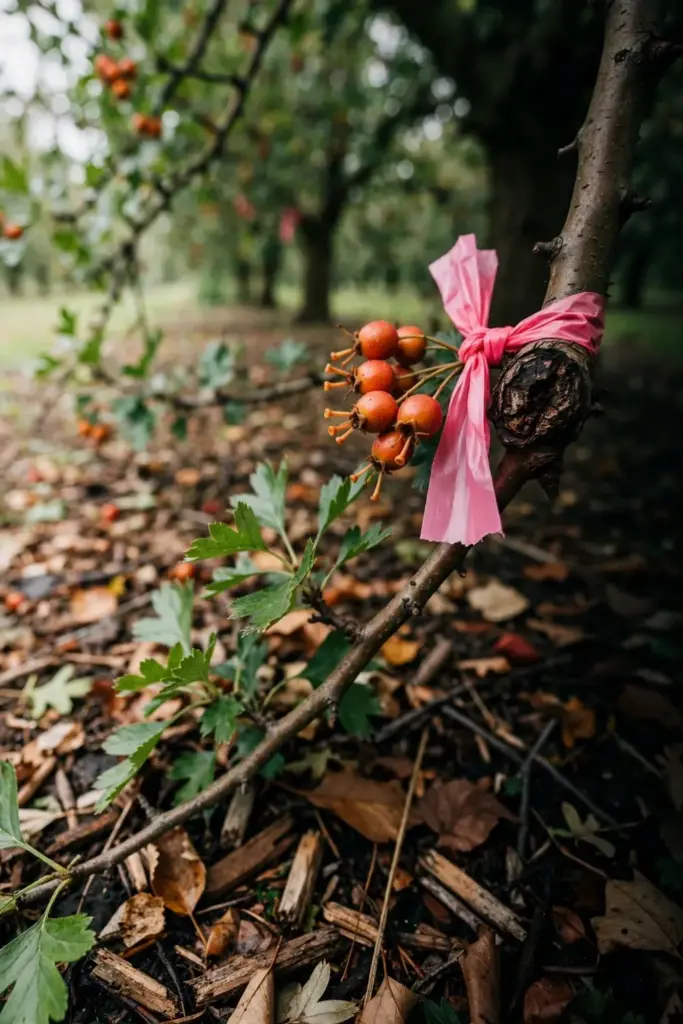
Spraying after symptoms appear wastes money, because protective sprays shield healthy tissue and nothing more. They do not cure fruit that already shows spore tubes. A hawthorn grown for spring flowers and fall color can live with quince rust for years. The fruit looks rough, the twigs die back in spots, and the tree survives. The Missouri Botanical Garden lists living with the disease as a real option, and for an ornamental hawthorn that option is often the right one.
A fruit tree you harvest from earns the work. Quince rust stunts and kills fruit, so a susceptible apple, crabapple, or mayhaw loses the crop it was planted to give. A tree with a few strikes earns pruning, sanitation, and a spring spray program. A tree with cankers on the main trunk earns removal, and Step 9 covers that call.
Ask one more question before you spend anything. Is there a juniper within spore range? Wind carries basidiospores well beyond the tree that shed them, so a juniper a street away still counts. If the neighborhood holds junipers you cannot remove, the program still helps, and it still lowers pressure. Separation alone never guarantees zero infection. The honest goal is fewer infected fruit each year, not a rust-free garden.
Step 2: Separate Pome Fruits From Junipers at Planting
Do not plant junipers close to susceptible varieties of apples, crabapples, or quince. That sentence is the cheapest control available.
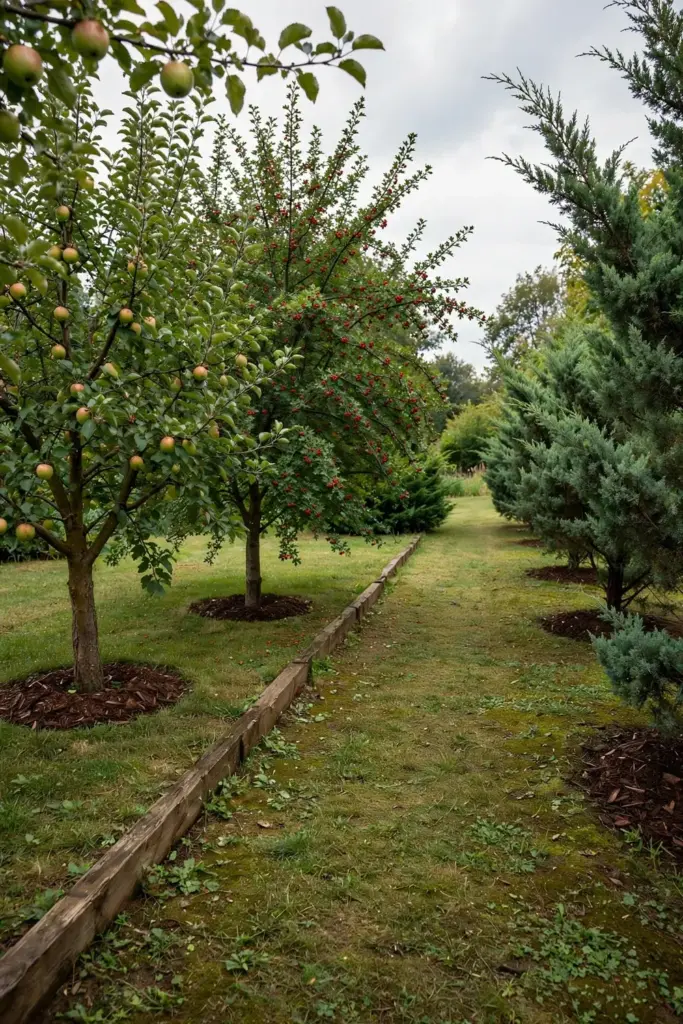
New plantings get the full benefit of separation. Put the pome group in one part of the garden and the junipers in another. Site the fruit trees where morning sun dries the canopy early. Site junipers where their spring gel does not sit upwind of the fruit trees. A windbreak, a fence, or a building between the groups helps, and distance helps more.
Existing plantings need a different decision. Moving a mature tree costs more than the rust it prevents. If both groups already grow side by side, skip transplanting and work the other nine steps. Prune the juniper swellings, protect the pome bloom, and clean up the fruit. Separation is a planting decision, not a retrofit.
Check the property lines too. A neighbor’s juniper counts as your juniper for spore purposes. You cannot prune a tree you do not own. You can still protect your own fruit trees, and you can still ask the neighbor about a shared pruning day. A polite conversation beats a fence-line argument, and a pruned juniper helps both gardens.
Step 3: Prune Out Cankers and Infected Fruit in Dry Weather
Prune out the cankered areas on the pome hosts and any gall-like areas on the junipers if practical. That is the working rule from Iowa State, and it holds for every host on the list.
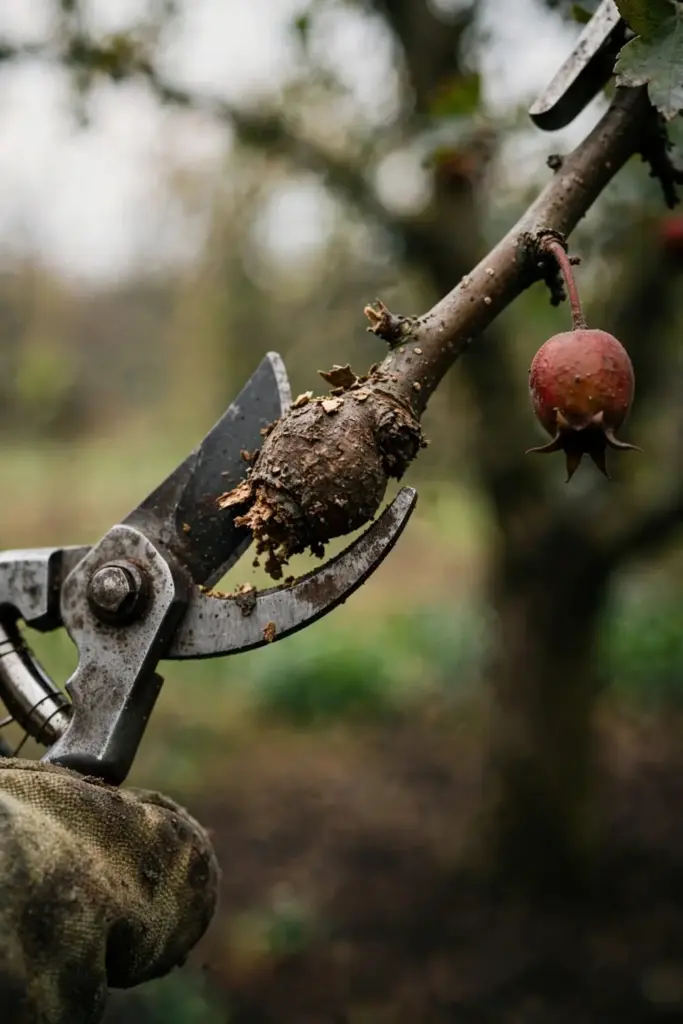
The Iowa State University Yard and Garden quince rust page gives that order directly: prune out the cankered areas on the pome hosts and any gall-like areas on the junipers if practical, and avoid planting pome trees in the vicinity of cedar hosts. Cut back into healthy wood past the swollen or cankered tissue. Remove infected fruit from the branch at the same time. A fruit left on the branch keeps releasing aeciospores into late summer.
Prune on a dry day. Wet bark spreads spores on tools and hands. Walk the tree first. Flag every canker with tape. Cut the worst branches first. Work outward to the lightest ones. Disinfect the blade between cuts, especially after cutting through ooze or gel. The spring pruning techniques guide covers clean cut placement for fruit trees in full.
Carry a bag or a tarp to the tree. Drop every cutting straight into it. Do not drag prunings through the garden on the way out. Dragging smears spores across healthy bark and drops infected fruit along the path. Step 4 covers what to do with the bag.
Step 4: Clean Up Fallen Fruit and Never Compost It
Remove as much of the infected twigs, fruit, and leaves as possible. That sentence is the sanitation standard from Illinois Extension, and it applies to the ground as well as the tree.
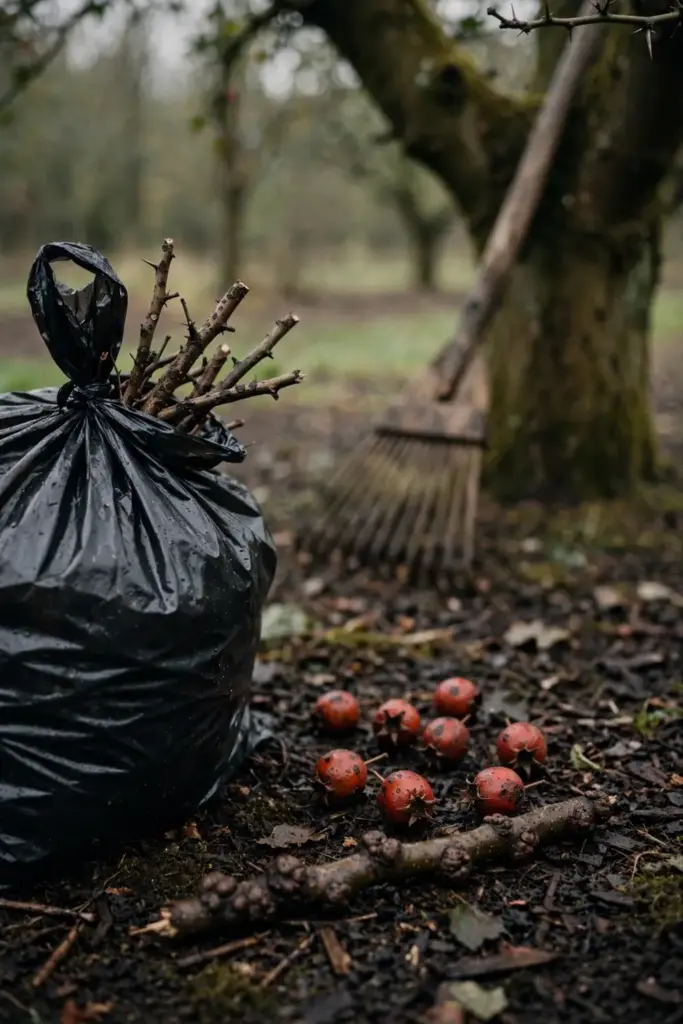
Pick up every fallen fruit under an infected tree. Fallen fruit carries aecia that release aeciospores toward junipers in late summer and fall. Rake the ground under a heavily struck tree and remove the debris. Check the branch crotches and the mulch for fruit that lodged out of sight. A single missed fruit still feeds the return trip.
Bag the trimmings for trash. A home compost pile rarely runs hot enough to kill rust fungi in thick wood, and the pile then feeds spores back into the garden when the compost spreads. Burning works where local rules allow it. Bagging works everywhere else. Do not leave prunings in a brush pile beside the orchard. A brush pile is a spore bank with a roof.
Work from the healthiest tree to the sickest tree if you can, or wash tools and hands after the sickest tree. The order matters less than the cleanup. Every cutting in the bag is a season of inoculum that never happens.
Step 5: Remove Infected Junipers You Own
Remove infected evergreens from your own property if practical. One heavily infected juniper can seed a whole street of pome trees.
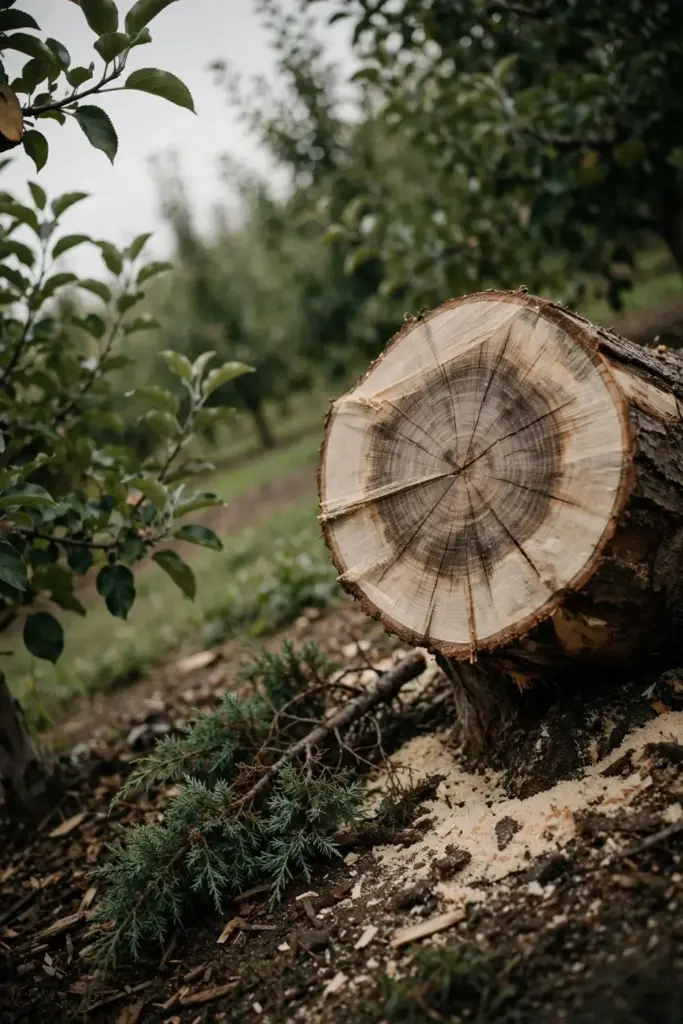
Start with the juniper that sits closest to the fruit trees. Walk it in spring. Count the swellings. A juniper with a few swellings earns pruning. Cut the swollen branches out in dry weather. Bag the wood. A juniper with swellings on most branches and cankers on the trunk earns removal. Pruning a juniper that is mostly gall tissue leaves a skeleton that still releases spores.
Do not cut a neighbor’s juniper. That tree is not yours to prune or remove. The honest answer for a neighbor’s juniper is protection on your side: prune your own trees, spray on schedule, and clean up your own fruit. A neighbor who understands the cycle may agree to prune. A neighbor who does not agree still leaves you with a workable program.
A juniper you value as a specimen deserves a middle path. Prune the gall areas each dormant season, inspect every spring, and accept that the tree needs yearly attention. A specimen juniper with light infection stays in the garden with care. A specimen juniper with heavy infection costs more in yearly pruning than a replacement tree costs once.
Step 6: Time Protective Sprays to Bloom and Juniper Gel
Protective sprays work in spring, when the orange masses appear on the junipers. That timing is the whole program.
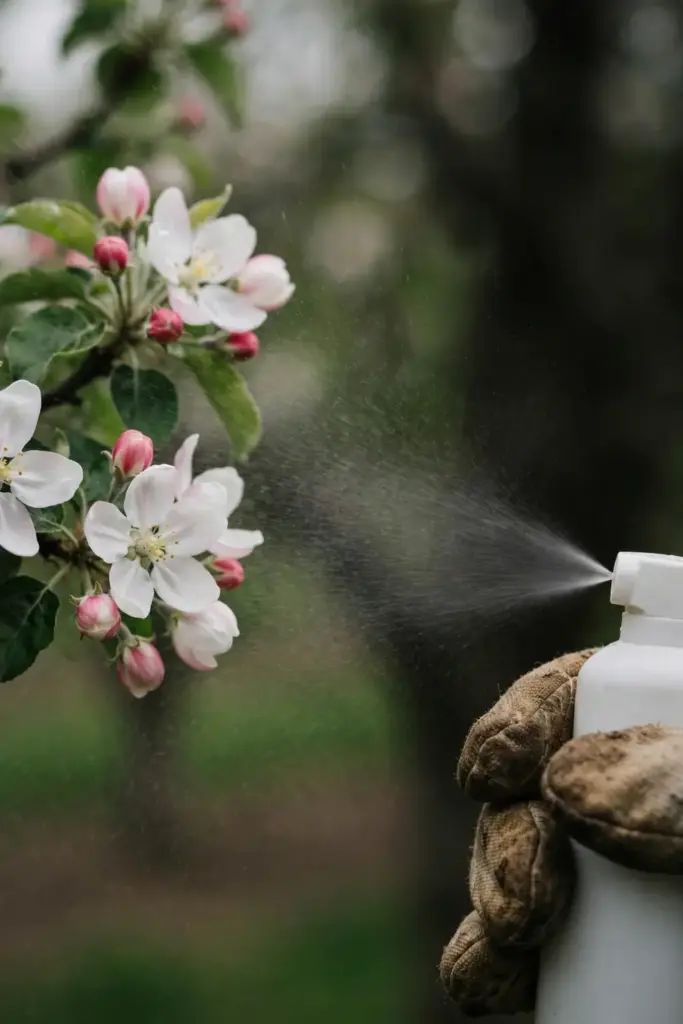
The Iowa State University Yard and Garden quince rust page states that protective fungicide sprays may be applied to the pome hosts in the spring when the orange masses appear on the junipers, and that the label determines whether the host is listed, plus the timing, the application rates, and the safety precautions. The orange gel on the juniper is the signal. No gel, no spores. Gel present, spores releasing. Walk the junipers first, then spray the pome trees.
Homeowner fungicide options start with sulfur or myclobutanil. The LSU AgCenter quince rust of mayhaw page states that fungicides available for homeowners are sulfur or myclobutanil, and that copper fungicides may be used but not during bloom. The same page sets the mayhaw window from the time the flower buds begin showing color through bloom, and warns that mayhaw fruit is susceptible to infection as the blossoms open and until shortly after petal fall. Read the product label to make sure the product is labeled for quince rust and for the crop you spray. Follow the mixing instructions and the pre-harvest interval.
The Missouri Botanical Garden adds a wider registered list: captan, chlorothalonil, mancozeb, sulfur, thiram, and ziram. Fungicide sprays protect developing twigs and branches from infection during the time the galls on the junipers are orange and gelatinous. That period usually lasts for several weeks. Fungicide applications are not necessary once the galls become dry and inactive. Spraying after the galls dry wastes product. Spraying after fruit shows spore tubes wastes product too. The spray protects tissue that is still healthy. It cures nothing.
Step 7: Watch Junipers Every Spring for Fresh Gel
Examine the junipers every spring, before the pome trees bloom. The gel stage sets the calendar for the whole year.
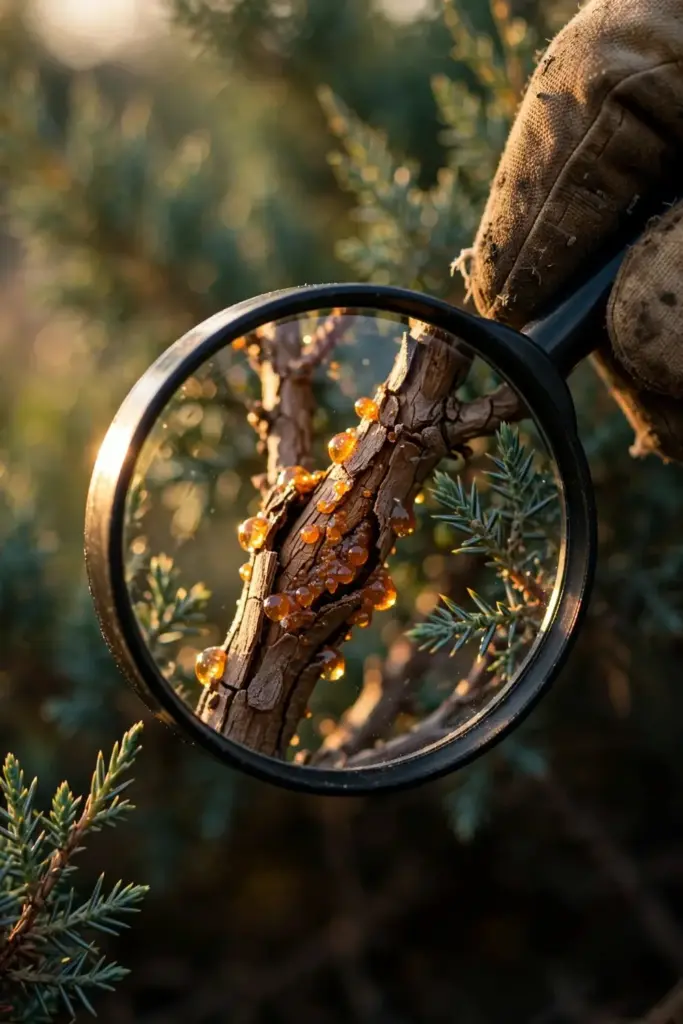
Start the watch when spring rain arrives and temperatures turn mild. Look for swellings on twig tips and small branches, and watch for the first orange blister breaking through the bark. A few hours of wet, cool spring weather at 74 to 78 degrees Fahrenheit are enough for mature swellings to swell again and release basidiospores. One wet weekend starts the infection round.
Mark the first gel sighting on a calendar. That date opens the spray window. That date also tells you when to walk the pome trees for the first symptoms, 7 to 10 days later. A log of gel dates across two or three springs shows the local pattern better than any regional forecast. A juniper that gels every year needs pruning or removal. A juniper that never gels needs watching anyway, since a new swelling takes a year to mature and can surprise you.
Walk the junipers again after the gel dries. Dry galls mean the spore release has stopped. Sprays can stop too. Pruning can resume without the wet-spore risk. The quiet weeks after the gel are the best time to cut out swellings for next year.
Step 8: Plant Resistant Varieties Next Time
Grow resistant varieties. That is the first management line from Illinois Extension, and it is the only step that pays off for decades.
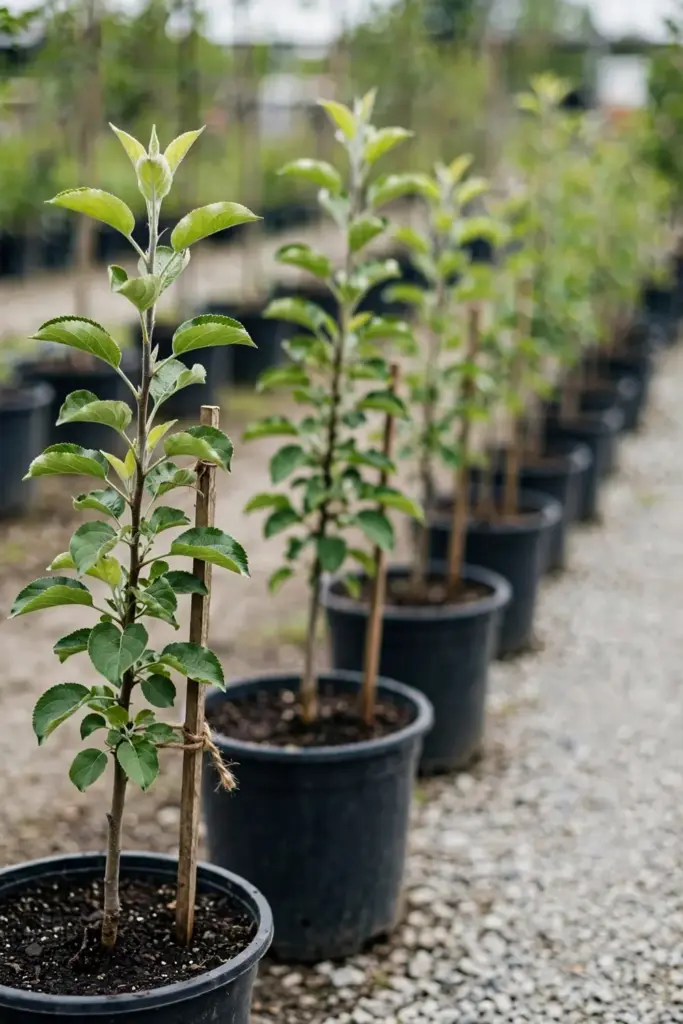
The Missouri Botanical Garden names three resistant apple varieties: Redfree, Liberty, and William’s Pride. A susceptible apple beside a juniper needs yearly spraying. A resistant apple beside the same juniper needs pruning and cleanup, and often nothing more. Resistance is not immunity. Resistant trees still need sanitation and dormant pruning. Resistance lowers the odds and slows the spread.
Ask the nursery for resistant selections of crabapple, hawthorn, and serviceberry before you buy. Resistant choices exist for most pome hosts, and the nursery tag or catalog entry names them. A resistant tree planted this year faces next spring with better armor than a susceptible tree planted the same day. The swap costs nothing extra at planting time. The swap costs years of spraying if you skip it.
Replace the worst performers first. A hawthorn that loses its fruit every year earns replacement with a resistant selection. A crabapple that defoliates and dies back each season earns the same call. Keep a tree that holds a decent crop with light care. Remove and replace a tree that fails despite pruning, sanitation, and spray.
Step 9: Cull Trees With Trunk Cankers Before They Fail
Cull plants that have formed cankers on the main trunk, because a trunk canker ends the pruning conversation. Trunk cankers girdle the stem, and a girdled stem cannot move water and nutrients past the canker. The canopy above the canker thins, dies back, and eventually fails. A juniper with trunk cankers weakens year by year and can collapse. A pome tree with a trunk canker faces the same end. Pruning cannot chase a canker that already rings the trunk.
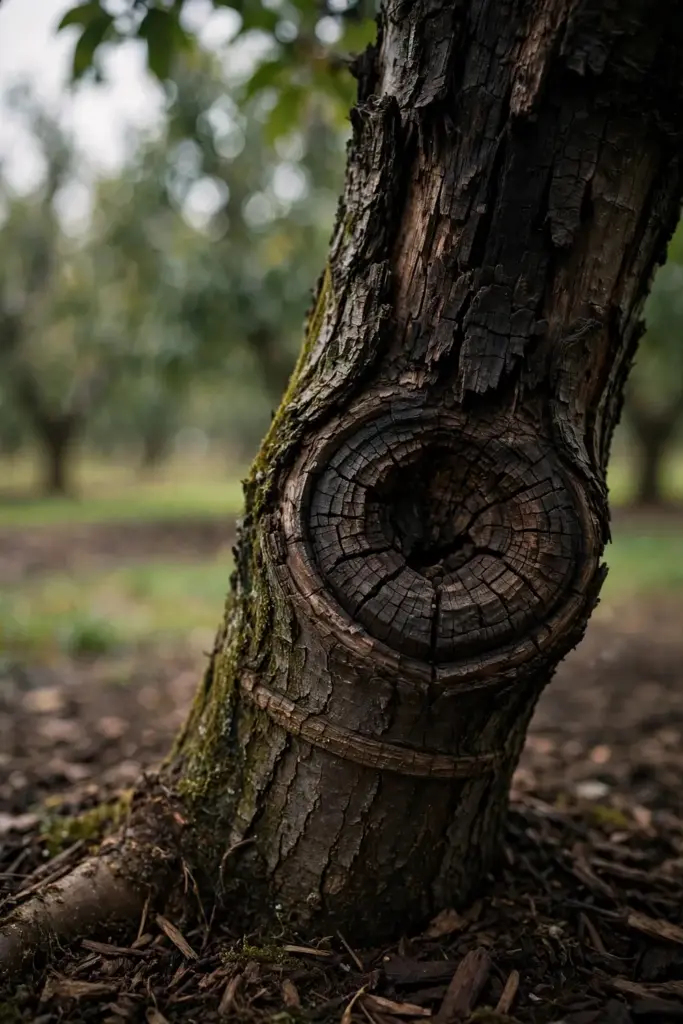
Cut the tree down and remove the wood, then bag or burn the trimmings. Do not leave the stump sprouts to regrow from infected tissue. Replant with a resistant variety on the same spot once the debris is gone. The fungus does not live in the soil, so the spot itself is safe for a new tree. The weather and the nearby junipers stay the same, so a resistant tree in the same spot faces the same spring with better armor, and that swap is the whole point of Step 8.
A tree with a few branch cankers earns pruning, not removal. The line sits at the trunk. Branch cankers cost branches. Trunk cankers cost trees. A tree that returns cankers every year despite pruning and sanitation tells you the answer. Remove it and replant resistant.
Step 10: Give Trees Air, Space, and Dry Leaves
Space trees so air moves between them. Thin the canopy so morning sun dries leaves and fruit early.
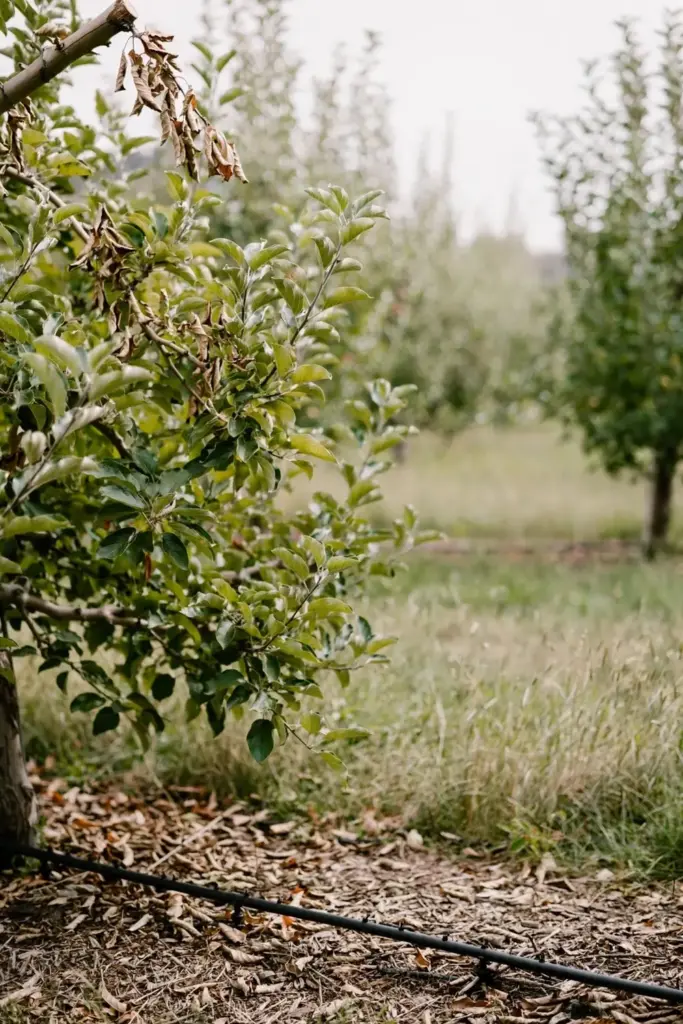
Airflow shortens the wet hours that spores need. A crowded planting holds morning humidity long after an open planting dries. A thinned canopy lets sun reach the inner branches and dries the fruit after rain. Prune crossing branches and open the center of each tree during dormant season. The same thinning cut that improves airflow also removes weak wood that rust cankers love.
Water at the base. Drip lines and soaker hoses keep the canopy dry. Overhead sprinklers wet the canopy and hold it wet through the infection window. If you must use a sprinkler, run it in the morning so the canopy dries by midday. Never run a sprinkler in the evening during bloom. Evening water keeps the canopy wet all night, and a wet night after a gel day is the infection event.
Mulch the root zone and keep mulch off the trunk. Mulch holds soil moisture and suppresses weeds. Mulch piled against the trunk holds bark wet and invites cankers. Pull mulch back a few inches from the bark. The root zone stays damp. The trunk stays dry.
Living With Quince Rust Damage You Cannot Undo
Some damage stays. A tree with a few dead twigs still crops. A tree with a girdled trunk does not.
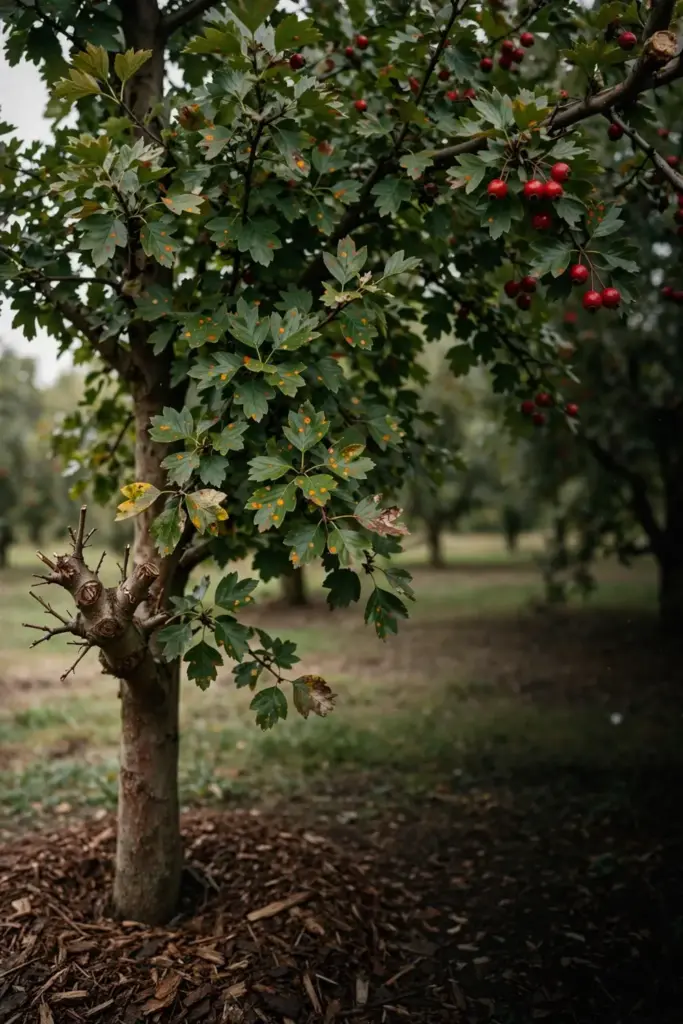
Fruit that shows spore tubes is done. Pick it off and bag it. Sound fruit beside infected fruit is fine to keep, and washing it before eating follows normal orchard practice. A light strike year costs a few twigs and some fruit. A heavy strike year costs branches. Either way, the tree itself usually survives. Quince rust rarely kills an otherwise healthy pome tree. The disease disfigures fruit and twigs, and in bad years it weakens the tree, and it rarely kills outright.
Keep a tree with light canopy loss. Prune dead wood in the dormant season, feed steady, and hold the spray program to the spring gel window. Scout the junipers every spring and the pome fruit every summer. A tree that loses a few branches a year and holds a decent crop earns its place.
Other rusts need their own responses. The guide to aster rust control covers a different rust on a different host, and its treatment does not transfer to quince rust. Fire blight, the bacterial lookalike from the differential section, needs cutting and disinfecting, not rust fungicide. Match the treatment to the disease. A rust spray on a bacterial infection wastes a season.
Frequently Asked Questions
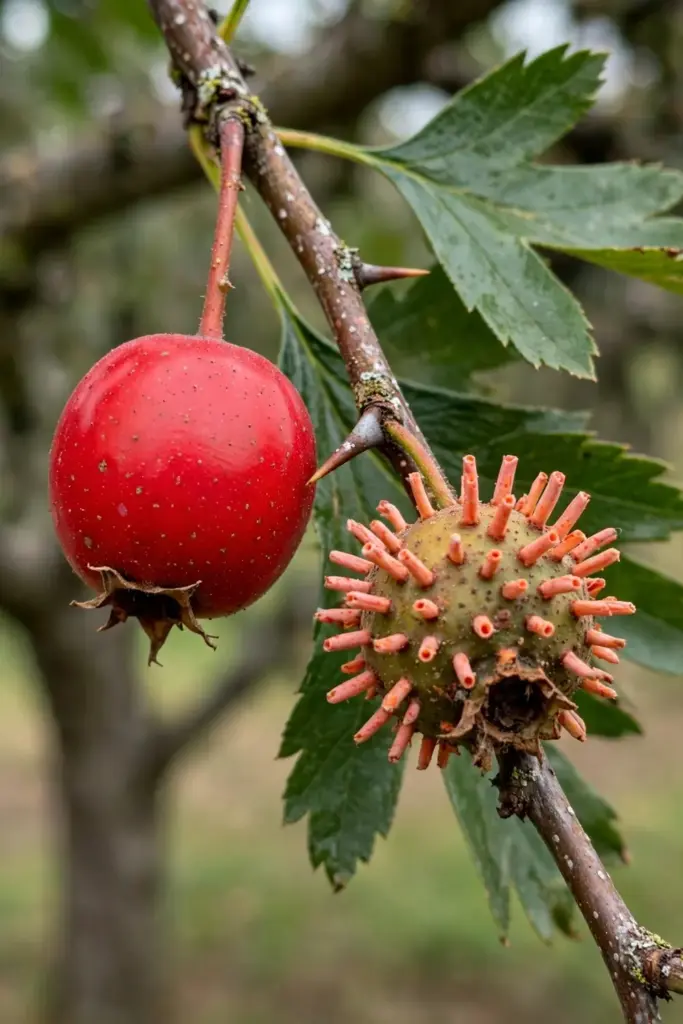
Quince rust rarely kills an otherwise healthy pome tree. The fungus stunts and kills fruit, girdles twigs, and dies back branches, and the tree usually survives. Heavy infections across several years weaken the tree and thin the canopy. A trunk canker is the exception. A canker that rings the main trunk girdles the tree and ends it, so remove any tree with a trunk canker and replant resistant.
Infected fruit is stunted, deformed, and covered with spore tubes, so pick it off and discard it. The fungus does not make sound fruit unsafe. Fruit without symptoms beside infected fruit is fine to keep. Wash sound fruit before eating, as with any orchard fruit. A light strike year costs some fruit. A heavy strike year costs most of the crop, and the spray program next spring is what recovers it.
Removal helps, and removal is not the only answer. One heavily infected juniper beside a fruit planting seeds the cycle every spring, so removing it cuts pressure fast. A juniper with a few swellings earns pruning instead. A neighbor’s juniper is not yours to cut, so protect your own trees with pruning, sanitation, and spring sprays. Separation lowers pressure without guaranteeing zero infection.
No spray cures fruit that already shows orange horns. Protective sprays shield healthy tissue before infection, and they do nothing for tissue that already shows spore tubes. The spray window opens when orange gel appears on the juniper, not when horns appear on the fruit. Once fruit shows horns, switch to sanitation. Pick infected fruit, bag it, and time next spring’s spray to the juniper gel.
Check the tissue and the juniper gall. Quince rust covers fruit and twigs with pinkish-orange tubes and leaves the leaves nearly clean, and its juniper swellings stay infectious for 4 to 6 years or more. Cedar-apple rust spots the leaves orange, grows round galls with tendrils on juniper, and its galls fire for one year only. Fruit and twig damage points at quince rust, while leaf spots point at cedar-apple rust.
Quince rust comes back as long as the two hosts stand near each other and the juniper swellings stay infectious. Swellings on juniper remain infectious for 4 to 6 years or more, up to 20, so one swelling seeds several springs. Pruning swellings, cleaning up fruit, and spraying on the spring gel schedule cut the return each year. Replacing susceptible trees with resistant varieties is the step that ends the cycle for good.
Where to Go From Here
Start with the walk. Check every juniper for elongated swellings and orange gel, then check every pome tree for swollen twigs and horned fruit.
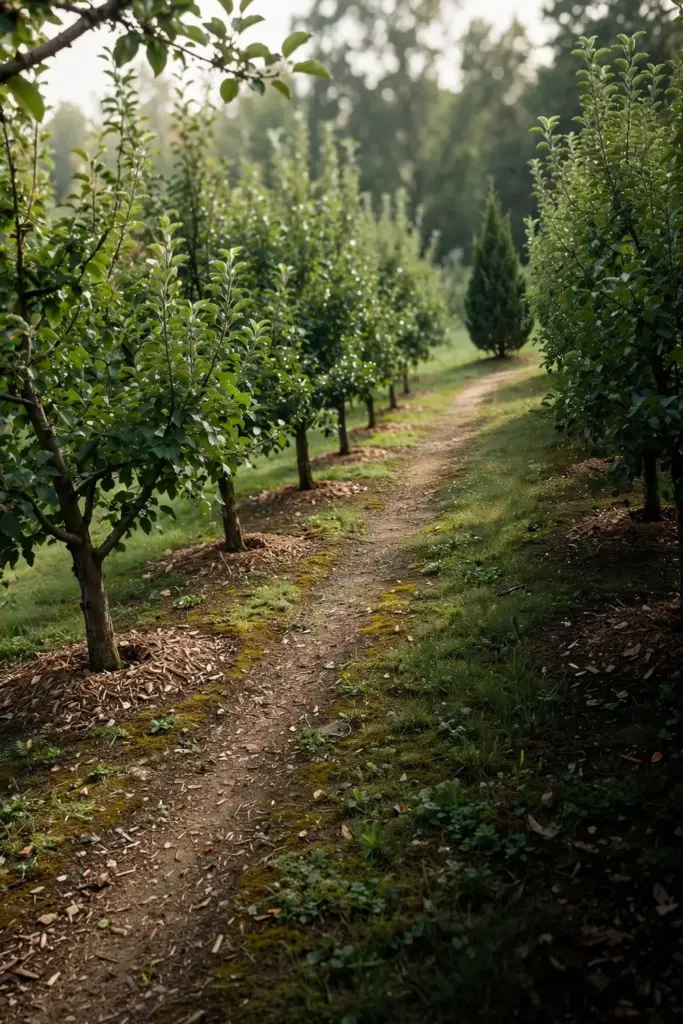
The order is identify, decide, separate, prune, clean up, remove what you own, spray on gel timing, watch every spring, plant resistant, cull trunk cankers, and give trees air. One next action beats ten good intentions. Walk the junipers this spring. Mark every swelling with tape. Prune on the next dry day.