
Zonate leaf spot on sorghum rarely costs a grain grower yield. 4 field decisions carry the whole response: rotation, residue, hybrid choice, and one honest spray call. Alabama Extension reports that the disease rarely has a significant effect on grain quality or yield. Arkansas records seasons when the disease was prevalent without causing yield loss. The spots look dramatic. The grain usually finishes fine.
Zonate leaf spot is a fungal disease of grain sorghum. The fungus Gloeocercospora sorghi causes it. The same fungus also carries the older synonym Microdochium sorghi in some references. Zonate leaf spot attacks the lower leaves and leaf sheaths first. The fungus spreads by spores in wet weather and survives winter in dead tissue.
The rest of this page walks through identification, the two sorghum diseases it gets confused with, and the four field decisions that carry real weight. I have learned that a sorghum field rewards the grower who walks the lower canopy early more than the grower who sprays late.
“Zonate” describes a pattern, not one disease. The same words label different diseases on turf, tomato, citrus, and coleus. This article covers only the sorghum disease. Turf managers know the same fungus as copper spot. That turf syndrome is a different host problem with different management, and it gets no section here.
1. What Zonate Leaf Spot on Sorghum Actually Is
Zonate leaf spot on sorghum is a fungal leaf disease of grain sorghum. Gloeocercospora sorghi causes it. The fungus lives through winter in dead tissue and infects lower leaves in wet weather.
Grain sorghum is Sorghum bicolor. Zonate leaf spot belongs to the foliar disease group on that crop, alongside anthracnose, gray leaf spot, target spot, and sooty stripe. The group shares wet weather as a driver. The diseases differ in lesion shape, speed, and damage, and the lesion shape is what separates them in the field.
The fungus runs a simple cycle. Sclerotia form in dead sorghum tissue. Sclerotia are small, dark, hard resting bodies that germinate and infect new growth or new plants in the next season. The Arkansas handbook describes that carryover in plain terms. Some evidence suggests the fungus may be carried on seed. That seed link stays unproven, so seed is a minor suspect beside residue and weeds.
During the season, the fungus produces pink or salmon colored spores in the lesions. Wind and rain splash move those spores to neighboring plants. The disease starts low and climbs when wet weather holds. Johnsongrass and other grasses can carry the fungus, so a weedy field edge feeds the next infection wave.
One honest frame matters before any management talk. Zonate leaf spot is a minor disease, even for commercial growers. Extension sources agree on that point across states. Management for a minor disease looks like this: cheap cultural steps first, chemistry only in a narrow exception.
2. How to Identify Zonate Leaf Spot on Sorghum Leaves
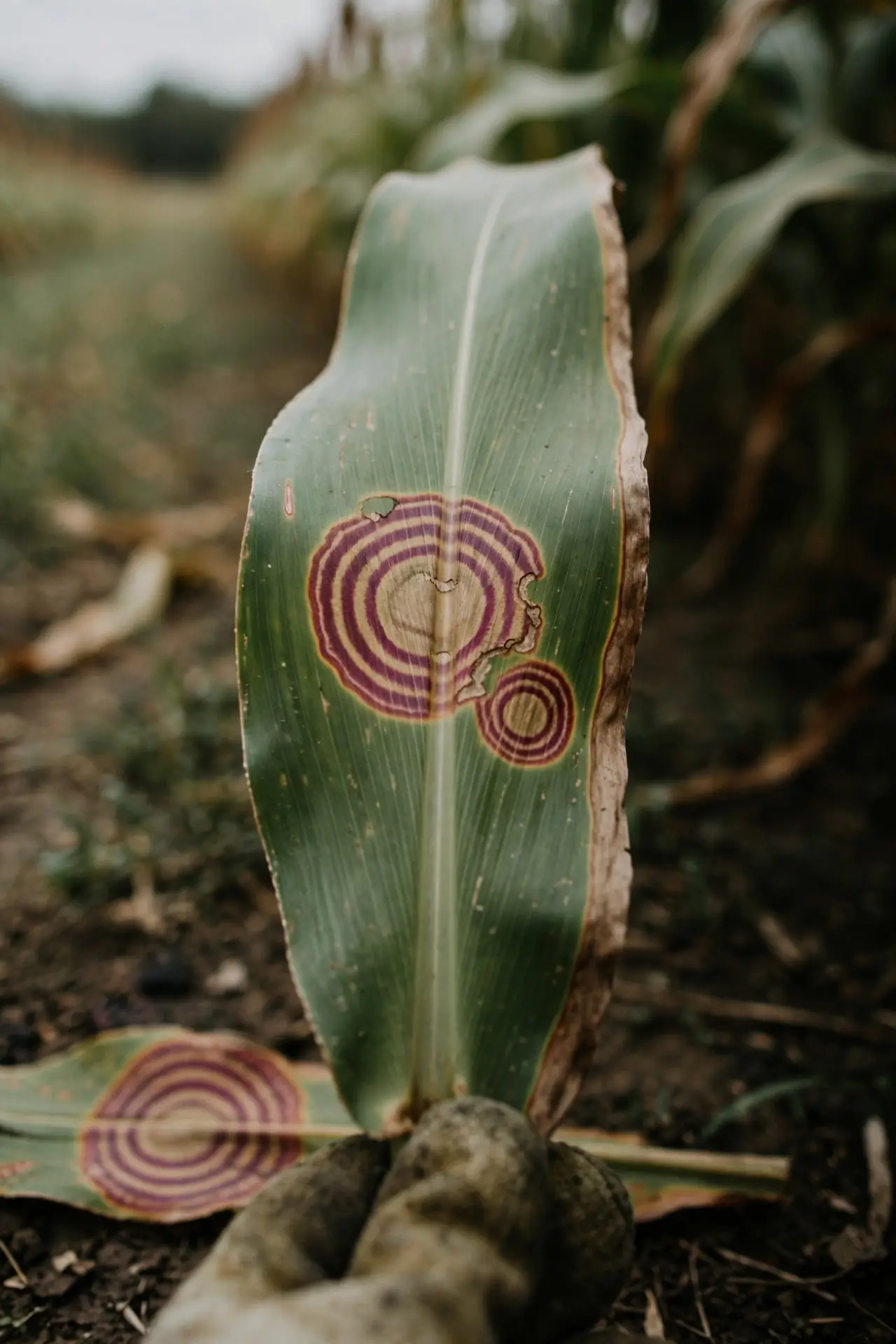
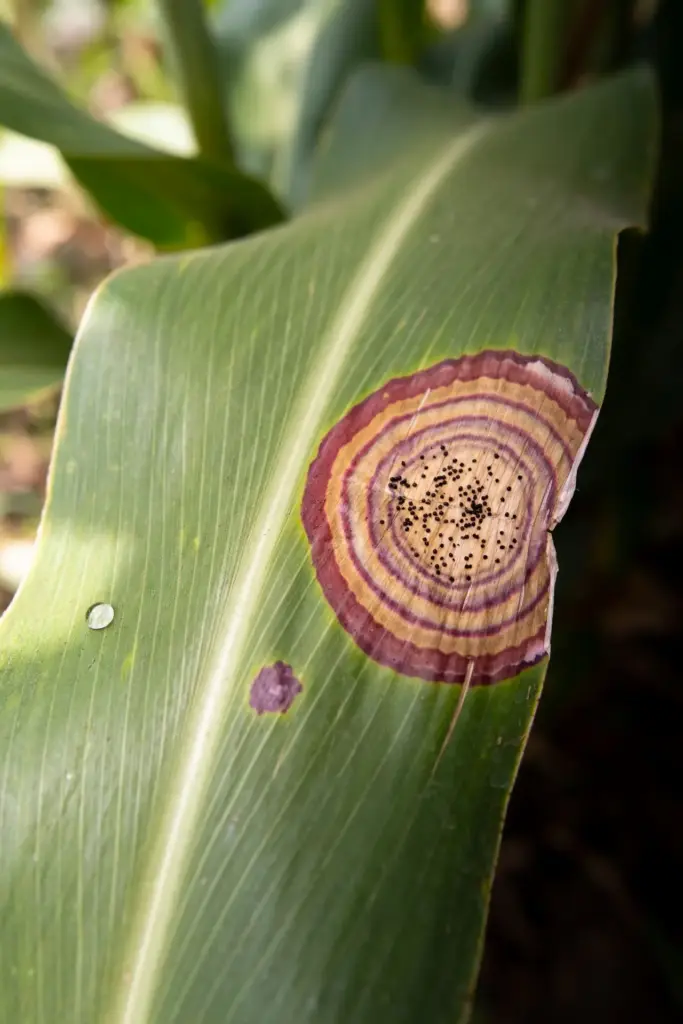
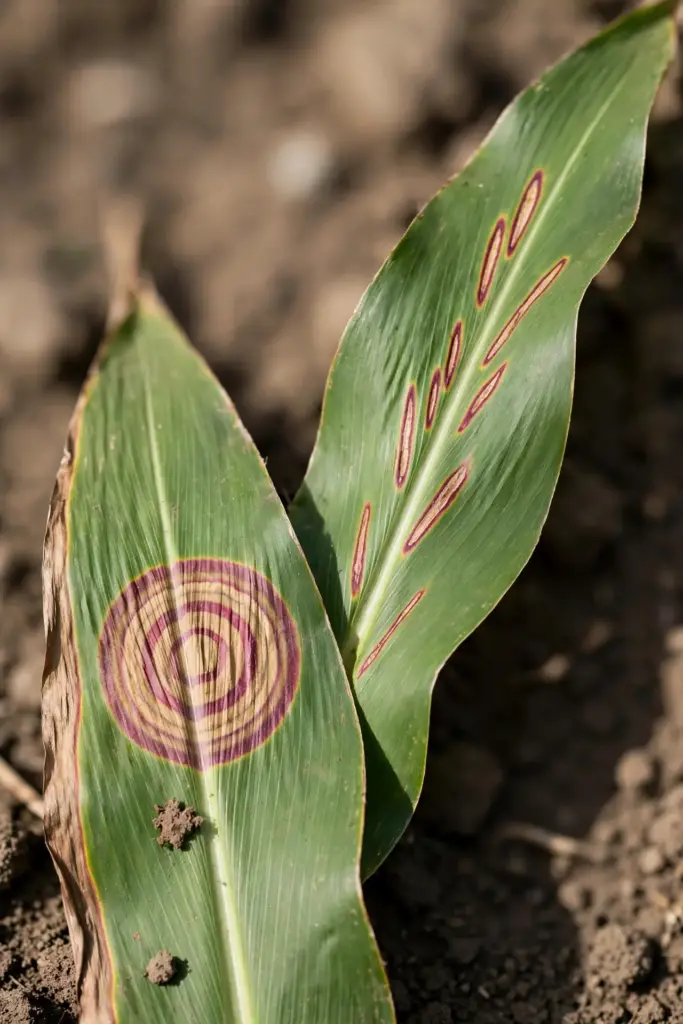
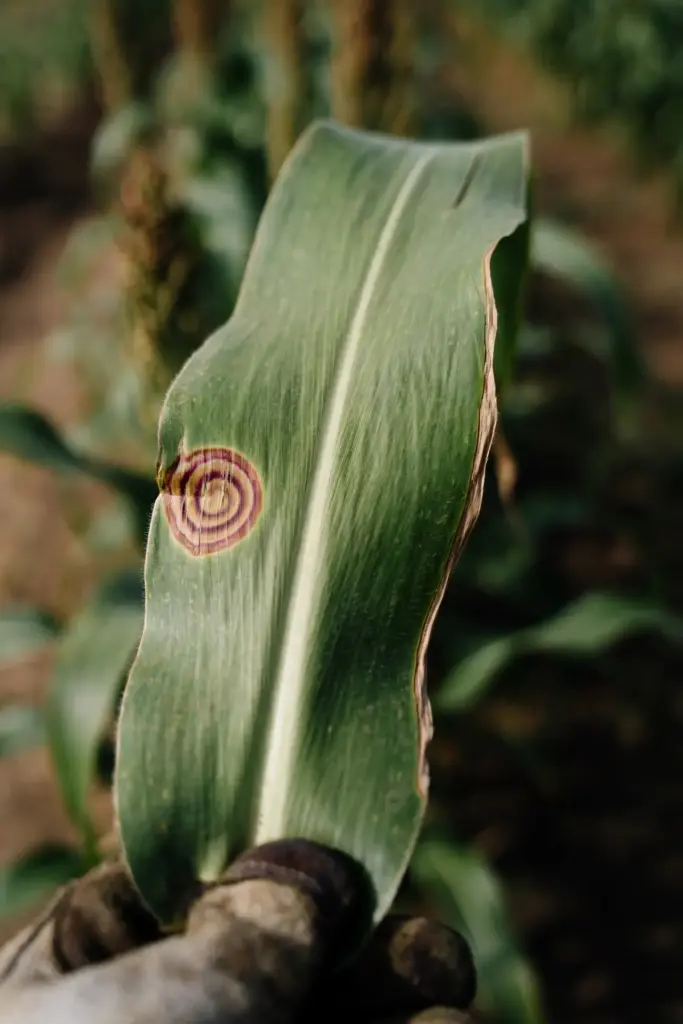
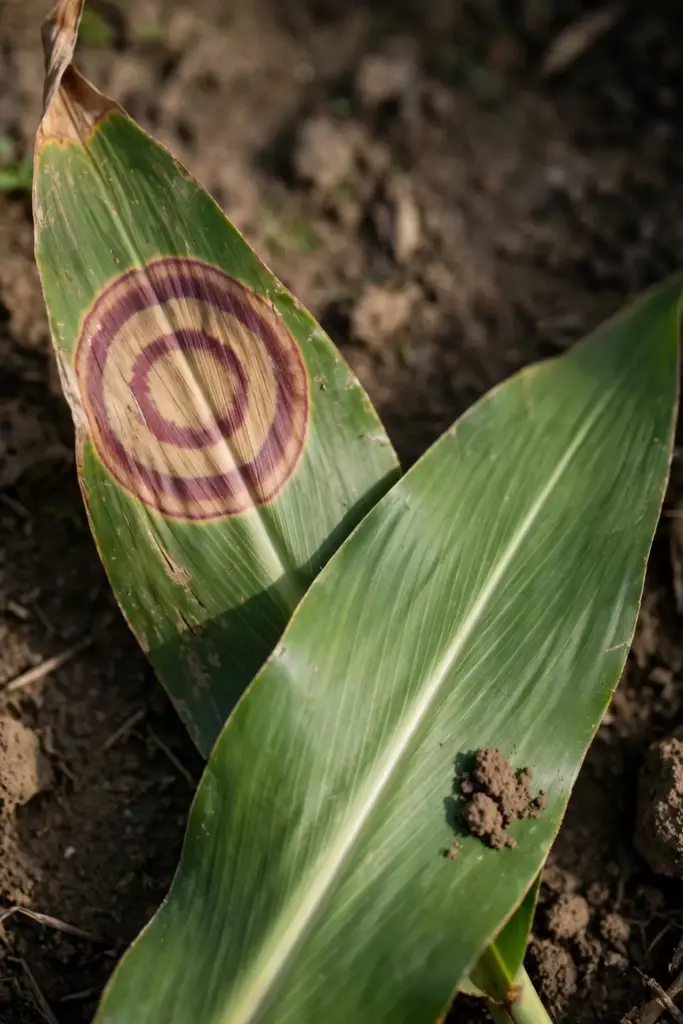
Look for large circular spots with alternating purple and tan bands. The bands form a concentric ring pattern. The pattern gives the disease its name.
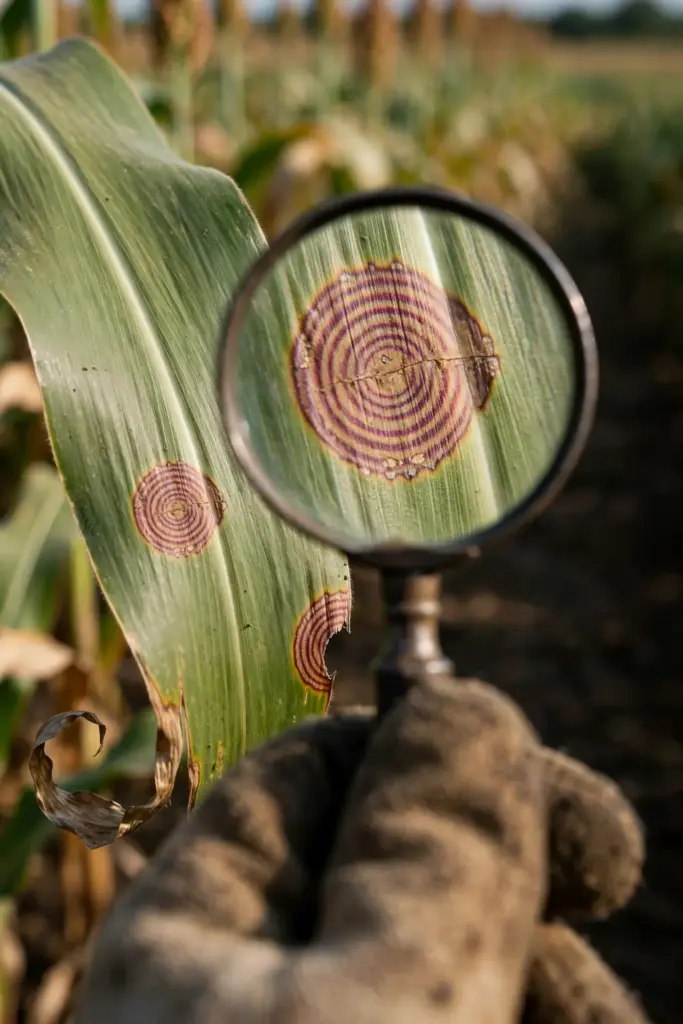
The lesions are often large. The University of Arkansas System Division of Agriculture puts lesion size at 1 to 7 cm in diameter, with lesions that can encompass the entire leaf width. A 7 cm lesion crosses most of a sorghum leaf. The ring pattern stays readable even at that size. Purple bands alternate with tan bands, and the edge stays irregular rather than smooth.
Early lesions look less clear. A young spot may show as a purple blotch with a light, irregularly shaped center. The rings develop as the lesion grows. A grower who scouts weekly sees the blotch first and the rings second. A grower who scouts once a season sees the finished pattern and may mistake it for a worse disease.
Check the lower leaves first. Zonate leaf spot starts on the lower portions of the plant. Small circular lesions expand into the target pattern there. Lesions near the leaf edges grow semicircular because the leaf edge stops the ring. In severe cases the lesions merge and destroy much of the photosynthetic leaf area. That severe outcome is unusual in grain fields and far more common on forage sorghum in India.
Pink or salmon colored spores may show on lesions during warm wet periods. The spore color is a useful field check. A lesion with pink salmon spores, concentric bands, and a lower-leaf position points hard at zonate leaf spot. A lesion without bands points elsewhere.
3. How to Identify Zonate Leaf Spot on Sheaths and Leaf Margins
Zonate leaf spot also attacks leaf sheaths and leaf margins. Sheath lesions look like leaf lesions. Margin lesions grow semicircular because the leaf edge stops them.
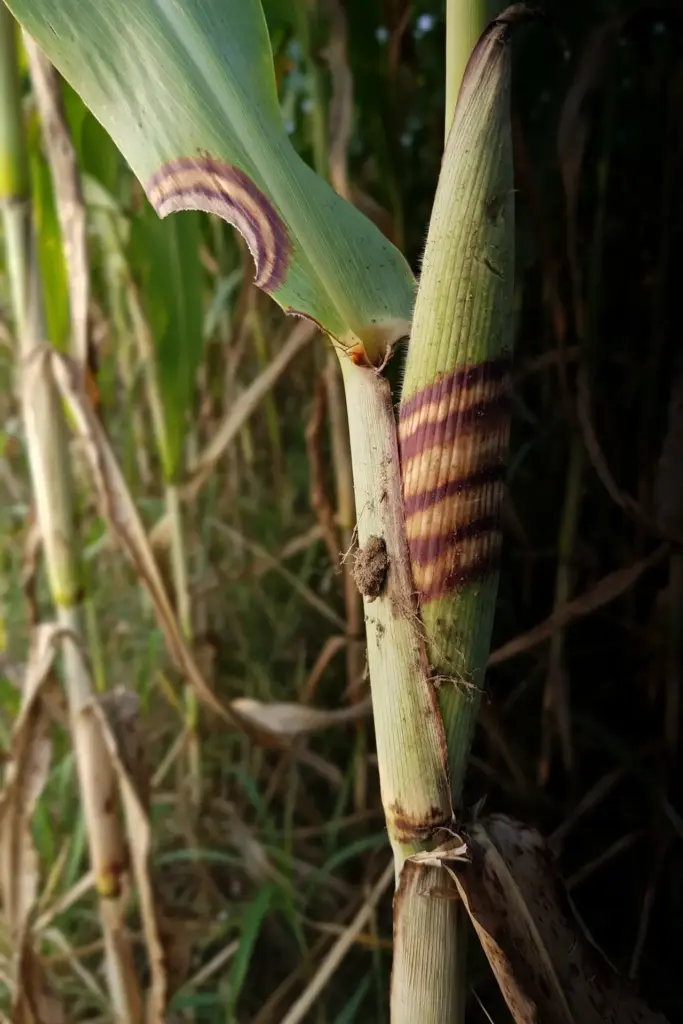
The leaf sheath wraps the stalk below each leaf blade. Lesions on the sheath carry the same banded pattern as leaf lesions. A sheath check belongs in every scouting pass because sheath lesions sit close to the stalk and read as stalk trouble at a glance. They are leaf disease on a sheath, not stalk rot.
Margin lesions follow the same rule as edge lesions anywhere on the blade. The ring starts, the leaf edge cuts it off, and the visible half ring looks semicircular. A semicircular banded lesion at a leaf margin is zonate leaf spot in its most common partial form. The full circle appears only where the lesion has room on all sides.
Lesions can also appear on other plant parts. The disease is not strictly a blade disease. The practical scouting habit is simple: start at the lowest leaves, check the sheaths on those leaves, then scan the margins. That pass catches the disease at its earliest visible stage.
One confusion deserves a plain line. Sheath lesions do not mean the stalk is rotting. Anthracnose rots stalks. Zonate leaf spot stays on leaves and sheaths. A grower who sees sheath banding and assumes stalk rot will overreact. Read the pattern, not the location alone.
4. Which Sorghum Fields Get Hit Hardest
Wet fields get hit hardest. Zonate leaf spot develops mainly during wet weather. Fields with sorghum residue on the surface and grassy weed pressure carry more inoculum.
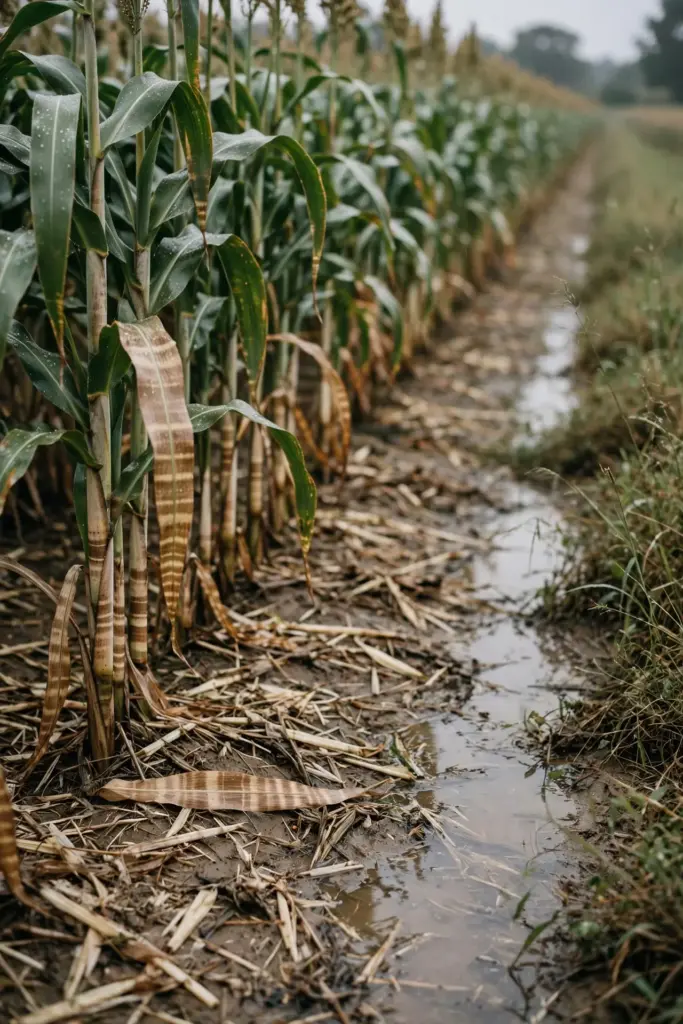
Warm humid years favor the disease. Pioneer notes that zonate leaf spot grows more prevalent in warm, humid years and overwinters on crop residue. A wet season after a sorghum year sets the table. A dry season after a long rotation starves it. Weather decides the ceiling. Field history decides the floor.
Continuous sorghum raises the risk. A field that grows sorghum year after year keeps the fungus fed and sheltered. The sclerotia in residue and dead tissue wait out the off season and germinate into the next crop. Rotation breaks that chain. Residue burial breaks it faster.
Grassy weeds raise the risk too. Johnsongrass hosts the fungus and bridges the gap between sorghum crops. A clean field edge matters as much as a clean field. The Arkansas handbook ties control of grassy weeds like johnsongrass to lower inoculum. A grower who controls johnsongrass in the field and on the border cuts the carryover at both ends.
Forage sorghum deserves a separate note. Pioneer reports the disease becomes especially a problem on forage sorghums in India. Forage growers harvest leaf area, so leaf loss is feed loss. Grain growers harvest seed, so leaf loss matters less. The same disease carries different weight in the two systems. This article speaks to grain growers and flags the forage difference so no reader carries grain advice into a forage problem without adjusting.
5. Zonate Leaf Spot vs Anthracnose vs Gray Leaf Spot
Three sorghum leaf diseases get confused in the field. The lesion pattern separates them. Read the table, then check the leaf in your hand.
| Clue | Zonate Leaf Spot | Anthracnose | Gray Leaf Spot |
|---|---|---|---|
| Pathogen | Gloeocercospora sorghi | Colletotrichum graminicola | Cercospora sorghi |
| Lesion pattern | Concentric rings of alternating purple and tan bands, 1 to 7 cm | Red to maroon lesions with tan centers along the midrib | Small dark purple or red spots, centers turn tan or brown, spots elongate with gray spore masses |
| Where it starts | Lower leaves and leaf sheaths | Lower leaves, then stalks | Leaf surface, scattered across the blade |
| Speed and damage | Slow, rarely affects grain quality or yield | Fast blighting in wet humid weather, can be serious in continuous sorghum | Most varieties carry adequate tolerance, damage stays limited |
| Stalk phase | None | Stalk rot with red to purple pith below the head | None |
| Overwintering | Sclerotia in dead tissue and residue | Infected residue and seed | Residue and grassy hosts including corn and johnsongrass |
This table is compiled from parallel Extension descriptions. No published head-to-head comparison of these three diseases exists. The zonate column follows the Arkansas handbook. The anthracnose column follows Alabama Extension. The gray leaf spot column follows the LSU AgCenter management guide. The compilation is honest about its construction, and the field check behind it stays simple: bands mean zonate, midrib lesions with tan centers mean anthracnose, small elongating spots with gray spore masses mean gray leaf spot.
The stalk phase is the fastest separator. Anthracnose alone rots stalks. A grower who finds red to purple tissue in the stalk pith below the seed head is looking at anthracnose, whatever the leaf spots show. Zonate leaf spot and gray leaf spot never produce that stalk symptom. That one check prevents the most expensive misidentification in the group.
Target spot and sooty stripe sit nearby in the same conversation. Target spot makes round to elliptical spots with reddish purple centers and tan margins, while sooty stripe makes elongated spots with a sooty look from sclerotia inside the lesions. Both belong to the same wet-weather foliar group. Neither changes how zonate leaf spot gets managed, and neither earns a second table here.
6. Why Wet Weather Drives Zonate Leaf Spot
Wet weather drives zonate leaf spot because the fungus moves on water. Spores splash from lesions to neighboring plants. Wet leaves stay infected longer.
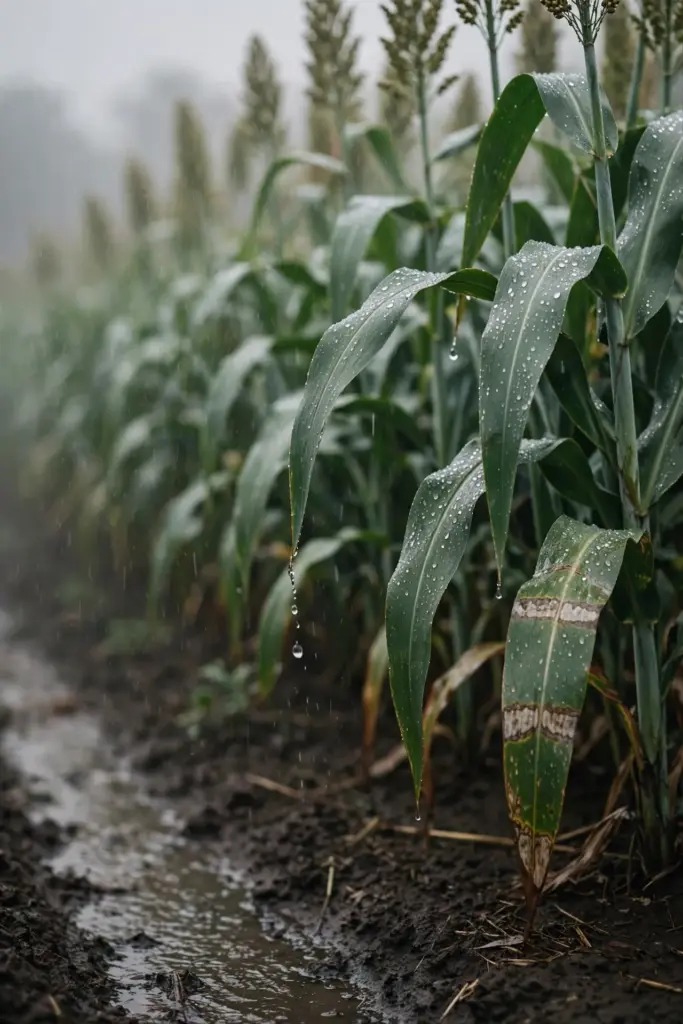
The spread mechanism is short range and water bound. Pioneer describes the disease spreading within the season from plant to plant by splashing or blowing colorless asexual conidia from the lesions. A rain event lifts spores from a lower lesion to the next leaf up. A dry week stops the lift. The disease climbs the plant one wet spell at a time.
Overwintering sets up the first splash. Small black sclerotia form in the dead tissue of the lesions. Those sclerotia wait through the off season in residue and dead tissue. Warm wet weather wakes them. The first infection lands on the lowest leaves, closest to the soil and the residue. Every later infection climbs from there.
Dew matters as much as rain. LSU AgCenter pathologists note that a long overnight dew period can drive sorghum foliar disease even in a dry season. A field can stay dry on the rain gauge and wet on the leaf for ten hours a night. That leaf wetness window is the real unit of risk. A grower who tracks dew and leaf wetness reads the disease better than a grower who tracks rainfall alone.
The practical read is straightforward. Wet weather plus residue plus a susceptible hybrid equals banded lower leaves. Remove any one leg and the disease weakens. Residue removal and rotation are the legs a grower controls. Weather is the leg nobody controls, which is why scouting after wet spells carries the whole early warning job.
7. Step 1: Decide Whether Zonate Leaf Spot Is Worth Treating
For most grain fields, zonate leaf spot is not worth treating. The disease rarely cuts grain quality or yield. A spray program aimed at zonate alone spends money on a cosmetic problem.
The decision table below turns that judgment into a field call. Read the observation column, take the matching call, and skip the rest.
| Observation | Call | Why |
|---|---|---|
| Light banding on lower leaves only | Do nothing, keep scouting | Zonate leaf spot rarely affects grain quality or yield at this level |
| Banding climbing past the lower third in a wet spell | Re-check the hybrid and the disease mix | Climbing banding may signal a susceptible hybrid or a second disease |
| Severe banding on an apparently susceptible hybrid | Weigh a fungicide, once | Arkansas Extension finds fungicides likely not economical unless the disease is severe on an apparently susceptible hybrid |
| Anthracnose or target spot riding along | Treat the complex, not zonate alone | Foliar fungicides have shown value against a moderate to severe disease complex in LSU AgCenter trials |
An LSU AgCenter pathologist puts the field rule plainly: fields do not have to look perfect to pay. A field with banded lower leaves and sound grain is a field doing its job. The cosmetic standard belongs to a garden show, not a grain field.
Florida Extension adds a useful calibration. Zonate leaf spot has historically not been a major problem in Florida. That statement covers forage sorghum in a warm humid state. A disease that stays minor there stays minor in most grain regions. The exception is a severe outbreak on a susceptible hybrid, and the table above holds that exception in its place.
The spray question deserves one more plain line. No spray cures a banded lesion. A fungicide protects healthy tissue ahead of infection. Spraying after the bands cover the canopy buys protection for leaves that are already lost. The timing rule is preventive or not at all, and the economics rule is severe-plus-susceptible or not at all.
8. Step 2: Rotate Fields Away From Sorghum for Four Years or Longer
Rotate fields away from sorghum for four years or longer. Plantix recommends crop rotations of four years or longer for zonate leaf spot. The gap starves the sclerotia in the soil and residue.
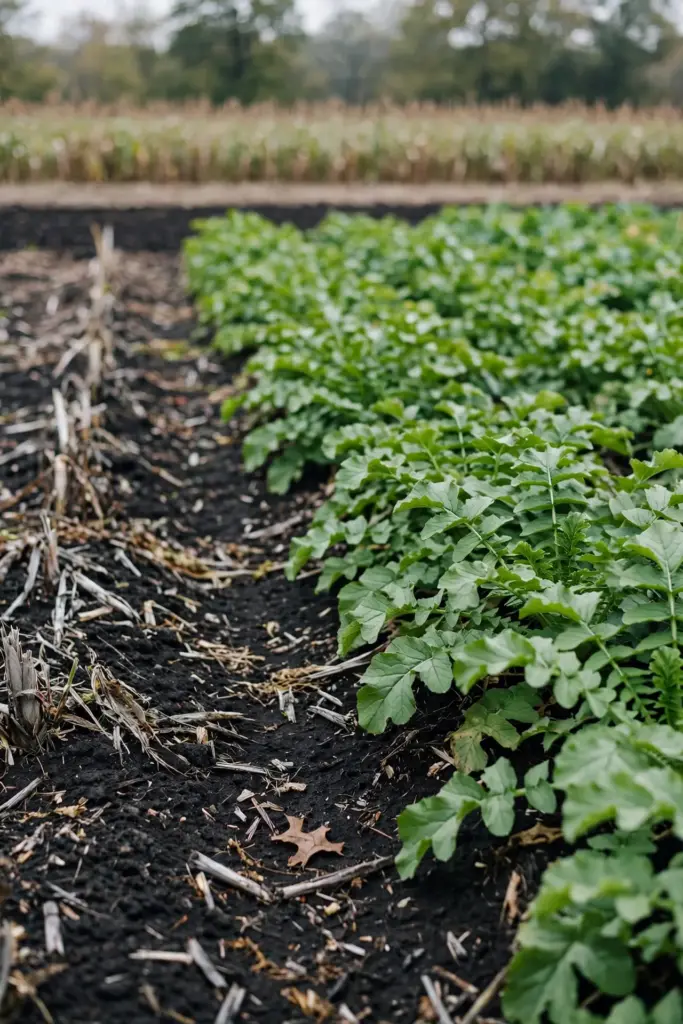
Sclerotia are built to wait. Plantix notes that the fungus can survive on seeds or in the soil for several years. A one-year break barely dents that bank. A two-year break helps. A four-year break or longer drains it. The rotation length is the treatment, and shortening it is the same as skipping it.
Do not rotate sorghum to corn or millet. The fungus that causes zonate leaf spot on sorghum can also infect other grasses, including corn and millet. Those hosts hold inoculum between sorghum seasons and refill the bank the rotation was supposed to drain. A rotation that swaps one host grass for another is a rotation in name only.
A nongrass crop does the real work. The rotation years should carry crops the fungus cannot use. Field history is the record that makes the rotation work, so write down which field grew sorghum in which year. Memory fails over a four-year gap. A notebook does not.
The crop rotation guide covers rotation planning for pest and soil health across the whole garden. The sorghum rule inside that wider practice is strict: four years or longer away from sorghum and its grass hosts before sorghum returns to the field.
9. Step 3: Bury Residue and Control Johnsongrass
Bury or destroy sorghum residue after harvest. The fungus overwinters in dead tissue. Removing the residue removes the starting inoculum for next season.
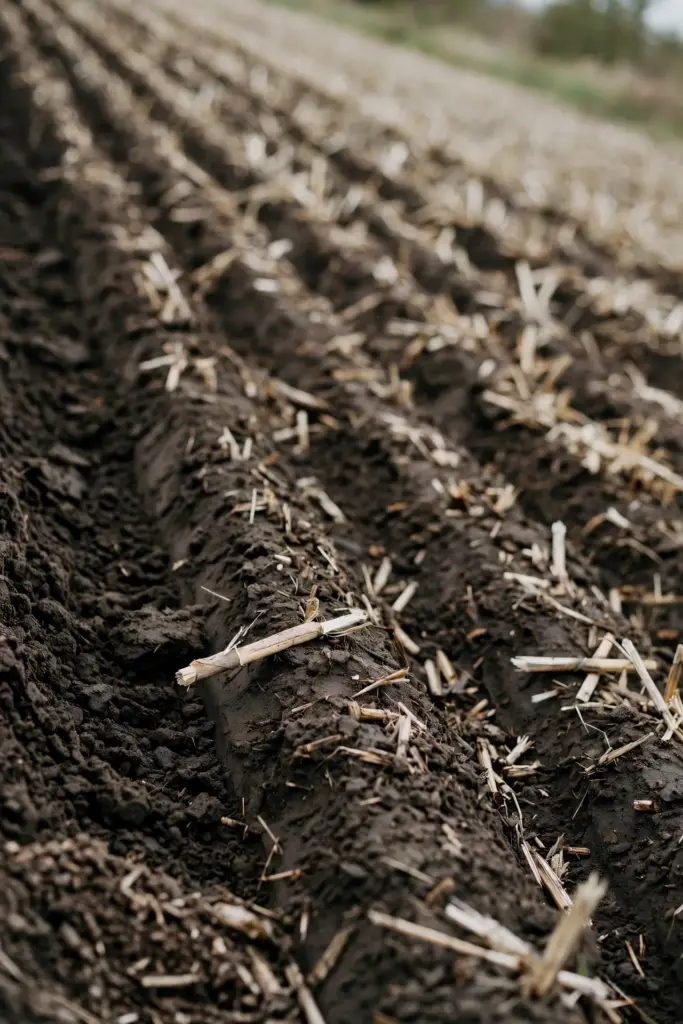
The residue rule is the cheapest move on the list. The University of Florida IFAS Extension lists burying old crop debris by plowing among its zonate leaf spot management steps. Plowing buries the sclerotia-bearing tissue where it breaks down faster. Burning destroys it outright where burning is legal and safe. Either path beats leaving residue on the surface through winter.
Johnsongrass control is the second half of the step. UF/IFAS Extension lists destroying johnsongrass and volunteers of susceptible crops in the vicinity as part of zonate management. The Arkansas handbook agrees that controlling grassy weeds like johnsongrass reduces inoculum. Field edges, ditch banks, and fence lines all count. A clean field with a weedy border is a clean field with a loaded border.
Residue that breaks down fast stops sheltering sclerotia sooner. Building soil health speeds that breakdown because active soil biology decomposes buried tissue. The soil health link is not a disease cure. It is the mechanism behind the residue rule, and it pays across every crop in the rotation.
A cover crop between sorghum years keeps the ground covered while the rotation runs. Cover crops do not feed the fungus when the cover is a nongrass species. The covered ground also holds soil against erosion through the rotation gap. Pick the cover species with the host rule in mind: no grass hosts in a zonate rotation.
One work habit closes the step. Avoid field tasks when leaves are wet. UF/IFAS Extension lists avoiding field work when leaves are wet among its zonate management steps. Boots, tires, and tools move spores through a wet canopy. Scout and work when the foliage is dry, and the field stays cleaner for the same effort.
10. Step 4: Plant Tolerant Hybrids and Scout the Lower Canopy
Plant tolerant hybrids and scout the lower canopy. Recommended varieties carry some tolerance to zonate leaf spot. Scouting catches the first banded lesions before they climb.
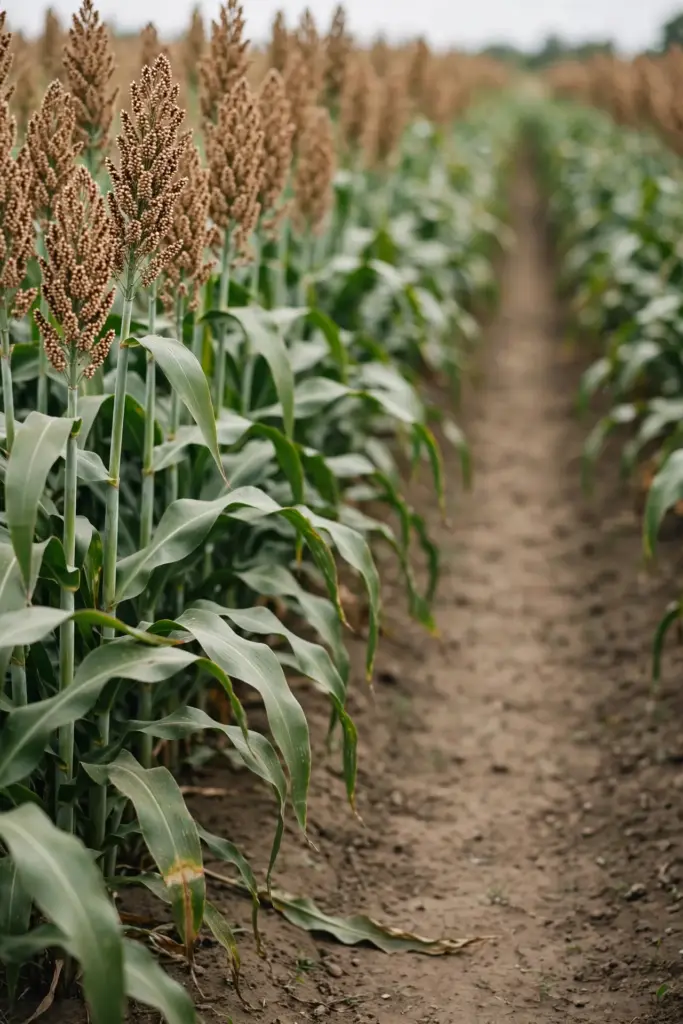
Tolerance is partial. The LSU AgCenter management guide describes the protection as some tolerance, not immunity. Hybrid reaction differs from one hybrid to the next. A tolerant hybrid slows the disease. A susceptible hybrid feeds it. Hybrid selection is the one decision a grower makes once a season that pays all season.
Hybrid selection also costs nothing extra. An LSU AgCenter sorghum pathologist has noted that resistant hybrids cost the same as susceptible ones, and that hybrid selection is the most important decision in disease management. That price point makes tolerance the cheapest control in the article. A grower who plants a tolerant hybrid has already bought the best zonate protection available.
Scouting is the second half of the step. Walk the lower canopy after every wet spell. Check the lowest leaves first, then the sheaths on those leaves, then the margins. Flag any field where banding climbs past the lower third. That flag sends the grower back to the Step 1 decision table with fresh evidence.
Clean cultivation backs both halves. The LSU AgCenter guide pairs crop rotation with clean cultivation for zonate leaf spot. Clean cultivation means grassy weeds out, volunteers out, and field edges kept clean. The practice costs labor and pays in lower inoculum. It is unglamorous work with a measurable return.
Seed health gets one honest line. Some evidence suggests the fungus may be carried on seed. The evidence is thin. Source seed from a reputable supplier and ask about seed health. Do not build a management plan around seed treatment for this disease. Residue, rotation, and hybrid choice carry the real weight.
11. Living With Zonate Leaf Spot After Harvest
After harvest, zonate leaf spot needs no rescue work. The grain is already in the bin, so the job shifts to next season: residue, rotation, and field notes.
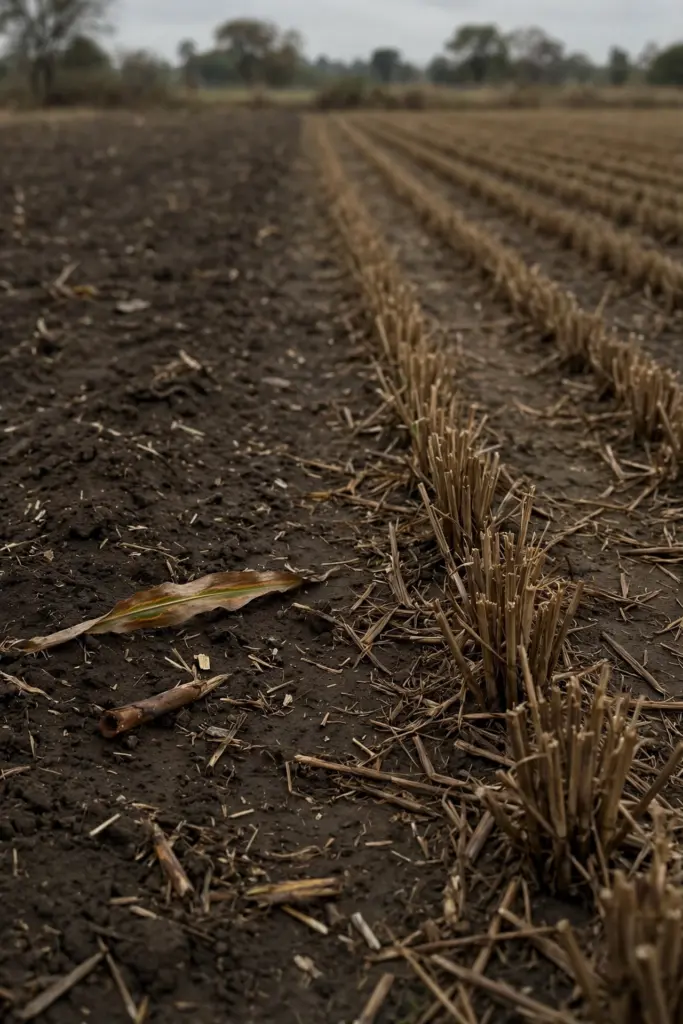
Grain quality rarely suffers. A field that showed banded lower leaves and filled sound grain needs no post-harvest treatment. No spray, no rescue, no rework. The bin tells the truth about the season. The leaves told a story that looked worse than the outcome.
Field notes are the one harvest-season task that pays. Write down which fields showed banding, how far the banding climbed, and which hybrid grew there. Those three facts set next season’s rotation order and hybrid choice. A field that climbed past the lower third goes to the back of the rotation queue. A hybrid that banded hard drops off the buy list.
Forage growers adjust the read. Leaf loss is feed loss in a forage system, so the same banding carries more weight there. The four steps still apply. The hybrid tolerance question matters more at selection time, and the scouting interval shortens. Grain growers can watch and wait. Forage growers should watch and act sooner on the same evidence.
The season ends with a simple audit. Residue buried or destroyed, rotation clock running, johnsongrass down, hybrid notes filed. A grower who closes those four items has done everything the evidence supports for zonate leaf spot. Anything beyond that is spending on a cosmetic problem.
12. Frequently Asked Questions
Usually no. Alabama Extension reports the disease rarely has a significant effect on grain quality or yield. Arkansas records seasons when the disease was prevalent without causing yield loss. Severe cases can merge lesions and strip leaf area, but that outcome is unusual in grain fields. Treat zonate leaf spot as a scouting signal, not a yield emergency.
Yes, corn is a possible host. The fungus that causes zonate leaf spot on sorghum can also infect other grasses, including corn and millet, and those hosts can hold inoculum between sorghum seasons. That risk is one more reason to keep grassy weeds down and to avoid rotating sorghum straight into corn. Other leaf spot names blur into the same field conversation. The Bipolaris leaf spot guide shows how a different leaf spot disease gets identified on its own host.
Usually no. Arkansas Extension finds fungicides likely not economical unless the disease is severe on an apparently susceptible hybrid. A light infection on lower leaves does not clear that bar. If anthracnose or target spot rides along and the combined complex threatens yield, a labeled foliar fungicide applied before significant disease development may help. Read the label. The label is the law on rates and timing.
Yes. The fungus overwinters as small black sclerotia in dead sorghum tissue and on crop residue. Sclerotia germinate and infect new growth or new plants the next season. That survival is why residue burial and rotation carry more weight than any spray. Remove the residue and the fungus loses its winter shelter.
On grasses, yes, the names describe the same fungus. Zonate leaf spot of sorghum is also called copper spot on many other grasses, and the pathogen is the same Gloeocercospora sorghi. The turf syndrome still gets its own management because turf and grain fields face different pressures. Do not carry turf copper spot advice into a grain field, or grain advice onto turf.
13. Where to Go From Here
Zonate leaf spot on sorghum is a minor disease with a dramatic signature. The bands look serious. The grain usually finishes fine. The four steps fit that reality: decide honestly whether treatment is worth it, rotate four years or longer, bury residue and control johnsongrass, and plant tolerant hybrids while scouting the lower canopy.
Two sorghum companions sit nearby in the disease library. Northern corn leaf blight is a different grain-crop leaf disease, and it gets its own article. Sorghum downy mildew is a different sorghum disease, and it gets its own article. Neither merges with zonate leaf spot. Each carries its own pathogen, pattern, and management.
The one next action is a walk. After the next wet spell, walk the lowest leaves in every sorghum field. Look for bands. Note how far they climbed. That walk, repeated through the season, is the whole early warning system for a disease that rarely needs more.