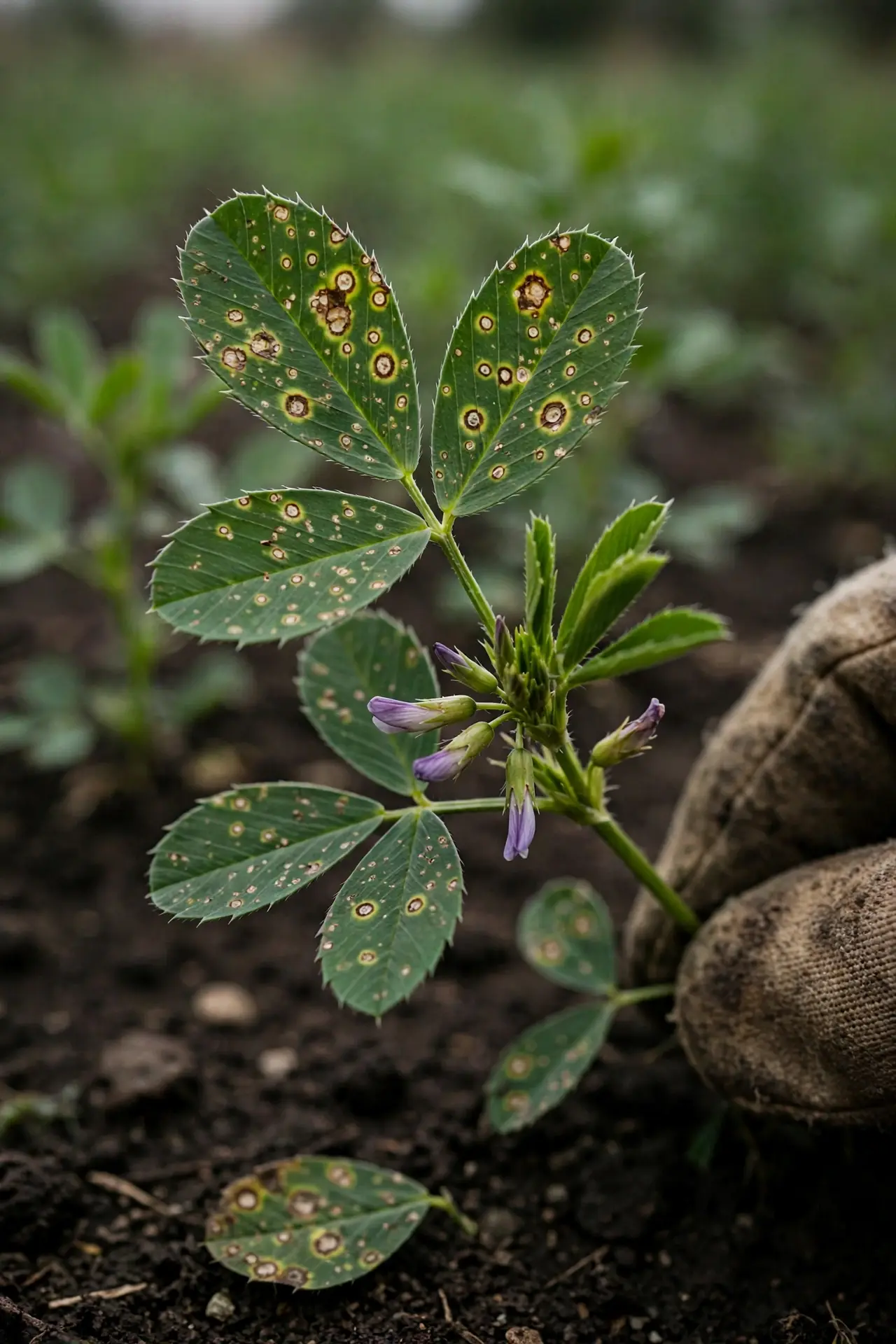

Leptosphaerulina leaf spot of alfalfa starts as pepper spots on new leaves and ends with leaf drop before harvest. The spots grow into eyespots, oval and brown with dark margins and yellow halos, and they merge along the leaf veins until the leaf falls. Pressure runs highest in the first or second cuttings, and a legume-free rotation of at least 2 years breaks the carryover.
The fungus behind it belongs to the genus Leptosphaerulina. It lives on infected leaf debris and moves to new leaves as they develop. A cutting left standing in the field feeds it. The cutting date decides more than any spray, because the only fungicides registered for this disease must go on before symptoms show.
I have learned to treat the cutting date as the main disease decision, not the sprayer. What follows starts with identification and ends with the rotation that breaks the cycle.
1. What Leptosphaerulina Leaf Spot Actually Is
Leptosphaerulina leaf spot is a foliar disease of alfalfa caused by fungi in the genus Leptosphaerulina. Extension sources name the pathogen two ways. The Crop Protection Network names Leptosphaerulina briosiana. Kentucky names Leptosphaerulina trifolii. Both describe the same alfalfa disease, and this article uses the disease name throughout.
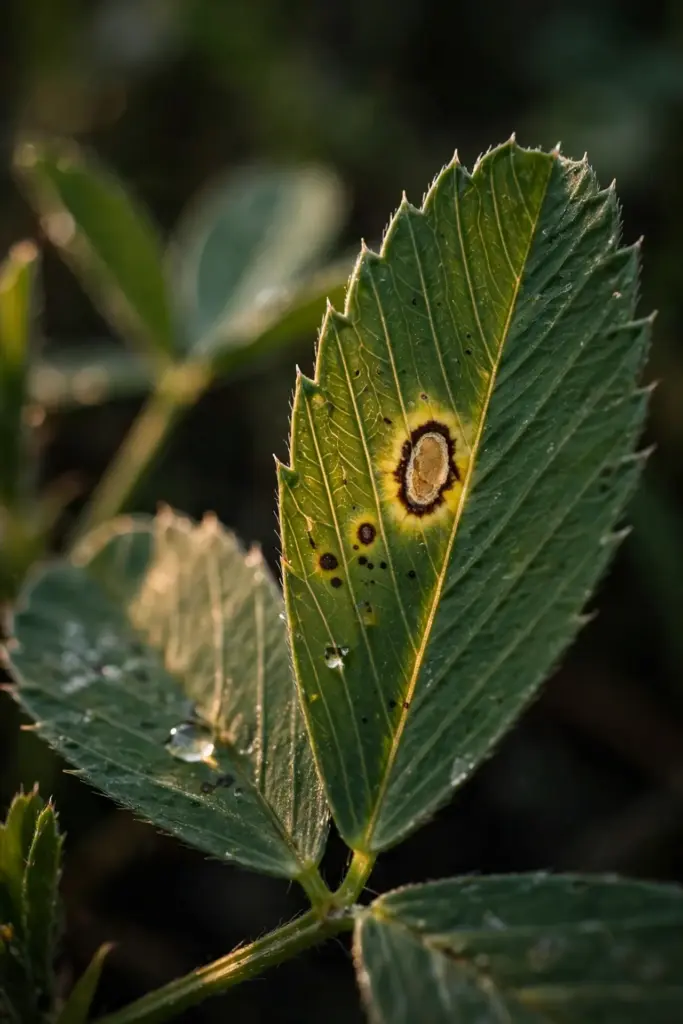
The disease counts among the most common foliar diseases of alfalfa, according to the Crop Protection Network encyclopedia entry on Leptosphaerulina leaf spot of alfalfa. Common does not mean harmless. The damage is leaf loss. Leaves carry the feed value of a cutting, and a cutting that drops its leaves before harvest carries less feed to the bale.
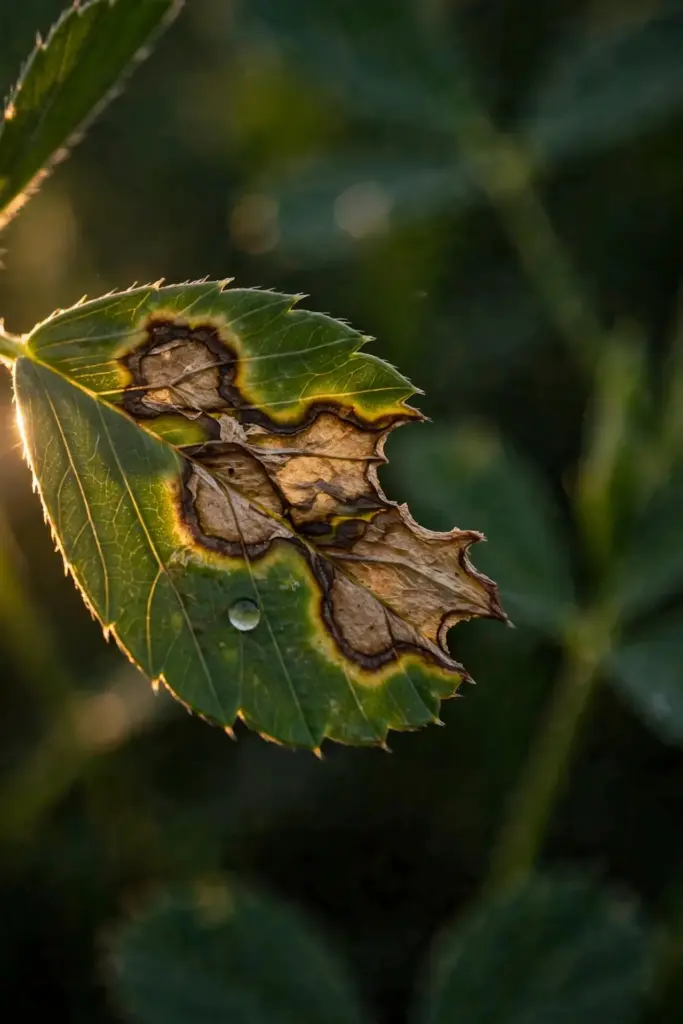
Symptoms show first on new leaves. Small dark lesions, called pepper spots, appear on the young foliage. Lesions enlarge into eyespots, oval and brown with dark margins and yellow halos. Lesions form parallel to leaf veins, then coalesce and cause leaf drop when conditions favor disease, according to the same Crop Protection Network entry. Infection may also occur on older leaves and petioles.
The same genus also causes a turfgrass disease called Leptosphaerulina leaf blight. That disease hits cool-season turfgrasses with dieback that begins at the leaf tip and moves down toward the sheath, plus water-soaked spots that fade to a bleached white color under warm humid conditions, according to the Nuturf guide to Leptosphaerulina leaf blight. Same genus, different host, different symptoms, different management. This article covers the alfalfa disease only. Turf managers should not carry alfalfa advice onto a lawn, and forage growers should not carry turf advice into a hay field.
2. How to Identify Leptosphaerulina Leaf Spot on Alfalfa Leaves
Leptosphaerulina leaf spot on alfalfa leaves starts on the newest growth. Walk to the top of the plant and read the young leaves first. Small dark lesions, the pepper spots, show there before they show anywhere else.
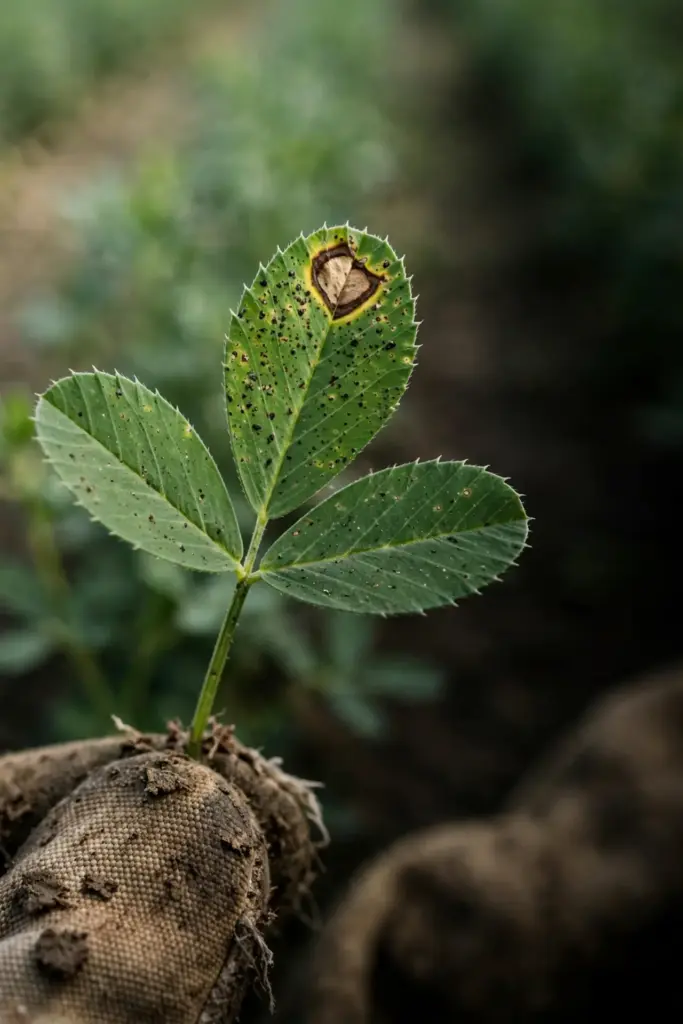
Pepper spots grow into eyespots. The eyespot is oval and brown with a dark margin and a yellow halo. Lesions line up parallel to the leaf veins. As they enlarge they merge, and merged lesions drop the leaf, according to the Crop Protection Network encyclopedia entry on Leptosphaerulina leaf spot of alfalfa. Spots sometimes carry a yellow margin around a tan center with a brown border, giving the same eyespot appearance described by the University of Kentucky IPM page on lepto leaf spot in alfalfa.
Spots show in all but the very youngest leaves on growing shoots, according to the same University of Kentucky IPM page. That detail sets the scouting pattern. The newest unfolded leaf may still read clean while the leaves just below it already carry spots. Read two or three leaf positions down from the tip, not the tip alone.
Leaf drop is the sign that the disease has moved past spotting. A plant that sheds spotted leaves before harvest has already lost the feed those leaves held. Scouting catches the disease at the pepper-spot stage, when the cutting decision still saves leaves.
3. How to Identify Leptosphaerulina Leaf Spot on Petioles and Stems
Leptosphaerulina leaf spot on petioles and stems shows after the leaf spots. Infection reaches older leaves and petioles, according to the Crop Protection Network encyclopedia entry on Leptosphaerulina leaf spot of alfalfa. Leaves and stems eventually blight and turn tan, according to the University of Kentucky IPM page on lepto leaf spot in alfalfa.
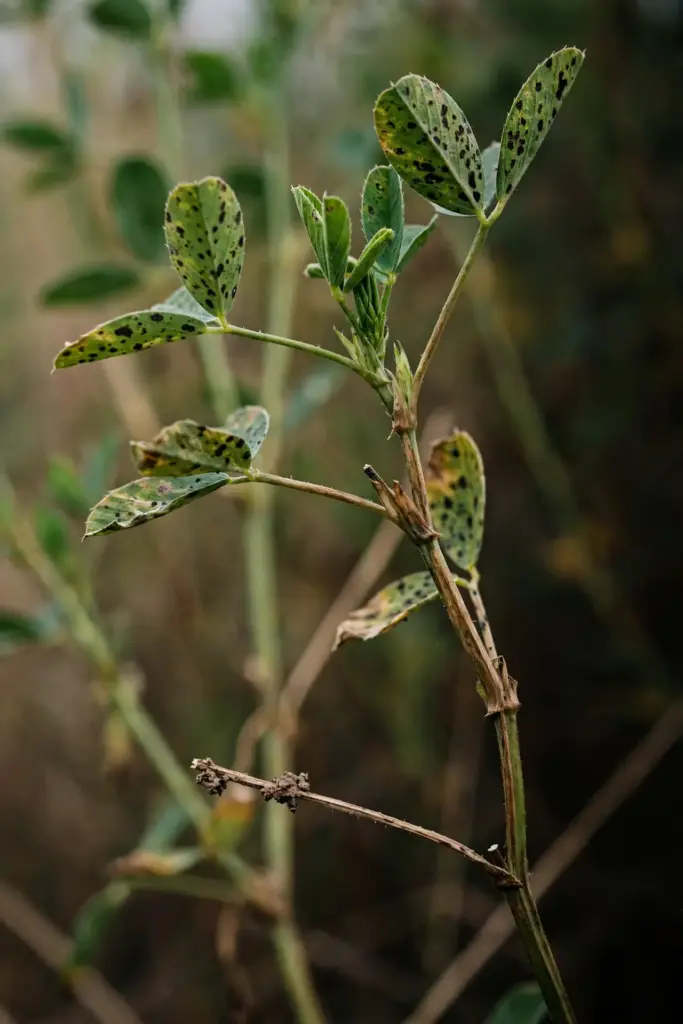
Petioles carry lesions where the leaf stalk meets the stem. A petiole lesion weakens the leaf it feeds, and the leaf drops early. Stem tissue blights as the disease advances, and whole shoots turn tan in a severe outbreak. Tan blighted shoots after a wet spell in a first cutting point toward this disease. They do not prove it. The next section covers the lookalike that shares the field.
Timing narrows the suspect list. The disease is most severe in first or second cuttings, according to the same University of Kentucky IPM page. Disease risk runs higher during spring, early summer, and fall in the northern United States, and it counts as a midwinter issue in the southern United States, according to the same Crop Protection Network entry. Cool wet weather favors the disease in both regions.
Across a field, the disease shows unevenly. Fields tend to be worst in areas that recently received heavy rains, according to the University of Nebraska CropWatch report on leaf fungal diseases severely damaging alfalfa. A low pocket that stays wet after a storm can carry heavy spotting while the high ground around it reads nearly clean. The whole field can look ragged with uneven regrowth, yellowish or dull green, while it deteriorates. Walk the low ground first when scouting after rain.
4. Leptosphaerulina Leaf Spot vs Spring Black Stem: A Field Comparison
Leptosphaerulina leaf spot and spring black stem ride together in bad years. Nebraska fields hit by severe fungal leaf disease usually carry both, and common leaf spot shows up less often alongside them, according to the University of Nebraska CropWatch report on leaf fungal diseases severely damaging alfalfa. A grower who finds one should look for the other.
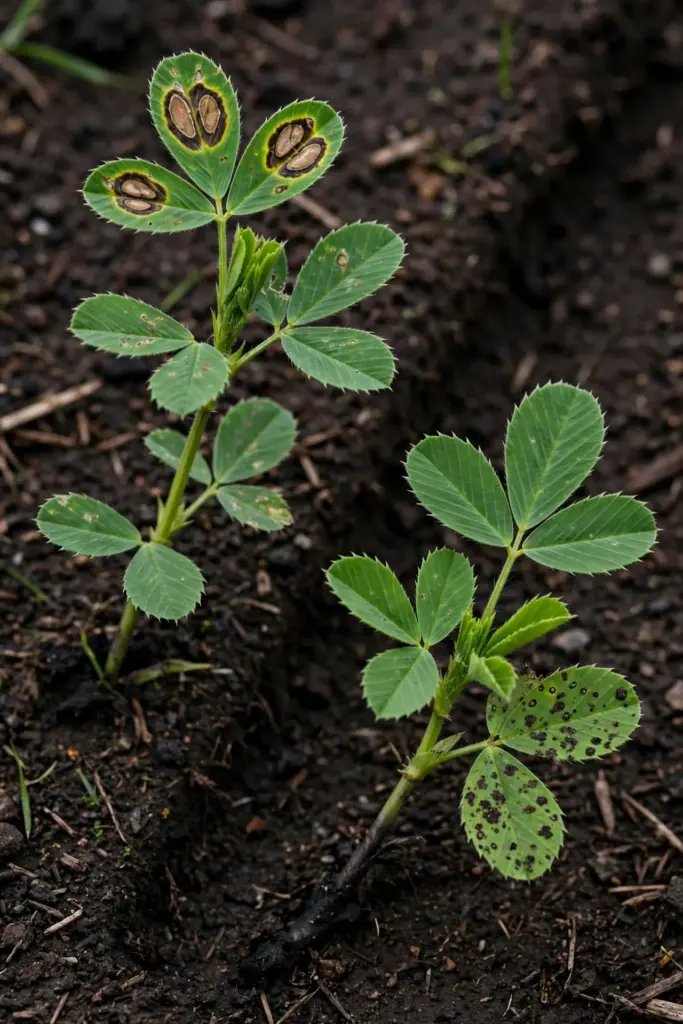
The two diseases split the plant by height. Leptosphaerulina leaf spot favors newer leaves near the top of the plant. Spring black stem favors lower leaves. That split is the fastest field clue, and the table below sets the two side by side.
| Field Sign | Leptosphaerulina Leaf Spot | Spring Black Stem |
|---|---|---|
| First leaves hit | Newer leaves near the top of the plant | Lower leaves first |
| Spot shape and color | Small lesions with tannish centers and brown or reddish-brown borders, often ringed by a yellowish area | Small brown to black spots, often called tar spots |
| How spots develop | Spots enlarge into eyespots, merge along the veins, and drop the leaf | Spots enlarge and merge, then later stages blacken the stem |
| Stem effect | Stems blight and turn tan in severe cases | Stems blacken, leaves yellow and fall |
| End result | Leaf drop before harvest | Leaf drop before harvest |
The table reads from the same Nebraska report, with the eyespot and tan-blight detail from the Crop Protection Network and Kentucky sources cited above. Both diseases end at the same loss. Leaves fall before harvest, and a field can look ragged with uneven regrowth, yellowish or dull green, while it deteriorates, according to the same University of Nebraska CropWatch report.
Mixed infection is the norm in a bad year, not the exception. A stand can carry both diseases at once, plus common leaf spot in a smaller share. Field identification narrows the suspects. It does not name the pathogen with certainty, and no field sign separates a mixed infection into clean halves. The scouting and cutting calls in the next sections answer leaf loss itself, so they hold whether one disease or two drive the damage.
5. Why Early Harvest Matters So Much
Early harvest matters because it removes the infected canopy and the spore source in one pass. The fungus survives on infected leaf debris and spreads to newly developing leaves, according to the Crop Protection Network encyclopedia entry on Leptosphaerulina leaf spot of alfalfa. The fungus survives in alfalfa residue, according to the University of Kentucky IPM page on lepto leaf spot in alfalfa. Spores come from fruiting structures formed on leaves and stems during the previous year, according to the University of Nebraska CropWatch report on leaf fungal diseases severely damaging alfalfa.
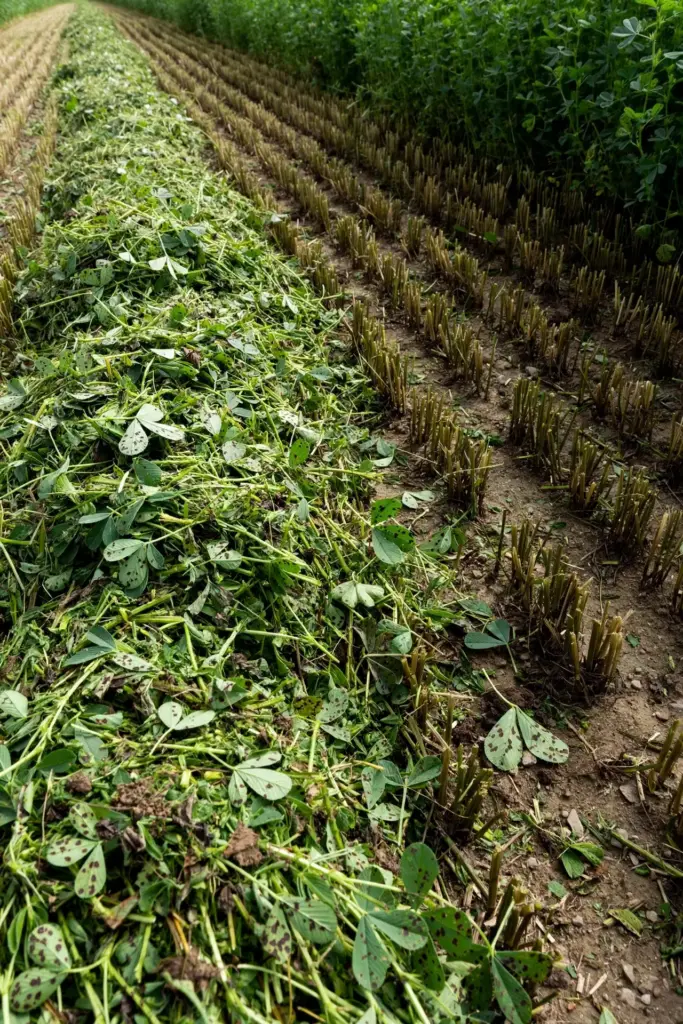
The cycle runs in a loop. Spores leave last year’s debris and land on new leaves. Spots form. Leaves fall and join the debris. The next flush of growth meets a fresh spore supply. A cutting on schedule breaks the loop by taking the infected leaves out of the field before they fall.
A cutting left standing feeds the loop. Disease pressure often runs high in fields where a cutting is left unharvested, according to the same University of Kentucky IPM page. Dead alfalfa leaves and stems get colonized by the fungus, which then produces spores that spread to the healthy alfalfa. A standing overmature cutting is a spore source with a roof over it. Cutting it removes the source. Leaving it grows the source.
The spray window closes before the cutting decision opens. Fungicides registered for this disease must go on before symptoms appear, according to the same Crop Protection Network entry. By the time pepper spots show, the preventive window has passed. The cutting decision is what remains, and the next sections walk through it.
Early harvest does not sterilize the field. The fungus still survives in residue after the cutting leaves, and the next flush of growth can pick up infection from that residue. An early cut buys leaves and breaks the canopy loop. It does not erase the carryover. The rotation section below answers the carryover, and the scouting habit answers the next flush.
6. What Makes Leptosphaerulina Leaf Spot Worse in a Forage Stand
Cool wet weather makes Leptosphaerulina leaf spot worse. The disease favors cool wet weather, according to the Crop Protection Network encyclopedia entry on Leptosphaerulina leaf spot of alfalfa. Rainy weather in spring releases spores from the fruiting structures on last year’s leaves and stems, and the spores spread by splashing water and wind, according to the University of Nebraska CropWatch report on leaf fungal diseases severely damaging alfalfa. Moist or humid conditions cause further spread of the diseases.
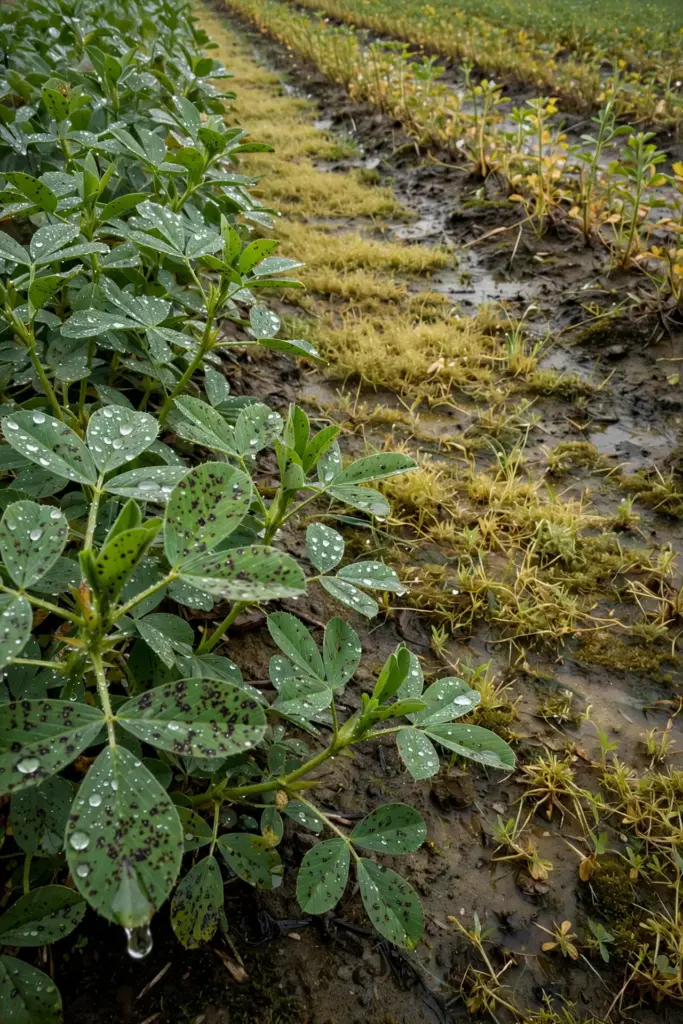
Fields hit worst sit where the rain fell heaviest. The Nebraska report notes that fields tend to be worst in areas that recently received heavy rains. A low pocket that holds moisture after a storm carries more disease than the high ground around it. Drainage differences inside one field show up as disease differences.
Freeze damage opens the door. Disease pressure often runs high following freezing of alfalfa stems, according to the University of Kentucky IPM page on lepto leaf spot in alfalfa. Frozen stems die back, dead tissue gets colonized, and spores move from the dead tissue to healthy growth. A spring freeze followed by wet weather is the highest-risk sequence in the whole season.
Residue carries the disease between cuttings and between years. The fungus survives on infected leaf debris and in residue, per the sources cited above. A field that ended last season with heavy leaf disease starts this season with a spore supply already in place. Good soil health keeps a stand vigorous enough to regrow after an early cut, and vigorous regrowth is the stand’s answer to a disease that strips leaves.
7. Step 1: Scout the Stand and Judge Severity
Scout the stand in the weeks before the planned cutting, and read the newest leaves first. Leptosphaerulina leaf spot shows on newer leaves near the top of the plant, according to the University of Nebraska CropWatch report on leaf fungal diseases severely damaging alfalfa. Walk the field and pull shoots from several spots. Read two or three leaf positions down from the tip on each shoot.
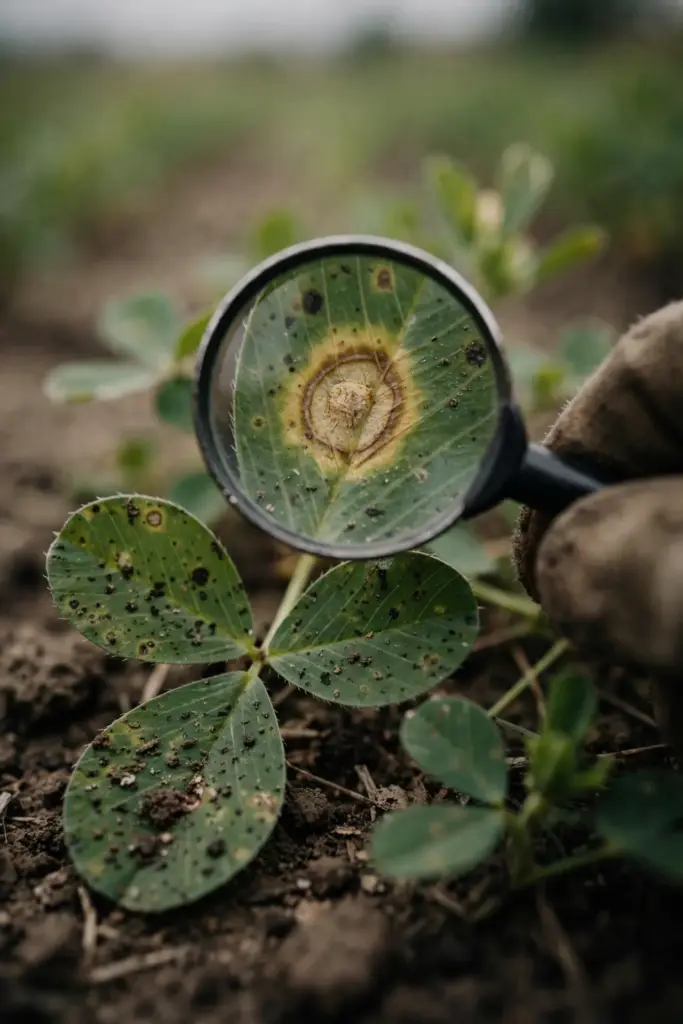
Judge severity by merging and dropping, not by spot count alone. A few pepper spots on upper leaves mean the disease has arrived. Spots merging along the veins mean the leaves are about to fall. Leaves already dropping mean the cutting is late. The line between those stages is the line between a saved cutting and a lost one.
Check the lower leaves too. Small brown to black spots on lower leaves point toward spring black stem, according to the same University of Nebraska CropWatch report. A stand that shows both patterns carries heavy leaf-disease pressure from two directions at once. The cutting call below answers both, because both end in leaf loss before harvest.
Write down what the walk shows. Note the cutting number, since the disease hits hardest in first or second cuttings. Note whether any cutting was left standing last season. Note the worst areas on a field map. The notes set the rotation plan later, and they keep the next season’s first scout from starting blind.
Time the scout to the weather. A walk a few days after a rainy spell shows the disease at its clearest, since moist conditions drive further spread. A walk in a dry stretch can read clean while spores wait in the residue. Scout after rain, and scout the low ground first.
8. Step 2: Cut Early When the Disease Is Severe
Cut early when spots are merging and leaves are dropping. Timely harvest is the first control, and early harvest is the answer when the disease turns severe, according to the Crop Protection Network encyclopedia entry on Leptosphaerulina leaf spot of alfalfa. Timely harvest, or early harvest if necessary, helps prevent leaf loss and accumulation of spores in the field, according to the University of Kentucky IPM page on lepto leaf spot in alfalfa.
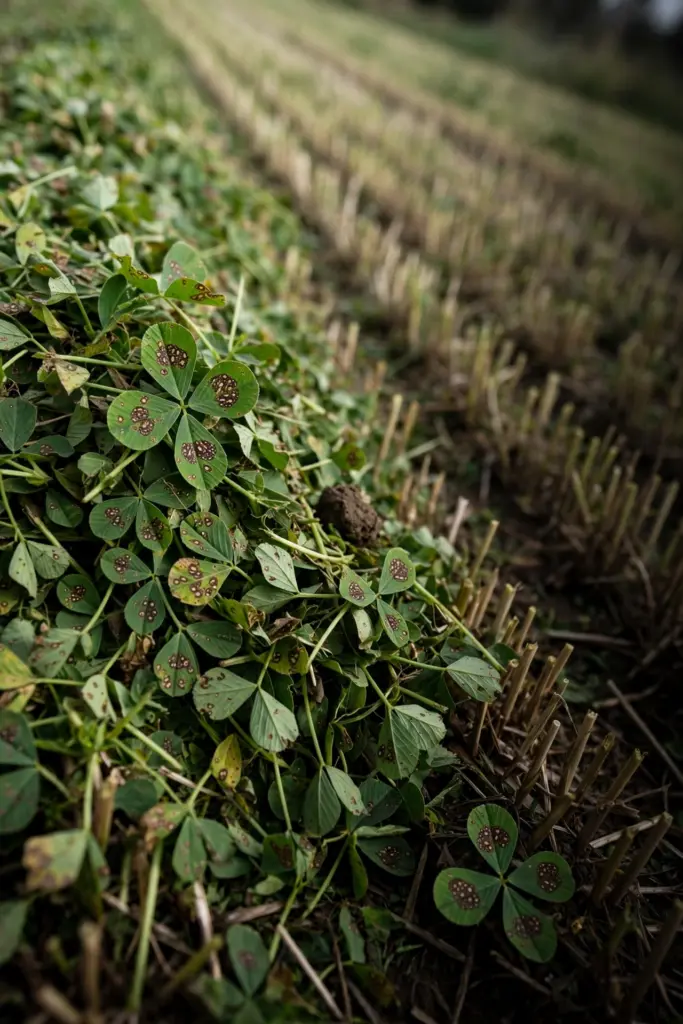
An early cut trades weight for leaves. The cutting comes off lighter than a full-maturity cutting. The leaves it carries stay in the bale instead of falling in the field. A grower who waits for bulk while leaves drop trades the same weight away, and the dropped leaves never come back. In severely affected fields, many leaves are likely to be lost prior to harvest, and little can be done to prevent it, according to the University of Nebraska CropWatch report on leaf fungal diseases severely damaging alfalfa. Early cutting moves before that point.
Cut on a dry window so the windrow dries. Do not leave the cut forage standing in the field longer than curing needs, since a cutting left unharvested builds spore pressure, per the Kentucky source cited above. Get the windrow up and off. The field then regrows from crowns that carry less infected canopy than the cut removed.
Scout the regrowth. Spores survive in residue, so the next flush can pick up infection again. The regrowth scout matters most after a first cutting that carried heavy disease. Catching pepper spots early in the second cutting keeps the same decision available a second time.
9. Step 3: Decide Whether a Fungicide Pays
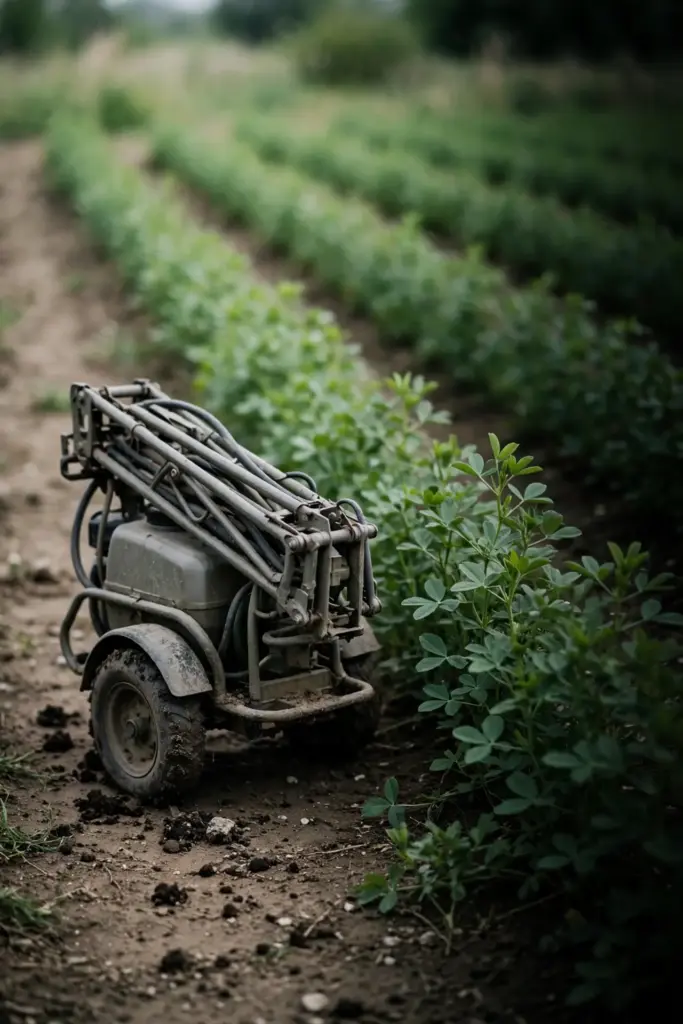
A fungicide pays only as a preventive, applied before symptoms. Fungicides are registered for Leptosphaerulina leaf spot, but they must be applied before symptoms are observed, according to the Crop Protection Network encyclopedia entry on Leptosphaerulina leaf spot of alfalfa. That single condition decides the whole question. Pepper spots on the leaves mean the preventive window has already closed for that cutting.
| Option | When It Works | What It Costs |
|---|---|---|
| Cut early | Spots merging, leaves dropping | A lighter cutting, with leaves kept in the bale |
| Preventive fungicide | Before symptoms, in a field with a history of heavy pressure | Product plus application, on the label schedule |
| Spray after symptoms show | It does not work | Money spent, leaves still drop |
The table carries no product names and no rates, because the sources give none. Any fungicide decision runs on the local label and local extension guidance. A grower who sprays after spots appear spends money on a window that has already closed.
Variety choice does not rescue a spray decision. A few cultivars have low levels of resistance, according to the same Crop Protection Network entry. Some varieties may suffer less yield loss, but the reaction of most varieties to the disease is unknown, according to the University of Kentucky IPM page on lepto leaf spot in alfalfa. Do not buy a variety on a disease claim the supplier cannot back with trial data. Treat resistance as a small edge, not a plan.
The honest order of tools is harvest first, prevention second, and rescue never. A grower who plans around the cutting date spends nothing on chemistry and keeps the leaves. A grower who plans around the sprayer has to guess the disease before it shows, season after season.
10. How to Break the Cycle Between Cuttings
Rotate away from forage legumes for at least two years. That is the rotation rule from the University of Kentucky IPM page on lepto leaf spot in alfalfa. Two years without a forage legume host breaks the carryover that residue holds in the field.
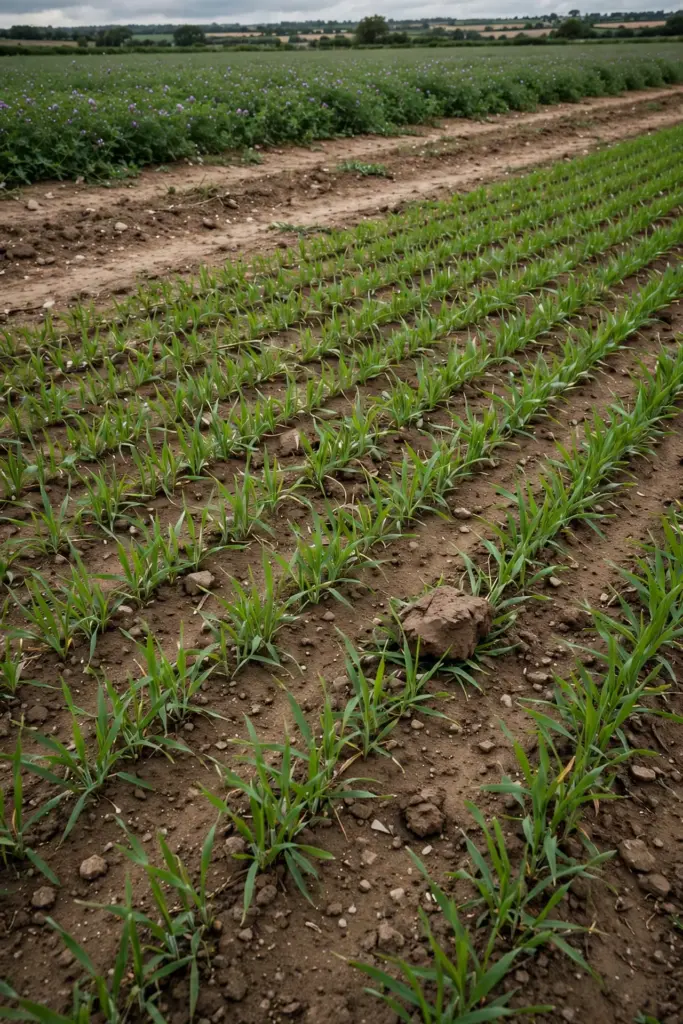
The rotation works because the fungus needs a legume host. It survives on infected leaf debris and in residue, per the sources cited above. A legume-free interval starves the carryover. The interval starts when the last alfalfa cutting leaves the field, not when the stand gets plowed under. Residue from the final cutting still counts as host material until it breaks down.
Clover counts as a forage legume for this rule. Spores spread by air currents and can also attack clovers, according to the same University of Kentucky IPM page. A clover cover crop in the rotation slot keeps a host in the ground and defeats the purpose of the break. Keep the rotation slot free of alfalfa, clover, and other forage legumes for the full two years. The wider crop rotation plan for the farm should show that gap.
Reseeding deserves the same discipline. When the rotation ends and alfalfa goes back in, ask the seed supplier for variety reaction data. A few cultivars carry low levels of resistance, per the Crop Protection Network source cited above, and most varieties carry no data at all. Pick the variety on yield and persistence data that exists, and treat any disease edge as a bonus.
11. How to Live With a Stand That Has Held Leptosphaerulina Leaf Spot
A stand that has held Leptosphaerulina leaf spot stays a risk, and the risk concentrates in the same part of the season. The disease is most severe in first or second cuttings, according to the University of Kentucky IPM page on lepto leaf spot in alfalfa. Later cuttings usually carry less pressure. Keep the cutting schedule tight in spring, when the disease runs hardest, and scout the first cutting first every year.
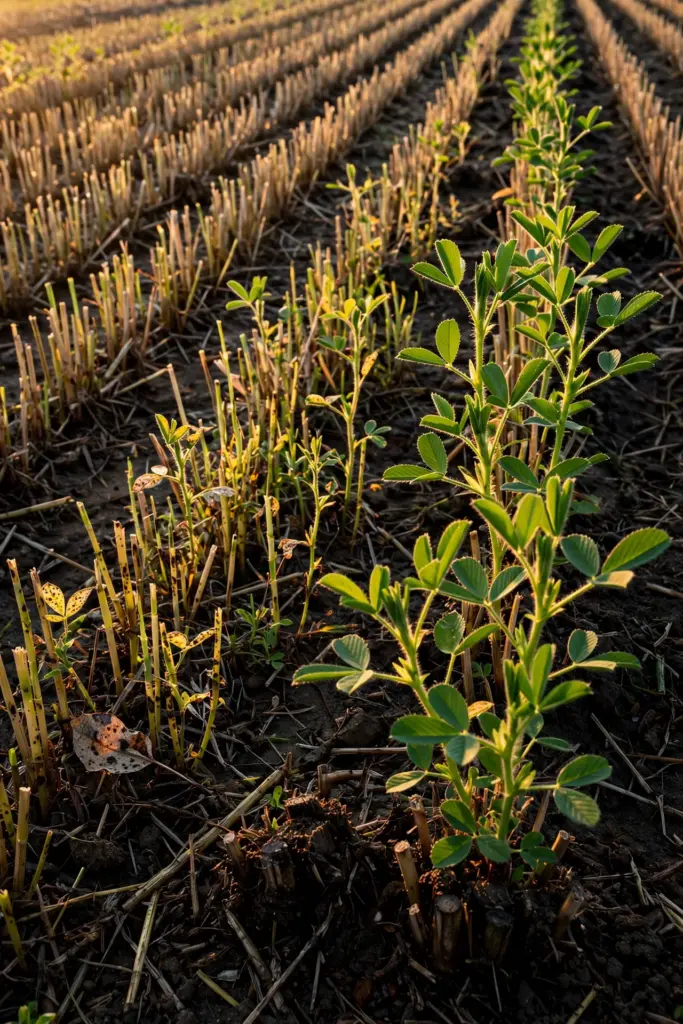
Last season’s residue sets this season’s starting pressure. Spores come from fruiting structures formed on leaves and stems during the previous year, according to the University of Nebraska CropWatch report on leaf fungal diseases severely damaging alfalfa. A field that ended last season with heavy leaf disease starts this season with spores already in place. The first scout of spring should cover that field before any other.
Judge the stand on regrowth and leaf retention across cuttings. A stand that drops its leaves before every harvest is a stand losing the feed it grew. A stand that holds its leaves through a wet spring after an early cut has answered the disease with management, not chemistry. The record from the scouting notes shows which pattern a field follows.
No source used here sets a replant threshold for this disease. The decision stays with the grower. Weigh regrowth vigor, leaf retention, stand density, and whether the rotation slot allows a full two-year legume-free break. A thin stand with repeated severe defoliation argues for rotation. A dense stand that holds its leaves after timely cuts argues for another season.
12. Frequently Asked Questions
No. No spray cures infected tissue, and the registered fungicides must go on before symptoms appear, according to the Crop Protection Network. The cutting decision is the only tool left once pepper spots show. Cut early to keep the leaves that remain. Spraying after symptoms spends money on a window that has already closed, and the leaves still drop.
The sources describe leaf drop and blighting, not stand death. Leaves fall before harvest, shoots blight and turn tan, and fields look ragged with uneven regrowth. The cost is lost leaves at harvest, cutting after cutting. A stand that drops leaves every spring still needs the rotation decision, since residue carries the disease forward into the next season.
No. The two diseases share a genus, not a host. The alfalfa disease shows pepper spots and eyespots on legume leaves in cool wet weather. The turf disease shows leaf-tip dieback and water-soaked spots fading to bleached white on cool-season grasses in warm humid weather, according to Nuturf. Management differs by host, so do not carry advice across the fence between them.
No. The first pepper spots mean the preventive window has closed. Fungicides registered for this disease must be applied before symptoms are observed, according to the Crop Protection Network. At the pepper-spot stage, cut early instead. A preventive program belongs in the plan before the season starts, in a field with a history of heavy pressure, not in the sprayer after spots show.
Yes. Spores spread by air currents and can also attack clovers, according to the University of Kentucky. That fact drives the rotation rule. A clover cover crop in the rotation slot keeps a host in the ground. Keep the rotation free of alfalfa, clover, and other forage legumes for at least two years to break the carryover.
13. Where to Go From Here
Leptosphaerulina leaf spot rewards growers who act before symptoms show. Scout the newest leaves before each cutting. Cut early when spots merge and leaves drop. Keep the rotation free of forage legumes for two full years after a bad field.
Start with the next walk. Read the newest leaves on several shoots. Note the cutting number and the worst areas. One early cut that keeps the leaves beats a season of sprays that arrive after the spots.