
Pestalotia leaf spot is a strawberry disease that starts as leaf spots and can end with rotted fruit, dead crowns, and whole fields pulled out of production. It hit Florida strawberry fields hard across two seasons, 2018-19 and 2019-20, and the outbreaks traced back to infected transplants from nursery stock. This page is written for commercial strawberry growers, and it gives the identification signs, the lab test that confirms them, and the planting and in-season decisions that keep the disease out.
The pathogen behind pestalotia leaf spot belongs to the genus Neopestalotiopsis. It attacks the whole strawberry plant, from leaves down to roots. A single infected transplant lot can seed a whole planting, because the fungus rides in on stock that looks healthy at delivery.
I have learned to inspect every incoming transplant lot as if it already carries the disease. What follows starts with identification and ends with the decisions that protect a crop.
1. What Pestalotia Leaf Spot Actually Is
Pestalotia leaf spot is a disease of strawberry caused by fungi in the genus Neopestalotiopsis. The name on the batch list is legacy taxonomy. The current pathogen name is Neopestalotiopsis sp.
Researchers in Florida and Israel first reported the fungus on strawberry as Pestalotia longisetula, describing it mainly as a fruit rot pathogen. Later work reclassified it as Pestalotiopsis longisetula. The most recent work places strawberry isolates in Neopestalotiopsis. Older isolates now carry the name Neopestalotiopsis rosae and show up mainly on roots and crowns during plant establishment. The aggressive strains behind the recent Florida outbreaks belong to a Neopestalotiopsis sp. distinct from Neopestalotiopsis rosae, according to the UF/IFAS Extension publication on pestalotia leaf spot and fruit rot of strawberry.
For years the fungus counted as a weak or secondary pathogen. It showed up on roots and crowns and rarely drove a field. That changed in the 2018-19 and 2019-20 seasons, when severe and unprecedented outbreaks struck Florida strawberry fields with symptoms on nearly all plant parts, including fruit and leaves, according to the UF/IFAS Extension publication. Yield fell hard, and several entire fields turned uneconomical to harvest and were destroyed. The common link among the outbreaks was the nursery source of the transplants. The same UF/IFAS publication records that most commercial strawberry cultivars grown in Florida are susceptible and that no fungicide carries a label for this disease in the United States or elsewhere.
The disease matters because it hits every part of the plant in sequence. Leaf spots cut photosynthesis. Fruit rot cuts marketable yield. Crown and root infection kills plants outright. A grower who reads leaf spots as a cosmetic problem misses the crown rot that follows.
The fungus often arrives with company. The same UF/IFAS publication notes that Neopestalotiopsis is sometimes isolated along with other root and crown pathogens such as Macrophomina phaseolina, Colletotrichum species, and Phytophthora species. A mixed infection complicates the field picture, because the plant carries more than one pathogen at once. The lab sample matters twice over in such fields. It names the Neopestalotiopsis strain and it shows whether a second pathogen shares the infection.
2. How to Identify Pestalotia Leaf Spot on Strawberry Leaves
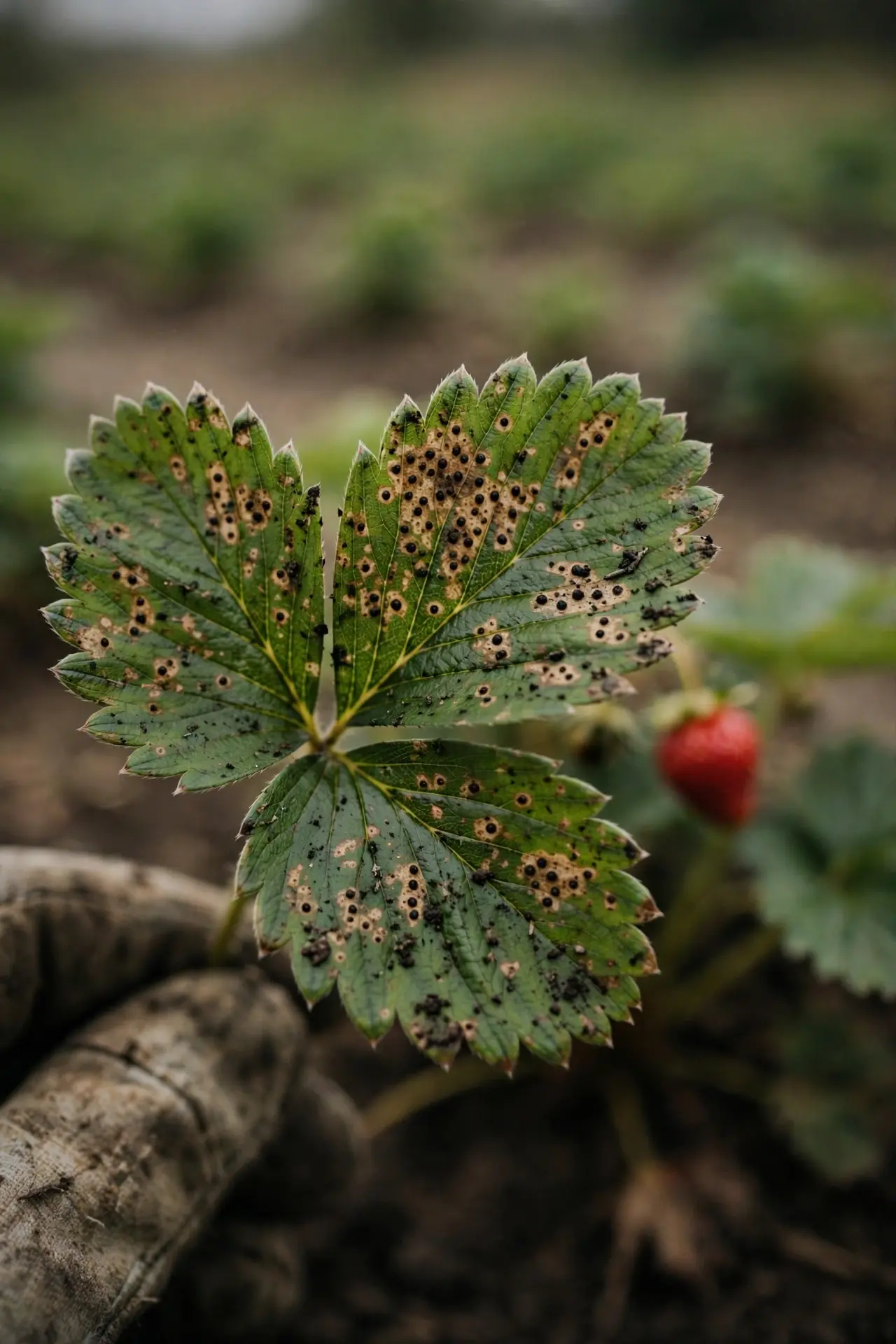
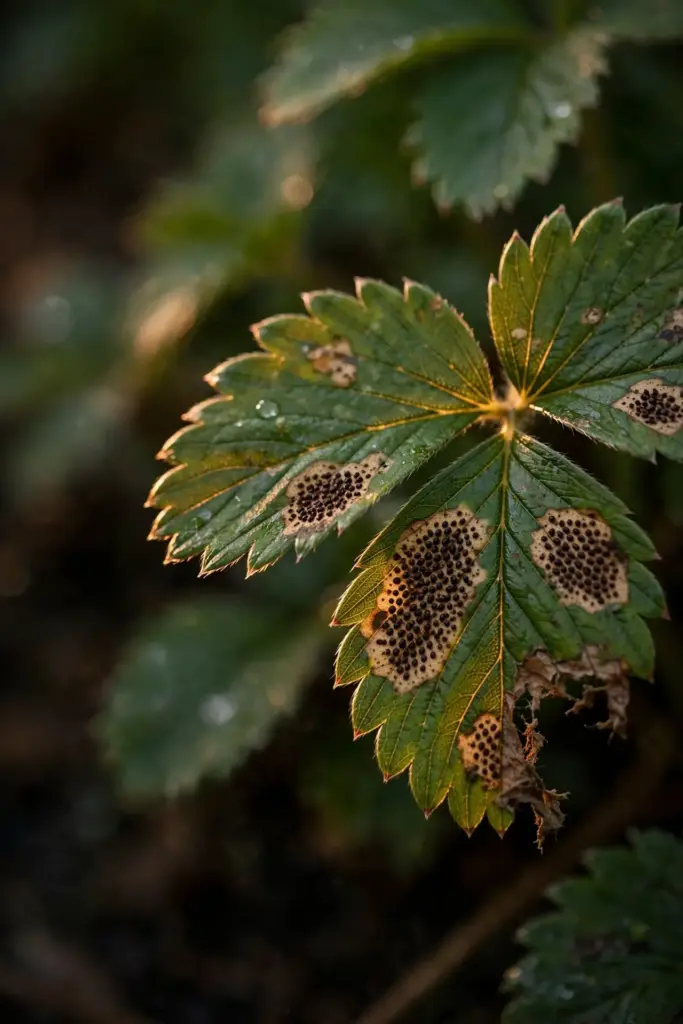
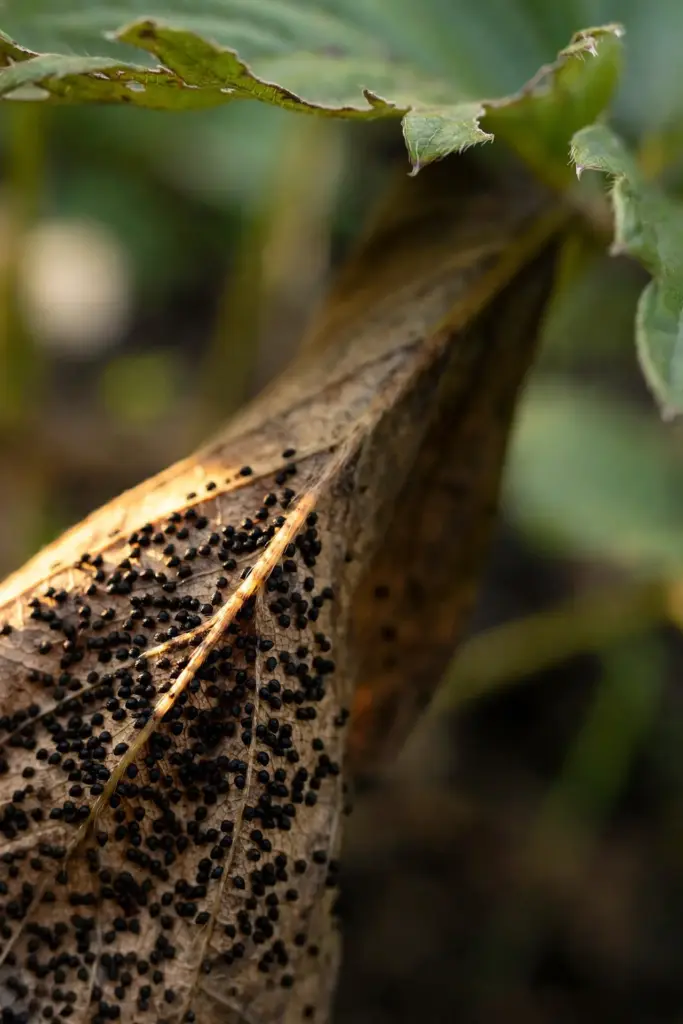
Pestalotia leaf spot on strawberry leaves starts as light to dark brown spots of varying sizes, scattered irregularly across the leaf. Young spots run roughly circular, then turn irregular as they enlarge toward the leaf margins. Older necrotic tissue carries dark fruiting bodies in the tan centers.
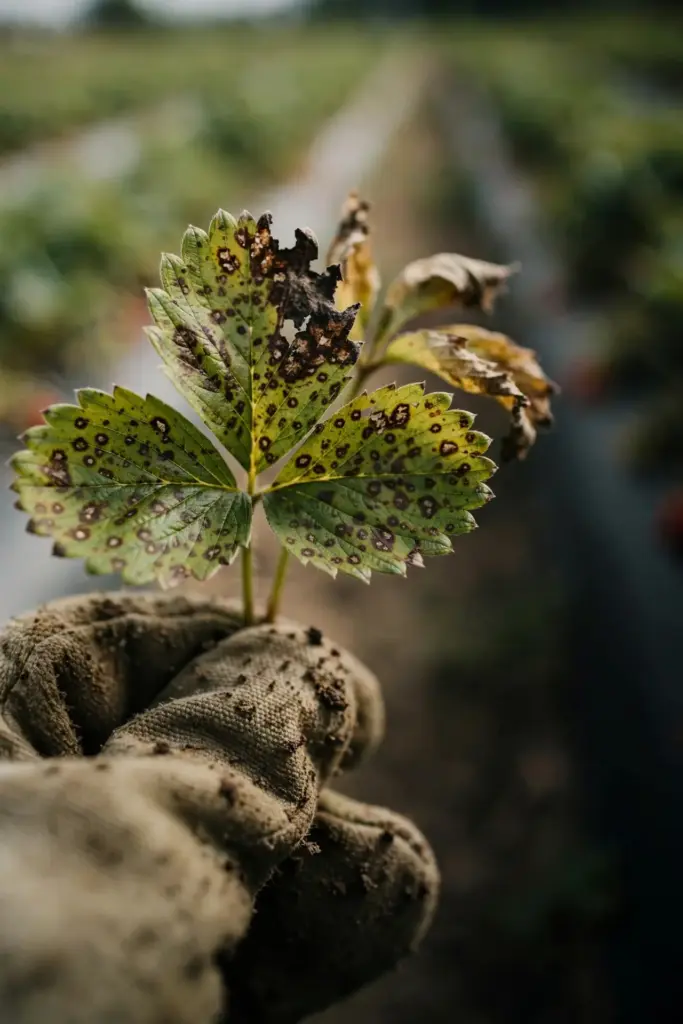
Speed separates this disease from slower leaf spots in the field. Speed is a clue. It is not proof. During warm wet spells, large portions of infected leaves fall within a few days. Penn State Extension notes that disease progression stays noticeable over just a few days, while other foliar diseases invade tissue far more gradually.
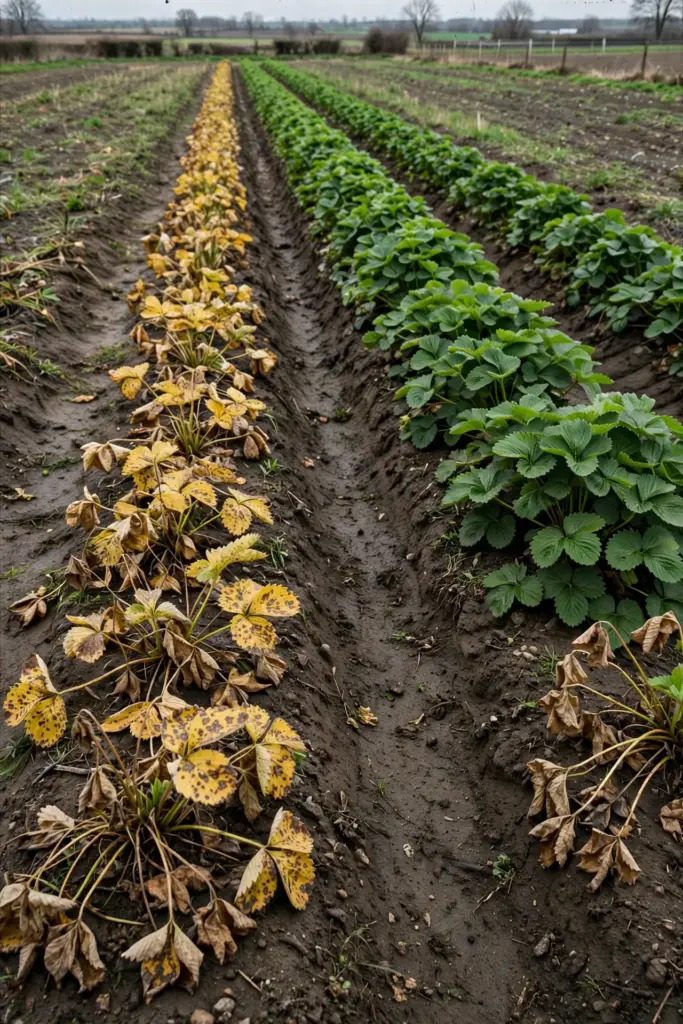
Mass spotting can produce blight-like necrosis across broad areas of a leaf and kill the leaf outright. Heavy spotting also stunts plants, which push smaller and weaker leaves after infection. Leaf spots often show first on older foliage, so fall scouting starts with the oldest leaves on the plant.
The fruiting bodies inside old spots are the spore source for the next round of infection. The UF/IFAS Extension publication describes dark fruiting bodies that develop in the tan centers of older necrotic tissue and hold the fungal spores. Spores leave those bodies in black droplets, and in dark sooty columns when relative humidity runs high. A leaf covered in old spots is not dead tissue alone. It is an active spore factory sitting in the canopy.
A moist chamber test gives a second clue. Leaves held in a sealed plastic bag with a wet paper towel at warm room temperature grow many black pycnidia, tiny black pimples, within a few days. Other diseases grow a few pycnidia and take longer. With Neopestalotiopsis, green tissue keeps getting invaded during the test. The same Penn State Extension page describes this test as a field hint. Only lab culturing or microscopy confirms the diagnosis.
3. How to Identify Pestalotia Leaf Spot on Fruit, Crowns, and Roots
Pestalotia leaf spot on fruit starts as young spots 2 to 4 mm across, dry, light tan, slightly sunken, and irregular in shape, according to the UF/IFAS Extension publication. Lesions grow and turn dark as fruiting bodies cover them. Ripe fruit can carry the same lesions on the calyx. Spores leave the fruiting bodies in shiny black liquid droplets.
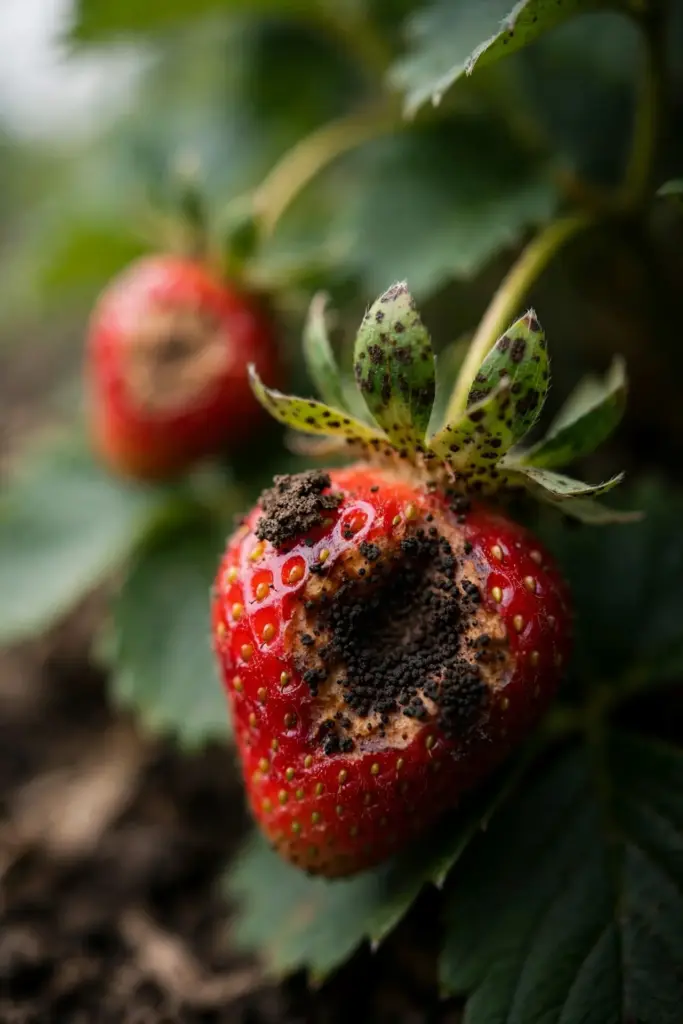
Crown infection shows aboveground before it kills the plant. Older leaves redden. New leaves emerge stunted and mottled. The plant wilts, and wilting peaks while the plant carries fruit. NC State Extension describes this sequence and notes that overall wilting and plant death follow when crown rot advances.
Below ground, roots darken and lose vigor. Crowns cut open show orange-brown necrosis. The same NC State Extension publication records that leaf spots often arrive first in newly planted fields, during fall and winter establishment, and that the pathogen reaches every part of the plant.
Fruit rot is the symptom that costs money first. A berry with a sunken tan lesion will not grade out, and a lesion covered in black spore masses spreads inoculum to the next berry on the same plant. Pickers who handle rotted fruit and then healthy fruit carry spores down the row.
Lesions follow the fruit from green to ripe. Early lesions show on green fruit as small dry tan spots. Ripe fruit carries larger lesions, and the calyx can carry them too. Late lesions turn black under a mass of spores. A picker who spots black spore masses on ripe fruit is looking at the most infectious fruit in the row, and that fruit should leave the field in a bag rather than in a flat.
4. Why Field Diagnosis Fails and Lab Confirmation Decides It
Field diagnosis of pestalotia leaf spot fails because the symptoms match several other strawberry diseases. No field sign separates this disease from its lookalikes with certainty. A grower who treats on a field guess can spray the wrong disease for a whole season.
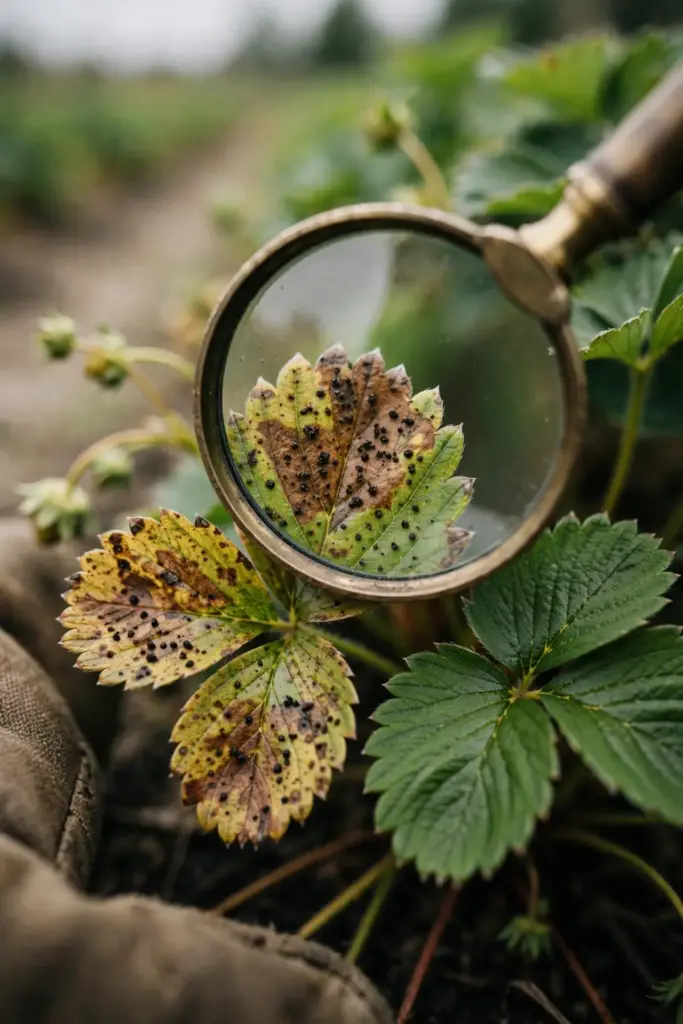
On fruit, the lesions resemble anthracnose fruit rot. Anthracnose is the closest fruit lookalike, and the two diseases demand different management. On leaves, the spots resemble leaf blotch, Phomopsis leaf blight, common leaf spot, Cercospora leaf spot, and leaf scorch. Phyllosticta leaf spot is another leaf spot disease with its own guide on this site, and it is not this disease.
Crown rot brings its own confusion. Early Neopestalotiopsis crown rot looks like Phytophthora crown rot and anthracnose crown rot. Cutting a crown open does not settle it either, since crown color overlaps between these diseases. Gray mold also rots strawberry fruit, and it answers to different management, as gray mold on tomatoes shows for the same fungus on another crop.
Two field cues help, and neither one confirms the disease. Fast tissue invasion during warm wet weather points toward Neopestalotiopsis. A moist chamber test that grows many black pycnidia in a few days points the same way. Both cues narrow the suspect list. The lab test names the pathogen.
Send symptomatic leaves, fruit, or whole plants to a diagnostic clinic. The lab cultures the fungus or incubates the sample in a moist chamber and examines the spores under a microscope. NC State Extension states that culturing or moist-chamber incubation followed by microscopic examination of spores is required for accurate diagnosis. A grower who skips this step and sprays on a guess can spend a season fighting the wrong disease.
A wrong guess also spends chemistry that the farm cannot get back. The industry leans on fludioxonil for Botrytis and anthracnose fruit rots, and overuse of that active ingredient selects for fungicide resistance. The UF/IFAS Extension publication reports that isolates of the new Neopestalotiopsis already resist strobilurin fungicides. Spraying a misdiagnosed field burns effective products on the wrong target and leaves less chemistry for the disease that is actually present.
5. Which Strawberry Cultivars Get Hit Hardest
Every commercial strawberry cultivar grown today is susceptible to pestalotia leaf spot. No resistant cultivar carries a commercial planting. Cultivar choice shifts risk. It does not remove it.
Florida Beauty and Florida Brilliance show the highest susceptibility in Florida trials. Sweet Sensation, sold as Florida127, along with Florida Medallion and Florida Encore, show intermediate susceptibility. Florida Ember and the Pearl white cultivars show lower disease levels and still take infection. The UF/IFAS Extension publication reports this ranking.
| Cultivar | Susceptibility | What It Means for a Grower |
|---|---|---|
| Florida Beauty | Highest | Avoid in fields with a disease history |
| Florida Brilliance | Highest | Avoid in fields with a disease history |
| Sweet Sensation (Florida127) | Intermediate | Usable with strict transplant inspection |
| Florida Medallion | Intermediate | Usable with strict transplant inspection |
| Florida Encore | Intermediate | Usable with strict transplant inspection |
| Florida Ember | Lower, still affected | Lower pressure, not immunity |
| Pearl white cultivars | Lower, still affected | Lower pressure, not immunity |
Treat the ranking as a risk lever, not a guarantee. A highly susceptible cultivar from a clean nursery lot outperforms an intermediate cultivar from an infected lot. Transplant health decides more than cultivar name.
North Carolina confirmed the disease in fruiting fields in 2022, after the Florida outbreaks. NC State Extension records that first confirmation. The disease now threatens plantings across the southeastern United States. A grower outside Florida cannot treat this as a Florida-only problem.
6. How Pestalotia Leaf Spot Spreads Through a Planting
Pestalotia leaf spot enters a planting on infected transplants. The primary source of inoculum for epidemics in Florida is infected strawberry transplants from specific nurseries. A lot can carry the fungus with no visible symptoms at delivery. The disease then spreads locally within and between fields.
The nursery link is what makes this disease different from leaf spots that blow in on the wind. One infected lot can seed several fields when a nursery ships to several growers. That shared origin is why the Florida outbreaks traced back to specific nursery sources rather than to weather alone. A grower who buys from a nursery with a clean record buys the cheapest insurance available against this disease.
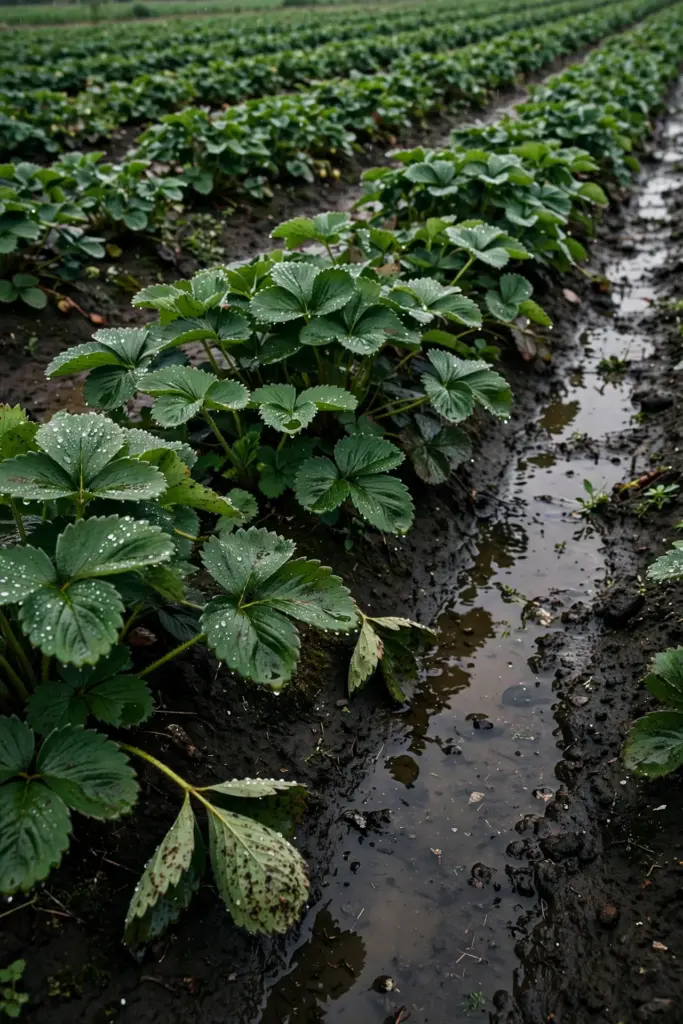
Water moves the spores. Rain splash and overhead irrigation lift spores from infected tissue to healthy leaves and fruit. Spores leave fruiting bodies on the surface of infected tissue. Farm equipment and field workers move spores during harvest and cleaning. Working a planting while it stays wet spreads the disease down the row.
Weather sets the pace. The disease favors consecutive and prolonged rain events. Temperatures above 50 degrees Fahrenheit allow development, with an optimum between 77 and 86 degrees Fahrenheit. Under favorable conditions the pathogen spreads very rapidly. The UF/IFAS Extension publication reports these thresholds.
Soil holds the pathogen between seasons. A recent study reported by the UF/IFAS Extension publication found the fungus surviving in soil for up to 17 months. That persistence makes a field with a confirmed outbreak a risk for the next strawberry crop, even after a skipped season. Rotation and site choice carry the answer, and the final section covers them.
| Pathway | How It Moves | Break It With |
|---|---|---|
| Infected transplants | Nursery stock carries the fungus, often without symptoms | Certified disease-free stock, inspection on arrival |
| Rain splash and irrigation | Water lifts spores to healthy leaves and fruit | Limit wet operations, manage irrigation timing |
| Equipment and workers | Spores ride tools, hands, and clothing down the row | Sanitation, work affected fields last |
| Infested soil | The fungus survives in soil for up to 17 months | Rotation, site choice, no strawberry back to back |
7. How to Keep Pestalotia Leaf Spot Out at Planting
Keeping pestalotia leaf spot out starts before the transplants arrive. Exclusion beats every later control, because no fungicide carries a label for this disease and no cultivar resists it. The planting decisions below cost little. The outbreak they prevent costs a field.
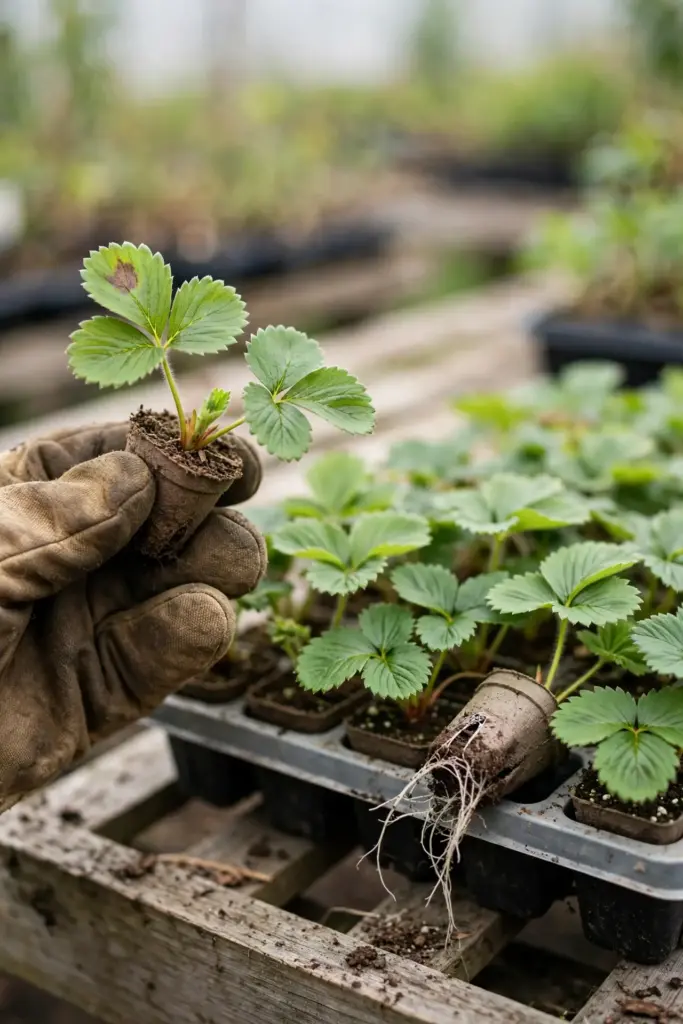
Buy certified disease-free transplants. Alabama Extension tips carried by Fruit Growers News put certified disease-free plants and inspection on arrival first among grower safeguards. Ask the nursery about its disease history. Refuse lots with leaf spots, even a few.
Inspect every lot on arrival. Symptoms are not always easy to recognize on transplants after arrival, so inspection takes time and light. Spread the plants out. Look at the oldest leaves first. Check crowns on a sample of plants. Flag any lot with spots and hold it apart from clean lots until a diagnostic clinic rules on it.
Push inspection back to the nursery level as well. The UF/IFAS Extension publication calls for routine inspections at the nursery level, because symptoms are not always easy to recognize on transplants after arrival in Florida. A grower who can verify nursery inspection records before ordering has a stronger position than a grower who inspects only at delivery. Ask for those records. A nursery with nothing to show is a nursery to question.
Choose the cultivar with the ranking in mind. Where the market allows, favor intermediate or lower-susceptibility cultivars over Florida Beauty and Florida Brilliance in fields with a disease history. Growers who plant several types together can read how different strawberry types share a bed before mixing lots in one planting.
Set the sanitation rules before planting day. Wash and disinfest tools between lots. Set a hand sanitation station at the field edge. Plan the work order so crews finish clean fields before entering any suspect block. Limit field operations when plants are wet, including harvest and spraying.
8. How to Scout and Remove Symptomatic Material During the Season
Scouting during the season catches pestalotia leaf spot while removal still helps. Walk the rows in fall. Look at older foliage first, where leaf lesions show up on newly planted fields. A weekly walk beats a monthly walk, because the disease moves fast in warm wet weather.
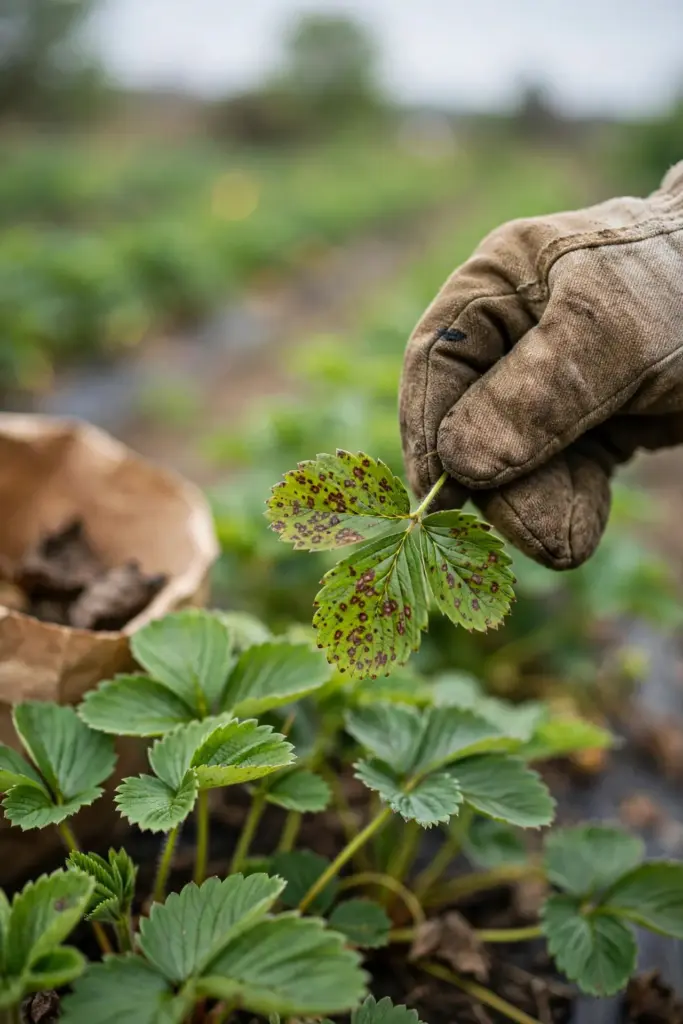
Plan the work order so the affected block comes last every day. The UF/IFAS Extension publication advises saving farm operations in affected fields for the last job of the day. A crew that finishes clean ground first and enters the suspect block last keeps spores off the clean ground on the next job. The same rule applies to harvest, spraying, and scouting passes.
Remove symptomatic leaves and plants. Pull leaves with spots and carry them out of the field. Destroy the material. Do not compost it and do not leave it in the row. The same Alabama Extension tips advise fall scouting with removal and destruction of symptomatic leaves.
Sanitation between rows stops the crew from becoming the vector. Clean tools after working a suspect row. Wash hands and change gloves between blocks. Work the affected block last in the day so spores do not ride to clean ground on the next job.
Record what you find. Mark the rows with spots on a field map. Note the date and the cultivar. A map from this season sets the rotation and the site choice for the next planting. It also gives the diagnostic clinic a clean sample history when you send material in.
9. What to Do When Pestalotia Leaf Spot Is Confirmed in Your Field
A confirmed case of pestalotia leaf spot changes the field plan at once. Confirmation means the lab has named the pathogen. Until the lab rules, treat suspect blocks as infected and keep them last in the work order.
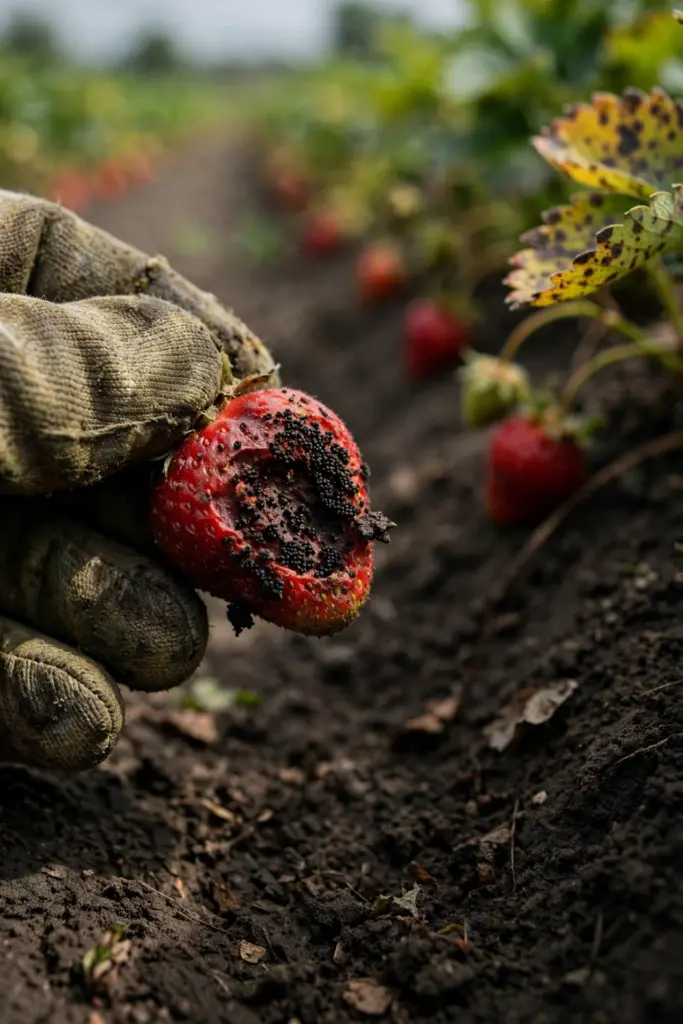
Remove and destroy symptomatic plants, including crowns and roots. A plant with crown rot will not recover. Leaving it in the row feeds spores to its neighbors. Bag the material on site and destroy it off the field.
Hold the sanitation line. Disinfest equipment after every pass through the affected block. Set hand sanitation at the block edge. Keep crews out of the block while plants stay wet. Harvest the affected block last, after the dew dries, and keep the crew out of wet rows until the leaves dry.
Set the fungicide program on facts. No fungicide carries a label for Neopestalotiopsis on strawberry. In UF/IFAS screening and field trials, Switch and Thiram controlled the pathogen best, while Thiram and Captan, both multi-site products, form the backbone of the program. Limit single-site materials such as Switch and Miravis Prime to rainy periods when weather favors disease. Follow the label for the maximum number of applications. The same UF/IFAS Extension publication reports that isolates of the new Neopestalotiopsis already resist strobilurin fungicides. Two other products, Bravo and Omega, are nursery options rather than production-field options.
| Action | Timing | Purpose |
|---|---|---|
| Confirm with the lab | At first suspect symptoms | Avoid spraying the wrong disease |
| Remove and destroy symptomatic plants | At once, crowns and roots included | Cut the spore supply |
| Work the block last | Every pass, all season | Keep spores off clean ground |
| Apply multi-site fungicides | On the label schedule | Suppress spread, slow resistance |
| Reserve single-site products | Rainy periods only | Save effective chemistry |
10. How to Live With a Field That Has Held Pestalotia Leaf Spot
A field that has held pestalotia leaf spot stays a risk after harvest. Soil persistence measured up to 17 months, according to the UF/IFAS Extension publication, means the pathogen can outlast a single skipped season. Planting strawberry back into the same ground the next year invites the disease back.
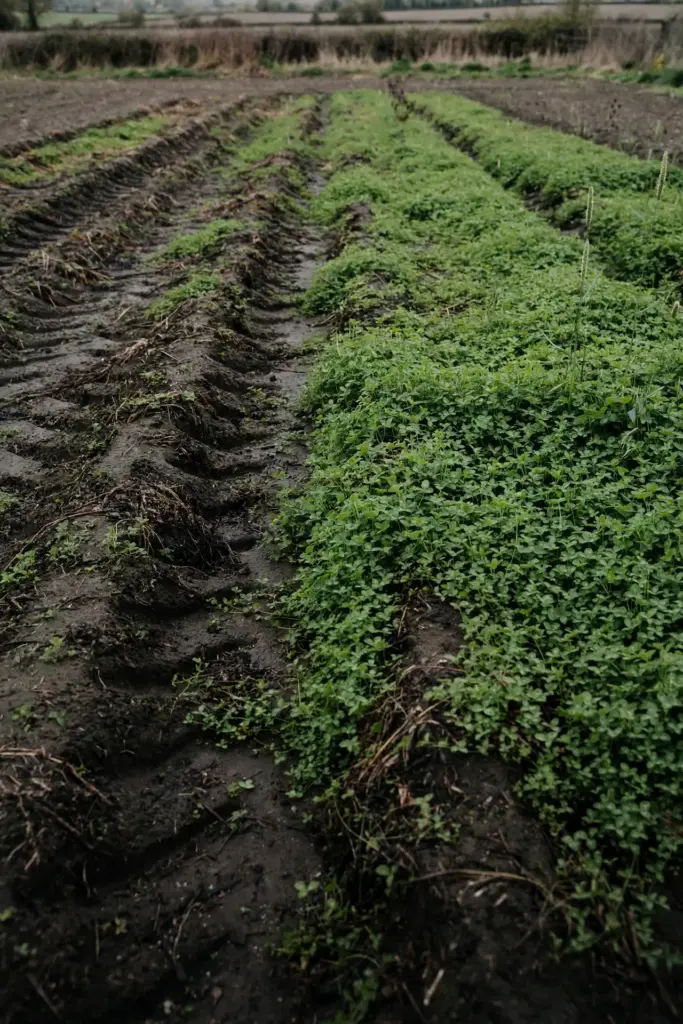
Rotate the field. Put a non-host crop in the ground and keep strawberry out until the soil risk drops. Consider another site for the next strawberry planting when the field history includes a confirmed outbreak. The decision costs a season of strawberry income. It costs less than a second destroyed field.
Treat the next transplant lot as the gate. Buy certified disease-free stock. Inspect on arrival. Scout the oldest leaves through fall establishment. The exclusion habits from planting day decide whether the field stays clean.
Keep the field record alive across seasons. File the patch map, the lab reports, and the cultivar list from the outbreak year with the rotation plan. A grower who pulls that file before ordering the next strawberry crop can see which blocks carry history and which lots came from which nursery. Memory fades. The file does not.
Keep the palm lane separate. The same genus complex attacks palms and other hosts, and a separate article covers Pestalotiopsis leaf spot on palms and conifers. That article does not duplicate this one, and this one does not cover palm disease.
11. Frequently Asked Questions
No. No fungicide cures infected tissue, and no product carries a label for this disease. Fungicides suppress spread and protect healthy plants. Remove and destroy symptomatic plants, including crowns and roots. A plant with crown rot will not recover. Management protects the healthy plants around the sick ones.
The evidence runs commercial, and home beds face the same pathogen when they buy infected transplants. The same habits apply at small scale: certified stock, inspection on arrival, dry work, and removal of symptomatic material. Home growers should not apply commercial spray programs. A diagnostic clinic confirms suspect cases before any treatment decision.
A UF/IFAS study found the fungus surviving in soil for up to 17 months, according to the UF/IFAS Extension publication. A single skipped season does not clear a field. Rotation and site choice matter more than any spray after harvest. Do not plant strawberry back into confirmed ground the next year. Scout and test before any replanting decision.
Leaf spots alone do not ruin the whole harvest at once. Pick healthy fruit from lightly affected plants and keep rotted fruit out of the picker. Fruit with lesions will not grade out. Spores on rotted fruit spread to healthy berries. Remove rotted fruit from the row instead of leaving it on the plant.
The genus complex attacks many plant species worldwide. The strawberry disease comes from a Neopestalotiopsis sp. tied to strawberry. Palm and conifer diseases in the same complex belong to a separate article. Do not carry strawberry advice over to palms. Host-specific guidance matters because management differs by crop.
12. Where to Go From Here
Pestalotia leaf spot rewards growers who act before symptoms show. Buy certified disease-free transplants. Inspect them on arrival. Keep crews and tools clean. Send suspect material to a diagnostic clinic early. The grower who holds that line keeps the disease out of the field, and the field keeps paying.
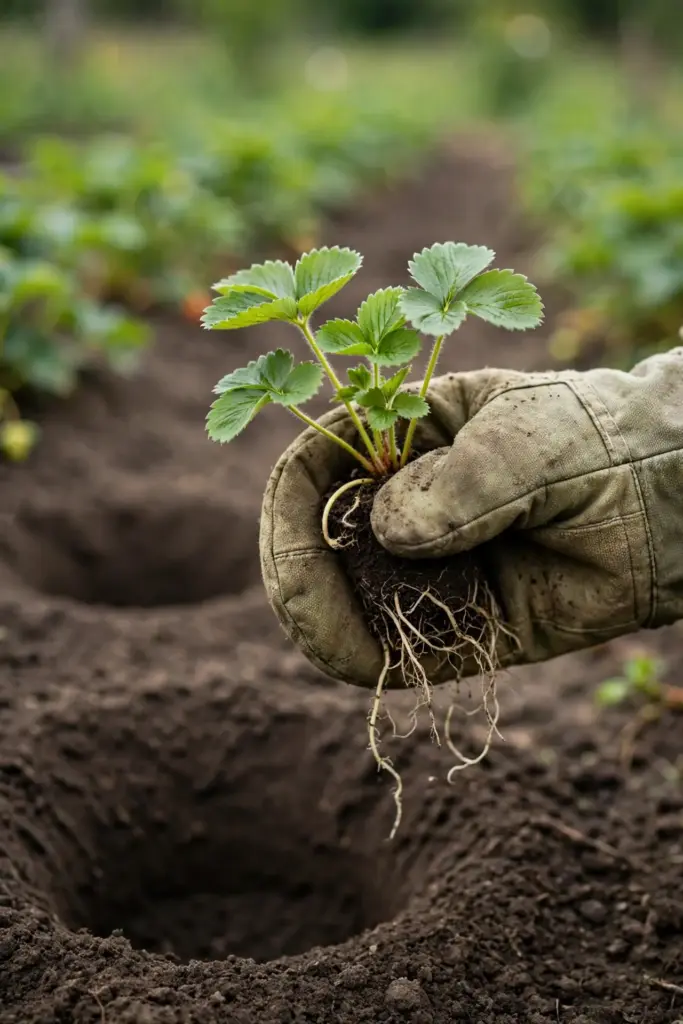
Start with the next incoming lot. Open the boxes in good light. Check the oldest leaves. Ask the nursery for its disease history. One clean lot at planting beats a season of salvage after the lab confirms the worst. The lab sample is cheap insurance against a season of wrong sprays.