Plant Snow Gum in Australia where winter actually bites, not where you wish winter would bite. That is the whole job: Eucalyptus pauciflora is an alpine tree that grows wild above 700 m from south-east Queensland to Tasmania, and it performs in Australian gardens exactly where its wild range says it should. In the cool districts it is close to indestructible. In the hot humid subtropics it grows poorly and dies young. This page is 21 moves for matching Snow Gum to a real Australian garden, from subspecies choice to spacing, and it tells you plainly which climates to skip.
I have learned to check a tree’s cold limit before falling for its bark, because a beautiful trunk buys no loyalty when the district fights the species.
One honest boundary up front. Some guides claim Snow Gum can be planted anywhere in the country. Evergreen Trees’ Snow Gum profile draws a sharper line: the best districts are the Snowy Mountains, the NSW tablelands, the Victorian high country, the Adelaide Hills and most of Tasmania, with Melbourne, Canberra and Hobart gardens also doing well, while hot humid subtropical climates give poor growth and a short life. This guide follows the sharper line, because the sharper line is what the tree’s wild range supports.
| Trait | Snow Gum (Eucalyptus pauciflora) |
|---|---|
| Mature height | 5 m to 20 m, usually 4 m to 15 m in gardens |
| Mature spread | 3 m to 10 m |
| Growth rate | 0.5 m to 1 m per year |
| Bark | Smooth, sheds in ribbons; cream, gray, olive and rust |
| Flowers | White clusters, late spring into summer (roughly November to January) |
| Hardiness | Frost hardy; survives heavy repeated frost and snow |
| Sun | Full sun for best form; tolerates part shade |
| Where it fails | Hot humid subtropical districts |
The sizes in the table come from Evergreen Trees’ Snow Gum profile, which gives the 5-to-20 m spec and the 4-to-15 m garden range separately. Read both numbers before you buy. A tree sold as “small” can still stand 15 m in a sheltered garden.
1. Start With the Wild Range, Not the Nursery Label
Trust the wild range first, because it has run a million-year trial your garden cannot. Snow Gum grows in woodland along the ranges and tablelands, in flat cold sites above 700 m from far south-east Queensland through NSW and Victoria to near Mount Gambier and Tasmania, according to Wikipedia’s Snow Gum entry. That single sentence draws your planting map. Tablelands, high country, cold flats: yes. Coastal heat: gamble.
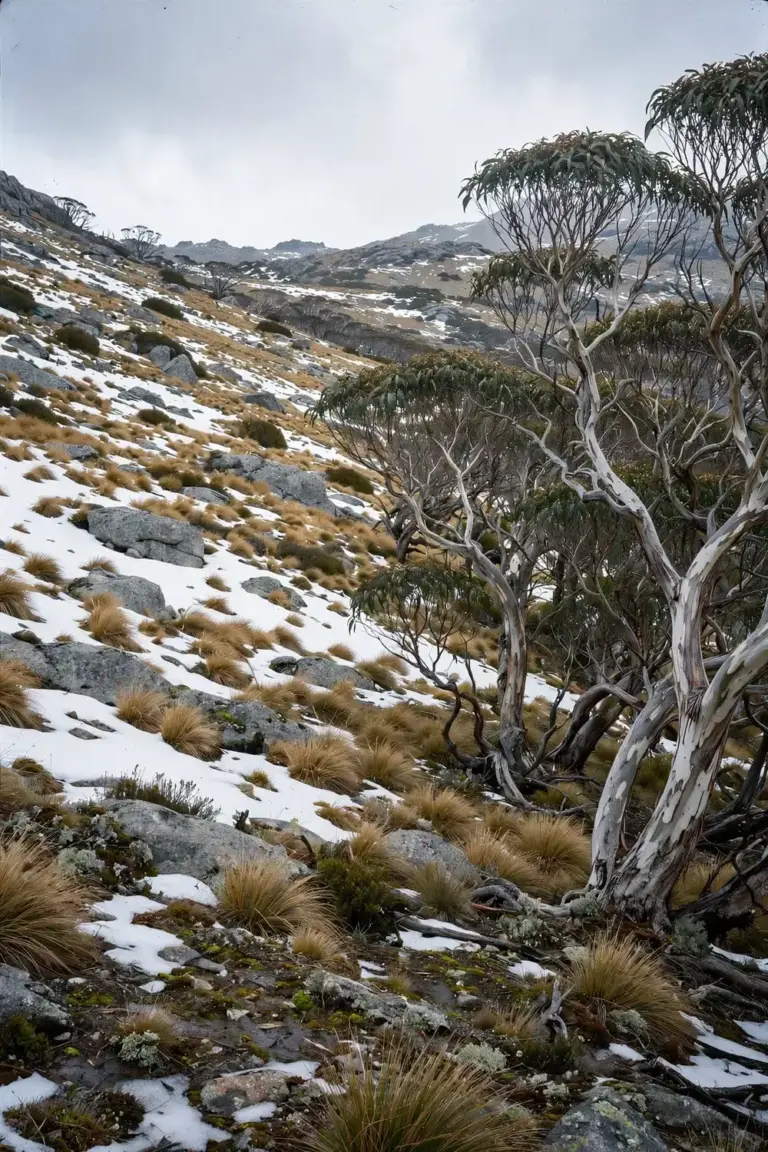
Six subspecies are recognised across that range, and they differ in size, bark and buds. Not all of them suit a domestic garden equally, and nursery stock is often sold as plain “Eucalyptus pauciflora” without a subspecies name. Ask which form the tube is. A grower who knows the provenance knows the tree.
Also called cabbage gum or white sally in some districts, this page keeps one name for it: Snow Gum. Nursery tags vary. The botanical name on the tag is the check, not the common name beside it.
2. Match Snow Gum to Your District Before You Pay
Check your district against the winners list before you spend a cent. The best Snow Gum districts in Australia are the Snowy Mountains, the NSW tablelands, the Victorian high country, the Adelaide Hills and most of Tasmania, with Melbourne, Canberra and Hobart gardens also proven ground, per Evergreen Trees’ Snow Gum profile. If your suburb sits in one of those zones, Snow Gum is close to a set-and-forget tree. If it does not, keep reading, because the next three moves are the ones that save you.
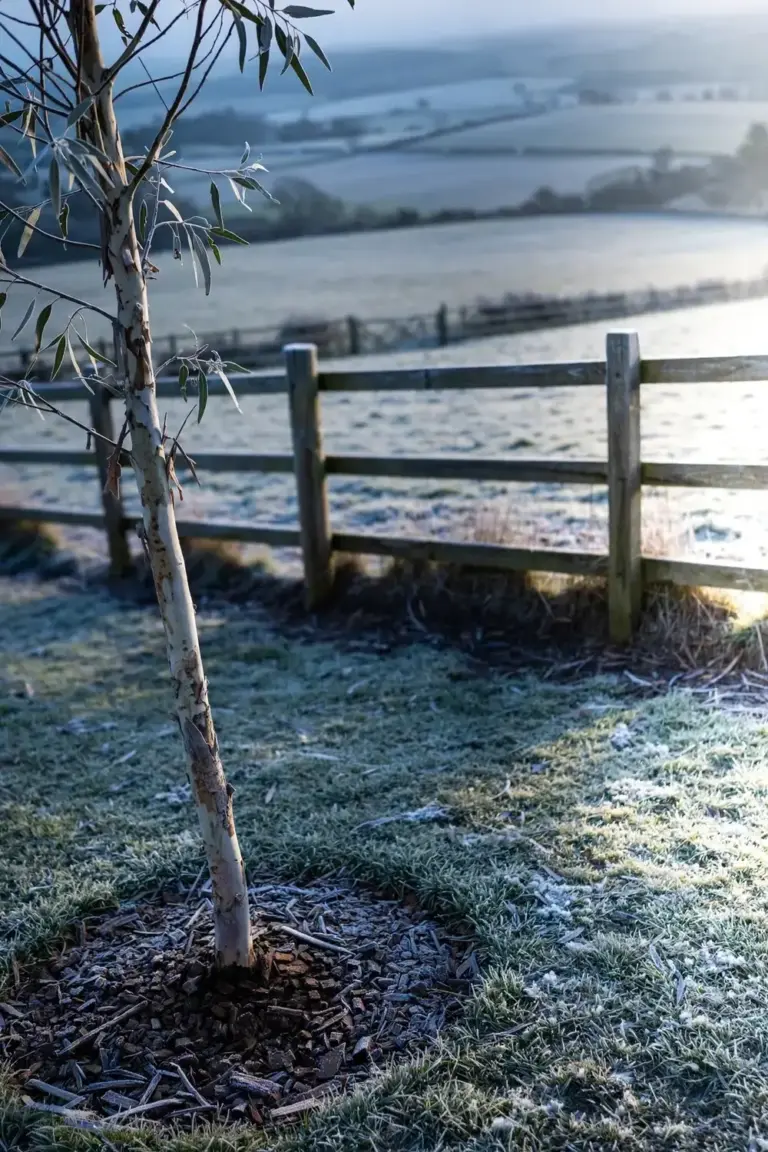
Altitude beats latitude here. A garden at 900 m in northern NSW behaves more like the Snowy Mountains than like the coast 100 km away. Snow Gum reads cold, not postcode. Cold air drainage, frost frequency and summer maximums matter more than which state you live in.
Write your summer maximums down. Snow Gum handles cold superbly, and it resents prolonged heat. If your district runs many weeks above 35 degrees, this is the wrong tree no matter how much you love the bark.
3. Skip the Hot Humid Subtropics Entirely
Do not plant Snow Gum in hot humid subtropical Australia. Growth there is poor and short lived, states Evergreen Trees’ Snow Gum profile. That is the correction this guide makes to the looser advice floating around, which claims the species can be planted anywhere in the country. Brisbane, the Sunshine Coast, the NSW north coast and the Top End sit in the skip zone.
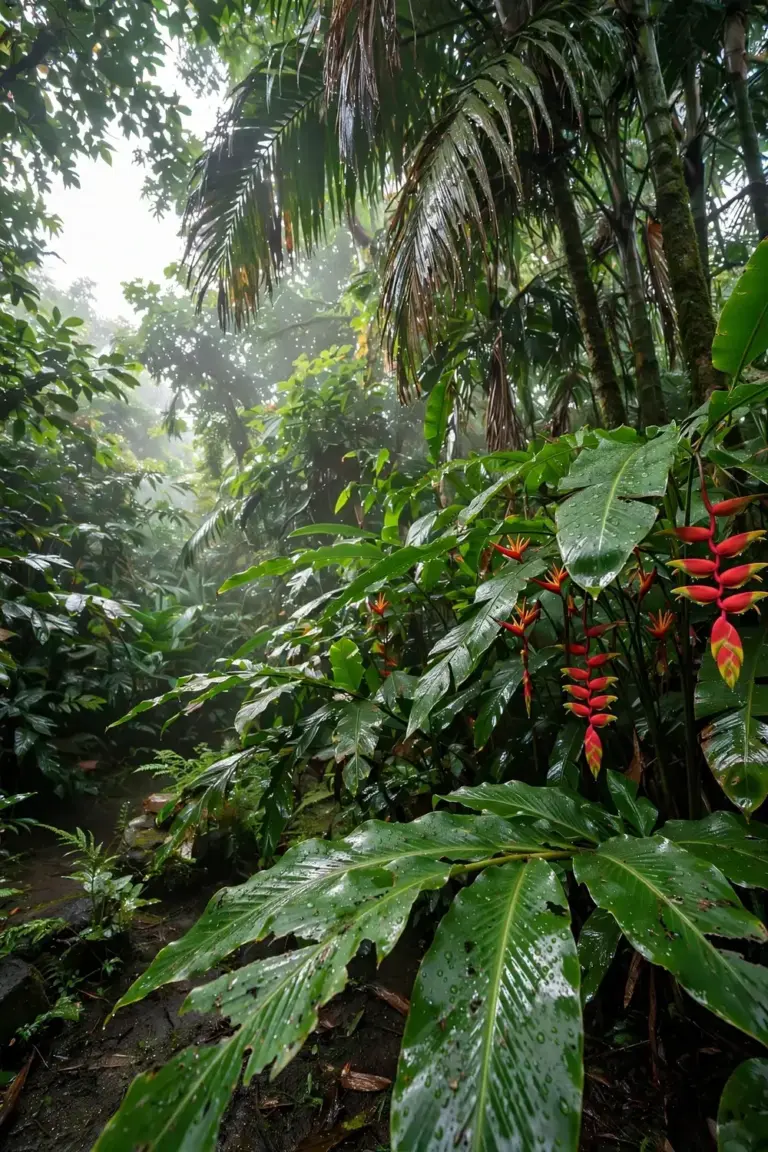
A tree that survives an alpine winter is not automatically tough everywhere. Snow Gum’s toughness is specific: frost, snow, wind, poor cold soil. Give it heat plus humidity instead and the toughness points the wrong way. The tree sulks, thins, and dies young.
Choose a heat-loving gum for those districts instead. Queensland gardens have their own cold-tolerant-looking options with completely different climate needs. Snow Gum is not one of them, and no planting trick changes that.
4. Pick the Subspecies That Fits Your Garden’s Size
Choose the subspecies deliberately, because “Snow Gum” on a tag can mean a 20 m tree or a small alpine shrub. The Australian Plant Census recognises six subspecies, notes Wikipedia’s Snow Gum entry: acerina, debeuzevillei, hedraia, niphophila, parvifructa and the nominate pauciflora. Three of them matter to gardeners. Trees and Shrubs Online’s subspecies key for Eucalyptus pauciflora separates them by bud wax, bud shape and leaf size, and this move uses that key.
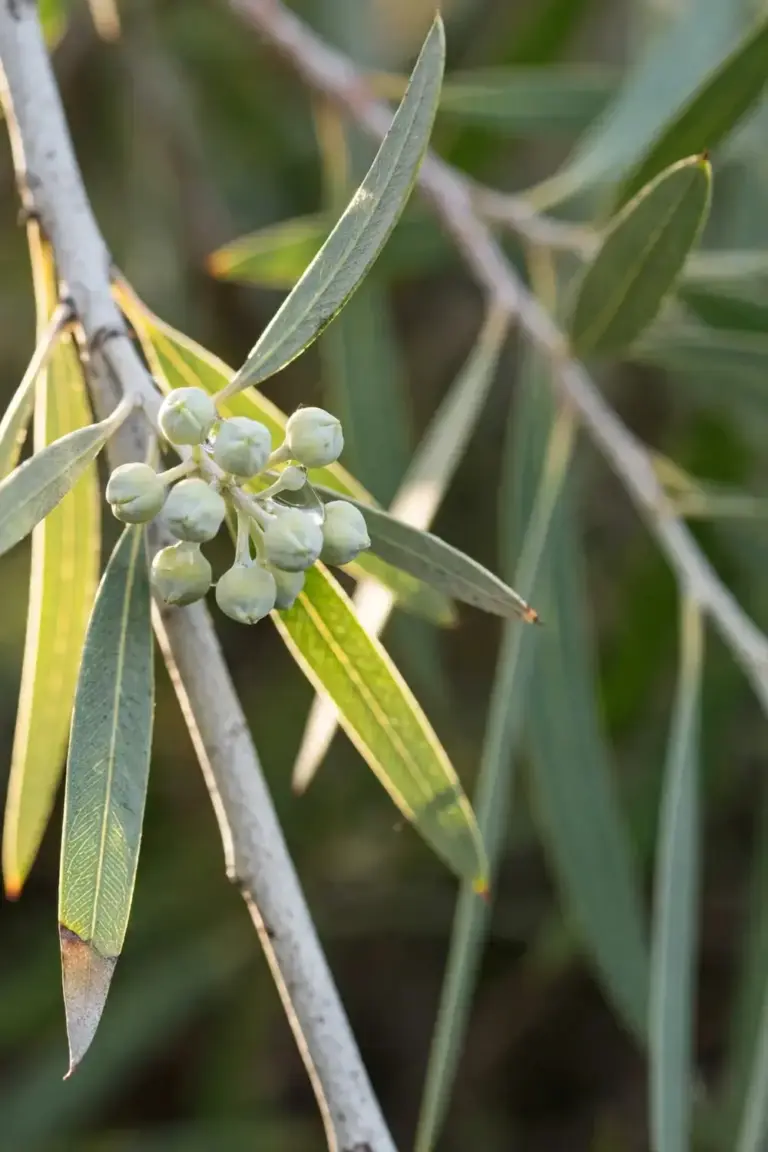
The nominate subspecies, Eucalyptus pauciflora subsp. pauciflora, is by far the most widespread form, and the one most nursery stock turns out to be. It is the tall option: a tree or large mallee with the widest natural range, from Queensland lowlands to Tasmania. Expect the full 5-to-20 m.
Eucalyptus pauciflora subsp. niphophila is the alpine form from the highest parts of the Australian Alps, a small tree or large shrub with smaller leaves and delicate stalked flower buds. The subspecies key separates it from its relatives by those buds and leaves, and in gardens it stays notably smaller than the nominate form, especially on exposed sites.
Eucalyptus pauciflora subsp. debeuzevillei, the Jounama Snow Gum, comes from the highest peaks south of the ACT into south-eastern NSW, identified by strongly angular mature buds. This is the form for gardeners chasing the glaucous, blue-tinged look. In cultivation it stays more compact than the nominate form in most reports.
Ask the nursery which subspecies the stock was grown from. If the grower cannot answer, buy from one who can. A Snow Gum of unknown provenance is a 20 m surprise waiting ten years to happen.
5. Try ‘Little Snowman’ Where Space Is Short
Plant the compact cultivar ‘Little Snowman’ when the garden cannot take a full-size Snow Gum. This named selection stays far smaller than the species while keeping the smooth mottled bark that makes Snow Gum worth growing. It suits courtyards, small suburban blocks and street-tree-scale planting where a 15 m tree would be a mistake.

Cultivar discipline matters here. ‘Little Snowman’ is a real, trade-named selection sold by specialist growers, not a marketing nickname for a small tube of the species. Check the tag for the single quotes. A tube labelled “dwarf snow gum” with no cultivar name is not the same plant.
For comparison with another genuinely cold-hardy eucalypt, the site’s guide to growing glacier eucalyptus walks through Eucalyptus gunnii, which fills a similar frosty-garden role with a different crown. Compare the two before committing a small garden to either.
6. Buy a Small Tube, Not an Advanced Pot
Buy the smallest healthy tube you can find, because eucalypts establish fastest from young stock. An advanced 45 L pot looks impressive at the nursery and grows slower in your ground than a tube planted the same day. Young roots explore outward instead of circling a big pot.
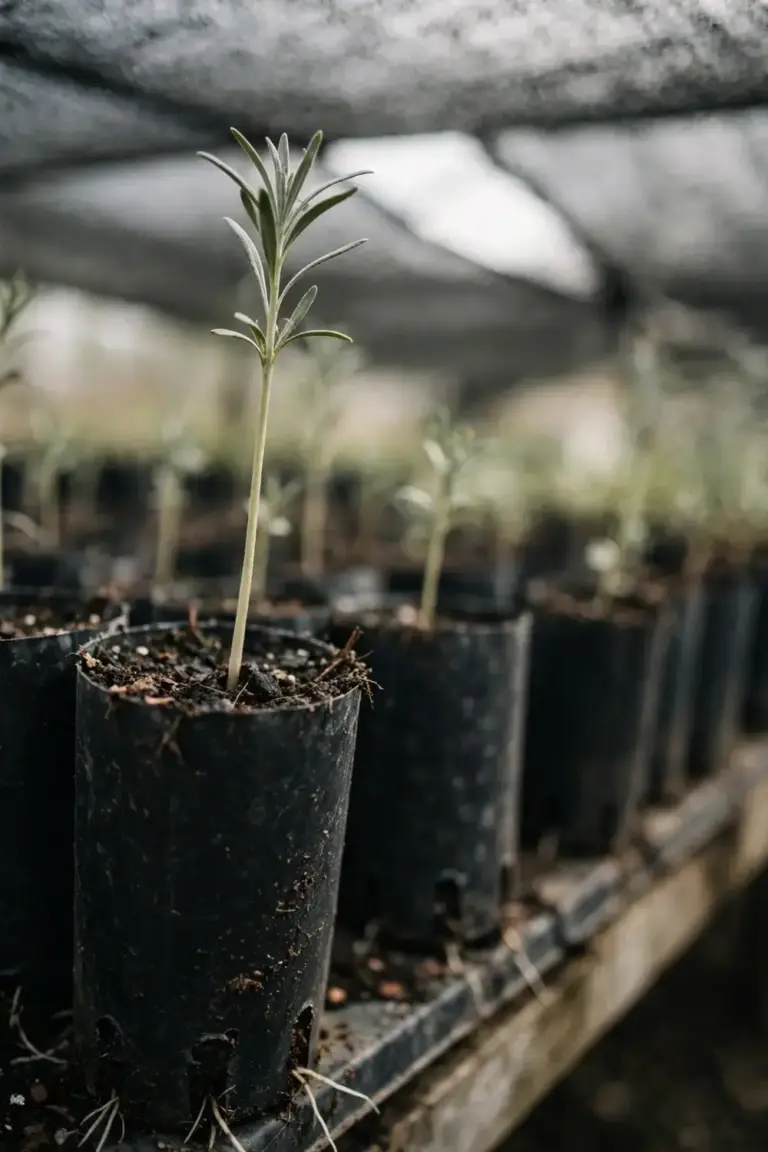
Check the root ball before you pay. Tip the tube and look: white root tips at the drainage holes are fine, a solid mat of circling brown roots is not. A root-bound Snow Gum never fully recovers its natural anchoring, and a poorly anchored gum in a windy district is a liability.
Plant in autumn or early winter in cool districts so the roots work through the cold months. Snow Gum establishes reliably even in cold exposed positions, notes Evergreen Trees’ Snow Gum profile. Autumn planting gives you a head start that spring planting cannot buy.
7. Give It Full Sun and Room to Become a Tree
Plant Snow Gum in full sun. Full sun gives the best form, the densest canopy and the strongest bark color, and that is the position to aim for, per Evergreen Trees’ Snow Gum profile. Part shade keeps the tree alive but the habit opens up and the trunk stretches toward the light. A stretched Snow Gum is a poor version of itself.
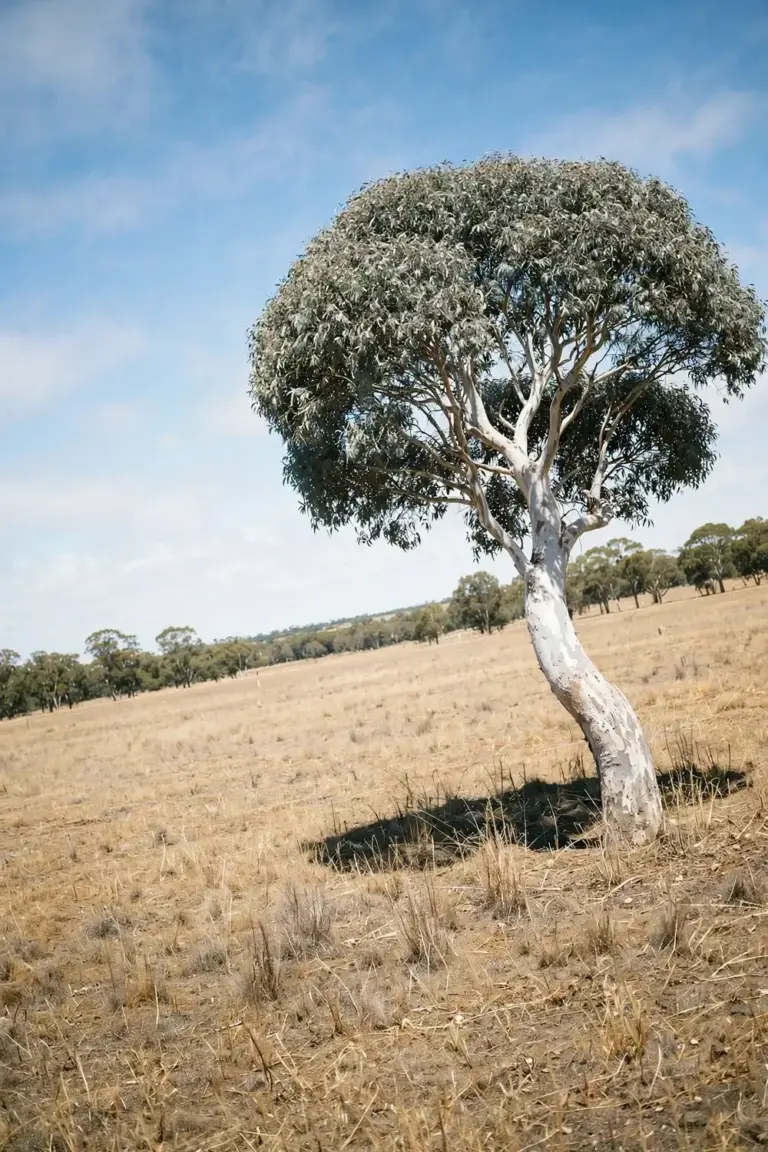
Allow the full spread. The species reaches 3 to 10 m wide, and crowding it against a fence forces the one-sided growth that part shade causes naturally. Give it the space of a tree, because it is a tree. Courtyard gardeners should return to move 5 and choose the compact cultivar.
Think in decades, not seasons. Snow Gum grows 0.5 m to 1 m per year, so a 2 m tube becomes an 8 m tree in roughly six to ten years. Plant for the 15 m tree it can become in a sheltered garden, not the 2 m tree you bought.
8. Dig the Hole Twice as Wide, Never Deeper
Dig the planting hole twice as wide as the root ball and exactly the same depth. That proportion comes straight from Evergreen Trees’ planting instructions, and it exists for one reason: wide loose soil lets new roots run sideways, while a deep hole lets the tree sink and buries the root collar.
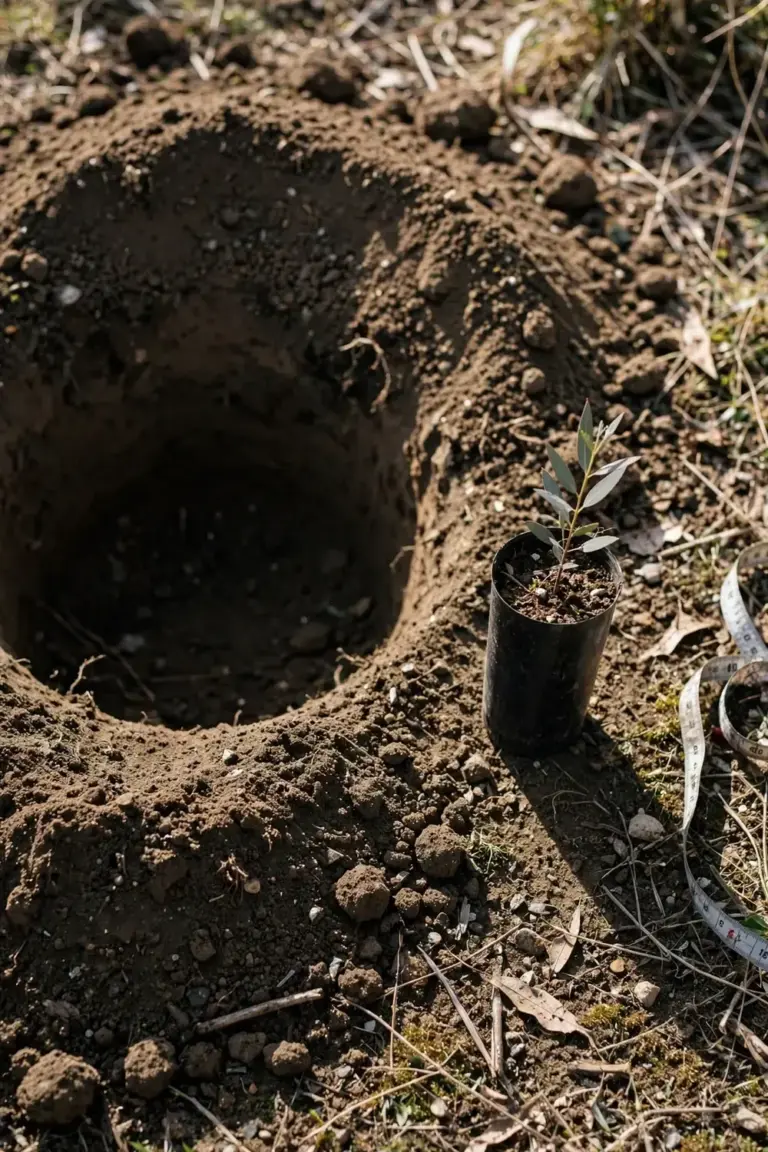
Position the tree level with the surrounding soil, backfill gently, firm in, then water deeply to settle the roots. Do not stomp the backfill into concrete. Air pockets kill more new trees than drought does, but compacted soil suffocates the roots you are trying to help.
Enrich the planting area with quality compost and aged manure for a strong establishment phase, as the same instructions recommend. Snow Gum tolerates poor soil once established, but a rich start builds the root system that later survives neglect. Feed the hole, not the tree.
9. Water Through the First Two Summers
Water deeply through the first two summers, then leave it to rain in most cool districts. That is the whole irrigation program, per Evergreen Trees’ Snow Gum profile. New trees need the help. Established Snow Gum is drought tolerant and only wants a deep soak in extended dry periods.
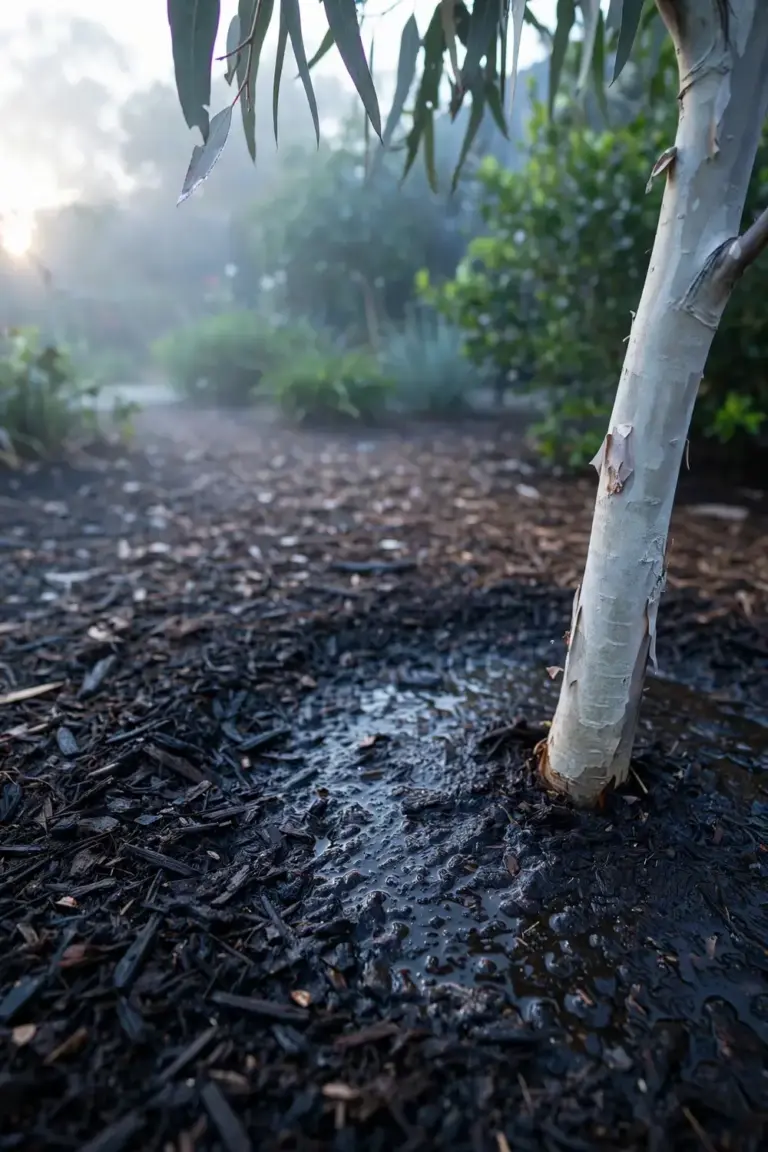
Water deeply twice weekly through the first 12 months as the baseline, then taper. The detailed care notes on the same page set that rhythm, and it matches how eucalypts establish: deep infrequent soaking drives roots down, while daily sprinkles keep them shallow and dependent.
Watch the leaves, not the calendar. Gray-green adult foliage that starts to dull or droop in the first summer is asking for water now, not next weekend. A tree planted in summer needs morning and evening watering for the first two weeks while the root ball knits into the surrounding soil.
10. Mulch 5 to 7 cm and Keep It Off the Trunk
Spread 5 to 7 cm of organic mulch over the root zone, keeping it 5 cm clear of the trunk. Both numbers come from Evergreen Trees’ long-term care notes. The mulch holds soil moisture through the establishment summers. The 5 cm gap stops collar rot, which kills young gums quietly.
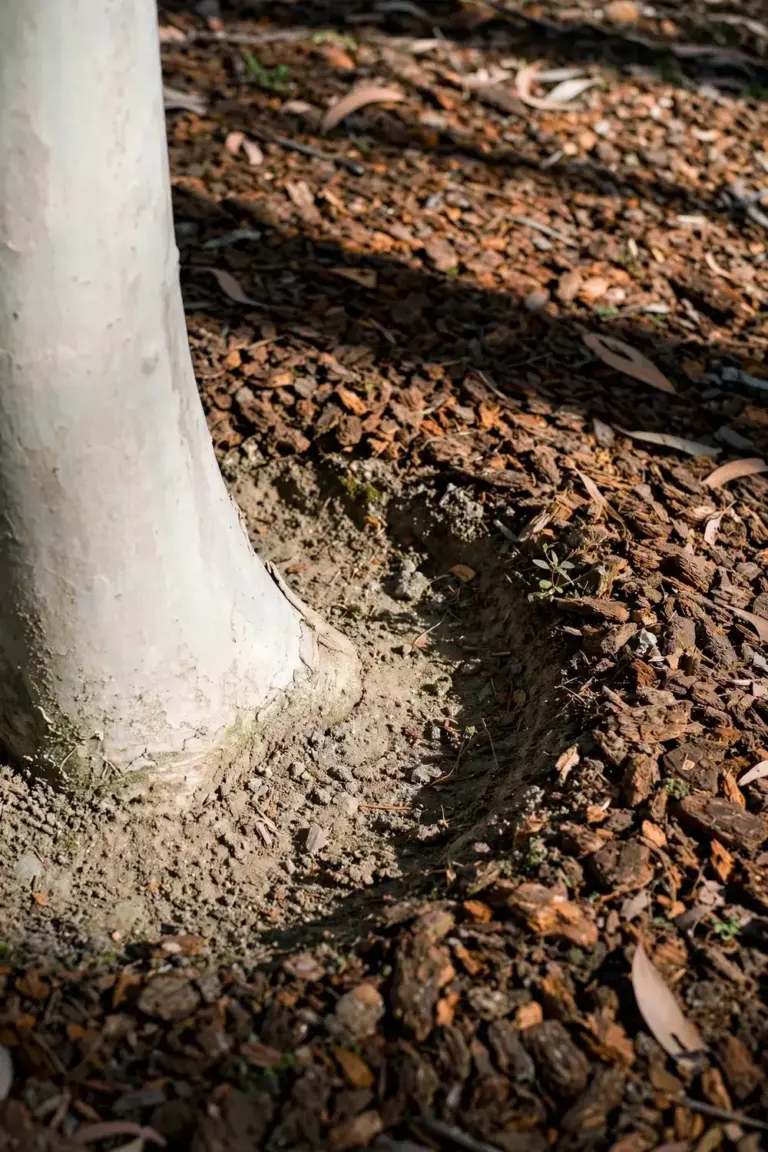
Extend the mulch out toward the drip line as the tree grows. A 30 cm mulch ring on a new tube should become a 2 m ring on a 5 m tree. Roots feed where the mulch is, so widen the ring and the root system follows.
Never volcano-mulch. Piling mulch against the trunk to “protect” it does the opposite: bark stays damp, fungi move in, and the tree you were protecting rots at the base. Every dead young gum with a mulch volcano is a lesson somebody paid for.
11. Skip High-Phosphorus Fertilizers
Avoid high-phosphorus fertilizers on Snow Gum. Australian natives evolved in phosphorus-poor soils, and excess phosphorus damages the fine roots that do the actual feeding. Evergreen Trees’ care notes list avoiding high-phosphorus formulations as a standing precaution.

Feed lightly in spring if growth seems slow, using a slow-release native blend. The detailed care notes suggest a native blend in early spring and again in autumn. “If growth seems slow” is the operative phrase. Snow Gum at 0.5 to 1 m a year in a cool district needs no pushing.
Do not fertilize a stressed tree into recovery. A Snow Gum sulking through its first hot summer wants water and mulch, not food. Fertilizer on a struggling root system burns the few working roots it has.
12. Let Wind Sculpt the Tree for You
Give Snow Gum an exposed windy spot if you have one. Wind is part of what produces the twisted branching that makes this tree famous, per Evergreen Trees’ Snow Gum profile. Sheltered trees grow straighter and taller. Exposed trees grow gnarled and sculptural.

This is the rare tree where exposure is a feature, not a problem. Most garden trees want shelter from wind when young. Snow Gum wants the wind, and the Royal Horticultural Society notes young plants should be sheltered only in the sense of establishment, not hidden from weather permanently. Plant it where the weather hits it and the bark rewards you.
Stake young trees only in genuinely windy positions, then remove the stake within a year. A staked tree that never learns to flex grows a weak trunk. Snow Gum’s whole character is flex; let it practice early.
13. Prune Only in Late Winter, and Only Damaged Wood
Prune Snow Gum minimally. The natural branch shape is the reason for growing it, so every cut should have a reason you can state in one sentence. Evergreen Trees’ care notes advise pruning only to remove damaged wood or lift the canopy, with a light tip prune in late winter to maintain shape if needed.
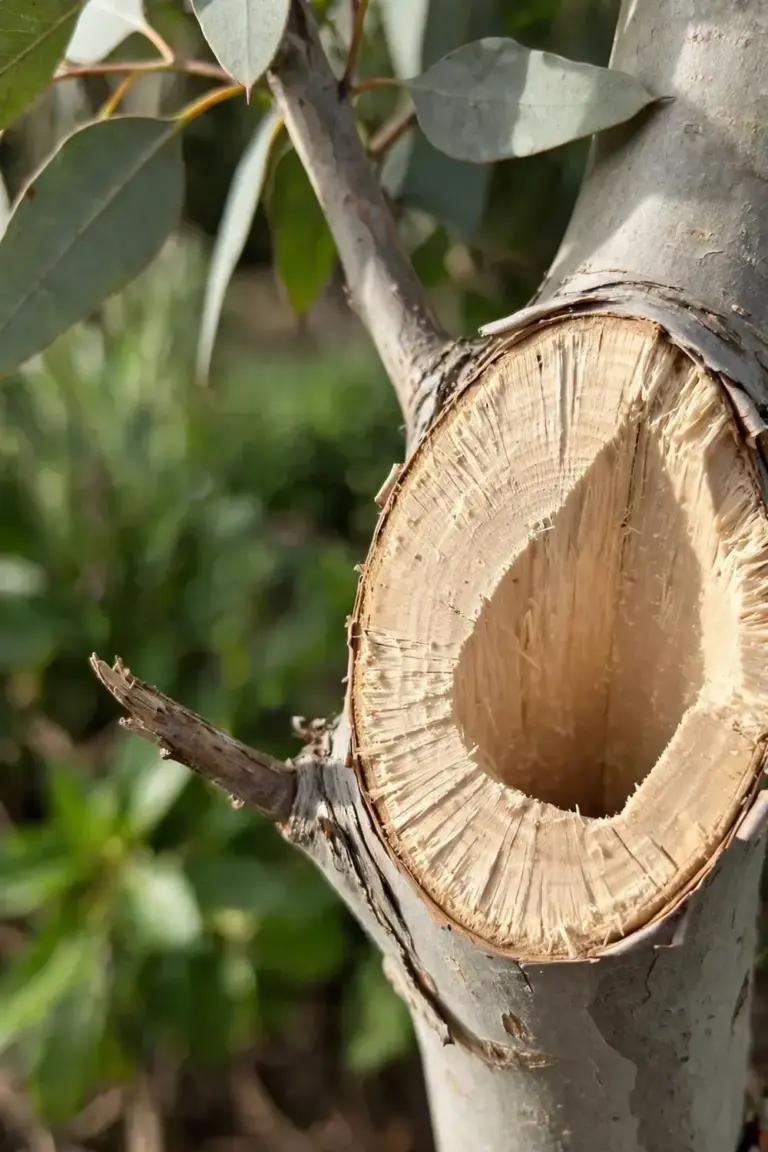
Remove dead or crossing branches in late winter. Late winter cuts heal as spring growth starts, and the tree is leafless enough that you can see the structure you are editing. Summer pruning on eucalypts invites stress and epicormic chaos.
Never top a Snow Gum. Topping destroys the crown architecture permanently and triggers a broom of weak shoots that all need removing later. A Snow Gum that has outgrown its space was the wrong subspecies; topping it punishes the tree for your planning error.
14. Limb Up the Trunk to Show the Bark
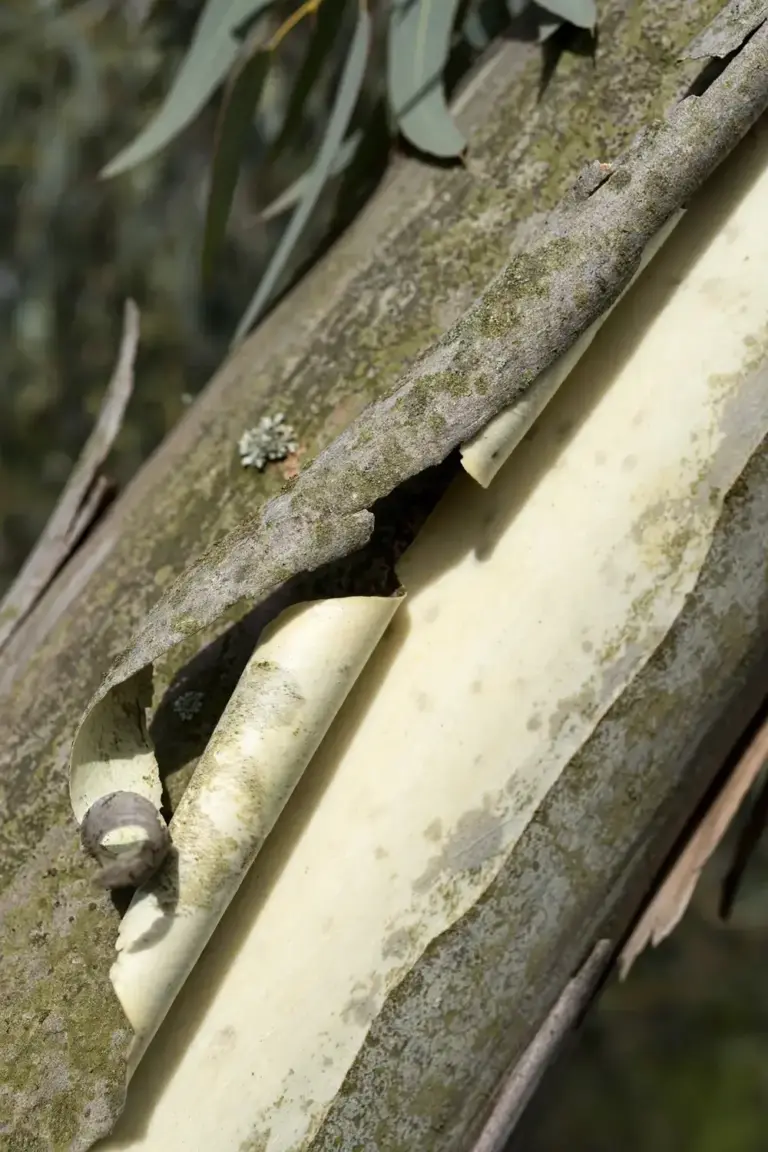
Remove lower branches gradually as the tree grows to develop a clean feature trunk. The bark is the feature, so give yourself the view of it, advises Evergreen Trees’ Snow Gum profile. The smooth trunk peels in ribbons to leave streaks of cream, gray, olive and rust that change through the year.
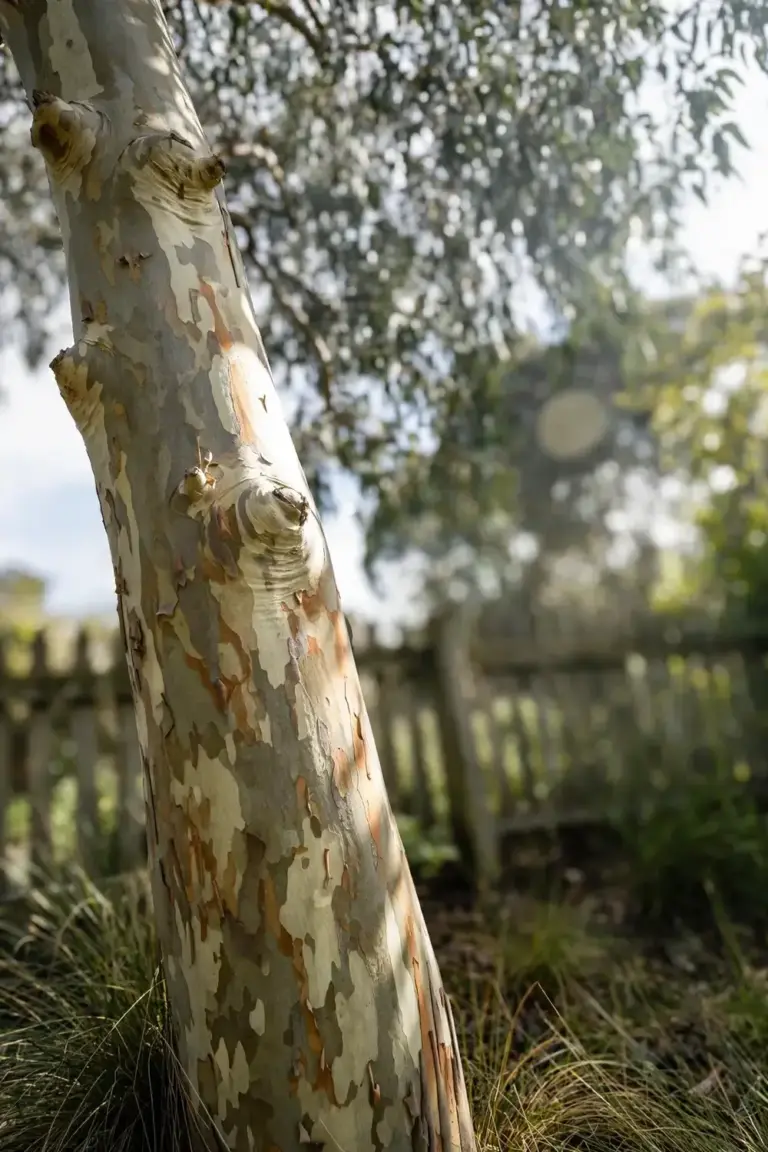
Limb up in stages, not all at once. Take the lowest whorl one year and the next the year after. A tree stripped to a pole in a single session loses too much leaf area at once and responds with stress shoots along the bare trunk.
Position the tree where the trunk is visible from inside the house. Snow Gum is a feature tree, and the design notes on the same page recommend planting it against a wall, hedge or sky where the trunks read from indoors. A feature trunk nobody sees is a wasted decade.
15. Space Feature Trees 3 to 4 m Apart
Plant feature Snow Gums 3 to 4 m apart to allow the full canopy and form to develop. That spacing comes from Evergreen Trees’ planting recommendations, which set 3 m apart for avenue planting as well. Closer spacing buys a thicket, not a grove.
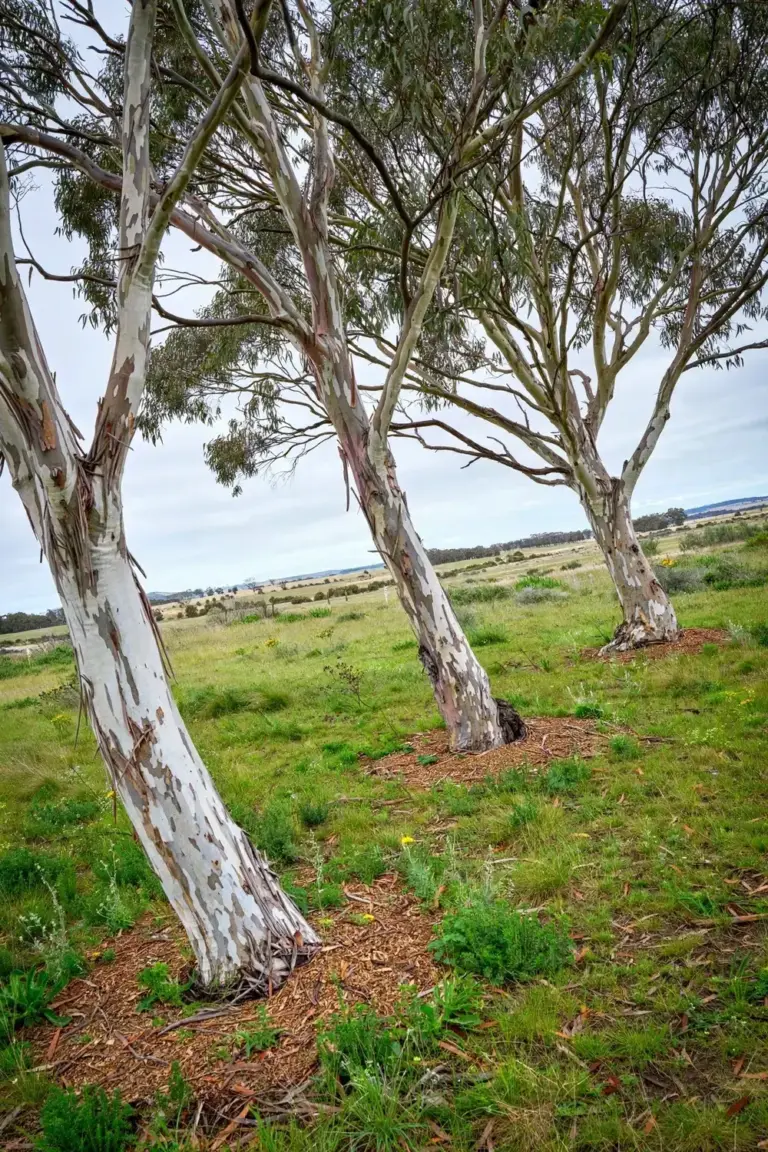
Think about the mature crowns touching, not the tubes you plant. At 3 m centres, two Snow Gums with 8 m crowns will interlock in about fifteen years, which is exactly the layered grove effect alpine plantings are famous for. At 6 m centres they stay separate sculptures. Both work. Choose deliberately.
Mark the spacings with stakes before you dig. Eyeballing distances on planting day consistently underestimates them, and every gardener who has planted “about 3 m apart” has actually planted 2 m apart. Measure it.
16. Keep 20 to 30 m Between Snow Gum and Structures
Plant Snow Gum 20 to 30 m from houses, sheds, pipes and paving. Snow Gum runs shallow, fast-growing roots, and Aussie Green Thumb’s Snow Gum growing guide sets that distance as the safe zone for structures. This is the move most small-garden plantings skip, and the one that costs the most later.
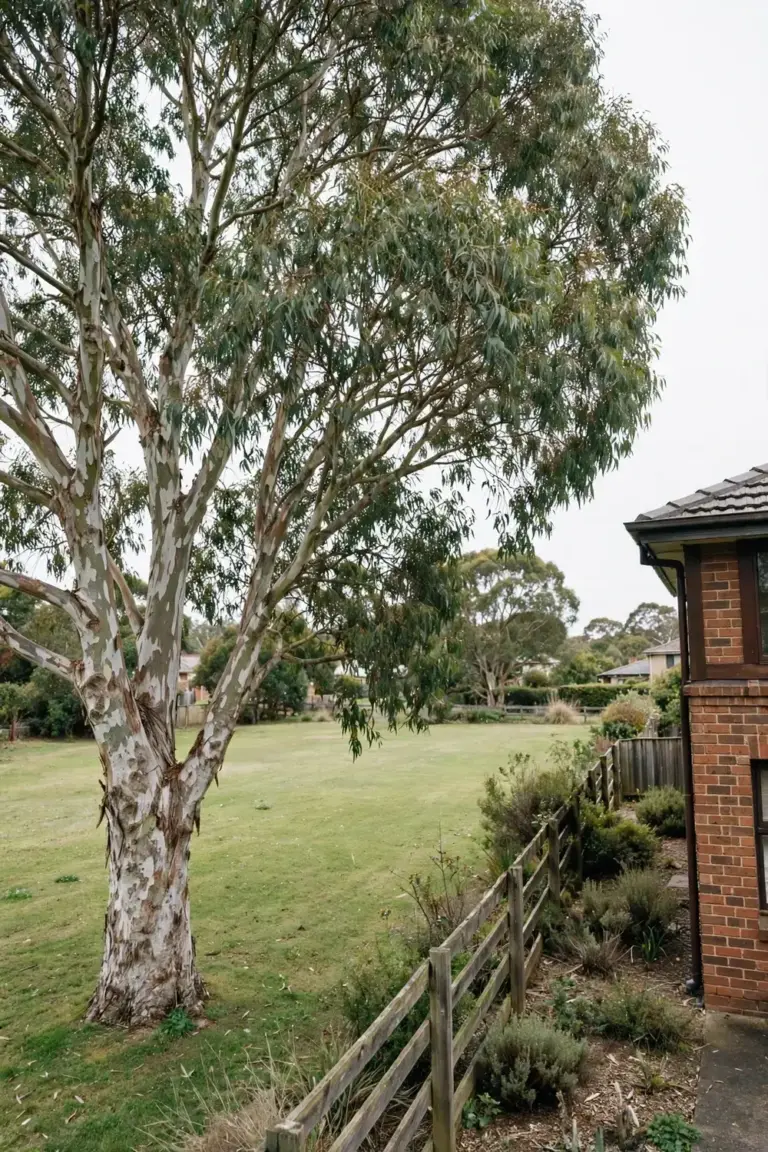
Fast roots plus shallow soil equals lifted paving and invaded pipes. The 0.5 to 1 m a year of top growth has a matching root system spreading wider than the crown. A tree 8 m from the house is a root system already under the house.
Apply the same distance to neighbours’ boundaries. Your Snow Gum’s roots do not respect fence lines, and a 20 m tree dropping limbs or lifting a neighbour’s driveway is a dispute with bark on it. Plant big trees in the middle of big blocks.
17. Watch for Longicorn-Beetle Dieback
Inspect mature Snow Gum for longicorn-beetle dieback, the decline syndrome noted in the Australian Alps. Aussie Green Thumb’s Snow Gum growing guide covers snow-gum dieback in its FAQ, linking it to longicorn beetles. Dieback shows as thinning crowns, dead branch tips and epicormic shoots sprouting below the damage.
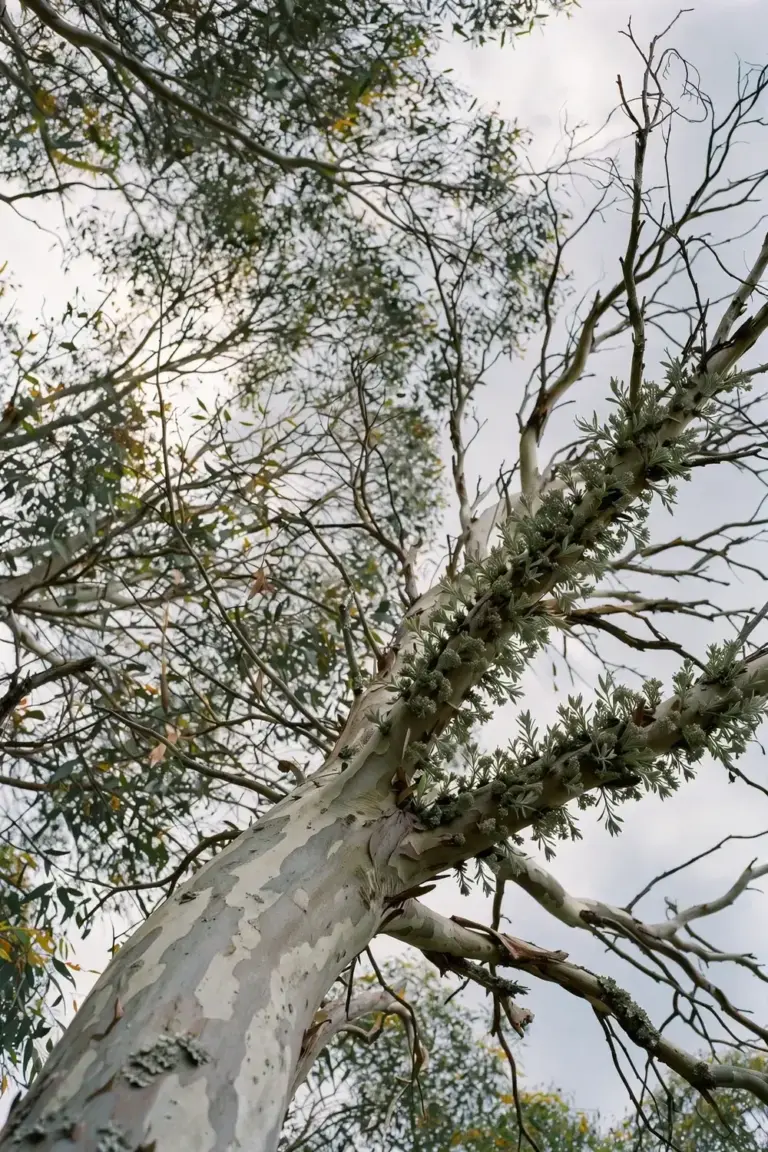
Stressed trees invite the beetles. Drought, root damage from trenching, and compaction around the root zone all weaken the tree first; the beetles finish the job. Protect the root zone and you prevent most dieback before it starts.
Do not confuse natural bark shedding with disease. Snow Gum sheds bark in ribbons every year, leaving fresh cream and gray patches. That is the tree being healthy and beautiful. Dieback is dead wood in the crown, not color on the trunk.
18. Skip Frost Cloth: Snow Gum Is Already Frost-Hardy
Do not wrap Snow Gum for frost. This is one of the hardiest eucalypts in the country, growing at altitudes where snow lies for weeks and frost is heavy and frequent, and it survives that without damage, per Evergreen Trees’ Snow Gum profile. Frost cloth on a Snow Gum is gardening theatre.
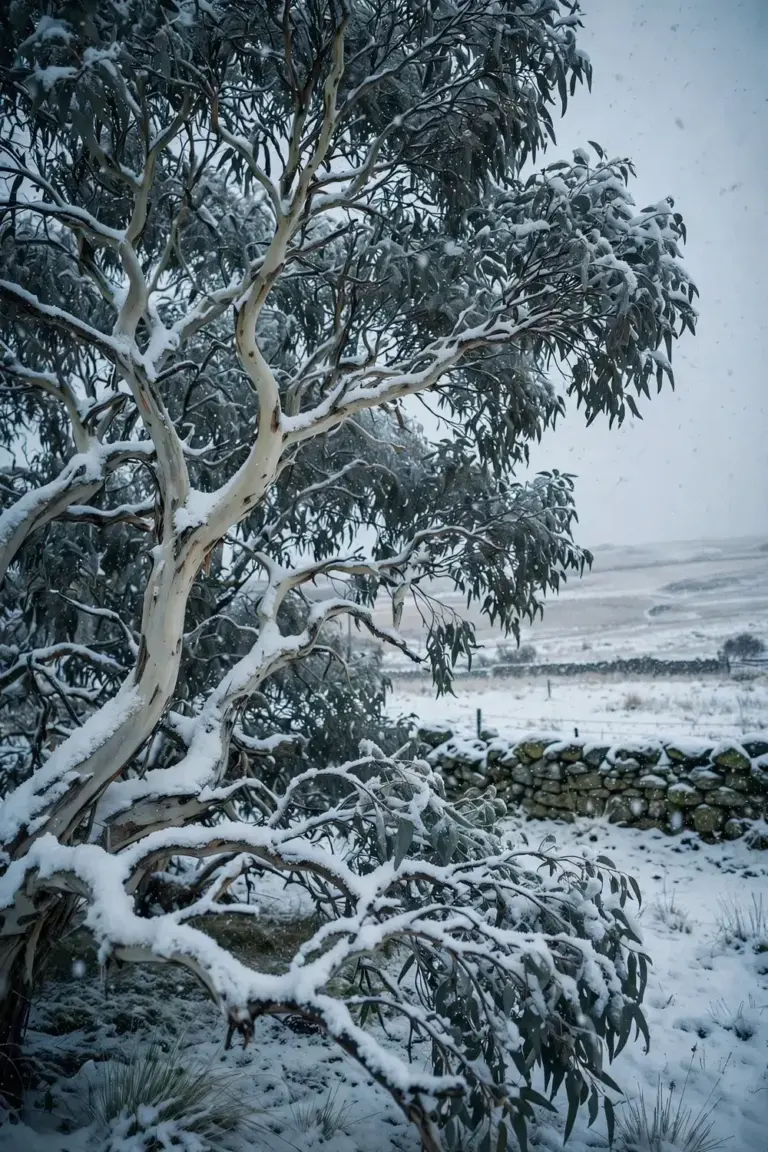
The cold even improves the tree. The same profile notes that cold seems to improve the color and character of the bark. Gardeners in marginal districts sometimes report their best bark color after the hardest winters. Suffering, for this tree, is cosmetic enhancement.
Young plants still establish reliably in cold exposed positions, so skip the winter coddling entirely and spend the effort on summer watering instead. For genuinely frost-tender plants elsewhere in the garden, the site’s guide to protecting plants from late frost covers the techniques that matter there.
19. Start Extra Trees From Fresh Seed
Sow fresh Snow Gum seed in spring to raise your own trees. Eucalypts germinate readily from fresh seed, and home-sown stock avoids the root-bound pots that plague nursery advanced trees. The site’s guide to growing a eucalyptus tree from seed walks through the full method.
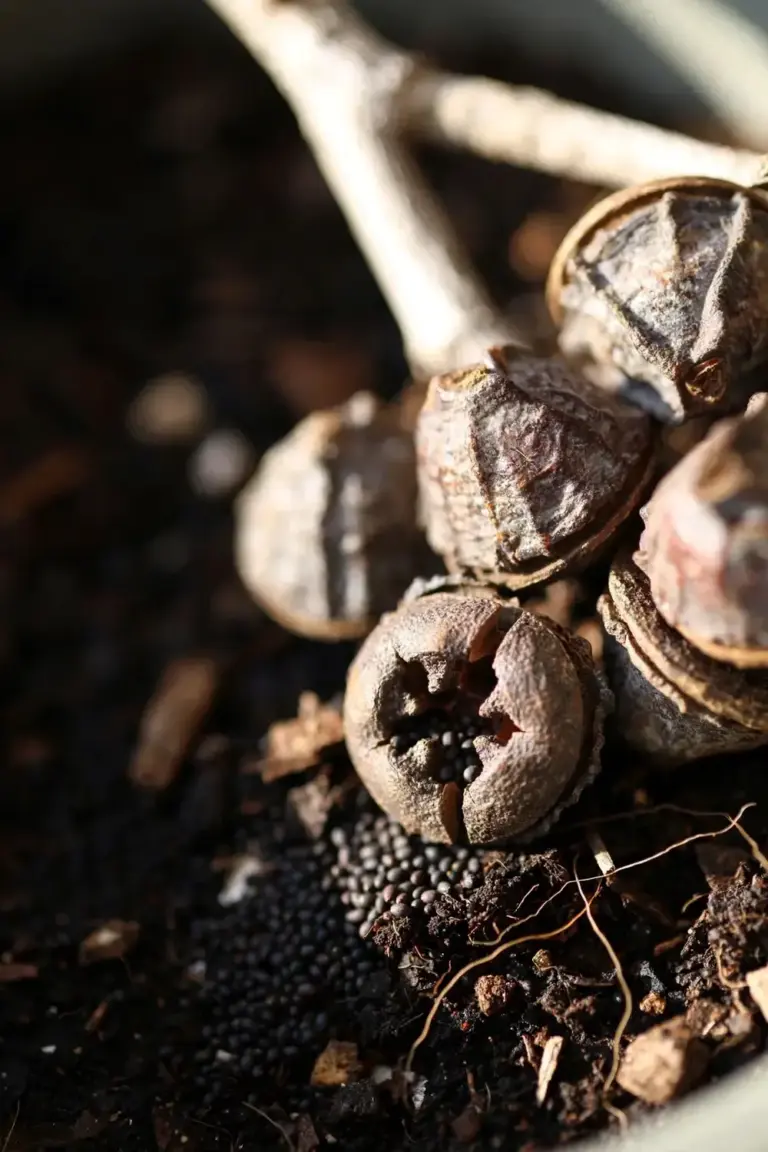
Use seed within months of collection. Eucalypt seed viability falls fast, and last year’s packet in the shed is mostly disappointment. Fresh seed from a local tree also carries local provenance, which matters for a species with six subspecies across a huge range.
Prick seedlings out early and grow them on fast. Eucalypts resent root disturbance, so move seedlings to their final tubes while small and plant out while young. A seedling planted at 30 cm outgrows a sulking advanced pot within two seasons.
20. Let the November Flowers Feed the Honeyeaters
Leave the flowers alone and let the wildlife come. Snow Gum flowers from late spring into summer, roughly November through January, with clusters of small fluffy white flowers scattered through the canopy, and bees and nectar-feeding birds work them heavily, per Evergreen Trees’ Snow Gum profile. Honeyeaters, native bees and butterflies all visit.
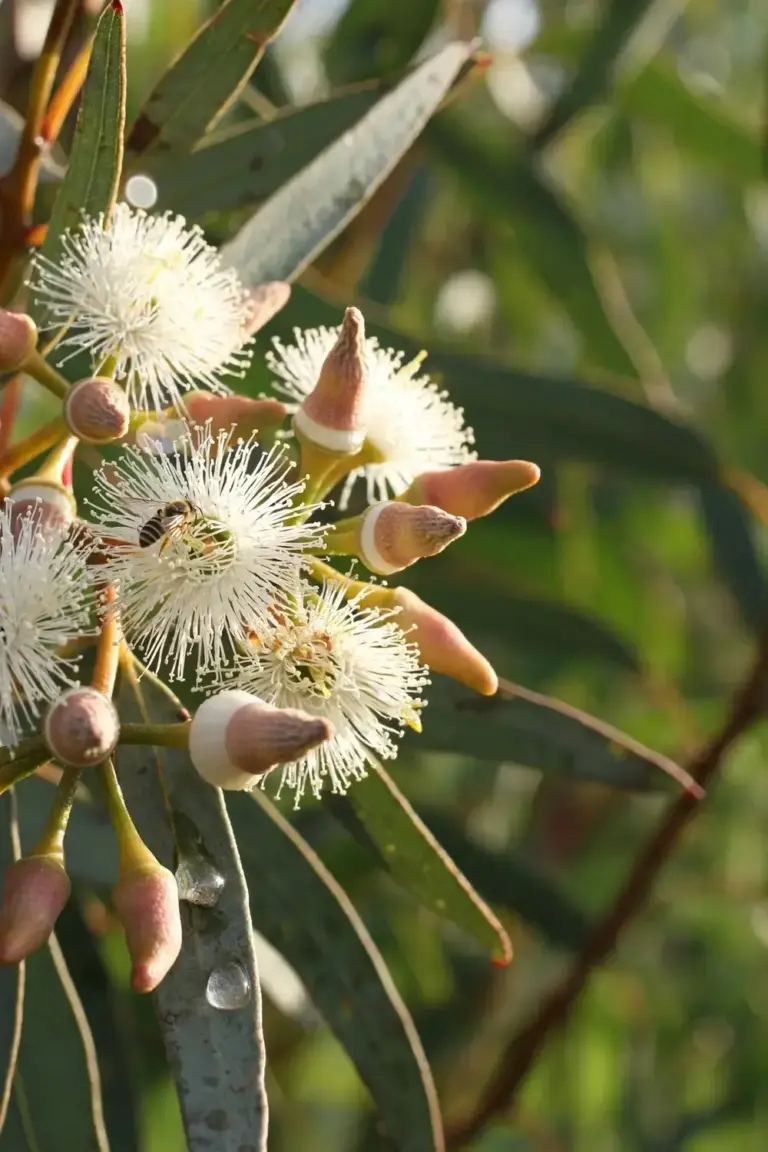
Do not deadhead. The small woody fruits that follow flowering persist on the tree afterwards and add their own texture through the year. Removing spent flowers to “tidy” the tree deletes both the seed source and the winter interest.
Plant Snow Gum where you watch birds. Near a kitchen window or a deck, the November flowering turns the tree into a feeding station. A Snow Gum in a back corner still grows, but you miss the month that justifies the other eleven.
21. Grow It as the Feature, Never as a Hedge
Plant Snow Gum as a single feature tree, not as a screening hedge. The twisted limbs, the ribbon-shedding bark, the open crown: every ornamental quality this tree has depends on space and light reaching the trunk. Sheared into a hedge it becomes expensive firewood with nice bark.
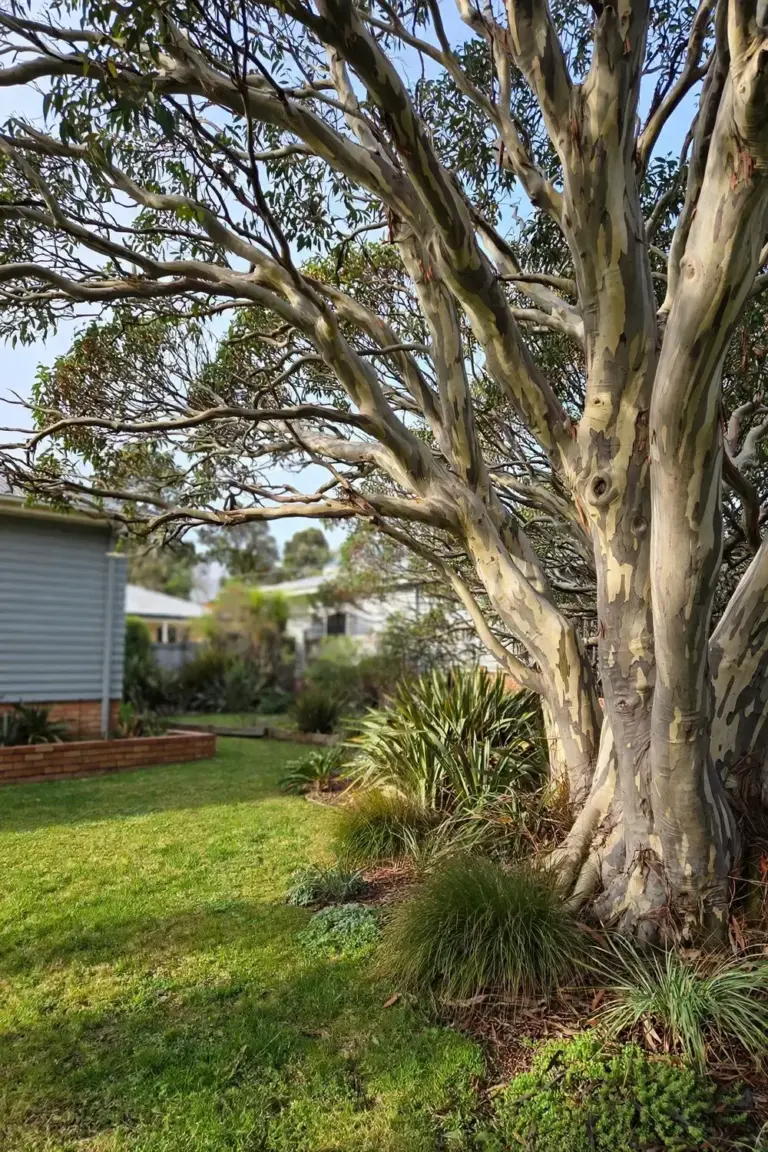
Design around the trunk, not the canopy. Underplant with low grasses and groundcovers that never compete for the trunk view: kangaroo grass, lomandra, native violets. Keep the ground layer under a metre so the bark reads from across the garden.
Photograph it in winter. Snow Gum earns its common name in the cold months, when the pale bark stands against gray skies and the twisted limbs hold snow. Summer is when it works. Winter is when it performs.
Frequently Asked Questions About Snow Gum in Australia
Expect 4 m to 15 m in most gardens, with 5 m to 20 m possible in ideal sheltered conditions, per Evergreen Trees’ Snow Gum profile. Exposure decides the outcome: cold windy high-country sites keep trees low and gnarled at the small end, while sheltered gardens grow taller trees with broad irregular crowns. Buy the subspecies that matches your space.
Yes. Snow Gum is one of the hardiest eucalypts in Australia, surviving heavy repeated frost and snow without damage, and it grows wild where snow lies for weeks. Young plants establish reliably even in cold exposed positions. No frost cloth, no wrapping, no winter coddling: the cold improves the bark color.
Brisbane and the hot humid subtropics are a clear no: growth there is poor and short lived. Sydney sits in a gray zone with warm humid summers that the species dislikes, and no major guide lists it as proven ground. If you are north of the proven cool districts, choose a heat-tolerant eucalypt instead of gambling.
Keep 20 m to 30 m between Snow Gum and houses, sheds, pipes and paving. The roots run shallow and fast, matching the 0.5 m to 1 m annual top growth, and they lift paving and invade pipes long before the crown looks threatening. Apply the same distance to boundary fences: the roots do not stop at the fence line.
Snow-gum dieback is a crown-decline syndrome of mature trees in the Australian Alps, associated with longicorn beetles. It shows as thinning crowns, dead branch tips and epicormic shoots below the damage. Stressed trees invite the beetles, so protect the root zone from trenching, compaction and drought. Natural bark shedding in ribbons is healthy and unrelated.
Start With the Right District and the Tree Does the Rest
Snow Gum rewards one decision above all others: planting it where winter bites. Get the district right and the tree handles frost, snow, wind and poor soil with almost no help from you. Get the district wrong and no amount of watering, feeding or pruning saves it. Check the map, pick the subspecies, give it sun and space, and let the cold do the styling.