
When you ask what’s wrong with my eucalyptus, start with a thumbnail scratch test on a suspect branch. Green moist tissue under the bark means the tree is alive. Of the 11 problems below, the first two, the dead-or-alive test and drought shed, resolve most worried-owner cases without any treatment at all.
Most worried owners land in the middle. The tree looks half dead, drops leaves by the bucketload, and still pushes green shoots from the trunk. That is usually a eucalypt doing what eucalypts do: shedding to survive. Eucalyptus here means the genus Eucalyptus, the gum trees planted across Australian home gardens. “Wrong” means any problem that stops the tree growing normally. Diagnosis means matching what you see to the cause, then acting on the match.
This is a diagnosis guide for home gardens, not a growing manual. The rest of this page walks 11 problems in the order you are most likely to meet them, from the dead-or-alive test through drought shed, root rot, lerp psyllids, beetles, leaf spots, frost, soil mismatch, root damage, landscape dieback, and when to call an arborist. Species differ across 800-plus eucalypts, so the checks below focus on the common garden species and cultivars rather than plantation forestry.
1. Run the Dead-or-Alive Test Before Anything Else
Scrape a thumbnail-sized patch of bark on a bare branch with your nail or a blunt knife. Green or cream moist tissue underneath is living cambium. The branch is alive even if it looks bare. Brown, dry, papery tissue with no moisture is dead wood. Test three or four branches at different heights before you judge the whole tree.
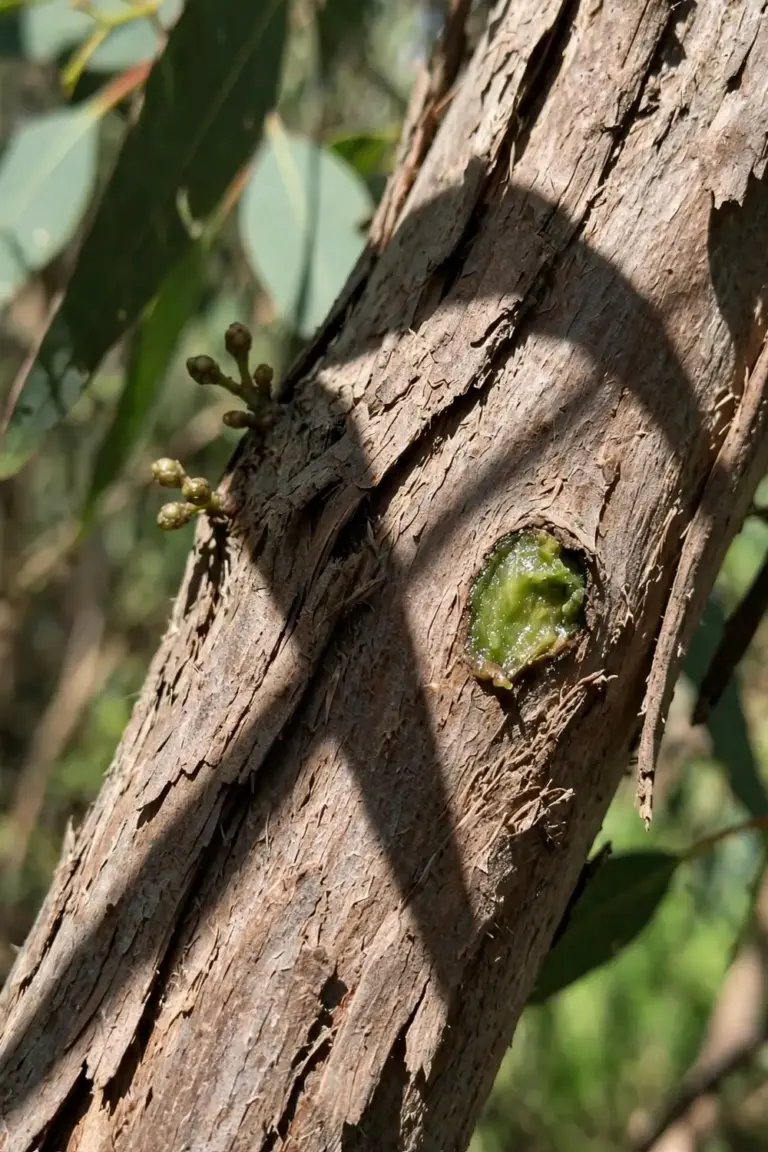
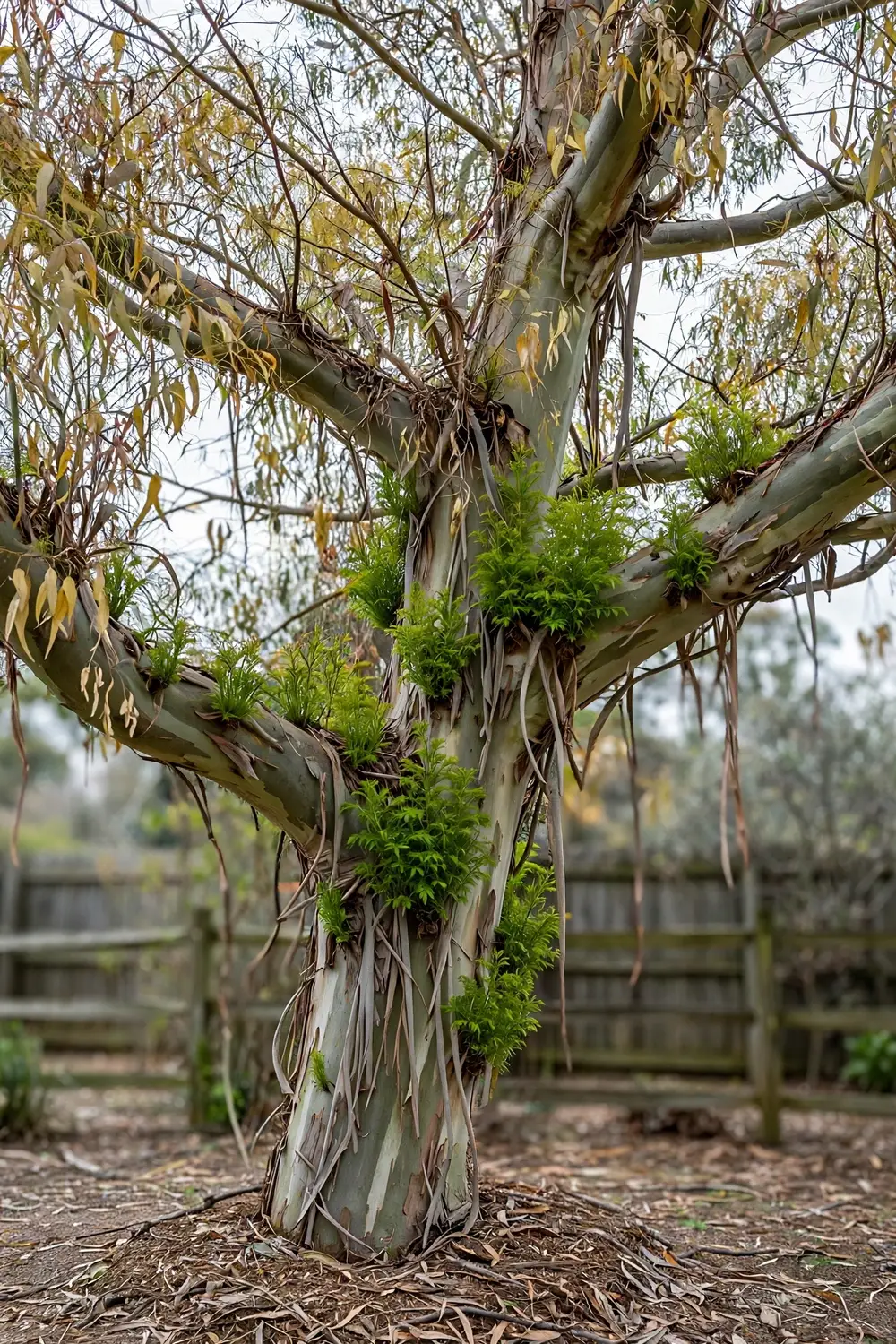
Watch for epicormic shoots while you test. These are the clusters of fresh green shoots that push straight from the trunk or large branches after stress. Eucalypts carry thousands of dormant buds under their bark, and these buds let the tree regrow rapidly after drought, fire, insect attack, or storm damage. Shoots can grow 27 cm in a single day and up to 6 metres in a year, according to Australian Geographic’s account of eucalypt survival adaptations. A tree pushing epicormic shoots is recovering, not dying.
A truly dead eucalypt shows brown wood under the bark on every test branch, no epicormic shoots anywhere, and bark peeling away to expose brown timber beneath. Sudden total leaf loss with none of these recovery signs points to a dead tree. If the scratch test shows life, move on to the problems below instead of planning a removal.
The last-resort backup is the lignotuber, the woody swelling at the base of many eucalypts. Think of it as the trunk’s emergency reboot: a ball of dormant buds with direct access to the full root system. Even when the entire crown is gone, the lignotuber can push a whole new tree. Do not grind the stump of a “dead” eucalypt until you have given the lignotuber one full growing season to respond. Many owners have removed trees that would have regrown from the base within months.
2. Accept Drought Leaf Shed as Normal, Not a Crisis
Eucalypts shed mature leaves and small twigs when soil dries out. This is a water-saving adaptation, not a disease. The tree reduces its leaf area to cut transpiration, conserves moisture in the lower branches, and replaces the lost foliage with epicormic growth once rain returns. A garden eucalypt dropping leaves through a dry summer is usually healthy.
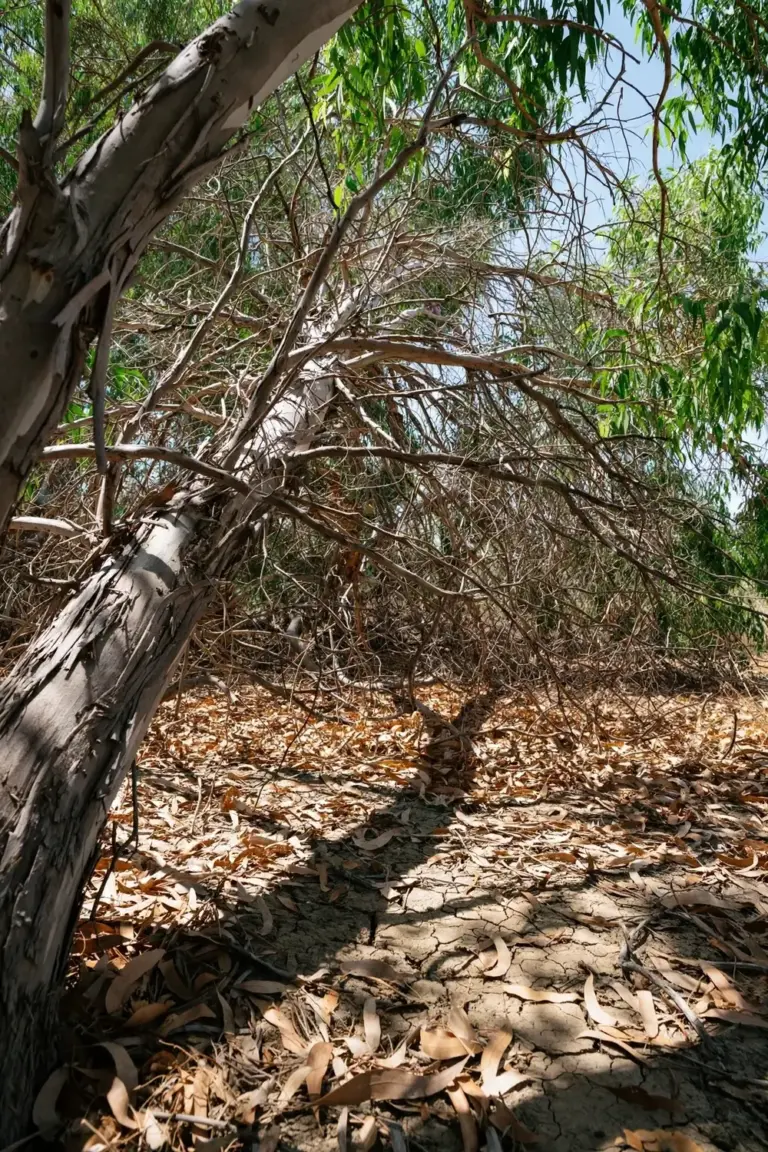
The shed follows a pattern you can recognise. Older interior leaves yellow and fall first. The canopy thins from the inside out. New growth at the branch tips stays green longest. If the pattern is reversed, with tip dieback and green interior foliage, look at problems 3 and 8 instead.
Do not fertilise a drought-shedding tree to “help” it. Extra nitrogen pushes soft new growth that loses water faster and attracts psyllids. Water deeply and infrequently to encourage deep roots, then leave the tree alone. A thick organic mulch ring out to the drip line holds soil moisture, as the site’s mulching guide explains, but keep mulch clear of the trunk itself.
I check the scratch test before I reach for the hose, because a tree pushing epicormic shoots is already solving the problem itself.
3. Check for Phytophthora Root and Crown Rot in Wet Spots
Phytophthora root rot is the most serious disease threat to garden eucalypts. The water mould Phytophthora cinnamomi attacks fine roots first in moist, poorly drained soil, then moves to larger roots. The tree cannot take up water or nutrients. Leaves turn dull green, then yellow, then drop. Branches die back from the tips. The decline is slow, over months, which is why owners often blame drought for the wrong problem.
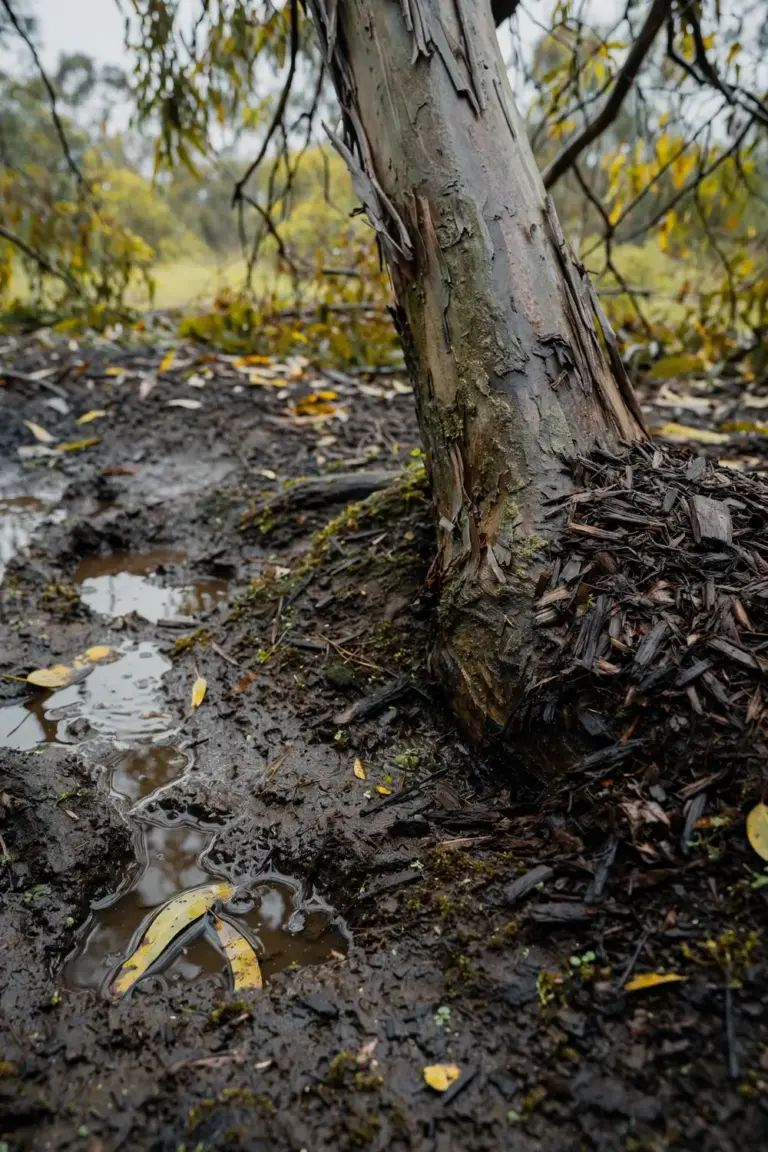
The telling difference from drought shed is soil moisture. Phytophthora strikes where drainage is poor: low spots, heavy clay, lawns watered daily, garden beds against the house with no fall. If the soil stays soggy and the tree still wilts, suspect root rot rather than thirst. Dig down 20 cm near the drip line and check. Dark, soft, decaying roots confirm it. Firm pale roots point elsewhere.
There is no chemical cure that reliably saves an established tree in a home garden. Management is cultural. Improve drainage before planting, plant on a slight mound in heavy soil, and never water the crown area directly. The UC IPM guide to Phytophthora root rot stresses that good water management is the key factor, and that pulling soil back from the base to let crown tissue dry can sometimes save a tree. If more than half the canopy has died back, removal is the honest call.
Watch for dark gummy exudate near the base of the trunk. Some infected eucalypts weep a resinous substance where the pathogen has damaged the bark at the soil line. This is not the normal kino that eucalypts produce at wounds. Kino is reddish brown and hardens. Phytophthora exudate stays dark and wet. Either way, do not carve into the trunk to investigate. You will wound the tree further and spread the pathogen on your tools. Disinfect secateurs and shovels with diluted bleach between cuts when working around a suspect tree, and never move soil from an infected spot to a healthy bed.
4. Look for Lerp Psyllids Under the Leaves
Lerp psyllids are the signature eucalypt pest in Australia. The nymphs are tiny sap-sucking insects that build white crystalline shelters called lerps on the undersides of leaves. Each lerp is a little shell made from the insect’s sugary waste. Heavy infestations coat foliage in sticky honeydew, leaves yellow and drop early, and black sooty mould grows on the honeydew below.
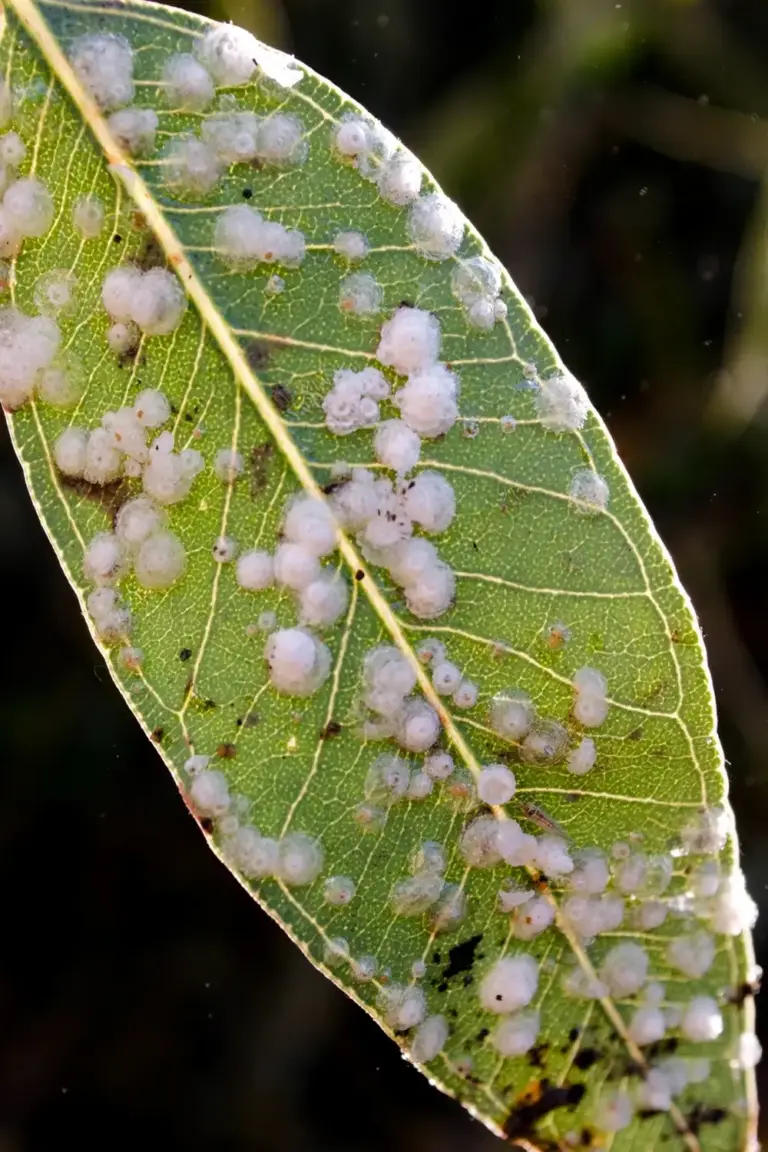
Flip a leaf and look. Lerps are the giveaway: small white cones, discs, or baskets sitting on the leaf underside, sometimes in rows along the veins. The red gum lerp psyllid, Glycaspis brimblecombei, attacks river red gum, flooded gum, and forest red gum, and is biologically controlled in many regions by the parasitoid wasp Psyllaephagus bliteus, according to the UC IPM psyllid pest note. Adults are only 2.5 to 5 mm long and hold their wings rooflike over their bodies.
Small numbers need no action. Most garden trees tolerate light infestations, and natural enemies usually catch up. Problems start when the tree is stressed by drought or over-fertilizing, which is why a lerp outbreak often signals another problem underneath. Fix the stress first. For heavy infestations on a small tree, wash lerps off with a strong jet of water. Avoid broad-spectrum insecticides; they kill the parasitoid wasps that do the real control work.
Ants complicate lerp control. Ants farm the psyllids for their honeydew and aggressively defend them from predators and parasitoids. If you see ant highways running up the trunk to a lerp infestation, the ants are protecting the problem. A band of horticultural glue around the trunk breaks the highway. Eco Organic Garden, an Australian organic gardening supplier, recommends this ant-exclusion step alongside washing leaves and cutting off badly infested sections. With the ants blocked, the wasps and birds can reach the psyllids. One sticky band does more than a season of spraying.
5. Identify Chewing Damage From Leaf Beetles and Snout Beetles
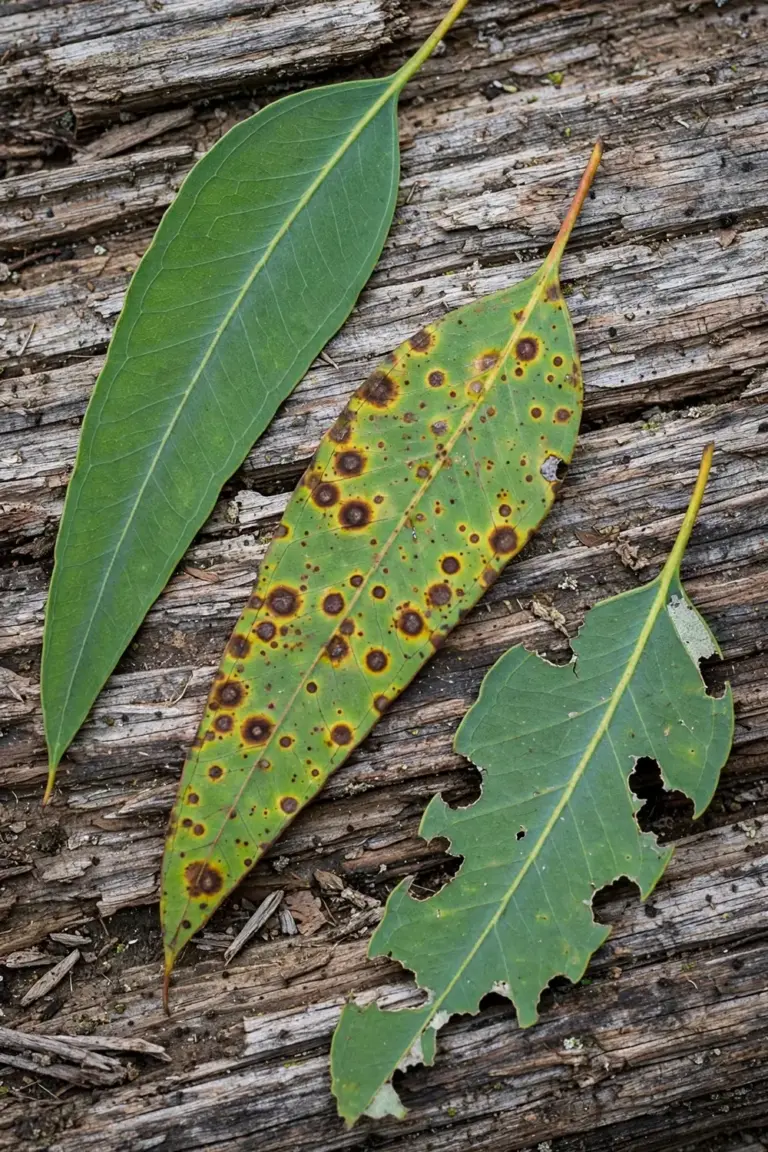
Eucalyptus leaf beetles chew semicircular notches from leaf edges. Severe feeding strips leaves to the midrib. The eucalyptus snout beetle, Gonipterus, is the well-studied one: adults chew leaf margins into a notched, scalloped pattern, while early larvae scrape pale trails across the leaf surface and older larvae chew clean through, as described in the UC IPM eucalyptus snout beetle page. Development from egg to adult takes 2 to 3 months in warm weather, with about 3 generations per year.
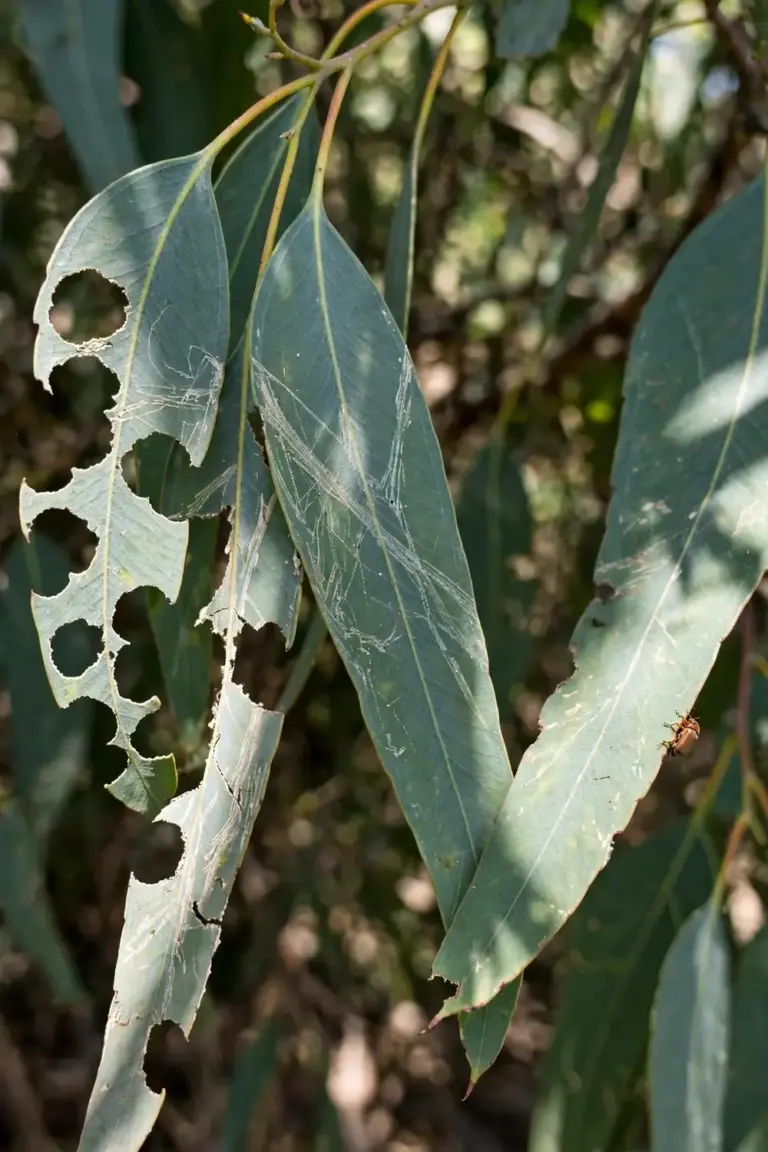
In Australia these beetles rarely kill healthy trees because native predators and parasites hold them in check. Defoliation becomes dangerous when it repeats across several seasons on an already stressed tree. Young trees and new plantings are the most vulnerable because they have less canopy to spare, which is why the establishment phase covered in the site’s eucalyptus from seed guide matters as much as pest control.
Check before you spray. Shake a branch over a white sheet in the morning and count what falls. A few beetles on a large tree need nothing. Repeated heavy defoliation on a small tree calls for an arborist’s advice, not a hardware-store spray applied from a ladder. Keep the tree vigorous with deep watering in dry spells; a healthy eucalypt outgrows moderate beetle damage by refoliating.
Time your sheet test for early morning when beetles are sluggish. Hold the sheet under the branch, give the branch three sharp taps with a stick, and count within 30 seconds before they recover and fly. Fewer than 10 beetles per branch on a mature tree is background noise. More than 30 per branch on a young tree, two weeks running, is a real infestation worth professional advice. Write the counts down. Memory exaggerates insect numbers, and a written record stops you spraying over five beetles.
6. Read Leaf Spots Before You Treat Them
Fungal leaf spots show as brown, purple, or black blotches on eucalypt foliage, sometimes with yellow halos. Most are cosmetic on established trees. Eucalypts drop spotted leaves and grow clean replacements. Treatment is rarely needed and rarely effective once spots appear, because fungicides protect new growth rather than curing old lesions.
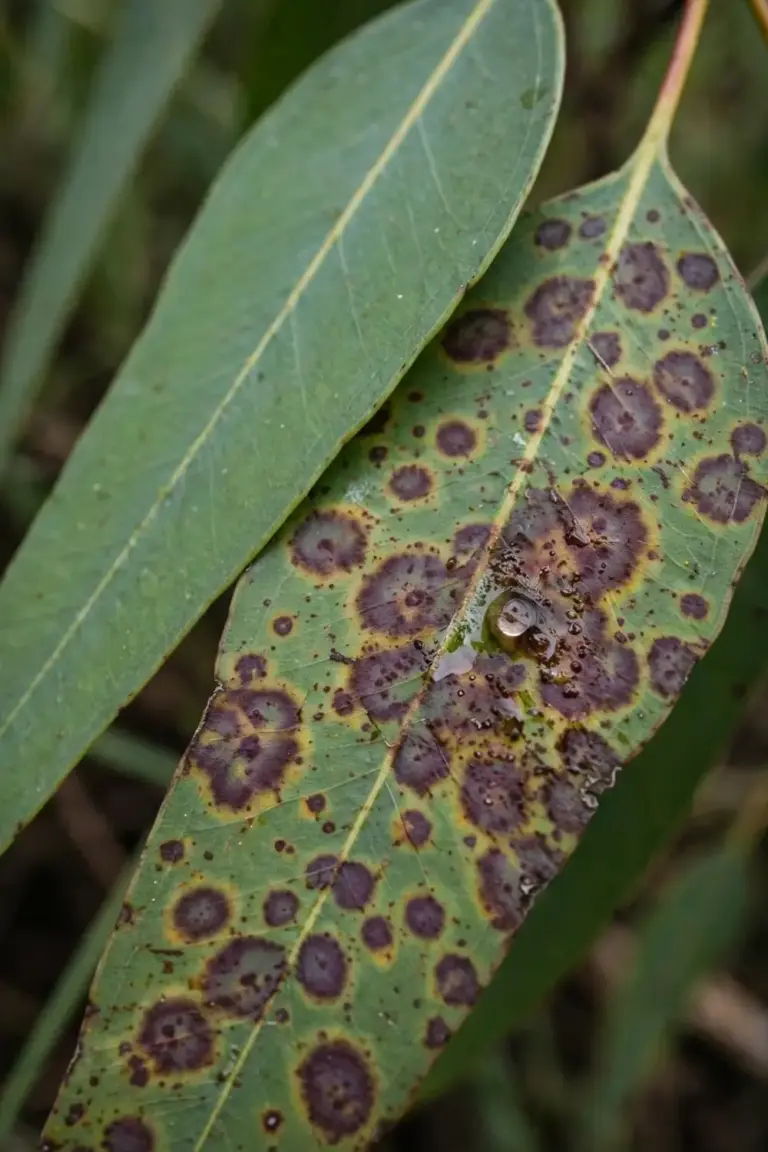
The spots worth attention are the ones paired with other symptoms. Spots plus twig dieback plus a stressed tree can indicate a canker disease entering through wounds. Spots on a newly planted tree in a wet winter may signal that the planting site stays too damp. In both cases the underlying problem is the site or the stress, not the fungus itself.
Improve air circulation with selective pruning of crossing branches. Rake up and bin heavily spotted fallen leaves rather than mulching them back under the tree. Do not overhead-water the canopy in the evening. If spots appear on more than half the canopy of a young tree two seasons running, take a sample in a sealed bag to your state agriculture department clinic for identification before spending money on treatments.
7. Separate Frost and Wind Scorch From Disease
Frost browns eucalypt foliage overnight. The damage shows as blackened or bronze leaf margins and dead shoot tips, worst on the windward side and on young growth. Wind scorch looks similar: desiccated brown leaf edges after hot dry winds, again worst on the exposed side. Both are weather injuries, not infections, and both are one-sided, which is the diagnostic clue.
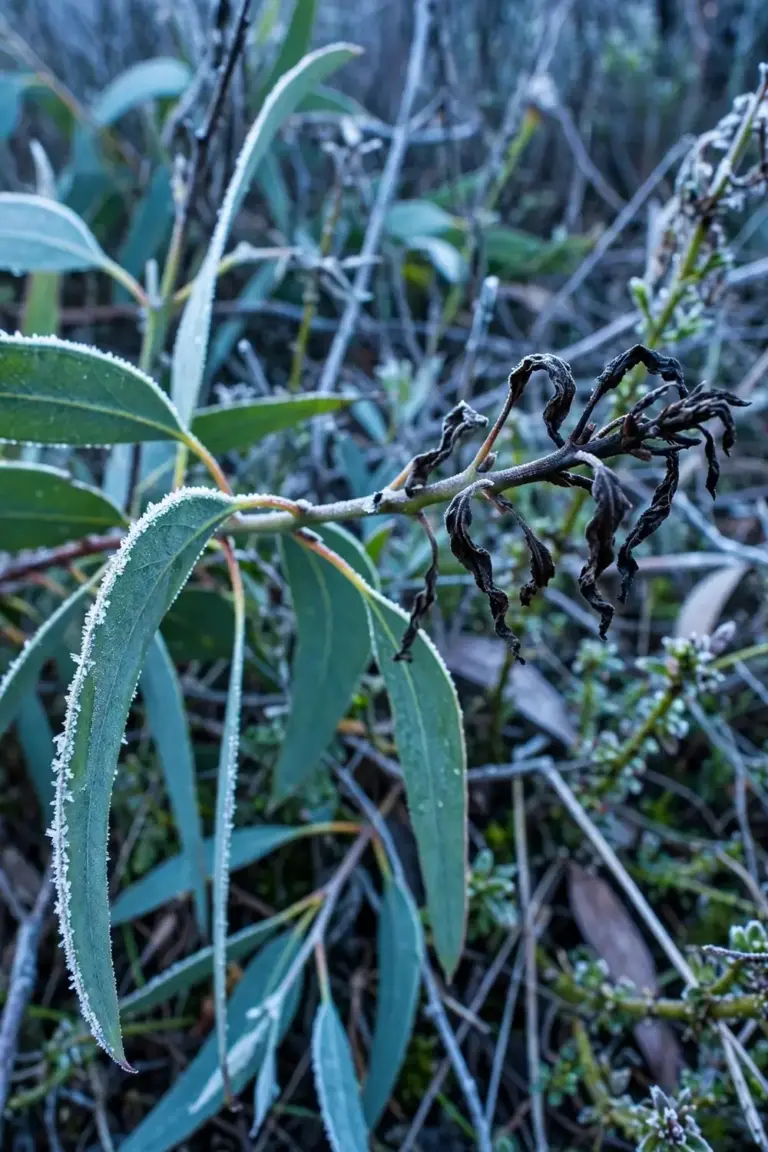
Young trees and new plantings suffer most. Species choice matters more than any treatment: a tropical or subtropical eucalypt planted in a frost hollow will scorch every winter. The site’s glacier eucalyptus growing guide shows how one cold-hardy cultivar is sited and cared for. The fix is long-term, not chemical. Plant frost-tender species in sheltered positions, avoid low spots where cold air pools, and protect new plantings with a temporary windbreak for their first two winters.
Do not prune frost damage in a hurry. Wait until spring growth starts, then cut back to living wood. Pruning too early removes tissue that would have insulated the buds below, and a late frost can then damage the fresh cuts. The tree will push epicormic shoots from below the damage if the wood is alive.
8. Fix Soil and Nutrient Mismatch, Not the Leaves
Eucalypts are adapted to Australia’s generally low-phosphorus soils. The classic home-garden mistake is treating a eucalypt like a rose: rich soil, regular complete fertilizer, frequent watering. The result is fast soft growth, more psyllids, and sometimes phosphorus toxicity in sensitive species. Yellow new growth with green veins can indicate iron deficiency in alkaline soils, but check the pH before adding anything.
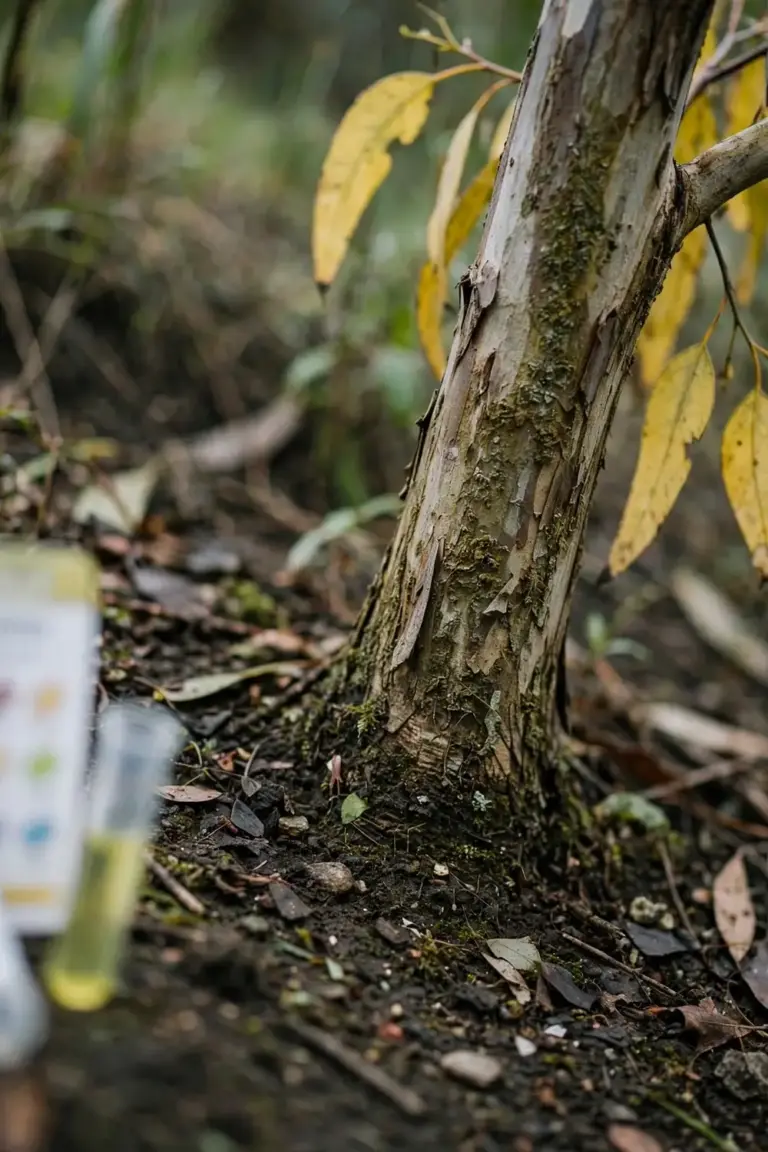
Test before you treat. A simple soil pH test from the nursery costs less than a bag of fertilizer and answers more questions. Most eucalypts prefer slightly acidic to neutral soil. If the pH is above 7.5 and the tree shows iron chlorosis, the fix is lowering pH with organic matter, not pouring on iron chelate every month. The site’s soil health guide walks through testing and organic-matter building.
Waterlogging and drought sit at opposite ends of the same problem: roots need both water and air. Heavy clay that stays saturated rots roots. Sandy soil that drains in hours starves them. Match the species to the site at planting time. For an established tree in the wrong soil, improve the surface with compost and mulch rather than digging around the roots, which causes the damage described in problem 9.
9. Protect Roots From Construction and Compaction Damage
Eucalypt roots spread well beyond the drip line, shallow and wide. Construction trenches, new driveways, retaining walls, and even repeated car parking over the root zone sever or crush them. The canopy symptoms appear months later: thinning crown, small leaves, branch dieback on one side. Owners blame disease for what machinery caused.
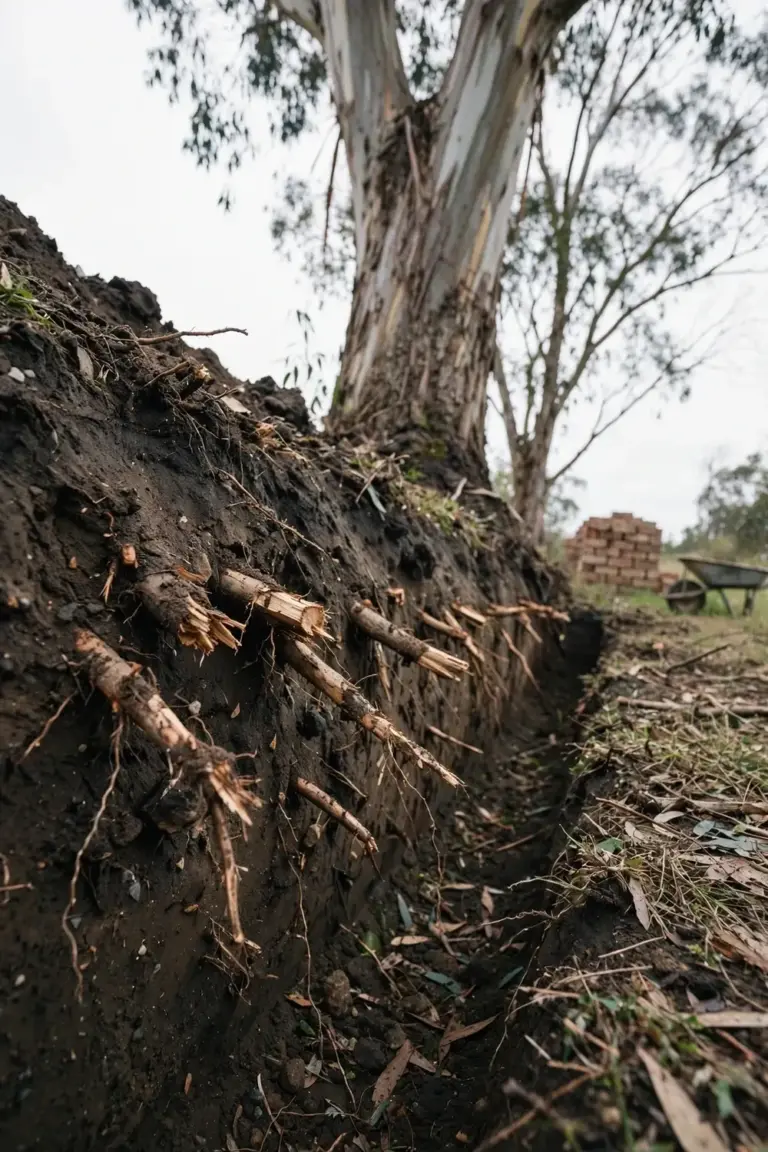
The damage is often invisible at the time. A trench cut halfway between the trunk and the drip line can remove a third of the absorbing roots. Soil compaction from vehicles or stockpiled building materials squeezes air from the soil, and roots suffocate slowly. Symptoms on one side of the canopy usually match damage on the same side at ground level.
Prevention beats every cure. Fence the root zone before work starts, out to at least the drip line. Never stockpile soil, bricks, or machinery under the canopy. If damage has already happened, water deeply through dry periods to support the remaining roots, mulch widely, and give the tree two full growing seasons to respond before judging it. Do not fertilise a root-damaged tree; it cannot use the nutrients and the salts add stress.
10. Keep Landscape Dieback in Perspective
News coverage of eucalypt dieback on the Monaro Plains and elsewhere describes landscape-scale decline across thousands of hectares. That is a different problem from one sick tree in a home garden. Landscape dieback involves complex interactions of drought, insects, soil change, and land use across whole districts. Your garden tree needs garden-scale diagnosis, not a regional narrative.
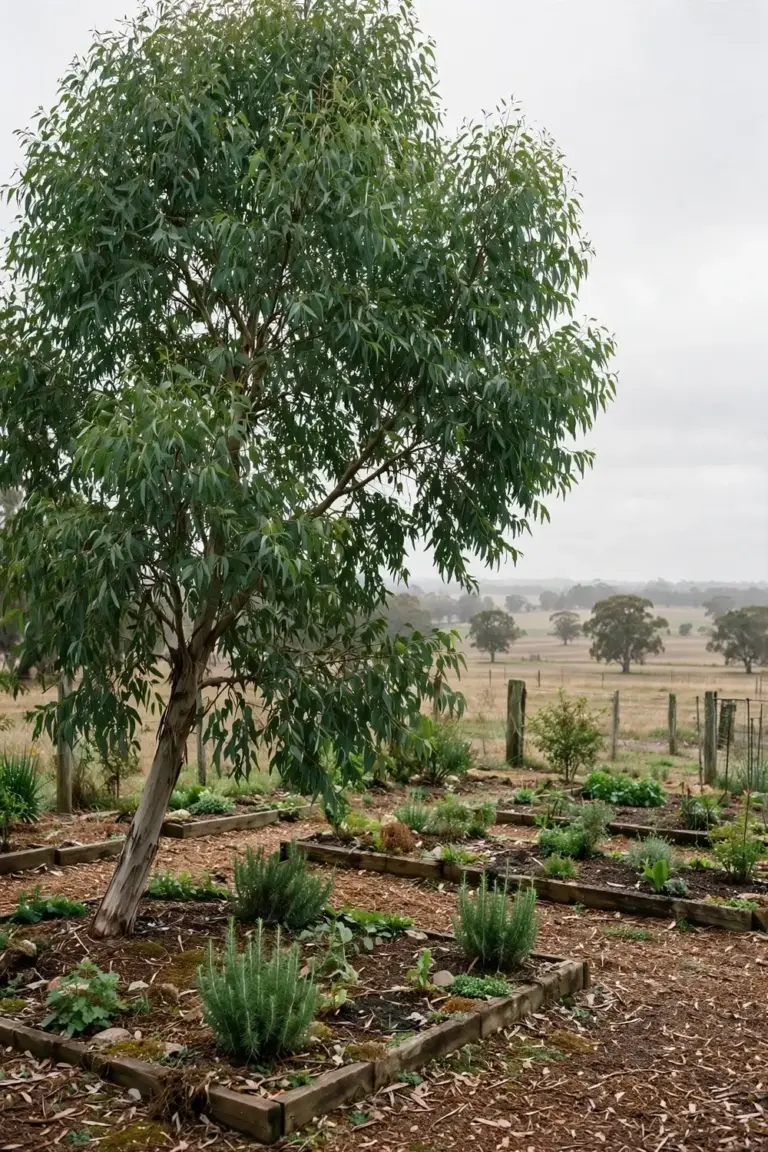
Do not apply landscape explanations to a single tree. “Dieback” as a news term does not diagnose your tree. Run the checks above in order: scratch test, water, roots, pests. In almost every home-garden case the cause is one of problems 1 through 9, acting alone or in combination.
The one lesson worth taking from landscape dieback is about stress stacking. Trees die when several stresses arrive together: drought plus insects plus root damage. Your job as a gardener is to remove the stresses you control. Water deeply in dry spells, protect the root zone, avoid over-fertilizing, and let natural enemies work. A tree with one problem recovers. A tree with four may not.
Think of it as a budget. A healthy eucalypt can spend energy fighting off beetles or pushing through a dry summer. It cannot do both while its roots are also drowning in a soggy lawn bed. Every stress you remove frees energy for recovery. This is why the order of this guide matters. Fix water first, then roots, then pests. Spraying beetles on a tree with rotting roots is mopping the floor while the tap runs.
11. Call an Arborist for Large, Leaning, or Dangerous Trees
Some eucalypt problems are not DIY jobs. Call a qualified arborist when the tree is large enough to damage property, when branches overhang roofs or powerlines, when the trunk leans suddenly or soil heaves at the base, or when fungal fruiting bodies appear on the trunk or major limbs. These are structural risk signs, not gardening questions.
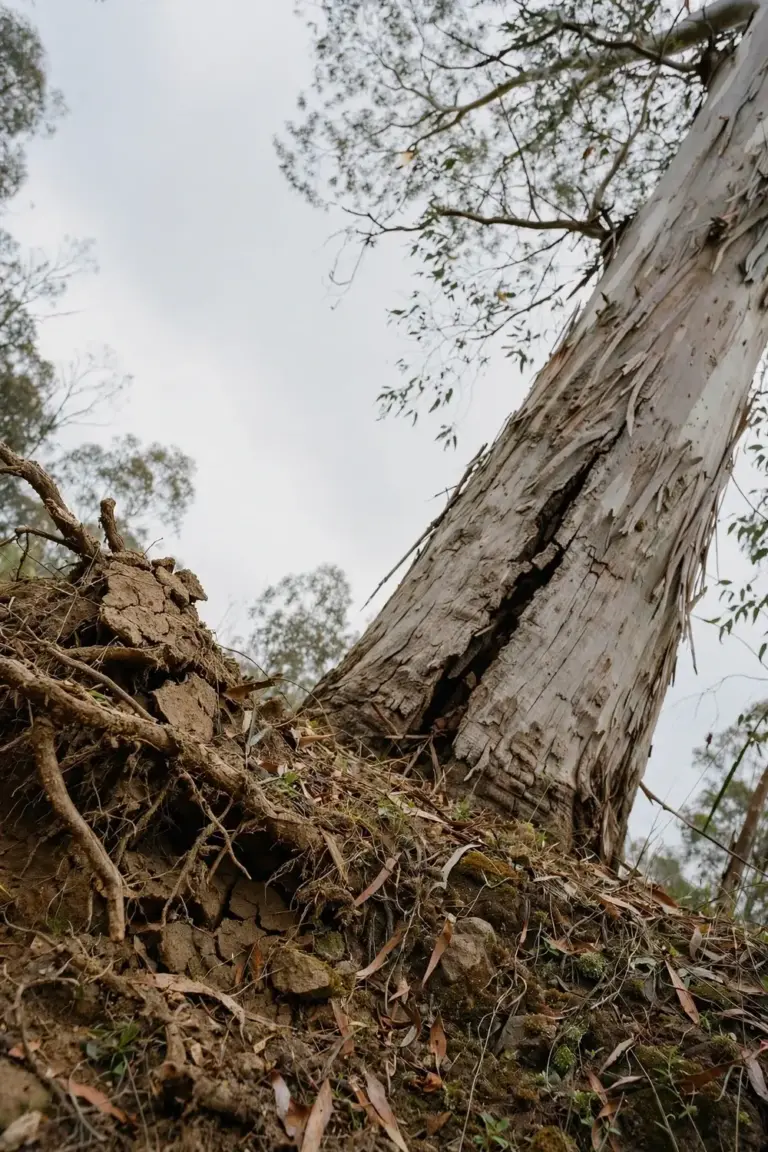
An arborist with proper equipment can assess internal decay, prune large limbs safely, and advise honestly whether the tree can stay. Expect to pay for the callout; it is cheaper than emergency removal after a storm. Ask for an arborist with Australian Qualifications Framework Level 5 in arboriculture for a formal tree assessment.
Do not let anyone “top” a eucalypt to make it safe. Topping creates weakly attached regrowth that is more dangerous than the original canopy within a few years. Proper crown reduction by a qualified arborist shortens selected branches to sound lateral growth. If a contractor suggests topping, find a different contractor.
Get a second opinion before removing a large tree. Removal is permanent and expensive, and a stressed eucalypt can look worse than it is. An honest arborist will tell you when a tree can be saved with pruning and patience. Ask what the diagnosis is, what the options cost, and what happens if you wait a season. If the answer is always removal regardless of the problem, that contractor sells removals, not advice.
Quick Symptom-to-Cause Reference
| What you see | Most likely cause | Check first |
|---|---|---|
| Leaves dropping in dry weather, interior first | Drought shed, normal | Problem 2, scratch test |
| Green under bark, shoots pushing from trunk | Recovery, not death | Problem 1, wait and watch |
| Brown dry wood, no shoots anywhere | Dead branch or tree | Problem 1, arborist if large |
| White lerps under leaves, sticky honeydew | Lerp psyllids | Problem 4, reduce stress |
| Notched leaf edges, scalloped margins | Leaf beetles or snout beetles | Problem 5, sheet test |
| Brown leaf spots, otherwise healthy | Fungal leaf spot, cosmetic | Problem 6, improve airflow |
| Blackened leaf margins after cold night | Frost damage | Problem 7, wait for spring |
| Wilting in wet soil, dark soft roots | Phytophthora root rot | Problem 3, improve drainage |
| One-sided dieback after building work | Root damage | Problem 9, protect and wait |
| Yellow new growth, high pH soil | Nutrient lockup | Problem 8, test soil |
Frequently Asked Questions
Run the scratch test on three or four branches at different heights. Green moist tissue under the bark means the branch is alive. Brown dry wood with no epicormic shoots pushing means that branch is dead. If most branches show life and shoots are pushing from the trunk, the tree is shedding to survive drought and will recover with rain. A tree with brown wood on every branch and no new shoots is dead.
Summer leaf drop is usually drought adaptation. Eucalypts shed mature interior leaves to cut water loss through transpiration, then replace them with epicormic growth when rain returns. Check that tip growth stays green and the scratch test shows living tissue. Water deeply and infrequently rather than daily, mulch out to the drip line, and do not fertilise. If leaves drop with tip dieback in wet soil, suspect Phytophthora instead.
Those are lerps, the sugary shelters built by psyllid nymphs feeding on sap. Each lerp houses one juvenile insect. Light infestations need no treatment and natural parasitoid wasps usually control them. Heavy infestations with yellowing leaves and sooty mould signal a stressed tree. Fix the underlying stress first: water properly, stop over-fertilizing, and wash heavy lerps off small trees with a strong water jet.
Often yes, if the wood is alive. Eucalypts carry thousands of dormant epicormic buds under the bark that can push new shoots after defoliation from drought, insects, or fire. These shoots can grow remarkably fast once conditions improve. The lignotuber at the base is the backup of last resort and can regrow the whole tree. Give a defoliated tree one full growing season with good water before deciding it is dead.
Usually no. Extra nitrogen pushes soft growth that loses water faster and attracts psyllids, which is the opposite of what a stressed tree needs. Test the soil pH first and fix drainage, watering, and root-zone protection before reaching for fertilizer. The one exception is a confirmed nutrient deficiency diagnosed by soil test, such as iron chlorosis in alkaline soil, where targeted correction beats a general-purpose feed.
Walk the Tree Before You Reach for the Spray
Most eucalyptus problems in Australian home gardens trace back to water, roots, or stress, not to exotic diseases. Run the scratch test, read the soil, and match the symptom to the cause before spending money. The tree has survived millions of years of Australian conditions. Give it the basics and it usually returns the favour.
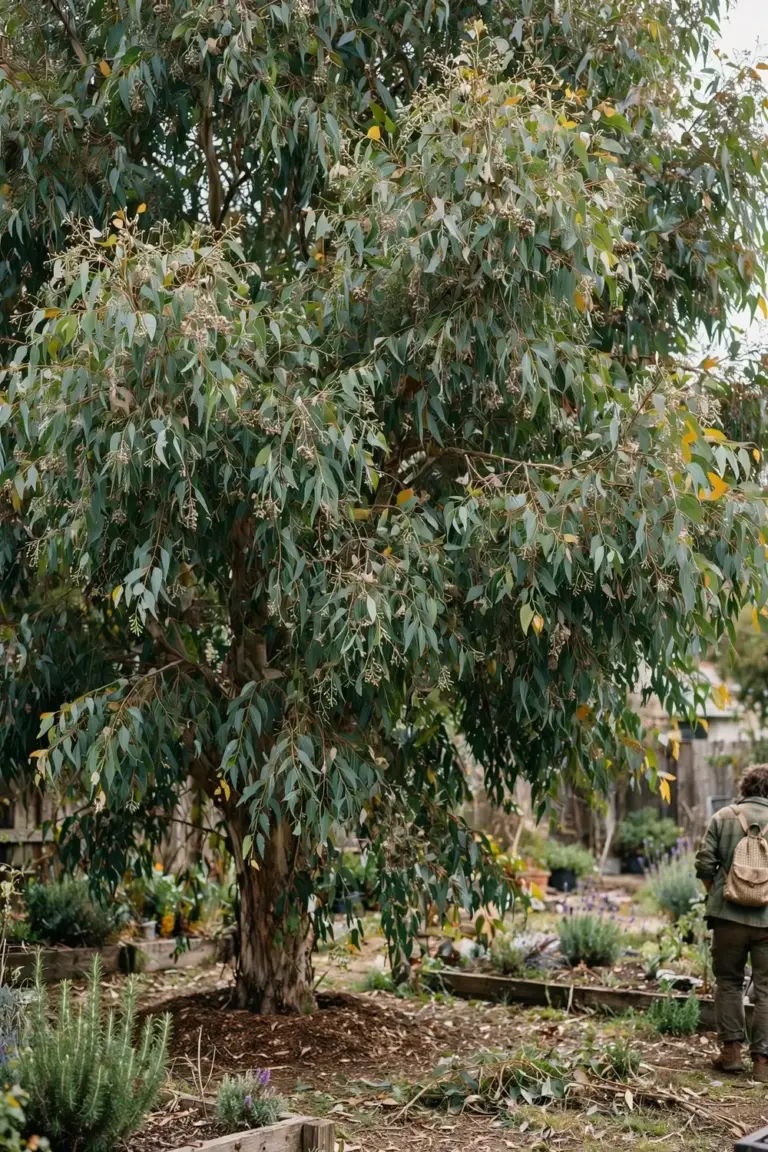
Keep a simple yearly routine and most of these problems never start. Walk the tree each autumn and look up: thin crown, dead tips, lerps building, bark changes. Check the ground too: mulch depth, drainage after rain, new trenches or compaction inside the drip line. Catch a problem in its first season and the fix is water, mulch, or patience. Catch it in its third season and the fix is an arborist with a chainsaw. The cheapest treatment in this whole guide is the walk itself. Put it in the calendar the way you would a smoke-alarm battery check: same weekend every year, no excuses.