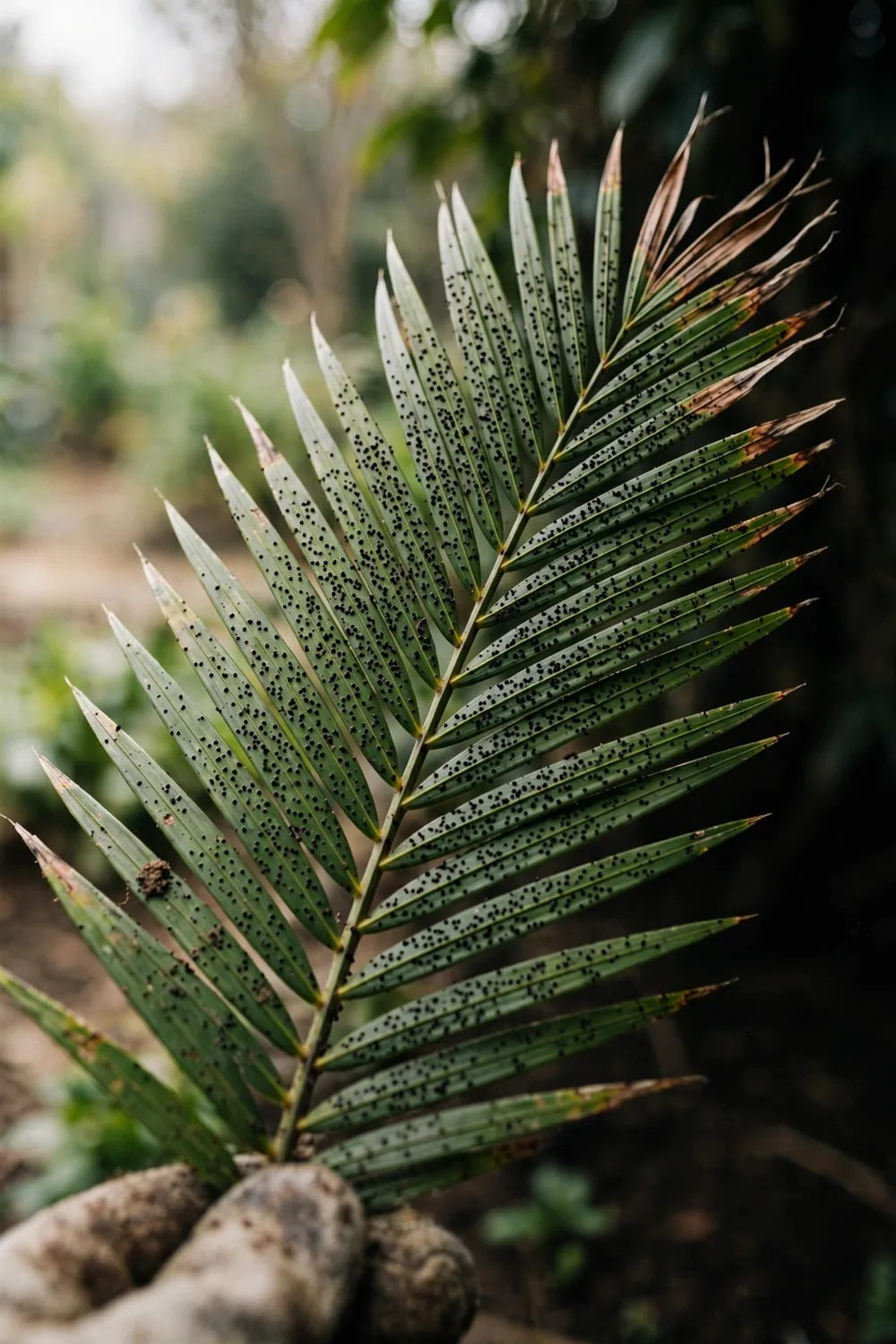

Black spots on your palm fronds are usually not the emergency they look like. False smut, the disease behind those black dots, is primarily cosmetic, and the 7 strategies below keep it that way. It does not kill palms, it does not stunt growth, and it does not need a spray program. The real danger is the mistake: treating the cosmetic fungus while missing the potassium deficiency that actually harms the palm. The 7 strategies below keep the disease cosmetic, fix the deficiency first, and stop you from spending money on the wrong problem.
The first fact to hold is the name. False smut is also called Graphiola leaf spot, and this article uses both names together. The bare phrase false smut on its own belongs to a different disease: rice false smut, a grain disease of rice that replaces grains with velvety spore balls. This article is about the palm disease only, caused by the fungus Graphiola phoenicis. I have learned that a palm owner who names the disease right, false smut on palms, avoids the most common confusion about it from the start.
The rest of this page walks the identification, the hosts, the one confusion that matters, the mechanism, the risk factors, and the 7 strategies. The disease name leads. The pathogen, Graphiola phoenicis, stays in the background after this introduction.
What False Smut (Graphiola Leaf Spot) on Palms Actually Is
False smut is a fungal leaf disease of palms. The pathogen is Graphiola phoenicis, with the older synonym Phacidium phoenicis. It is a basidiomycete fungus, an unusual one: instead of the familiar mold or mildew, it builds tiny black fruiting bodies called sori that erupt through the leaf epidermis. The sori are the disease as the eye sees it.
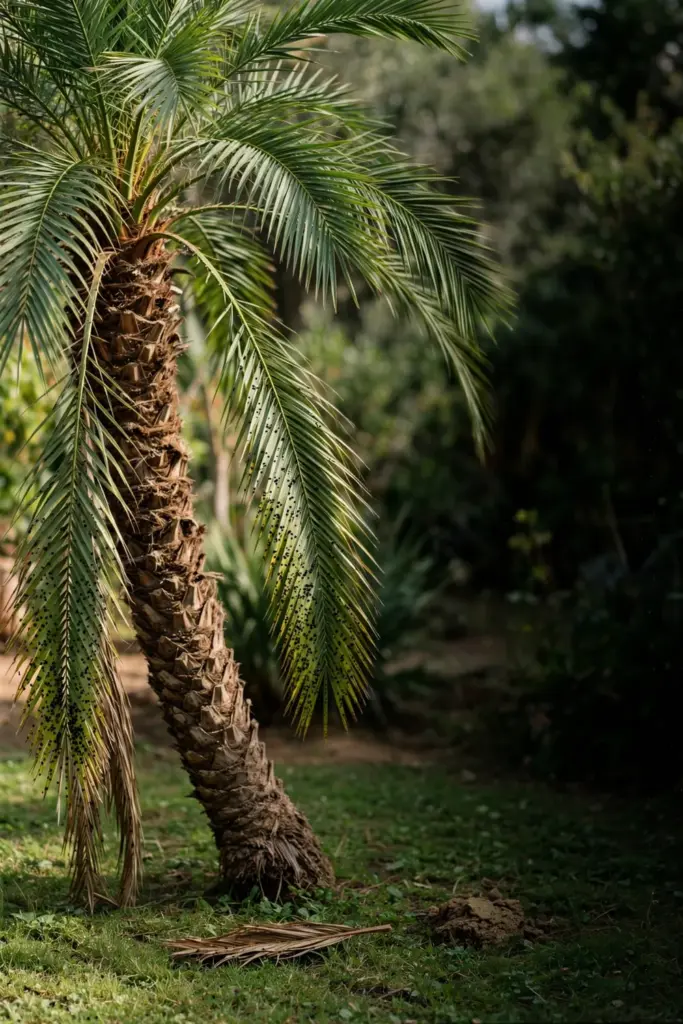
The disease is primarily cosmetic. UF/IFAS Extension states it plainly: Graphiola leaf spot is primarily cosmetic and does not adversely affect plant growth in the landscape. Confusion about the seriousness of the problem occurs because most Phoenix palms grown in Florida suffer from nutrient deficiencies, which are far more debilitating than this disease. The fungus marks the leaves. The deficiency harms the palm.
Diagnosis needs no culturing and no lab. Examine the leaf. The sori are visible to the naked eye and feelable with a finger, and a hand lens gives adequate close-up views. A palm owner with a hand lens and a fingertip has the whole diagnostic kit. The lab confirms where it matters, and leaf nutrient analysis clarifies the deficiency side, but the field check carries the day.
One fence stays firm. Coconut false smut, caused by Graphiola cocoina, is a different pathogen on coconut. True smuts, the grain-replacing smut fungi, are different fungi entirely. This article is Graphiola phoenicis only, on palms, with Phoenix species as the flagship hosts.
How to Identify False Smut on Each Part of the Palm
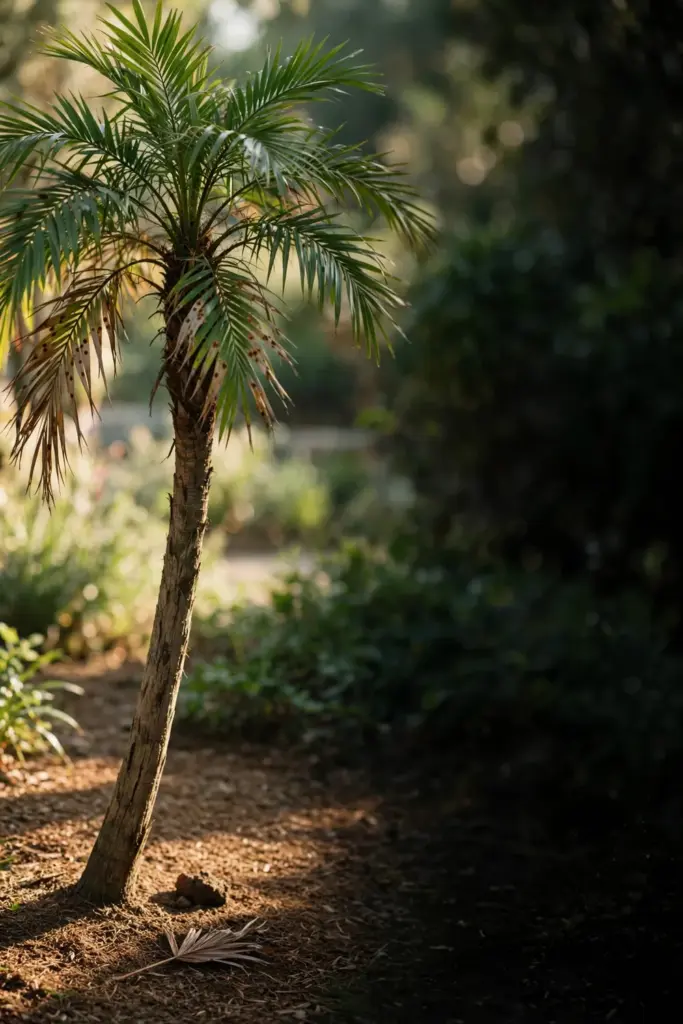
Start on the oldest leaves. False smut appears on the oldest leaves, the lowest in the canopy. A palm whose lowest fronds carry black dots while the upper canopy stays clean fits the pattern. A palm whose newest spear leaf carries the dots does not. The oldest-first pattern is the first check.
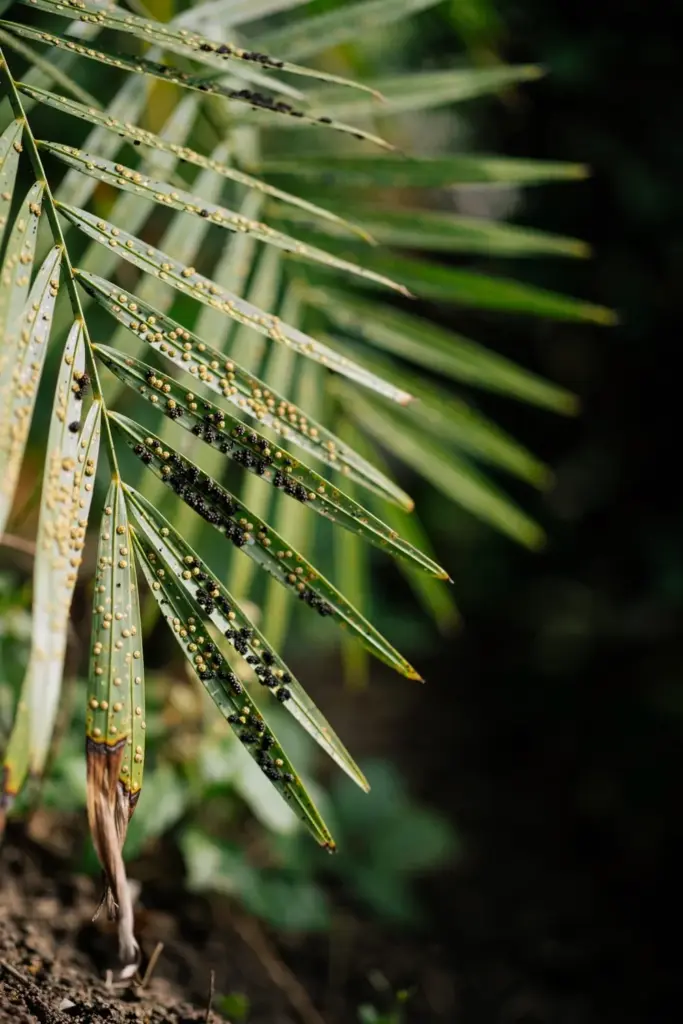
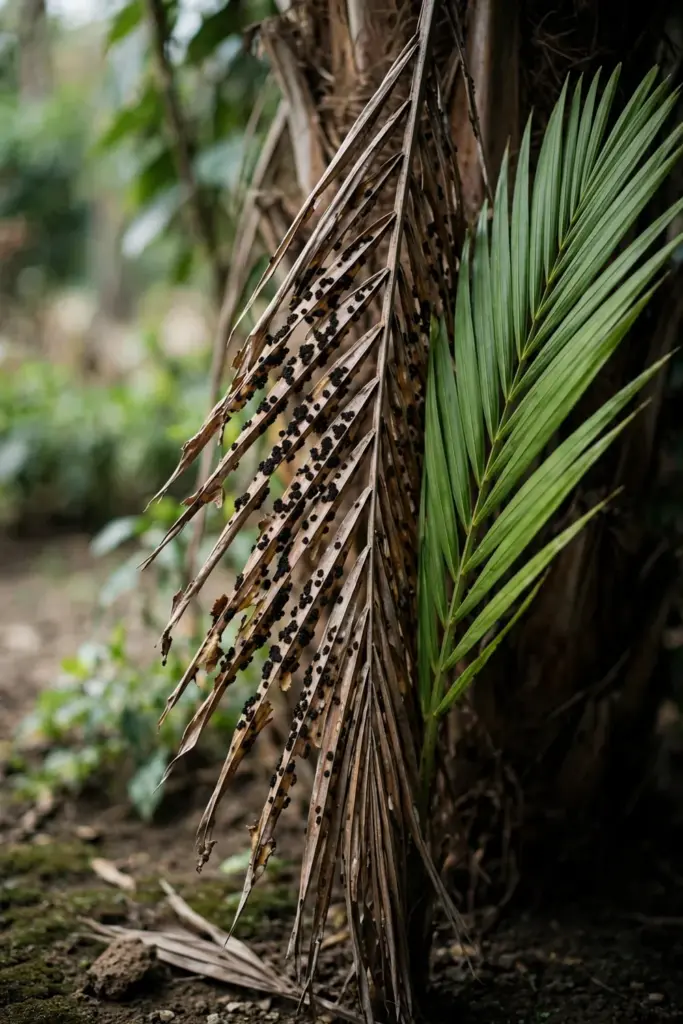
Read the leaf blade. Initial symptoms are tiny spots, 1/32 inch or less, yellow, brown, or black, on both sides of the leaf blade, easily missed. The fungus emerges from these spots, rupturing the leaf epidermis. The resulting fruiting bodies, the sori, are what observers actually see. Signs, the sori, are more prevalent and more easily observed than symptoms, the spots.
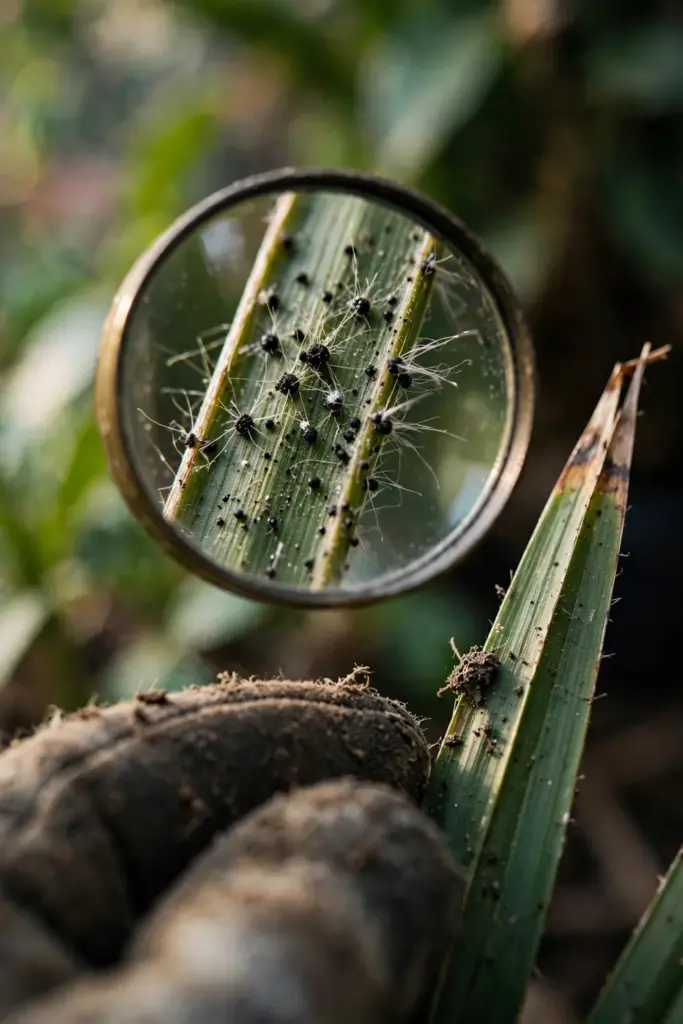
Feel the sori. A sorus is a black fruiting body under 1/16 inch in diameter, raised above the epidermis, so run a fingertip across the leaflet and feel for tiny bumps. As a sorus matures, yellow spores form and short light-colored filaments emerge from the black body to aid spore dispersal, and after spore release the sori deflate into black cup-shaped bodies, little craters on the leaf. The feel test is the single most field-usable check here.
Check the leaflets, the petiole, and the canopy in order. Leaflets carry the sori. The petiole, the stalk, does not carry sori in this disease; a petiole problem is a different disease. The canopy as a whole shows the distribution: sori on the oldest fronds, fewer above, none on the spear. The number of sori indicates the infection level. A frond with a handful of sori is a light infection. A frond peppered with sori is a heavy one.
Use a hand lens for the filaments and cups. The filaments look like tiny strings, the spent sori look like black cups, and a 10x hand lens costs little and settles the sorus question where the naked eye hesitates.
Which Palms Get Hit Hardest
Phoenix species carry the disease first. In Florida, the primary hosts are Phoenix canariensis, the Canary Island date palm, and Phoenix dactylifera, the edible date palm. A Canary Island date palm with black sori on its lowest fronds is the textbook case. A date palm in a dry climate may never show it at all.
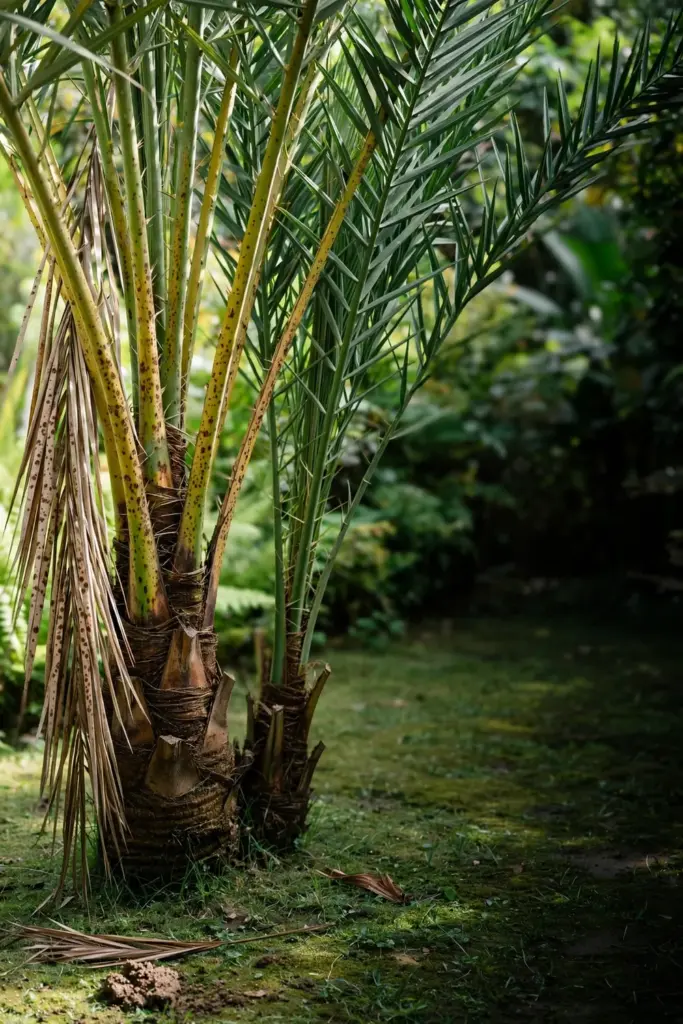
Other palms host the fungus too. Graphiola phoenicis has been observed on many palm species, including Butia, Chamaerops, Cocos, Dypsis, Livistona, Roystonea, Sabal, Syagrus, and Washingtonia. The article leads with Phoenix and does not overclaim severity on secondary hosts. A Washingtonia with sori is a real case, but the evidence weight sits with Phoenix.
Geography decides the pressure. In California, Graphiola is not a problem due to the dry Mediterranean climate. In humid Florida, it is common on Phoenix palms. The fungus needs humidity and leaf wetness. A palm in a dry climate with sori is the exception. A palm in a humid climate with sori is the rule.
No date cultivar claims of resistance are supported. Deglet Noor, Medjool, and Zahidi all proved susceptible in reported studies, so do not buy a date palm on a resistance promise for this disease. The variety does not decide the outcome. The climate and the potassium do.
False Smut vs Potassium Deficiency
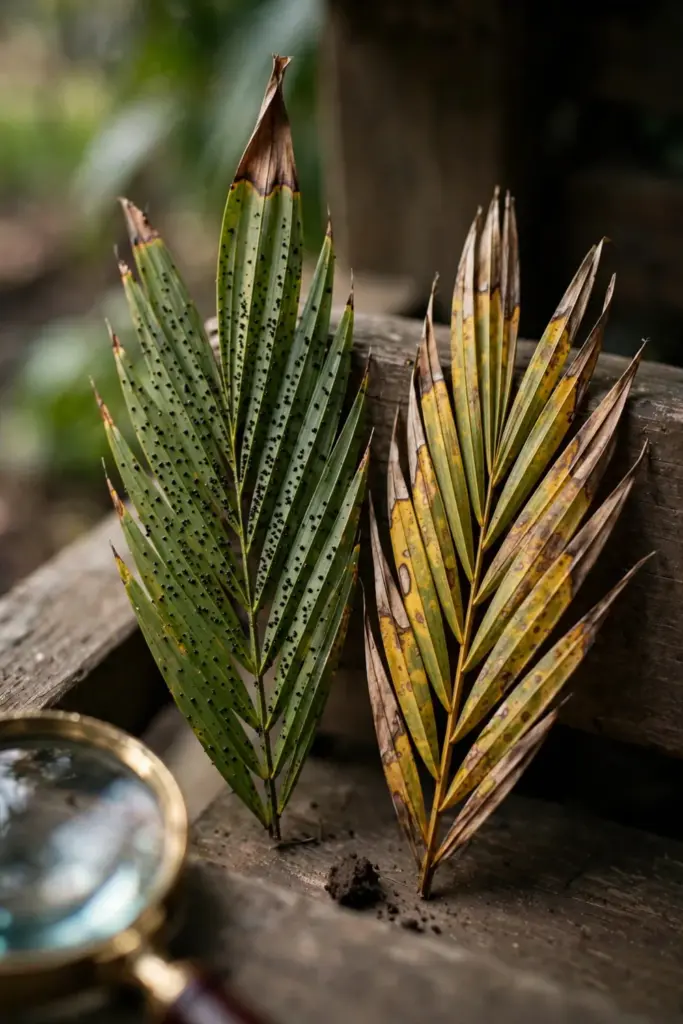
The field check is the fingertip. False smut sori are raised black bodies you can feel with a finger. Potassium deficiency spots are flat discoloration with no fruiting bodies. Raised means fungus. Flat means nutrition. The fingertip settles most cases before the hand lens comes out.
| Clue | False Smut (Graphiola Leaf Spot) | Potassium Deficiency |
|---|---|---|
| Cause | Fungus, Graphiola phoenicis | Nutrient deficiency, potassium shortage |
| Feel test | Sori RAISED above the leaf surface, feelable with a finger | Spots FLAT, no raised bodies, no fruiting bodies |
| Fruiting bodies | Black sori under 1/16 inch, filaments + yellow spores when mature, deflating to cup-shaped craters | None at all |
| Spots | Tiny initial spots 1/32 inch or less, yellow, brown, or black, on both sides of the leaf blade | Yellow + necrotic spotting, extensive necrosis on old Phoenix leaves |
| Where found | Oldest leaves, lowest in the canopy | Oldest leaves, lowest in the canopy. Same leaves for both. |
| Co-occurrence | Both can appear on the same oldest leaves; one does not rule out the other | Both can appear on the same oldest leaves; check for sori AND for flat necrotic spotting |
| What harms the palm | Cosmetic only, does not adversely affect growth | The real cause of leaf decline and poor palm health |
| Action | Sanitation + humidity control; fungicide last resort | Fix the potassium first with a palm fertilizer program |
No published head-to-head comparison article exists for this pair. This table compiles the distinction from UF/IFAS Extension PP-216, which documents it in detail inside the fact sheet, including a figure showing Graphiola sori and potassium-deficiency black spots on the same leaf. UF/IFAS states the confusion plainly: potassium deficiency is often misidentified as Graphiola leaf spot, and extensive necrosis on old Phoenix leaves is caused by potassium deficiency, not Graphiola.
One secondary lookalike gets one line. Stigmina palmivora leaf spot makes large brown spots with dark edges and flat centers, and a Graphiola sorus can sit inside a Stigmina spot. One line only, never a second table. Leaf nutrient analysis confirms where it matters.
How the Fungus Works and Why It Takes So Long to Show
The fungus grows almost entirely in place. After penetration, growth within leaf tissue is very limited, mostly just below the sorus. The fungus does not race through the frond. It sits, builds its fruiting body, and erupts through the epidermis. The limited growth is why the disease stays cosmetic: the fungus never invades the palm’s vital tissues.
Infection to spore production takes 10 to 11 months, per UF/IFAS Extension. That is an unusually long wait. Visible disease today means infection from almost a year ago. A palm that shows sori this spring was infected last spring. The calendar gap sets expectations: no action taken today changes the sori already present, and no quick fix exists, because the disease moves on a yearly clock.
Spores spread by wind and water. The filaments that emerge from mature sori aid spore dispersal, and the spores move on wind and water, rainfall or overhead irrigation. Spore-release timing in Florida is unclear, possibly continuous year-round. The unclear timing matters for fungicide decisions: without a known release window, preventive sprays cannot be timed, which is one reason landscape fungicide use is questionable.
The fungus survives on the palm and in debris. Sori on old fronds keep releasing spores. Fallen fronds carry the fungus. The reservoir is the old canopy and the debris beneath it. Sanitation removes the reservoir. Humidity keeps it active. The two levers, sanitation and humidity, are the whole management story.
What Raises the Risk of False Smut
Humidity leads the list. The fungus needs humidity and leaf wetness to infect and sporulate. A palm in a humid climate, a palm under overhead irrigation, and a palm in a crowded planting all face more pressure. A palm in a dry climate faces little. The climate lever is the largest one, and it is the one the homeowner controls least.
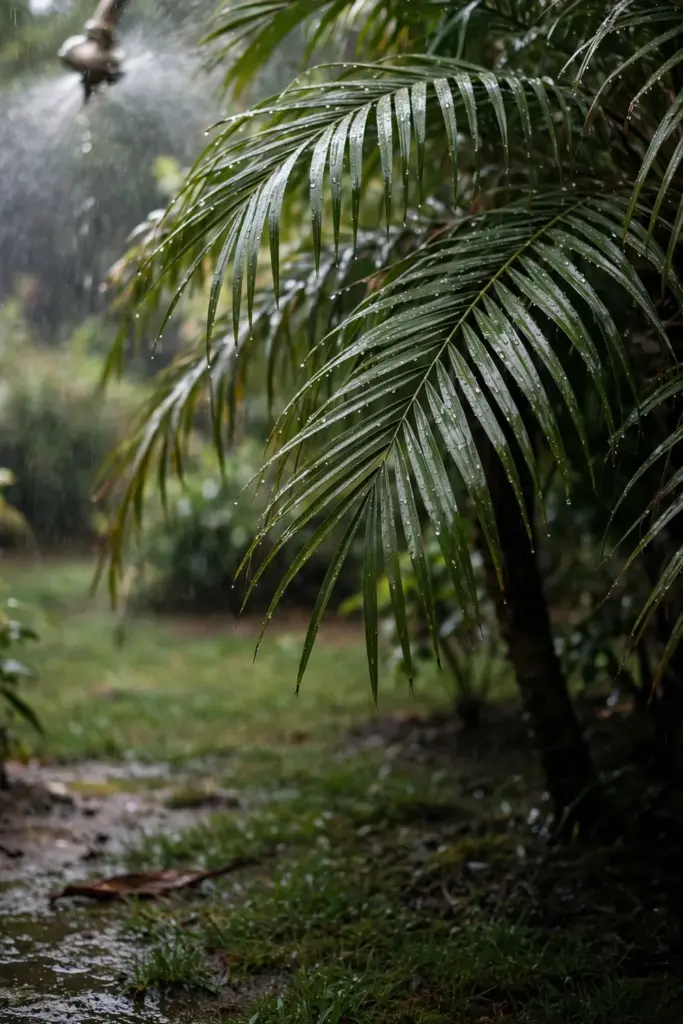
Overhead irrigation wets the fronds. Water on the leaf surface carries spores and extends the wet period. A palm watered by overhead sprinklers gets its fronds wet on a schedule. A palm watered below the canopy stays drier. The irrigation choice is a disease choice.
Crowded plantings hold humidity. Tight spacing blocks airflow, and still air keeps fronds wet longer after rain and irrigation. A palm in a crowded bed dries slower than a palm in open air. Spacing and air circulation are the home-scale humidity controls.
Old fronds left standing hold inoculum. The sori sit on the oldest fronds. A palm whose old fronds hang for months carries its own spore source. Removing old fronds removes the source, with the potassium caveat that governs the whole article. The frond that feeds the fungus is also the frond that feeds the palm.
Potassium deficiency leaves the fungal risk unchanged. It raises the stakes. A potassium-deficient palm with false smut looks far worse than a healthy palm with false smut, because the deficiency does the real damage. The deficiency also changes the management: frond removal, the standard sanitation step, worsens the deficiency. The risk factor that matters most is the one that is not the fungus.
Strategy 1: Confirm the ID Before Spending Anything
Check the oldest fronds first. Sori on the lowest fronds, none on the spear, fits false smut. Sori on the newest growth does not. The oldest-first pattern costs nothing to check and saves everything that follows. A misidentified palm gets the wrong treatment.
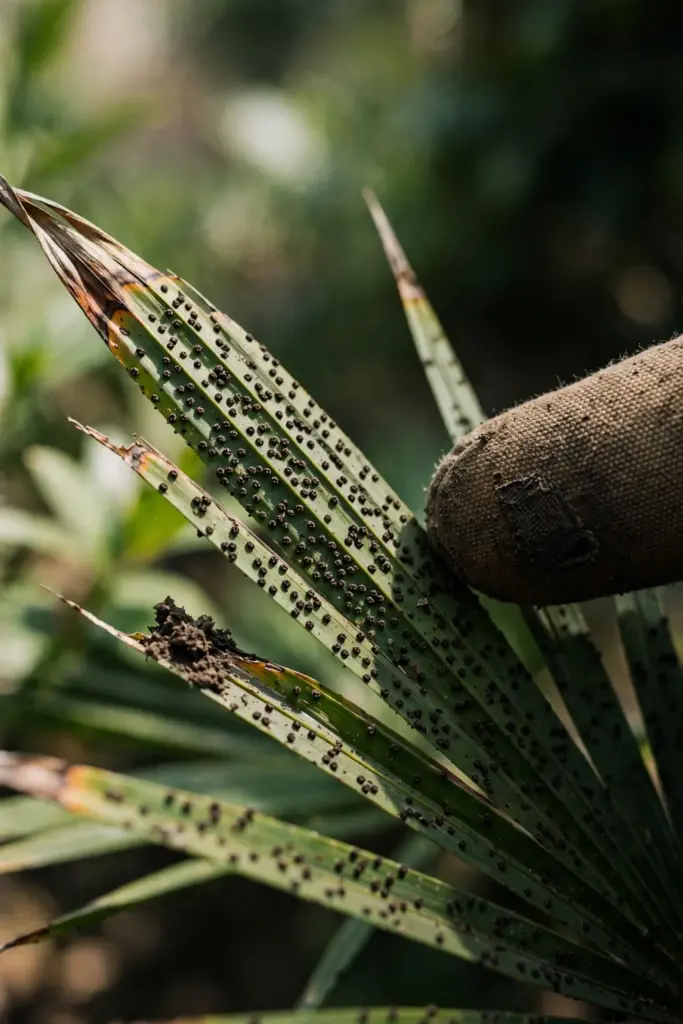
Run the feel test. Run a fingertip across the leaflet. Raised bumps mean sori. Flat discoloration means deficiency. The fingertip is free, immediate, and more reliable than a photograph. A palm owner who feels the spots knows more than a palm owner who only looks at them.
Use a hand lens for the filaments and cups. The filaments look like tiny strings. The spent sori look like black cups. The hand lens confirms what the fingertip suggests. A 10x hand lens costs little and settles the sorus question.
Count the cost of getting it wrong. Treating false smut as the main problem while potassium deficiency goes unfixed leaves the palm declining, removing fronds from a potassium-deficient palm makes the deficiency worse, and spraying a cosmetic fungus wastes money and adds chemicals to the landscape.
Strategy 2: Tell It From Potassium Deficiency With the Feel Test
Compare the feel, not the color. Both conditions spot the oldest leaves and both make brown and black marks, so color does not separate them, while the fingertip does: raised means fungus, flat means nutrition.
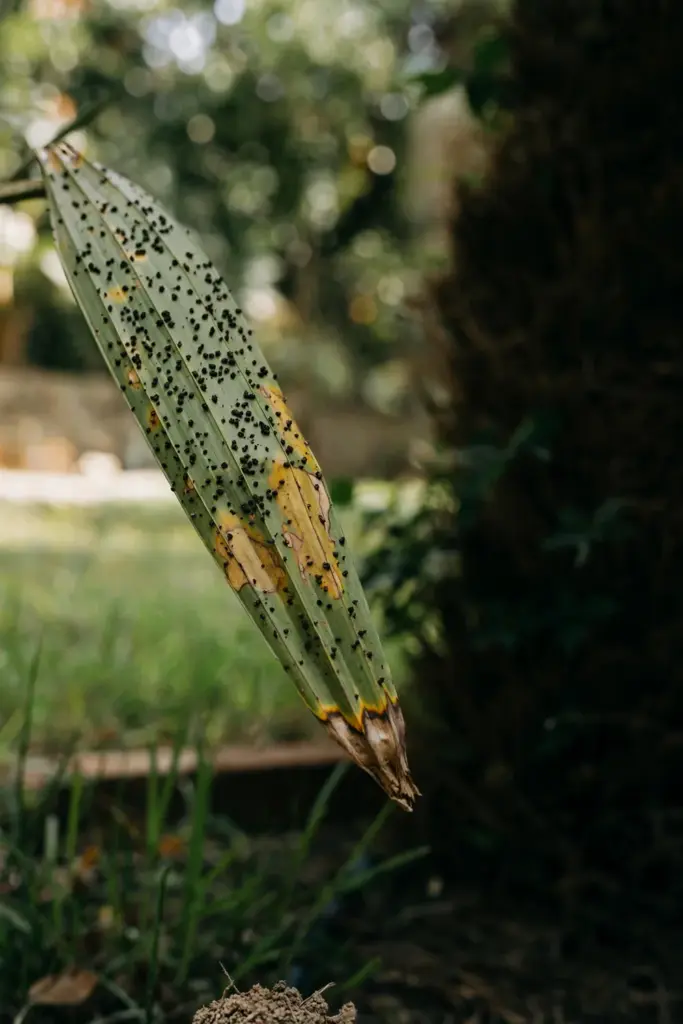
Check for both at once. Both can appear on the same oldest leaves, so the presence of sori does not rule out deficiency, and the presence of flat necrotic spotting does not rule out sori, which means a leaf with both needs both responses, sanitation for the fungus and fertilizer for the deficiency, while a leaf with sori only needs sanitation and a leaf with flat necrosis only needs fertilizer.
Get a leaf nutrient analysis where it matters. Leaf nutrient analysis clarifies the deficiency side where the eye hesitates, and a palm with extensive necrosis, a palm with repeated decline, or a palm where the feel test is unclear all deserve the lab, since the analysis costs less than a season of wrong treatment.
Fix the potassium first. Potassium deficiency is far more debilitating than false smut, and it is the real cause of the leaf decline the owner sees. A palm with both conditions gets the fertilizer first and the fungus second. The order matters, because the frond-removal step depends on it.
Strategy 3: Do Not Panic, It Is Cosmetic
Accept the cosmetic verdict. UF/IFAS is explicit: primarily cosmetic, does not adversely affect plant growth. A palm with false smut keeps growing. A palm with false smut keeps fruiting. A palm with false smut does not die of false smut. The black dots are ugly, not lethal.
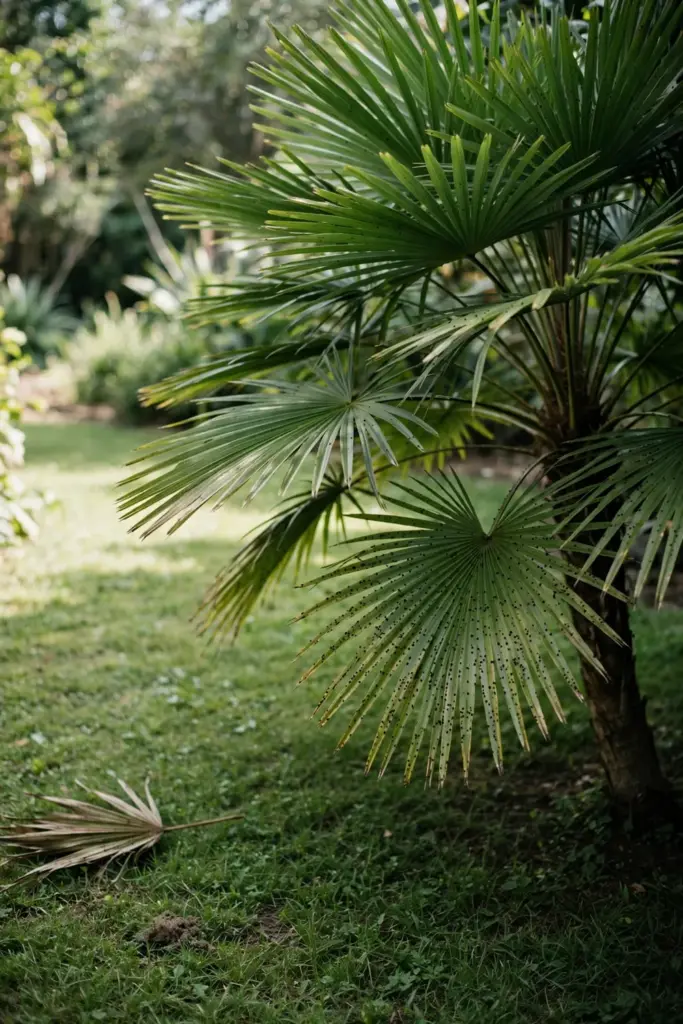
Do not carry the outlier claims. One source claims significant damage, defoliation, and even death. Another claims the disease can progress to killing the entire leaf and petiole. Both overstate against UF/IFAS. This article defaults to UF/IFAS. The outlier claims stay out.
Set expectations on the yearly clock. Visible disease today means infection from almost a year ago, so no action taken today changes the sori already present, the sori will not vanish with a spray, and the fronds will not clear up in a week. The cosmetic verdict plus the yearly clock means patience, not panic.
Spend the worry on the deficiency. The palm owner’s worry budget is finite. False smut deserves little of it. Potassium deficiency deserves most of it. A palm owner who stops worrying about the cosmetic fungus and starts feeding the potassium has reallocated the worry to the right problem.
Strategy 4: Fix the Real Problem First With a Palm Fertilizer Program
Feed the potassium. Potassium deficiency is the real cause of leaf decline on Phoenix palms, and the fix is a palm fertilizer program. Use a palm fertilizer formulated for palms, applied per the label, on a regular schedule. Do not invent a fertilizer schedule. The label and local Extension guidance govern.
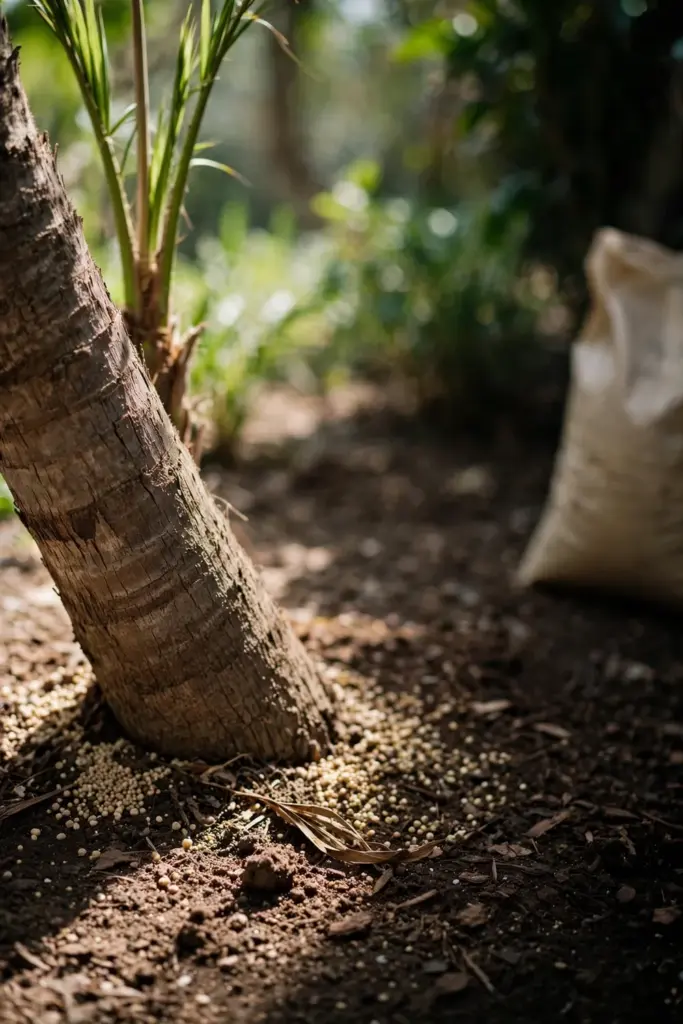
Understand the palm fertilizer difference. Palm fertilizers differ from general fertilizers: they carry the potassium and magnesium palms need in the right balance, and they release slowly. A general lawn fertilizer on a palm feeds the lawn’s needs, not the palm’s. The palm-specific product matters. The label matters more.
Apply on a schedule, not on a symptom. Potassium deficiency takes months to correct, because the palm must grow new, healthy fronds. A single feeding does not fix a deficient palm. The program runs across seasons. The new fronds tell the story: green, full, and free of flat necrosis.
Watch the new fronds, not the old ones. Old fronds with deficiency damage do not heal. New fronds show whether the program works. A palm whose new fronds emerge green and full is a palm on the mend. A palm whose new fronds emerge spotted and necrotic is a palm that needs more potassium or a different diagnosis.
Strategy 5: Remove Infected Fronds Only If the Palm Shows No Deficiency
Remove infected fronds when the palm is nutritionally sound. Removal of older infested leaves is normally recommended to reduce inoculum. A palm with no deficiency signs can spare its old fronds. The removal takes the spore source off the palm and out of the landscape.
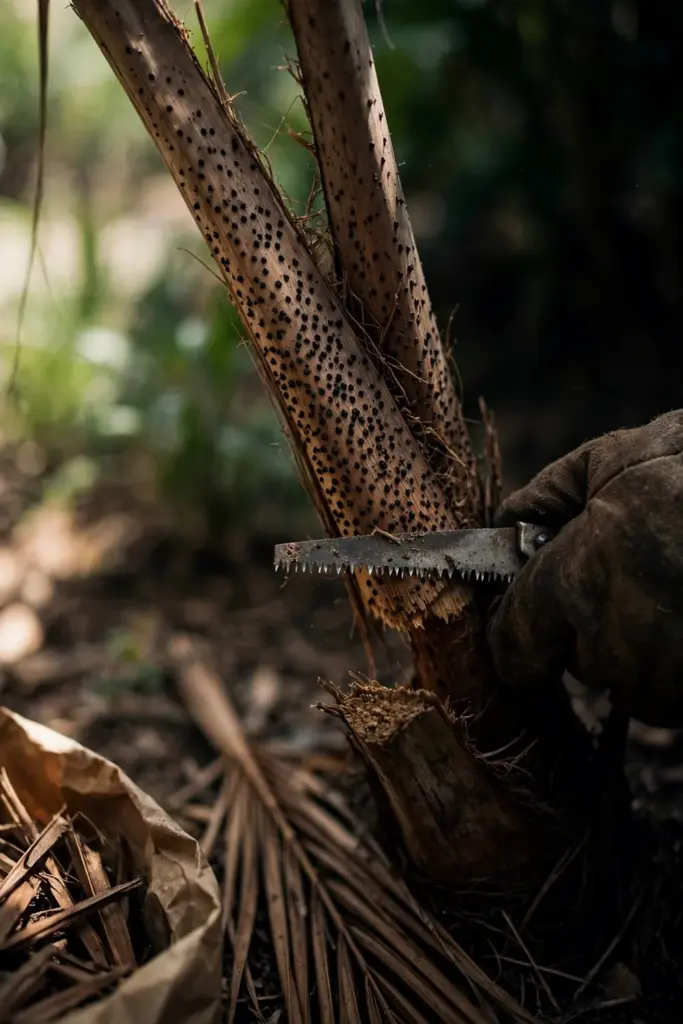
Do NOT remove fronds from a potassium-deficient palm. UF/IFAS is explicit: remove diseased leaves only if the palm is not exhibiting nutrient deficiency symptoms. Removal of nutrient-deficient leaves makes the nutrient deficiency worse, which adversely affects palm health. The fronds the fungus marks are also the fronds feeding the palm’s potassium reserves. Cutting them starves the palm further.
Destroy the removed material. Bag the fronds and put them in municipal waste. Do not compost diseased fronds: home compost does not reliably kill the fungus, and the pile returns spores to the garden. Burn or bury where local rules allow, and default to bag and trash.
Time the removal to the deficiency check. Check the palm for deficiency first, then decide on removal. A palm with flat necrotic spotting and extensive necrosis keeps its fronds until the potassium program shows results. A palm with sori only, no flat necrosis, loses its old fronds. The deficiency check gates the sanitation step.
Strategy 6: Reduce Humidity and Leaf Wetness Around the Palm
Increase spacing for air circulation. Crowded plantings hold humidity. A palm in open air dries faster after rain and irrigation. Thin surrounding plants where the canopy closes too tightly. The spacing change costs nothing and pays every wet season.
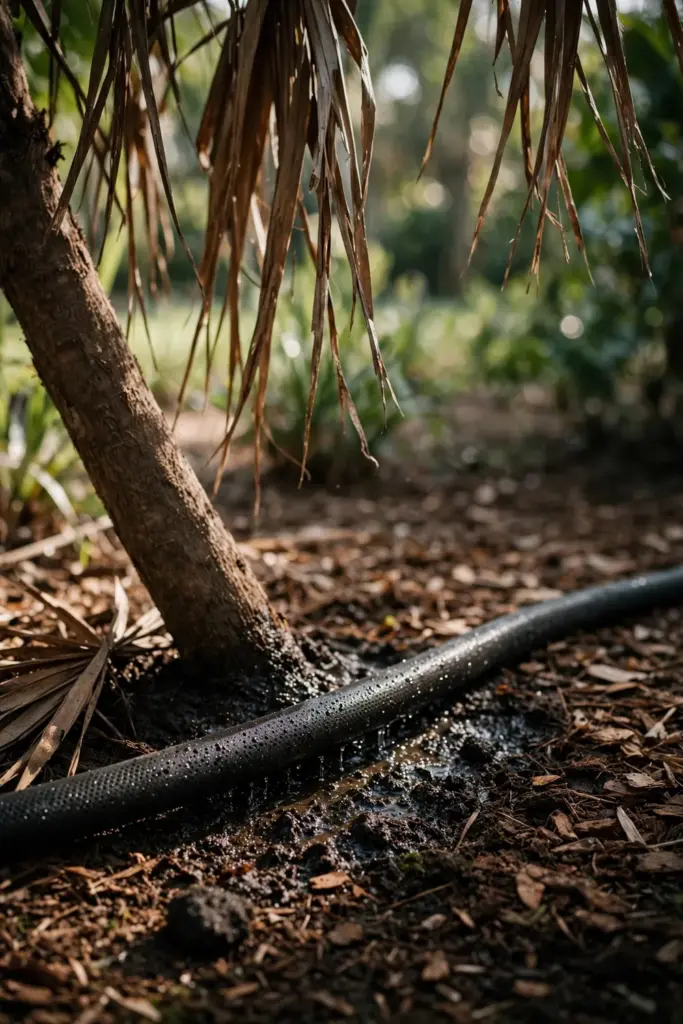
Design irrigation to direct water below the canopy. Water the soil, not the fronds, since drip lines, soaker hoses, and bubblers all keep fronds dry while overhead sprinklers wet the fronds on a schedule.
Irrigate early in the morning. UF/IFAS advises irrigating early morning when dew is already present, to reduce the dew period. Morning irrigation adds water when the fronds are already wet, so the total wet period barely grows. Evening irrigation adds a second wet period. The same amount of water, given in the morning, carries less disease risk.
Accept the nursery-landscape gap. Humidity management works better in the nursery than in the landscape, per UF/IFAS. A landscape palm stands in the weather. The homeowner controls irrigation and spacing, not rain. The humidity steps trim the risk, not eliminate it. The cosmetic verdict makes that acceptable.
Strategy 7: Fungicides Last Resort, Protectant Only, Landscape Use Questionable
Understand what fungicide can and cannot do. Fungicide will NOT eliminate sori already present on older leaves, since it protects leaf tissue from future disease development only, so a spray applied to sori changes nothing on those fronds while a spray applied to clean fronds protects them.
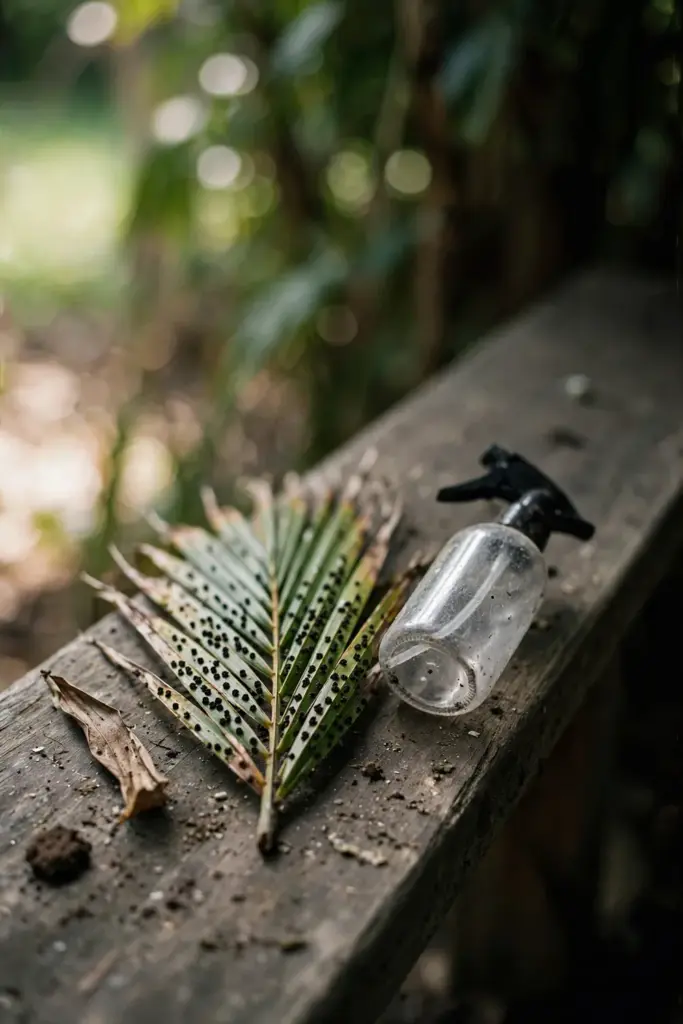
Expect multiple sprays within a year. A single spray does not cover a season, multiple sprays are required, and spore-release timing in Florida is unclear, possibly continuous year-round, so without a known release window preventive sprays cannot be timed and the schedule becomes a treadmill, not a cure.
Weigh the landscape question honestly. UF/IFAS calls fungicide use in the landscape questionable for economical, environmental, and safety reasons. The greatest difficulty is applying foliar sprays to large landscape palms. A homeowner with a tall Canary Island date palm cannot reach the canopy safely, and a professional spray program costs more than the cosmetic problem warrants. The economics alone argue against spraying.
If a fungicide is used, the label governs. Protectant products only, applied to clean fronds, per the label, with safety equipment, and do not carry research-trial rates or vendor product recommendations as home advice, do not present fungicide as the first step or as a cure, and keep the spray bottle on the shelf unless the cosmetic problem justifies the cost, the effort, and the chemicals.
Living With False Smut on a Palm You Already Own
A palm with false smut is a palm to monitor, not a palm to mourn. Keep feeding the potassium. Keep the irrigation below the canopy. Keep the old fronds when the palm is deficient, and remove them when it is not. The sori will still appear in humid seasons, and the palm will keep growing.
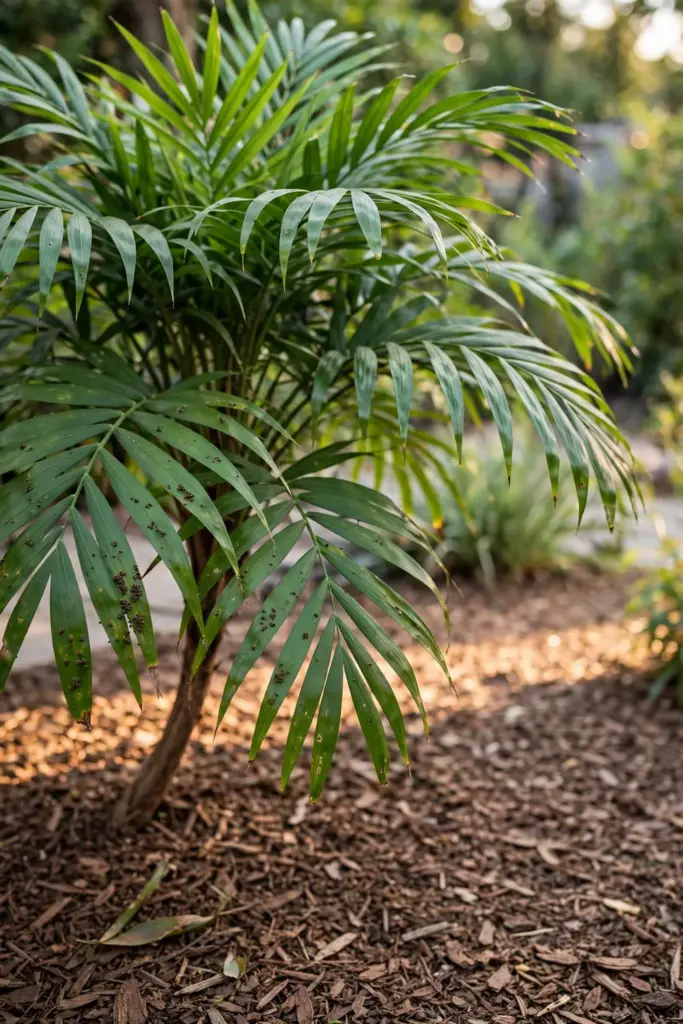
Stop three habits. Do not remove fronds from a deficient palm. Do not spray a cosmetic fungus as a first step. Do not mistake flat deficiency spots for raised sori. Keep those three lines unbroken and the disease stays cosmetic, the deficiency gets fixed, and the palm keeps its canopy.
The Plant Care archive collects the site’s disease coverage, and the palm growing guide covers palms from seed. Neither replaces the 7 strategies here. The feel test, the potassium, and the below-canopy water carry the palm.
Frequently Asked Questions
No. False smut is primarily cosmetic and does not adversely affect plant growth in the landscape. It marks the leaves and nothing more. What kills palms is not this fungus. Potassium deficiency, lethal yellowing, Fusarium wilt, and Ganoderma butt rot are the palm killers. A palm with false smut and a healthy canopy is a palm with a cosmetic problem. A palm with false smut and a declining canopy has a different problem, and the deficiency check finds it.
Only if the palm shows no nutrient deficiency. Removal of older infested leaves reduces inoculum, and a nutritionally sound palm can spare its old fronds. A potassium-deficient palm cannot: removing its fronds makes the deficiency worse and harms the palm. Check for flat necrotic spotting first. Sori only, no deficiency signs, remove the fronds. Flat necrosis present, keep the fronds and fix the potassium first.
No. Fungicide will not eliminate sori already present on older leaves. It protects leaf tissue from future disease development only, and multiple sprays within a year are required. Spore-release timing is unclear, possibly continuous year-round. Landscape fungicide use is questionable for economical, environmental, and safety reasons. The spray is a protectant treadmill, not a cure. Sanitation, potassium, and humidity control carry the palm.
Use the feel test. False smut sori are raised black bodies under 1/16 inch that you can feel with a finger, with filaments and yellow spores when mature, deflating to black cups. Potassium deficiency spots are flat, with no fruiting bodies, and extensive necrosis on old Phoenix leaves. Both appear on the oldest leaves and can appear together. Raised means fungus. Flat means nutrition. A leaf nutrient analysis confirms where it matters.
Yes. False smut is a plant disease, not a human one. It affects the leaves, not the fruit, and it does not make dates unsafe. Dates from a palm with false smut are safe to eat after washing and normal preparation. The disease costs the palm nothing in growth, and it costs you nothing in fruit safety. Discard fallen fronds. The dates are the crop, and the crop stays edible.
Where to Go From Here
False smut rewards the palm owner who feels the spots and feeds the potassium. Confirm the ID with the feel test. Separate it from potassium deficiency. Accept the cosmetic verdict. Fix the potassium first. Remove fronds only when the palm is sound. Reduce humidity. Keep fungicide last.
Next season, start with the deficiency check. A palm with sound nutrition, below-canopy water, and a clean old canopy will carry false smut as a cosmetic footnote. The UF/IFAS Extension fact sheet on Graphiola leaf spot is a useful companion for the full disease picture, since it sets the home-garden response here against the Extension evidence behind it.