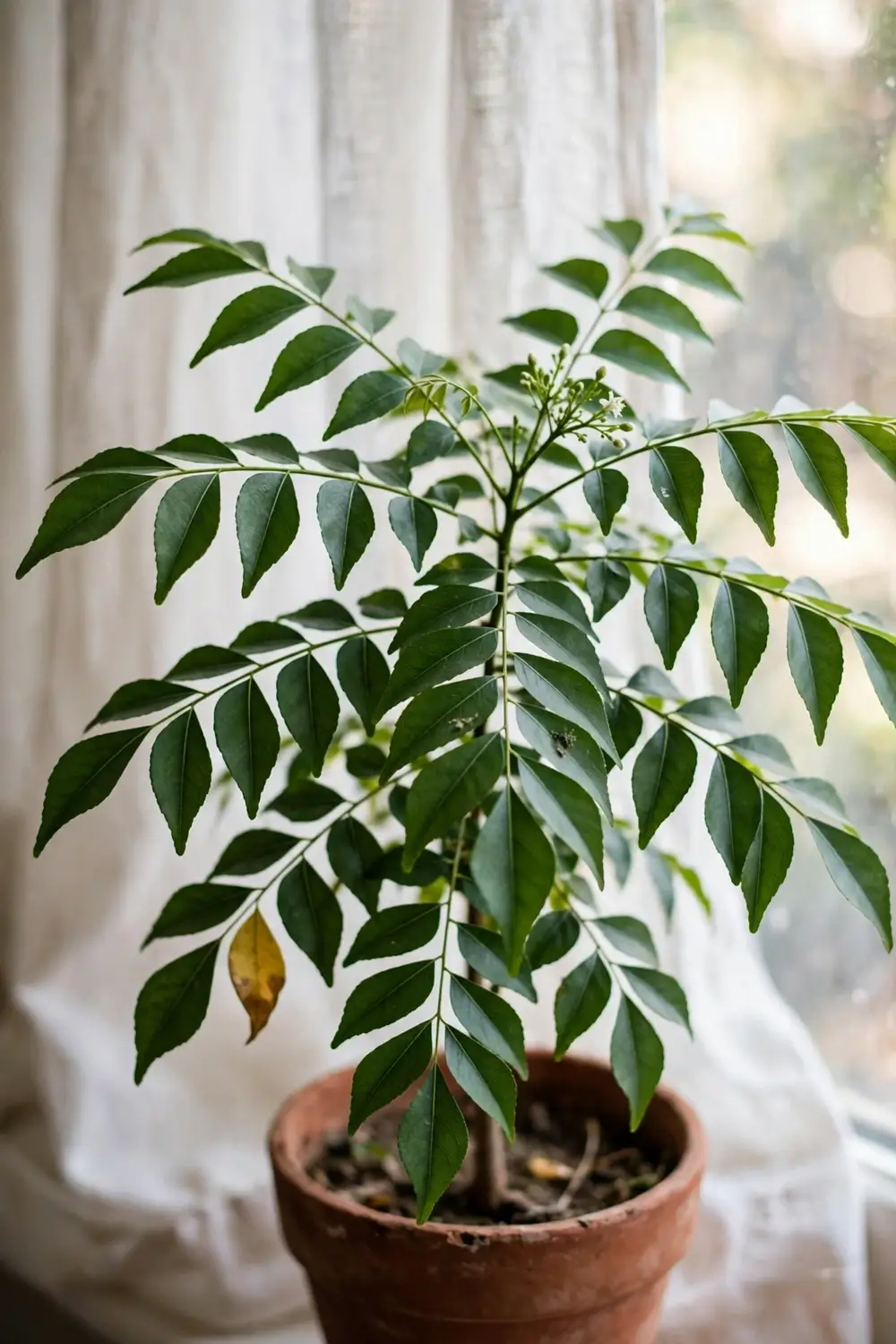

A curry leaf tree lives outdoors in zones 9 to 12 and freezes in much of the rest of the country. If your winters drop below 50°F (10°C), the only honest way to keep one alive is to grow it in a pot and bring it inside before the first frost. A nursery plant in a 5-gallon container, moved to a south-facing window each winter, gives you fresh kadi patta leaves year after year while a tree planted in the ground would die in December.
When learning how to grow curry leaf plant from India in a cold climate, the container decision matters more than any fertilizer or pruning trick. A curry leaf tree (Murraya koenigii) is a tropical member of the citrus family Rutaceae, and it behaves like one: sun-loving, drainage-demanding, and completely frost-tender. Once you accept the tree as a portable tree rather than a landscape plant, the rest of the care becomes straightforward. If you already grow herbs through winter indoors, much of the rhythm will feel familiar, as the guide to growing fresh herbs indoors shows with its south-window rules.
This guide owns the cold-climate lane end to end: the species disambiguation, the container method, the 50°F move-inside rule, winter survival indoors, and the dormancy honesty that keeps you from composting a sleeping tree. In my experience, the biggest trap is not the cold itself. It is the months of a bare, brown-stemmed tree on a windowsill, which look like failure and are actually normal dormancy.
1. Start With Zone Reality: Curry Leaf Is a Zones 9 to 12 Tree
A curry leaf tree is a tropical evergreen tree that grows 6 to 15 feet tall and 4 to 12 feet wide, and it is hardy only in USDA zones 9 to 12, where temperatures stay above or around 65°F (18°C), according to the University of Illinois Chicago Heritage Garden’s curry leaf tree profile. Below zone 9, a planted tree dies to the ground in the first hard freeze.
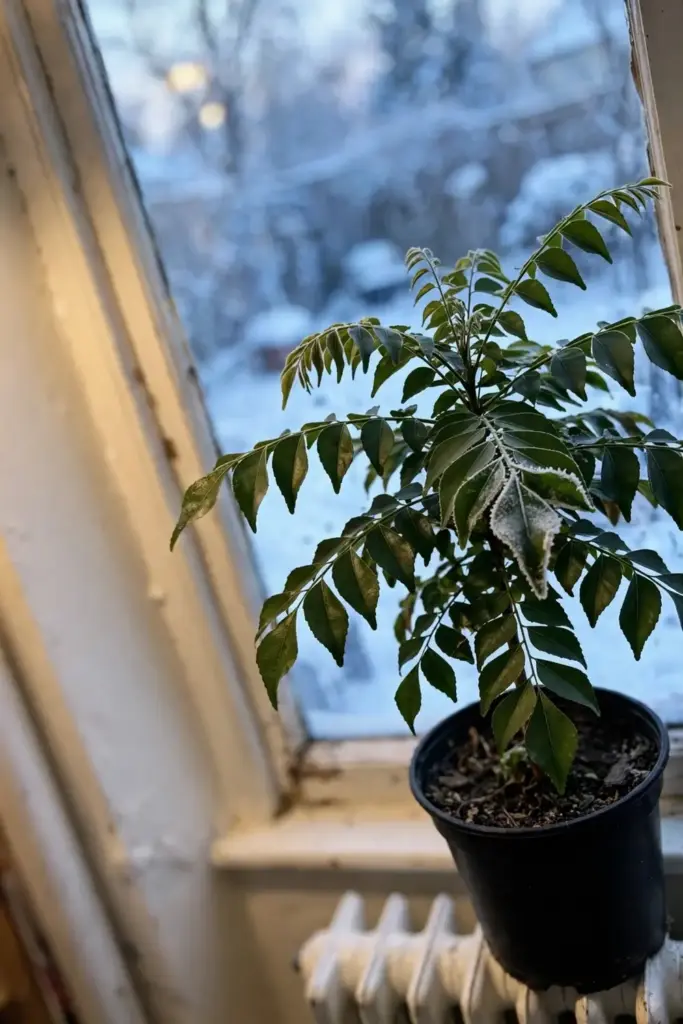
That single fact draws the boundary for this whole article. If you garden in South Florida, Southern California, South Texas, or a similar zone 9-plus region, you can plant a curry leaf tree in the ground in a sunny, wind-sheltered spot. Everywhere else, zones 5 through 8 included, the tree lives in a pot and spends winter indoors. This is not a limitation you can train away with mulch or burlap. Burlap protects tender perennials; it does not turn a tropical tree hardy.
In cold climates the pot is what makes the tree possible. The tree stays mobile, the roots stay above the frozen soil, and in October or November you carry it through the door before night temperatures fall below 50°F (10°C). Most American growers outside the deep south succeed exactly this way.
2. Which “Curry” Are You Buying? Get the Species Right
The single most expensive mistake a beginner makes is buying the wrong plant entirely. Three different products trade on the word “curry,” and only one gives you kadi patta leaves.
| What it is | Botanical name | Leaves for Indian cooking? | Notes |
|---|---|---|---|
| Curry leaf plant (kadi patta, karivepaku) | Murraya koenigii | Yes | A tropical tree in the citrus family (Rutaceae); aromatic pinnate leaves used fresh or dried |
| Curry powder | Spice blend | Not a plant | A mixture of ground spices such as turmeric and coriander; shares no plant with the curry leaf tree |
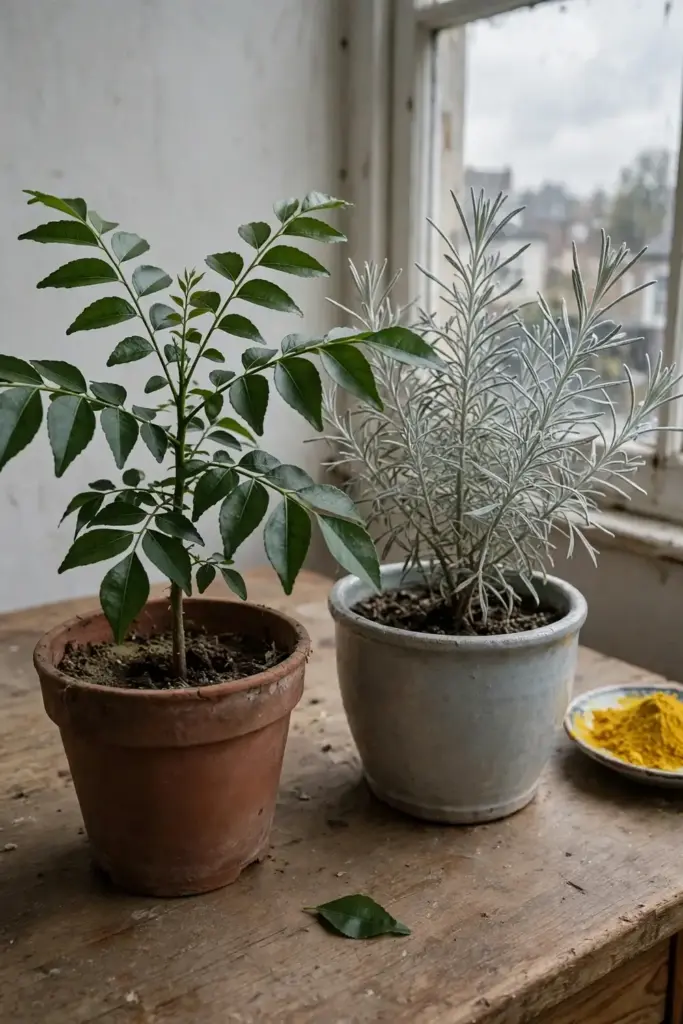
| Curry plant | Helichrysum italicum | No | A Mediterranean ornamental whose silvery leaves smell like curry but are not edible and are never used in tadka |
The confusion is real because seed sellers and garden centers mix the names freely. Helichrysum italicum, the “curry plant,” is a gray-leaved Mediterranean shrub with a curry-like scent and it will happily survive a cold winter outdoors. It is also useless for cooking. If your goal is tempering leaves in hot oil, demand Murraya koenigii on the label, and when buying seed or seedlings, check the botanical name before the price.
3. Buy the Tree, Not the Seed Packet
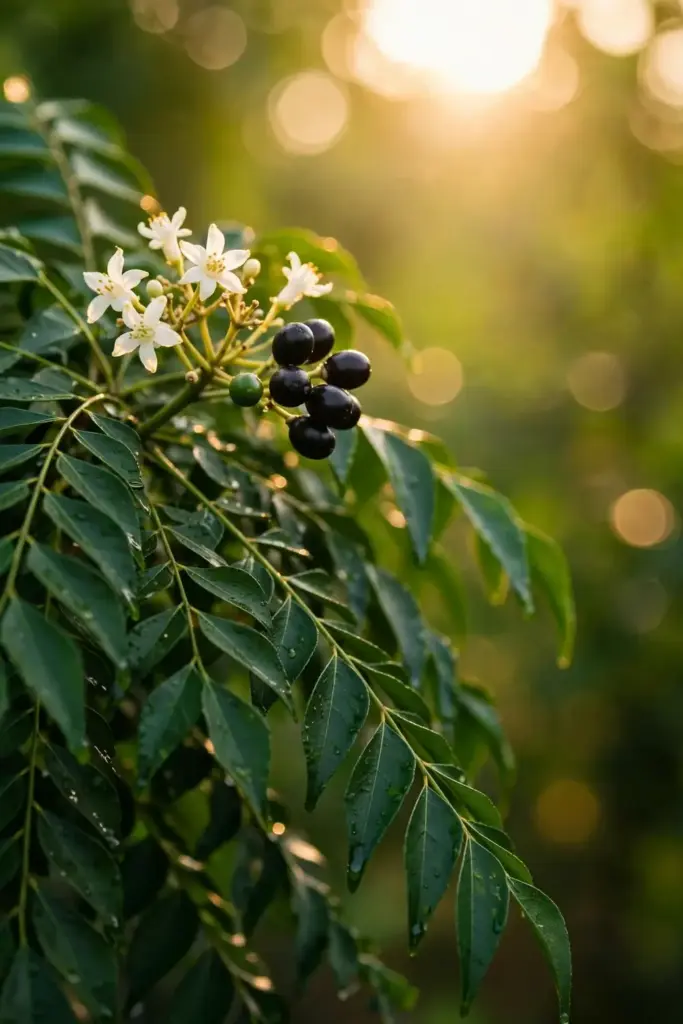
A curry leaf tree can be grown from seed or from stem cuttings, but for a home grower the smartest start is a potted plant from a specialist nursery. Seed germination works: collect ripe black berries, squeeze out the seed, and expect sprouts in 10 to 14 days in warm conditions, as Agriculture Review’s propagation guide describes. Cuttings root too: 5 to 8 inch semi-hardwood pieces, 6 to 8 millimeters thick, show new shoots in 10 to 15 days under humidity.
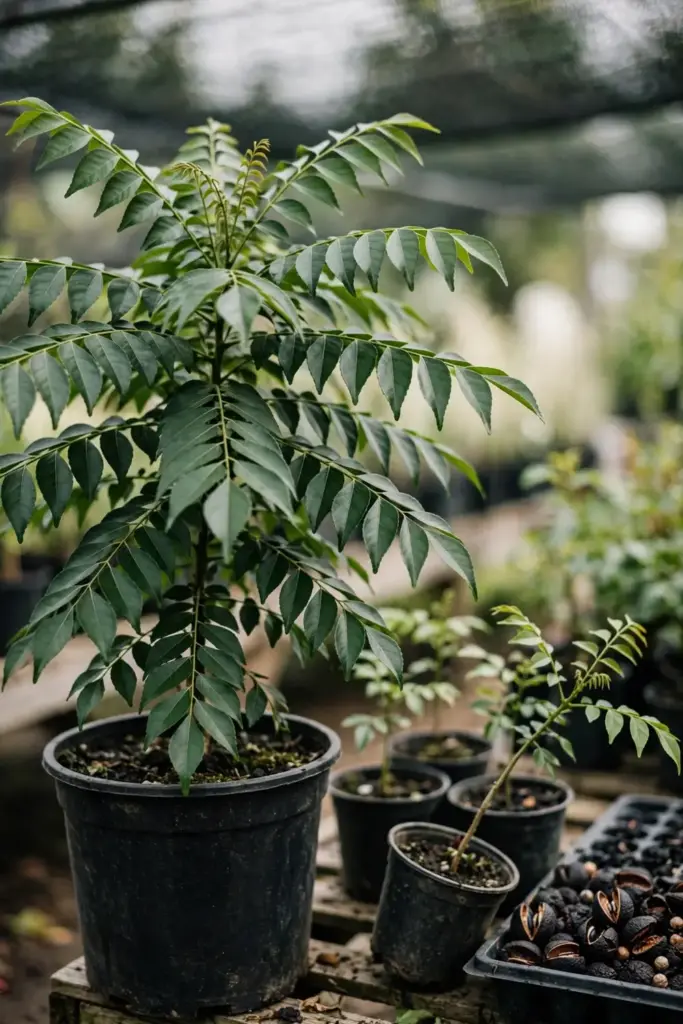
The problem is time, not possibility. A seedling spends its first year building a root system and reaches only 6 to 10 inches in height. The UIC Heritage Garden notes that seed-grown plants take 1 to 2 years just to establish before real growth begins. When you are learning how to grow curry leaf plant from India indoors, you want the tree’s calendar on your side, not against you. A 2- to 3-foot nursery plant costs the equivalent of a few bunches of grocery-store leaves and harvests a year or two sooner.
| Starting option | Time to first real harvest | Cost | Best for |
|---|---|---|---|
| Nursery plant (2 to 3 feet) | First season after settling | $30 to $60 | Beginners and anyone with one winter to survive |
| Stem cutting | 1 to 2 years | Free if you know a grower | Gardeners with a mother plant and patience |
| Seed | 2 to 3 years | Cheap | Patient gardeners who enjoy the full process |
One caution when buying: fake and mislabeled listings exist for exotic plants online. Buy from a nursery that shows the botanical name Murraya koenigii and photos of pinnate leaves with 11 to 21 leaflets. Ask which variety it is, because the answer changes your plan.
4. Three Varieties: Regular, Dwarf, and Gamthi
The UIC Heritage Garden’s curry leaf tree profile describes three types of curry leaf tree, and choosing among them shapes how the tree fits in your house.
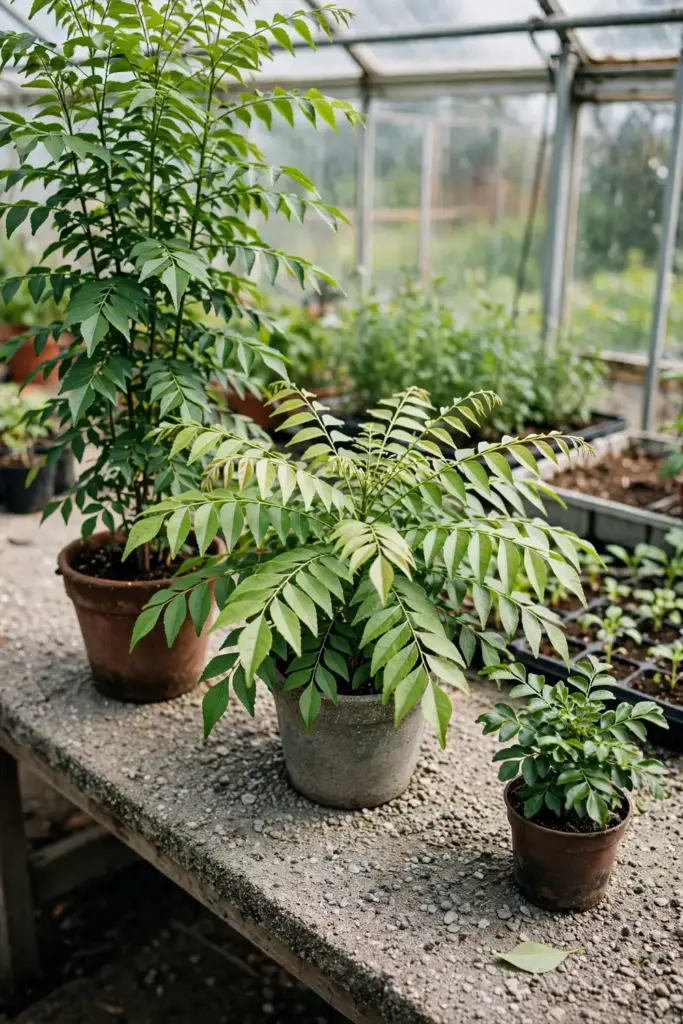
The regular type grows fast and tall. Its leaves are the ones sold in grocery stores, which makes it the right pick if you cook with curry leaves weekly and have ceiling height to spare. In a pot with winter pruning, a regular type still stays manageable, but it wants to be a tree.
The dwarf type does not grow as tall but spreads wider, with longer, light green leaves. For a container grower this is the easy default: more harvestable leaf per inch of height and a shape that fits under a windowsill or grow light.
The gamthi type grows very slowly with thick leaves and the strongest aroma of the three. It is the connoisseur’s choice, but its slow growth means years before it produces meaningful harvests. A first tree should be regular or dwarf.
Whatever variety you buy, plan on repotting into a bigger container every year or two as the tree grows, because container size is the root ball’s whole world.
5. The Right Container: 5-Gallon Minimum and Real Drainage
A curry leaf tree tolerates confinement well, but the pot must meet three conditions: large enough, deep enough, and able to drain. Start a 2-foot tree in a 5-gallon container (about 12 to 14 inches wide and deep) and increase the size every year or two as growth demands.
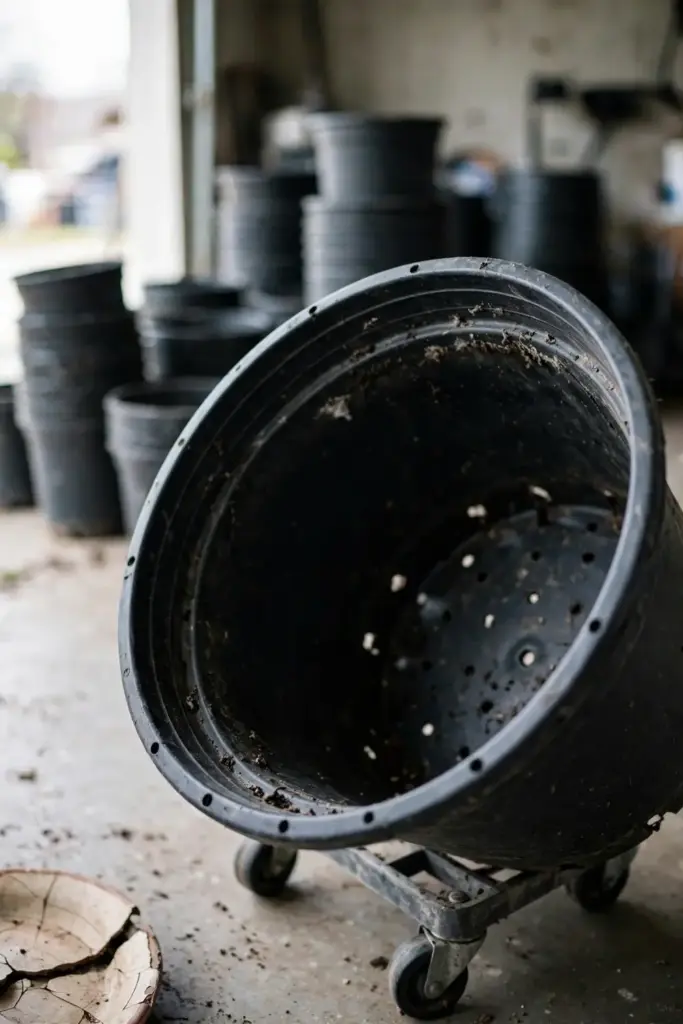
Plastic nursery pots work fine and keep the weight manageable for the twice-yearly move. Terracotta dries faster, which suits a tree that hates wet feet, but a full-size terracotta pot is heavy enough to discourage the autumn carry indoors. Fabric grow bags are a practical middle ground: light, self-pruning roots, and excellent drainage.
Whatever the material, the pot must have drainage holes, several of them. Root rot is the number one killer of potted curry leaf trees, and a decorative pot without holes is a root-rot machine. Set the pot on a wheeled plant caddy or a plant stand with casters from day one. Your future self, carrying a 40-pound tree through a doorway in November, will be grateful.
6. Soil: Fast-Draining Mix, Never Garden Soil
A curry leaf tree in a pot wants a loose, fast-draining mix that mimics its preference for rich but well-drained soil. Never use garden soil in a container. It compacts, holds water against the roots, and suffocates a plant that needs air around its root crown.
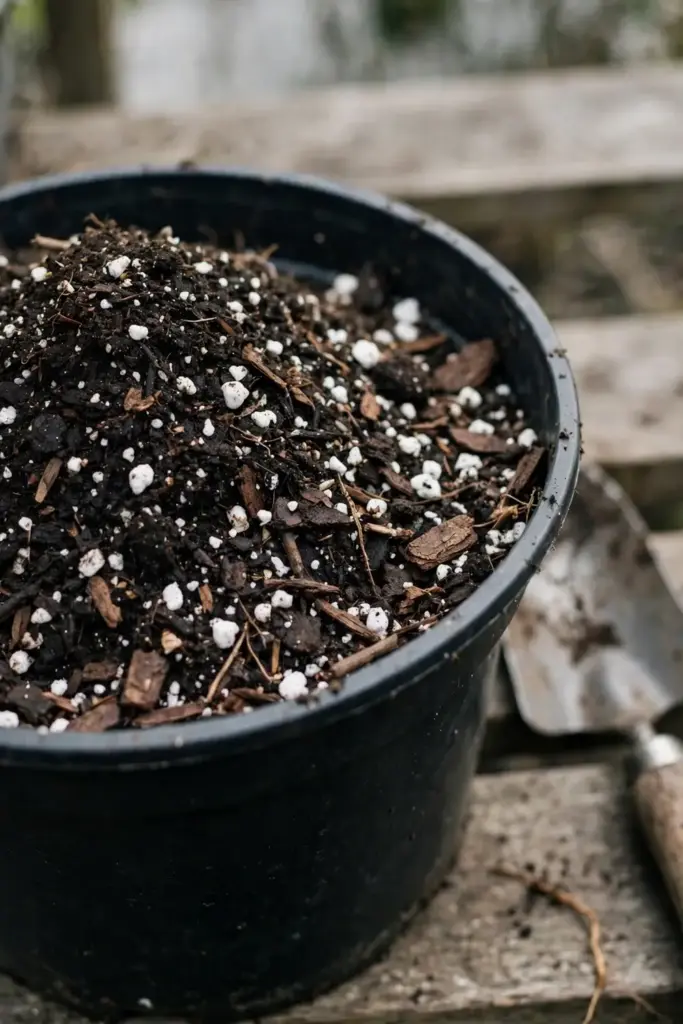
A practical home mix is 60 percent good potting soil, 20 percent perlite or coarse sand, and 20 percent compost or well-rotted bark, which matches the potting soil, small bark, and perlite blend that Four Winds Growers recommends for curry leaf trees in their growing guide, where they also stress that the pot must have drainage holes to prevent waterlogging. Citrus and tropical potting mixes sold bagged also work straight from the bag.
Plant the tree at the same depth it grew in the nursery pot. Burying the stem deeper invites rot where the bark meets damp soil. Water thoroughly once after planting so the mix settles around the roots, then leave it alone until the top of the mix begins to dry.
7. Watering: Let the Top 1 to 2 Inches Dry
Curry leaf trees die from too much water far more often than from too little. The UIC Heritage Garden advises letting the soil dry a little between waterings whether the tree is in a pot or outdoors, because damp soil promotes root rot.
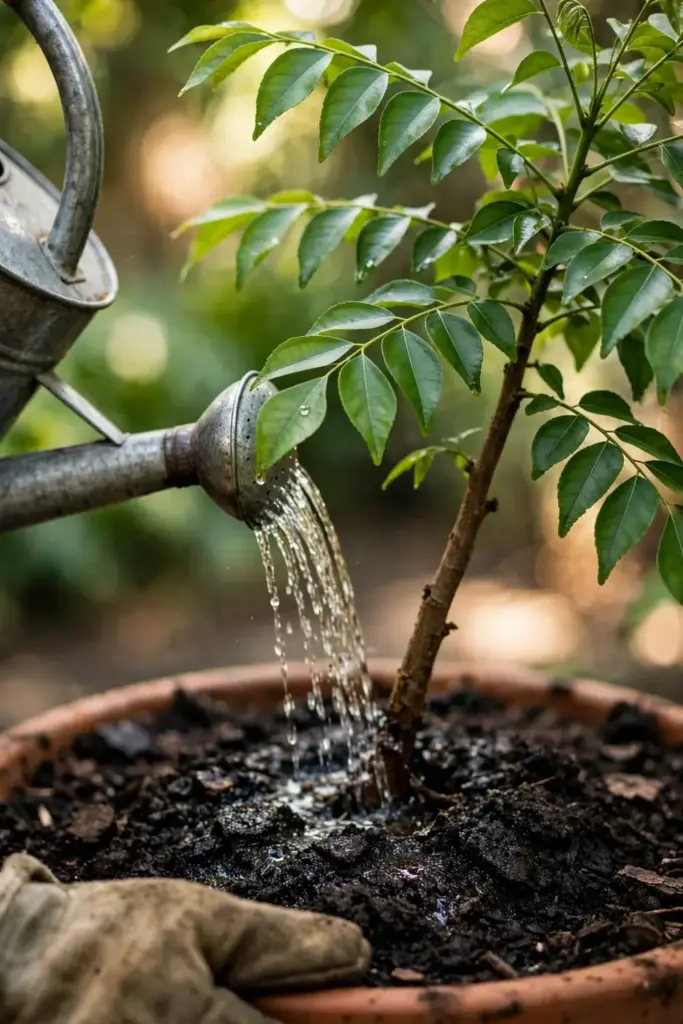
The practical rule from Four Winds Growers is to water moderately and let the top inch or two of soil dry out between waterings. In summer, a pot in full sun may need water every 2 to 4 days. In winter indoors, the same pot may need water only every 10 to 14 days, because a dormant or semi-dormant tree in cool indoor air drinks almost nothing.
Two habits prevent nearly all watering mistakes. First, check before you water: push a finger 2 inches into the mix, and water only if it feels dry. Second, use slightly warm water in winter rather than cold tap water, which can shock chilled roots. Always empty the saucer after watering. A pot standing in a saucer of water is the fastest route to root rot.
8. Feeding: Every 4 to 6 Weeks, Spring and Summer Only
A curry leaf tree is a light feeder, and the feeding calendar follows the seasons exactly. Feed with a balanced, water-soluble fertilizer every 4 to 6 weeks during active growth in spring and summer, then stop completely when growth slows in fall and winter. Four Winds Growers gives this rhythm in their growing guide, and the UIC Heritage Garden reports a similar schedule of feeding once every 5 weeks in spring and summer.
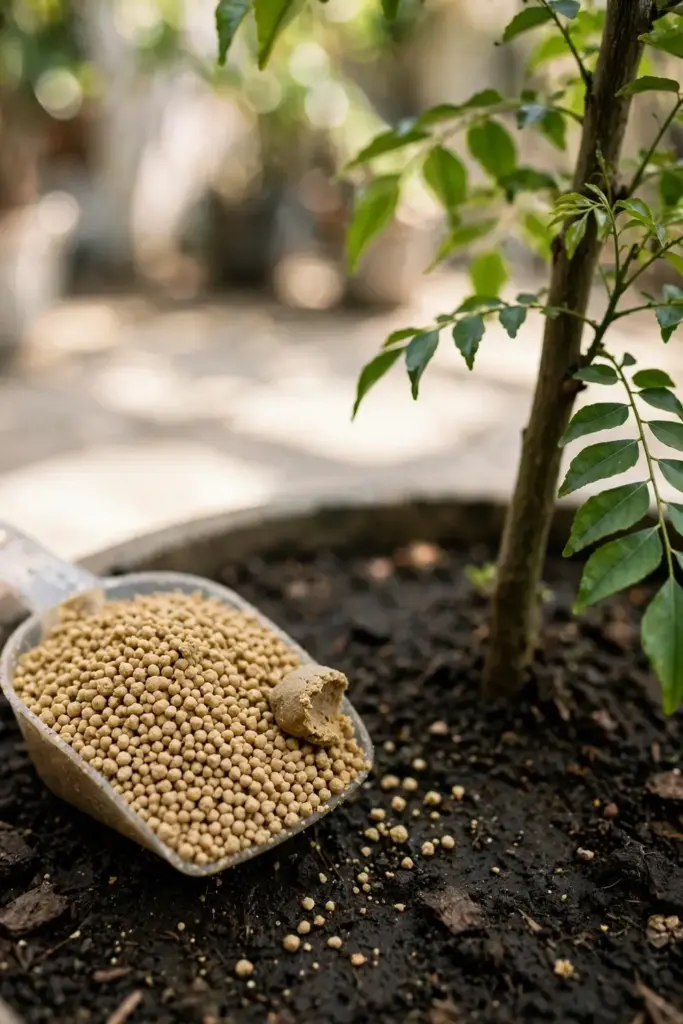
Use a balanced formula or a citrus and fruit tree fertilizer at half the label rate for a container tree. Indoors under lights, quarter-strength monthly feedings from March through August are plenty. Compost tea or diluted fish emulsion work as organic options.
The two feeding rules that matter most are negative ones. Do not fertilize in fall or winter. A dormant tree cannot use nutrients, and salts build up in the dry winter mix and burn roots. And do not fertilize a freshly repotted tree for 4 to 6 weeks, because the new mix already contains nutrients and damaged roots need to heal before being pushed.
9. Pruning: How to Grow a Bushy Tree Instead of a Pole
An unpruned curry leaf tree grows as a single leggy stem racing for height, which is the worst possible shape for a windowsill. Pruning redirects the tree into a bushy, harvestable form and it is the closest thing to a free growth fertilizer.
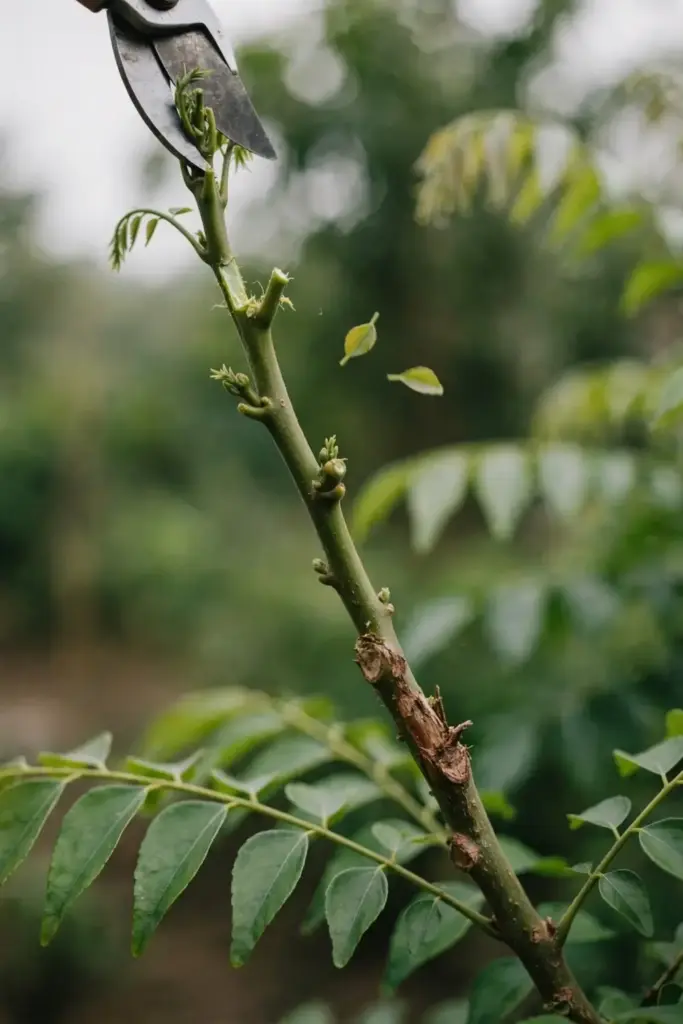
When the tree reaches about 12 inches tall, pinch or cut the growing tip. This breaks apical dominance and forces side branches. Each time a new branch grows 8 to 10 inches, tip it back too. The result is a multi-branched tree with leaves at arm’s height instead of near the ceiling.
Harvest and pruning are the same motion. Curry leaves grow on compound stems with 11 to 21 leaflets, and the tree replaces a harvested stem with two or three new ones. In practice this means every harvest is a pruning cut, which is why regular harvesters end up with the bushiest trees.
Pinch off the small white flowers in the first year or two. Flowering diverts energy into berries and seeds that you do not need yet, and removing them keeps the tree’s effort focused on leaves. Once the tree is established and large, you can let it flower if you like. The blossoms smell wonderful.
10. The 50°F Rule: Move It Inside Before First Frost
This is the section that decides whether your tree lives or dies. A curry leaf tree must come indoors before night temperatures fall below 50°F (10°C), because frost damages or kills it, as Australian nursery Weraplants states in their curry leaf plant care notes.
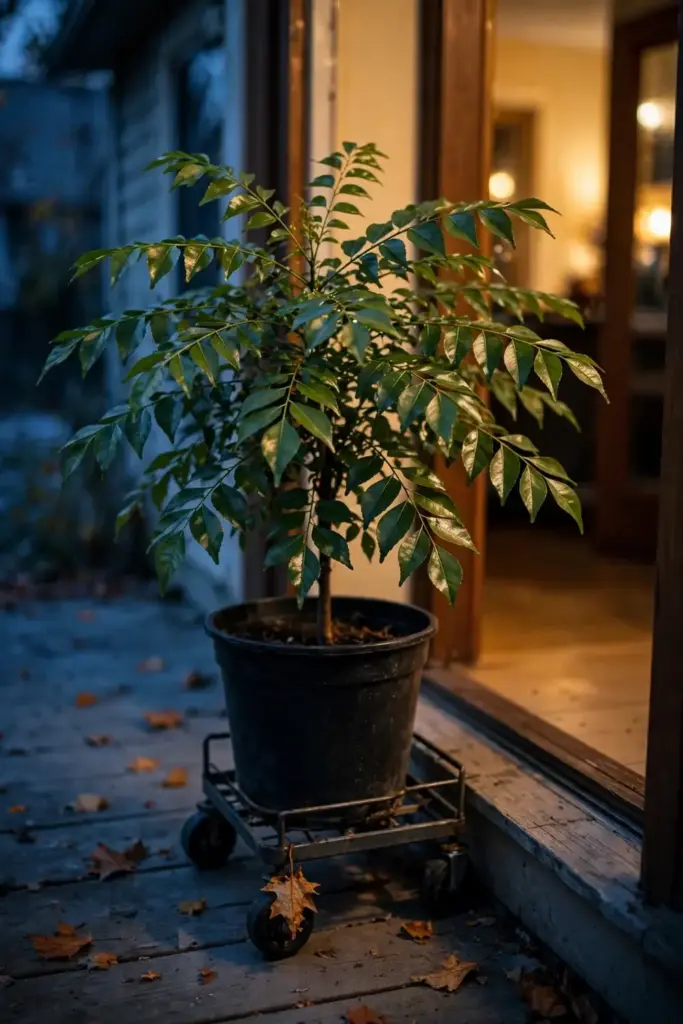
Watch the forecast, not the calendar. In zone 7 that moment often arrives in late October or early November, but an early cold snap can bring it sooner. The tree itself gives no reliable warning. Curry leaf trees do not harden off the way temperate plants do. A single hard freeze can kill a tree that looked perfectly healthy in September.
A few days before the move, inspect the tree carefully: hose down the foliage, check the undersides of leaves for spider mites and scale, and treat any problem before the plant joins your indoor collection. Once inside, keep the tree away from heating vents, which blast dry hot air and cause rapid leaf drop. The garage works only if it stays above 50°F and gets light. An unheated garage that freezes is just a slower death than the porch.
11. Winter Survival Indoors: Light, Humidity, and Patience
Indoors, a curry leaf tree needs three things: the brightest spot you have, some humidity, and your patience. It needs zero fertilizer and very little water.
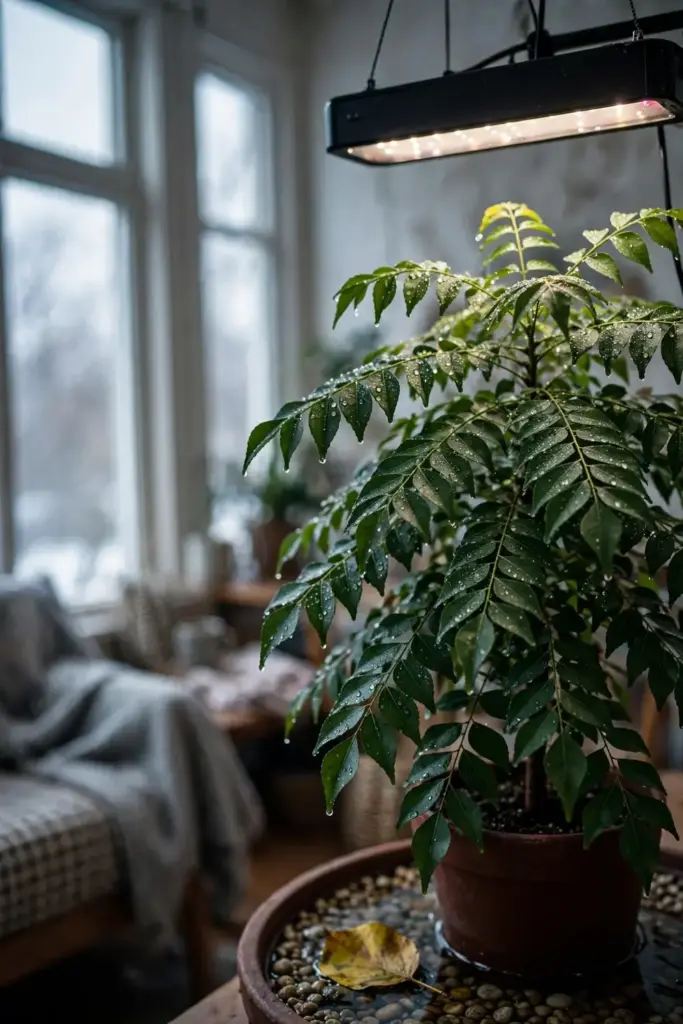
Light is the limiting factor. Place the tree in front of a south-facing window where it gets 6 to 8 hours of direct sun, which is the same light the tree wants outdoors according to Four Winds Growers. In northern latitudes, a winter window alone rarely delivers that, so supplement with an LED grow light for 10 to 12 hours a day. Grow lights are one of the highest-payoff upgrades for wintering tropical plants indoors, and the guide to choosing grow lights for an indoor garden covers choosing one for a single large plant.
Humidity is the second lever. Winter indoor air runs much drier than a tropical tree wants. Mist the leaves a few times a week, set the pot on a pebble tray with water, or run a small humidifier nearby. Dry air plus a warm room is the recipe for spider mites, which love curry leaf trees indoors.
| Winter task | Frequency | Notes |
|---|---|---|
| Check light position | Weekly | Rotate the pot a quarter turn so all sides get sun |
| Water | Every 10 to 14 days | Only when the top 2 inches are dry; slightly warm water |
| Mist leaves | 2 to 3 times a week | Raises humidity around the foliage; discourages spider mites |
| Check for pests | Weekly | Look under leaves for mites and scale |
| Fertilize | Never | No feeding from October through February |
| Prune | Never | Save all cutting for spring |
Growth will slow to almost nothing. A healthy indoor curry leaf tree may push a few weak, pale leaves in deep winter. That is the tree conserving energy, and it is exactly what it should do.
12. Leaf Drop Means Dormancy: How to Tell a Sleeping Tree From a Dead One
Here is the honest part every new grower needs. A curry leaf tree brought indoors in fall will very likely drop many of its leaves, sometimes most of them. This is winter dormancy, and it is normal. The tree is a tropical evergreen going to sleep in a cold dark house, and shedding leaves is its strategy for surviving until spring.
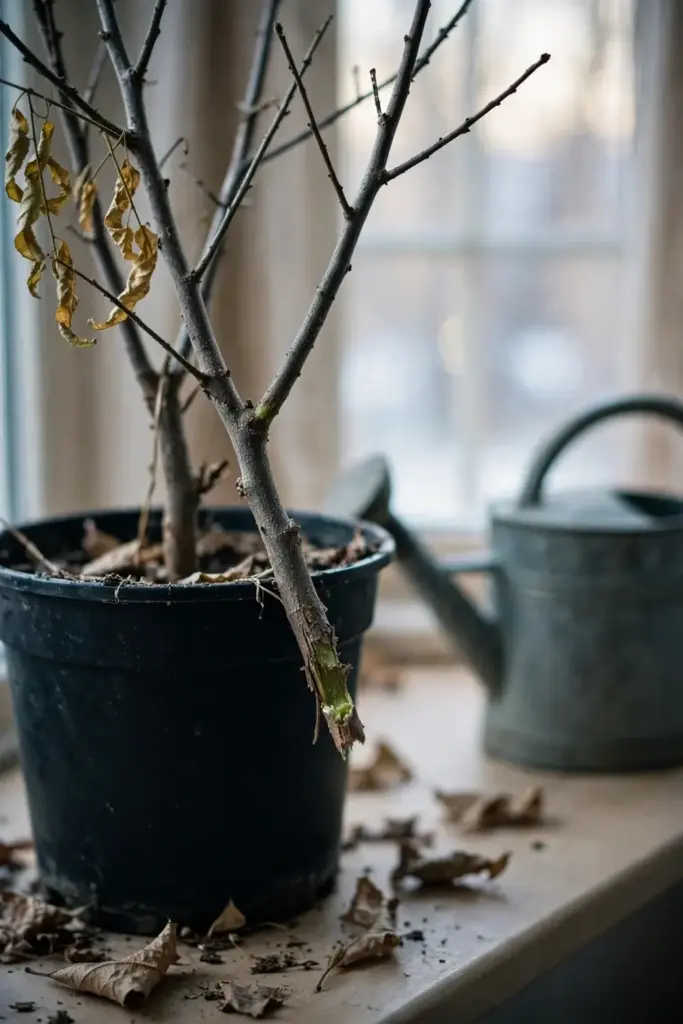
The mistake is reading leaf drop as death and throwing the tree away in January. Do not. A dormant curry leaf tree has supple, greenish-brown stems that bend without snapping. Scratch a small section of bark on a stem with your thumbnail. Green underneath means alive. Brown and dry all the way through means that stem is dead, but check several stems before judging the tree.
Water sparingly through the leafless weeks, keep the pot in the brightest spot, and wait. When days lengthen and temperatures rise, a live tree pushes new growth from the stem tips and from buds along older wood. Most growers who report “my curry leaf tree died in winter” actually report a tree that was still alive and had not woken up yet.
Yellowing leaves in December follow the same logic. Lower leaves yellow and fall first as the tree reduces its canopy to match the available light. It looks alarming. It is the tree being rational.
13. Pests and Problems Indoors
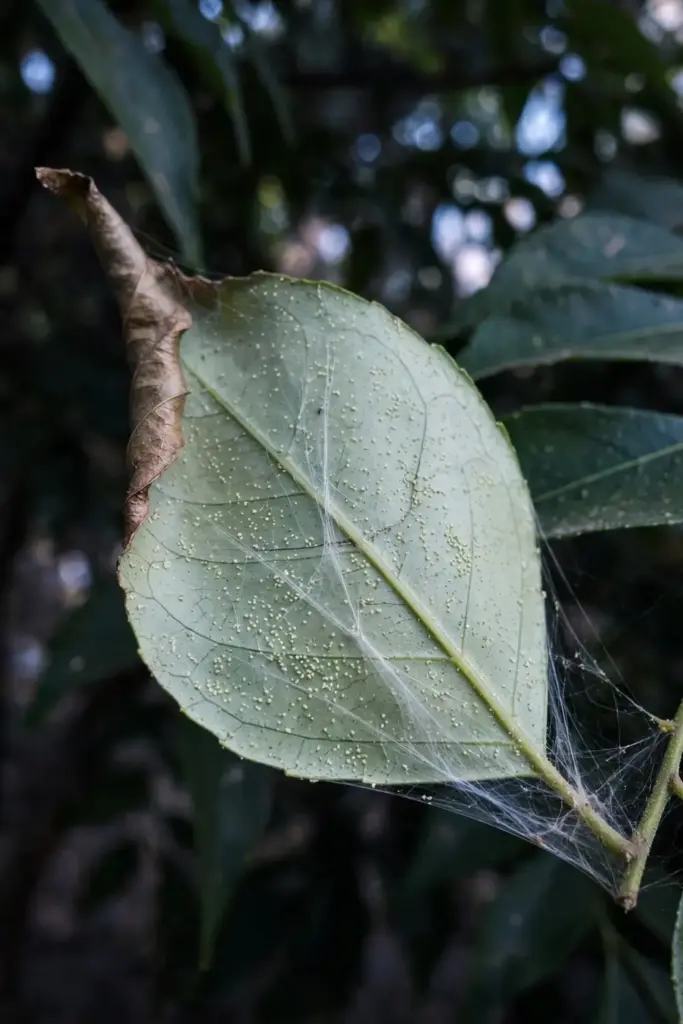
A stressed indoor curry leaf tree attracts exactly the pests you would expect: spider mites, scale, aphids, and mealybugs. Spider mites are the most common, thriving in the dry air of heated homes. Fine webbing at the leaf joints and stippled, dusty-looking leaves are the telltale signs. A weekly shower with the kitchen sprayer, aimed at the leaf undersides, keeps most mite populations down. For persistent cases, neem oil or insecticidal soap works on contact.
Scale insects appear as small brown bumps along stems and leaf midribs. They do not move, which makes them easy to miss and easy to treat: dab each one with a cotton swab dipped in rubbing alcohol, then follow with horticultural oil. Aphids cluster on new growth in spring when the tree wakes up; a strong stream of water dislodges them.
The other indoor problem is not a pest at all. Overwatering in winter causes root rot, which shows as yellowing leaves and a general decline even though you are “taking good care” of the plant. If the soil smells sour or the base of the stem feels soft, unpot the tree, trim any black mushy roots back to white tissue, repot in fresh dry mix, and do not water for a week.
14. Harvest: Take Whole Stems, Never Strip a Young Tree
Wait until the tree is well established before harvesting in earnest, usually its second season in your care. Then harvest by cutting whole compound stems with clean pruners, leaving 2 to 3 inches of stem with several leaf nodes behind. The tree responds by pushing new branches from those nodes, so each harvest makes the next one bigger.
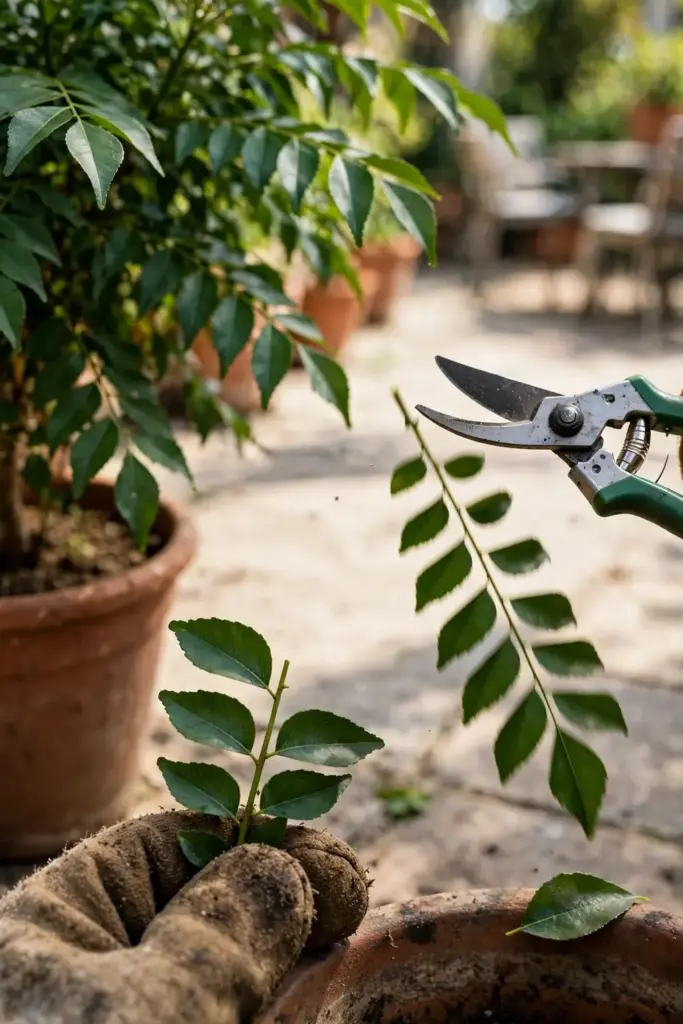
Strip individual leaflets only when you need a few leaves for tonight’s cooking. Picking leaflets bare-stems the branch and yields far less new growth than cutting the whole stem. Never remove more than a third of the tree’s foliage at once. A container tree has limited root volume and limited winter reserves, and overharvesting a small tree sets it back months.
The best harvest time is morning, after the dew dries but before the heat of the day, when the leaves’ aromatic oils are at their peak. Fresh leaves go straight into the pan or into storage.
15. Drying and Storing Leaves for the Off-Season
Winter is exactly when a cold-climate grower cannot harvest, which makes summer the season to put leaves by. Air-dry whole stems in a warm, dark, well-ventilated spot for 5 to 7 days, then strip the dried leaflets into an airtight jar. Dried curry leaves keep their character for 6 to 12 months in a cool dark cupboard.
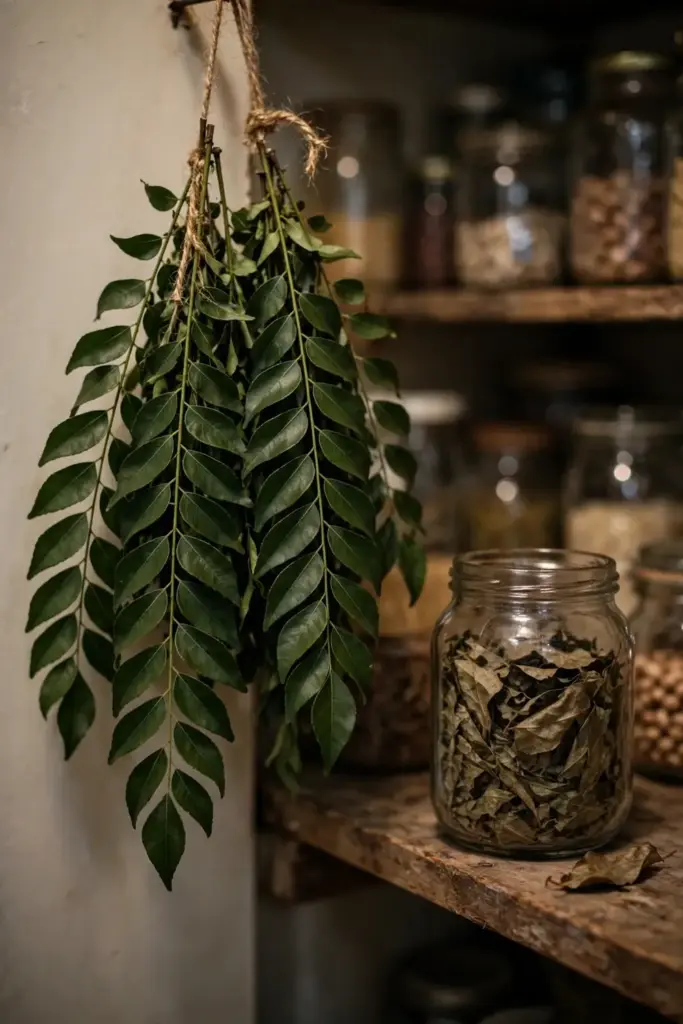
Freezing preserves more aroma than drying. Wash and pat the leaves dry, spread whole stems or loose leaflets on a tray, freeze until solid, then transfer to a freezer bag with the air pressed out. Frozen leaves go straight from the freezer into hot oil, no thawing needed, and they taste remarkably close to fresh.
A mature container tree in full summer production can supply a household’s curry leaf needs for months. Harvest generously through July and August, process the surplus the same week, and the winter kitchen stays stocked even while the tree sleeps on the windowsill.
16. Cooking With Kadi Patta: The Tempering Basics
Kadi patta earns its place in Indian cooking through tempering, the technique of blooming spices in hot oil at the start of a dish. Heat oil or ghee until it shimmers, add a sprig of curry leaves, and let them crackle for 15 to 20 seconds before adding mustard seeds, cumin, or dals. The hot fat carries the leaves’ citrusy, almost nutty aroma through the entire dish.
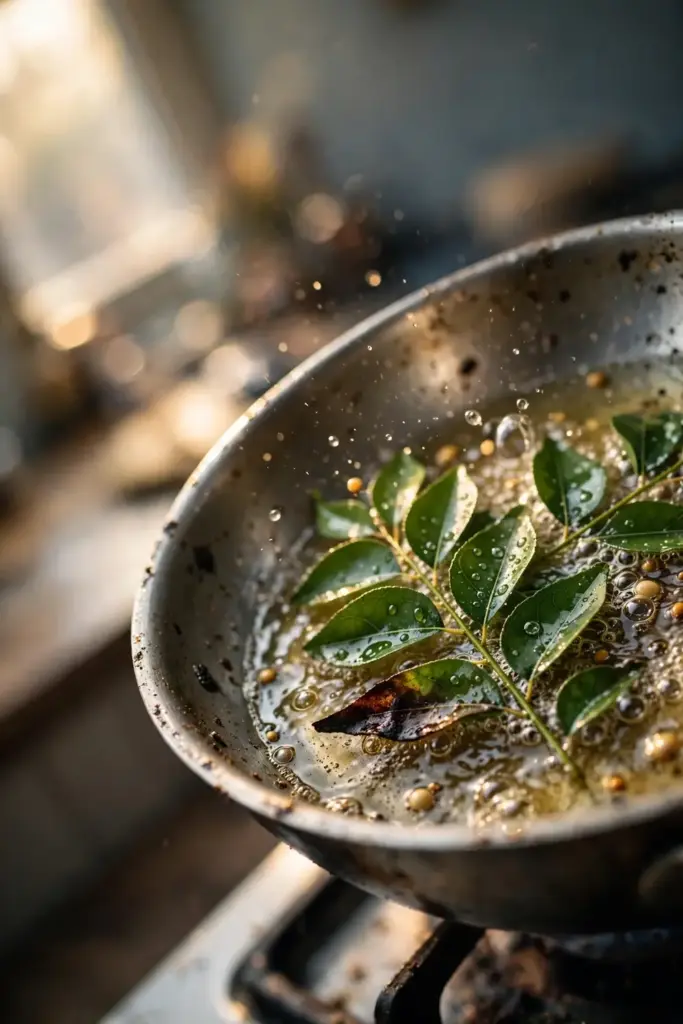
Fresh leaves are always best for tempering, dried leaves are a close second, and frozen leaves land between the two. Dried leaves also grind into spice blends, chutney powders, and rice seasonings. This is the culinary lane where growing your own beats the grocery store: store-bought leaves are often weeks old and half their aroma is gone before you open the packet, while a leaf picked minutes before the pan is a different ingredient entirely.
17. Five Mistakes That Kill Curry Leaf Trees
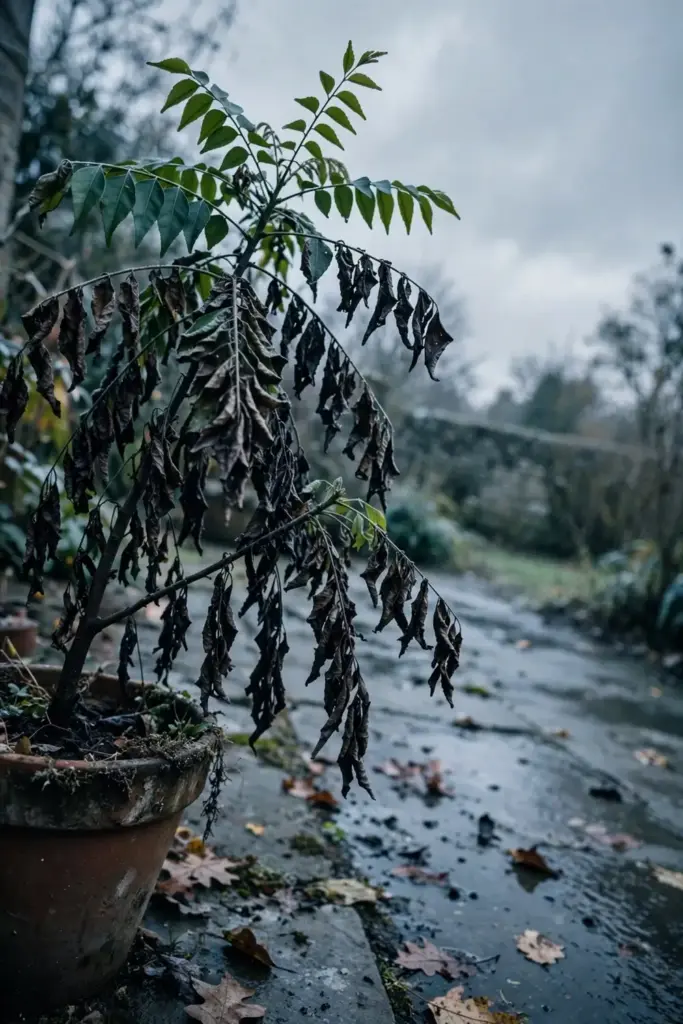
- Planting it in the ground in zone 8 or below. The tree is tropical. One hard freeze ends the experiment. Containers are not a compromise; they are the method.
- Missing the 50°F move-inside window. Watching the calendar instead of the thermometer kills more trees than any pest. When the forecast shows nights near 50°F, the tree comes in.
- Watering on a schedule instead of by soil. A fixed weekly watering rots roots in winter and underwatered pots in July. Check the top 2 inches every time.
- Fertilizing in winter. Dormant roots cannot use nutrients. Salts accumulate and burn the roots you need for spring.
- Composting the tree in January. A leafless curry leaf tree on a windowsill is usually dormant, not dead. Scratch the bark, check for green, and wait for spring.
18. Troubleshooting
The tree dropped all its leaves two weeks after coming indoors. Normal dormancy response to lower light. Reduce watering, keep it bright, do not fertilize, and wait for spring regrowth. Scratch-test the stems if you need reassurance.
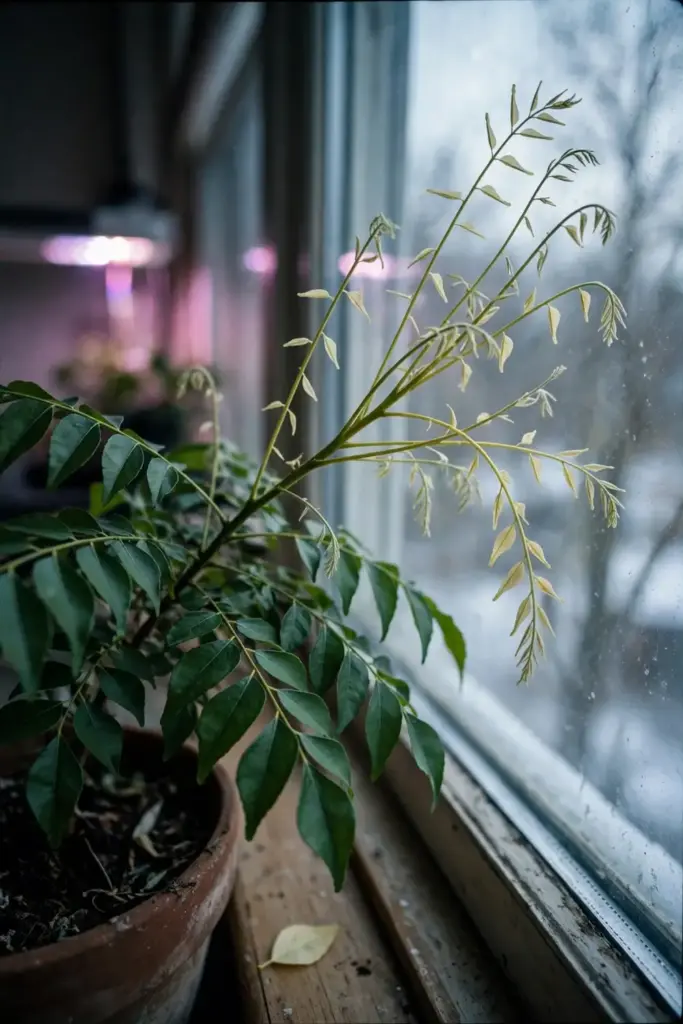
Leaves are yellowing in December but not falling. Usually the tree adjusting its canopy to low light, or early overwatering. Let the mix dry more between waterings and confirm the saucer is empty.
New growth is pale and leggy in February. Insufficient light. Move the tree closer to the window or add a grow light for 10 to 12 hours daily. Do not prune the weak growth until spring; it is still photosynthesizing.
Spider mites appeared in January. Dry indoor air is the cause. Shower the foliage weekly, raise humidity with a pebble tray, and treat with insecticidal soap if the population persists.
The tree has not grown at all in its first year. Normal. Curry leaf trees are slow starters, and a first-year tree builds roots before shoots. Consistent sun, careful watering, and patience deliver the second-year growth spurt.
Flower buds formed in year one. Pinch them off. A young tree should spend its energy on leaves and roots, not berries.
The pot dries out every day in July. The tree has outgrown its container. Move up one pot size, refresh the mix, and water deeply. Daily drying in midsummer is the repotting signal.
19. Frequently Asked Questions
Only in zones 9 to 12, where winters stay mild. Anywhere colder, frost kills the tree outright. It must live in a container and move indoors before nights drop below 50°F (10°C). If you are learning how to grow curry leaf plant from India, think of the pot as the method itself rather than a compromise, because no amount of mulch or burlap makes a tropical tree survive a real freeze.
Mist the leaves 2 to 3 times a week during winter, when heated indoor air is at its driest. Misting raises local humidity around the foliage and discourages spider mites, which thrive in dry air. A pebble tray under the pot works as a lower-effort alternative.
Move the tree back outside when night temperatures reliably stay above 50°F (10°C), usually 2 to 3 weeks after your last frost date. Harden it off over 7 to 10 days, starting with a few hours of morning sun and increasing exposure gradually, so the tender indoor leaves do not sunburn.
The tree is entering winter dormancy and reducing its canopy to match low indoor light. Lower leaves yellow and drop first, which is the tree being rational about its energy budget. Keep watering minimal, stop fertilizing, and check stems with the scratch test rather than judging by leaves.
A nursery plant settles in its first season and produces real harvests by year two. Seed-grown trees take 2 to 3 years to reach harvestable size, and a first-year tree of any origin grows only 6 to 10 inches while it builds roots. Patience in year one buys productivity in year three.
No. Leaves without a stem node cannot root. To propagate you need a stem cutting with nodes, a rooted sucker, fresh seed from ripe berries, or a nursery plant. A bag of leaves from the store is for cooking only.
20. Where to Go From Here
How to grow curry leaf plant from India in a cold climate comes down to one habit repeated every year: pot it, feed it in summer, and bring it inside at 50°F. The tree asks for bright light, dry-between-waterings soil, and the patience to let it sleep through winter. In return it gives you the freshest kadi patta outside of India, picked minutes before the tempering oil shimmers.
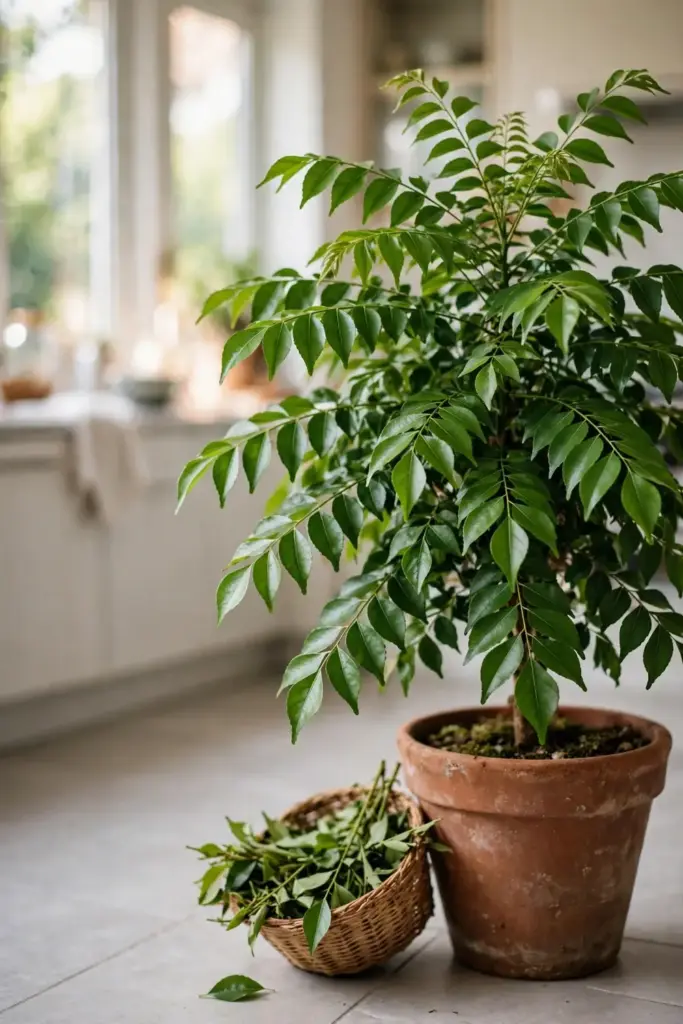
Buy a nursery plant this spring, settle it into a 5-gallon pot, and let it grow all summer. When the first cool nights of fall arrive, carry it inside to its winter window. By the second summer you will be harvesting whole stems, drying the surplus, and wondering why you ever bought curry leaves in a plastic box. If fall planting season has you thinking about the rest of the garden too, the fall herb planting guide keeps the calendar honest about what goes in the ground and what stays in pots.