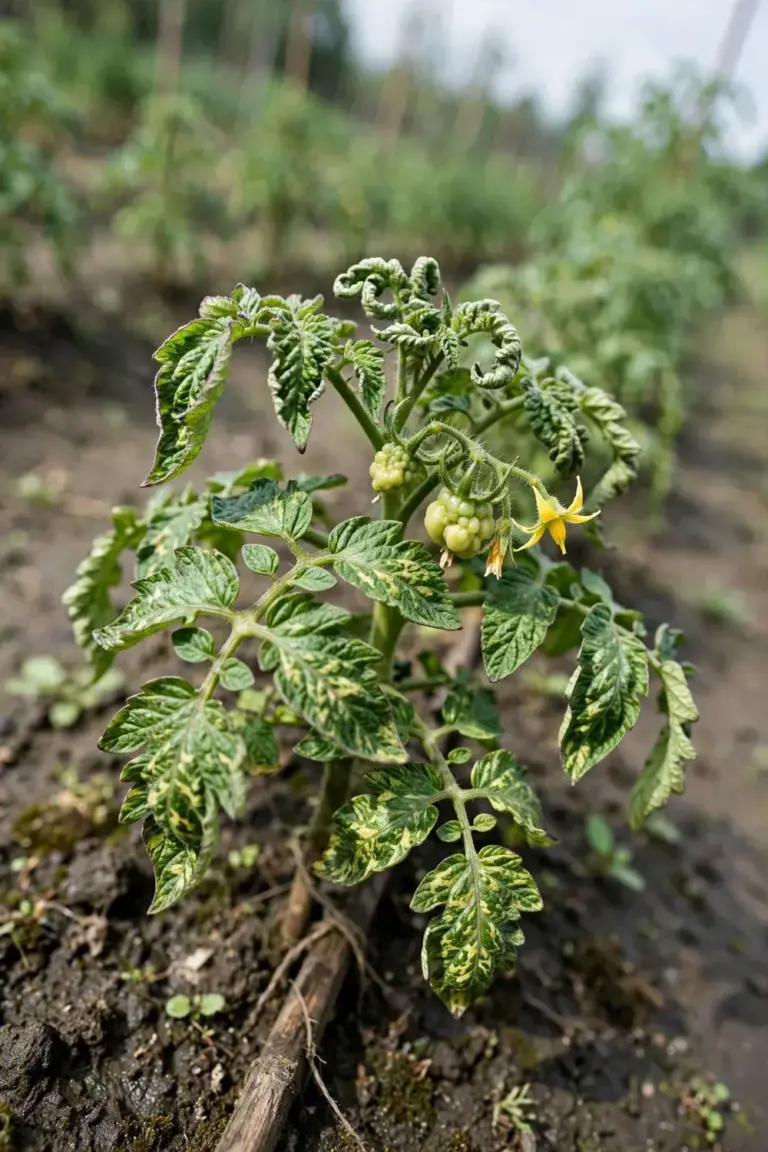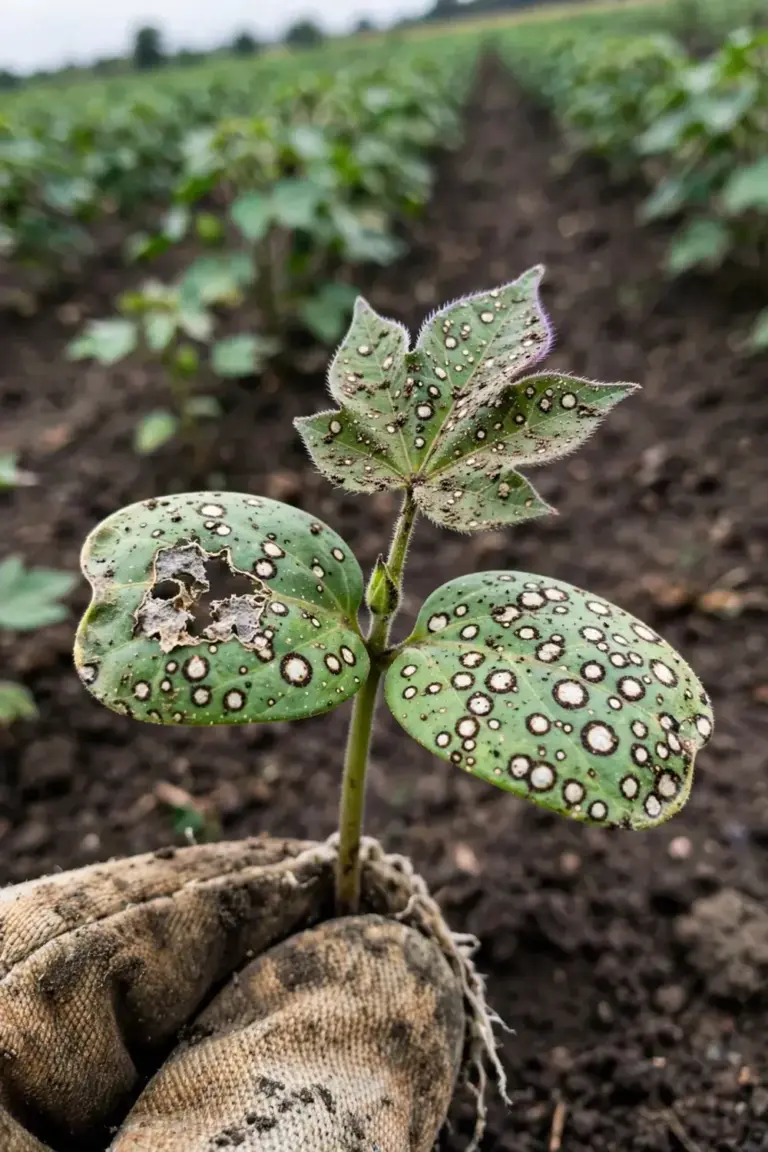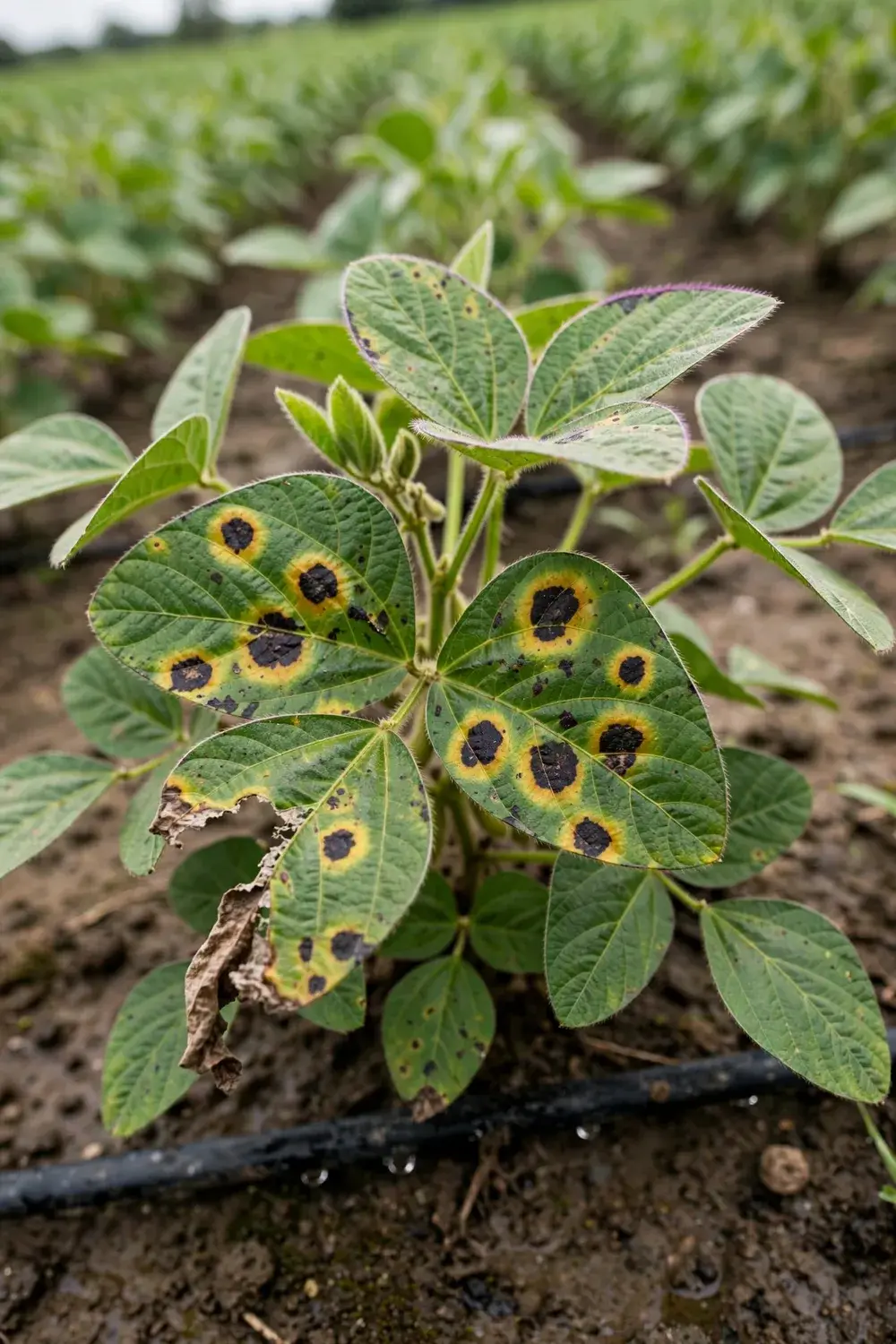

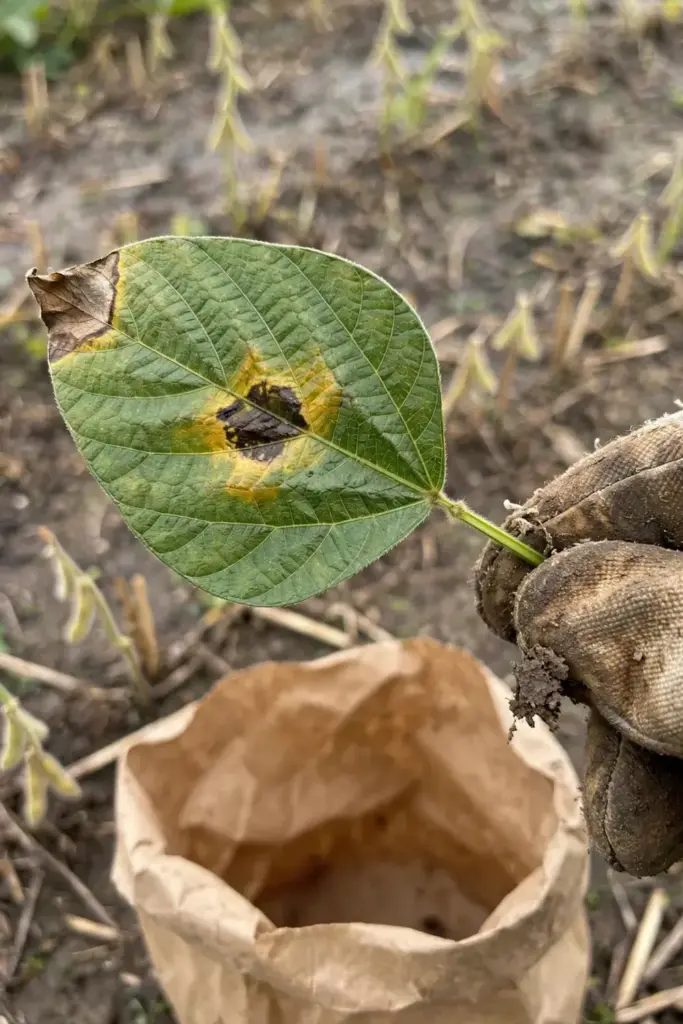
Soybean wildfire shows as dark leaf spots 3 to 13 mm across, each ringed by a broad yellow halo. A bacterium causes soybean wildfire. No spray cures a spotted leaf.
I have learned to hold off on naming any yellow halo until I check the leaf closely, since several leaf diseases share that look.
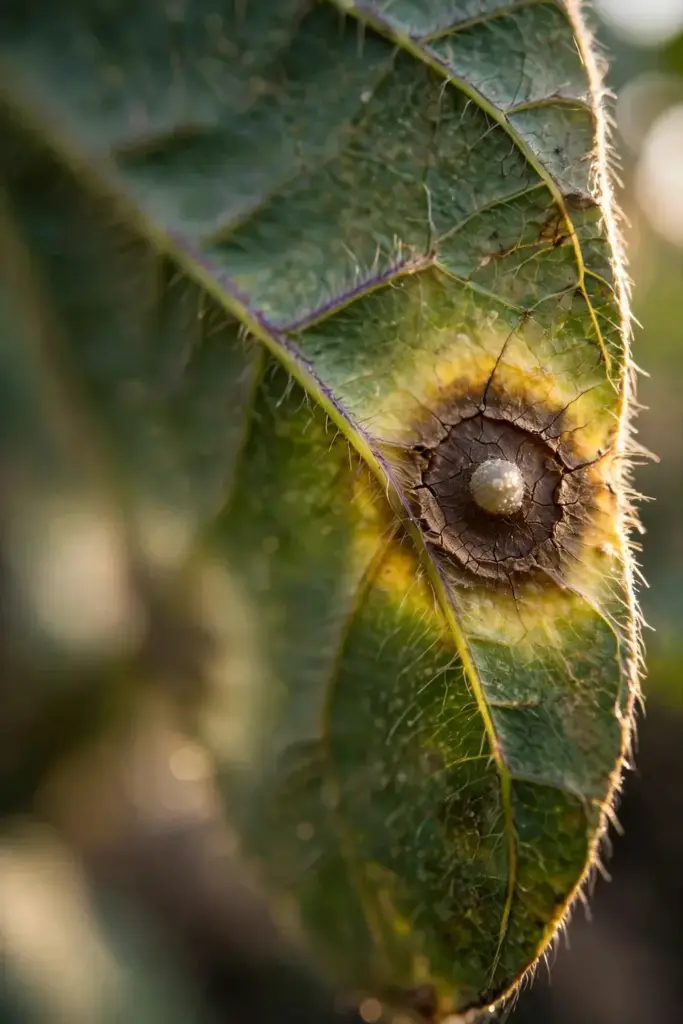
The halo comes from tabtoxin. Tabtoxin is a toxin the bacterium releases as it grows in the leaf. The toxin blocks chlorophyll formation around the infection, and the leaf turns yellow in a wide ring. That ring is the field mark. The ring is also the trap, since other soybean leaf spots show halos too.
What Soybean Wildfire Actually Is
Soybean wildfire is a bacterial leaf disease of soybean. The pathogen is Pseudomonas syringae pv. tabaci. The name stays the same through this page.
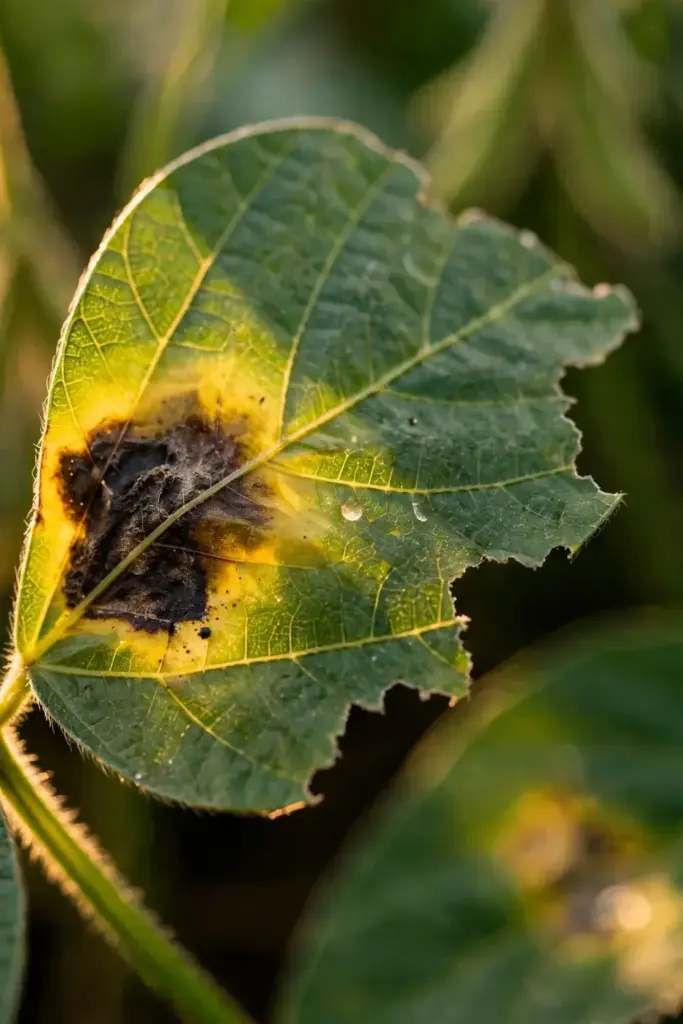
Illinois Extension names the bacterium Pseudomonas syringae subsp. tabaci, synonym P. tabaci. Modern usage ranks it as a pathovar, pv. tabaci. A Korean first report confirmed P. syringae pv. tabaci as the cause of wildfire on soybean. The Clemson index of plant diseases lists this entry under soybean as Pseudomonas sp., genus only, so the pathovar name comes from the later sources, not from Clemson.
Pseudomonas syringae pv. tabaci produces tabtoxin. Tabtoxin blocks chlorophyll formation in the tissue around each lesion. The blockage yellows that tissue in a broad ring. The ring gives wildfire its name and its look.
Illinois Extension calls wildfire a minor disease in that state: it rarely occurs in Illinois and almost always shows up alongside bacterial pustule. That rarity cuts both ways. A home gardener may never see it, and a halo on a soybean leaf more often belongs to a different disease.
How to Identify Soybean Wildfire on Leaves
Check for light brown to black dead spots with a broad, sharp yellow halo. The halo is the mark to look for first, and the mark to doubt first.
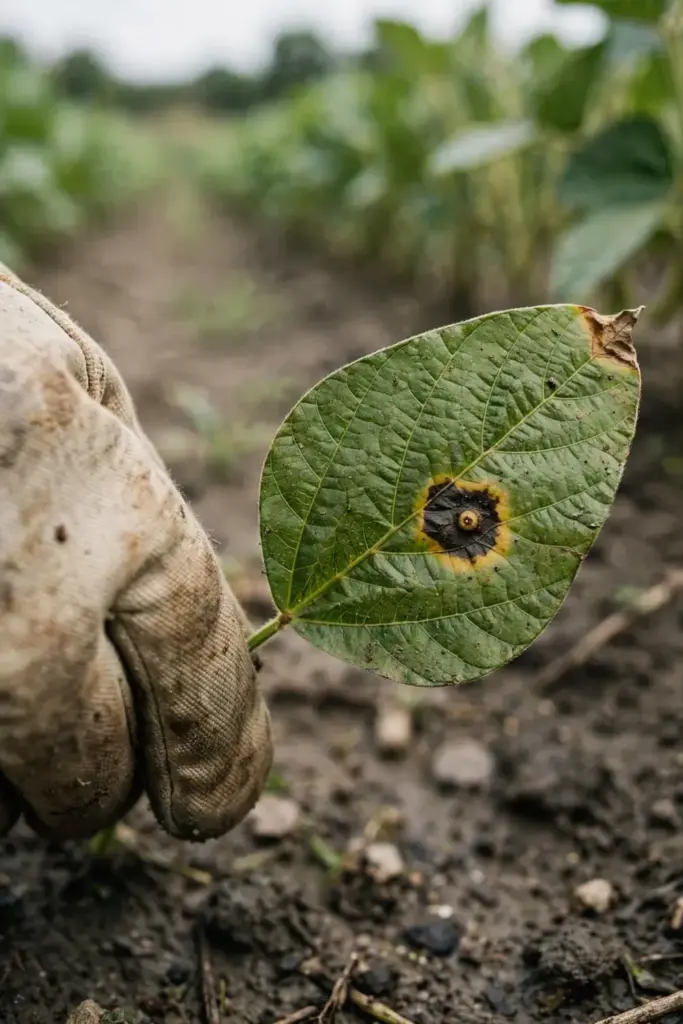
Lesions measure 3 to 13 mm across, or 1/8 to 1/2 inch, and vary in shape. Some lesions stay small and dark brown to black with no sharp halo. In damp weather, lesions enlarge and merge. Dead areas dry, tear away, and leave tattered leaves. Severe cases rarely strip a plant close to bare.
A bacterial pustule sits almost always at the center of a wildfire lesion. Evidence suggests the pustule may be required for wildfire infection. Bacterial blight lesions can serve the same way. That co-occurrence confounds field identification. The halo points at wildfire, and the pustule at the center muddies the call. A lab settles the identification when it matters.
Wildfire here names a plant disease. It has nothing to do with bushfires or burned ground. The shared word causes confusion, and the two have no connection.
Bacterial blight is a separate soybean disease with its own pattern. Blight lesions carry a yellowish green halo too, and blight favors cool, rainy weather, so do not treat a halo as a wildfire diagnosis on its own.
Which Plants Get Soybean Wildfire
Soybean is the host here. The same bacterium causes wildfire on tobacco, and the two hosts do not behave the same.
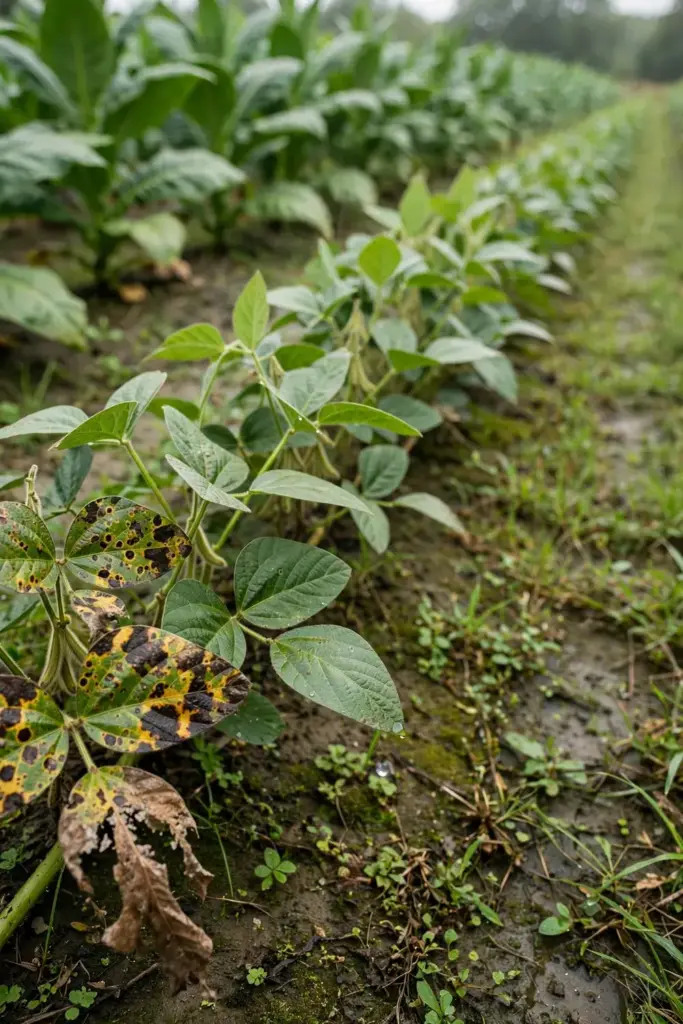
Tobacco is the classic wildfire host. Tobacco isolates hit tobacco harder than they hit soybean. Soybean isolates hit both crops equally. That asymmetry matters. Tobacco trial results do not transfer to a soybean row, and soybean observations do not transfer to a tobacco bed.
The bacterium has also been reported on bean and papaya, in a review of wildfire diagnosis and surveillance. Those reports sit outside this article. They show the host range is wider than one crop, and they do not change what a soybean grower should do.
Soybean rust is a different soybean disease, caused by a fungus. It shows how far apart two soybean leaf problems can sit. One answers to sanitation and seed. The other answers to fungicides. Mixing them up wastes a season.
What to Do When You See the Halo
Start with sanitation, not with a spray. No spray cures a spotted leaf, and fungicides do not touch a bacterium.
| Action | What It Does | Honest Limit |
|---|---|---|
| Start from pathogen-free seed | Cuts the seed-borne route into the next crop | Seed lots vary, so buy from a reputable dealer |
| Rotate soybeans for 1 year or more with corn, sorghum, alfalfa, clovers, or cereals | Starves residue-borne bacteria of a host | It needs a full season and a different crop in that spot |
| Clear and bury crop residue after harvest | Removes the bacteria that overwinter in residue | Skip plowing where it worsens erosion |
| Stay out of wet foliage | Stops splash spread across leaves | Wet-weather work spreads bacteria from leaf to leaf |
The bacterium grows best at 24 to 28 degrees C, or 75 to 82 degrees F. Warm, wet weather favors it. Dry foliage and moving air do not cure it, and they slow every bacterial leaf disease at once.
Bacteria do not answer to fungicides. The same rule shapes bacterial canker on fruit trees. Spraying a fungicide on a bacterial spot spends money and leaves the bacteria alone.
Field programs built on per-acre bactericide schedules and seed-certification economics belong to commercial growers. This page does not carry them as home advice. The honest home program is the table above: clean seed, rotation, residue, dry foliage. When the identification matters for next season, send a sample to a diagnostic lab and let the lab settle it.
Frequently Asked Questions
No. Soybean wildfire and bacterial blight are separate diseases caused by different pathovars. Wildfire comes from Pseudomonas syringae pv. tabaci. Bacterial blight comes from Pseudomonas syringae pv. glycinea. Both show halos, and blight favors cool, rainy weather. The Clemson index lists them as two separate entries under soybean. Treat a halo as a question, not a diagnosis, and let a lab settle it.
Rarely. Severe wildfire can strip a plant close to bare, and Illinois Extension calls that outcome rare. Most infections cost leaf area, not the plant. Wildfire stays minor in Illinois and shows up alongside bacterial pustule. A plant with a few haloed spots keeps growing. A plant losing most of its leaves needs a lab identification, since several diseases strip leaves and the fix differs.
No. A bacterium causes soybean wildfire, and fungicides target fungi. Spraying a fungicide on a bacterial spot spends money and leaves the bacteria alone. No spray cures a leaf that already shows spots. The honest moves are sanitation: clean seed, rotation, residue cleanup, and dry foliage. Save the sprayer for fungal problems with a label that names them.
Start from pathogen-free seed from a reputable dealer. Rotate soybeans for one year or more with corn, sorghum, alfalfa, clovers, or cereals. Clear and bury crop residue after harvest, unless plowing worsens erosion on your ground. Stay out of wet foliage, since splash spread and wet work move bacteria across leaves. None of these steps guarantees a clean season, and all four beat a spray.
Where to Go From Here
Soybean wildfire is a bacterial leaf disease with one clear field mark and one firm limit: the broad yellow halo points at it, while the pustule at the center and the shared halos of other diseases keep field identification uncertain.
Bag the worst leaves, keep off wet plants, and start next season from clean seed. That is the whole home program, and it is enough.